Lawrence Brothers and Company Store

Tags

, , ,

Lawrence Brothers and Company Store

The Lawrence Brothers & Co. Store is a 1½-story rectangular stone commercial building constructed in 1874. It is located at 31 West Main Street in the town of Ophir, Tooele County, Utah. The building footprint measures 26 feet by 60 feet with the narrow end facing Main Street. Due to the steep grade through Ophir Canyon, the façade appears as a one-story building while both the main floor and basement levels are visible at the rear elevation. The foundation is granite as are the walls. The building operated primarily as a general store between 1874 and 1956, the period of significance. The original iron shutters are still intact on the façade and rear elevation. After a period of vacancy, the simple gable roof was replaced in 1987. Since 2005, two separate rehabilitation phases have focused on stabilizing the structural walls, cleaning and re-pointing the original masonry, and replacing the electrical and plumbing systems. The current owners hope to complete the interior rehabilitation in the near future.

The Lawrence Brothers and Company Store is located at 31 East Main Street inĀ Ophir, Utah and was added to the National Register of Historic Places (#13000842) on October 16, 2013.

The Lawrence Brothers & Co. Store, built in 1874, is locally significant under Criteria A and C for its association with the development of Ophir, Utah. Under Criterion A in the area of Commerce, the building is particularly notable as one of the few extant commercial buildings that represent the town’s efforts to transform from a boom-and-bust mining camp to a more stable community. Unlike many of Utah’s mining towns of the early 1870s, particularly those in narrow canyons, Ophir was never completely abandoned. The building was originally built to house a general mercantile and a Wells Fargo office at the peak of mining activity in the canyon. Though the management of the store changed several times, the Lawrence brothers and their successors kept the building commercially viable, contributing to the stability of the town for over eight decades. The period of significance spans the initial construction in 1874 to the store’s closure in 1956. The building is also significant under Criterion C in the area of Architecture as the only substantial stone building constructed in Ophir and a rare surviving stone structure built in a Utah mining camp. The building has undergone minor modifications over the years, but retains the majority of elements from the original construction such as the granite stone masonry and operable iron door-window shutters. The building was constructed by Shelby Alfred Lineback, a former soldier and stone mason turned farmer. The Lawrence Brothers & Co. Store is currently undergoing a multi-phase rehabilitation and is a contributing historic resource in the community of Ophir, Utah.

Mining for precious metals in Utah began in 1862 when soldiers from Fort Douglas under the command of Colonel Patrick E. Connor staked claims in the canyons southeast and southwest of Salt Lake City. Many of the men were experienced prospectors from the California gold rush, and by the late 1860s numerous mining districts had been established in the Utah Territory, although mining did not become commercially successful in Utah until after the completion of the transcontinental railroad in 1869. In 1865, the soldiers began exploring East Canyon (later Ophir Canyon) after reports that Native Americans had previously worked the area to make gold and silver trinkets, as well as silver and lead bullets.2 A mining camp of canvas tents, log cabins, and whipsaw lumber shacks quickly grew parallel to Bates Creek (later Ophir Creek) as prospectors rushed to the canyon to stake claims. The Ophir Mining District was organized in 1870 with the name taken from the geographical location of King Solomon’s mines.

More than 2,500 mining claims had been staked at Ophir by 1871. That year Ophir’s population reached 1,200. By the time a townsite plat was filed with Tooele County in April 1873, the town had a thriving commercial district along Main Street with stores, saloons, brothels, restaurants, a hotel, a post office, and a Methodist church. Most of the commercial buildings featured false fronts facing Main Street, the only road through the canyon. Residences were built on the two short streets that paralleled Main Street, east and west of the business district, and up and down both sides of the canyon. A Salt Lake City newspaper article published in April 1871 referred to the town as ā€œOphir Cityā€ and described it as ā€œflourishing and rapidly increasing.ā€ A town hall/firehouse was built around 1870. The false front wood building with a belfry is one of only three surviving nineteenth-century mining camp town halls in Utah. The Ophir Town Hall was listed on the National Register of Historic Places in 1983 (NRIS #83003193).

The Lawrence Brothers & Co. General Merchandise was one of the first businesses in Ophir. Nelson Lawrence (1830-1877), the middle brother, was born in Pickering, Ontario, Canada, and immigrated to Utah in 1849. His older and younger brothers, James Lawrence (1828-1891) and Henry William Lawrence (1835-1924), and the remaining siblings came to Utah in 1850. The brothers were living in northern California at the time of the 1860 census and later returned to Utah with prospecting experience. All three worked in mercantile establishments in Salt Lake City. The brothers’ first store in Ophir operated out of a tent until March 1871 when the brothers constructed a wood building. The rectangular building was sheathed vertical planks, a false front, and had a log lean-to at the rear. In October 1871, the Salt Lake Tribune described the state of commerce in Ophir: ā€œLegitimate business is good, Lawrence Bros. [et al] have each a large stock of goods and are doing a good and safe business.ā€ A year later, the newspaper noted: ā€œThe firm of Lawrence and Bros. is engaged in the grocery and miners outfitting trade.ā€ Around the same time, the Wells Fargo Company had opened an office in Ophir and by March 1872, newspapers reported that ā€œPackages are sent through daily from Corinne to Ophir.ā€ It is uncertain when the partnership between the Lawrence brothers and the Wells Fargo Company was created, but the Utah Gazetteer of 1874 lists the two entities at the same location ā€œon Main Street, below Cliff Street.ā€

On December 17, 1873, James, Nelson, and Henry Lawrence were granted the deed to Lot 3, Block A of the Ophir City plat. In a letter to the Salt Lake Herald, an observer noted the stability and success of the business in 1873: ā€œIn the prosperity of my friend Lawrence Bros the merchant princes who have stayed by the camp and got well heeled by it.ā€ In July 1874, Lawrence Bros. & Co. engaged a former soldier and stone mason, Alfred ā€œFredā€ Shelby Lineback, to construct a new building of native granite. In September 1874, the Salt Lake Tribune provided a description of the almost finished building:

The new building of Lawrence Bro.’s [sic] is fast nearing completion and will be quite an addition to Ophir. The building is sixty feet in depth and twenty-six feet in width, with a cellar eight feet from floor to ceiling, and store room twelve feet in height, built of rock, and is perfectly fireproof. It will be occupied as a general merchandising establishment by this enterprising firm when completed.

At its completion, the signboard on the stone building’s false front advertised the following items available: dry goods, clothing, shoes, groceries, hardware, liquors, tobacco, and miner’s tools. The stone building was a contrast to the wooden structures in town and boasted numerous security features in addition to the iron shutters on the doors and windows. The Wells Fargo Company express office was housed in the basement. The dividing rock wall in the basement may have been designed as space for a vault, but the purpose of the trapdoor directly south of the wall remains a mystery. The splayed window with bars was located near the basement entrance, possibly for a lookout guard. When the roof was replaced in 1987, it was discovered that the main-floor ceiling had a foot of sand on top of it. This may have been a security barrier, but could also have been used to keep a fire from moving from the roof to the interior of the building. The stone building was also reportedly used to secure post office deliveries.

The city directories show that all three Lawrence brothers maintained residences in Salt Lake City. Henry W. Lawrence ran his own grocery and provisions company in Salt Lake City. He was married to Jeanette Sophia Kimball (1842-1911), had a large family, and stayed in Salt Lake City until his death in 1924. James Lawrence never married. He moved to Park City where he managed a grocery business until his death in 1891. Nelson Lawrence, the middle brother, was responsible for the day-to-day operations of the Ophir store until his death in 1877. His widow, Julia Delecta Young Lawrence (1848-1938), appears to have kept the business going for a few years. The 1879 Utah Gazetteer lists the Lawrence Bros. & Co. general merchandise still in business with J. D. Lawrence as the purveyor of liquors. Julia D. Lawrence continued to live in Salt Lake City with her two sons, Nelson and William. The deed to the property was transferred to Julia and her sons in 1892. The family moved to California in the late 1890s, but held the title to the property until 1927.

In 1874, the Utah Gazetteer had 119 business listings for the town, which it described as the ā€œbusiness centreā€ of the Ophir Mining District. The Lawrence Bros. & Co. Store was one out of ten listings under the heading for general merchandise. It is estimated that during its peak in the early 1870s, the Ophir mines produced $13 million in silver, lead, and zinc, and over $300,000 in gold.12 There are reports that suggest the population of the town may have swelled to between 5,000 and 6,000 people at one point during the early 1870s, but the output of the mines decreased dramatically soon after the Lawrence brothers completed their stone building. Only five years later, the 1879 Utah Gazetteer provides only seven business listings, while stating ā€œOphir was once a busy mining camp but is now almost deserted.ā€13 In 1879, the Lawrence Bros. & Co. store was the only general merchandise establishment still in operation. The office of the Wells Fargo Company is not among the remaining Ophir businesses. Despite the downturn, there were signs the town was not completely abandoned. For example, Catholic mass was held monthly between 1874 and 1878.

A number of renters kept a mercantile business in the stone building after the death of Nelson Lawrence. Joseph Green (1820-?) held an interest in the property between 1878 and 1881 and is listed as a grocer on the 1880 census. He does not appear to have operated the business under his own name. Around 1881, John Faunce (1832-1907) began operating a general store in the stone building. George E. Edwards (1870-1948) took over the lease on the building probably around the time he moved to Ophir in 1898. He eventually constructed a new frame building for his own mercantile business across the street sometime before 1907 (now demolished). The Ophir Mercantile Company began operating out of the stone building when Edwards left. In September 1907, the Salt Lake Mining Review described the two rival companies:

The camp (of Ophir) boasts the usual number of saloons, two hotels and two general stores. The leading business house is the Ophir Mercantile Company, which carries a most complete line of general utilities. At the head of this institution are E.W. Clark, H. A. Wagner, H. J. Green and C.E. Green, who are among the leading and most progressive citizens. Mr. Edwards conducts the other mercantile establishment and also has charge of the leading hotel in the camp.

From the 1920s to his death in 1948, George E. Edwards operated the only general store in Ophir. The 1917 Sanborn fire insurance map of the town indicates the former Lawrence Brothers building was a drugstore, confectionary, and billiards hall. On September 12, 1927, Julia D. Lawrence and Nelson W. Lawrence sold the store and property to Peter Morzenti. Peter Morzenti (1882-1943) emigrated from Italy to Utah in 1910. He is listed as a grocer in Ophir on the 1930 census, a carpenter on the 1940 census, and the proprietor of a ā€œbeer parlorā€ on his 1943 death certificate. The property was later sold to Truman W. Wheeler and Richard R. Wray, who held the deed only two years before selling to John S. and Concetta Morrell in 1948. John S. Morrell (1885-1975) operated a ā€œsoft drink loungeā€ in the old stone building; however, it was known to local residents as the ā€œbeer hall.ā€ The Morrells deeded the property to their children on April 18, 1956, after which time the building remained vacant.

By the time Steven S. Hall purchased the property in 1982, most of the surrounding buildings had been demolished. After completing some work on the interior, Steven S. Hall sold the building to Hal D. Hawkins and Connie H. LeFevre in 1986. They replaced the roof, began work to stabilize the basement, installed a septic tank, and completed plumbing and electrical work. On October 15, 2001, Hal D. Hawkins and Connie H. LeFevre sold the partially renovated building to the current owners, James T. O’Rourke and Lora Hawkins O’Rourke, Hal’s sister and brother-in-law. The O’Rourke family has continued the work of rehabilitating the building.

The historical significance of the Lawrence Brothers & Co. Store is in the area of Commerce, representing a source of economic stability to the community of Ophir. Historians have pointed to three distinct phases of development in most mining communities: settlement, camp, and town. By the year 1870, Ophir had already moved from the settlement phase to the camp phase. The construction of the town hall marked the beginning of the town phase. The substantial stone building of the Lawrence Brothers & Co. Store also represents the initial efforts to create a more permanent and stable town. Though the town phase was interrupted by a dramatic fall in silver prices in the late 1870s, the stone building outlasted most of its more ephemeral counterparts as Ophir entered the twentieth century. In 1907, the Salt Lake City Mining Review described the survival and subsequent revival of Ophir with the advent of more modern mining equipment and a large influx of capitol in the early 1900s:

A noticeable feature in the town is the absence of the down-and-out spirit that is so prevalent among camps of the ā€œhas-beenā€ type. It is encouraging to get in a mining town like Ophir, where every citizen has the progressive habit of boosting. One is infected with this enthusiasm upon first entering the camp, and begins to feel that Ophir is the only town in Utah.

The town of Ophir has never been completely deserted and the spirit of ā€œboostingā€ remains. Many current residents refuse to accept the label of ā€œghost townā€ used by outsiders. The significance of the Lawrence Brothers & Co. Store is in its contribution to the commercial and economic viability of the town through the entire historic period.

Architecture Significance
The Lawrence Brothers & Co. Store in Ophir, built in 1874, is architecturally significant as a rare example of substantial stone architecture in a Utah mining camp. Although the Lawrence Brothers & Co. Store has been modified over time, the modifications do not greatly impact its historic character as a mining camp-era stone structure. They also follow the pattern typical of many commercial buildings in the alteration of the structure to meet the needs of the current tenant. The surviving physical characteristics of the building meet six of out seven of the National Register of Historic Places qualities of historic integrity: location, setting, materials, workmanship, feeling, and association. The integrity of the original design (seventh quality) of the building has been compromised by the removal of the false front signboard, an important element of mining camp architecture. However, the false front was removed within the historic period and therefore part of the architectural evolution of the building as it is associated with the historical development of Ophir. The extended replacement roof line is a minor modification to the original design and will likely protect the integrity of the stone masonry (workmanship and materials) in the future.

The vast majority of buildings erected in Utah’s nineteenth century mining camps were made of wood. The residences were mostly log cabins or plank shacks, while the commercial buildings were usually frame with a simple gable roof and a false front. False front architecture, where the faƧade was extended above the apex of the roof or beyond the side walls, was used in Utah mining camps to give the impression of a much larger, more substantial structure and increase signage. Only a few mining camps lasted long enough to see dramatic changes in the physical environment during the transformation from camp to town. In contrast to the small towns of the Mormon pioneer settlements, there were no incentives to build permanent structures and to invest in adobe and brick yards. The stone quarries needed to support stone architecture were even rarer. The only comparable stone building is located in the southern Utah mining camp of Silver Reef, where in 1877 the Wells Fargo and Company built an express office of red sandstone with metal shutters similar to the Ophir building.

The Lawrence Brothers & Co. Store was constructed in the isolated canyon mining camp of Ophir by a local builder, Fred Lineback. Alfred ā€œFredā€ Shelby Lineback (1830-1914), a soldier discharged from the army at Camp Floyd in Cedar Valley in 1861, is believed to have been the first man of European descent to settle in Ophir. A deep basin boxed in by steep walls, once a natural grazing area for horses, Lineback Hollow, bears his name today.23 Fred Lineback was born in Kentucky and was a stone and brick mason before moving to Utah as a soldier. He returned to Iowa for his family and later established a farm in Ophir Canyon where he remained the rest of his life. He is listed in the 1874 gazetteer as a lime burner and on the 1880 census as brick mason. In later years, he gave his occupation as farmer. The Lawrence building may have been one of the few chances Lineback had to use his skill as a stone mason in Utah. The granite from a local canyon would have been difficult to quarry and tool into smooth blocks. The 1917 Sanborn map show only three stone buildings in Ophir, two dwellings and the store. One of the dwellings has survived, but the other was demolished after 1940. It is not known whether Fred Lineback was involved with the construction of the other buildings. In spite of some alteration the building retains enough historical integrity in concert with its historical and architectural significance to be considered a contributing historic building in the mining community of Ophir.
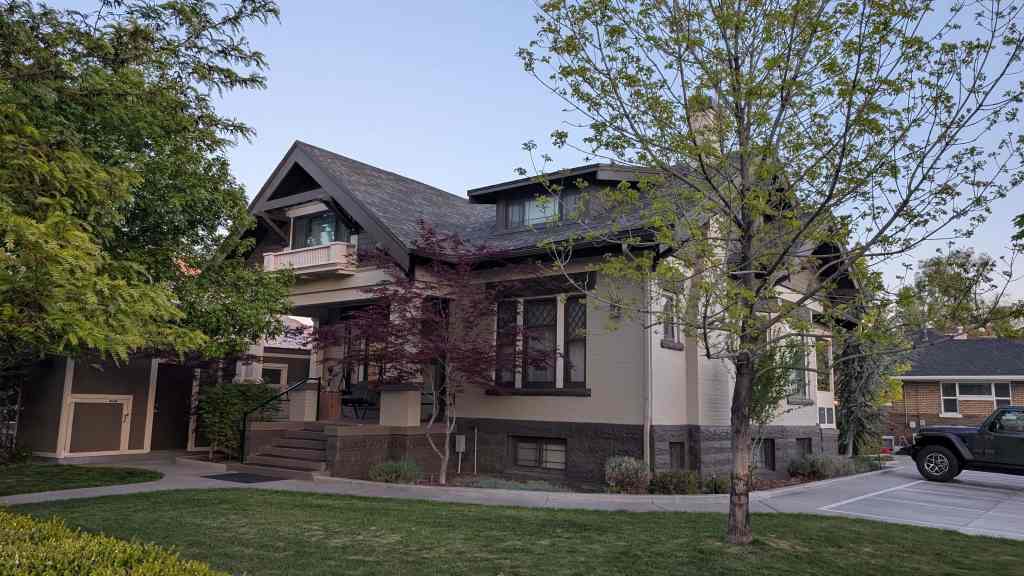
Hilda Erickson House

Tags

Hilda Erickson House

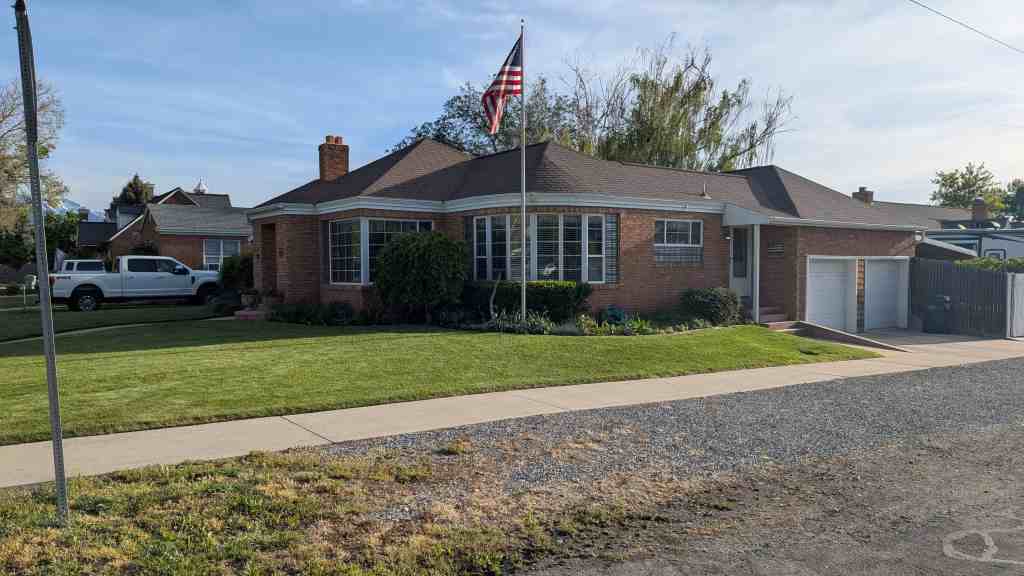
The Hilda Erickson House, a bungalow built in 1915, is significant under Criterion B for its association with Hilda Anderson Erickson. Hilda Anderson was born in Sweden in 1859. She immigrated to the United States in 1866 and with her family crossed the plains as a member of a Mormon wagon train three years before the completion of the continental railroad. Hilda’s life as a pioneer woman in Utah was both typical and extraordinary. For many years, she was a rancher in the western Utah town of Ibapah, along with her husband John A. Erickson, but she was also a seamstress, doctor, merchant and politician. The life of Hilda Erickson is significant primarily for its longevity. In 1947, she was honored along with her contemporaries at the centennial celebration of Utah’s pioneer settlement. The accolades continued through the 1950s, but by the early 1960s, she had outlived them all, and received local, state and national attention as the “last living pioneer,” out of approximately 80,000 pioneers who came to Utah before the railroad. Hilda Erickson died on January 1, 1968, at the age of 108. The newspapers proclaimed her death as the end of an era and the dissolution of the last living link to Utah’s pioneer past. Although she spent portions of her life outside of Grantsville, Hilda Erickson was associated with the city for the majority of her long productive life, particularly the last half of her life, from 1925 on, when she resided in the 1915 bungalow built by her son Perry Erickson. Although one other residence in which Hilda resided intermittently for several years is still extant, the bungalow was her longest and most permanent residence in Grantsville and the one in which she resided when she was most actively involved with the local community, ] The house is also eligible for the National Register within the Multiple Property Submission: Historic and Architectural Resources of Grantsville, Utah, 1850 — 1955. The associated historic contexts are “Impact of Technology and Transportation Period, 1905-1930,” and the “Economic Diversification Period, 1930-1955.” The Hilda Erickson House retains its architectural integrity and is a contributing historic resource of Grantsville, Utah.

The Hilda Erickson House, built in 1915, is located at 247 W Main Street in Grantsville, Utah and was added to the National Register of Historic Places (#05001626) on July 11, 2006.

The community of Grantsville was settled on October 10, 1850, three years after the first settlement of the Salt Lake Valley by members of the Church of Jesus Christ of Latter-day Saints (LDS Church or Mormon Church). After several altercations with the nomadic Native Americans who camped in the area, the Grantsville area was settled and known as Willow Creek. In 1852 a town site was surveyed and in 1853, the town was renamed Grantsville in honor of George D. Grant, who led a company of the territorial militia to protect the settlement. Before 1905, Grantsville was primarily an agricultural village. With improvements in transportation and technology, the economy diversified in the first half of the twentieth century. The life of Hilda Erickson spans the four historic periods of the Grantsville MPS. The life history of Hilda Erickson reflects the development of Grantsville as she evolved from pioneer rancher and housewife to merchant. Throughout her adult life, she practiced medicine, though her mode of transportation (from horses to automobile) changed with the times. Her last home on Main Street is significant within the two later periods of the MPS.

The first recorded deed to Lot 3, Block 2 of the Grantsville City Survey, was from Charles L. Anderson (1846o 1908), administrator, to Otto Moline. Otto Moline presumably built the cross wing house, which sits directly east of the Erickson House on Lot 3. He and his wife sold the property to John A. Erickson on October 18, 1911. John A. Erickson’s son, John Perry Erickson, built the bungalow on the west half of the lot, around 1915, the year he married Mary Higgs. Perry and Mary Erickson lived in the house until 1925 when they moved to California. John A. and his wife, Hilda Anderson Erickson, moved into the bungalow that year as their primary residence, and spent the remainder of their lives there.

Hilda Anderson was born in Ledsjo, Sweden, on November 11, 1859. She was the youngest of five and the only girl born to Pehr Anderson (1820-1887) and Maria Kathrina Larson (1819-1888). When she was four years old, her parents converted to the LDS Church. Her father sent her mother, Hilda and the two youngest sons, to America in May 1866. Pehr Anderson stayed behind with the older boys to raise money. After nine weeks on the ship Cavour, they landed in New York in July. They traveled by train to St. Joseph, Missouri, and by boat on the Missouri River to Omaha, Nebraska. Hilda was six and a half years old when she walked across the plains from Omaha to Salt Lake City. They arrived in Salt Lake on October 22. A man named Frederick Peterson, who had driven the wagon holding their belongings, offered to take Maria Anderson and her children to Mount Pleasant, Sanpete County, in central Utah to live with his parents. The Peterson family allowed Maria and the three children to live in two rooms in of their house. Hilda’s mother, who was trained in the craft of weaving and spinning, provided a livelihood for her family. In 1868, the Peterson family decided to relocate to Grantsville and take Maria and her family with them. The same year, Hilda’s father, Pehr Anderson, joined them in Grantsville.

Hilda Anderson grew up attending Grantsville schools until the age of fourteen when she went to Salt Lake City to take a course in dress-making and tailoring. Her father bought her a sewing machine on her return to Grantsville and her skills were in constant demand. She charged 50 cents for a pair of overalls and $2.50 for a dress. She often completed an entire dress, suit, or coat in a day. When the Grantsville Brass Band was organized, Hilda helped make the uniforms for its fifteen members. In her spare time, she loved horseback riding and dancing. She met John A. Erickson at a dance in Grantsville. After a lengthy courtship, they were married on February 23, 1882.

John August Erickson was born on January 20, 1860 in Hemsjo, Sweden. He immigrated to Utah with his family in 1864, where they settled in Grantsville. A year after their marriage, John and Hilda Erickson, were called along with two other Grantsville families to serve an LDS mission to the Goshute Indians. They went to live in Ipabah near Deep Creek at the west end of Tooele County, ninety miles southwest of Grantsville. The LDS Church bought property there with the intent to proselytize the Goshutes while teaching them farming methods. In addition to her duties on the ranch and farm, Hilda taught the native women to read, write, spin, weave, and sew. She also served as the mission’s Sunday school secretary. Hilda kept a diary of her early days in Ipabah and sewing was still her primary occupation on most days. Their first child was Amy Dorothy Erickson, who was born in Ipabah, on July 23, 1884.

Among her duties at the ranch, Hilda Erickson nursed many of the native women during illness and confinement. As a result of these experiences, in the fall of 1885, Hilda was invited to attend a course in obstetrics from Dr. Romania B. Pratt being held in Salt Lake City. Hilda left her young daughter Amy with her mother Maria in Grantsville while she attended school. She graduated from the course in 1886 and returned to Ipabah. She practiced medicine among the natives and the white settlers, often riding sidesaddle for miles in order to attend to the sick. Hilda Erickson became the de facto dentist for the community and always carried her forceps with her in case of emergencies. She continued practicing medicine upon her return to Grantsville, riding her horse until she bought her first automobile in 1915. She received a state license for obstetrics in 1898 and kept it renewed until 1953, when she retired from medicine.

John and Hilda Erickson spent fifteen years on the church’s mission ranch. Their second child, John Perry Erickson, known as Perry, was born in Ipabah on October 6, 1890. The Erickson’s log home soon also became the community center. In 1900, they are listed on the census with their children and three hired hands. Because of Ipabah’s isolation, John and Hilda opened a store and trading post for their white and native neighbors. After being released from the mission, John Erickson purchased property in the area for his personal farm. He grew alfalfa and wheat, under difficult circumstances, which earned the ranch the nickname “Last Chance Ranch.” For many years, it was an oasis for travelers across Utah’s desert to the Gold Hill mining district. He also raised cattle and had the first Pole Angus herd in the county. Hilda Erickson returned to Grantsville in 1898 so her children could attend school there. Her daughter, Amy married John Ulrick Buhler Hicks (1873-1963), on June 21, 1905.

For several years, Hilda split her time between Grantsville and the ranch. On the 1910 census, Hilda is listed living with her son Perry in Grantsville. After John Erickson purchased the Moline property in 1911, Hilda and Perry probably lived in the cross-wing house. Perry graduated from Grantsville High School. In 1909, he accompanied his mother and sister on a trip to Sweden and returned there in 1912-1913 as a missionary for the LDS Church. After his return home, he married Mary Higgs on June 30, 1915. Mary Melvira Higgs was born on May 11, 1892, in Salt Lake City. The couple and their three sons lived in the Grantsville bungalow for the first ten years of their marriage. The 1920 census lists the two Erickson families and the Hicks family living side by side on Main Street. In 1926, John A. Erickson sold the Last Chance Ranch and moved to Grantsville permanently. Since Perry had moved his family to California, John and Hilda took up residence in the bungalow which would be their most permanent home.

While in Grantsville, Hilda sewed a little and kept up her medical/dental practices using her automobile purchased in 1915 to visit patients. She made the four-to-six day trip out to the ranch while her husband served a mission in Sweden in 1903-1904. When the Grantsville Deseret Bank was organized in 1910, Hilda was one of its directors. She held this position until the bank closed in 1931. She also served as the secretary of the Grantsville Farm Loan Association. In 1922, Hilda was nominated by the Democratic Party to run for the state legislature, however she lost the bid. Though her life, she held numerous leadership positions in the LDS Church.

Hilda and John opened a general store in Grantsville in 1925. The 1927-28 Utah State Gazetteer lists her as the general manager of the J. A. Erickson Company. Sometimes she would combine her many vocations. Often young toothache sufferers would be taken to the back room of the store, where Hilda would extract the tooth, then send the youngster home with a bag of candy to soften the blow. She continued to deliver babies (an estimated 200) and stitch up the wounds of her neighbors. After the death of her husband, Hilda continued managing the store until 1946. She also had a butcher shop, a Texaco gas station and a lumberyard in connection with her store. During World War II when commodities were scarce, she would lock up the store for a few hours and drive to Salt Lake City for supplies (the full war allowance), and return to her waiting customers, John August Erickson died on January 20, 1943. Her son, Perry Erickson, died just one year later in 1944.

In 1946, when she was eighty-seven years old, Hilda Erickson’s pioneer memories were chronicled by the local chapter of the Daughters of Utah Pioneers (DUP), of which she was a lifelong member. She was feted, with many other pioneers, during the DUP centennial celebrations in 1947. The DUP also sponsored a trip to Nauvoo, Illinois, for Hilda and five other elderly Utah pioneers. The return trip, which originally took Hilda’s family ten weeks on foot, was made in less than six hours by plane. At the age of ninety-nine, she flew to Washington D.C. to meet President Dwight D. Eisenhower. Hilda always thought of an airplane ride as her greatest adventure. On Hilda’s 91st birthday she attributed her longevity to “right living, plenty of exercise, work, proper food and rest, then early to bed and early to rise.” She went on to say “More people rust out than wear out.”7 Hilda loved automobiles and speed. She enjoyed racing the train from Grantsville to Wendover whenever she traveled that route. She wore out nearly a dozen automobiles over her lifetime before she reluctantly gave up her driver’s license at the age of 94. Alice Palmer Hawker recalled that “Aunt Hildy was our town’s famed and most talked about citizen for many years as I was growing up in Grantsville, Utah.”

By the time she reached the age of 100, Hilda Erickson was a celebrity. The Tooele Transcript Bulletin provided a three-page write up for her 100th birthday. Although she had been in several Days of ’47 Parades, she took great pride at the age of 101 of appearing on a special float with two of her great-granddaughters. On July 24′ 1962, Hilda Erickson was honored at a special DUP luncheon. In October 1962, the DUP prepared a lesson entitled “Hilda Erickson — Pioneer” which detailed her life story. The lesson was presented to DUP members throughout Utah and the United States. The lesson declared that Hilda Erickson was Utah’s “oldest living pioneer.”9 She would continue to be Utah’s last pioneer for nearly six more years, living in her own home alone until just shortly before her death. She lived with Amy in Salt Lake City before moving to a Salt Lake nursing home. Hilda remained alert to the end. She celebrated her 108th birthday in November 1967 and the same month, voted in a Grantsville election by absentee ballot. Hilda Erickson died on January 1, 1968.

The day after her death, the newspaper headlines read “Utah’s Last Original Pioneer Dies at 108” and “Oldest Utahn, 108, Dies, Mrs Hilda A. Erickson.” Both articles had similar statements, noting that “Mrs. Erickson was the last living link with Utah’s pioneer era. She was the sole survivor of the 80,000 persons who came to Utah before the transcontinental railroad was completed in 1869.” In reporting on her funeral, the Deseret News had the headline that read “Erickson Rites End Pioneer Era.” At the funeral, Elder LeGrand Richards of the LDS Church during his remarks stated “We are not just laying away here today this body of Sister Erickson. We are burying a dispensation, a generation. There are none left – she was the last.”

Hilda Erickson was buried in the Grantsville Cemetery. In 1962, Hilda deeded the Grantsville bungalow to her oldest granddaughter Hilda Richens. The property was transferred to Hilda Richen’s brother, Jay Hicks, in November 1968. Jay Hicks and his wife, Leatha, are the current owners. The bungalow remains one of the few historic reminders of Hilda Erickson’s remarkable life. The older cross-wing house to the east was subsequently rented to relatives. This house is still standing and from the outside appears to have sufficient historic integrity. However, an argument can be made that it is less significant than the bungalow because Hilda lived in the cross wing intermittently only about ten years during which time she went back and forth from Grantsville to the ranch in Ibapah where her husband was living. The bungalow is her longest and most permanent residence in Grantsville, and is the house that the community associates with Hilda. In 1998, the city of Grantsville honored her by placing a statue of her in front of city hall on Main Street. The statue depicts Hilda Erickson, circa 1900, riding her horse sidesaddle on her way to care for another of her pioneer neighbors.

Orson Pratt House

Tags

Orson Pratt House

The Orson Pratt House is the only remaining house in Utah associated with Orson Pratt, one of the most influential and important leaders in the first half-century of the LDS Church, noted mathematician, astronomer, scientist, author, public servant and educator. Self-educated in a wide range of disciplines, he gained international recognition for some of his published mathematical and astronomical theories. He served 13 terms in the territorial legislature and 8 terms as Speaker of the House of Representatives. Orson Pratt had this house built in 1862 while helping direct the settlement of St. George and the Cotton Mission.

The Orson Pratt House is located at 76 West Tabernacle Street inĀ St George, Utah, it was added to the National Register of Historic Places (#83003199) on August 11, 1983.

The Orson Pratt House is significant as the only remaining house in Utah associated with Orson Pratt, one of the most influential and important leaders in the first half-century of The Church of Jesus Christ of Latter-day Saints, and a noted mathematician, astronomer, scientist, author, public servant and educator. Pratt, as a member of the first Quorum of the Twelve, the governing body of the church under the First Presidency, was involved not only in directing ecclesiastical and settlement activities, but also, as a philosopher and intellectual, made unique contributions to Mormonism by articulating and systematizing religious philosophies of the church. Self-educated in a wide range of disciplines, he gained international recognition for some of his published mathematical and astronomical theories, and was a leading proponent of education in territorial Utah. He served for thirteen terms in the territorial legislature, eight as Speaker of the House of Representatives. Orson Pratt had this house built in 1862 while helping direct the settlement of St. George and the Cotton Mission, the LDS Church’s attempt to establish a cotton industry in the warm southwestern corner of the state. Although he lived here for only about two years, residing in Salt Lake City for most of his years in Utah, none of his other houses remain standing. His home in Nauvoo, Illinois, headquarters of the LDS Church from 1839 to 1846, is still standing.

In 1861, Brigham Young, fearing cotton shortages as a result of the Civil War, sent a group of colonizers to the Virgin River area in what is now southwestern Utah to establish a cotton industry in that warm climate. Under the leadership of apostles Orson Pratt, Erastus Snow and George A. Smith, the group established the commu nity of St. George late in 1861. Pratt, though presiding leader of the group, was not gifted as a colonizer, and much of the responsibility for settlement was assumed by Snow and Smith. Orson Pratt first settled upriver from the main settlement, but joined them a few months later in the spring of 1862 when he accepted the office of postmaster there. He built this two-story adobe house soon after, but lived here for only a short time, being called to the territorial capital by his duties as a legislator and later to Great Britain as a missionary. In 1864 he sold the house to Richard Bentley, whose family retained ownership of it for more than a century. This settlement effort in St. George was Orson Pratt1 s only colonizing attempt. He spent the remainder of his life either in Europe as a missionary or in Salt Lake City. Richard Bentley, a prominent political, civic, and business leader in St. George, operated the first mercantile business in the city out of part of the first floor area of the house from 1864 until 1875J He served in many civic positions including Water Commissioner (1871), City Alderman (1872), County Treasurer, and Mayor for three terms.

Orson Pratt was born September 19, 1811 in Hartford, Mew York to Jared and Charity Dickinson Pratt. The fourth of six children, he had little opportunity for education as a youth, but pursued studies on his own and gained proficiency in several subjects, including mathematics, astronomy and physical sciences.

A major turning point in his life occurred on his nineteenth birthday when he was baptized a member of The Church of Jesus Christ of Latter-day Saints by his older brother, Parley P. Pratt. For the remaining fifty years of his life, he served the church tirelessly in many positions, continuing faithfully with the organization as it moved from New York, to Ohio, to Missouri, to Illinois, then to Utah. Soon after his conversion he began proselyting as a missionary, and in 1835 he was chosen as a member of the first Quorum of the Twelve of the church, which had been organized in 1830. (His brother Parley was also chosen as a member of that body.) The Quorum operated under the direction of the prophet and president of the church, and its members were called to help direct the preaching and administrative affairs of the church. Their responsibilities usually included serving proselyting missions that often lasted for two or three years. Orson Pratt was sent to Scotland on such a mission soon after his appointment to the Quorum, and, in all, he crossed the Atlantic Ocean sixteen times in response to the call to serve. His success as a missionary in the British Isles was phenomenal, bringing thousands into the church through the power of both his speech and his writing, having authored and published many pamphlets and written for and edited the Mi “Menial Star, the LDS Church publication in Great Britain.

While serving in his church positions he found time to pursue his educational interests as well. He discovered a law governing planet rotation in 1850, published Pratt’s Cubic and Bi-Quadratic Equations in 1866 in England, and later published an astronomical work, Key to the Universe. Although such discoveries and publications gained him some international attention at the time they were brought forth, he never attained international prominence as a mathematician and astronomer, primarily because, due to lack of time and proper facilities, he did not empirically prove his theories. Pratt’s abilities, however, were remarkable enough to prompt Richard Anthony Proctor of the Royal Astronomical Society to pronounce him to be “one of only four real mathematicians in the world.”

His keen perception and gift of expression enabled him to expand and combine the doctrines and principles introduced somewhat randomly by Joseph Smith, founder and first prophet of the LDS Church, into a philosophic system of the Mormon religion. He would often combine his own scientific knowledge with Biblical and Mormon scripture to create a philosophy which reinforced both. He was chosen by Brigham Young in 1870 to represent the church in the celebrated three-day debate on polygamy with Dr. John P. Newman, an eloquent Methodist minister. Although the debate was officially ruled a draw, most newspapers around the country conceded Pratt the victor.

Orson Pratt is also credited for devising the symbols of the Deseret Alphabet, a phonetic alphabet which church leaders viewed as a major breakthrough in aiding thousands of Mormon converts from foreign countries to easily learn English. He transcribed and published the Book of Mormon in the Deseret Alphabet in 1869, but the new alphabet never gained widespread acceptance. In 1877 he arranged the Doctrine and Covenants and the Book of Mormon, canonized Mormon scriptures, into paragraphs with footnotes and references, a format which remained virtually unchanged for over one hundred years. He also served as Church Historian from 1874 until his death in 1881.

Although his main interests were in preaching the gospel and engaging in educational pursuits, Orson Pratt was also involved in the initial settlement of the church in Utah. As a member of the vanguard company of Mormon pioneers who led the trek across the plains to Utah in 1847, he and Erastus Snow were sent ahead as scouts when the party neared the Salt Lake Valley. Alternating walking on foot and riding the single horse that they shared, Pratt and Snow were the first two men of the Mormon group to enter and explore the valley. On August 2, 1847, Orson ran the official survey of Salt Lake City, ascertaining the altitude of the valley and determining its longitude and latitude at the same time.

Education and learning were extremely important to Orson Pratt, perhaps second only to preaching the gospel, and “he dreamed of establishing a great educational system among the Saints, where the more cultured things of life could be taught.” He never realized that dream, however, due to the lack of interest by the people, who had little time for anything but providing a living for themselves in the desert wilderness, and due to the unsupportive and even opposing attitude of practical-minded Brigham Young. Pratt served for a time as an instructor and regent at the University of Deseret, and was well known in the Salt Lake area for his series of twelve lectures on astronomy, which stirred great interest in the subject. In 1869 an observatory was constructed for him at the southeast corner of Temple Square from where he made astronomical observations, the most noted of which were his detailed observations of the lunar cycle in 1878, which were depicted in fifty granite moonstones inserted in the temple walls as part of its symbolic decoration. (The observatory was razed in 1909.)

His political activities included serving in the territorial legislature for thirteen terms, eight as Speaker of the House of Representatives. While in that position, he was instrumental in securing passage of the act giving women in Utah the right to vote in 1870; Utah was the second state or territory in the Union to grant that right. He also served for a time on the Salt Lake City Council.

Orson Pratt died in 1881 at his home in Salt Lake City, survived by his several wives and forty-five children. His eulogy included all the expected praise and respect for one of his abilities and position, but, unlike any of his fellow luminaries in the church, he stood alone as a philosopher and intellectual.