• About JacobBarlow.com
  • Cemeteries in Utah
  • D.U.P. Markers
  • Doors
  • Exploring Utah Email List
  • Geocaching
  • Historic Marker Map
  • Links
  • Movie/TV Show Filming Locations
  • Oldest in Utah
  • Other Travels
  • Photos Then and Now
  • S.U.P. Markers
  • U.P.T.L.A. Markers
  • Utah Cities and Places.
  • Utah Homes for Sale
  • Utah Treasure Hunt

JacobBarlow.com

~ Exploring with Jacob Barlow

JacobBarlow.com

Tag Archives: Art

Hope Rising – To Lift a Nation Memorial

14 Friday Jan 2022

Posted by Jacob Barlow in Uncategorized

≈ Leave a comment

Tags

Art, Memorials, Sculptures, September 11th, Statues

The Hope Rising – To Lift a Nation Story

Hope Rising – To Lift a Nation, is a heroic-size (9ft) bronze monument that depicts the three firemen who raised the American flag at Ground Zero soon after the attacks on the World Trade Center in New York City.

The photograph of that poignant moment was captured by Thomas E. Franklin, a photographer for The Record, a newspaper in Bergen County, New Jersey. World-renowned sculptor, Stan Watts, was granted permission to create a sculpture in the likeness of this photograph.

The humble wish of the three firemen depicted here is to honor the brave fire fighters who perished running up the stairs, offering hope to everyone running down.

This monument will stand as a permanent reminder of a day we should never forget. It will serve as a fitting memorial for those we list in the attacks of 9.11, and have since list in the war on terror.

Most importantly, it will stand as a symbol of the hope we felt on the day we lost so many… and stood together.

The Healing Field Story

Dear Visitor,

Amidst the horrific aftermath of the terrorist attacks on September 11th 2001, three New York City firefighters quietly raised an American Flag. A flagpole bearing an American Flag, the simplest of devices, supported by the rubble of what used to be the World Trade Center, became a powerful symbol of hope to our country that day. That hope offered a measure of meaning to the rest of us as we processed with heavy hearts these cowardly attacks on our own soil.

In that spirit, on September 10th, 2002, as the first anniversary approached, the first Healing First Flag Display was erected 200 feet directly south of this location. The massive field of United States flags posted on 8 ft. tall poles, set in a reverent grid of perfect rows and columns, became a solemn, unifying and patriotic tribute clearly demonstrating the enormity of the loss of the 2,981 souls murdered on that fateful day. Many of the tens of thousands of visitors expressed a sense of healing as they walked through the field of flags. The title “Healing Field Flag Display” was adopted.

By September of 2003, 534 men and women of our armed forces had perished in the wars in Iraq and Afghanistan. Flags honoring our fallen military were posted a 4 more flag memorials arose on the second anniversary throughout the country. The designation “Field of Honor” was adopted for the military tribute flag displays. By the third anniversary, 35 additional fields of flags arose across America. By the tenth anniversary, 523 Healing Field and Field of Honor flag displays had touched the lives of millions nationwide.

To the thousands of dedicated volunteers, Colonial Flag employees, generous friends, courageous Front Line Responders and members of our Armed Forces which came together each year to create a place to remember, honor and heal, I thank you.

Paul B. Swenson – September 11th, 2011

Hope Rising – To Lift a Nation Memorial

This memorial is made possible by the generosity of our sponsors. Their support, as well as their dedication to freedom, loyalty to our flag, and commitment to our community will never be forgotten.

Special Thanks

Sandy City – Mayor Tom Dolan & The Sandy City Council
Salt Lake County – Mayor Peter Corroon & The County Council

Donors

IPM, Inc. – Ralph Dlugas
Larry H. Miller Family – LHM Charities
Les Olson Company
Colonial Flag Company
Arlen Crouch
Energy Solutions
KUTV2 News
Merit Medical
Sandy Area Chambers
Todd Maurer
Workers Compensation Fund
105.7 AM – 570 AM

Design & Construction

Stan Watts (Sculptor)
Van Schelt Design
Monument Arts
CMI Specialty Insulation
Ensign Engineering
Layton Construction
Rob Saxey Construction

The Family, an Everlasting Heritage

21 Tuesday Dec 2021

Posted by Jacob Barlow in Uncategorized

≈ 1 Comment

Tags

Art, Sculptures

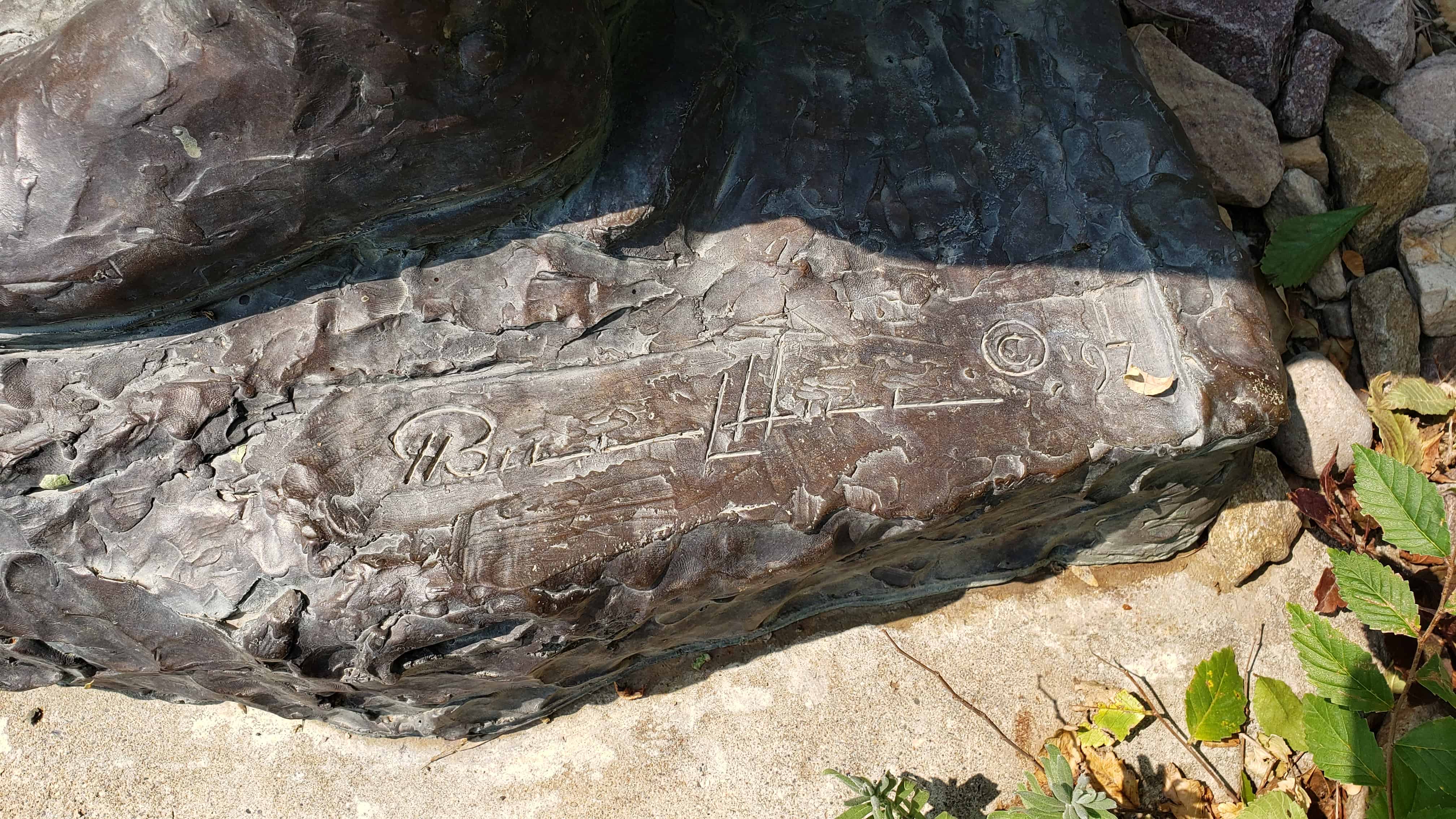
The Family, an Everlasting Heritage, by Bill L. Hill, located in Mendon‘s Pioneer Park.

Distant Thunder

07 Tuesday Dec 2021

Posted by Jacob Barlow in Uncategorized

≈ Leave a comment

Tags

Art, Sculptures, Statues

“Distant Thunder” was created by artist Michael Coleman and first exhibited on May 10th, 2019. The 3,500 pound bronze sculpture took over a year to create. It was donated to Golden Spike National Historical Park in 2019 in commemoration of the 150th anniversary of the driving of the last spike in the Transcontinental Railroad.

Michael Coleman was born and raised in Provo, Utah and spent lots of time outdoors. Coleman is a prominent Western artist who has exhibited at the National Academy of Western Art and the Buffalo Bill Center of the West in Wyoming.

When discussing his sculpture “Distant Thunder,” Coleman said “My love of buffalo runs deep. The first painting I ever sold was of a buffalo. There was a small herd of bison down near Utah Lake about 10 or so miles from my house… they were magic!”

Where the Buffalo Roamed

Bison herds in the western United States were so massive, they shook the ground and sounded like thunder in the distance. The American bison roamed most of North American and in the early 19th century, population estimates were between 30 million to 60 million. Their story is inextricably tied to the history of America’s first transcontinental railroad.

Hundreds of thousands of bison were slaughtered by hunters, travelers and U.S. Troops. Trains shipped bison carcasses back east for machine belts, tongues as a delicacy, and bones as fertilizer. When the Transcontinental Railroad was completed in 1869, it accelerated the decimation of the species and by 1900, naturalists estimated less than 1,000 bison remained.

By the late 1880s, the endless herds of bison were wiped out and just a few hundred individuals remained. Near extinction of the majestic animal deprived the Pains Indians of their livelihood and resulted in tremendous suffering. The last remaining bison were protected in Yellowstone National Park and other sanctuaries in North America. Today, bison populations are slowly recovering. The sculpture “Distant Thunder” is a tribute to the vast herds that once roamed the American West.

This sculpture is located at the Golden Spike National Historical Park at Promontory, Utah.

Cliffside Thunderbird

02 Thursday Dec 2021

Posted by Jacob Barlow in Uncategorized

≈ Leave a comment

Tags

Art

I don’t know anything about this art on the cliff or what to call it, I went with “cliffside bird-man” for now until I can learn more. It is huge and on a cliff overlooking Highway 89 just east of Gunnison, Utah.

Update:
This was my Grandfather who painted this on the cliff. It is a Thunderbird. As history states from the early Indian settlers of the area, thunderbirds were a sign of a good omen to help watch over. This Thunderbird was painted by Don Larson to watch over his Broken Arrow Ranch. The story of it being painted for my Grandmother Emogene was a bit of a tail. She did not have the greatest fondest of the Thunderbird painted on the cliff. This was directly out of her kitchen window and a sight she just didn’t love. However, anybody many years ago that ever participated or was around a 4th of July parade in Gunnison or surrounding areas would remember Don in a full Indian head dress, custom sewn leathers, riding an appaloosa horse. He always enjoyed putting on a good show. Don was an absolute history buff who loved Native American history and art. We are fortunate to still have several pieces of his art on display; mostly made up of Native American paintings. The Thunderbird had a hand dug shelf underneath the cliff and an old wooden ladder that probably still lays up there. This was all free hand painted and to my knowledge, only ever touched up one time. It has been quite a conversation piece in the local valleys for a number of years. Thank you for posting this up, it sure does bring back a lot of really good memories.
JL & Sarah Larson

Over the Cottonwoods

02 Thursday Sep 2021

Posted by Jacob Barlow in Uncategorized

≈ Leave a comment

Tags

Art, mural, Murray, Salt Lake County, utah

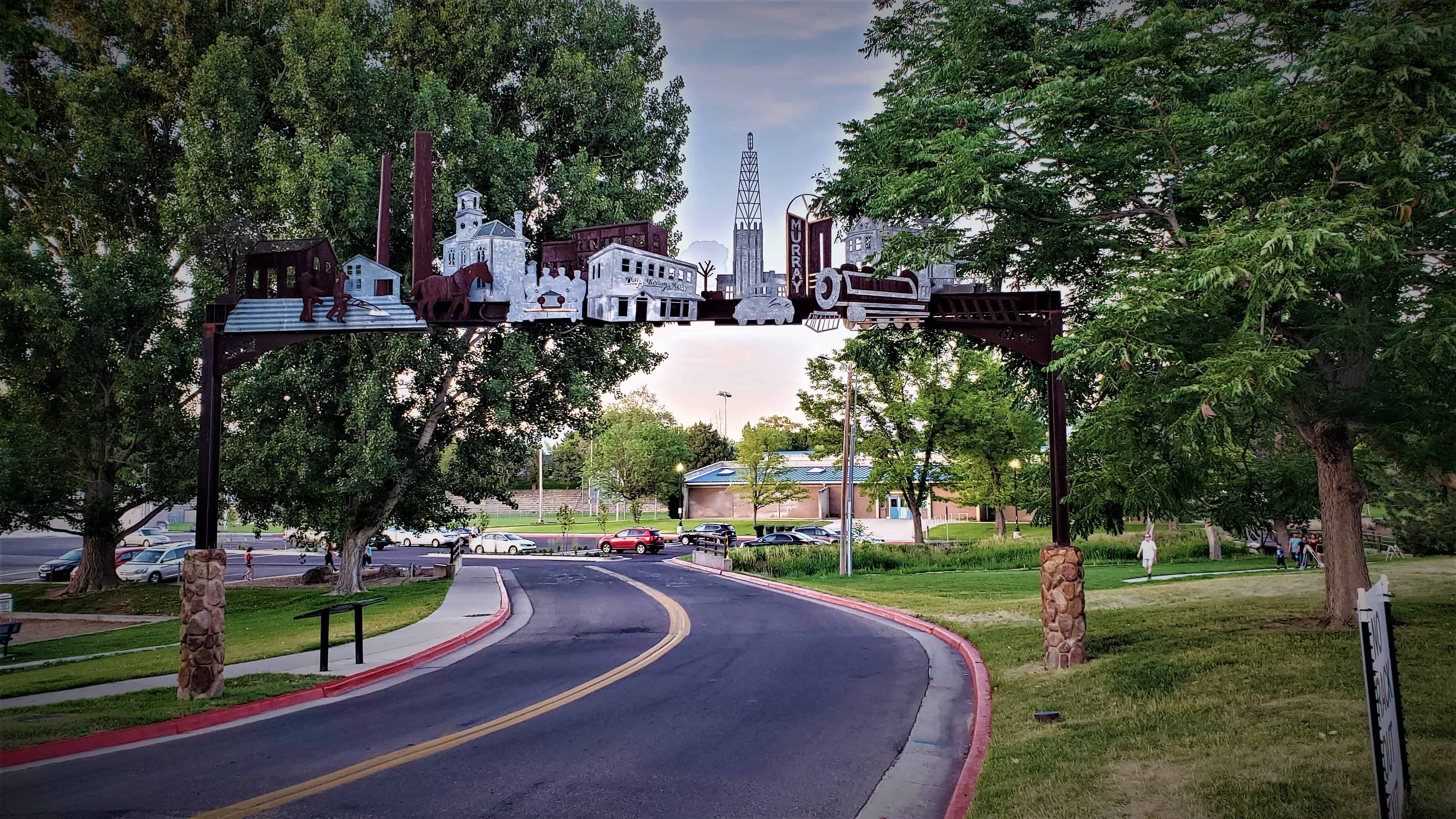
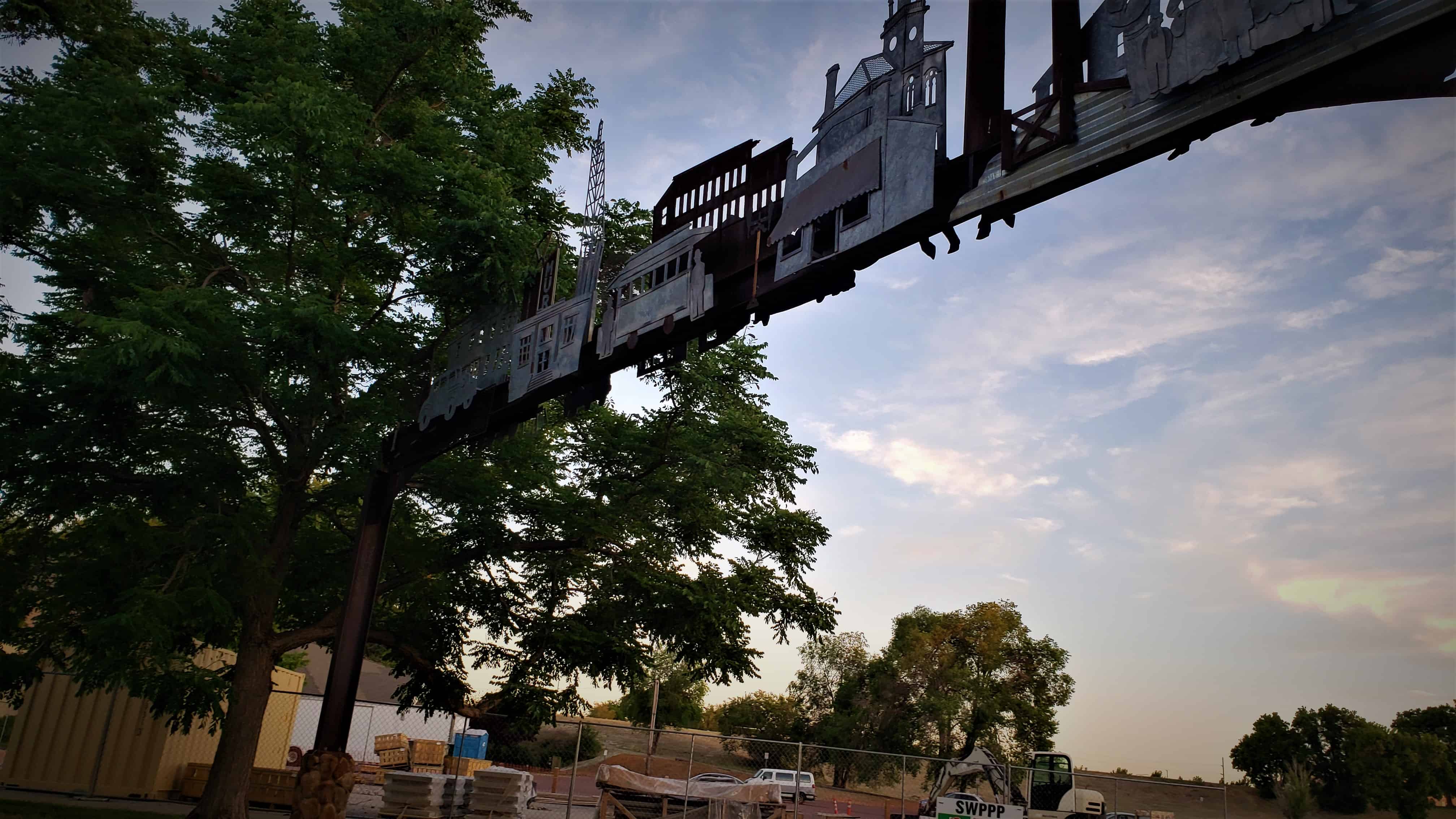
Over the Cottonwoods is an overhead piece of art / metal mural in Murray Park in Murray, Utah.

It is commissioned art by William Littig and Paul Heath for Utah’s 1996 Centennial Celebration.

Depicted on the northeast side from left to right:

  • 1 – 1848 – the first pioneers settled in the Murray area which was previously called South Cottonwood. The group arrived from the southern states in October 1848 under the direction of Amada Lyman and lived in wagons and dugouts for the first winter just south of the present day South Cottonwood LDS Ward Chapel.
  • 2 – Cahoon Mansion and Street Clock was built in 1899 by the prestigious Cahoon family who owned the Miller Cahoon Company (lumber and hardware), Progress Company (power), Murray Orchard (irrigation) and Salt Lake Pressed Brick (now known as Interstate Brick). The Mansion is built on 4 levels, contains 33 rooms, and has more than 12,000 square feet. It was placed on the National Historic Register in 1984.
  • 3 – Automobile transportation began to grow after the turn of the century and for many years moved alongside the trolley tracks.
  • 4 – Carnegie Library, better known as the Vine Street library built in 1916 was one of two Carnegie libraries built in Utah with a $10,000 donation by US tycoon Andrew Carnegie.
  • 5 – State Street Trolley came to Murray in 1895 and operated from electric wires hung above the tracks.
  • 6 – Harker Building and Murray Mercantile were build side by side in 1898. The Harker building is Murray’s only historic three-story brick structure and has housed apartments, doctor offices, floral shops, bakeries, taverns, jewelry stores, and the Murray Eagle. The Murray Mercantile featured many turn-of-the-century items such as buggy whips and button shoes which were still on hand when the store closed in 1976.
  • 7 – Street lights were some of the first improvements added by the newly incorporated city.
  • 8 – Cooperative stores were common during the early days of the community when the settlers would trade their own crops and produce for things they needed. This particular storefront is designed from one of the first stores in Murray owned by Mr. Warenski.
  • 9 – Pioneer family and adobe home represents the early settlers. Between 20 and 40 families farmed the Murray area during the first 20 years. The pioneers first lived in dugouts and log cabins. Eventually they were able to use the clay soil to make adobe bricks for their homes.
  • 10 – 1902 – residents voted to incorporate as Murray City with C.L. Miller as the first Mayor.

Depicted on the southwest side from left to right:

  • 11 – Smelter Building and stacks represent one of the most notable landmarks in the Salt Lake Valley. The smelter industry began in Murray in 1870 with up to 16 different smelters operating at different times in the south end of the valley. ASARCO began operating in 1899 where the previous Germania Smelter had been operating since 1972. ASARCO was the last operating smelter in Murray which rebuilt its tallest smokestack in 1918 at 455 feet to help dissipate large concentrations of sulphur.
  • 12 – Farmers plowing with horse represents the agricultural element that was present in Murray for many years. In 1859, James Fickel made the first plow in Murray using iron from braces and wheels of old army wagons. The plow was hammered into its shape and pulled by three yoke of oxen.
  • 13 – City Hall was built in 1908 on the northeast corner of Vine and State Street. The two story building was made of granite blocks for the foundation. Oak paneling was used inside and a beautiful clock tower and large bell adorned the top. The building housed a court room, police station, city officials, and later a small library. Restrooms called comfort stations were built under city hall with the entrance located outside and downstairs. This beautiful building was destroyed in the 1950s.
  • 14 – Firemen stand around a fire truck ready to serve the public.
  • 15 – Day Murray Music began operating in 1947.
  • 16 – Murray Laundry began operating south of our current city hall in 1910.
  • 17 – Murray Theater opened its doors to the public.
  • 18 – Trains arrived in Murray via the Utah Southern Railroad in 1871.
  • 19 – Trees were located mostly along the Cottonwood Creeks.

May We Have Peace

25 Wednesday Aug 2021

Posted by Jacob Barlow in Uncategorized

≈ Leave a comment

Tags

Art, Salt Lake City, Salt Lake County, Sculptures, utah

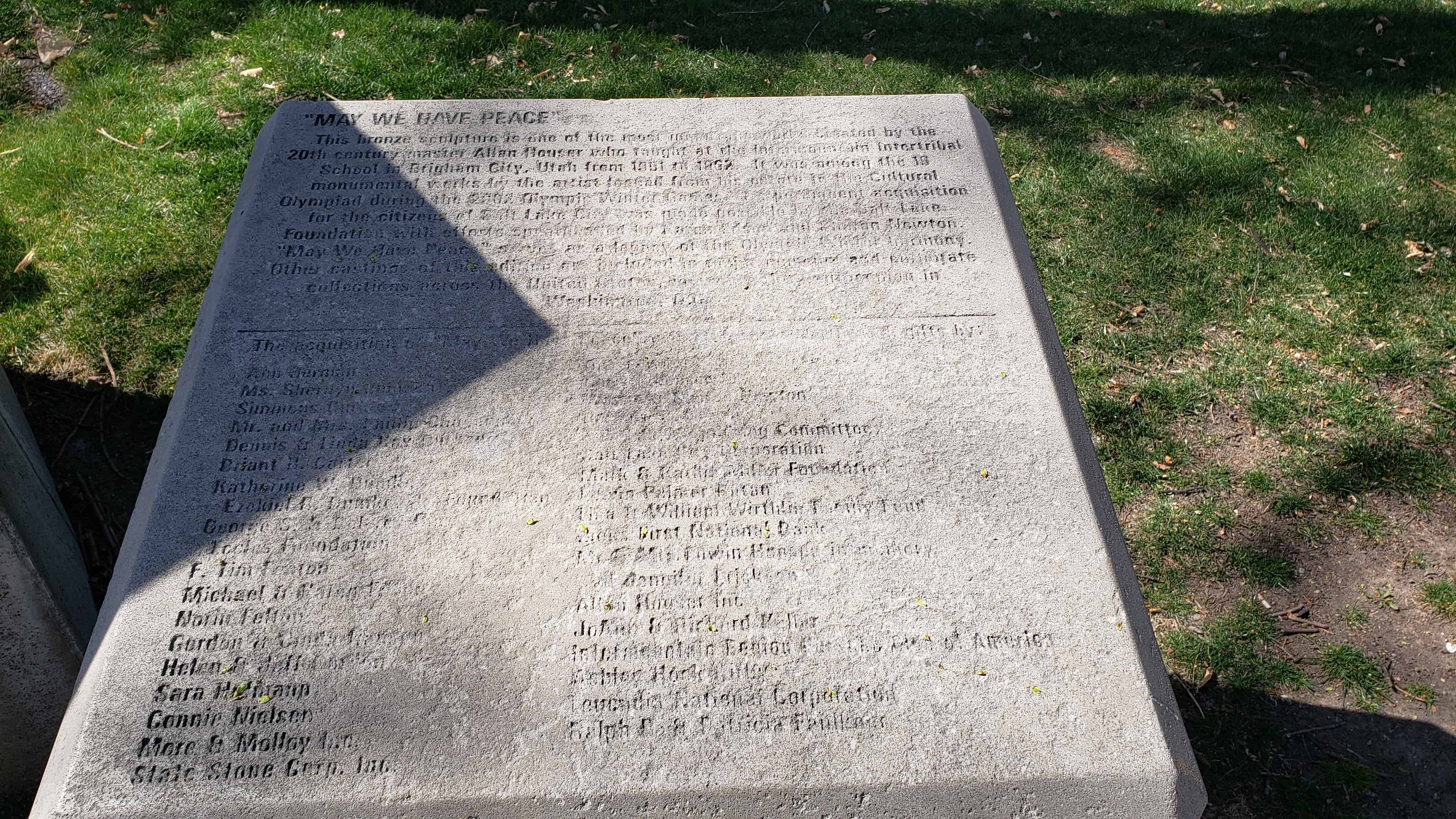
May We Have Peace

This Bronze Sculpture is one of the most important works created by the 20th Century master Allan Houser who taught at the Intermountain Intertribal School in Brigham City, Utah from 1951-1962. It was among the 19 monumental works by the artist loaned from his estate to the Cultural Olympiad during the 2002 Olympic Winter Games. It’s Permanent acquisition for the citizens of Salt Lake City was made possible by the Salt Lake Foundation with efforts spearheaded by Karen Edson and Sharon Newton. “May We Have Peace” serves as a legacy of the Olympic harmony. Other castings of this edition are included in major museum and corporate collections across the United States, including the Smithsonian in Washington, D.C.

This sculpture is located in Washington Square outside the Salt Lake City and County Building.

Petunia

03 Saturday Jul 2021

Posted by Jacob Barlow in Uncategorized

≈ Leave a comment

Tags

Art

This Little Piggy Went to Market…
Petunia

Chris Waddell 2002

Donations Support Art & Music in the Market

Located at 336 West 300 South in Salt Lake.

Brigham Young

23 Friday Apr 2021

Posted by Jacob Barlow in Uncategorized

≈ Leave a comment

Tags

Art, BYU, Sculptures

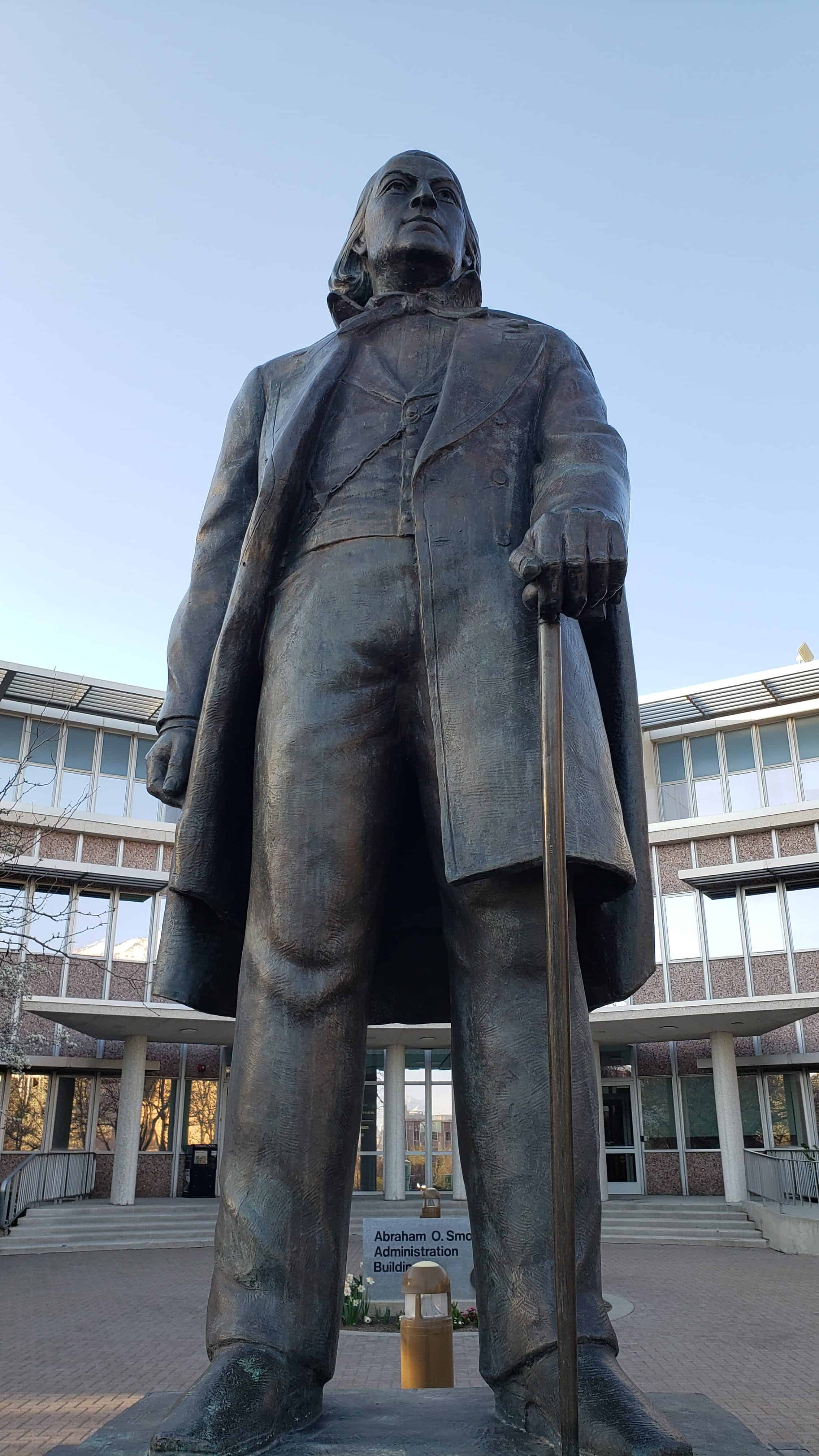
This sculpture is outside the Abraham O. Smoot Building at BYU and was used for a scene in the movie Brigham City.

Brigham Young
1801-1877
Sculpted by his grandson
Mahonri Young
1877-1957

Emmeline B. Wells

18 Sunday Apr 2021

Posted by Jacob Barlow in Uncategorized

≈ 1 Comment

Tags

Art, Statues


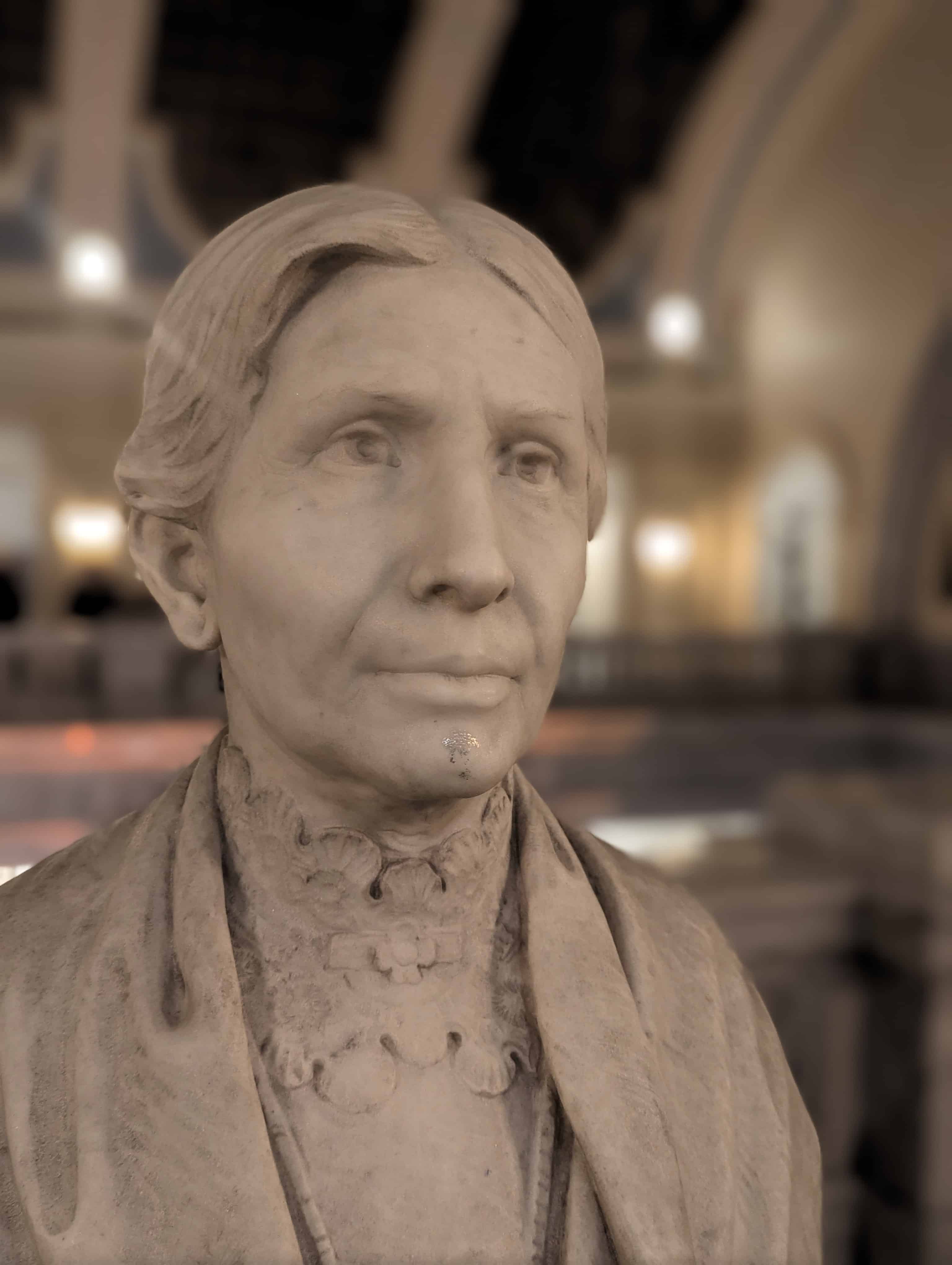
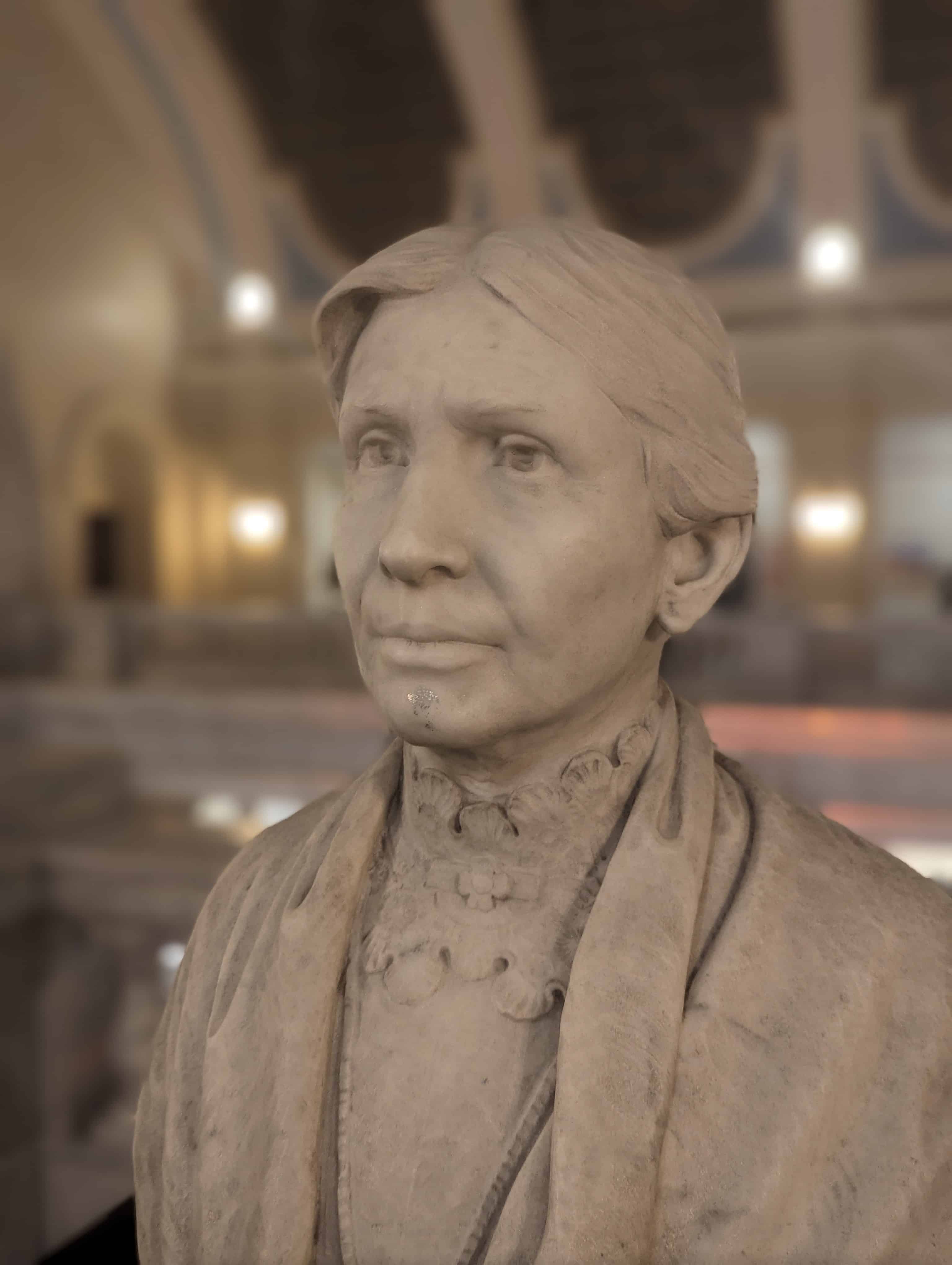
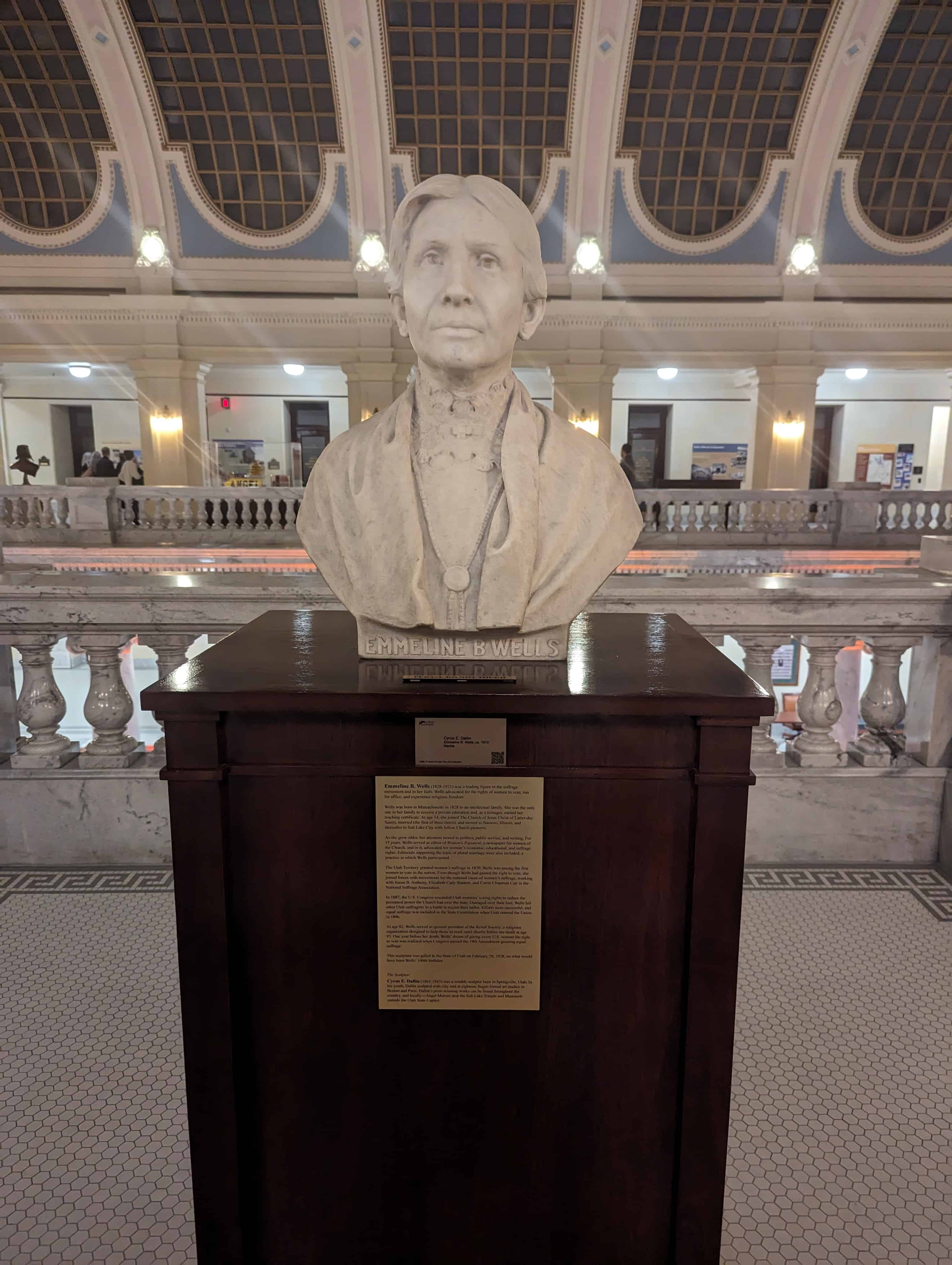
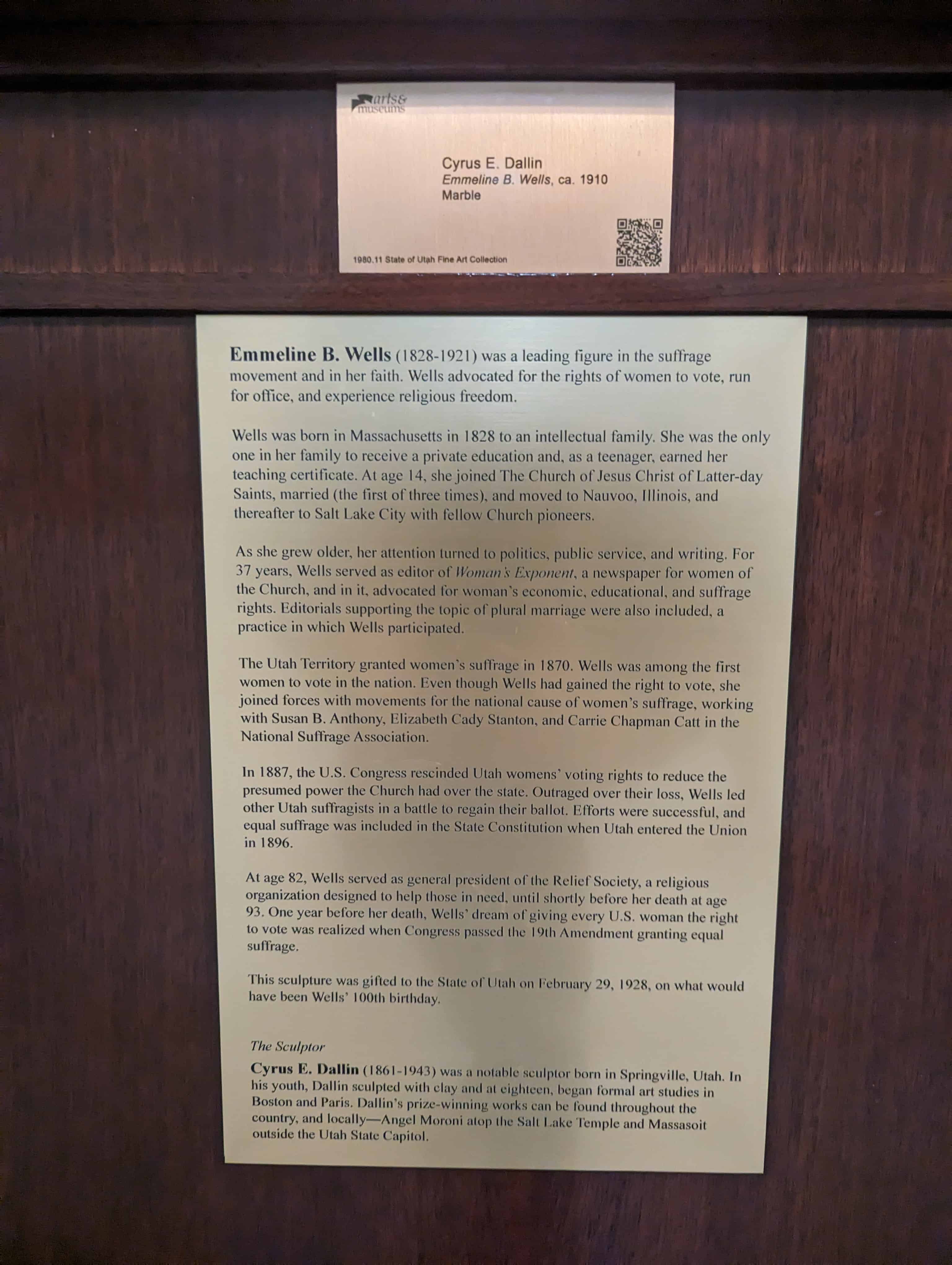
Emmeline B. Wells (1828-1921) was a leading figure in the suffrage movement and in her faith. Wells advocated for the rights of women to vote, run for office, and experience religious freedom.

Wells was born in Massachusetts in 1828 to an intellectual family. She was the only one in her family to receive a private education and, as a teenager, earned her teaching certificate. At age 14, she joined The Church of Jesus Christ of Latter-day Saints, married (the first of three times), and moved to Nauvoo, Illinois, and thereafter to Salt Lake City with fellow Church pioneers.

As she grew older, her attention turned to politics, public service, and writing. For 37 years, Wells served as editor of Woman’s Exponent, a newspaper for women of the Church, and in it, advocated for woman’s economic, educational, and suffrage rights. Editorials supporting the topic of plural marriage were also included, a practice in which Wells participated.

The Utah Territory granted women’s suffrage in 1870. Wells was among the first women to vote in the nation. Even though Wells had gained the right to vote, she joined forces with movements for the national cause of women’s suffrage, working with Susan B. Anthony, Elizabeth Cady Stanton, and Carrie Chapman Catt in the National Suffrage Association.

In 1887, the U.S. Congress rescinded Utah womens’ voting rights to reduce the presumed power the Church had over the state. Outraged over their loss, Wells led other Utah suffragists in a battle to regain their ballot. Efforts were successful, and equal suffrage was included in the State Constitution when Utah entered the Union in 1896.

At age 82, Wells served as general president of the Relief Society, a religious organization designed to help those in need, until shortly before her death at age 93. One year before her death, Wells’ dream of giving every U.S. woman the right to vote was realized when Congress passed the 19th Amendment granting equal suffrage.

This sculpture was gifted to the State of Utah on February 29, 1928, on what would have been Wells’ 100th birthday.

The Sculptor
Cyrus E. Dallin (1861-1943) was a notable sculptor born in Springville, Utah. In his youth, Dallin sculpted with clay and at eighteen, began formal art studies in Boston and Paris. Dallin’s prize-winning works can be found throughout the country, and locally-Angel Moroni atop the Salt Lake Temple and Massasoit outside the Utah State Capitol.

Another of the many works of Cyrus E. Dallin I have been documenting. This is located in the Utah State Capitol Building.

Cyrus E. Dallin Emmeline B. Wells, ca. 1910 Marble
1980.11 State of Utah Fine Art Collection

Statue of Massassoit

18 Sunday Apr 2021

Posted by Jacob Barlow in Uncategorized

≈ 1 Comment

Tags

Art, Statues

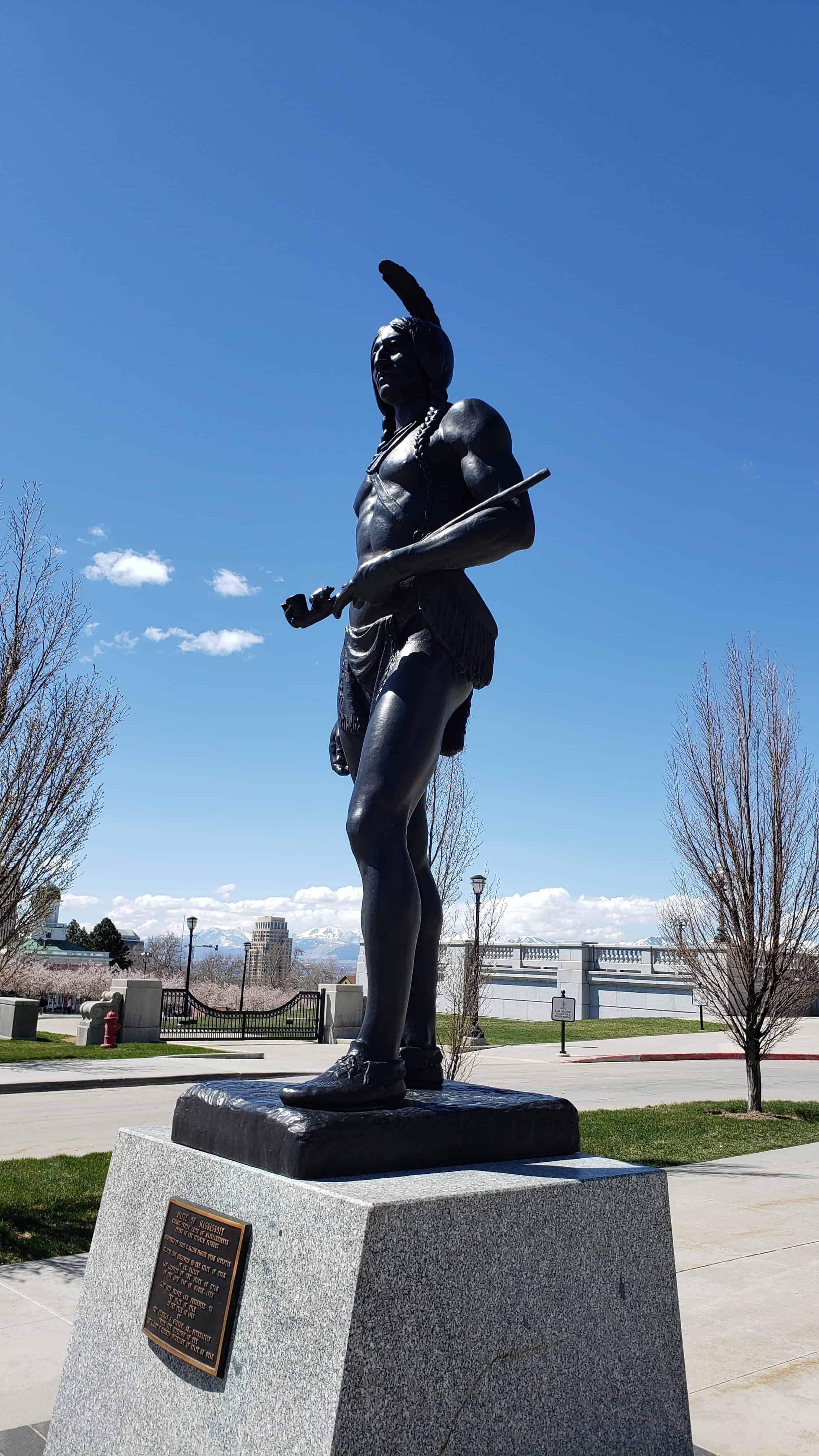
Statue of Massassoit (Massasoit)
Historic Indian Chief of Massachusetts
Friend of the pilgrim fathers.

Sculptured by Cyrus E. Dallin, famous Utah sculptor.

Plaster cast presented to the State of Utah by Mr. Dallin and accepted by the State of Utah on the 20th day of March, 1922.

Cast into bronze and presented to the State of Utah in the year of 1959 by the Nicholas G. Morgan, Sr. Foundation under the direction of the Hon. Lamont F. Toronto. Secretary of State of Utah.

This is located outside to the east of the Utah State Capitol Building.

See this page for the links to other locations this statue, its original and replicas are located.

← Older posts
Newer posts →

Follow Jacob

Follow Jacob

Come wander with me on Youtube.

Blog Stats

  • 2,207,655 hits

Social and Other Links

BarlowLinks.com

Recent Posts

  • Melanie Brennan Hanneman-Medina
  • 416 W 3900 S
  • 2005 E 3300 S
  • Effie Louisa Buchanan
  • Kansas State Capitol

Archives

Loading Comments...