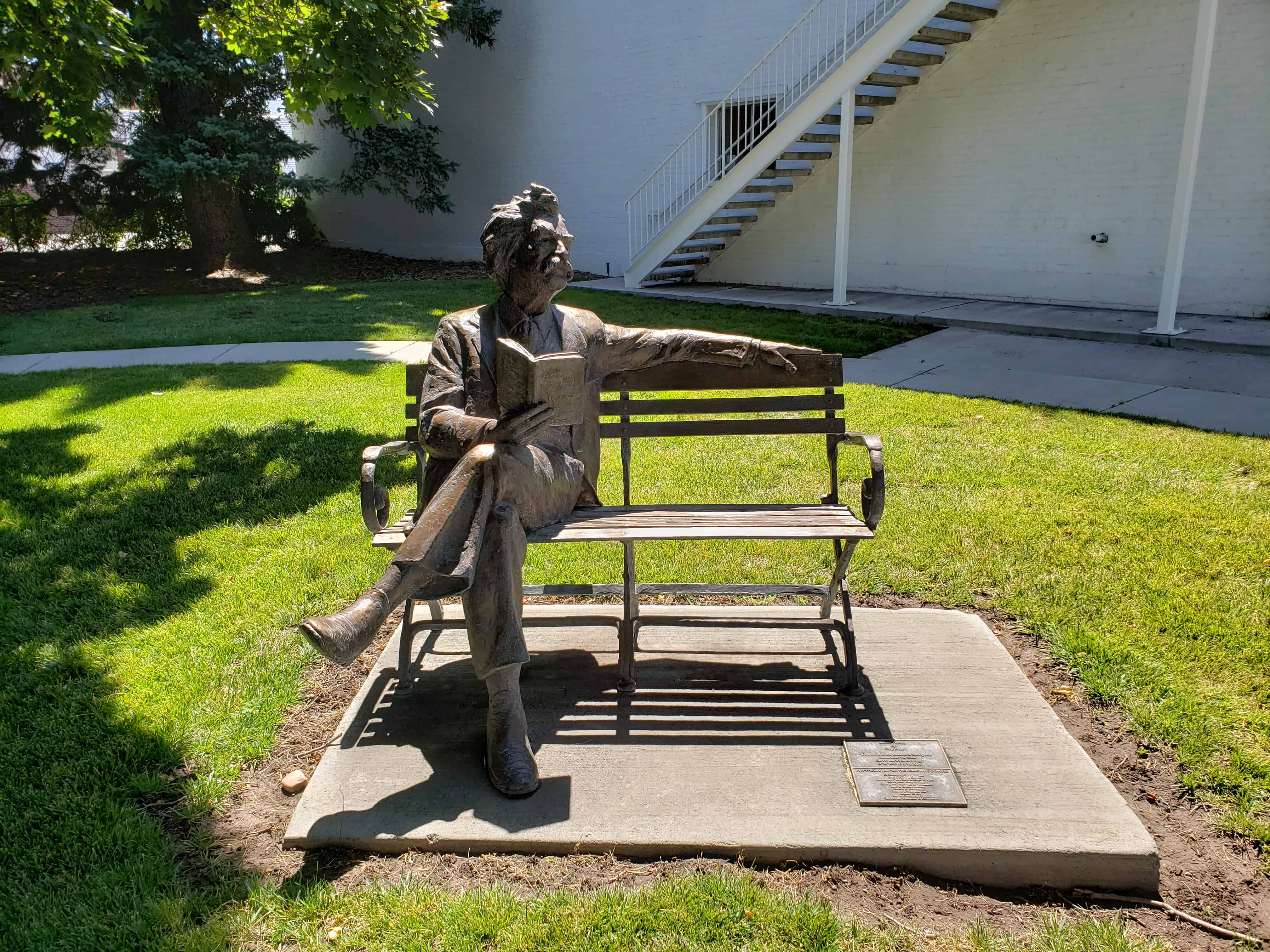
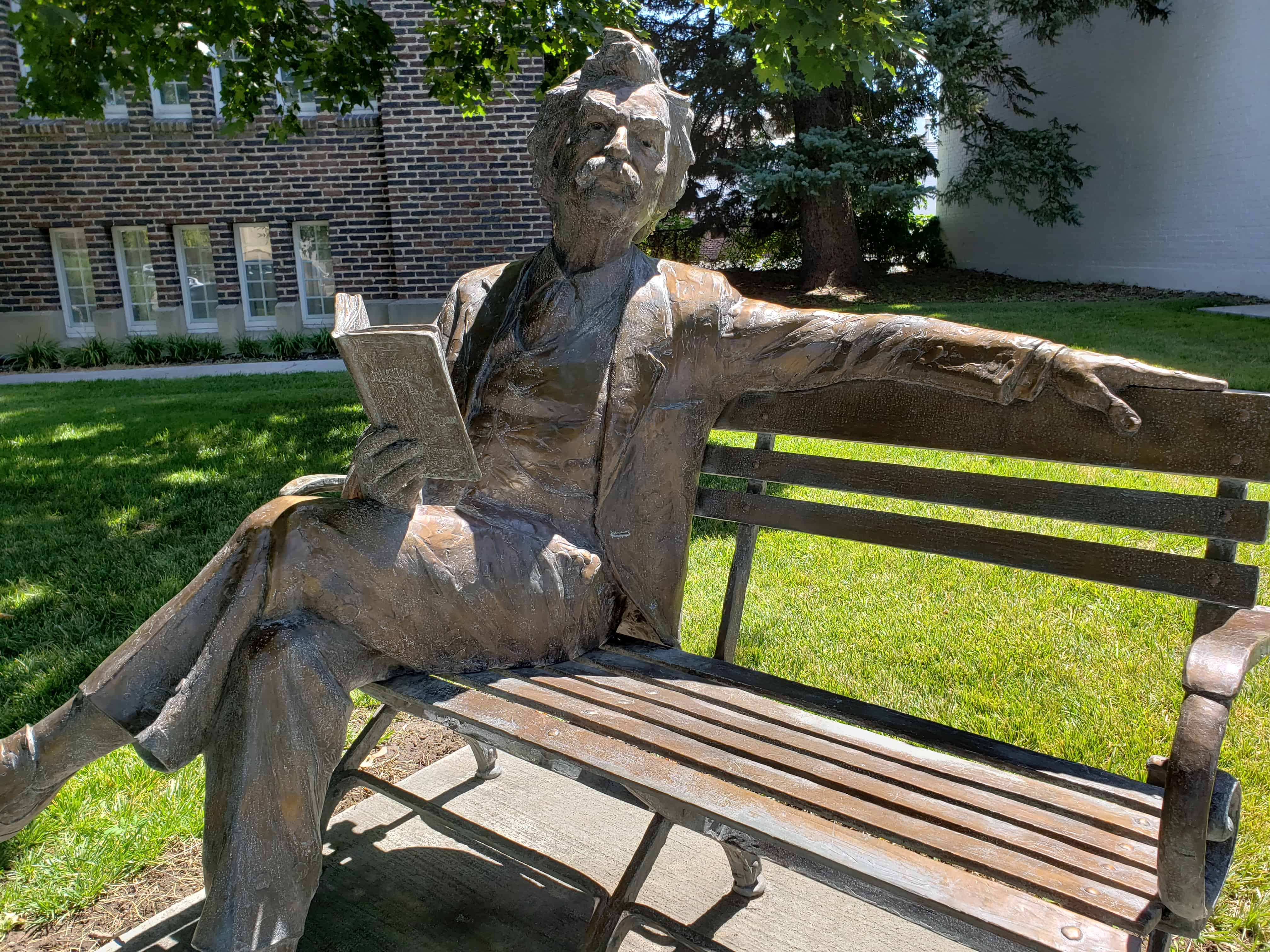
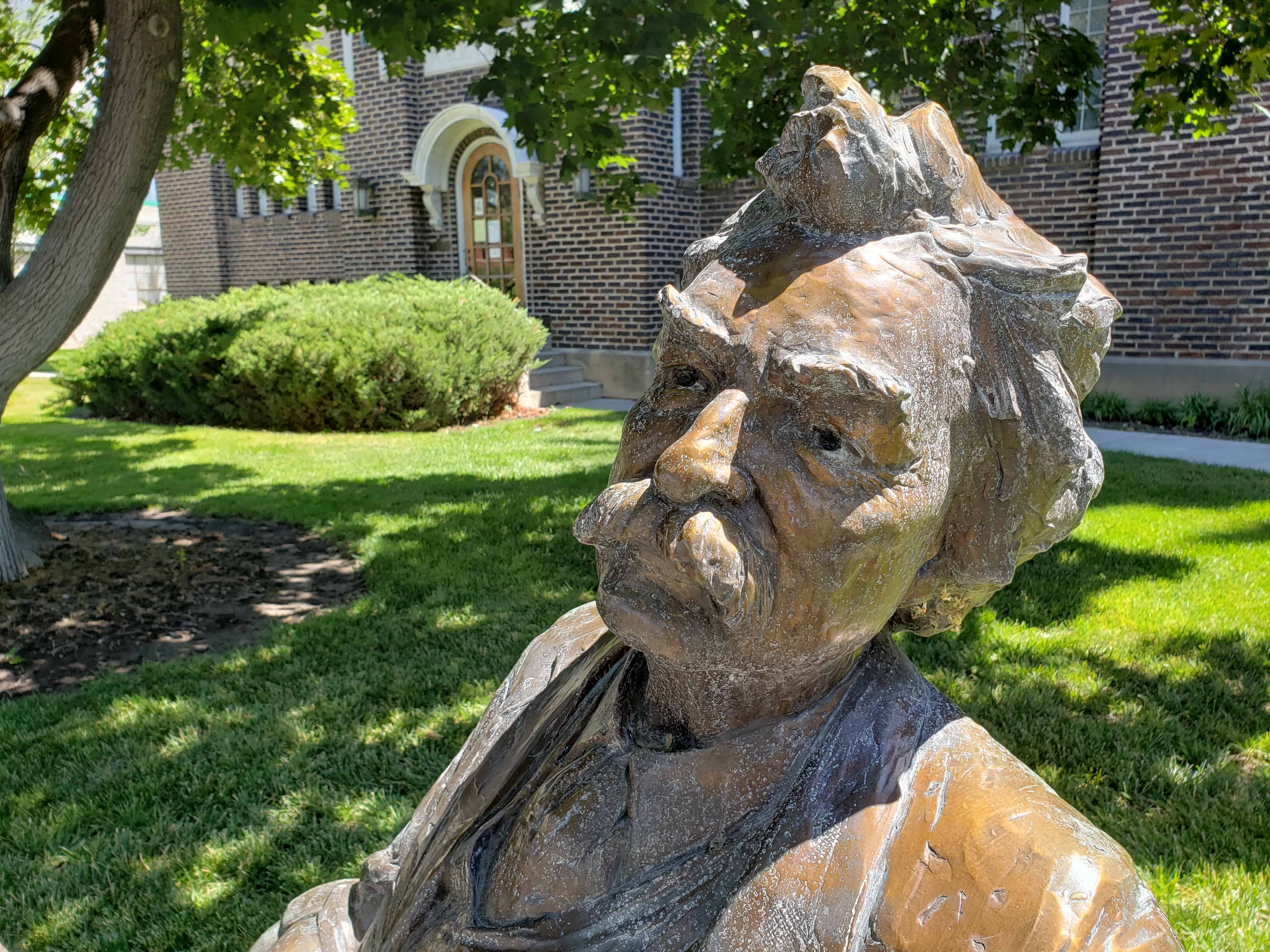
The above Mark Twain statue is located in front of the historic Springville Carnegie Library which is now a museum, there are other copies of it around – I know I saw one in California.
Gary Price is a local to Springville and his artwork is very common to see around town.
The Violin Making School of America was founded in 1972 by Peter Paul Prier, a master luthier from Germany. Thirty two years later we unveiled this statue as a tribute to the school. Here, the finest string instruments and bows are expertly crafted, repaired, and restored, keeping alive the art of violin making.
To the residents of Sugar House, the sugar beet symbolizes the area’s history and represents the distinctive character of their community. Sugar was a scarce commodity in the west during pioneer times. In the 1850s, sugar beet seeds were imported from France and one of Utah’s earliest industries was launched. A sugar mill was built near the intersection of present day 2100 South and 1100 East. Water from Parley’s Creek was employed to turn the factory’s water wheel. Although the plan to produce sugar never materialized, the neighborhood adopted the name Sugar House in reference to this centrally located building. The mill was refitted to manufacture paper, and over the years, the Sugar Mill housed a machine shop for the Salt Lake and Utah Central Railway, and then was used as offices for Bamberger Coal Company.
For the artist, the giant cast-bronze sugar beets represent – with humor and affection – a permanent version of this Sugar House symbol.
These beets are located around Sugarhouse and the plaques explaining them are located at both ends of Hidden Hollow.
This large mural created by Everett Clark Thorpe in 1941 is located in the Federal Building at 88 W 100 N in Provo, Utah and is titled “History of Provo and Brigham Young University.”
This mural depicts important events in the history of Provo, Utah. The historical development of Brigham Young University is the focus of the upper-left side of the mural which includes images of Old Lewis Hall, the university’s first building; the church school’s cooperative mercantile store room; and a contemporary parade.
Focusing on early Provo history, the lower-left section depicts early settlers gathering honey dew from leaves along the river and promising Native Americans not to drive them from their traditional hunting grounds. The center of the mural features the migration of early settlers from Salt Lake City to Provo with the approach of Johnston’s army, and hikers pausing by an Aspen Grove on Mt. Timpanogas. Economic development is the focus of the right side with images of the wool, iron, fishing, and mining industries juxtaposed with images of Mt Timpanogas and the Provo River.
Born in 1907 in Providence, Cache County, Utah, the artist later lived in Logan. He died in 1976. His work has been exhibited in numerous galleries and museums including the Utah State Institute of Fine Arts, the Corcoran Gallery of Art, the Denver Art Museum and the Utah Art Center.