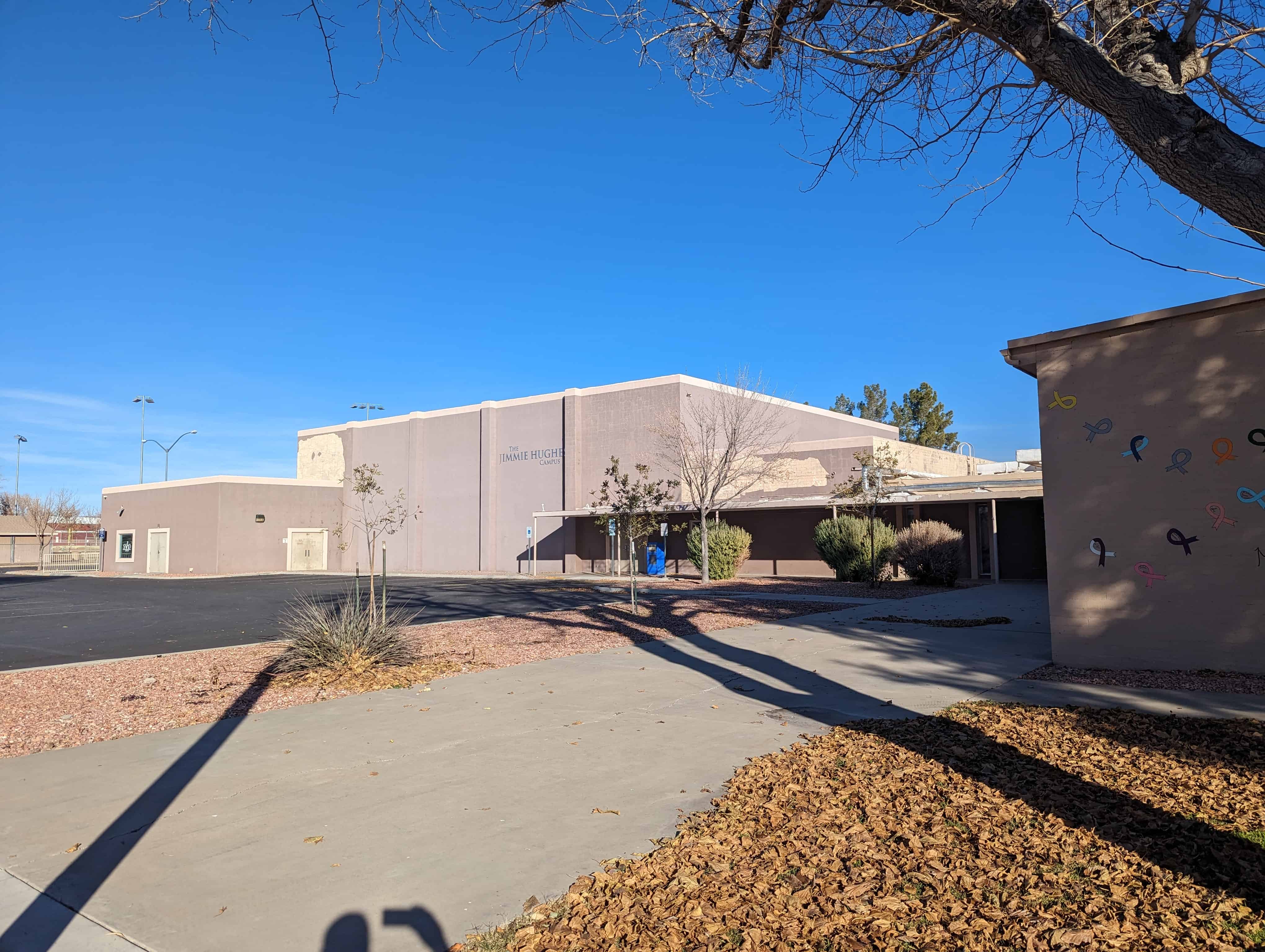
Jimmie Hughes was born February 21, 1940 to Archie Hughes (of Mesquite, NV) and Anna Brotherson (of Boneta, UT), the oldest of five children. Jimmie has spent the best part of the last 80 years in Mesquite.
He did 12 years of schooling here in the Valley. During this time he became the first Eagle Scout in Mesquite in 1955. He graduated from Virgin Valley High School in 1958 went on to college in Cedar City, UT in 1960 and then graduated from Brigham Young University in 1965 with a degree in Animal Science and minoring in Economics, Zoology and German.
Between 1960 and 1963 he served a mission for the Church of Jesus Christ in Germany. After completing his education he married his beloved wife Angie and together they have six children.
Jimmie was also the Volunteer Fire chief for over five years He served as a lay minister (Bishop of an LDS Ward) for 5 years and went on to give generously of his time and service in many leadership positions in the Church of Jesus Christ of Latter Day Saints.
In 1984 Mesquite was the first city incorporated in the state of Nevada in over 40 years Jimmie Hughes was elected the first mayor and served three terms (1 year, 2 years, 4 years). During his time as Mayor, some of the achievements he accomplished were: served on the board of the Las Vegas Convention and Visitors Authority and as the President of the League of Cities. In his 7 years as mayor, councilmen Tommy Leavitt, Craig Pulsipher and Bill Lee served diligently alongside him.
This is Mesquite Historic Marker #25 (see others on this page) located at 150 North Yucca Street in Mesquite, Nevada.
This is a two-story adobe building with a rock foundation. The walls are three adobes thick and there are six rooms on each floor. Abbott served as Bishop of the local congregation of the Church of Jesus Christ of Later-day Saints for 27 years. His large home was a gathering place and hotel, offering lodging for weary travelers and visiting church authorities.
This is Mesquite Historic Marker #19 (see others on this page) located at 200 East Mesquite Boulevard in Mesquite, Nevada.
Tent Chapel and School, circa 1899. When Mormon settlers came to Mesquite Flats in 1894, they designed the southeast corner of this block as the Public Square. It was a place where the community gathered for many events. At this site a tent was set up circa 1899 for use as a chapel and a school. It was 16′ x 16′ with no windows, no heat, a dirt floor, and only logs to sit on.
Block School, circa 1922.
The Block School, so-named because it was made of cement block, had four classrooms and an auditorium. It stood on the southeast corner of the block until it was replaced with a new campus in the 1960’s. The Church of Jesus Christ of Latter-Day Saints rented the schoolhouse for meetings and gatherings for several years.
Gymnasium, circa 1938.
This red brick gymnasium was built adjacent to the Block School and became the center of recreation for the community. The gymnasium was placed on the National Register of Historic Places in 1992. It represents Italian Renaissance REvival style architecture. Construction of the gymnasium was funded through the federal Public Works Administration (WPA) program.
This is Mesquite Historic Marker #9 (see others on this page) located at 51 East 100 North in Mesquite, Nevada.
The Mesquite High School Gymnasium was added to the National Register of Historic Places (#92000119) on March 10, 1992.
From the national register’s nomination form: The Mesquite High School Gymnasium is significant under Criteria C in the area of significance of Architecture. Built in the Italian Renaissance Revival Style, it is representative of the historic context “Schoolhouse Architecture in Southern Nevada’s Fifth Supervision District, 1870 to 1942.” It is significant as an example of its style as well as its rare use of terra cotta and tinted concrete brick. The Mesquite Gymnasium is illustrative of the School Support Building property type, and possesses the characteristics of that type in terms of its historic use, which reflected the expanding educational curriculums of the 1930s, and its functional design, which incorporated a central gymnasium with classrooms on the perimeter. The building is representative of the Custom Architecturally Designed Schoolhouse property type as well. It embodies the characteristics of that type in terms of the formality of its style, and the special attention paid to the spatial organization of the building’s uses.
School support buildings were important components of the expanding role of education that occurred beginning in the early 20th Century. Their function and necessary large size often required designs and methods of construction quite different from traditional school buildings. Almost always designed by architects, and usually in the formal styles, the school support building became symbolic, not only of educational reform, but also of community stature.
Funded by the federal Public Works Administration (PWA), the Mesquite Gymnasium was designed by Salt Lake City architect Miles E. Miller, and built by Salzner-Thompson, contractors. Miller also designed gymnasiums in the nearby towns of Bunkerville (1939) and Overton (1938) under the PWA program. The Mesquite Gymnasium exemplifies the public architecture sponsored by the federal relief programs of the Depression era. The federal government promoted subdued or minimal versions of the traditional styles associated with public buildings. Those styles were mostly drawn from Italian Renaissance or classical examples. They also promoted the use of modern, fireproof materials, particularly concrete and steel.
The design of the Mesquite Gymnasium illustrates that preference through its incorporation of elements of the Italian Renaissance Revival Style in a simple, straightforward manner. Stylistic features of the Mesquite Gymnasium that typify the Italian Renaissance Revival model are strict attention to symmetry at the principal façade, a division of the façade into three primary bays, and classical detailing of the cornice, entry frontispiece, pilasters, and doorways. The gymnasium entrance bay is designed with a pair of fluted classical pilasters flanking each side of the recessed, round arch doorway. The pilasters terminate at an ornate entablature and cornice that extends the length of the facade. Those elements are built of tan terra cotta. Although a common architectural product, its application on Southern Nevada school buildings is rare. The stylized frieze at the gymnasium eave is also decorated with terra cotta, in the form of medallions.
Aside from the application of terra cotta ornamentation and symmetry of the building, the design makes little additional reference to classical architecture. The balance of the gymnasium’s design is, however, in keeping with the concepts of minimalism, simplicity, and use of modern materials, as promoted by the federal government. Windows along the front of the building, which shed light into classrooms, are organized in groups of five and are tall, steel sash awning windows. Other windows are symmetrically located and also constructed of steel. Tall, arched windows along the rear wall of the gymnasium, now infilled, were also constructed of steel sash.
The use of brick-size, red-tinted concrete masonry units is regionally rare, but reflects the desire to use modern fireproof materials that simulated traditional clay brick. Although briefly popular during the 1920s and 1930s, the use of concrete brick was not economical and was soon replaced with larger concrete block, which required less material to manufacture and less labor to erect. The masonry work at the gymnasium is well detailed, with stepped back reveals at the building corners, and soldier courses at the water table and as a decorative band along the upper walls of the lesser facades.
John Pulsipher purchased the Tent School (Marker #9) and moved it across the street to this location to use as a residence. The following year he built a large adobe brick one-room house with walls three adobes thick. The tent was then converted to a kitchen by attaching it to the rear of the house and lining its walls with lumber hauled from Mt. Trumbull.
This is Mesquite Historic Marker #10 (see others on this page) located at 111 East 100 North in Mesquite, Nevada.
At this location stood Alf Hardy’s garage – with an open-air dance hall above the garage. It was a popular recreation spot for the community. A partial wall and railing 4-5′ high encircled the wooden dance floor, which was also used for roller-skating.
This is Mesquite Historic Marker #14 (see others on this page) located at 61 North Sandhill Boulevard in Mesquite, Nevada.
Charles Hardy, one of the first settlers in Mesquite, used lumber he brought back from Mt. Trumbull and local adobe to build the original large central room of his home – the other rooms were added later. The room was used as a bedroom, living room, school and church. The first school classes and church meetings held in Mesquite after its permanent settlement in 1894 took place in the home that was built on this site.
This is Mesquite Historic Marker #12 (see others on this page) located at 126 East 100 North in Mesquite, Nevada.
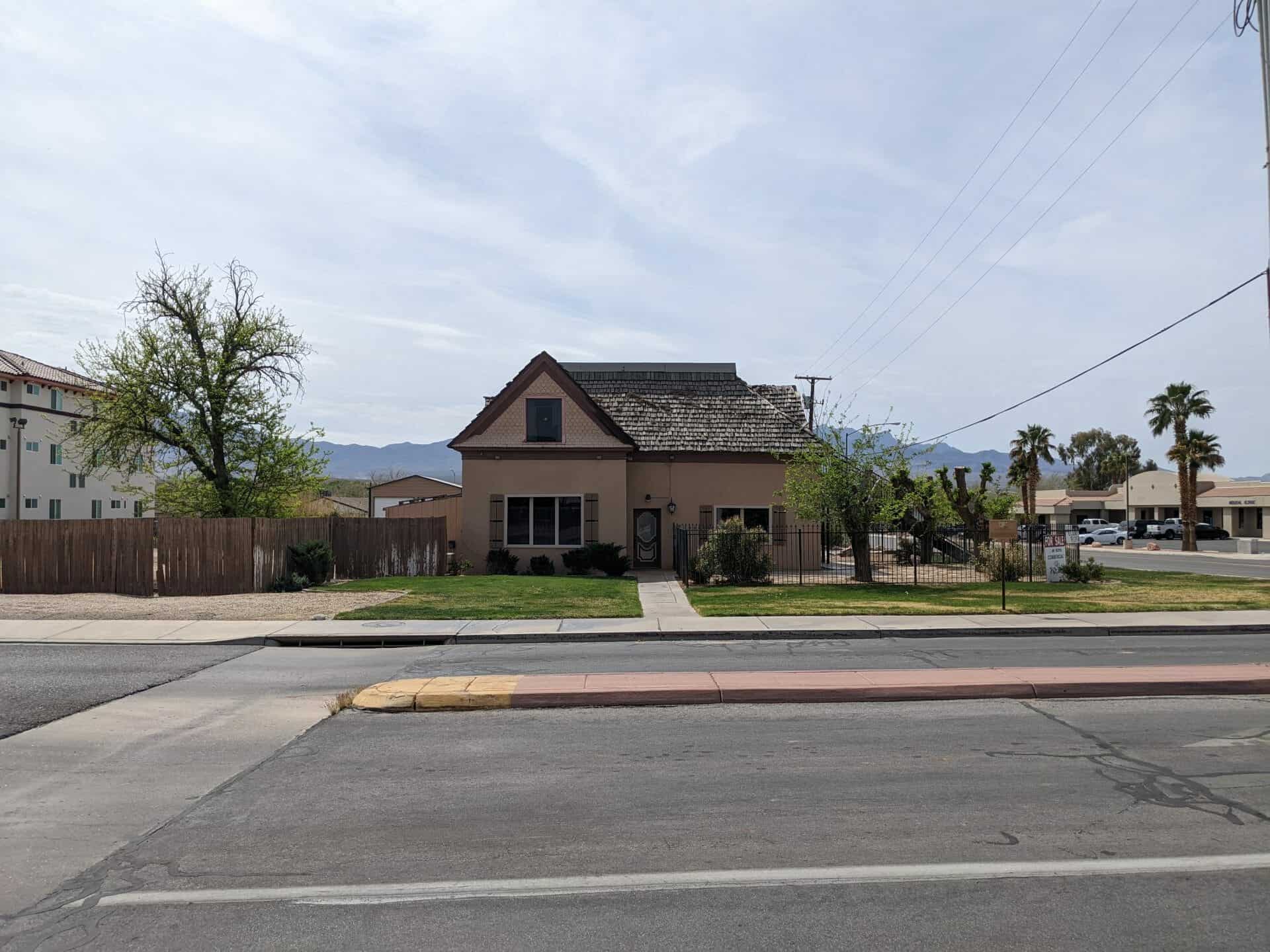
This is the oldest standing house in Mesquite and was continuously used as a residence from 1894 until 2003. The original portion of the house dates from circa 1880 occupation when Mesquite Flats was temporarily settled. The large rocks made the walls of the room 18-20 inches thick. An adobe lean-to was added later.
This is Mesquite Historic Marker #11 (see others on this page) located at 110 East 100 North in Mesquite, Nevada
This site was the location of a 5-room adobe brick home with a screened porch. The porch was later enclosed and became a store and the Post Office. As business grew, a separate store and Post Office was built adjacent to the home.
On this site was the first freestanding theater in Mesquite, which operated until 1960. This site is part of the original Tithing Lot (Marker #4). Prior to building the Edward Theater at this location, movies were shown in garages and at schools.
This is Mesquite Historic Marker #6 (see others on this page) located at 29 Willow Street in Mesquite, Nevada
The southeast quarter of this block was originally owned by the Church of Jesus Christ of Latter Day Saints and was used as a tithing lot. Church members paid tithing in-kind donations of fruit, crops, etc., and items were then distributed to the poor. The tithing office was an adobe room over a rock cellar. The lot was enclosed with a fence and had a barn to store hay.
Hughes and Frehner Store Circa early 1920s
The Hughes and Frehner Store was built on this site after the land was purchased from the LDS Church. The building was later converted to the Valley Inn Bar and then rebuilt, using the same cement walls, as the Golden West Restaurant and Casino.
Howard Pulsipher Home Circa 1923
The Pulsiphers converted a granary from the old tithing lot into a 1-room home next to the Hughes and Frehner Store. Within a year they had outgrown it and Howard built a new one on the same lot. It was concrete, plastered inside and out. This was the first home in the Virgin Valley to have running water and a bathtub inside.