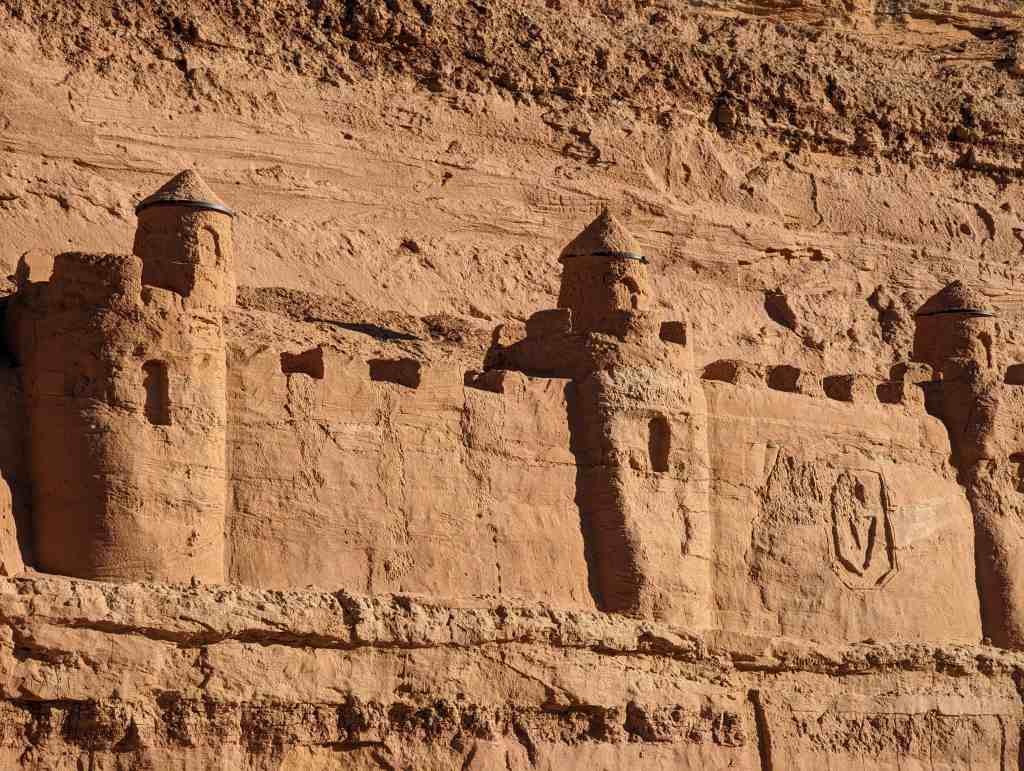
The community greatly appreciated the chapel-school built on this site – previous school classes and church services were held in homes or in a tent. Known as the First Chapel-School, the building was erected by members of the Church of Jesus Christ of Latter-day Saints with lumber hauled over the mountains from Block Rock by way of Elbow Canyon.
The first building on this site was a home built for Walter Hughes, located on the northwest quarter of the block. In 1901 he replaced it with a beautiful adobe brick home that he built himself. It stood here until 1972.
Abram Woodbury and James Hughes, Sr. also built early homes on the block. Over the years more homes were built and a few businesses, including Faye’s Café and the Hughes Motel, stood on the block until circa 1995.
Clark County Offices 1973
Clark County built an office building on the northwest corner of the block where the Walter Hughes home had stood. When Mesquite incorporated in 1984 the building became City Hall. It housed a library, a police station and jail, a fire station, and other offices for nearly 30 years.
City Hall Annex/Fire Station 1989
The Fire Station behind City Hall was built in three phases. The original building was a child care center, then a medical clinic. The City purchased and expanded it as an annex office building a few years later, then added the fire engine bays in 2001. Since that time the building has been used exclusively as a Fire and Rescue Station.
Mesquite City Hall 2001
This City Hall complex, completed in 2001, reflects the history, architecture and beauty of Mesquite and the Virgin Valley. Its award-winning design, which focuses attention on the Indian family sculpture and fountain in the amphitheater creates a special place for civic activities.
This is Mesquite Historic Marker #24 (see others on this page) located at Mesquite City Hall at 10 East Mesquite Boulevard in Mesquite, Nevada
Mary Jane Leavitt Abbott July 16, 1873 – November 30, 1956
… from weary travelers to women and their children who would come to visit … she never turned anyone away without feeding them. She would invite you to eat and then say ‘There’s plenty such as ’tis; … Bless her heart, it was as big as al outdoors when it came to hospitality. —Nellie Hughes Barnett (granddaughter).
Mary Jane was Mesquite’s Angel of Mercy. Her satchel, filled to the brim with mustard plasters, castor oil, chaparral tea, and other supplies, sat by her door ready for any emergency. She delivered babies, cared for the sick, and brought hope to the disheartened. When a crisis occurred, Get Aunt Mary Jane ricocheted across the valley and any call for help spurred her into action.
Born in 1873, at Gunlock, Utah, Mary Jane was the tenth child and second daughter of Dudley and Mary Huntsman Leavitt. A delightful addition to the family, she was high spirited and independent – notorious for expressing her opinion. When she was four years old, the family moved to Bunkerville, Nevada, where she met William Abbott. They later married and moved to Mesquite. She gave birth to thirteen children: Christina, Dorothy, Josepha, Orval, Emily, Oscar, Gussie, Anthon, Deloy, John, Rulon, Claude, and Allen.
Shunning personal praise, Mary Jane valued and paid tribute to other women. She called them her sisters, knowing them to be wise, compassionate, and independent. In addition to rearing families, these women preserved food, rendered lard, and made soap and candles over an open fire. They served one another by attending to the physical and emotional needs of the living, comforting the bereaved, and making paper flowers to honor the deceased. Together they were unstoppable! They planted, tended, and picked cotton while babies played in furrows and children lugged cotton sacks. Wagons hauled the cotton to Washington, Utah, where the going price was three-and-a-half cents per pound. In turn, the women received brooms, oil cloths, petticoats and other supplies—a mere pittance for their labor. The bulk of the profit was generously allocated to a women’s fund used for community needs such as cloth for burial clothes and casket linings.
Charity Never Faileth was more than their motto; it was what they lived by. Mesquite thrived because good women performed good works. This was the expression of their faith—etched with indelible ink. This sculpture is in honor of those pioneer women who works are a keepsake from the past and whose faith is a beacon for the future.
History of Mesquite
Mesquite proved a total failure after several years labor. And today only a few ravines and sand-filled ditches mark the place where the village once stood. —LDS Church Historian Andrew Jensen, 1891.
The remoteness of the area, the water woes, the scanty provisions, the scorched earth, and undoubtedly the scorpions, badgers and snakes offered incentive for settlers to recoil, rethink, and reestablish elsewhere.
Mesquite had its origins in February 1880, when leaders and selected families of the Church of Jesus Christ of Latter-day Saints gathered on the northeast bank of the Virgin River. At that time William Branch was sustained as bishop, and church members were given specific duties related to the cotton enterprise. Because water was critical, the pioneers dug a seven-and-a-half mile irrigation canal. The settlers enjoyed an ample harvest in their first year. But in June of 1882, a flood wreaked havoc demolishing homes and causing the canal to be breached in fifty-eight places. A month later, Bishop Branch dispatched this report: The brethren are steadily working on the canal, 12 of the men are down with chills leaving but 9 at work … 110 degrees in shade and 140 degrees where the men work and filthy water to drink. Families began to leave. By 1883, when Dudley Leavitt’s family moved to Mesquite, the town was deserted. Widespread damage from subsequent storms forced the Leavitts to relocate as well.
After two failed attempts to settle Mesquite, a few resolute men, including William Abbott, camped along the abandoned irrigation canal. The year was 1894, and the workers, all in their early twenties, labored to repair the damage. Their rations consisted of an occasional crust of bread, molasses, and warm milk from an old red cow tied to a wagon. In a miraculous way the youthful men prevailed. Water once again flowed, the land was fenced and divided, crops were planted, school classes began, and a voting precinct and post office were established. By 1900, nineteen families called Mesquite home—a humble home, as they lived in wagons, tents, adobe structures and under tarps.
Those who continued on in Mesquite harvested meager crops, were resourceful by necessity, and resolved to be cheerful. In their poverty there arose a noticeable attachment and tenderness toward one another. Soon, life in Mesquite offered more than mere existence. There were magical musical moments: singing, choirs, bands, and dancing. Poetry was written, recitations given, and nearly all tried their hand at acting. Reveling in celebrations, they used any excuse to feast, picnic, and compete in sports.
In due course, Mesquite became known to the outside world. Mesquite’s grapes and pomegranates took first place at the San Francisco Fair in 1906. Young men served their country, missionaries went forth, trails became roads, and roads became highways. Highways needed bridges, all of which required a united effort at home and input from outside.
Etched in the past—more than the dam, the road, or the bridge—are the builders, the dreamers, those willing to dedicate their lives for a better tomorrow. Tomorrow is here and dreams do come true.
William Elias Abbott October 16, 1869 – February 19, 1949
It was under William Abbott’s supervision that Mesquite was founded on a firm foundation. —Howard Pulsipher, Mesquite Pioneer.
At the age of eight, William journeyed from his birthplace in Ogden, Utah, to Bunkerville, Nevada. The year was 1877, and Will, a youthful participant in establishing the town, was a keen observer. He listened to debates, took note of critical decisions, and became skilled in diplomacy. In his youth, Will raised melons, picked cotton,, cared for animals, and made molasses. Later, he delivered mail pony express style, peddled produce to mining camps, hauled salt from St. Thomas to Silver Reef mine, and herded three thousand steer from Arizona to Utah.
After completing a mission to Illinois for the Church of Jesus Christ of Latter-day Saints, William was called to be bishop of the Mesquite Ward, a position he held from 1901 until 1927. His involvement in church and community affairs was unequaled and his leadership extended to all people. He was on the town board, school board, board of directors of the grape farm, and chairman of the telephone committee. Will was involved in the building of a bridge between Mesqute and Bunkerville—and when completed—he was in charge of the Bridge Day Celebration. He was a judge, justice of the peace, farmer, delegate to the International Irrigation Congress, and amateur dentist, and with his wife, ran a hotel and café.
William championed the road-building cause He surveyed the original road between Las Vegas and Mesquite. He campaigned for and took charge of the construction of a road which was one hundred feet in width and a mile-and-a-half long. This was a grueling, three year project as even a bird couldn’t fly through the dense, impassable underbrush The road is now known as Mesquite Boulevard.
Maintaining the dam was also a challenge. When the all-too-familiar cry, the damn dam is out, spread by word of mouth, men promptly transported available teams and wagons to the dam site. William wrote, I have worked in the river building dams in water to my neck for two and three weeks at a time. We put into our dam at one time 300 loads of brush and 500 loads of rock.
The establishment of Mesquite was not a one-man effort. Settlers moved in for a variety of reasons and were endowed with a diversity of talents. It tool strong minded and strong-backed men with unwavering conviction to make Mesquite a viable community; men who were willing to surrender their own comfort and welfare for future generations.
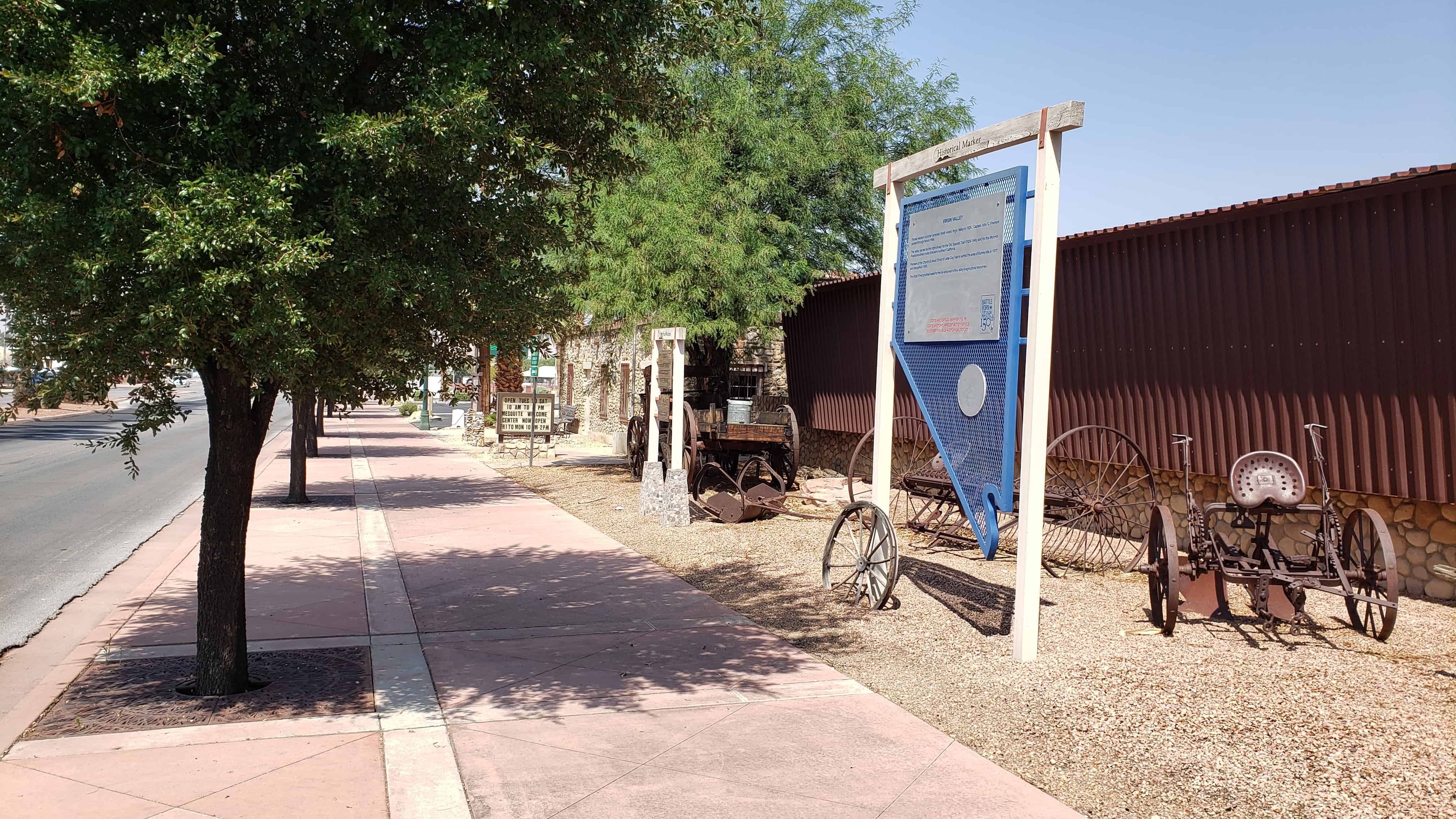
The valley served as the right-of-way for the Old Spanish Trail (1829-1848) and for the Mormon Road or southern route of travel to southern California.
Pioneers of the Church of Jesus Christ of Latter-Day Saints settled the area of Bunkerville in 1877 and Mesquite in 1880.
The Virgin River provided water for the development of the valley’s agricultural resources.
Nevada Historic Marker #56, located at 15 West Mesquite Blvd in Mesquite, Nevada.