• About JacobBarlow.com
  • Cemeteries in Utah
  • D.U.P. Markers
  • Doors
  • Exploring Utah Email List
  • Geocaching
  • Historic Marker Map
  • Links
  • Movie/TV Show Filming Locations
  • Oldest in Utah
  • Other Travels
  • Photos Then and Now
  • S.U.P. Markers
  • U.P.T.L.A. Markers
  • Utah Cities and Places.
  • Utah Homes for Sale
  • Utah Treasure Hunt

JacobBarlow.com

~ Exploring with Jacob Barlow

JacobBarlow.com

Tag Archives: Neo-Classical style

Empress Theatre

31 Saturday Dec 2022

Posted by Jacob Barlow in Uncategorized

≈ Leave a comment

Tags

Beaux Arts style, high-style architecture, Magna, Neo-Classical style, Neon Signs, NRHP, Salt Lake County, Theaters, utah, Vintage Signs

The Empress Theatre, built in 1917, is both historically and architecturally significant. The design of the building, a combination of Neo-classical and Beaux Arts styles, makes it the most outstanding example of high style architecture in Magna. Though not a premier example of the Neo-classical style in Utah, the Empress Theatre is one of a number of distinctively styled theatres in small Utah towns that are dominated by relatively plain commercial buildings. Historically, the Empress Theatre is one of the oldest and best preserved commercial buildings in Magna, and it is the oldest theatre in the community.

The theater was added to the National Historic Register (#85000962) in 1985 and is located at 9104 West 2700 South in Magna, Utah

  • Theaters in Utah

The Empress Theatre was built on Main Street in Magna in 1917 by the Western Theatre Corporation, about which nothing is known. The theatre was owned by Western Theatre Corporation only until October 1918, when it was sold to Thirza A. Hemingway, also an unknown. During Hemingway’s years of
ownership, 1919-23, the theatre was listed in the city directories only in 1919 and 1923, indicating that it was not in operation for 3-4 years. Frank Burgner, who bought the theatre in 1923, owned and operated it until 1932, after which it was owned for three years by State Building and Loan Association. From 1931 through 1935 the theatre was once again left vacant, as indicated by the city directories. George and Alice Smith bought the Empress Theatre in 1935 and operated it for almost 20 years. The building has been virtually unused for the past 30 years.

At the time of its construction the Empress Theatre was the second theatre in Magna. The other theatre, the Palace Theatre, operated from 1914-17, but its location is currently unknown. Two other theatres also operated in the town during the period from the 1920s through the 1940s, the Rialto (1921-26) and the Gem (1927-44+). Only the Gem remains and it has been significantly altered.

The Empress Theatre was constructed during the period of greatest growth in Magna, the 1910s-20s. The Utah Copper Corporation was established in 1903, incorporating numerous small mining operations into one large one, and soon after erected the Magna and Arthur concentrators near the site of Pleasant Green, which several years later became known as Magna. The Empress Theatre was one of a number of buildings that were erected along Main Street during the decades of the 1910s and ’20s, creating a substantial commercial district. Most of those buildings have been left vacant and neglected over the past 20-30 years, however, as the prime commercial district has shifted further west and south and the depressed local economy has dried up most businesses in the old Main Street area. The Empress Theatre is one of the best preserved of the older commercial buildings along Main Street, and it is easily the most sophisticated in terms of its architectural design. Most of the remaining buildings in the area are relatively plain, nondescript commercial buildings.

This is a 1-story one-part commercial block type building that is constructed of brick and has a flat roof. The design is essentially Neo-Classical, although some Beaux Arts influences are in evidence. The most distinctive features of the building are its pressed tin dentiled” cornice and decorative curvilinear gable on the parapet. At the center if the gable is a rectangular panel framed by rosettes and topped by scroll work and a flag pole. There are swags and garlands on the frieze above the recessed front entrance. The façade is broken up into three bays by brick piers. The entrance bay is highlighted by ornate, pressed tin pandrels at both corners. These spandrels appear to be inspired by the Beaux Arts style. The brick piers have vertical recessed panels, a decorative motif that is carried over on horizontal panels on each of the side bays. Narrow transom lights are found above the openings on each of the side bays. The building is currently vacant but remains in good condition and retains its historical integrity.

The Empress Theatre was built in 1917 by the Western Theatre Corporation. Originally a burlesque theater for the local miners, the theater soon began showing silent movies. The Empress is one of four theaters that were erected along Magna’s Main Street during the decades of the 1910s-1930s. This followed the establishment of Utah Copper Corporation, which brought jobs and population growth to the area.

For many years, the Empress went through a number of owners as well as periods of vacancies. The theater was abandoned for several decades and was purchased in 1978 by the Barker family who began restoring the building. Leo Ware took over ownership in 1983 and continued the project. However, in July 1984, the Salt Lake County Commission threatened to have the building demolished because it was unsafe. After an appeal, the Commission reversed their decision and allowed Ware until the end of the year to stabilize the building, which he did. He continued working on the building for more than a decade, using state and federal grants to help with the expenses. Unfortunately, Ware was injured in an auto accident in 2002 and could not finish the rehabilitation of the building. In 2006, a local non-profit organization, Oquirrh Hills Performing Arts Alliance, was formed to take over the project from Ware. The Alliance continued to receive grants and completed the work. The Empress finally reopened as a live performing arts theater in November 2006 and has seen over 100 productions since then.

The design of the building, a combination of Neo-classical and Beaux Arts styles, makes the Empress Theatre the most outstanding example of high-style architecture in Magna. This theater is an example of the many distinctively styled, early 20th-century theaters found in small Utah towns, which are dominated by relatively plain commercial buildings. Historically, the Empress Theatre is one of the oldest and best preserved commercial buildings in Magna.

Box Elder County Courthouse

26 Sunday Sep 2021

Posted by Jacob Barlow in Uncategorized

≈ Leave a comment

Tags

Box Elder County, Brigham City, Courthouses, Neo-Classical style, utah

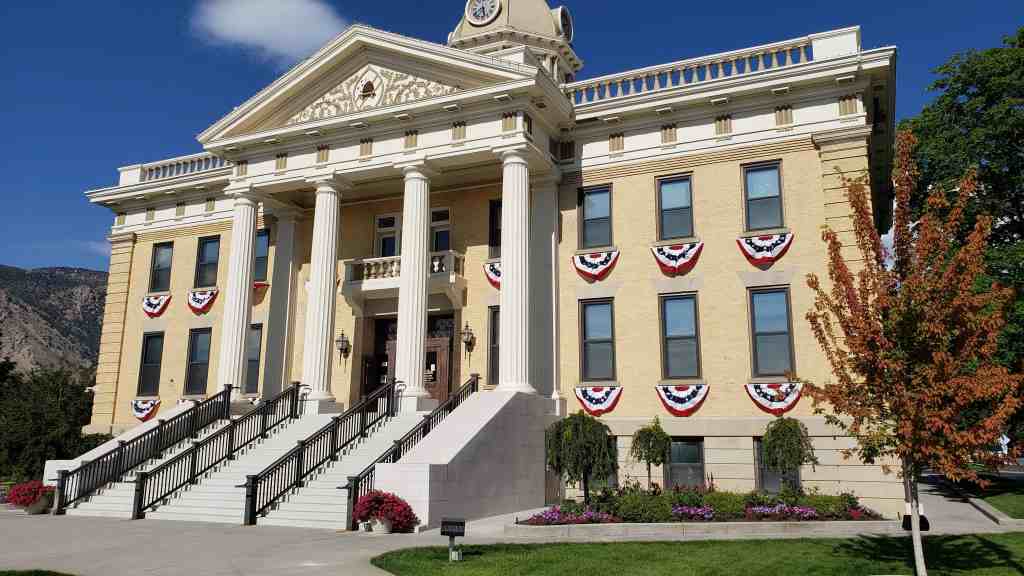
Constructed in 1857 and greatly enlarged in 1910, the Box Elder County Courthouse is historically significant as the center of government in Box Elder County for over 130 years. The building has housed virtually all departments of the county government, including the court and judge’s chambers, commission chambers, offices of the cleric, recorder, assessor, and so forth. No other courthouse has ever been built in the county, therefore, this is the only building associated with the administration of Box Elder County governmental affairs. The building is also architecturally significant as the best example of the Neo-Classical Revival style in both Brigham City and Box Elder County. The significant stylistic features are confined only to the 1910 section of the building; the 1857 section is now the non-descript rear wing. The Neo-Classical Revival style was used in Utah primarily just for public and institutional buildings, such as schools, civic buildings, and churches. No other examples of the style have been identified in the Brigham City area.

Located at 1 North Main Street in Brigham City, Utah

Related:

  • Box Elder Courthouse War Memorial
  • Grace V. Price Flag Pole
  • #9 in the Brigham City Historic Tour
  • #196 of the S.U.P. historic markers
  • NRHP #88000399

The county courthouse was begun in 1855 or 1856 as the first public building in the area. Vaughn Nielson in The History of Box Elder Stake stated that the rock walls for the basement story were all laid by the fall of 1856. After these basement walls were laid up and windows and doors installed, the structure was covered with a temporary roof, and the building was utilized for meetings and drama during the winter of 1856.

In 1857, two stories of adobe brick were built upon this foundation, but before the walls were finished, a strong wind partially blew them down. These walls were then rebuilt and the building was completed before the end of 1857. Lorenzo Snow, the leader of the community, stated that “by the fall of 1857 they had built the second and much better court house, the upper story of which was 45 x 65, while the original basement room was 22 x 45.” He says the roofing of the new structure was fastened with wooden pins.

The cost to construct this building came from donations or labor tithing provided by the townspeople, the vast majority of whom were members of the LDS or Mormon church. The men of the area were asked to spend one tenth of their time working, or were required to supply materials for the workers. Among those who labored on the building were George F. Hamson Sr. who donated ten thousand adobes, William Wrighton, D.M. Burbanks and Peter Baird did carpentry work, Lars Stranquist did rock masonry work, and Joshua Holland did plastering work.

As the only public building for a time, it had many uses: a church, a school, a dance hall, and a theater. Before the community was divided into wards (ecclesiastical boundaries) and separate churches were built, the people of the entire community met in the large upstairs room of the building for church services. It was the largest hall in town and had a gallery built into the entire west end of it with a choir loft under the gallery. A stage was located at the east end of the room and a table was placed on this stage which served as a pulpit during church meetings, When stage entertainment was held, public and church officials sat with their wives in the choir loft. After the town’s division into wards, the Fourth Ward continued to hold church services in the courthouse. They met in the down-stairs east room until 1880.

School was taught in the downstairs east room of the building as late as 1880 and theatrical productions were staged first in the basement, where the scenery was painted directly onto the walls, and later in the large hall upstairs where religious and social functions took place.

County and city government meetings were also held in the early courthouse. Brigham City was incorporated in 1867, and meetings with the mayor and city council at first took place quarterly, then by 1894 bi-monthly sessions were held.

By the early 1870’s there was a large bell which hung in the tower (on the roof) of the courthouse which signaled work time, lunch time, and quitting time with the Brigham City Co-operative enterprises. It also was a fire bell. Late in 1892, the old bell cracked and was replaced by a borrowed one. This one also cracked when it was rung too long celebrating Utah’s Statehood day on January 4, 1896. A town clock was procured in April 1887 for $433.15 and during this year the building was remodeled with a clock tower added plus Italianate detailing on the building. Around the turn of the century, the top floor of the courthouse was being used for the district courtroom, assessor’s office, commissioner’s chambers, sheriff’s office and judge’s chamber.

In January 1910 a major addition to the front (west end) of the original adobe structure was planned by the county commissioners. Local architects Funk and Wells designed this Neo-Classical style addition, which included four large pillars and a larger clock tower in which the 1887 clock would be placed. S.A. Sackett was accepted to do the construction with the low bid of $67,521.00.

By the spring of 1910, the new addition was well underway. it took a year and one-half to complete, and on November 14, 1911, county and district officials moved into the new wing. The Box Elder News of Thursday, November 9, 1911 gives a detailed description of the building and its interior arrangement.

Few changes have been made to the building since its completion. A new clock was purchased for the clock tower in 1950 and in 1960 a small addition was constructed on the northeast part of the building, which was the original adobe part. The architect was Don Frandsen and the contractor was Wayne A. Jensen. This new addition provided more office space for the assessor and treasurer plus additional office space in the basement. The board of education quarters on the top floor was also remodeled at that time – a section of the corridor was partitioned off for office spaces. the Daughters of Utah Pioneer’s relic hall that had been located in the several rooms at the top floor from 1928 until the 1940’s became more visible when it was put behind a glass partition in the hallway of the basement in 1948.24 Those exhibits were moved to the city museum-gallery in 1978 when the hallway was narrowed to accommodate an elevator for handicapped access. the board of education also moved out of the courthouse in March of 1977 when it acquired an old church building for its offices at 230 West 200 South.

Follow Jacob

Follow Jacob

Blog Stats

  • 2,010,180 hits

Social and Other Links

BarlowLinks.com

Recent Posts

  • Fred H. Thompson Home
  • G.W. Thatcher Home
  • Fort Douglas Commanders House
  • Herbert B. Maw Home
  • Marriner S. Eccles Home

Archives


Loading Comments...