
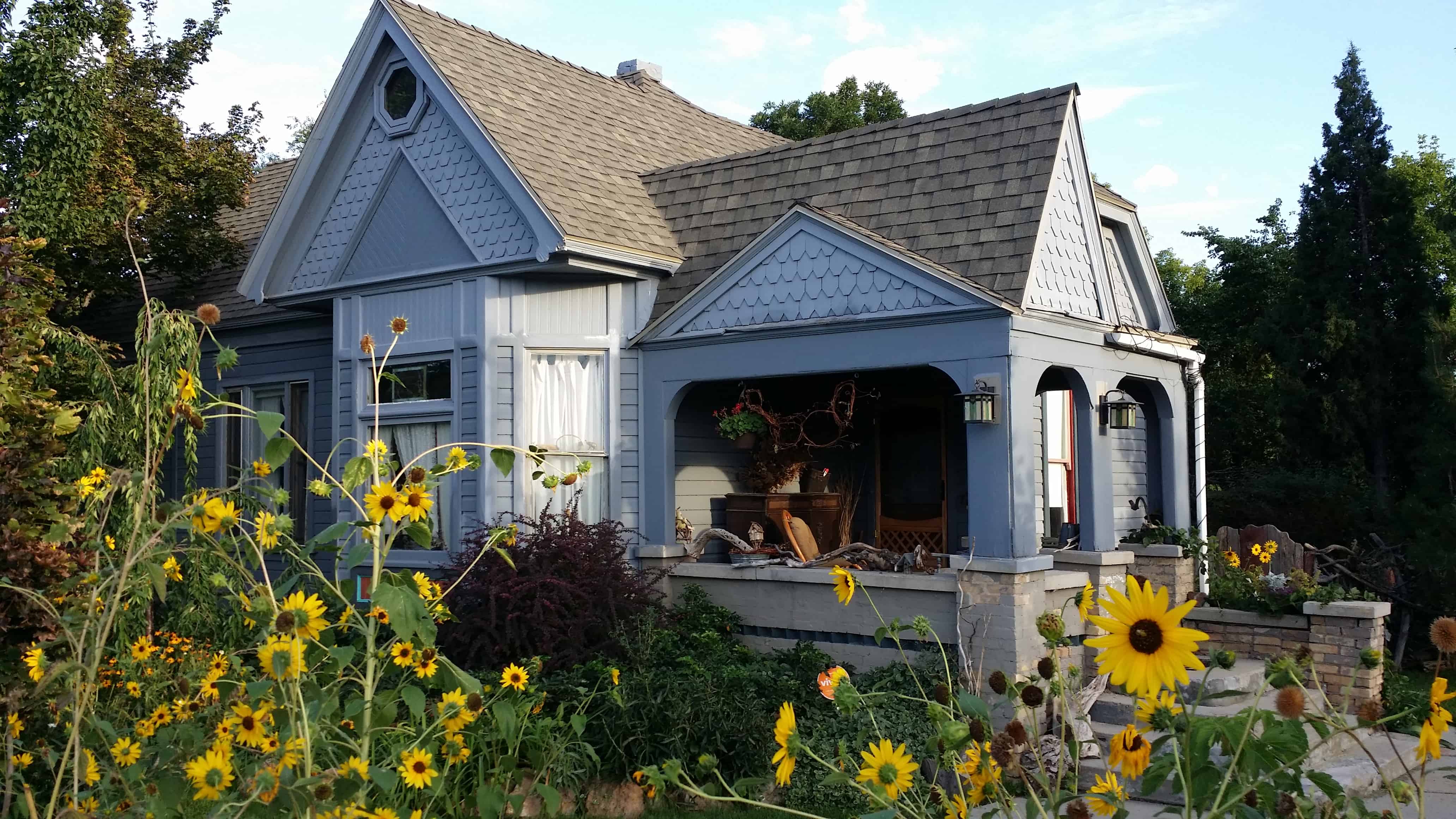
The Thomas Elof & Beda Anderberg House, built C. 1895, is significant for its association with Sandy’s historical development. This house is a single-story frame Victorian Eclectic crosswing type with wooden drop siding.
Thomas E. Anderberg was an early leader in the Sandy community. Thomas E. Anderberg learned the painting trade and was also millwright. He supposedly labored at one time or another on every mill in the state of Utah. He also served as a trustee of the Sandy School Board and was a member of the Lutheran Church, the Ladies Aid of the Sandy Congregational Church, and the Sandy Social Club.
The above text is from the plaque on the home, the text below is from the national register nomination form. This home is located at 28 East Pioneer Avenue (429 West Pioneer Avenue before the system change) in the Historic Sandy area of Sandy, Utah and was added to the National Historic Register (#04001420) on December 30, 2004.

The Thomas and Beda Anderberg House, built c. 1895, is significant under Criterion A for its association with both the Mining, Smelting and Small Farm Era (1871-c. 1910) and the Specialized Agriculture, Small Business and Community Development (1906-1946) categories of the Historic Resources of Sandy City Multiple Property Submission. During that time period the city of Sandy changed from its nineteenth-century reliance on mining and smelting to a more diversified agricultural and small business economy. The property is associated with Thomas and Beda Anderberg, Swedish immigrants who moved to Sandy for employment in the smelters and became a strong part of the community, remaining here after the closure of the smelters and the end of the mining era. The Anderberg family has owned the house for over a hundred years and the great-great grandchildren of the Anderbergs are currently living here. The house has had alterations and additions from the historic period but retains its historic integrity and is a contributing historic resource in Sandy.
The property on which the Anderberg House sits went through a number of owners until William T. Vincent purchased a four-acre piece of the property in 1890. Based on information from the tax file, it is possible he built the existing house sometime around 1895, although through available records it is difficult to determine if this is the actual year of construction and if the Vincents even lived here. William Tyler Vincent was an early leader in the community and a member of the Church of Jesus Christ of Latter-day Saints (LDS or Mormon), owner of one of the four bars in Sandy in 19007 , and active in the local government in Sandy. He was on the initial Sandy City Council in 1893 and in 1896 was the mayor pro tern. He was born in England in 1854 and married Amorillis Gammett in 1875 in Salt Lake City. She was born in 1857 in Little Sioux, Iowa. The Vincents sold this property to Thomas and Beda Anderberg in 1902.
The Anderbergs were Lutheran Swedish immigrants who were supported by the smelters, active in their
communities and long-time residents of Sandy. Thomas Elof Anderberg was born in Malmo, Sweden, in 1865 to Ernest and Truin Munson Anderberg. He immigrated to the United States as a small child with his family and settled in St. Louis, Missouri, where his father was employed as a streetcar builder. His father, Ernest Anderberg, brought his family to Utah for his job as a repairman on the first streetcar in Salt Lake City in 1877. Thomas Anderberg learned his painting trade and worked doing sign writing, carriage painting and general house painting. He was also a millwright and supposedly labored at one time or another on every mill in the state of Utah. The United States Smelting, Refining and Mining Company employed Thomas Anderberg as a painter from 1893 when he moved to Sandy until he retired in 1926. He qualified as a member of its Oldtimers Club.
Beda Caroline Soderberg was also a native of Sweden, born in 1866 to Johann and Frederika Soderberg. She migrated to the United States as a young woman. She learned her skills in tailoring in the public schools and worked in the trade when she lived in Bellevue, Idaho. Beda and Thomas were married in Bellevue, Idaho, in 1889 and moved to Sandy in 1893. They purchased this house in 1902 and lived in it for the rest of their lives.
Thomas Anderberg was active in the community as a member of the IOOF, the Pythian Lodge, the Republican Party, and the Congregational Church. He also served as a trustee of the Sandy School Board and was a member of the Sandy City Council, serving as city treasurer in 1898.9 Beda Anderberg was also active in the community as a member of the Lutheran Church, the Ladies Aid of the Sandy Congregational Church, and the Sandy Social Club. Beda died in 1942 and Thomas in 1957. Their son, Donald P., one of their seven children, and his wife, Edith, took title to the property in 1976. Donald and Edith Anderberg moved into the house to the west as newlyweds in 1939. Edith Anderberg currently owns the property and still lives in the house to the west.
There were no mortgages on the property and presumably the Anderbergs added to the initial structure, as space was needed and they had extra funds available. They had two children when they moved to the house and five more children while living there.
Pingback: Historic Sandy | JacobBarlow.com