
Tags
Box Elder County, Brigham City, Historic Buildings, Historic Churches, Historic Markers, SUP, Tabernacles, utah
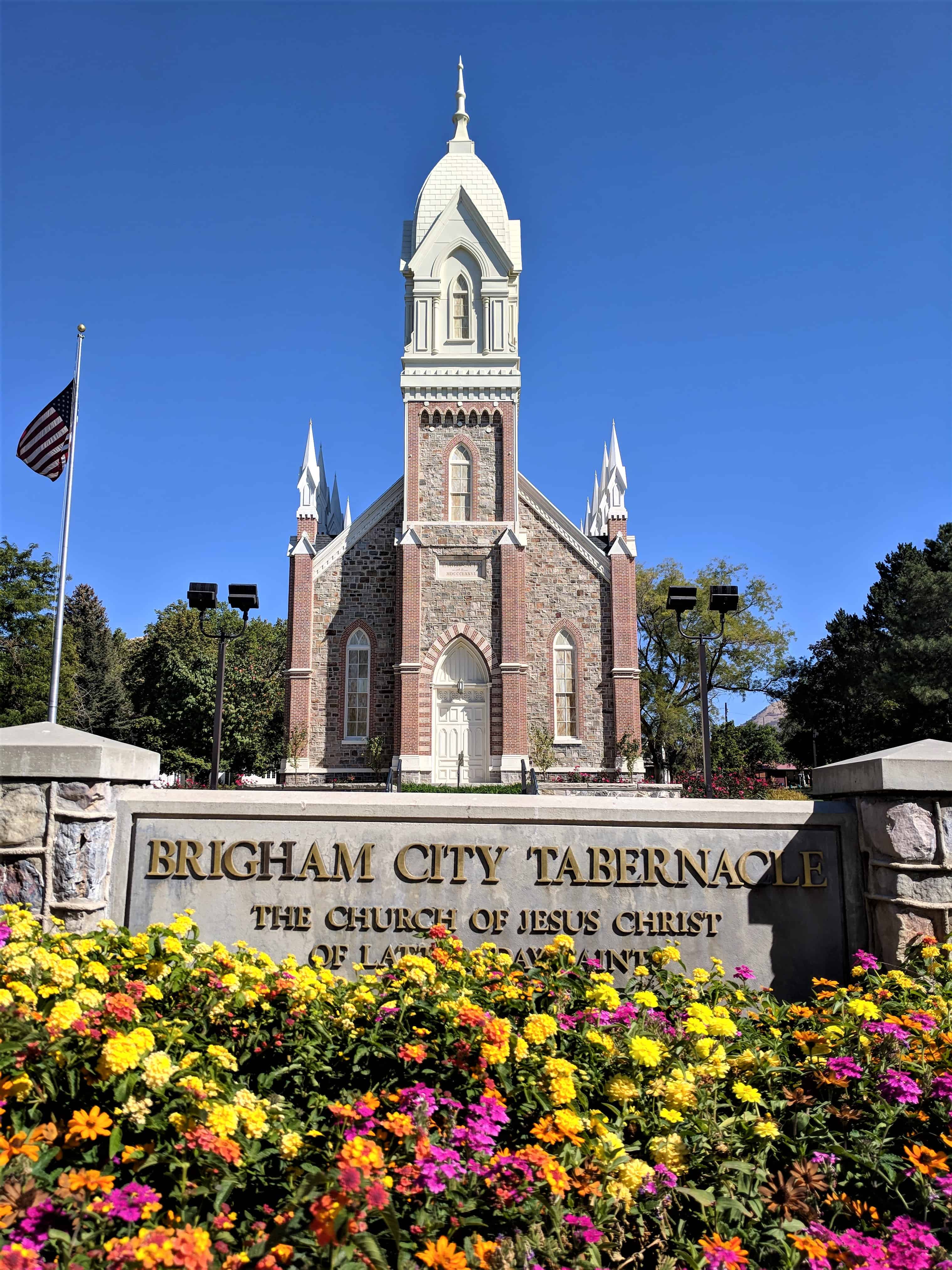
Brigham City Tabernacle
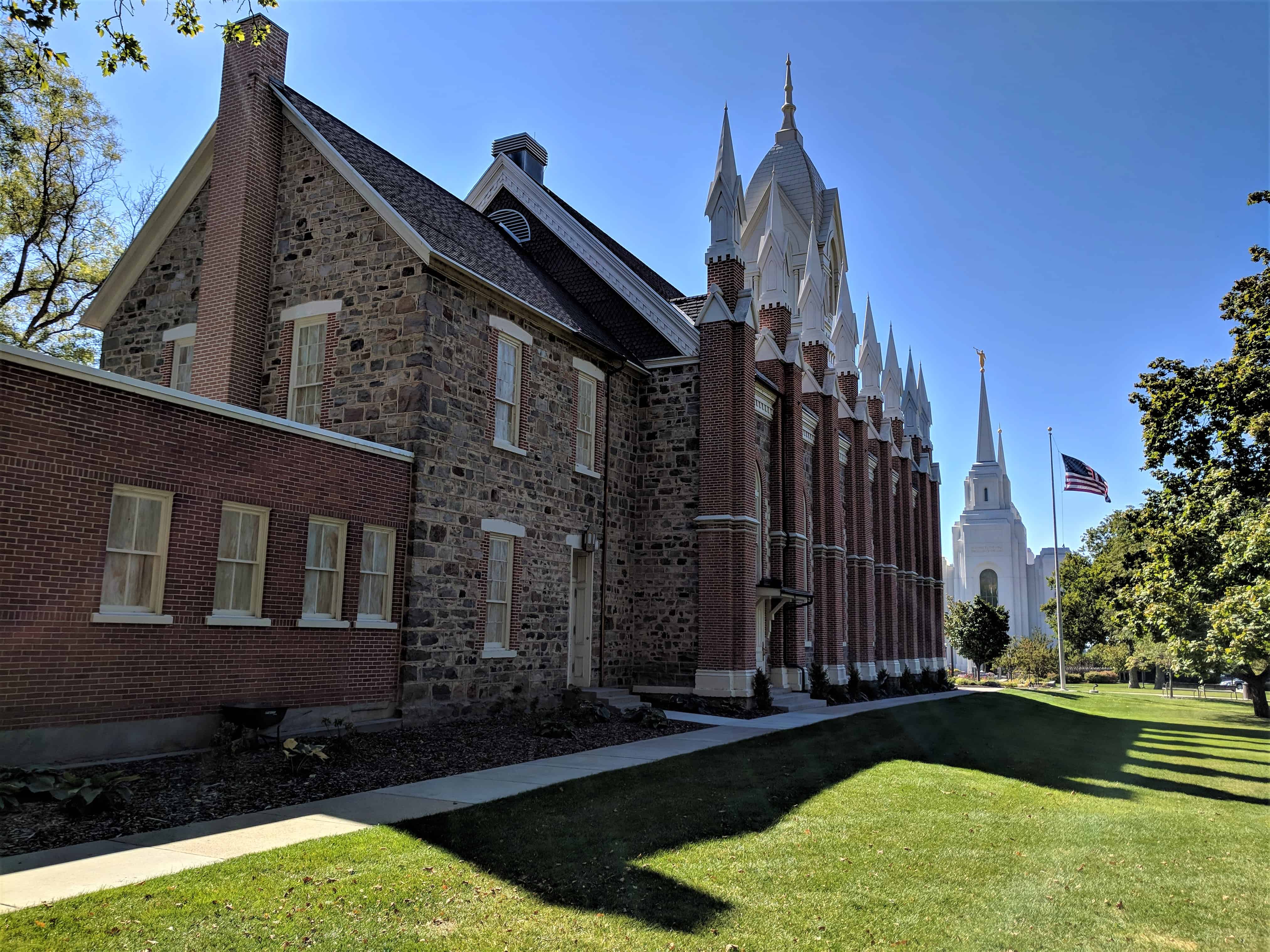
This stately building is one of the finest examples of nineteenth century Latter-day Saint architecture. For more than a century, it has served as a center of Christian worship, cultural enrichment, and community activities. Towering above the trees, it has become one of the principal landmarks of the region.
Members of the Church of Jesus Christ of Latter-day Saints settled this area in 1851, just four years after the arrival of the first pioneers in Salt Lake City. Under the leadership of Elder Lorenzo Snow of the Council of the Twelve Apostles, they built this town at the mouth of Box Elder Canyon, near traditional Shoshone Indian campgrounds and renamed it for the Church president Brigham Young. For many years they worshiped in a log meetinghouse and in the local courthouse, but in 1865 Brigham Young directed Elder Snow and other community leaders to build a tabernacle for conferences of the Box Elder Stake. The local leaders had already selected a site on the corner of Main and Forest Streets in the center of town when President Young visited the community. However, according to tradition, he led them here to “Sagebrush Hill,” the highest point on Main Street and said, “This is the spot for your Tabernacle.” The selection of this site insured that the building would be visible for many miles across the valley. President Young and his territorial surveyor Jesse W. Fox laid the cornerstones on 9 May 1865.
Construction proceeded slowly as local manpower was diverted to completing the transcontinental railroad. Work on the building resumed in earnest in 1876, mostly with donated labor. Local craftsmen used quartzite, sandstone and lumber from the nearby mountains. Women donated produce from their gardens and eggs laid on Sundays to sell for the needed cash for glass and other materials that could not be produced locally. Fourteen years after Brigham Young laid the cornerstone, the first meeting in the partially completed building took place on 27 May 1879.
As originally built, the Tabernacle was sturdy but plain in appearance. However, in 1889, a conference of the Box Elder Stake voted to “complete” the building. In the following months, a tower, a gallery, a rear vestibule, brick buttresses with decorative caps, and other improvements added to beautify the structure. Church President Wilford Woodruff dedicated the finished building 28 October 1890.
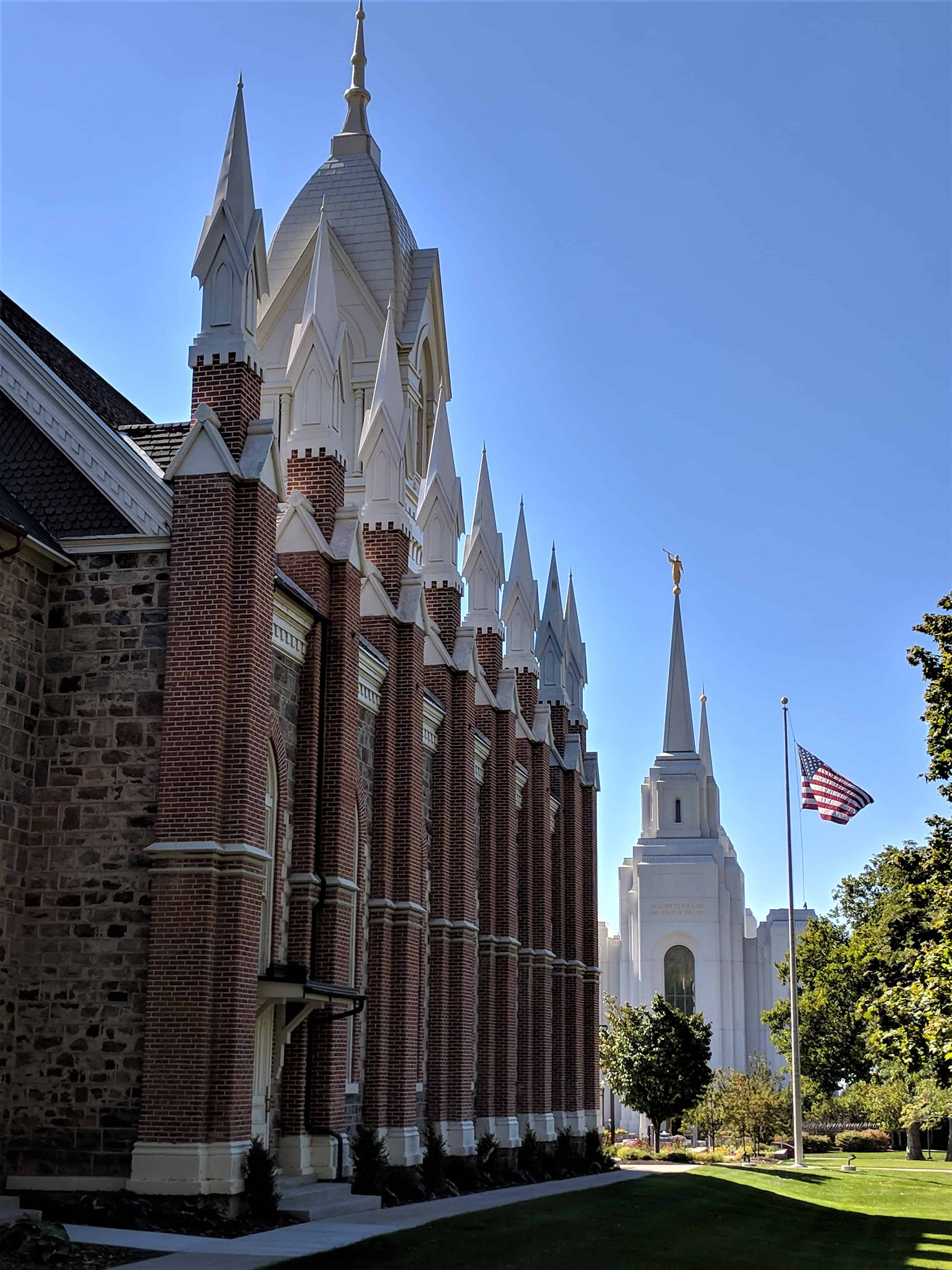
On Sunday 9 February 1896, as people began to assemble for afternoon services, a fire started in the furnace room. No one was injured but despite frantic efforts, only smoke-blackened stone walls remained an hour later. Stake President Rodger Clawson supervised reconstruction over the next thirteen months. The new Tabernacle was even finer than the old, with elegant woodwork, a distinctive gothic/revival tower and sixteen graceful pinnacles. On 21 March 1897, George Q. Cannon, First Counselor to President Woodruff, dedicated the rebuilt structure.
Throughout the following years, the people of Brigham City and neighboring towns have preserved and maintained this beloved building. In 1971, it was listed on the National Register of Historic Places, one of the first buildings in Utah to be so honored. Beginning in 1985, an extensive restoration project replaced the mechanical and electrical systems, reinforced the structure, and carefully renewed both the exterior and interior to guarantee the continued preservation of this magnificent landmark. The 106-old Tabernacle was rededicated on 12 April 1987 by Elder Boyd K. Packer of the Council of the Twelve Apostles, a native of Brigham City.

Located at 251 South Main Street in Brigham City, Utah and is #6 in the Brigham City Historic Tour and #21 of the S.U.P. historic markers. It was added to the National Register of Historic Places (#71000840) on May 14, 1971.

Box Elder Tabernacle- Built 1867-1890 Pioneer settlers used stone and wood from nearby mountains and their finest craftsmanship to built this place of worship. It was finished and dedicated in 1890. Six years later in 1896, it was gutted by fire and had to be rebuilt. The building was finished and rededicated in 1897.






The following is from the National Historic Register’s nomination form:
During the summer of 1865, Brigham Young visited the community. When he observed men beginning an excavation, he asked its purpose. When told it was to be the site of their new tabernacle, he objected. Taking Jesse W. Fox, church surveyor with him, he located a spot on Sagebrush Hill, the back bone of the community. Actually, the site was on the crest of the alluvial fan so characteristic of many of the Mormon communities along the Wasatch front. From that spot the water ran north, south and west.
During the next 11 years rocks were hauled to the site. Construction was begun with some serious intent in 1876. By 1881, the building was sufficiently completed to hold conference in it. However, the buiIding was not finished until 1890. It was dedicated by President Wilford Woodruff October 27th of that year. The building had taken twenty-five years to build, in part because the small community was also building numerous other structures tannery, gristmills, broom factory, etc. under the cooperative arrangement of the United Order or communal economic system.
The lovely structure served well, except for the furnace. One Sunday afternoon, February 9, 1896, it burned down, leaving only the four sturdy walls standing. Stake President Charles Kelley asked architects to investigate the walls. They were declared sound. On March 27, 1896, the people voted to rebuild it. Monies were solicited from as far away as Salt Lake City. Reconstruction began immediately and by March 21, 1897, a lovely new structure was ready for dedication by Apostle George Q. Cannon.
Brigham City holds its tabernacle in high regard. It sits proudly on the crest of the hill, probably one of Utah’s most photographed buildings. Its architectural style and history mark it as one of the State’s most significant structures.
Brigham City’s first Stake President was Lorenzo Snow 1853-1877. He was succeeded by Oliver B. Snow, who served until 1888 when Rudger Clawson became president. His successor, who rebuilt the Tabernacle, was Charles Kelley. The building is still used for L.D.S. Church functions and is open to the public on a restricted basis.
The original Box Elder Stake Tabernacle was built of field stone collected nearby. The architect was probably Truman O. Angel, Jr. or his father, one of the more famous L.D.S. Church architects. The Tabernacle was 50 feet by 95 feet with a tower rising above each of the four corners. The interior when finally completed in 1890, had a gallery on the north and south walls, with the elevated speaker’s stand on the east end. Most of the lumber was hauled from nearly mountains, sawed and delivered to the site. The seating capacity was 1200.
After the building burned in 1896, it was rebuilt even more elaborately. The restoration architect is not identified. Sixteen brick buttresses were added to the exterior with steeples topping each one, A major tower was built on the front. The style has been described as neo-Sothic. Inside the building a vestibule was added, and the seating capacity increased by 400. A very simple hand-carved design goes all around the new balcony to focus the eyes on the pulpit which, with the choir seats, is now on the west end of the building.
The building has an excellent organ and modern lighting and heat. It is maintained by the Box Elder Stake L.D.S. Church.
Pingback: Brigham City, Utah | JacobBarlow.com