
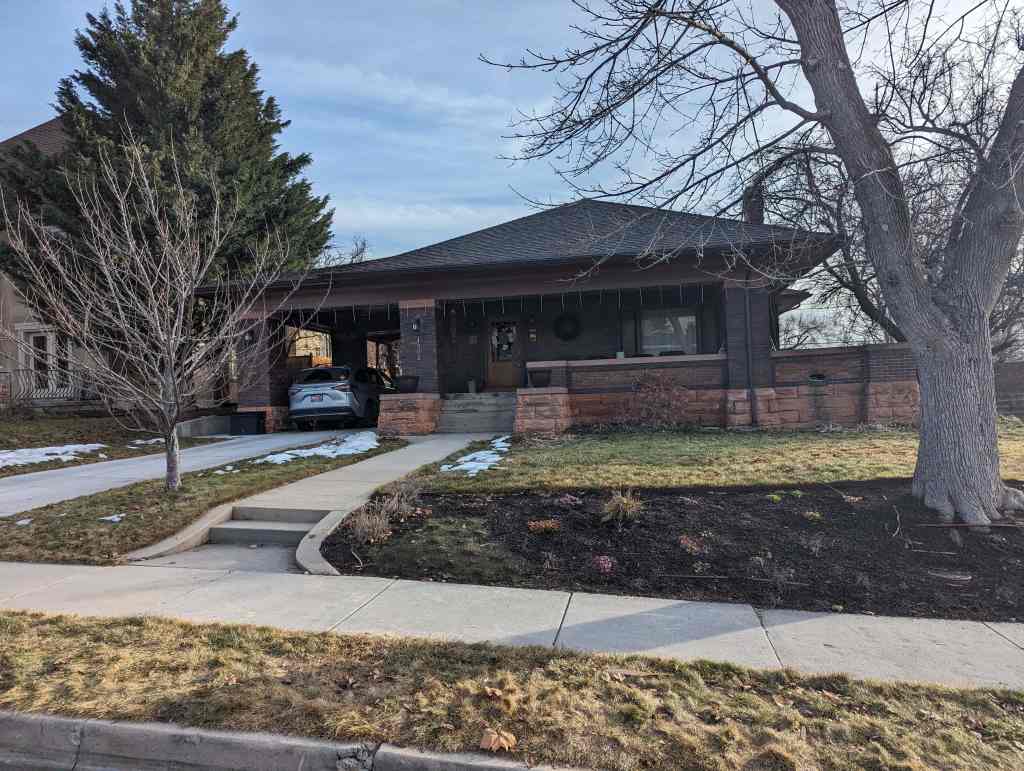
George Albert Smith House
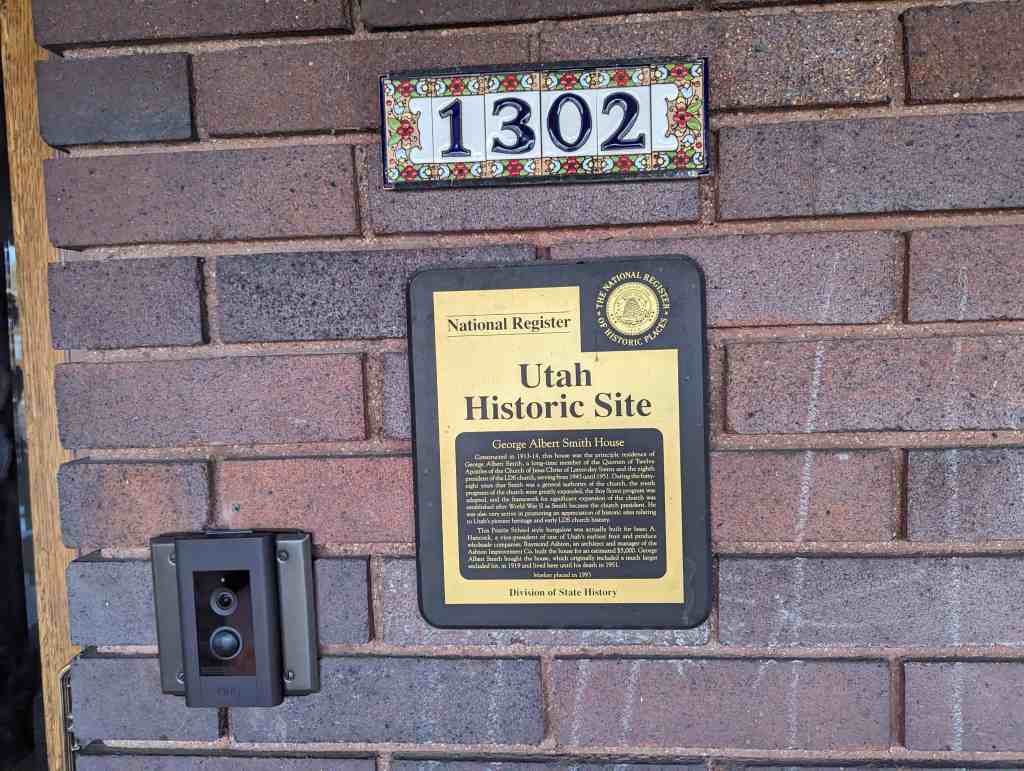
Constructed in 1913-14, this house was the principle residence of George Albert Smith, a long-time member of the Quorum of Twelve Apostles of the Church of Jesus Christ of Latter-day Saints and the eighth president of the LDS church, serving from 1945 until 1951. During the forty-eight years that Smith was a general authority of the church, the youth programs of the church were greatly expanded, the Boy Scout program was adopted, and the framework for significant expansion of the church was established after World War II as Smith became the church president. He was also very active in promoting an appreciation of historic sites relating to Utah’s pioneer heritage and early LDS church history.
This Prairie School style bungalow was actually built for Isaac A. Hancock, a vice-president of one of Utah’s earliest fruit and produce wholesale companies. Raymond Ashton, an architect and manager of the Ashton Improvement Co. built the house for an estimated $5,000, George Albert Smith bought the house, which originally included a much larger secluded lot, in 1919 and lived here until his death in 1951.
Located at 1302 East Yale Avenue in the Yalecrest Neighborhood and the Yalecrest Historic District in Salt Lake City, Utah and added to the National Register of Historic Places (#93000066) on March 12, 1993. The text above is from the plaque on the home, the text below is from the nomination form for the National Register.
Related:
- George Albert Smith Fieldhouse (named after him)
- George Albert Smith Gravesite
Constructed in 1913-14, this house is significant for its association with George Albert Smith, long-time apostle of the Church of Jesus Christ of Latter-day Saints (LDS or Mormon church) and president of the church from 1945 until 1951. Smith bought the house in 1919 and remained here until his death in 1951. Though he lived in other residences prior to this one, this was his principal residence and the one most closely associated with his career as an important religious leader. As eighth president of the LDS church, George Albert Smith ranks as an exceptionally significant figure, thereby overriding the requirement that properties achieve their significance at least fifty years ago.
The George Albert Smith House was actually constructed for Isaac A. Hancock, vice-president of Hancock Brothers Fruit Company, which was one of the earliest wholesale fruit and produce companies in Utah. Hancock obtained a building permit for the house on November 26, 1913. The estimated cost of construction was $5,000, and the builder was listed as Raymond Ashton. Mr. Hancock lived in the house until 1919, when he sold it to George Albert and Lucy Emily Smith and moved up the street to 1340 Yale Avenue. Raymond Ashton was the manager of Ashton Improvement Company and was also an architect, suggesting that he may have been involved in the design of the house. Raymond Ashton was also associated with Edward M. Ashton (his brother) and Edward M. Jenkins, developers of Yale Park subdivision and other east side, Salt Lake residential areas.
At the time the Smiths purchased this house, George Albert was vice-president of Utah Savings and Trust Company and a member of the Quorum of the Twelve Apostles in the Church of Jesus Christ of Latter-day Saints. The Quorum of the Twelve is the governing body of the church directly under the president and his councilors. Members of the Quorum and other top church officials, known as general authorities, held positions with church-owned companies as a means of financial support; their primary occupation, however, was church work. George Albert Smith had been appointed to serve as an apostle in 1903 at the relatively young age of 33. Both his father and grandfather had also served as apostles. His occupation prior to his call to the apostleship was as receiver for the Land Office of Utah, having been appointed by U.S. President William McKinley in 1897 and reappointed by Theodore Roosevelt in 1902. Smith served as an apostle in the LDS church until his selection as eighth president of the church on May 21, 1945, after the death of president Heber J. Grant. He was 75 years old at the time. He remained president of the church until his death on April 4, 1951.
George Albert Smith’s career as an apostle and president of the LDS church spanned 48 years and was marked by several significant achievements. He was particularly active in programs for the youth of the church. He was a member of the general board of the church’s Young Men’s Mutual Improvement Association (YMMIA) from 1904 until 1921, then served as general superintendent of that organization from 1921 to 1935. In that role he was influential in setting policies, establishing programs, and directing youth activities throughout the church. Smith was impressed with the Boy Scout program and recommended its incorporation into the YMMIA program after it was introduced in the United States in 1910. The church adopted the program with such enthusiasm that Utah and the church emerged as world leaders in the percentage of boys enrolled in scouting programs. Smith directed the scouting program in the church and in 1931 was appointed to the advisory board of the National Council of Boy Scouts of America. In 1932 he was awarded the Silver Beaver, and in 1934 the Silver Buffalo, two of scouting 1 s highest awards.
Smith was also very active in promoting awareness and appreciation for historic sites related to church and Utah pioneer history. He was instrumental in acquiring property and erecting a monument in upstate New York in recognition of church founder Joseph Smith and in 1937 organized the Utah Pioneer Trails and Landmarks Association. That organization erected hundreds of historic monuments are markers along the Mormon Trail (from Nauvoo, Illinois, to Utah) and throughout the west, including the “This Is The Place” monument at the mouth of Emigration Canyon east of Salt Lake City, which was erected in 1947 on the 100-year anniversary of the arrival of the Mormon pioneers to the Salt Lake Valley.
During George Albert Smith’s tenure as church president the church began expanding its presence in the United States and throughout the world. His appointment as president in 1945 coincided with the end of World War II, which afforded new opportunities for church expansion. The church’s missionary program was revitalized as the number of missionaries rose to over 5,000, an unprecedented high. There was a marked increase in the number of wards (congregations) and stakes (groups of congregations) organized, some 200 new meetinghouses were built, new hospitals were constructed and old ones enlarged, and a new temple was completed in Idaho Falls, Idaho. Growth of the church in subsequent decades would be even more dramatic, but the pattern for much of that later growth was established in the years after World War II while George Albert Smith was president.
When the Smiths purchased the home from Isaac Hancock in 1919, they were attracted by its location and large lot. The house is situated on the east bench of Salt Lake City, a new and desirable residential neighborhood at the time. They had been living downtown near Temple Square (21 N. West Temple, now demolished), a neighborhood that was rapidly losing its residential character. An especially attractive feature of the new house and lot was Red Butte Creek, which ran through the back of the property. The creek was far below the level of the street and house, and offered a secluded natural retreat for the family. The large size of the property–large enough for three additional houses added to the sense of seclusion that the Smiths enjoyed. They envisioned a family compound, with all three of their children constructing houses on the property. This dream was only partially realized. The two married daughters built homes nearby, one to the south across the creek and the other to the east, but their son Albert chose to remain in the East after completing his schooling at Harvard. The lot earmarked for his home, directly east of the parents’, was instead used as a garden area for outdoor entertaining. One notable event celebrated in the Smith’s yard was a dinner party for 400 guests, including the governors of forty-six states, their wives, and other dignitaries on July 15, 1947. This was one of the key events in the pioneer centennial celebration that culminated on July 24, 1947.
After George Albert Smith’s death in 1951, the house was held in trust by his family until 1953, when it was sold to Warwick Lamoreaux, an attorney. During Lamoreaux’s ownership, a number of minor changes were made to the house and a duplex was built next door in the garden area. Two other houses were also built on the property down near the creek; these are now separate properties. The current owners of the Smith House, Dennis M. Greenlee and Diana G. Pounder, purchased it in 1989 and have returned much of the house to its original condition.
Description:
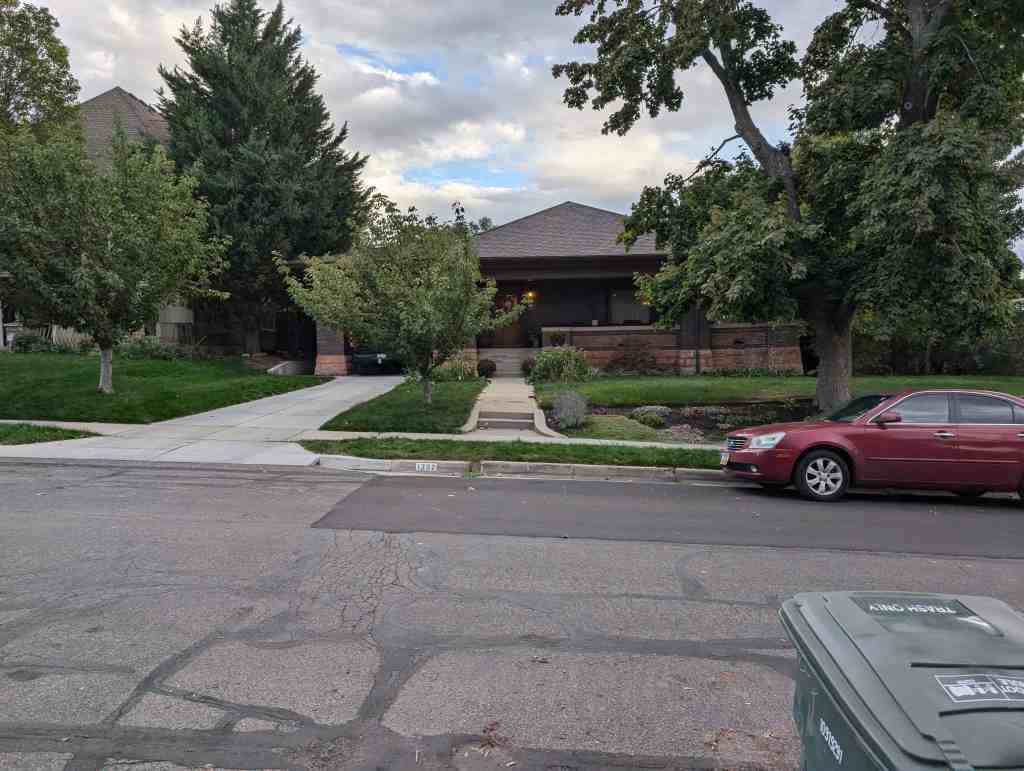
The George Albert Smith House, built in 1913, is a one-story brick bungalow with a hip roof, sandstone foundation, and Prairie School stylistic influences. No major alterations have been made to the house, though a few minor changes have been made on both the exterior and interior. Overall, however, it retains a high degree of its original integrity.
The house is slightly elevated above and east of 1300 East Street and is on the corner lot on the south side of Yale Avenue. The house is approximately 41 feet wide (plus the 13 foot wide porte-cochere) and 70 feet long with the more narrow front end facing Yale Avenue. The original property included both the lot directly east of the house as well as the lot directly south of the house adjoining Red Butte Creek. The side lot was used as a rose garden and the back lot was a terraced wooded area down to the creek. The east lot now has a brick duplex on it, and the south lot has two more contemporary residences overlooking the creek. These are no longer part of the Smith House property and are not included in the nomination.
Typical of Prairie School bungalows, the house has a low, horizontal emphasis. This horizontality is created by the low-pitched hip roof with wide eaves, the fullwidth, wrap-around front porch with a brick railing wall, and the porch cochere which extends the overall width of the house to the east. The house appears very heavy and large (a total of over 4000 square feet on the main floor and basement combined). It rests on a large rusticated sandstone foundation, and the exterior walls are a very dark reddish-brown fired brick, still in very good condition. The use of these natural materials and earthen colors are typical of the Prairie style home. These brick walls support a low hip roof which overhangs the walls by nearly two feet, again typical of the Prairie style homes. On the east side of the house is a porte-cochere with steps leading to the porch and front entrance. The porch extends across the entire front of the house and about a third of the way down the west side. The porte-cochere and porch are supported by heavy brick columns.
On either side of the front door and on the columns by the stairs are light fixtures with a hand-crafted appearance, similar to those found in Greene and Greene’s Gamble House in Pasadena, CA. The fixtures flanking the door have simple red and green stained glass flower figures in them, whereas those mounted on the columns of the porte-cochere have no stained glass work. The front door and the side door to the dining room (from the porch) are heavy oak doors with Arts and Crafts type brass hardware and beveled glass inserts on the top half.
There are a variety of window types used in the house. Many of the original windows are casement type, the most interesting of which are the stained glass windows on either end of the living room mantel and in the front bath (formerly a part of the entry hall). These stained glass windows have a more curvilinear and organic design than is typical of the Prairie School style, which tend to be geometric patterns, and are highlighted with green and gold colors. The bookcases flanking the fireplace are also encased with leaded glass doors which have a more elaborate geometric pattern. There are two large picture windows, one each in the living room and dining room. The east side bedrooms and the kitchen contain standard single hung windows, whereas the back of the house contain large casement type windows with small panes in them. Some are hinged on the top, swing into the room and hooking on the ceiling for a “porch-like” effect. (The exterior storm windows were added in recent years.) A shed-roofed carport extension has been added on the rear of the porte-cochere (probably post-1960s), but it is barely visible from the front of the house.
The large living and dining areas are open to each other with only a third-height wall separating the two spaces midway down on the west side of the room (see floor plan). Markings on the original quarter-sawn oak floors and salvaged red gum woodwork found in the attic suggest that the two rooms were formerly separated by built-in bookcases enclosed with leaded glass doors on either side of the living/dining dividing wall. George Albert Smith’s granddaughter, Margaret Hatch, reports that the living and dining areas were also separated by full-length folding glass doors that stretched between the built-in bookcases.
The dining area also originally had a built-in buffet cabinet on its south wall with a pass-through to the kitchen. Other gumwood detail including a large plate rail about two-thirds up the wall height were removed during Mr. Lamoreaux’s occupancy (post-1953). These former and present wood accents would have been typical of a Prairie bungalow home. Much of the original woodwork has been painted, but the entry hall “divider,” the fireplace mantel, stained glass windows, bookcase leaded glass doors, and the doors in the living/dining area are refinished red gum wood. The entry/living/dining floors are quarter-sawn oak. Other floors in the house are currently carpeted, but have cedar floors beneath them. The entry hall and dining room also have matching copper-colored chandeliers with a hand-crafted geometric appearance.
The kitchen is immediately south of the dining area and is appointed with almost all of the original cabinet work, including the original built-in ironing board and potato bin. Only slight alterations have been done to accommodate more modern appliances. The flow or movement between the kitchen and dining room was probably made easier by use of the original pass-through to the built-in dining room cabinet, though the pass-through is closed off now.
There is a clear distinction in the floor plan between public and private space. The living, dining, and kitchen areas are on the west side of the house nearer 1300 East Street, whereas the bedrooms and baths are on the more private east side of the house. The bedrooms are a comfortable size and have unusual built-in closets/cupboards with glass front doors, all of which are original to the house. The hallway also has similar built-in cupboards. The walls of the bedrooms as well as all other rooms are the original plaster, all of which is in very good condition. The main bath is appointed with most of its original fixtures, including a claw foot tub, built-in vanity cabinet, and white hexagonal ceramic floor tiles.
The home is well-built and well-preserved, with only minor changes in its design. The house is still heated with the original furnace (converted to gas) and original steam heated radiators. The only major alterations have been in the basement, where the floor plan has been altered to accommodate a basement apartment.
