
Nels G. Hall House
The Hall house is one of the best examples of the Spanish Colonial Revival style in Salt Lake City. Especially significant are the tiles of the front entry. They are probably the work of Ernest Batchelder, an important southern California artist of the Arts and Crafts period. The house was built for Nels G. Hall, a prominent businessman, and designed by the architect Slack Winburn and his sons. Hall desired a simplicity and elegance in the exterior design and a functional interior, which are reflected in the house.
The Nels G. Hall House is located at 1340 East Second Avenue in the Avenues of Salt Lake City, Utah and was added to the National Register of Historic Places (#80003923) on October 3, 1980. The text on this page is from the national register’s nomination form.
Nels G. Hall was born on December 29, 1884, in Provo, Utah, a son of Nels and Josephine Bergstrom Hall. He was educated in Provo and graduated from Brigham Young Academy’s School of Business. He married Hazel Greaves at Ephraim on September 5, 1910. They had three children; Katherine, Jeanne and Nels G. Hall.
Hall’s business career began in 1905 when he moved to Salt Lake City to accept a position with the Utah Savings and Trust Company. He then became assistant to Heber M. Wells, who later became the first governor of Utah, in 1914 Hall helped create the Columbia Trust Company and became vice president. In 1920 he left to become secretary-treasurer of the Panama Sugar Company. He soon returned to Salt Lake City to become manager of the Utah Wholesale Grocery, and at that time lived at 275 llth East. He then assumed vice presidency of the Columbia Trust Company and entered into the mining business with several business associates, forming the South Mountain Mining Company at Jordan Valley, Oregon. It was during this period of Mr. Hall’s life that he began the plans for the house. He had visited California and resolved to build a Spanish Colonial or Mission style similar to houses he had seen, and eventually decided on the Spanish Colonial Revival plans. In 1945 Hall sold the mining company and devoted his time to personal investments and business. l He was active in the Church of Jesus Christ of Latter-day Saints in the Federal Heights Ward, and he was also active in civic affairs.
Nels G. Hall lived in the house from the day it was ready to occupy until his death at the age of 80 on December 31, 1964. His widow, Hazel, remained in the house until her death some six years later. Their only son, Nels, lived in the home a short time until his untimely death in 1971. The house remained vacant as such for five years and later occupied by Dr. Alien S. McGaughey. The Thomas Buranek family are the current residents.
Nels G. Hall hired the architect Slack Winburn and his son to design a house similar to Spanish-style houses he had seen in California. According to Hall’s daughter, he wanted simplicity and elegance in the exterior design and a functional and warm interior. The builder was J.H. Johnson.
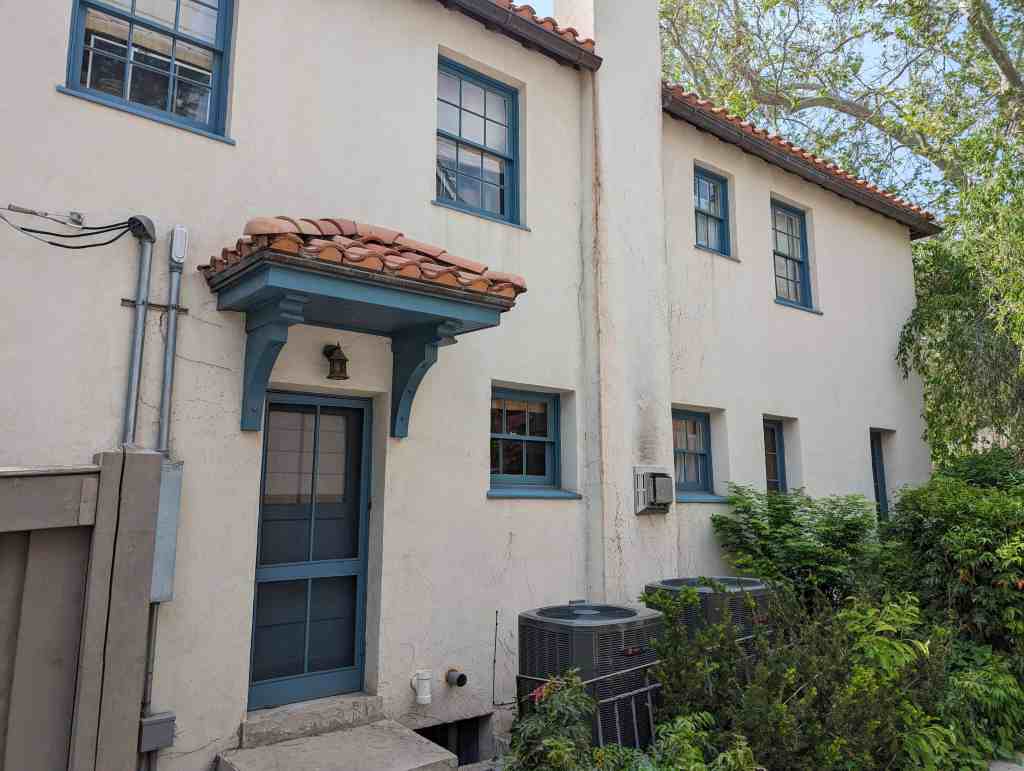
The exterior appearance of the house is in keeping with the simplicity and elegance desired by Mr. Hall. The principal building material is brick, with a stucco finish. The house has a very solid appearance, with the windows recessed from the exterior façade about six inches. One exception to the brick construction is a frame extension of the master bedroom in the rear of the house. This is also covered with stucco.
Wood was used on the exterior of the house mainly for the cornice and the openings. Doorways, window frames, balconies and support posts in the rear of the house are wooden. There is also a small wooden deck extension in the rear. Simple wooden posts support a roof over a sun porch located above the concrete garage. The garage is partially underground, and was built at the same time as the original structure.
In the Spanish Revival style chimneys were commonly placed in the interior of the house. The Hall house, however, has both its chimneys located on the exterior walls, one on; the east and one on the west façade. The physical appearances of the two chimneys are in keeping with popular designs used for this style. One chimney is used for two fireplaces, one below the other.
The wooden posts which support the rear extension of the second floor (the master bedroom) are designed in the style of the Spanish Colonial Revival. Two posts are placed very close together, as if to resemble a single post. A common feature of the Spanish Colonial Revival style is the balcony. Typical balconies are long and extend around a portion of the exterior. Two balconies are situated on the Hall house on the street façade, second floor. The first is made of wood, with panels having a cutout sun motif in the center. These panels of wood were quite common for privacy as well as for wind protection. The second balcony, around the corner from the other, is ornamented with wooden spindles.
One of the loveliest features of the house is the front door surrounded by beautiful ceramic tiles. These tiles were probably the work of Ernest Batchelder, an artist of the Arts and Crafts period who lived and worked in southern California. The tiles depict popular Spanish motifs. Extra tiles were purchased in case tiles were damaged by weather or age. These tiles were ordered, as were the roofing tiles, through the Cahoon Brick Company.
The Hall house main floor plan consists of a living room, dining room, breakfast room, study, kitchen and one-half bath. There are two fireplaces on the main floor. On the second floor, there are three bedrooms, a full bath, and the master bedroom is in the rear of the house. The lower level consists of an amusement room, a bedroom, a laundry room and a three/quarter bath.
Pingback: Historic Homes and Buildings in the SLC Avenues | JacobBarlow.com