
Tags
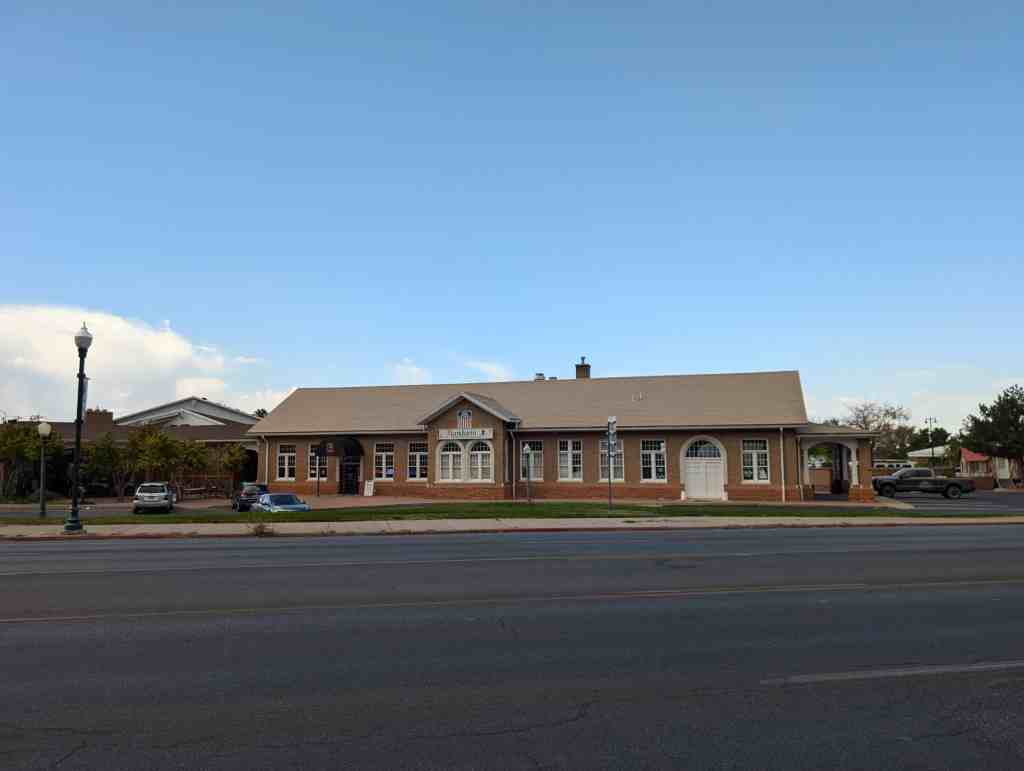
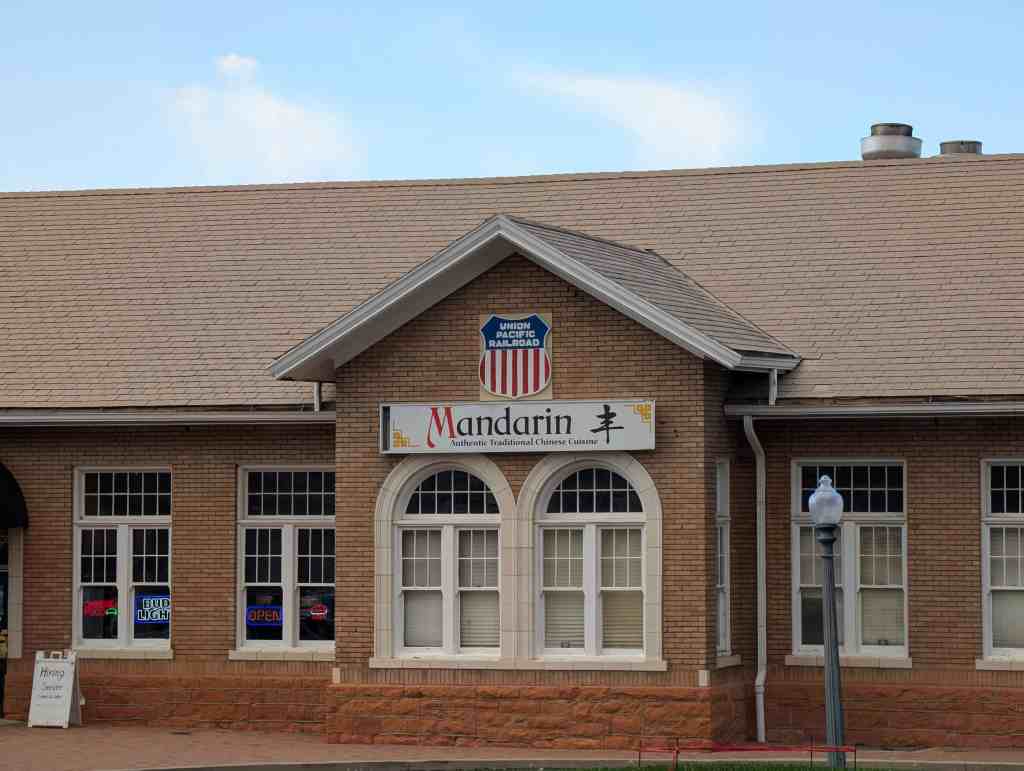
Cedar City Railroad Depot
The Cedar City Railroad Depot, built in 1923, is historically significant as the only extant building associated with Cedar City’s railroad connection which, in addition to stimulating the iron ore and livestock industries in the area, contributed greatly to the expansion of the tourism industry in southern Utah and the establishment of Cedar City as the focal point for that industry. As roads to scenic areas in southern Utah were promoted and developed, Cedar City became a strategic center for travel to the national. parks and monuments. After many years of hoping for a railroad connection to boost the iron ore industry in the area the promise of tourist traffic finally drew the railroad to Cedar City in 1923. In addition to constructing the depot, the Union Pacific Railroad became fully involved in the tourist business by purchasing hotels, busses, and building lodges. Automobile traffic gradually superseded railroad traffic and bus tours to the point that the railroad eventually closed its line to Cedar City in 1959. The Cedar City Railroad Depot is the only building that remains in Cedar City to document the important influence that tourism and the railroad had on Cedar City’s development.
Located at 241 North Main Street in Cedar City, Utah and added to the National Register of Historic Places (#84002184) on August 9, 1984.
Cedar City was founded in the fall of 1851 by members of The Church of Jesus Christ of Latter-day Saints (Mormons or L.D.S.) who were sent to establish an iron manufacturing center in the area. The group experienced many, setbacks: floods, collapse of the iron works, technical problems, and the Utah War. To add to these problems, in 1857 members of the community were involved in the Mountain Meadows Massacre. The year following this tragedy, Cedar City’s population went from 928 to 376. Those who remained turned to agriculture as a means of support. Agriculture instead of iron production became the economic base for the area. Various efforts during the 1870s and 1880s were successful in producing iron, however, as the Deseret News commented in 1874, “The successful manufacture of iron in Utah is now demonstrated beyond the shadow of a doubt and it but needs railroad connections between the works (at Iron Town [about 15 miles southwest of Cedar City]) and this city [Salt Lake City]….”‘ Despite such encouragement, it was not until 1905 that the railway reached Iron County, and even then its nearest connection to Cedar City was 30 miles northwest of the city at Lund. For nearly 20 years after the arrival of the railroad to the area wagons were used to haul freight and passengers between Lund and Cedar City.
With the growing popularity of the automobile in the early decades of the twentieth century, the demand for more and better roads developed. Concurrently, the scenic beauty of southern Utah Mukuntuweap National Monument (Zion National Park after 1919), the North Rim of the Grand Canyon, Bryce Canyon, the Kaibab Plateau, and Wayne Wonderland (the Capitol Reef area) was receiving more and more attention, and much of it was national. The assistant director of the National Park Service, Horace Albright, visited the Zion area and realized that it was of national park caliber. When Albright reported his visit to Director Mather, Mather did not reply immediately and “later wrote that he thought Albright must have fallen into the hands of some chamber of commerce directors or had been given some very potent drink, for he had never heard of such country and found it difficult to believe it existed.” Three years later when Zion was made into a national park, Mather visited the area and became an enthusiastic promoter himself. As the reports, pictures, and travel shows spread the word about southern Utah’s scenic beauty, public demand for roads to these areas increased. As roads were developed to the parks and monuments it became obvious that Cedar City, because of its central location, was the strategic center for tourists wishing to see southern Utah’s scenic beauty.
As early as August of 1916 representatives of the Union Pacific and the Oregon Short Line railroads, along with representatives from other travel agencies, made an expedition through the area by bus to scout “the possibilities for railroad traffic in the region.” On March 5, 1920, it was announced that a spur line from Lund to Cedar City would be built. In 1921 the President of the Union Pacific Railroad Company, Carl R. Gray, visited the area to investigate the potential of southern Utah to support a railway line. Gray was impressed with the stability of the communities he visited and the quality of the people he met, “and the next year a spur of the railroad was run from Lund to Cedar City, justified on the anticipated traffic from livestock, agriculture, iron ore, and tourist travel.”
The promise of tourist traffic was obviously Cedar City’s biggest drawing card for the railroad because the Union Pacific soon formed the Utah Parks Company and became heavily involved in the tourist trade. The Union Pacific bought the El Escalante Hotel (which was built 1918-23 by a group of Cedar City citizens who saw the need for larger and more commodious hotel accommodations than Cedar City then offered), set up a large bus station at Cedar City, and in 1927 purchased the Wylie Tourist Camp interests in Zion Canyon and the Parry Transportation Route from Cedar City to Zion. The Parry Brothers had previously provided transportation for park visitors and had set up a 10-day trip from Cedar City to Zion, Kaibab, North Rim, Bryce, Panguitch, and back to Cedar City.
Cedar City’s enthusiasm for the anticipated spur line was great. Citizens set up a committee responsible for raising and purchasing the property and homes over which the railroad would pass. “The City Council voted $5,000 to assist in purchasing this property; but so successful was the committee that, after all the bills were paid (a total of $115,000 was expended), the $5,000 was still intact with $2,500 to add to it. The $7,500 nest egg was put in trust and subsequently used to purchase land for a federal building.” Thirty-eight families donated property and/or money to purchase the railroad right of way and the depot site.
In less than three months and at a cost of $1,049,000 the railroad tracks were brought to Cedar City. The depot building was built by the Union Pacific during 1923. Plans for the building were prepared by the Union Pacific System’s Office of Chief Engineer, Los Angeles and Salt Lake Railroad Company. W.T. Wellman, architect was in charge of the project. George A. Wood of Cedar City was the general contractor. The portico area extending to the south was constructed in 1929 to serve as a passenger waiting area and bus shelter.
The first train over the track was a trial run made on Sunday, June 10, 1923. The event was a cause for celebration, although the laying of the tracks was not yet completed and the train could only reach within 4 miles of the town. In a symbolic act, David Bulloch, who was the first boy to ride a wagon into Cedar City in 1851, rode the cow catcher of the test run engine and photographs were taken. The first official train that crossed the tracks and stopped at the depot was on June 27, 1923. The passengers on this first train included President and Mrs. Warren G. Harding and the presidential party. After a warm greeting at the depot by southern Utah citizens, the entourage loaded into 24 automobiles and traveled south to Zion Park. Upon their return to Cedar City to board the train for their departure, President Harding was honored at a special program.
The depot was officially opened on September 12, 1923, with the ceremonial laying of a golden rail, named the Warren G, Harding Memorial Rail. President Harding had died in Alaska shortly after his visit to southern Utah, and a memorial service was held at the railway opening ceremonies for the president on the spot where his train had stood just weeks before. Among the dignitaries in attendance at the combined ceremonies were Senator Reed Smoot, Utah Governor Mabey, L.D.S. church President Heber J. Grant, Union Pacific Vice-President H.M. Adams, the mayor of Salt Lake City, and the president of the Los Angeles Chamber of Commerce. Speakers at the services talked of the great center Cedar City would become and one speaker even suggested that because of the area’s vast ore deposits and other natural resources Cedar City would soon rival Pittsburgh.
Tourist travel dramatically increased after the railroad was built; visitors to Zion National Park increased from 3,692 in 1920 to 55,297 in 1930. The number of visitors to the national parks and monuments in the area has continued to increase, but as roads were developed private automobiles handled most of the traffic. Rail passenger service into Cedar City was discontinued in 1959 and in the mid 1970s the Utah Parks Company sold out to TWA (Trans World Airways).
In addition to the increased tourism, Cedar City benefitted in other ways from the railroad connection. Iron ore production increased dramatically from annual production of 15,000-45,000 tons to 164,154 tons mined the year after the railroad came. During World War II, Iron County ore production rose to 1 million tons and increased to nearly 2 million tons during the last year of the war. Ore was shipped by rail from Iron County mines to the Ironton plant in Springville, Utah, the Geneva plant in Provo, Utah, the Minnequa plant in Pueblo, Colorado, and the Kaiser plant in Montana.
Growth of Iron County’s livestock industry was also encouraged by the railroad. The railroad was important in transporting wool and lambs from Iron County’s important sheep industry. Iron County purebred Rambouilett sheep became famous in the late 1920s, and buyers from the Russian government came to the area to purchase sheep to improve their native breeds.
However, the most immediate effect of the railroad on Iron County’s economy was seen in the increase of visitors in the area. The Cedar City Railroad Depot is the only building that remains in Cedar City to document early tourism in the area before the nation’s highway system was fully developed. The El Escalante Hotel, Bus Driver’s Dorm, and railroad warehouses have all been torn down.