The Blackfoot US. Land Office was located here during the land rush of 1902. All staked claims for land in the Upper Snake River Valley were filed in this office.
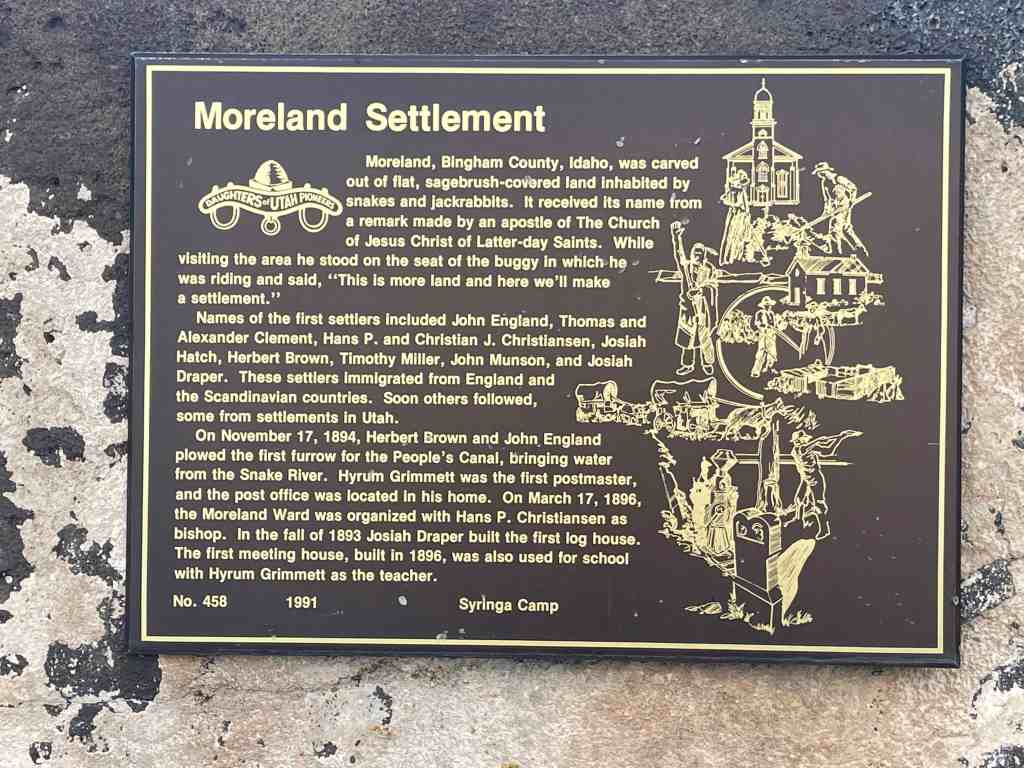
Moreland, Bingham County, Idaho, was carved out of flat, sagebrush-covered land inhabited by snakes and jackrabbits. It received its name from a remark made by an apostle of the Church of Jesus Christ of Latter-day Saints While visiting the area he stood on the seat of a buggy which he was riding and said, “This is more land and here and we’ll make a settlement.”
Names of the first settlers included John England, Thomas and Alexander Clement, Hans P. and Christian J. Christiansen, Josiah Hatch, Herbert Brown, Timothy Miller, John Munson, and Josiah Draper. These settlers immigrated from England and the Scandinavian countries. Soon others followed, some from settlements in Utah.
On November 17, 1894, Herbert Brown and John England plowed the first furor for the People’s Canal, bringing water from the Snake River. Hyrum Grimmett was the first postmaster, and the post office was located in his home. On March 17, 1896, the Moreland Ward was organized with Hans P. Christiansen as bishop. In the fall of 1893 Josiah Draper built the first log house. The first meeting house, built in 1896, was also used for school with Hyrum Gimmett as the teacher.
This is Daughters of Utah Pioneers historic marker #291 located at 880 South 5th Avenue in Pocatello, Idaho. The marker was dedicated in 1963.
A log structure was erected one half mile north of this site in 1864, which served as a stage station. The Ben Holliday stages use it as a stopping place as did the freighters who passed this way. Mail was unofficially handled here for more than a decade. On October 10, 1878 it became a United States Post Office with Theodore T. Danielson as Postmaster. It was given the name of Central Ferry and later changed to Blackfoot.
This is Daughters of Utah Pioneers historic marker #188 located at 880 West Bridge Street in Blackfoot, Idaho. The marker was dedicated in 1963.