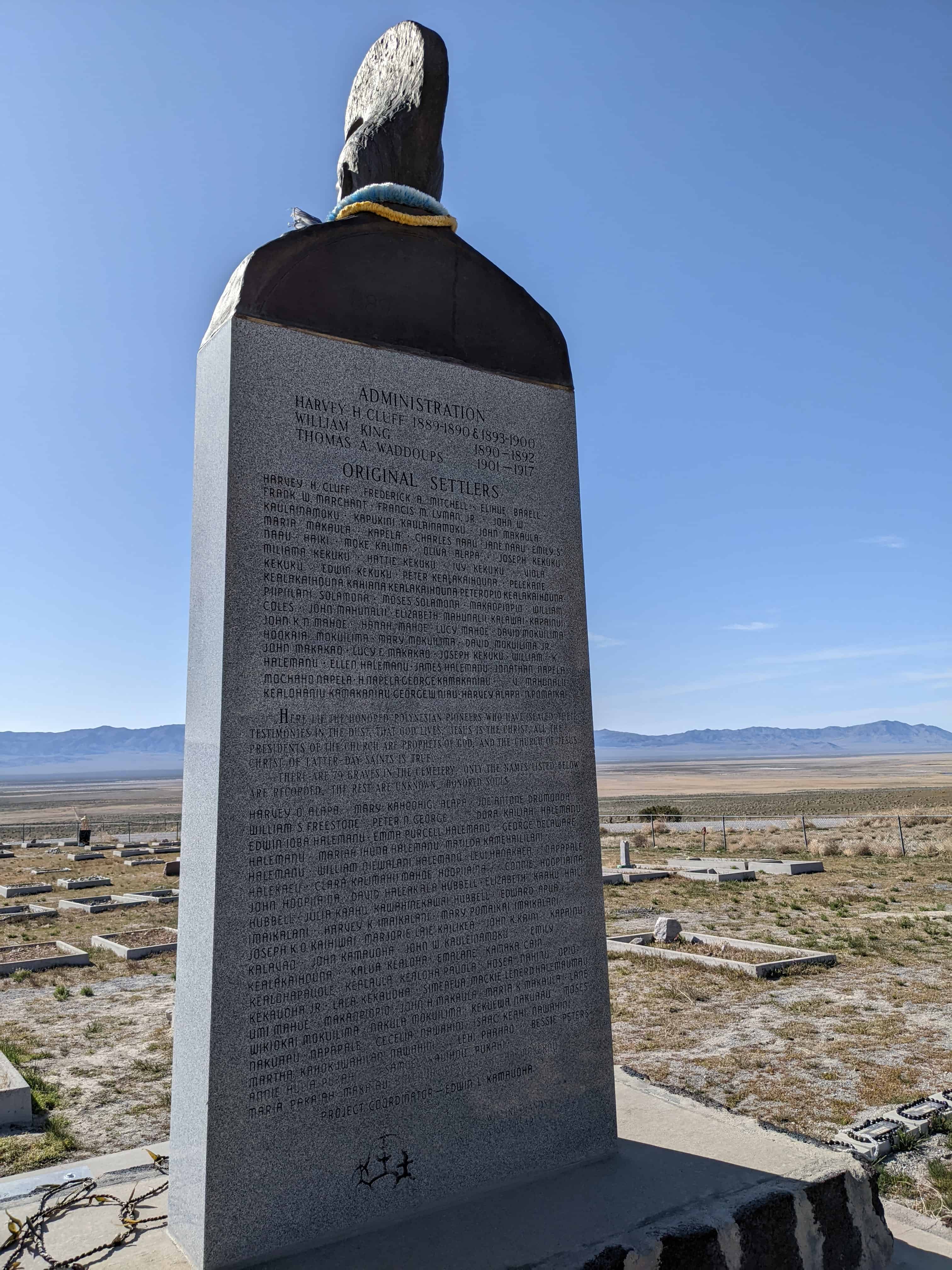
This hallowed place was dedicated on August 28, 1890 by President Wilford Woodruff for all the nations in the isles of the seas, the Polynesian pioneers, their descendants and the faithful Church leaders who left their home in the mid 1800’s and migrated to this gathering place in Zion to be married in the holy Temple for time and eternity.
For 28 years (1889–1917) Iosepa was their home. In spite of the climate, isolation, loneliness, sickness, hardship and death, their faith and courage never faltered. They overcame the cold winter, the summer heat, enjoyed the new life of spring and the bounteous harvest of the fall.
Their native songs and dances filled this beautiful valley, which they made “bloom as a rose,” with love and aloha. A few remained in Utah, some on this consecrated spot, while the rest returned home to their beloved isles of the sea.
The seeds of our Polynesian pioneers bore fruit in Hawaii—the Laie Temple, Brigham Young University – Hawaii, and the Polynesian Cultural Center. Holy Temples stand firm in New Zealand, Western Samoa, Tonga, and Tahiti as monuments to the testimonies of the faithful Polynesian pioneers. We close this memory with their song of love: Iosepa Kuu Home Aloha Iosepa My Home of Love / Iosepa Kuahiwi Ika Nani Iosepa With its Beautiful Mountains / Iosepa Ka Home No Ka’oi Iosepa My Best Home.
This lonely fire hydrant serves as a land marker for the town site of Iosepa, Utah, located on the desert floor between Cedar Mountain and the Stansbury Range in Skull Valley. Iosepa was named after Joseph F. Smith, 6th president of the L.D.S. Church. About 50 Hawaiians left Salt Lake City via Garfield by train, then by 20 wagons to Grantsville, spent the night arriving in Iosepa August 28, 1889.
The public square consisted of 169 acres, with four center streets 132 ft. wide. On four sides of the town park a row of trees were planted in the center of each street. All the other streets were 66 ft. wide and the blocks were divided into 4 lots each containing ¾ acres. All the streets had Hawaiian names. The original purchase consisted of 1,920 acres, of which 200 were under cultivation, the next two years accumulated to 5,273 acres. The water came from five streams, collected in an open ditch, put into a concrete conduit that furnished culinary water to each home. A fire hydrant and irrigation ditch went with each lot. The cemetery, about ½ acre is located a mile northeast of the settlement. Iosepa won the State prize in 1911 for the best kept town and the most progressive city in the State of Utah. Only the Hoopiiana family and J. Palikapeg Nawahine remained in Utah, the rest returned home to Hawaii to settle and help built the Laie Temple (1917–1919). Iosepa returned to dust, leaving a heritage of the faithful Polynesian Pioneers and closed the chapter in the great western American History.
The Iosepa Community developed after Polynesian converts to the Mormon faith were employed as laborers by the Iosepa Agriculture and Stock Company in 1889. After numerous hardships, including bouts with leprosy, the colony attained a degree of financial independence and its population reached 228. In 1915 when the L.D.S. Church began to build the Hawaiian Temple, the need for “gathering” subsided. The Iosepa project was allowed to end and most of the settlers and their children returned to the Islands by 1917.
Mormon Church Converts from Polynesia settled in Skull Valley in 1889-1917. Working for the Church-owned Iosepa Agriculture and Stock Company.
Their settlement located 1/2 mile to the southwest and named Iosepa (Joseph) after Joseph F. Smith, then President of the church flourished until 1917 when a Hawaiian Temple was constructed. Most of the Islanders returned to their homeland, many who succumbed to the hardships of the land are buried in this cemetery.
The Iosepa settlement in Skull Valley, Utah, represents both a unique colonization effort by the Mormon Church and in the West itself. Very early in the 1850’s the Mormon Church had sent missionaries to the Polynesian people. Joseph F. Smith served his first mission at the age of fifteen and became especially beloved to them. Later many answered the “call to gather to Zion,” and settled near Wasatch Springs in North Salt Lake City However, as they did not Integrate into the society very well, and rumors of leprosy were reported, the Mormon Church undertook to settle them as a group in Skull Valley. Under a paternalistic arrangement with the Iosepa Agriculture and Stock Company (incorporated August 7, 1889), these people were employed as laborers to do farm and ranch work. In time a community of 228 souls was developed in which the Polynesian culture flourished. Fish were raised in the springs and marshes nearby. The luau was preserved as were many of their dances and customs. The Polynesians were popular performers throughout the area.
After numerous hardships, including bouts with leprosy, the colony obtained a degree of financial independence by 1910. Their standard of living was commensurate with others living in that area. When in 1915, the L.D.S. Church began to build a temple in Hawaii, the need for “gathering” subsided. The Iosepa project was allowed to end. Most of the settlers and their children returned to the Islands by 1917. However, a few remained in the area of Iosepa and Utah. Today descendants visit the region to view “the land of their inheritance.”
The first funeral was held September 15, 1889 and the cemetery established. Many others have been buried there. Finally, in 1968 Tony Hoopiana, who had been born at Iosepa and lived nearby all his life, was buried in a northeast corner plot. This Hawaiian is home, forever.
The Iosepa Settlement Cemetery in Iosepa, Utah was added to the National Historic Register (#71000856) on August 12, 1971.
The area of Iosepa, in Skull Valley, Utah, was a large 1,920 acre ranch originally. With the settlement of the Hawaiians, a small community was established, following the “block grid” common to Mormon villages. A center block was reserved for the church, a schoolhouse and other public buildings, which were built in time. At first the water supply came from a stream and ran down the edges of the streets in ditches. Later a water system was piped through the town. One fire hydrant still remains. Most of the buildings have been removed or destroyed.
However, north of the town site sets the “Iosepa Cemetery,” a small plot enclosed with a black barbed wire fence, where several score of the colonists have been buried. Many of the graves are unmarked, others have only wooden markers, some carved, and a few stone markers reflecting their artistic qualities.
Although poorly cared for today, there is genuine interest in proper fencing and upkeep of the site from both the Bureau of Land Management personnel and the Deseret Livestock Company whose property line crosses the cemetery. Its location will permit the public to visit it, where an interpretive display can be developed.
The cemetery best preserves the story of this distinctive settlement experience by a Polynesian minority.
The Iosepa Community developed after Polynesian converts to the Mormon faith were employed as laborers by the Iosepa Agriculture and Stock Company in 1889. After numerous hardships, including bouts with leprosy, the colony attained a degree of financial independence and its population reached 228. In 1915 when the L.D.S. Church began to build the Hawaiian Temple, the need for “gathering” subsided. The Iosepa project was allowed to end and most of the settlers and their children returned to the Islands by 1917.
Mormon Church Converts from Polynesia settled in Skull Valley in 1889-1917. Working for the Church-owned Iosepa Agriculture and Stock Company.
Their settlement was named Iosepa (Joseph) after Joseph F. Smith, then President of the church flourished until 1917 when a Hawaiian Temple was constructed. Most of the Islanders returned to their homeland, many who succumbed to the hardships of the land are buried in this cemetery.