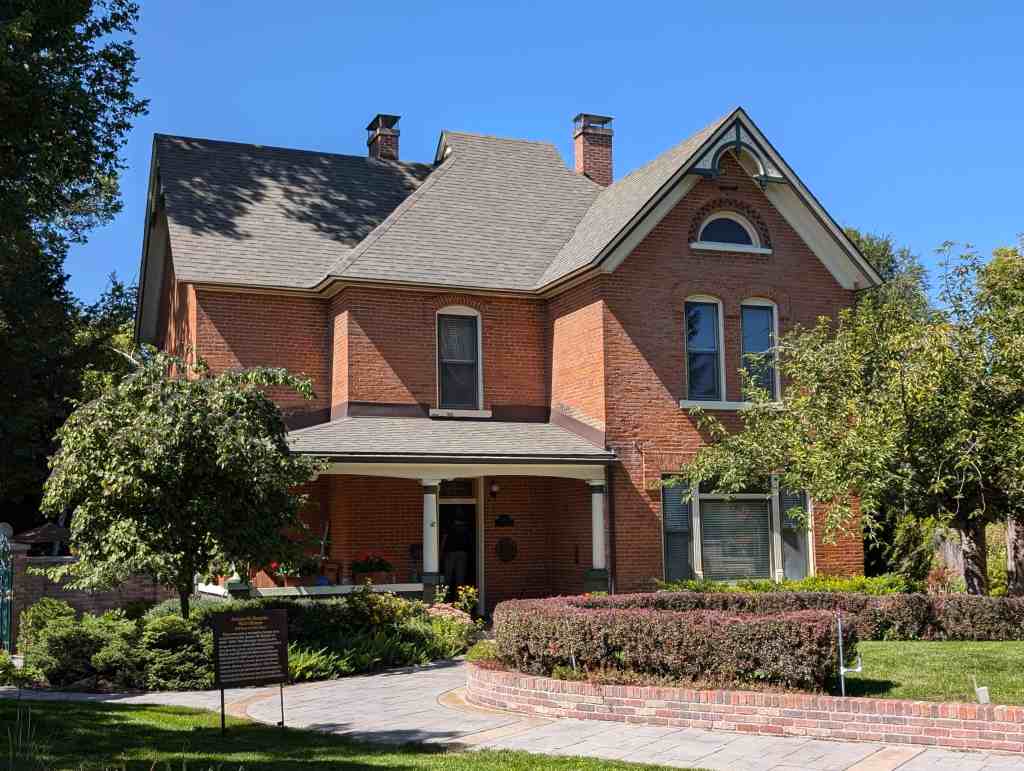
The Redmond Hotel is significant as a good example of a public boarding house in a rural, Mormon community. Based upon a comprehensive survey of Sevier County, it is the best example of this building type in the county. It is also an excellent example of structural adaptation of a building to local events for the “hotel” has evolved as the community evolved. The Redmond Hotel stands today as one of the best remembered “old hotels” in Sevier County.
The Redmond Hotel is located at 15 East Main Street in Redmond, Utah and was added to the National Register of Historic Places (#80003964) on June 20, 1980.
Ifedmond Utah is a small agricultural community settled in 1876, surveyed in 1879 and “given” a local government in 1878. in 1879, John Johnson, an early Jtedmond settler, town surveyor and Mormon bishop contracted to have a three-room stone home built on Main and Center. The probable builder of the home was Jacob Nielsen, a Mormon, local stone mason, and Danish immigrant like John Johnson. This early structure is the core of the Ifedmond Hotel on which later additions were built.
The appointment of Johnson to the office of bishop, a position he held for 10 years, reflected his growing economic and social importance in the area. Around 1888 Johnson had a larger and more stylish home built east of his first home on Main Street. The older, smaller home was rented out, probably to his son-in-law and business partner, John B. Sorenson with whom he established the financially successful Redmond Co-op.
In 1892, two years after the Denver and Rio Gande Railroad arrived in the Sevier Valley, Johnson sold his main street properties to Henry McKenna Sr. The latter was an early settler of Salina whose past and future experiences with hotel building leads one to suppose that his purchase was a form of “hotel speculation.” Redmond was only a few miles from the Salina railhead and its untapped agricultural and mineral resources could be expected to bring in new residents. This demographic change was expected to cause, as it had elsewhere in Utah, the need for the temporary or seasonal services of teachers, salesmen, laborers, miners and entertainment troupes. To accommodate these mobile residents a pifolic house would be necessary for the community.
Henry McKenna sold his property in 1894 to his son, Henry McKenna Jr. Redmond’s economy continued to improve and so in 1503, the new owner mortgaged the Johnson properties to finance the remodeling of the three-room home into a public boarding house. In 1904, apparently unable to satisfy his creditors, McKenna Jr. sold the structure to James Frandsen who had been hired to do the remodeling work for the hotel (the new owner had done the remodeling work in the area before under taking the building of the Redmond Hotel). The daily operation of the boarding house given over to his wife Miranda as James continued to farm and raise livestock.
After sixteen years of successfully keeping boarders the Fandsen’s sold the building to Anthony C. Willardsen a local merchant. In B20 Anthony opened a store in the front and hired Ada Nielsen, granddaughter of Jacob Nielsen, to run the boarding house. The collapse of agricultural prices that followed World War I adversely affected the local economy and thereby affected the success of the Willardsen enterprise. With two outstanding mortgages and under threat of public sale for payment of back taxes, he sold the boarding house to Ada. With her extra income as post mistress and sales clerk, she was also able to keep the boarding business afloat. It was during her ownership that the public house became widely known as the Redmond Hotel. Ada continued to rent rooms through the depression. In 1946 Charles Hampton bought the building and continued to rent rooms until 1951 when he readapted the public house again, this time back into a private residence. The economic boom for Resdmond had come and gone and with it the Redmond Hotel.
This site is significant as the original launch site for the United States Air Force’s first supersonic guided missile, which was named the Ground-to-Air Pilotless Aircraft (GAPA). Thirty-eight two-stage GAPA solid-rocket-propelled aerodynamic test vehicles were launched by the Boeing Airplane Company from this site between June 13, 1946, and July 1, 1947. Stable supersonic flight was first achieved by GAPA test Vehicle 600 Series, Serial Number 10 on August 6, 1946. The GAPA program was subsequently transferred to Holloman Air Base in New Mexico, where an additional 73 missiles, propelled by various combinations of ramjet engines and solid and liquid rockets, were launched between July 24, 1947 and May 9, 1950.
GAPA was the lineal ancestor of the Air Force’s Bomarc air defense missile, which first flew on September 10, 1952, and is still in limited service 28 years later. The original GAPA launch site in Utah was the birthplace of the United States Air Force supersonic missile flight test program.
The GAPA Launch Site and Blockhouse was added to the National Register of Historic Places (#80003972) on August 26, 1980.
Reinforced concrete, semisubmerged blockhouse and launch pad. The Blockhouse is in original condition, except for damage caused by a single act of vandalism, to wit: entry door blown off hinges, glass viewports gone, hole blown in concrete floor and walls cracked, all apparently from a single explosive charge placed on blockhouse floor.
Reinforced concrete launch pad in same condition as when site was abandoned in July 1947. Steel launch tower no longer present.
The GAPA launch site and blockhouse is located three miles east and seven miles north of Knolls, Utah. The site includes the reinforced concrete launch pad approximately 100′ x 100′. The 40 foot steel tower, used in the launching moves, has been removed. Approximately 300 feet south of the launch pad is the original blockhouse from which the GAPA missiles were launched by remote control. The blockhouse remains in original condition except for damage done when an explosive charge was set off on the blockhouse floor. The explosion blew the entry door off its hinges, broke the glass view-ports, cracked the walls and left a hole in the concrete floor. The blockhouse is build of concrete, rises six feet above the ground level and is approximately 40 feet x 40 feet in size.
The Elsinore Sugar Factory is significant as the single most important agri-business in Sevier County history. The factory’s economic and social impact on local communities, as assessed by a recent county wide historical survey, exceeds that of any other business enterprise for the years 1911 to 1928. Also, the Elsinore plant is significant as a good representative of the overall sugar beet industry in Utah and as an excellent example of the Utah-Idaho Sugar Company’s contribution to the history of the state.
The Elsinore Sugar Factory is located at approximately 2905 North Highway 118 in Elsinore, Utah and was added to the National Register of Historic Places (#80003959) on June 17, 1980.
The first attempt at refining sugar from beets in Utah occurred in the early 1850 ‘s under the auspicious of the Deseret Manufacturing Company. With the strong financial and social support of Brigham Young, and with imported French machinery, a sugar beet factory was erected in Provo. This primitive plant was unable to recrystallize the sugar from the beet juice. With the company near ing financial ruin, it was purchased by the Mormon Church. After removing the machinery to Salt Lake City, the church tried anew, and again the process failed. This second attempt was the last try at refining sugar in Utah until 1891.
During these thirty plus years the MDrmon desire for economic self-sufficiency kept alive the “sugar beet hope”. Experimentation with sugar beets reached Sevier County in 1878 as William Seegmiller and C.A. Madsen each produced a few high quality plants. Local soil conditions were discovered to be excellent and with improved irrigation systems, large yearly crops were predicted. The improved refining techniques used by E.H. Dyer at his California plant that resulted in the production of a high quality sugar, helped revive the sugar beet interests in Utah. With increased tariffs on sugar that came with the Merrill Act, 1883 and the McKinley Act, 1890, the atmosphere for the “sugar business” improved.
The Mormon desire hope for financial autonomy now had the technological means, the capital and the interest to form the Utah Sugar Company in 1889. Two years after incorporation a sugar beet refinery was erected in Lehi under the direction of E.H. Dyer. As in the 1850 ‘s the Mormon leadership strongly endorsed the enterprise. Church wards encouraged local farmers to plant sugar beets in the spring for processing in the fall. The refinery was from the beginning a technical success but it took time for utahns to accept the fact that beet sugar was as good as cane sugar.
As the financial success of the sugar beet enterprise became apparent, it accelerated the proliferation of other sugar beet refineries. In 1898 sugar produced from beets made up 2% of the American sugar out-put, by 1901 it was 7% and rising. At this time that the American Sugar Refining Company, which controlled 98% of sugar cane market decided to buy stock in western sugar beet companies. In 1902 ASR purchased 50% interest in the Utah Sugar Company the result of which liquified assets for investment in new sugar beet refineries.
Around this same time the farmers of Sevier and San Pete Counties began to agitate for the location of a plant there. In 1906 the Utah Sugar Company promised to help build a factory at Moroni and towards implementing this offer a local sugar company was incorporated. An infestation of “curly-top”, a sugar beet disease, and opposition to the San Pete County location by Sevier County farmers, killed the proposed plant. The next year, 1907, the Utah-Idaho Sugar Company was created by the merger of Utah Sugar, Idaho Sugar and Western Idaho Sugar companies. The new corporation, as a result of increased assets and decreased competition, was able to increase its factory building program.
After getting a promise from Sevier County farmers to raise at least 6000 tons of sugar beets, a factory site was selected east of Elsinore and North of Monroe, near a small settlement named Frogs Jump. The land was purchased in 1910 and the construction of the rail spurs and beet silo sheds were begun. The following summer the main structural elements of the factory were completed so that by the fall of 1911 the first sugar beet campaign was carried out in Sevier County. The Elsinore plant like the one in Lehi was erected by the E.H. Dyer and Sons Construction Company. It was built at a cost of 620,000 dollars. In 1916 and again in 1925 the factory was enlarged to handle an ever greater number of beets. In its lifetime the Elsinore plant produced 1.9 million, 100 pound bags of high quality sugar.
The impact of the new enterprise on Sevier County was immediate and profound. From a steadily widening area of expenditures, through workers wages and payments to farmers, new homes, barns and schools were built, and new farm machinery purchased. The influx of technicians needed to operate the plant settled in Frogs Jump, changing the scattered community into an organized company town which was renamed Austin. In addition to the direct impacts of the plant, one must consider an important secondary economic consequence of sugar beet production. Local livestock interests were able to use the beet tops, pulp and unrefined molasses to feed both sheep and cattle. Southern Sevier County became Central Utah’s center for fattening livestock.
In 1926, one year after increasing the beet capacity at the Elsinore factory, the plant was forced to shut down. It reopened in 1927 but the sugar production was so low that U & I officials closed it for good in 1928. There
have been four explanations advanced for the plant’s failure. The first justifies closure by the recurring infestation of the “curly-top” disease in the Sevier Valley. Competition for locally grown beets by the erection of the Gunnison Sugar Beet Factory in 1918 is offered as the second; and the third argues that the relationship between the farmers and U & I officials continued to decline as both struggled to stay alive during the agricultural decline of the 1920’s. The fourth explanation argues that low tariffs on sugar confoined with a 20 million dollar mortgage hanging over U & I properties did not allow for keeping marginal factories in operation.
In 1928 the beet processing machinery was sold to a firm in Quebec. Fourteen years later, in 1942, the factory’s main structural elements were dismantled leaving only the office and sugar warehouse intact. At the end of World War II the warehouse was converted into a drying plant for potatoes from which a flour was made and then shipped to Europe. The operation was owned by Utah Food Products Cooperative and was a locally owned concern. In 1945 the business was forced to sale the property because it had failed to meet its mortgage payments. American Food Products Corporation bought the site but it suffered the same fate as the Utah Company. After a series of owners the Elsinore Sugar Factory property was purchased by Wilson Milburn. He has converted the office into a home and hopes to reuse the sugar warehouse as a local shopping mall.
Only two buildings of the Utah-Idaho Sugar Company’s factory complex in Elsinore, Utah are extant. The warehouse is a large brick building of symmetrical rectangular plan with a gabled roof. Piers divide the elevations into bays. Brick corbelling at the roof line creates the effect of a cornice. All openings have segmental arches.
Most of the houses in Austin were built by the sugar beet factory for workers. They were all variations of a similar pattern of modest, detached single family dwellings typical of the period, ca. 1910. The different configurations of this building may reflect its different function and location near the factory. The factory office occupies the ground floor. Rooms on the upper floor undoubtedly served as temporary accommodations for seasonal employees.
The factory office and rooming house is a gable roofed rectangular structure. The ground floor of the 1 1/2 story building is brick while the upper level is frame with shingle siding. Piercing of gable end facades is symmetrical. The broad sides exhibit asymmetrical piercing and paired shed dormers. Ground floor openings have segmental arches. The original window configuration was a two-over-two scheme. A balcony and porte cochere have been extended from the main façade. A small gable roofed portico shelters the entrance of the rear elevation.
The boundaries of the nomination encompass almost the same acreage as was purchased by the Utah-Idaho Sugar Company in 1910 for their Elsinore factory. Its addition to the two standing structures, the office/boardinghouse and sugar warehouse, the foundations of the main factory, the boiler and machine shop, the beet sheds and, the numerous pulp silo storage pits are included.
In the realm of airplane hangar construction and design, the Garfield County Airport Hangar is truly an oddity. The barn-like construction of native materials is a testimony to the ranching/agricultural background of the men who built it. Having no previous experience in designing or building an airplane hangar, they built in the style they knew with what they had. The soundness of this building bears witness to the excellence of craftsmanship and ingenuity of design.
The hangar is a tribute to the early days of air travel in the United States. In the mid-1930’s remote places such as Garfield County began to realize the benefits that could be derived from air services. Simultaneously, the U.S. Government realized that a network of airport facilities was a necessity. Thus, the W.P.A. and Garfield County worked together to further both local and national concerns.
The airport reflects an attempt to encourage tourism by local officials and private individuals to Bryce Canyon which was declared a National Park in 1928. Xt also reflects the hope that air mail service could reach one of the most remote parts of the country. Finally the airport has served as a recreational, center for residents of Garfield County. Located roughly midway between Panguitch and Escalante, the airport hangar has been used for dances, ‘celebrations and other county activities since 1938. Although the structure is only 40 years old, it is recognized as an important local historical resource. .The hangar is undoubtedly one of only a few surviving hangars constructed of log.
Bryce Canyon Airport is located at 450 Airport Road in Bryce Canyon City, Utah and added to the National Register of Historic Places (#78002660) on October 19, 1978.
The Garfield County Airport began as a County W.P.A. project in 1936. Since the W.P.A. only provided partial funding, the county called for local men to donate their labor towards completion of the structure. Land for the airport was acquired from Ruby Syrett, J. Austin Cope, and others. Design of the structure and construction supervision was handled by the three county commissioners, Sam Pollock, Jennings Alien, and Walter Daly.
The logs used in construction of the hangar were cut as part of the C.C.C. project to eradicate the black beetle in Southern Utah. Infested trees were cut and sawed at the East Fork Sevier River sawmill by Garfield County men. They hauled the logs by teams of horses to the construction site.
A Garfield County News article of September 25, 1936 reported: “The project is being sponsored by Garfield County as a W.P.A. project and will cost about $38,669.00. About 320 acres of land has been set aside for the airport, which will consist of an 80-foot by 80-foot hangar of log construction with metal roof and concrete floor and warming-up apron.
Two runways, 5,000 feet long and 500 feet wide will be built. There will also be a waiting room with all the modern conveniences.”
The project was enthusiastically pursued especially after reports that Western Air Express would make the airport a regular stop between Los Angeles and Salt Lake City. The importance of the airport to tourism was recognized by Mormon church leader, George Albert Smith in a letter to County Commissioner, Walter B. Daley:
“I notice an article in one of the daily papers referring to your attitude toward the establishment of an airport in your section of the country.
Being airminded and believing that an airport near Bryce Canyon would be of great advantage to your people in that it would advertise the scenery of your section of the world and induce many people, sane of whom are welcome to investigate down there. I feel that it would be an excellent investment if it doesn’t cost too much.” (Garfield County News, February 28, 1936, p.1)
Despite some delays because of a lack of workers and administrative technicalities, the project progressed and by the spring of 1938, was sufficiently complete to schedule the first landing during Air Mail Week. On May 12, 1938 the Garfield County News announced that the following Thursday, May 19th, T. E. Garn, Director of Aeronautics for the State of Utah would make a 15 minute stop at the airport to pick up all the air mail sent that day. The flight was to be a part of the Air Mail Week observance and as an experiment to determine the need for an air mail route through the section. Local residents were encouraged to “…send at least one letter to some friend or relative., .as the amount of mail sent may have a great amount of effect on the determining of whether a regular route will be established through this section…” (Ibid, May 12, 1938, p.1)
An elaborate reception was planned for the arrival of the plane piloted by T.E. Garn. The Garfield County News for May 19th reported:
“It is expected that more than three hundred letters will be carried from Panguitch post office by the pick up airplane that will stop at Bryce Canyon Airport today, Thursday. A special program has been arranged and the fifteen minutes that the plane will rest on the new filed will be taken up” in musical numbers and talks. Residents from every part of the county are expected to be in attendance.
Two o’clock has been set as the time for the plane to land and it will rest on the field for a quarter of an hour. As soon as the plane comes in sight, the band will begin playing and will furnish at least one selection as the plane lands. L.C. Sargent will call the group to order and Postmaster Rudolph Church and Civic Clubs.
President James M. Sargent, will give short talks and a quartette from Tropic will furnish a number. When the plane is ready to take off, the band will again play a selection.
County High School Day has been arranged so that the students from the three high schools in the county will be at the airport for the landing and take-off of the plane and it has been reported that throngs of delegates from every town in the county will be on hand. A great amount of interest is being taken in the event and those not at the airport on that day will miss a chance to mingle in one of the largest gatherings ever held in the county.”
Despite the elaborate plans, the arrival was postponed for two days because of bad weather.
The reception, welcoming pilot T.E. Gam was insignificant compared with the three day celebration staged to dedicate the airport.
“Plans have been completed for one of the biggest celebrations ever to be held in this section, when the Bryce Canyon airport and hangar will be officially dedicated, Tuesday, Wednesday and Thursday of next week, July 5,6, and 7. The celebration will be in connection with the big wild west show and rodeo to be held at the “Y” service station and will be sponsored by the Gar field County Commission.
Official dedication will take place Wednesday, July 6, when county commissioners, civic leaders and others will take part on the dedicatory program. It is the plan to have every town in the county represented and short speeches, a dedicatory prayer and musical numbers will be presented.
Arrangements are being made to have at least three airplanes on the grounds and performing over the field. Passengers will be taken for rides over the beautiful Bryce Canyon and stunt flyers will “cut didos”, take dives and exhibit other stunts in the clear, mountain sky. Some of the best pilots in the state are expected to be on hand and take part in each day’s program.
Dode Burch and Sons will present a wild west show each day and promise something real in their line. It is reported that they will have a contingent of Navajo Indians directly from the reservation to take part in the chicken pull, squaw races and other Indian contests. Fancy roping, bronco riding and horse races will be staged by some of the best performers to be found in the southwest and each day’s events will be a variation from the preceding day.
Each evening a dance will be given in the spacious hangar, where revelers will have a choice of dancing either indoors on the spacious hangar floor, or in the open air on the huge apron that extends in front. Special music is being obtained for the dancers which will be under the management of the Panguitch Lions Club and will be on the largest floor in all of southern Utah. A special sound system will be installed for the occasion so dancers will have no trouble in hearing the music and thousands are expected to gather each evening for the fun.” (Ibid, June 30,1938,p.1)
Since 1938, the airport has served for other celebrations and exemplifies the ability of a people to use a resource of widely divergent purposes.
The airport has been in continuous operation since it was built as an emergency landing facility and for the promotion of tourism. On January 2, 1946, the airport was commissioned by the P.A.A. A series of fixed base operators have leased the facility from the county. Paul and Donna Cox became the most recent operators in August 1977. Their “Aero-Copters Scenic Flights” provides plane and helicopter tours in the Bryce Canyon vicinity.
In March of 1906, Thomas Maurice Hinton with his wife, Wilhelmina Walker, moved to Hurricane, a town with a name but no permanent residents. This couple, along with their three small children, have the distinction of being Hurricane’s first citizens.
Thomas Maurice Hinton was born to John Nock and Emma Spendlove Hinton in Virgin, Utah, on April 26, 1872, almost ten years after his parents had voluntarily come to settle the Cotton Mission. John, his father, was a cabinet maker and the only member of his family to join The Church of Jesus Christ of Latter- day Saints (Mormon Church) and immigrate from England. Emma Spendlove, his mother, had joined the Mormon Church in England, along with most of her family. She sailed on the same ship as John, and they were married aboard ship before arriving in America.
Wilhelmina was born to Francis and Elizabeth Staheli Walker on October 18, 1873, in Little Spring Valley, Nevada. Her parents had immigrated from Germany and Switzerland. Her mother joined the Mormon Church before arriving in America, and her father joined the Church in 1862, following his arrival in Utah.
Thomas Maurice and Wilhelmina Hinton, 1898.
For the first few weeks, Thomas Maurice and his family lived in a tent on this lot until he completed building a lumber house/granary for Thomas and Annie Hinton Isom, his sister and brother-in-law. Because of sickness, the Isom family had to delay their arrival to Hurricane. The Hinton family then moved into the Isom home where they lived for several months while Thomas completed his own home at 200 North and 200 West, on property purchased a year earlier.
Maurice, an accomplished carpenter, built many of the first homes, cabinets, and furniture for the early residents of this town. He donated liberally of his carpentry skills in the building of the first social hall, Relief Society hall, the elementary and high schools, and the stake center. He also made caskets, refusing any pay for them. He passed away February 29, 1948, and is buried in the Hurricane Cemetery.
After the Hintons moved into their new home, the Isom family moved into their home/granary on this lot. By November 1906, ten families-Amos, Jacob, Nephi, and Charles Workman; Anthony Jepson; Erastus Lee; Ira E. Bradshaw; Frank Ashton; Thomas Isom; and Bernard Hinton-had joined the Thomas Maurice family to become the first settlers of Hurricane.
Thomas Maurice and Wilhelmina Hinton, 1946.
As a young woman, Wilhelmina taught school in Hinckley, Utah, for several years before moving to Virgin and then to Hurricane. Aunt Mina, as she was affectionately called, became a local legend as a midwife and attendant to the sick. From 1920 to 1944 she assisted the local doctors in their medical practice. She possessed the “healing touch.” As a midwife, her pay was meager, consisting mainly of chickens or produce. She walked to and from one patient’s home to another, covering many, many miles. Her gait was described as a “half lope.” Following the delivery of a baby, she often stayed in the home of a new mother for seven to ten days, caring for the mother and other family members. She helped deliver 448 babies during the early years of Hurricane. For many years, she was a main news correspondent for the Washington County News. Much of Hurricane’s history can be documented through the articles she wrote for the paper. She passed away October 10, 1968.
This First Family, the Hintons, were a faithful and noble couple. They were great contributors to the well-being, growth, and progress of Hurricane and represent the pioneering spirit and unselfish service needed to build the beautiful city of Hurricane.
The Isom home no longer exists. The house that you see before you was built by Thomas Maurice on his lot at 200 North 200 West in 1906. It is the oldest, still-standing house in Hurricane. In the fall of 1997, Cody Dennett, the new property owner of the lot and house, donated the old home to the Hurricane Valley Heritage Park Foundation. The house was moved to this location and set upon a rock-lined basement, using the rock from the original basement.
This house shows the simple and plain life of Hurricane’s pioneers, along with the many inconveniences and hardships that were endured. The Hintons lived in this house with their seven children until 1918 when a new brick home was built, on the same lot, directly in front of the old home. How grateful and joyful they were for the new home which provided ample room, water piped into the house, electricity, and an indoor bathroom to replace the “outhouse.” This old house became Maurice’s carpentry shop for many years. The rock-lined cellar was an integral part of the family’s living activities, even after completion of the new home. The cellar provided a constantly cool, dark place to store much of the family’s food supply…such as fresh and bottled fruit and vegetables, meat, milk, and cheese, etc.
The Thomas Isom Home built by Thomas Maurice Hinton in 1906. Shown in picture: daughter Vera and mother Wilhelmina Hinton.
In 1886, Elizabeth Dalton purchased property and later that same year, took out a loan to begin construction of this house. Elizabeth and her husband, John were the parents of eleven children. John Dalton was a partner in the Dalton, Nye and Cannon Store, located at 2376 Washington Boulevard. The business sold books and music and later expanded to include furniture and stoves.
In 1890, John married a plural wife in Mexico, just shortly before the birth of his eleventh child with his first wife Elizabeth. In 1892, he left, taking along his second wife, Amy, to serve as the president of the California Mission for the LDS Church. John resided with Amy the remainder of his life in Pocatello, Idaho. Elizabeth Dalton resided in the house until 1899, selling the house to James L. Porter. Mrs. Dalton moved to a slightly smaller house at 1153-24th Street, where she resided until a few years before her death in 1931.
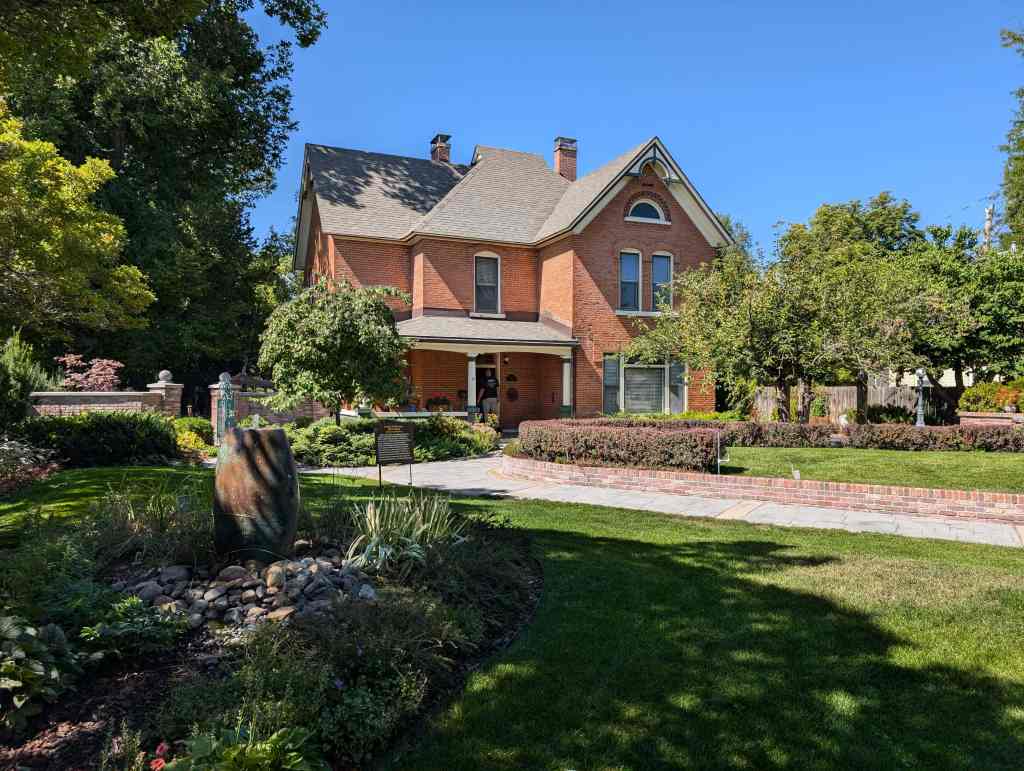
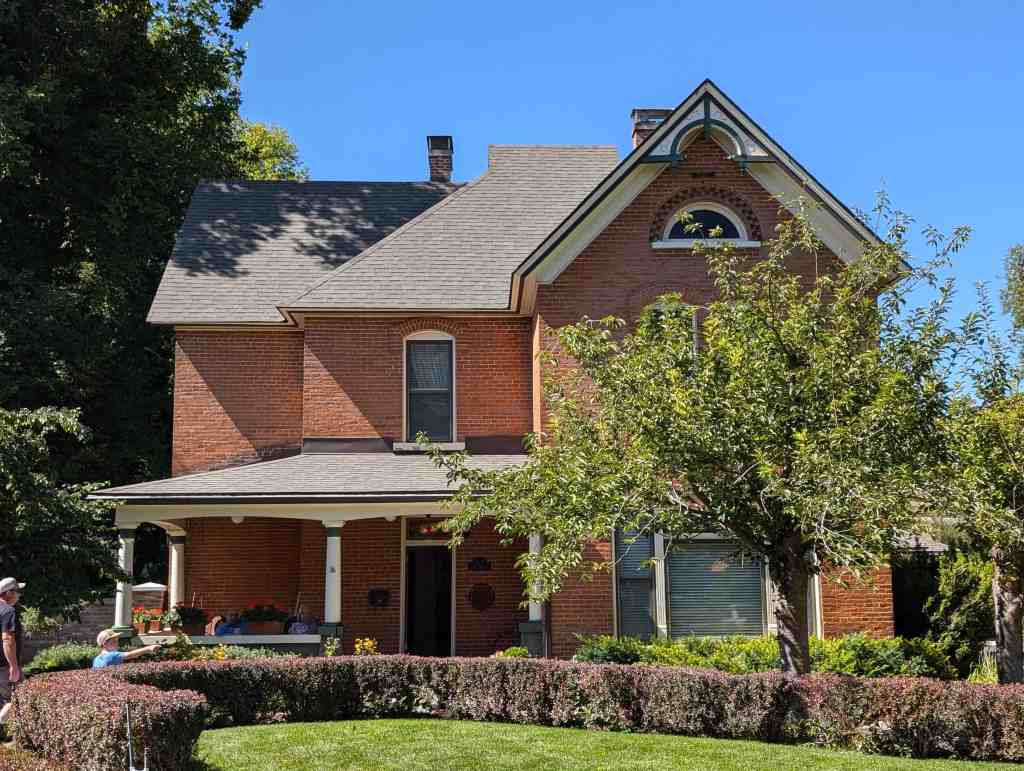
The Dalton House is architecturally significant as one of the best of only a few extant examples of the Second Empire architectural style still standing in Utah. The style was typically associated with urban locations throughout the United States and was a popular style between 1870 and 1900 in the state. Elements of the Second Empire style contained in this house include the rectangular massing of the house, with its central pavilion, along with the concave mansard roof and dormer windows.
The Dalton House was placed on the National Register of Historic Places in 1986 and on the Ogden City Register of Historic Resources in 1989 and is located at 2622 Madison Avenue in Ogden’s Central Bench Historic District in Ogden, Utah.
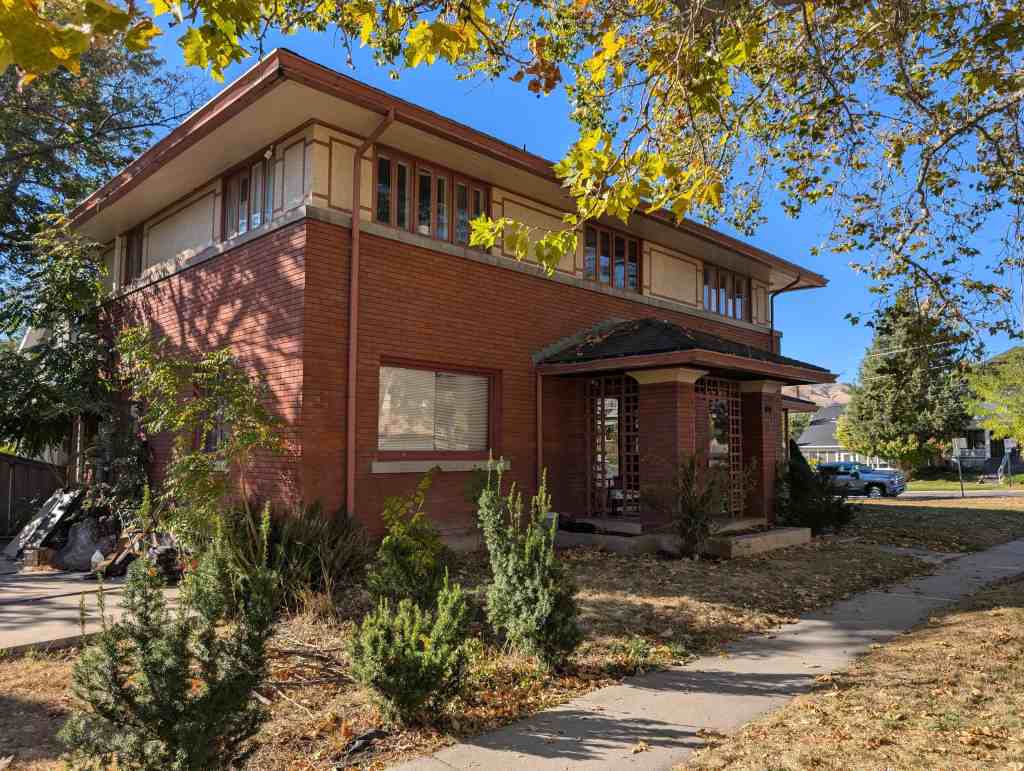
This one-and-one-half-story Arts & Crafts bungalow was designed and built by local contractor Ralph C. Holsclaw in 1915, probably using ideas from Craftsman pattern books of the period. Constructed of wood shingles and clinker brick, it is in excellent condition. Although the house has been modified over the years, it retains enough historic material and integrity to be a contributing historic resource of the neighborhood surrounding Westminster College and of Salt Lake City.
The house is also significant for its association with the development of Westminster College in the first half of the twentieth century. The construction and subsequent use of the house as a residence by four college presidents coincides with significant changes in the college’s policies and its relationship to the greater Utah community. During the historic period of the house, Westminster College grew from a small, financially insecure Presbyterian academy to a fully functioning, independent four-year college. Much of the credit for the progress is due to Herbert W. Reherd, the home’s first occupant, and his successor, Robert D. Steele.
This house was constructed c.1925 for Joseph Fielding Smith and his second wife Ethel G. Reynolds. Dedicated to studying and gaining an understanding of LDS principles, Smith was ranked among the leading LDS church scholars. He began work in the Church Historian’s office in 1901 and was eventually named to the position of Church Historian in 1921. Smith was also chosen to fill a vacancy in the Quorum of Twelve in 1921. Thirty years later, he became president of the Council of Twelve and was later appointed the tenth LDS church president in 1970. Following the death of his wife Ethel, Smith married Jessie Evans in 1937. Jessie was most noted for her singing abilities as soloist with the Mormon Tabernacle Choir and her participation in many church and public events. The Smiths continued to live in this home until 1954.
This two-story brick house is an example of the Colonial Revival style popular in Utah during the early twentieth century. The design includes a centered main entry that incorporates side lights within a symmetrical façade. The hipped roof and multiple lights in the upper sashes of the windows also are typical design elements of the Colonial Revival style.
mentioned in Gilmer Park Historic District: LDS Church leaders also made their home in Gilmer Park Historic District. Richard L. Evans lived at 1032 Douglas Street between 1936-71 and was best known as the radio announcer for the nationally broadcast radio program, “Music and the Spoken Word.” Sterling W. Sill who resided at 1264 Yale Avenue from 1935 through the 1980s was bishop of the Garden Park Ward and a member of the Quorum of the Seventy. Adam S. Bennion was a member of the Council of the Twelve and a United States Senate candidate who lived at 1183 Herbert Avenue between 1918-58. Joseph Fielding Smith (998 Douglas Street, 1926-53) was the tenth LDS Church president.
also, Smith, Joseph Fielding – 998 Douglas St. (1926-53); Tenth L.D.S. Church President
Constructed in 1889, this two-story central-block-with-projecting- bays-type house is an example of Victorian Eclectic architecture that was popular in Utah from 1885 to 1910. The house was constructed for Frank B. Hurlbut and his wife, Mattie. A druggist by profession, Mr. Hurlbut operated the F.B. Hurlbut pharmacy out of the Broom Hotel that was located on Washington Boulevard. The Hurlbuts lived in the home through the 1890s.
The second, and perhaps most famous, owner was Jacob S. Boreman and his wife, Mary, who purchased the home in 1900. Jacob was an Ogden attorney and had been a prominent and influential federal judge over the Utah Territory. He was instrumental in asserting federal authority over Utah’s Mormon leaders with regard to such issues as plural marriage, theocratic rule, and Mormon-Gentile conflict. The Boremans owned the house until Jacob’s death in 1913. There have been several subsequent owners since, including a wholesale/retail merchant, a manufacturer, and a stenographer.
Built in 1935-36, the Boulder Elementary School is part of the Public o Works Buildings Thematic Resources nomination and is significant because it w helps document the impact of New Deal programs in Utah, which was one of the states that the Great Depression of the 1930s most severely affected. In 1933 Utah had an unemployment rate of 36 percent, the fourth highest in the country, and for the period 1932-1940 Utah’s unemployment rate averaged 25 percent. Because the depression hit Utah so hard, federal programs were extensive in the state. Overall, per capita federal spending in Utah during the 1930s was 9th among the 48 states, and the percentage of workers on federal work projects was far above the national average. Building programs were of great importance. During the 1930s virtually every public building constructed in Utah, including county courthouses, city halls, fire stations, national guard armories, public school buildings, and a variety of others, were built under federal programs by one of several agencies, including the Civil Works Administration (CWA), the Federal Emergency Relief Administration (FERA), the National Youth Administration (NYA), the Works Progress Administration (WPA), or the Public Works Administration (PWA), and almost without exception none of the buildings would have been built when they were without the assistance of the federal government.
Boulder Elementary School is located in 351 North 100 East in Boulder, Utah and was added to the National Register of Historic Places (#85000805) on April 1, 1985.
The Boulder Elementary School is one of 233 public works buildings identified in Utah that were built during the 1930s and early 1940s. Only 130 of the 233 buildings are known to remain today and retain their historic integrity. Of the 233, 107 were public school buildings and 55 of them remain. This is one of 43 elementary schools built, 19 of which remain. In Garfield County 7 buildings were constructed; 5 are left. The Boulder Elementary School was built in 1935 and 1936. Construction began in September of 1935 and was completed in the early spring of 1936. It was a Works Progress Administration (WPA) project. Superintendent of construction was Arthur McNelly of Escalante.
This is a one-story frame school building displaying the blending of classical and moderne elements that characterizes the PWA-sponsored architecture in Utah. It has a hipped roof over a basic rectangular plan. There is a projecting gabled porch on the front that contains a recessed entrance and small flanking windows. A long hipped roof extension on the rear appears to be original. The siding consists of narrow, 4″ clapboards and there is a plain cornice and frieze under the overhanging eaves. Classical motifs dominate the front entrance porch in the form of cornice returns, a pedimented head over the recessed doorway, and a transom above the door itself. The formality of the porch is broken by a zig-zag belt course that circles the building and gives it a sense of the abstract geometric quality associated with the moderne movement. The building remains in excellent original condition.