• About JacobBarlow.com
  • Cemeteries in Utah
  • D.U.P. Markers
  • Doors
  • Exploring Utah Email List
  • Geocaching
  • Historic Marker Map
  • Links
  • Movie/TV Show Filming Locations
  • Oldest in Utah
  • Other Travels
  • Photos Then and Now
  • S.U.P. Markers
  • U.P.T.L.A. Markers
  • Utah Cities and Places.
  • Utah Homes for Sale
  • Utah Treasure Hunt

JacobBarlow.com

~ Exploring with Jacob Barlow

JacobBarlow.com

Tag Archives: Wyoming Historic Markers

Simpson’s Hollow

20 Tuesday Mar 2018

Posted by Jacob Barlow in Uncategorized

≈ 1 Comment

Tags

Historic Markers, Sweetwater County, The Utah War, Wyoming, Wyoming Historic Markers

2018-01-05 15.03.43

One of only three significant engagements of the Utah War, the incident at Simpson’s Hollow played a key role in the conflict. The Utah War (1857-1858) was the result of a lack of communication between the U.S. Government and the Utah Territory concerning Brigham Young’s power as governor of Utah and as head of the Church of Latter Day Saints. To resolve this conflict of interest, President Buchanan appointed a new governor, Alfred Cumming. However, fearing Utah’s citizens would not calmly accept the replacement of Young, Buchanan canceled mail service to Utah and sent out a military force of 2,500 men to safely escort Cumming to Salt Lake City. Captain Lew Simpson, for which the site is named, and his troops, were part of this military force sent to Utah on the Oregon Trail.

Upon notification of the approaching troops, Young and other Mormon leaders assumed, because they had not been notified of the administrative changes, that the army’s intent was religious persecution. Young deployed the Utah Militia, also known as the Nauvoo Legion, to slow the U.S. troops.

In October 1857, a wagon train under the command of Captain Simpson was surrounded by the Utah Militia and forced to surrender its wagons. The Militia, led by Lot Smith, released the livestock and burned all but one supply wagon, resulting in damages estimated at over $85,000. In addition to the incident at Simpson’s Hollow, the Militia burned two other wagon trains, forcing the entire army to winter near the recently burned Fort Bridger.

In the spring, Thomas L. Kane, long-time friend of the Mormons, negotiated a settlement that allowed U.S. troops to peacefully enter Salt Lake City. Young stepped down from his position and created a diplomatic relationship with Governor Cumming.

There are four historic markers here:

  • Burning Wagons
  • Simpson’s Hollow
  • Simpson’s Hollow
  • The Utah War

2018-01-05 15.03.56

2018-01-05 15.05.05

2018-01-05 15.05.09

Burning Wagons

20 Tuesday Mar 2018

Posted by Jacob Barlow in Uncategorized

≈ Leave a comment

Tags

Historic Markers, Sweetwater County, The Utah War, Wyoming, Wyoming Historic Markers

2018-01-05 15.03.43

Brigham Young sent the Utah Militia, also known as the Nauvoo Legion, to harass the Federal troops and delay their approach. In the early hours of October 4th, Major Lot Smith of the Utah Militia and 40 men captured and burned two supply trains, totaling 52 wagons, west of here near the Green River.

The next day Smith and his men struck again near where you are now standing. Militiaman Newton Tuttle, wrote in his journal:

“Mond 5 We went on to the Sandy got breakfast then we went up to the road & found 24 waggons we burnt 22 of them & took 7 mules and 2 saddles we then went off from the road …”.

Wagonmaster Lewis Simpson led the supply train and ever since the wagon burning episode this little valley has been called Simpson’s Hollow.

Wagon train owners Russell, Majors, and Waddell valued the damage at more than $85,000. The only casualty of both wagon incidents was when one of Lot Smith’s men who was wounded by Smith when his pistol discharged accidentally.

The loss of three months rations and livestock, as well as an early, bitter winter stalled the army at Fort Bridger. The severe weather kept the militia and the army apart. During this lull in action, intermediary Thomas Kane negotiated a peaceful settlement of the conflict. In the spring of 1858, the army peacefully entered Salt Lake City and Alfred Cumming was installed as Utah Territorial Governor.

There are four historic markers here:

  • Burning Wagons
  • Simpson’s Hollow
  • Simpson’s Hollow
  • The Utah War

2018-01-05 15.04.13

2018-01-05 15.05.05

2018-01-05 15.05.09

The Utah War

20 Tuesday Mar 2018

Posted by Jacob Barlow in Uncategorized

≈ Leave a comment

Tags

Historic Markers, Sweetwater County, The Utah War, Wyoming, Wyoming Historic Markers

2018-01-05 15.03.43

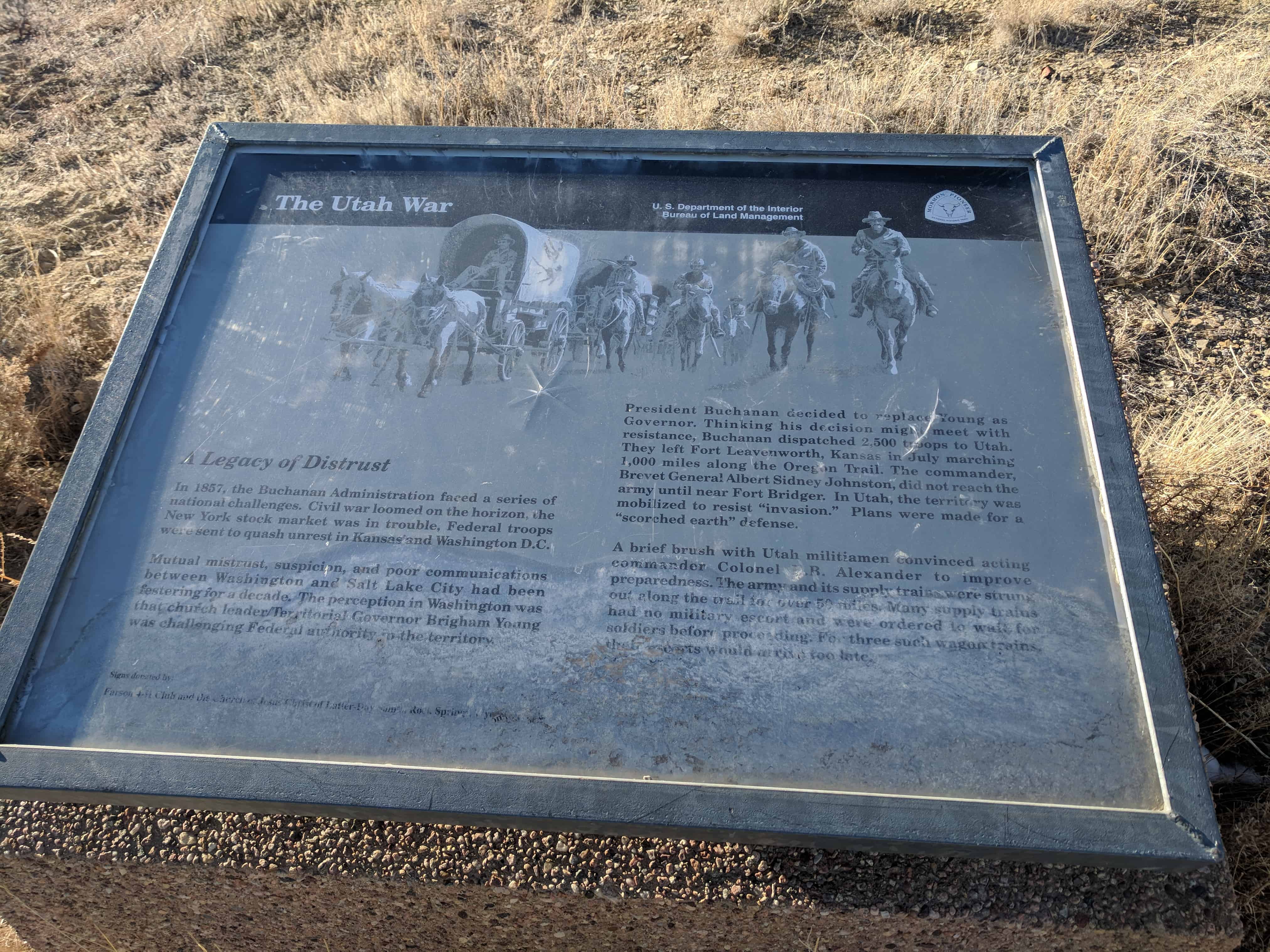
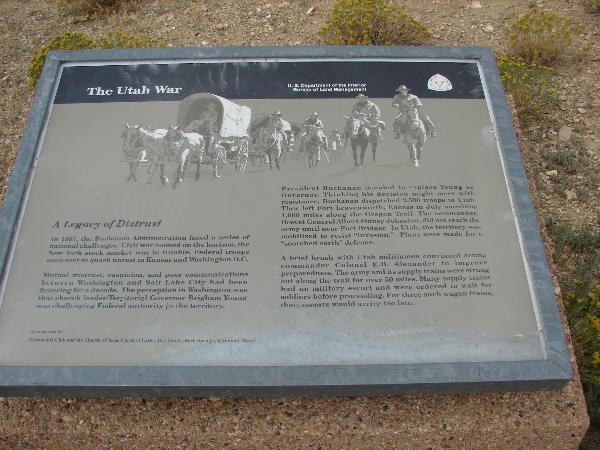
A Legacy of Distrust

In 1857, the Buchanan Administration faced a series of national challenges. Civil war loomed on the horizon, the New York stock market was in trouble, Federal troops were sent to quash unrest in Kansas and Washington D.C.

Mutual mistrust, suspicion, and poor communications between Washington and Salt Lake City had been festering for a decade. The perception in Washington was that church leader / Territorial Governor Brigham Young was challenging Federal authority in the territory.

President Buchanan decided to replace Young as Governor. Thinking his decision might meet with resistance, Buchanan dispatched 2,500 troops to Utah. They left Fort Leavenworth, Kansas in July marching 1,000 miles along the Oregon Trail. The commander, Brevet General Albert Sidney Johnston, did not reach the army until near Fort Bridger. In Utah, the territory was mobilized to resist “invasion.” Plans were made for a “scorched earth” defense.

A brief brush with Utah militiamen convinced acting commander Colonel F.B. Alexander to improve preparedness. The army and its supply trains were strung out along the trail for over 50 miles. Many supply trains had no military escort and were ordered to wait for soldiers before proceeding. For three such wagon trains, their escorts would arrive too late.

There are four historic markers here:

  • Burning Wagons
  • Simpson’s Hollow
  • Simpson’s Hollow
  • The Utah War

2018-01-05 15.04.06

2018-01-05 15.05.05

2018-01-05 15.05.09

California/Mormon/Oregon/Pony Express Trail.

The Big Sandy River

14 Wednesday Mar 2018

Posted by Jacob Barlow in Uncategorized

≈ 1 Comment

Tags

Farson, Historic Markers, Wyoming, Wyoming Historic Markers

  • 2018-01-05 14.52.25

The Big Sandy River

Long before the Oregon/California westward migration, animals instinctively stopped at the Big Sandy River during their migration process. With South Pass just 35 miles east, the river was also a natural East-West pathway for man.

The pathway, in combination with the river, made the area a stopping place for Native Americans and later explorers, including the Mountain Men. With the advent of travel to Oregon, California, and Utah, it also became a stop for wagon trains on this part of the Oregon/California/Utah trial. The Donner party encamped here on July 24, 1846 having made its fateful decision to try a new shortcut to California beyond Fort Bridger. Seven miles east of here, on June 28, 1847, the first Mormon wagon train with the Prophet Brigham Young met with frontiersman Jim Bridger on the Little Sandy River. The next day, the Mormons rested at the Big Sandy before pushing on to reach the Green River that same day.

By 1858, the Big Sandy Mail Station had developed as a site for mail service between the Missouri River and Salt Lake City. The Central Overland California & Pike’s Peak Express Company, which operated the Pony Express, made the mail station one of the original stops for its famed Pony Express and Overland Stage service. The Pony Express started on April 3, 1860 and operated 19½ months, only to be replaced by the Transcontinental Telegraph service whose telegraph line came through at this location.

Other notable travelers like Horace Greeley, Sir Richard Burton, Samuel Clemens (Mark Twain), and tens of thousands of trail emigrants used this pathway traveling either East or West, but mainly West.

This historic marker is located in the same highway pullout as Little Sandy Crossing and is right around the corner from the Big Sandy Pony Express Station in Farson, Wyoming.

2018-01-05 14.52.29

To all pioneer who passed this way to win and hold the west

10 Saturday Mar 2018

Posted by Jacob Barlow in Uncategorized

≈ Leave a comment

Tags

Sublette County, Wyoming, Wyoming Historic Markers

2018-01-05 14.40.30

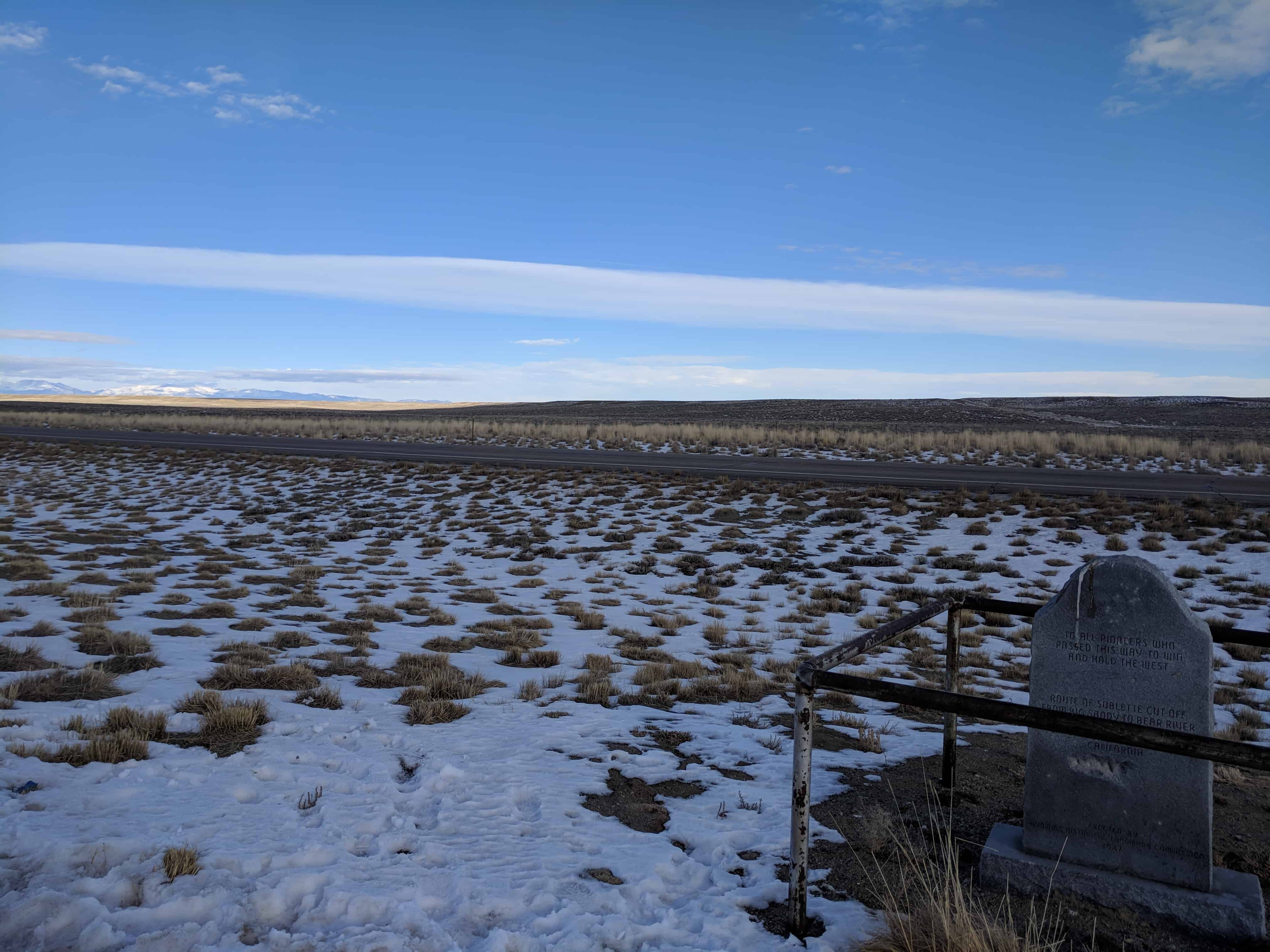
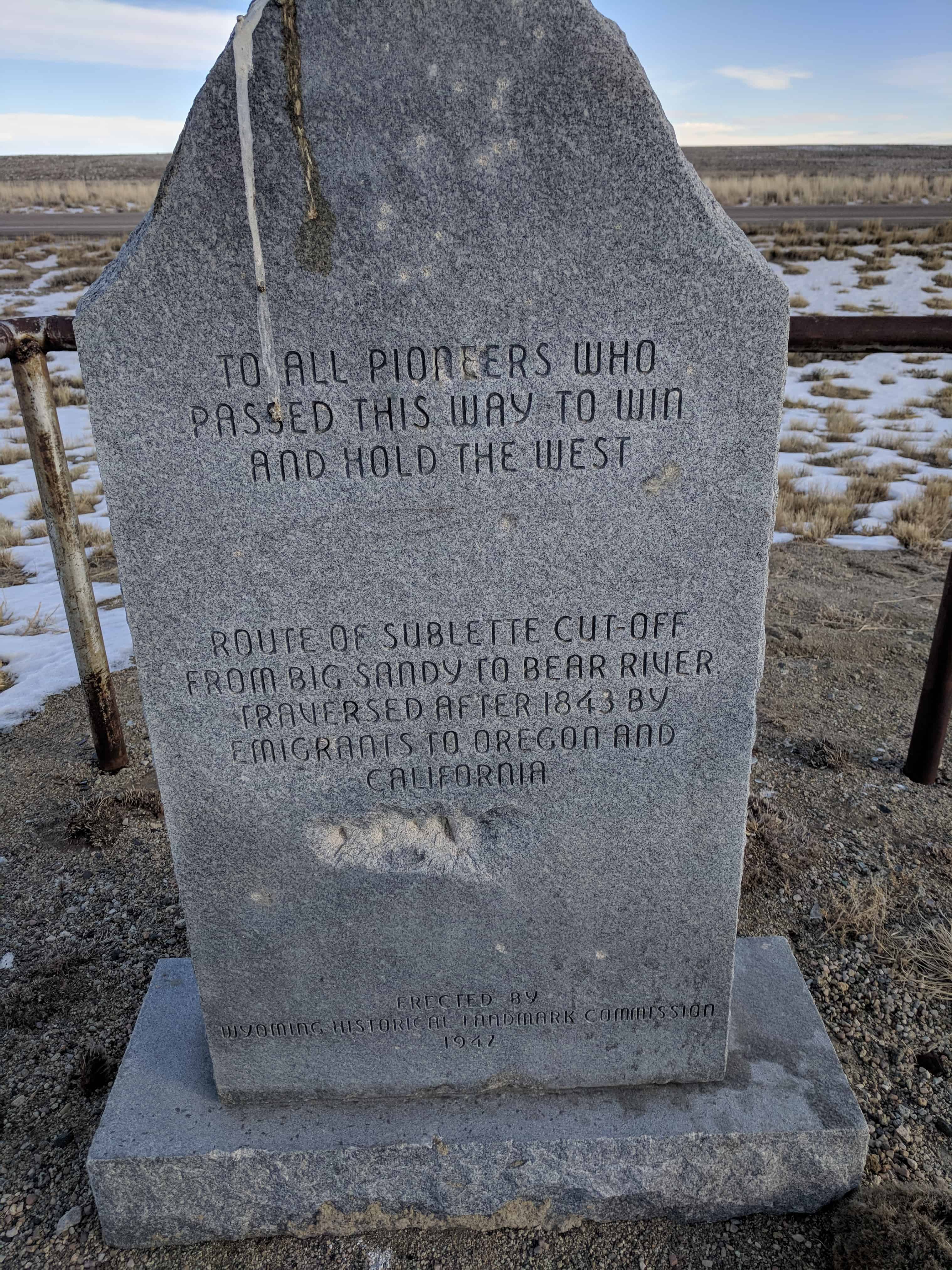
To all pioneer who passed this way to win and hold the west.

Route of Sublette cut-off from Big Sandy to Bear River. Traversed after 1843 by emigrants to Oregon and California.

2018-01-05 14.40.36

Pronghorn Antelope and the High Cold Desert

08 Thursday Mar 2018

Posted by Jacob Barlow in Uncategorized

≈ 1 Comment

Tags

Wyoming, Wyoming Historic Markers

2018-01-05 14.32.45

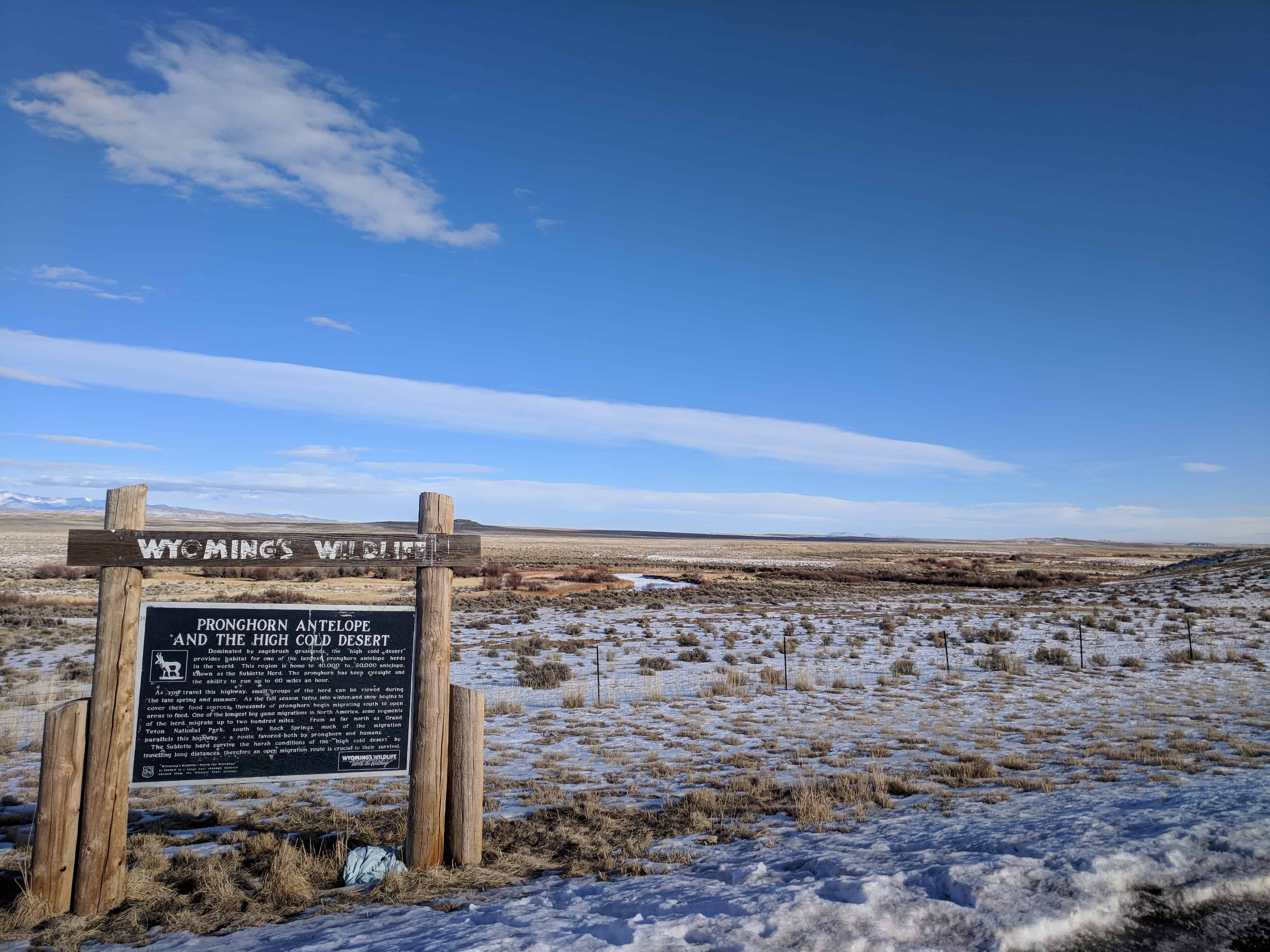
Pronghorn Antelope and the High Cold Desert

Dominated by sagebrush grasslands, the “high cold desert” provides habitat for one of the largest pronghorn antelope herds in the world. This region is home to 40,000 to 60,000 antelope, known as the Sublette Herd. The pronghorn has keen eyesight and the ability to run up to 60 miles an hour.

As you travel this highway, small groups of the herd can be viewed during the late spring and summer. As the fall season turns into winter and snow begins to cover their food sources, thousands of pronghorn begin migrating south to open areas to feed. One of the longest big game migrations in North America, some segments of the herd migrate up to two hundred miles. From as far north as Grand Teton National Park, south to Rock Springs, much of the migration parallels this highway – a route favored both by pronghorn and humans.

The Sublette herd survive the harsh conditions of the “high cold desert” by travelling long distances, therefore an open migration route is crucial to their survival.

Other sites about Wyoming Wildlife here.

2018-01-05 14.32.54

Simpson’s Hollow

29 Sunday Oct 2017

Posted by Jacob Barlow in Uncategorized

≈ 2 Comments

Tags

Historic Markers, Sweetwater County, The Utah War, Wyoming, Wyoming Historic Markers

e1809295-ba01-43c8-80bb-d2036fc938c3

2018-01-05 15.03.43

Here on Oct. 6 1857 U.S. Army Supply wagons led by a capt. Simpson were burned by a Major Lot Smith and 43 Utah Militia Men.  They were under orders from Brigham Young, Utah Territorial Governor, to delay the army’s advance on Utah.  This delay of the army helped affect a peaceful settlement of difficulties.

The day earlier a similar burning of 52 army supply wagons took place near here at Smith’s Bluff.

There are four historic markers here:

  • Burning Wagons
  • Simpson’s Hollow
  • Simpson’s Hollow
  • The Utah War

2018-01-05 15.04.18

2018-01-05 15.05.05

2018-01-05 15.05.09

afc9bc1b-32af-42eb-a513-cabc58a2ee5a

2d8c1fdc-ab7f-4f89-a70a-4fd215917909

James Bridger – Trapper 1844

27 Friday Oct 2017

Posted by Jacob Barlow in Uncategorized

≈ 2 Comments

Tags

Historic Markers, Wyoming, Wyoming Historic Markers

  • f6756095-b239-4430-9557-9a24621f6815

Names Hill, located on the west side of Highway 189 about 5 miles south of LaBarge, is a very important location, being on the west side of the Green River where thousands of people made a crossing and camped before going on to Immigrant Springs and on down into Utah. Hundreds of names had been carved in the rocks: many of them now have crumbled away. The most famous is James Bridger. To protect it a fences has been placed around it and a marker placed next to it which reads:

“He little knew that when he cut his name, or had it cut, in this stone, that it would be engraved in the annals of the West deeper than that of any other man. As one of the world’s outstanding explorers he guided emigrants, railroads and army in the expansion of the nation”

43b81603-0c8a-4e26-8011-83ef19ae76ee
5400286a-c0ea-4680-8e21-ae3c5a2ed6d2
710f5541-6749-4c61-820d-50d4f94a3ca0

Almy

27 Friday Oct 2017

Posted by Jacob Barlow in Uncategorized

≈ 2 Comments

Tags

Historic Markers, Wyoming, Wyoming Historic Markers

a12fffac-0c8f-48b2-896b-c8d80ce07708

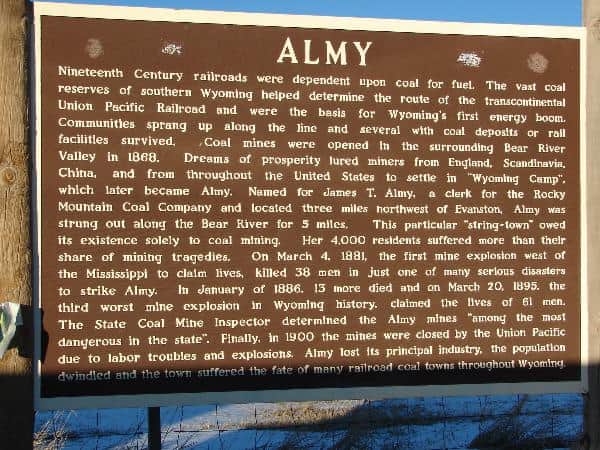
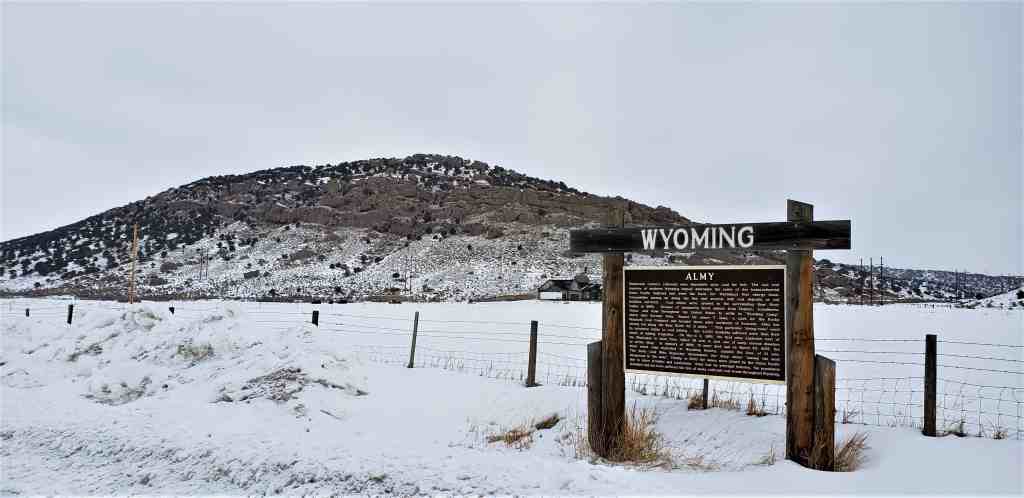
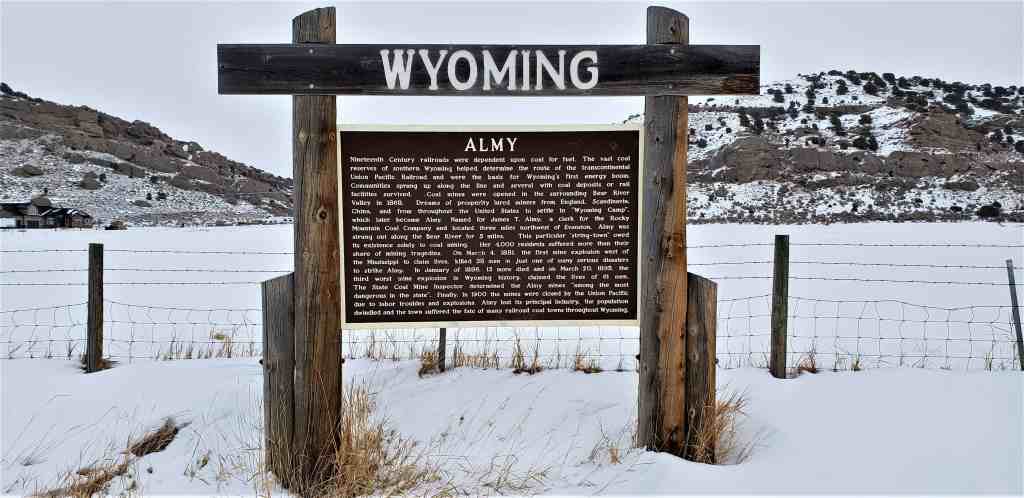
Nineteenth Century railroads were dependent upon coal for fuel. The vast coal reserves of southern Wyoming helped determine the route of the transcontinental Union Pacific Railroad and were the basis for Wyoming’s first energy boom. Communities sprang up along the line and several with coal deposits or rail facilities survived. Coal mines were opened in the surrounding Bear River Valley in 1868. Dreams of prosperity lured miners from England, Scandinavia, China, and from throughout the United States to settle in “Wyoming Camp”, which later became Almy. Named for James T. Almy, a clerk for the Rocky Mountain Coal Company and located three miles northwest of Evanston, Almy was strung out along the Bear River for 5 miles. This particular “string-town” owed its existence soley to coal mining. Her 4,000 residents suffered more than their share of mining tragedies. On March 4, 1881, the first mine explosion west of the Mississippi to claim lives, killed 38 men in just one of many serious disasters to strike Almy. In January of 1886, 13 more died and on March 20, 1895, the third worst mine explosion in Wyoming history, claimed the lives of 61 men. The state Coal Mine Inspector determined the Almy mines “among the most dangerous in the state”. Finally, in 1900 the mines were closed by the Union Pacific due to labor troubles and explosions. Almy lost its principal industry, the population dwindled and the town suffered the fate of many railroad coal towns throughout Wyoming.

ec531998-9ded-4724-b6ae-d619fe814633

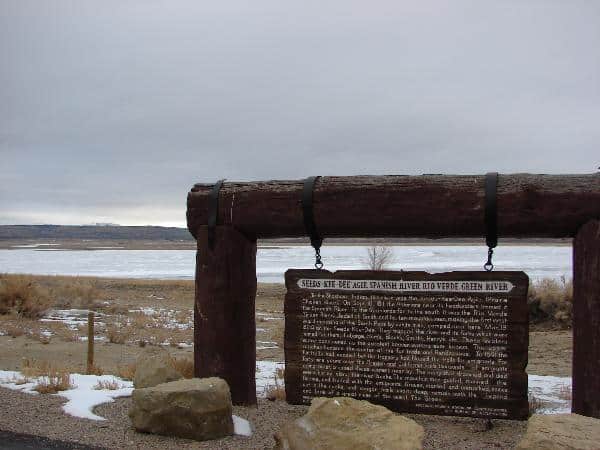
Seeds-Kee-Dee-Agie

27 Friday Oct 2017

Posted by Jacob Barlow in Uncategorized

≈ 2 Comments

Tags

Historic Markers, Wyoming, Wyoming Historic Markers

d8e9c1b6-b63f-48cb-9dac-bc8a0ba4bb4a

“To the Shoshone Indian, this river was the Seeds-Kee-Dee Agie (Prairie Chicken River). On Sept. 16 1811, the Astorians near it’s headwaters termed it the Spanish River. To the Spaniards, far to the south, it was the Rio Verde (Green River). Jedediah Smith and his Mountain Men, making the first westward crossing of the south Pass by white men, camped near here Mar 19, 1824 on the Seeds-Kee-Dee. They trapped the river and its forks which were named for them: LaBarge, Ham’s, Black’s, Smith’s, Henry’s, etc. These waters were considered as the greatest beaver waters ever known. The upper reaches became the center of the fur trade and the Rendezvous. In 1841 the fur trade ceased, but the trappers had blazed the trails for the emigrants. For forty-nine years over the Oregon and California trails, thousands of emigrants going west, crossed these waters nearby. The many that drowned and died were buried along the river banks. The Mountain Men guided, manned the ferries and traded with the emigrants. Graves, marked and unmarked, names cut in the rocks and wagon trails worn deep remain with the legend and lore of a great river of the West – The Green.”

327c23a5-9c55-4d35-b6f3-763dc6e2f1b2
645ed6a4-cd80-4a19-be61-55e79df39ac0
← Older posts
Newer posts →

Follow Jacob

Follow Jacob

Come wander with me on Youtube.

Blog Stats

  • 2,091,388 hits

Social and Other Links

BarlowLinks.com

Recent Posts

  • Provo High School Seminary Building
  • 821 E 100 S
  • 820 E 100 S
  • 817-819 E 100 S
  • 814 E 100 S

Archives

Loading Comments...