• About JacobBarlow.com
  • Cemeteries in Utah
  • D.U.P. Markers
  • Doors
  • Exploring Utah Email List
  • Geocaching
  • Historic Marker Map
  • Links
  • Movie/TV Show Filming Locations
  • Oldest in Utah
  • Other Travels
  • Photos Then and Now
  • S.U.P. Markers
  • U.P.T.L.A. Markers
  • Utah Cities and Places.
  • Utah Homes for Sale
  • Utah Treasure Hunt

JacobBarlow.com

~ Exploring with Jacob Barlow

JacobBarlow.com

Tag Archives: Wyoming Historic Markers

Lander Cut-Off of the Oregon Trail

06 Friday Jan 2017

Posted by Jacob Barlow in Uncategorized

≈ 3 Comments

Tags

Historic Markers, Lincoln County, Oregon Trail, Star Valley, Wyoming, Wyoming Historic Markers

picture7sep07-241

Beginning in 1843, emigrants traveled across the continent along what became known as the Oregon Trail. Increased traffic during the 1850’s resulted in the first government road construction project in the west. The 345 mile Central Division of the Pacific Wagon Road went from South Pass, Wyoming, to City of Rocks, Idaho, a geologic formation, which marked the Division’s western boundary. Superintendent Frederick W. Lander of Salem, Massachussetts, supervised construction for the U. S. Department of the Interior. The 256 mile section of the road leading from South Pass to Fort Hall, Idaho, is known as the Lander Cut-off. The cut-off traversed this Salt River Valley for 21 miles and parallels Highway 89 through this area. The new route afforded water, wood, and forage for emigrants and their stock. Between 1858 and 1912, it provided travelers with a new, shorter route to Oregon and California, saving wagon trains seven days. Lander, with a crew of 15 engineers, surveyed the route in the summer of 1857. The following summer, 115 men, many recruited from Salt Lake City’s Mormon emigrants, constructed the road in less that 90 days at a cost of $67,873. The invention of the automobile led to its abandonment.

Lander Cut-Off of the Oregon Trail. Dedicated to all the pioneers who passed to win and hold the West.

  •  Wyoming Historic Markers

Little Sandy Crossing

14 Monday Nov 2016

Posted by Jacob Barlow in Uncategorized

≈ 3 Comments

Tags

Farson, Historic Markers, SUP, Sweetwater County, UPTLA, Wyoming, Wyoming Historic Markers

  • 2018-01-05 14.52.51

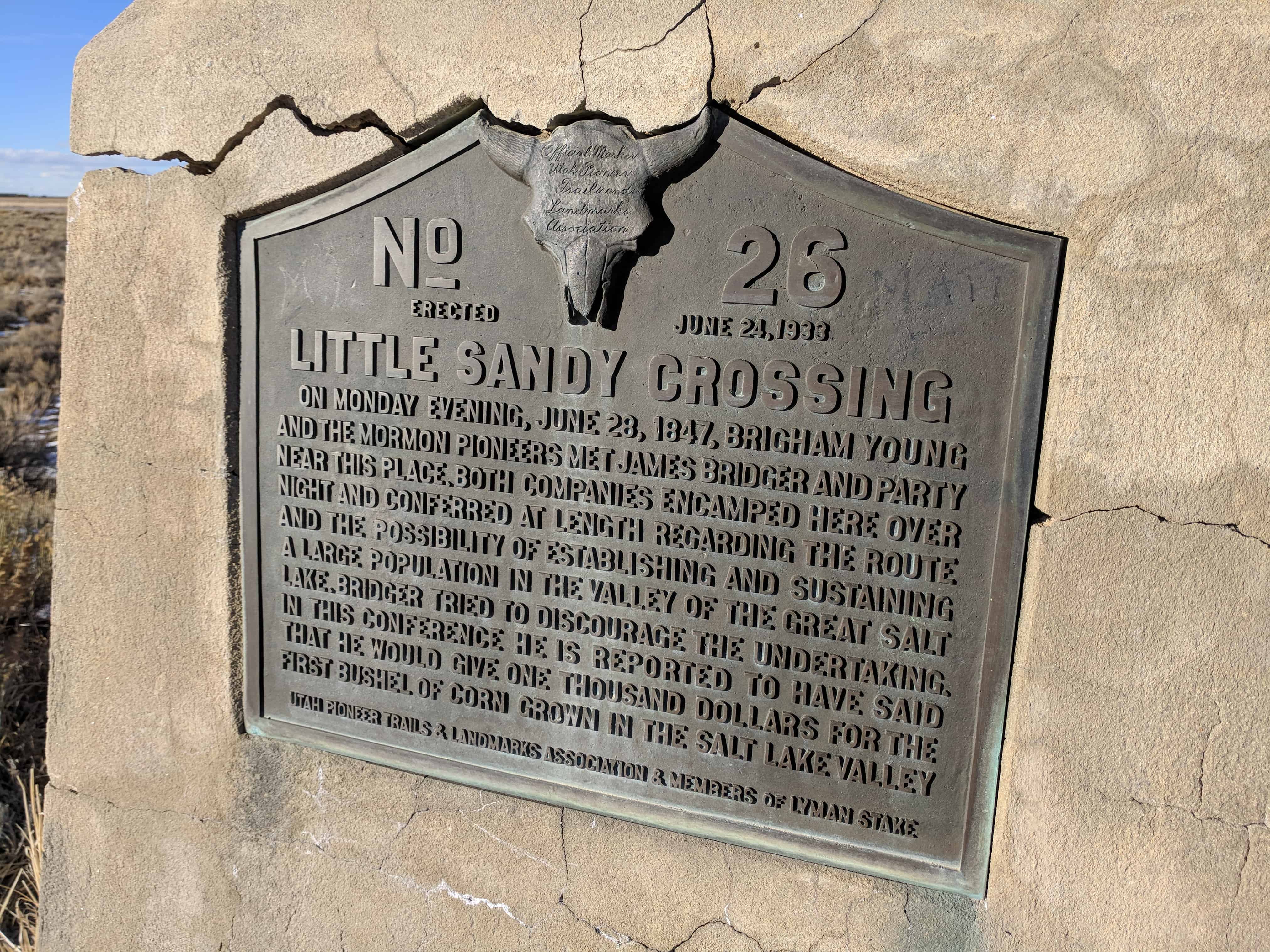
Little Sandy Crossing

On Monday evening, June 28, 1847, Brigham Young and the Mormon Pioneers met James Bridger and party near this place.  Both companies encamped here over night and conferred at length regarding the route and the possibility of establishing and sustaining a large population in the valley of the Great Salt Lake.  Bridger tried to discourage the undertaking.  In this conference he is reported to have said that he would give one thousand dollars for the first bushel of corn grown in the Salt Lake Valley.

2018-01-05 14.52.57

See other historic markers in the series on this page for UPTLA/SUP Markers.

picture2aug07-017
picture2aug07-018

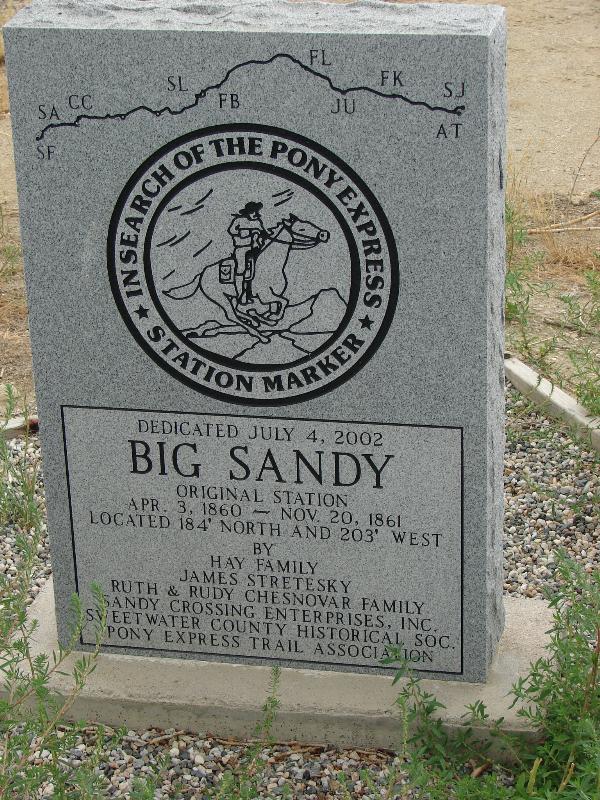
Pony Express Station – Big Sandy

15 Thursday Sep 2016

Posted by Jacob Barlow in Uncategorized

≈ 2 Comments

Tags

Farson, historic, Historic Markers, Pony Express, Sweetwater County, Wyoming, Wyoming Historic Markers

180cd54a-c46a-4f4d-a5ca-267bfeed4866

See also, Pony Express Stations.

Located 13 miles from Little Sandy Station and 15 miles from Big Timber Station at west edge of the town of Farson and east of Big Sandy Creek. (Henderson) Burned by Indians in 1862. The Sandy and Little Sandy flow past on the west and south. (Wyoming Guide) The Big Sandy was a stage station on the Overland route which was destroyed by the Indians when they set fire to several stage stations and farm houses in 1864. On the eastern division of the stage line, between Big Sandy and Thirty Two Mile Creek, every station but one was burnt by the Indians. Nearly every ranchman’s house between old Julesburg and Big Sandy was deserted. Big Sandy, Little Sandy and Old Dry Sandy were stage stations which were named from the creeks in that region. (WPA)

Cross Miry Creek. Road down Pacific Creek; water scarce for 20 miles. After 11 miles, “Dry Sandy Creek ;” water scarce and too brackish to drink ; grass little; sage and greasewood plentiful. After 16 miles, “Sublette’s Cut-off,” or the “Dry Drive,” turns N.W. to Soda Springs and Fort Hall: the left fork leads to Fort Bridger and Great Salt Lake City. Four miles beyond the junction is “Little Sandy Creek,” 20-25×2; grass, timber, and good camping-ground. Eight miles beyond is “Big Sandy Creek,” clear, swift, and with good crossing, 110×2. The southern route is the best; along the old road, no water for 49 miles. Big Sandy Creek Station.(*)

9f43766d-c2c8-4050-b756-bf882b5d479d

b400cbf4-7133-4543-878b-efc0ceb216c1

f75fa329-a959-42d8-8641-72a609902aad

More photos from another time stopping by, in January 2018.

2018-01-05 14.49.35

2018-01-05 14.49.56

2018-01-05 14.50.00


2018-01-05 14.50.06.jpg

2018-01-05 14.50.11

2018-01-05 14.51.27

Newer posts →

Follow Jacob

Follow Jacob

Come wander with me on Youtube.

Blog Stats

  • 2,096,056 hits

Social and Other Links

BarlowLinks.com

Recent Posts

  • Scout Monument
  • Provo High School Seminary Building
  • 821 E 100 S
  • 820 E 100 S
  • 817-819 E 100 S

Archives

Loading Comments...