Tooele County Courthouse and City Hall
The Tooele County Courthouse and City Hall was added to the National Historic Register (#83003194) on July 21, 1983 and is located at 41 East Vine Street in Tooele, Utah.
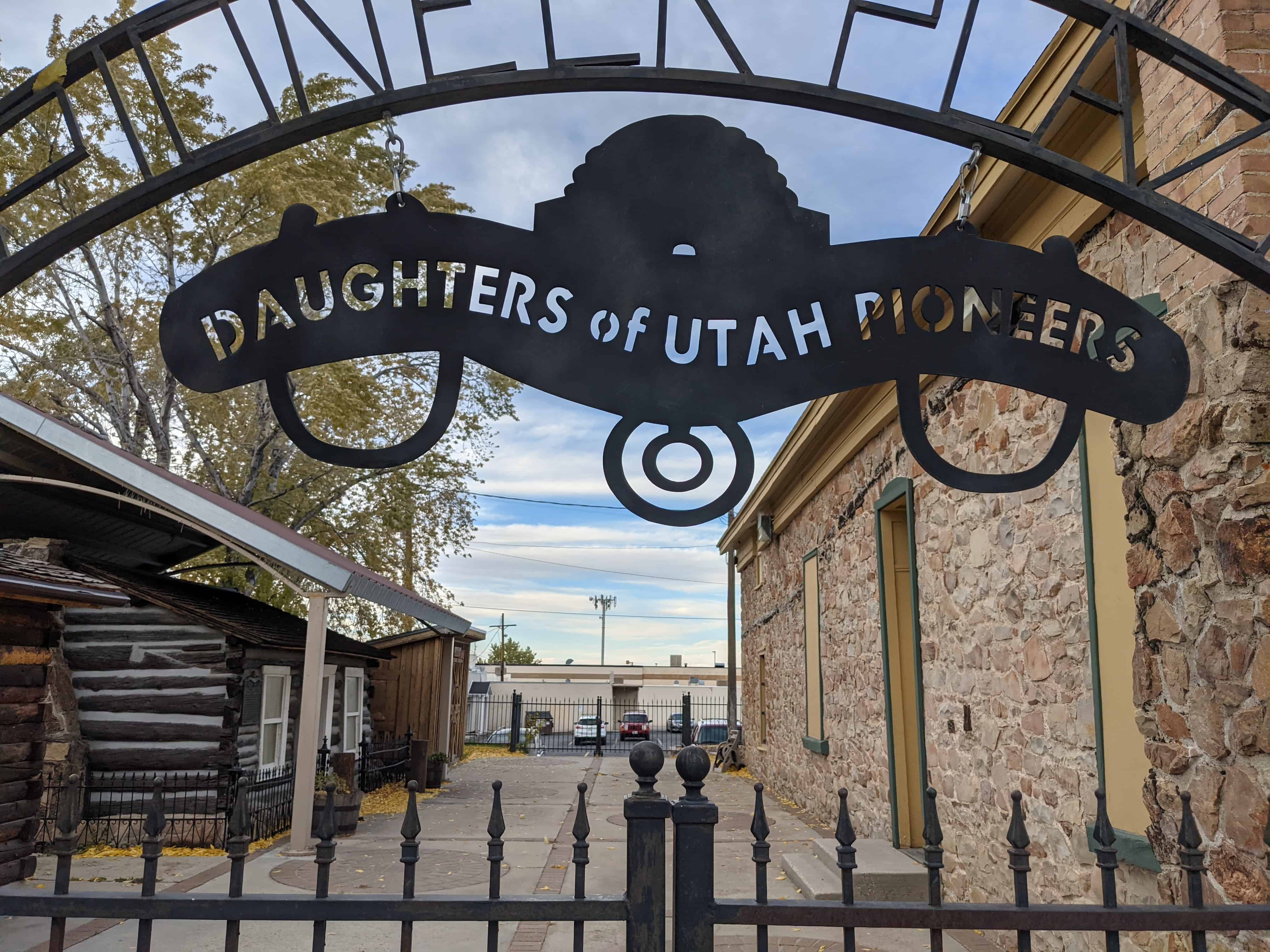
Pioneer City Hall – DUP Historic Marker #84 is located here.
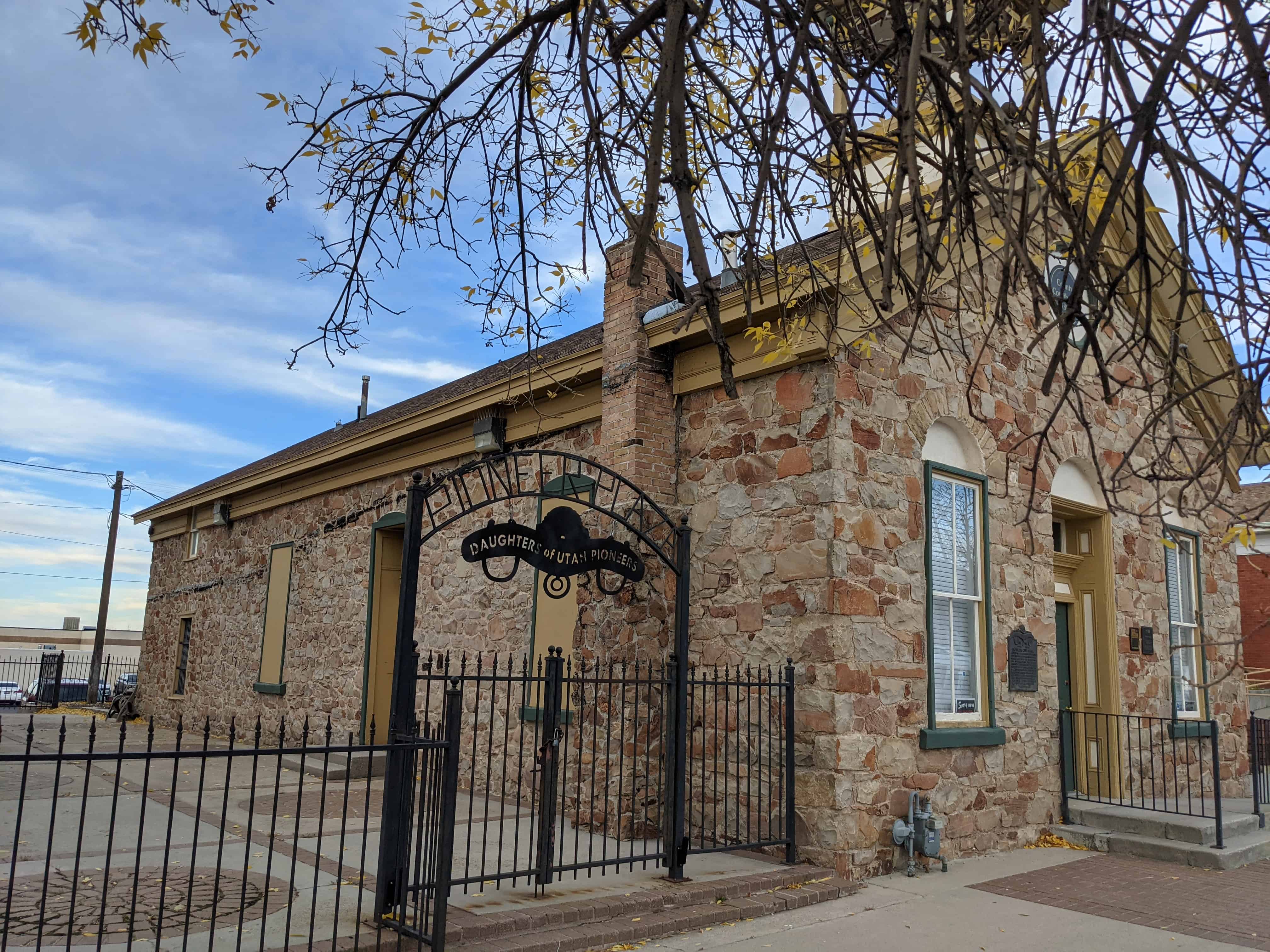
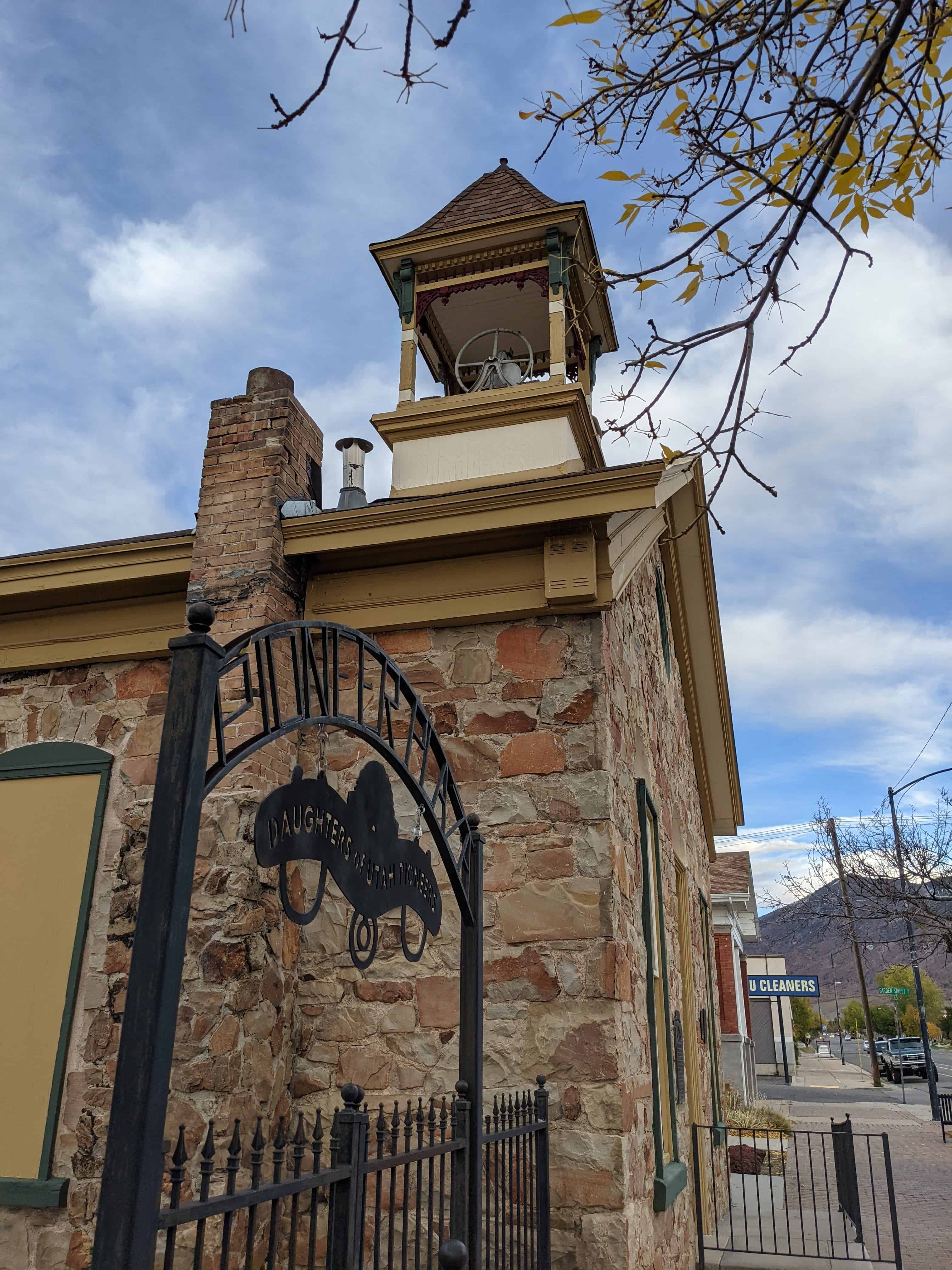
This Greek Revival temple-form building was constructed in 1867 using local stone. The belfry, added sometime after 1874, is Picturesque in style and has lathe-turned posts accentuated by scroll brackets, a distinctive spindle band, and a slightly bellcast pyramid roof. The hall was built, according to a newspaper article of the time, by the citizens of Tooele “for a dancing hall, for dramatic representations and other social and intellectual purposes.” It was leased to William C. Foster and Thomas Croft but was also used for holding court and other city and county business. Live entertainment, however, proved financially unsuccessful, and by 1871 the hall was utilized primarily as a courthouse. In 1899 a new courthouse was constructed, and the building became solely the city hall. In 1942, with the construction of a new city hall, it was authorized for use as a museum by the Daughters of the Utah Pioneers.
The text below is from the nomination form from when it was added to the register.

The Tooele County Courthouse and City Hall, built in 1867, is significant as an important governmental building in the historical development of Tooele County, Utah, and as an excellent example of an early city hall-county courthouse in the state. It is one of fourteen such structures documented and remains both the oldest (known to date) and only extant temple-form city hall in Utah The temple-form, which typically has its short end to the street and a pedimented gable façade in imitation of monumental classical buildings, originated in the Greek Revival period of American building, and was the first and most common building type used in Utah’s early public buildings. Tooele County, located immediately west of Salt Lake County, was organized in the 1851-52 period, some four years after the founding of Salt Lake City by Mormon pioneers. Within the county political framework, Tooele City functioned as the center, but did not gain votes as the County Seat until 1861, and did not become the effective location of county government until 1867, upon completion of this building. The red sandstone, rectangular structure, topped by a belfry (post-1874), also served as an early pioneer social center. It functioned as a courthouse and city hall until 1899, and as city hall until 1944; thus, the Tooele County Courthouse and City Hall formed a central link in the community’s social and political life. In 1968 the building was recorded by the Historic American Buildings Survey.
Tooele County, located approximately twenty-five miles west of Salt Lake City, and extending to the Nevada border, formed one of the earliest units of government in Utah. Settlement in the area reportedly occurred in 1849, with agricultural and milling activity dominant. Within this early period, Mormon ecclesiastical authority also served political purposes; but in 1851 Tooele County was organized and the “first” civil political government in the county was formed in 1852. Although Tooele City, incorporated on January 3, 1853 — the fifth incorporated settlement in Utah was the predominant settlement, the Territorial legislature placed the county seat at Richville. However, in 1861 that act was repealed and citizens voted to make Tooele City the seat of county government. County court continued to be held alternately in Tooele, Richville, and Grantsville until 1867 when the new building was constructed in Tooele to house county facilities.
The structure was built in 1867 of red sandstone, in an uncoursed rubble masonry construction. Interestingly, this time marked a transitional period in building materials and ideas of permanence in the Tooele area. Writing from Tooele in March, 1867, Eli B. Kelsey stated:
The time honored “adobe” is fast loosing [sic] prestige as a building material, and brick and rock are rapidly taking its place. The primitive log cabin, with its turf roof, is fast approaching its destiny, namely, to shelter the lower orders of the animal creation for a little season, and then become one of the things of the past, while the “genus homo” find refuge in structures of brick and stone, with shingle roofs.
In August, 1867 a newspaper article reported that the citizens of Tooele were constructing a social and multi-purpose hall, which was “being done by shares.” The notice continued, “the house is substantially built of rock; its dimensions, 60 x 30. It will be used for a dancing hall, for dramatic representations and other social and intellectual purposes. It is estimated that this building will cost twelve thousand dollars.” In addition, the structure was to house county and city records, and form a type of community center.
According to one source, bids to erect the structure were actually submitted to county officials on February 13, 1865. Those involved in the construction were: Isaac Lee, James Hammond, W. C. Gollaher, and John Gordan. The architect is unknown. A basement was then excavated, where a jail was to be located, and a foundation laid. A Tooele County history noted that a two-room structure started by Isaac Lee, one of the contractors, was purchased and placed on the foundation. Finish work was then completed, including the plastering of the interior by George Atkin and George W. Bryan.
In describing the building’s use, the Daughters of Utah Pioneers, History of Tooele County, records:
Upon the completion of these two rooms, it was decided that the building might serve as the general entertainment and amusement center for the community, inasmuch as no such building was then available and could also be used for purposes of holding court or transacting any city or county business also. A committee was appointed to consider any suggestions or offers from anyone who might be interested. An offer of leasing the building to present home dramatic plays and entertainments was made by William C. Foster and Thomas Croft, and was considered favorable by the council.
On December 25, 1870, the first entertainment was held in this building and the leasors offered a rental of $400.00 for the building. However, due to hard times the financial end of the project was not so good, and in April of 1871, the leasors appeared before the council and petitioned them to be merciful, and offered all the furnishings they had acquired for dramatic purposes in payment of the overdue rent. This petition was accepted and the building was from then on used as a court house except for special entertainments given on very special occasions.
. . .it became necessary to build onto the building to enlarge the jail quarters. The Tooele City officials then petitioned the county officials to permit them to use a portion of the building for city offices. This was granted.
Thus, the Tooele County Courthouse and City Hall continued to function as such until 1899. At that time a new court house was built and the county moved into that facility. The structure then became solely the City Hall, until 1941 when Tooele City erected a new building. In 1942 the city leased the 1867 structure to the Daughters of Utah Pioneers for fifty years. That group utilizes the hall as a museum.

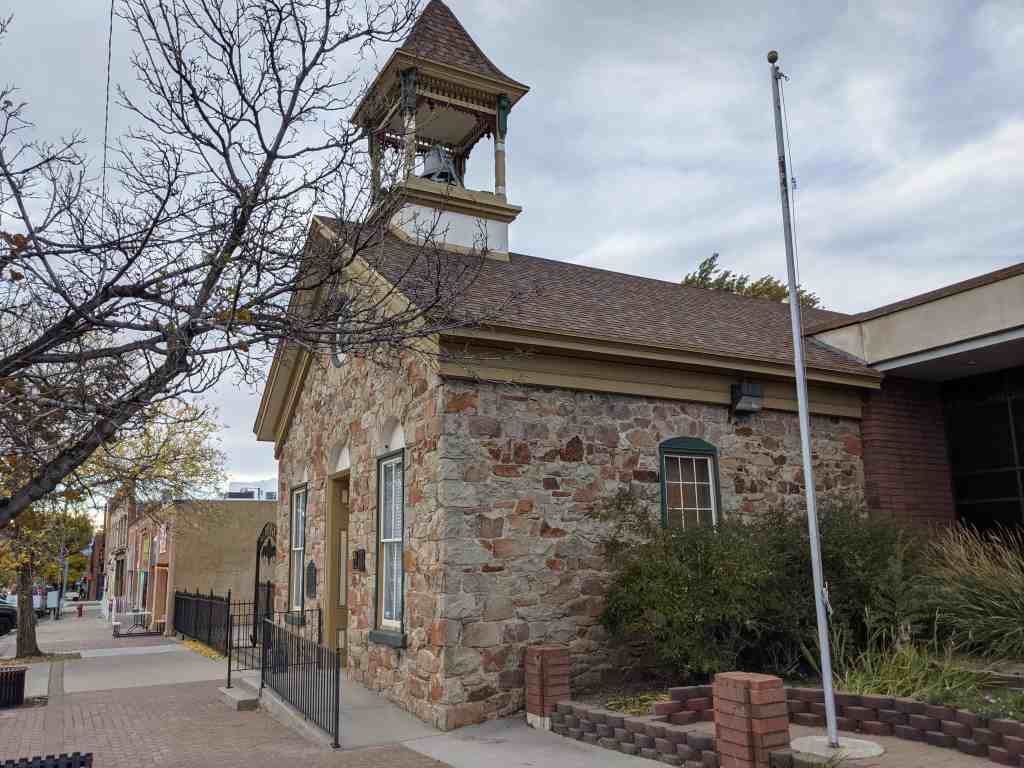
The Old City Hall is a Greek Revival inspired temple-form stone building. It was built in 1867 of uncoursed rubble masonry containing some red sandstone. The building is a rectangular form (27′-3″ x 66′-5″), one story in height at the front, and two stories at the rear. It has a gable roof. A belfry was added sometime after 1874.
This building is oriented with its gable end toward the street, a typical characteristic of temple-form buildings. It has a heavy wooden cornice, and a door is centered between two windows on the façade. A round date stone is located in the point of the gable over the door. Each of the openings on the façade has a semicircular relieving arch of stone, and the date stone is also surrounded by a ring of stone pieces. The windows are the two over two double hung sash type. There is a segmented transom over the door.
Originally the building had three long, narrow windows on the east and west side walls. A window on the east wall was later enlarged to contain an inset door, providing additional access to the interior of the building. A modern addition, made in the 1970s which connects the old courthouse to the city library, resulted in covering two of the windows on the west wall. These changes, however, have not affected the original integrity of the building. The door in the east wall was added well within the historic period, and the brick addition attached to the rear of the west side is unobtrusive, and has provided access to the building, so that it may function as part of a cultural complex.
The belfry, reflecting the influence of the Picturesque movement which followed the period of the Greek Revival, has lathe turned posts accented by scroll brackets, and a distinctive spindle band. It has a slightly bellcast pyramid roof. The addition of the belfry may have been an attempt by the Tooele townspeople to highlight the building in the Victorian period when because of its small scale it would not have been as distinctive among the larger buildings of the period. It may also represent an attempt to bring the building up to date using decorative features of the period. Or, it may have been added strictly for practical reasons, and was designed using the most typical decorative features of the period.
The Old City Hall in Tooele is an excellent, well preserved example of a Greek Revival inspired temple-form building. It has received alterations, previously mentioned, which were made to allow it continual use, but which do not affect the original integrity of the building.