• About JacobBarlow.com
  • Cemeteries in Utah
  • D.U.P. Markers
  • Doors
  • Exploring Utah Email List
  • Geocaching
  • Historic Marker Map
  • Links
  • Movie/TV Show Filming Locations
  • Oldest in Utah
  • Other Travels
  • Photos Then and Now
  • S.U.P. Markers
  • U.P.T.L.A. Markers
  • Utah Cities and Places.
  • Utah Homes for Sale
  • Utah Treasure Hunt

JacobBarlow.com

~ Exploring with Jacob Barlow

JacobBarlow.com

Tag Archives: indians

Schellbourne: Gateway to the Goshute Nation

18 Thursday Aug 2022

Posted by Jacob Barlow in Uncategorized

≈ Leave a comment

Tags

Goshutes, indians

Schellbourne: Gateway to the Goshute Nation

Before Schellbourne: Before the Lincoln Highway, before the Pony Express, and before wagon trains rolled across the plains, the Kusiutta people (the Goshute people) lived here. This desert home made survival difficult, but the extreme climate and remote location protected and isolated the Goshutes from encroaching settlers.

Life in the Great Basin: The surrounding area is part of the Great Basin, and land mass consisting oh high mountain peaks and low desert valleys. Living in the basin was extremely challenging for the Goshute people as they faced dramatic changes in temperature and unforgiving terrain. However, the people connected with the land and prospered in the area. They hunted deer, elk, and antelope, and gathered berries, roots, pine nuts, and grasses to sustain themselves.

A Life Changed: Though the desolation of the area served to protect the Goshutes, in 1827 outsiders arrived and began to influence the people. By the mid-1800s, essential lands were overtaken by the settlers to make way for stage stations and Pony Express routes. The placement of the stations and routes prevented the Goshute people from accessing water and their traditional hunting and gathering sites.

With access to their lands restricted, hostilities grew between the settlers and the Goshutes. The tensions burned for several years until a treaty was on October 12, 1863. The treaty ultimately resulted in the creation of two reservations: 17,248 acres for the Skull Valley Goshute band and 108,000 for the Deep Creek Goshute band, though the reservations were not formally established until 1912.

A life to Live: The Goshute people have faced many hardships since the first group of trappers and explorers entered their lives in 1827, forever changing the Goshute story. In the midst of the chaos and upheaval , the people have maintained their cultural values and have continued to foster their connection to the arid desert landscape. It is this connection that keeps them bound to their birthplace, connected to their ancestry, and looking forward to a lasting future.

This historic marker is located at the Schellbourne Rest Area is located along Highway 93 in Nevada.

A Heritage of Respect

18 Monday Apr 2022

Posted by Jacob Barlow in Uncategorized

≈ Leave a comment

Tags

Historic Markers, indians, Ute

You are standing on ground once considered a part of the “traditional” hunting and fishing grounds of the Ute Indians.

During the 19th century, tensions multiplied when white settlers began to hunt, fish, farm and fence these traditional areas. Between 1853 and 1872, many people were killed in battles for this land and its resources.

In 1873, a Mormon delegation arrived at Fish Lake to make peace with the Utes. This treaty, signed along the southwestern shores of Fish Lake, has never been broken.

Today, fish Lake is visited and enjoyed by people from many cultures. To protect this beautiful lake and its resources, learn from the wisdom of those who used this land before you. Dispose of your garbage properly and practice proper hunting and fishing etiquette.

This marker is located at Fish Lake very near the marker Peace Treaty with Fish Lake Indians.

Utah’s Largest Indian Battle was Called the “Battle of Provo River.”

29 Tuesday Oct 2013

Posted by Jacob Barlow in Uncategorized

≈ 4 Comments

Tags

battles, historic, indians, Provo, utah, utah county

2017-10-07 11.33.49

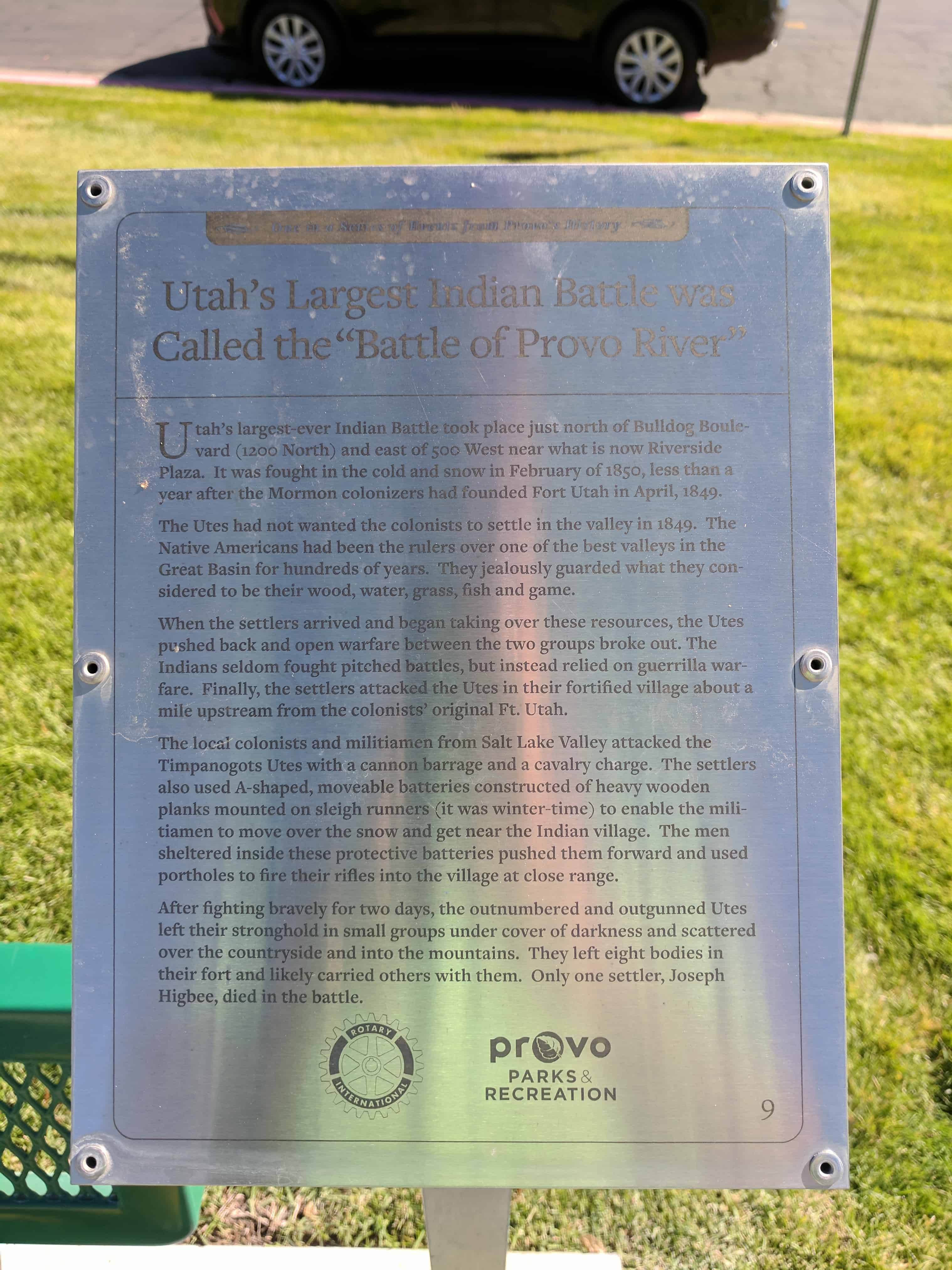
Utah’s largest-ever Indian Battle took place just north of Bulldog Boulevard (1200 North) and east of 500 West near what is now Riverside Plaza.  It was fought in the cold and snow in February of 1850, less than a year after the Mormon colonizers had founded Fort Utah in April, 1849.

The Utes had not wanted the colonists to settle in the valley in 1849.   The native Americans had been the rulers over one of the best valleys in the Great Basin for hundreds of years.  They jealously guarded what they considered to be their wood, water, grass, fish and game.

When the settlers arrived and began taking over these resources, the Utes pushed back and open warfare between the two groups broke out.  The Indians seldom fought pitched battles but instead relied on guerrilla warfare.  Finally, the settlers attacked the Utes in their fortified village about a mile upstream from the colonists’ original Ft. Utah.

The local colonists and militiamen from Salt Lake valley attacked the Timanogots Utes with a cannon barrage and a cavalry charge.  The settlers also used A-shaped, moveable batteries constructed of heavy wooden planks mounted on sleigh runners (it was winter time) to enable the militiamen to move over the snow and get near the Indian village.  The men sheltered inside these protective batteries pushed themselves forward and used portholes to fire their rifles into the village at close range.

After fighting bravely for two days, the outnumbered and outgunned Utes left their stronghold in small groups under cover of darkness and scattered over the countryside and into the mountains.  They left eight bodies in their fort and likely carried others with them.  Only one settler, Joseph Higbee, died in the battle.

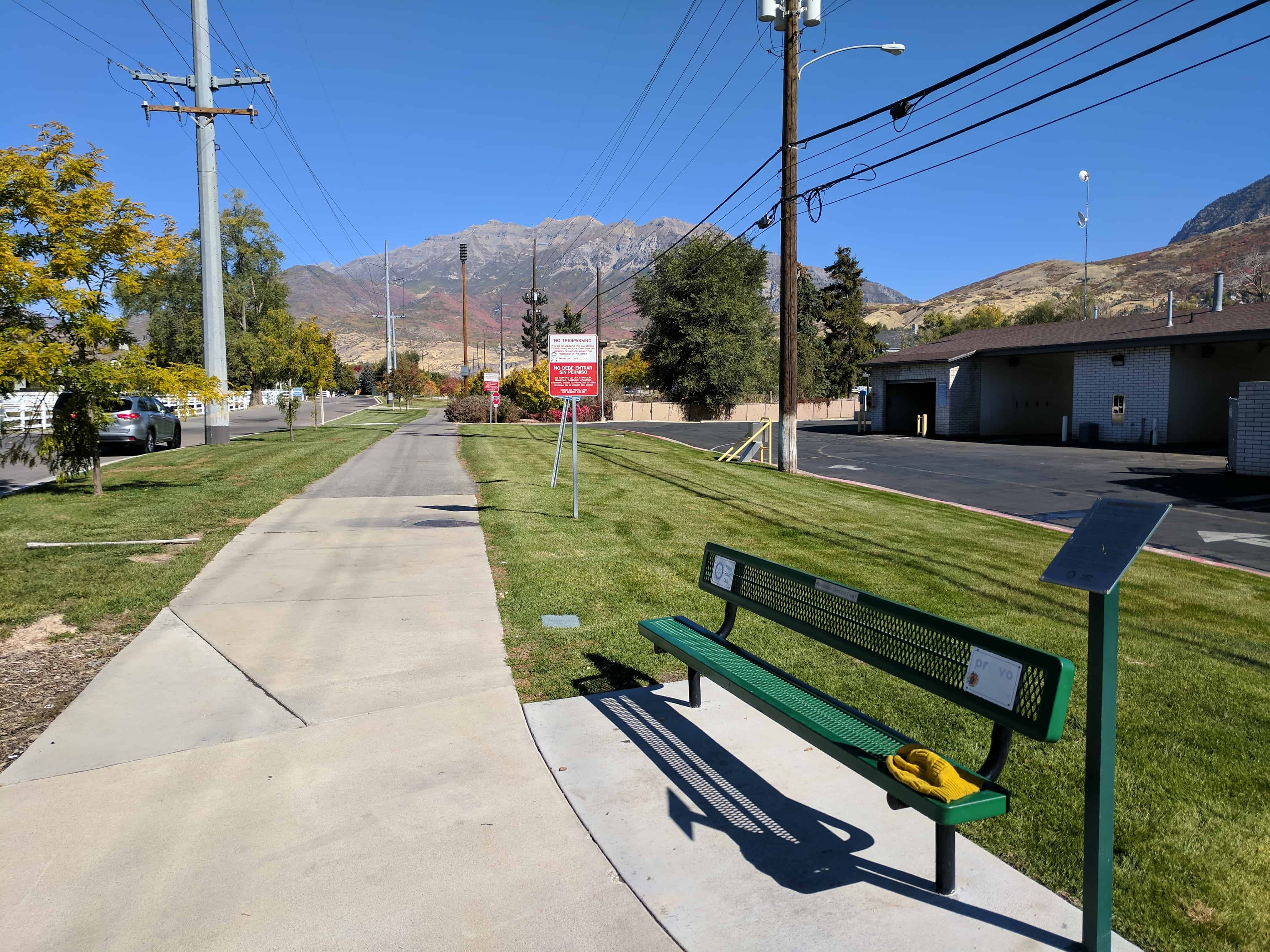
This marker is #9 in a series, see the others on this page. The marker is located at 37 West 3700 North in Provo, Utah

Image

2017-10-07 11.33.59

Follow Jacob

Follow Jacob

Blog Stats

  • 2,044,947 hits

Social and Other Links

BarlowLinks.com

Recent Posts

  • Anson Call
  • Jane Elizabeth Manning
  • Green Flake
  • Hark Wales & Oscar Smith
  • Threshing Machine

Archives


Loading Comments...