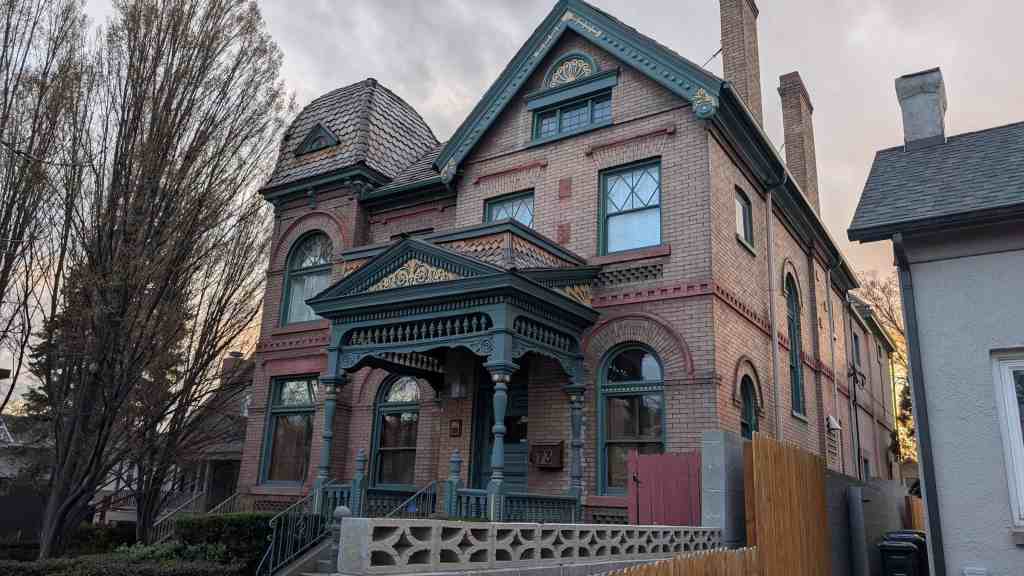
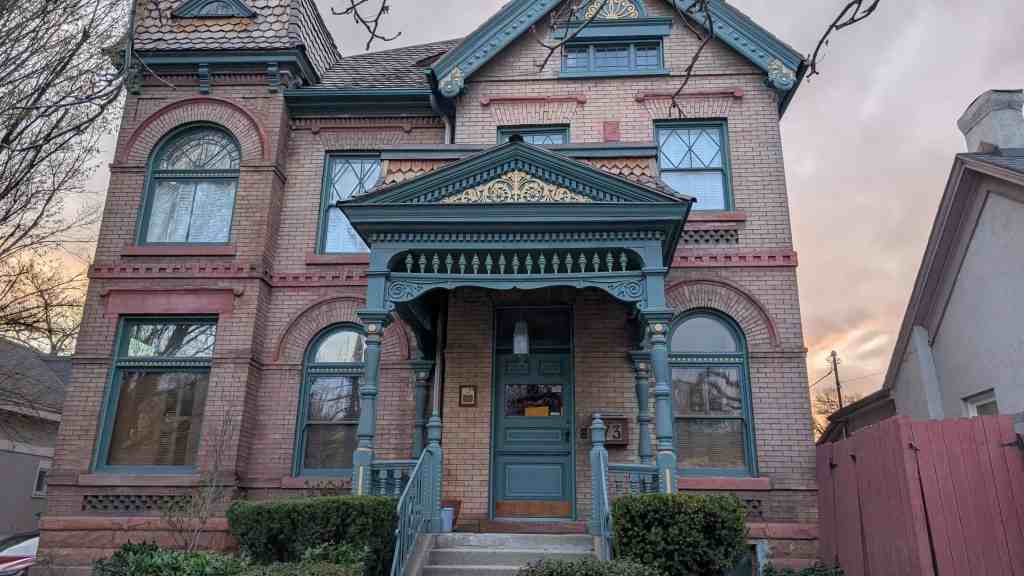
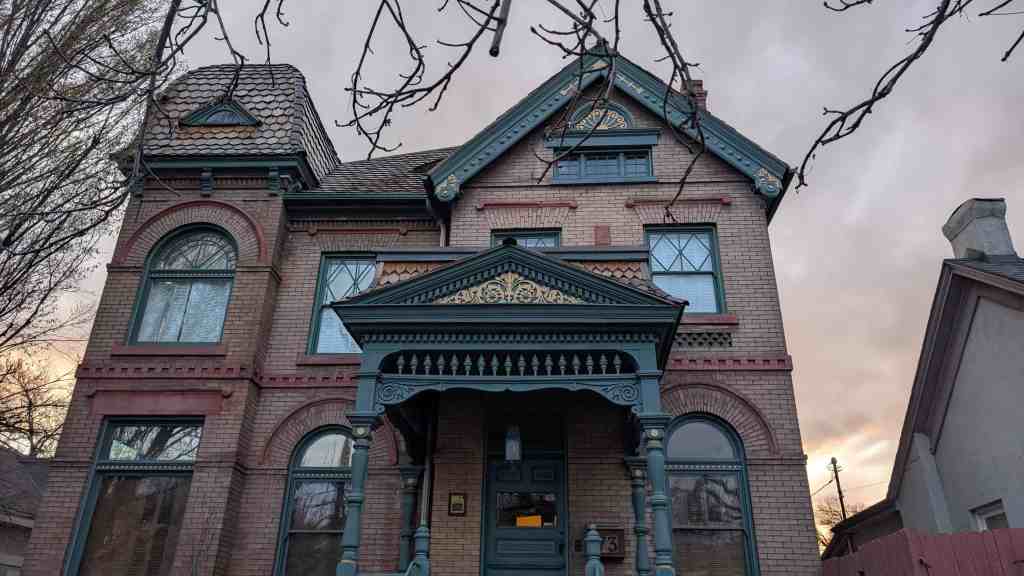
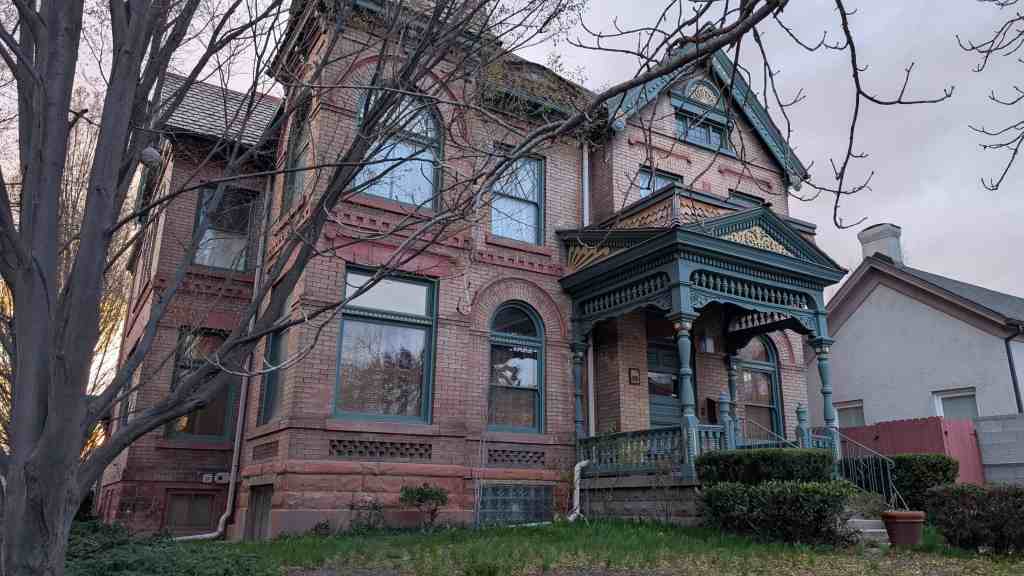
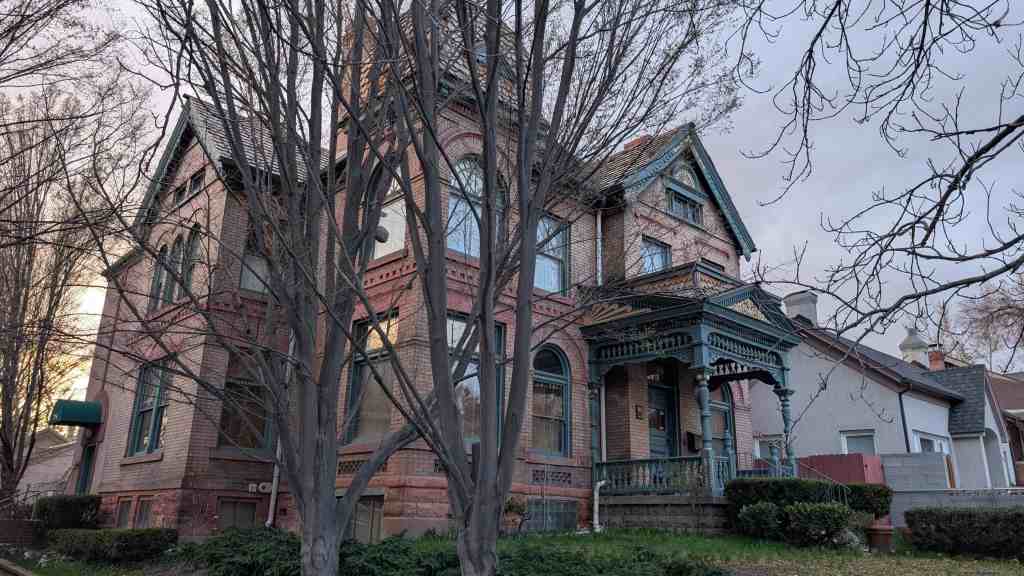
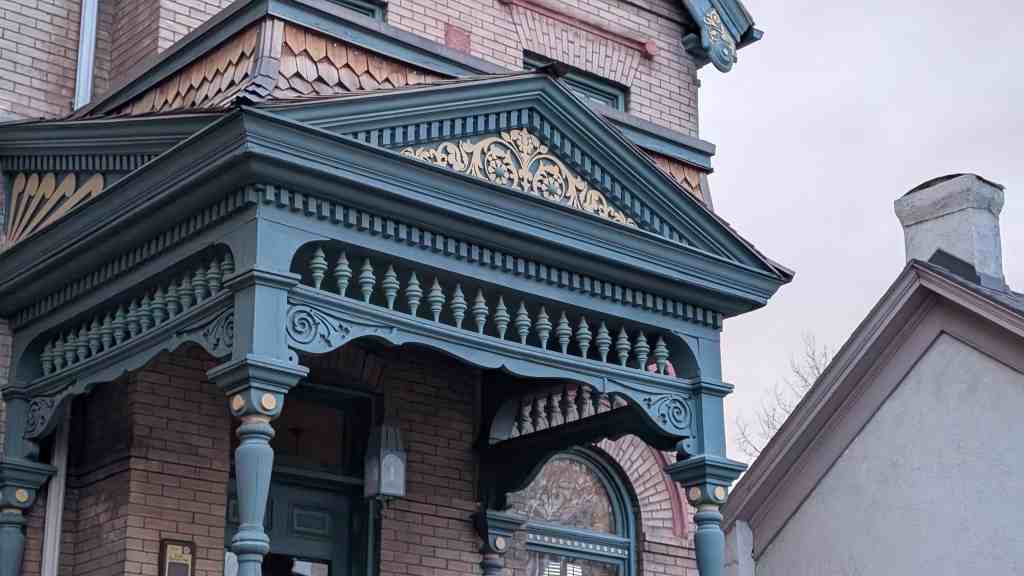
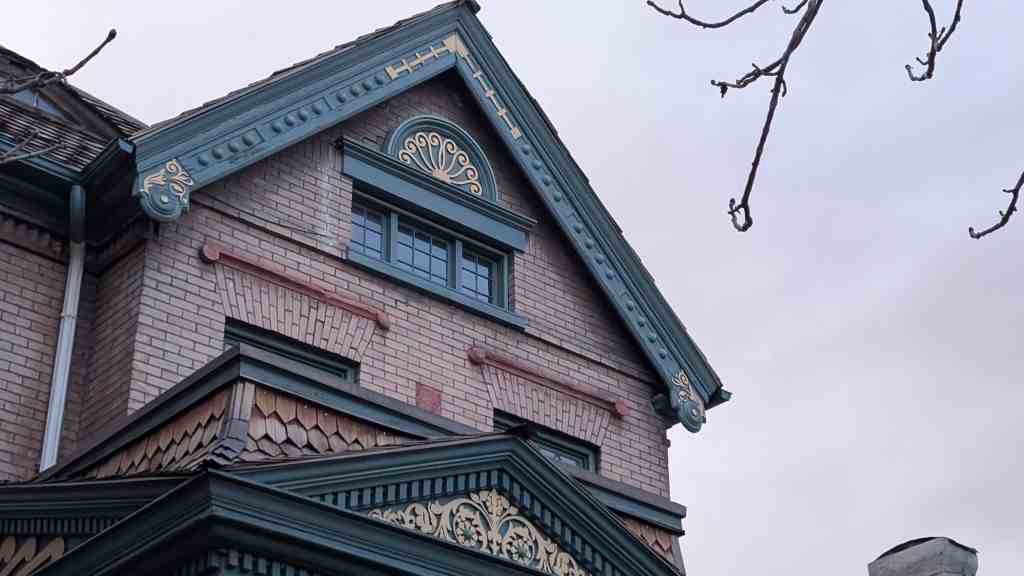
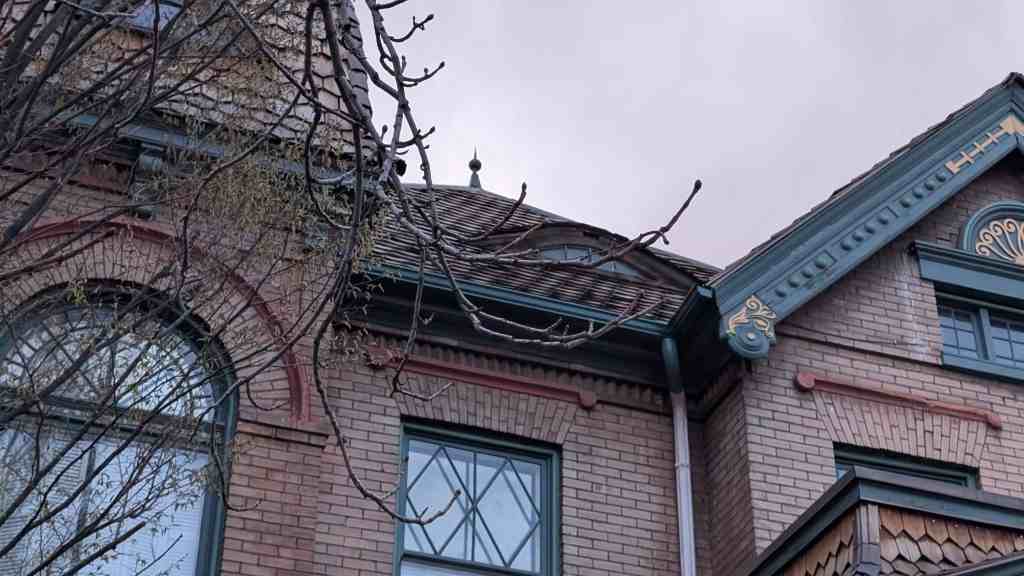
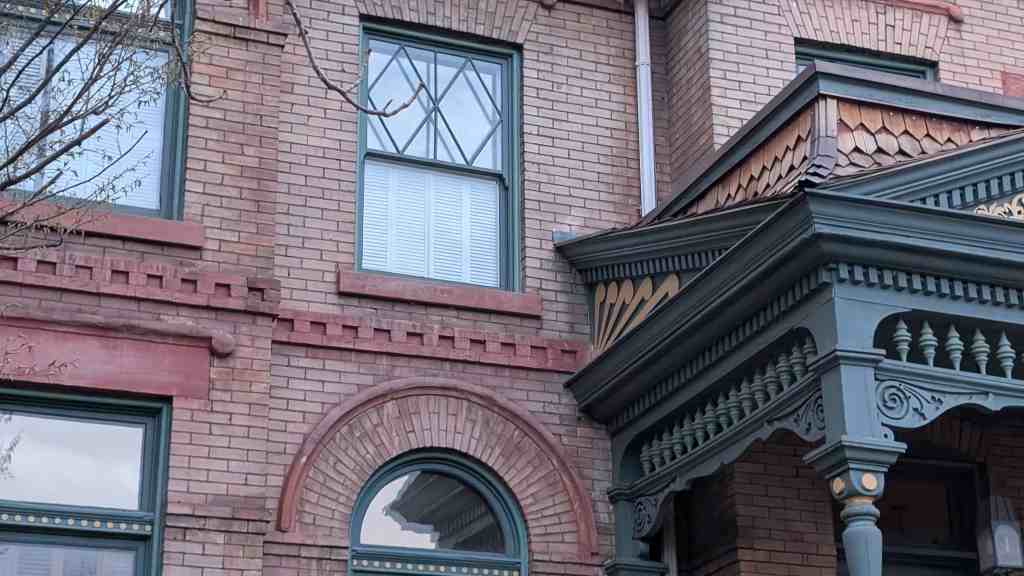
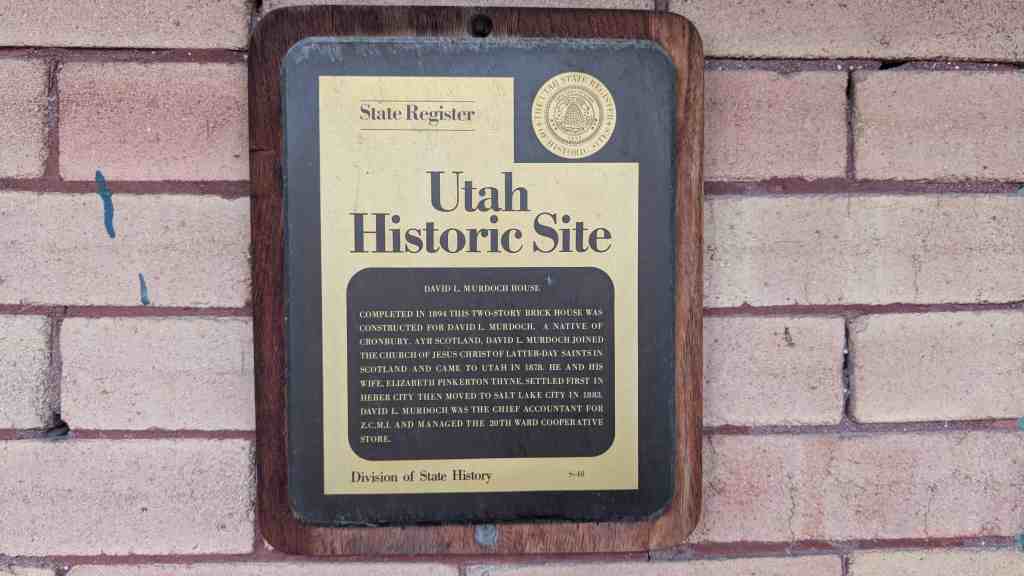
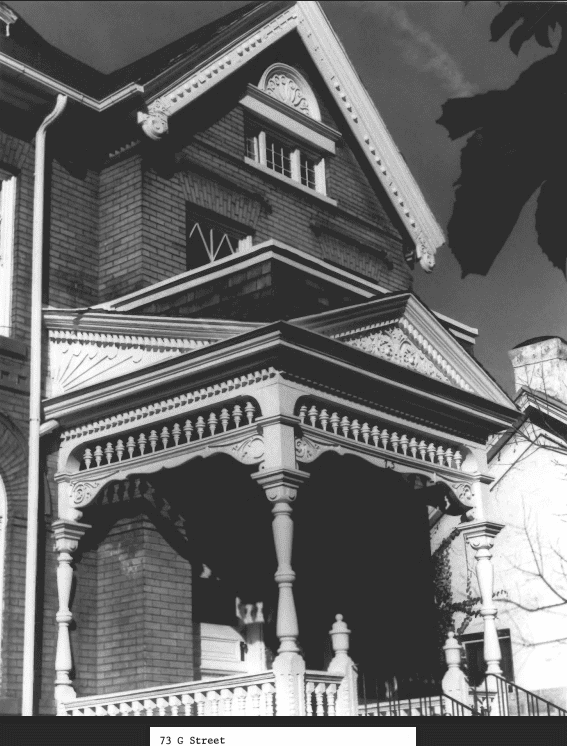
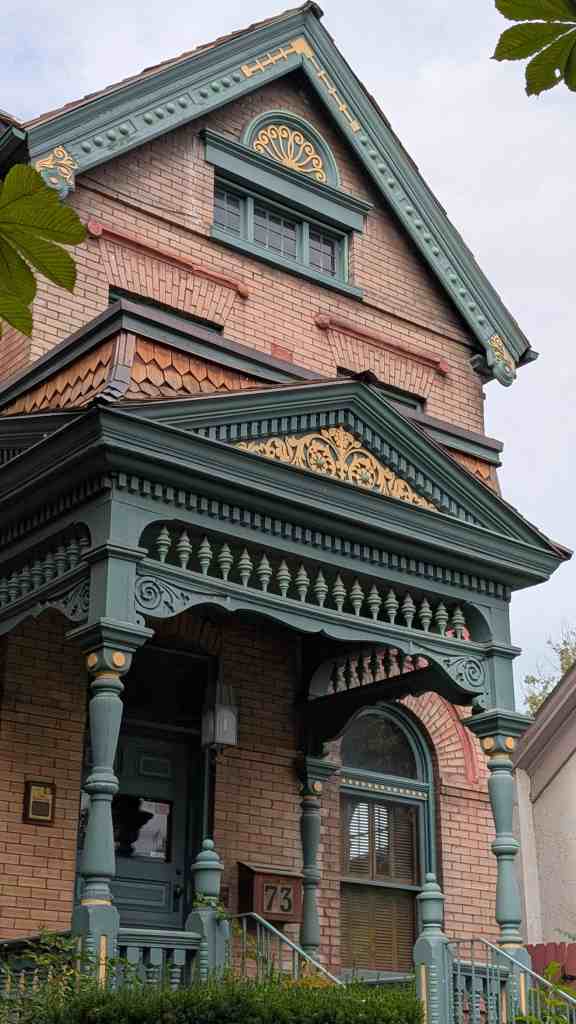
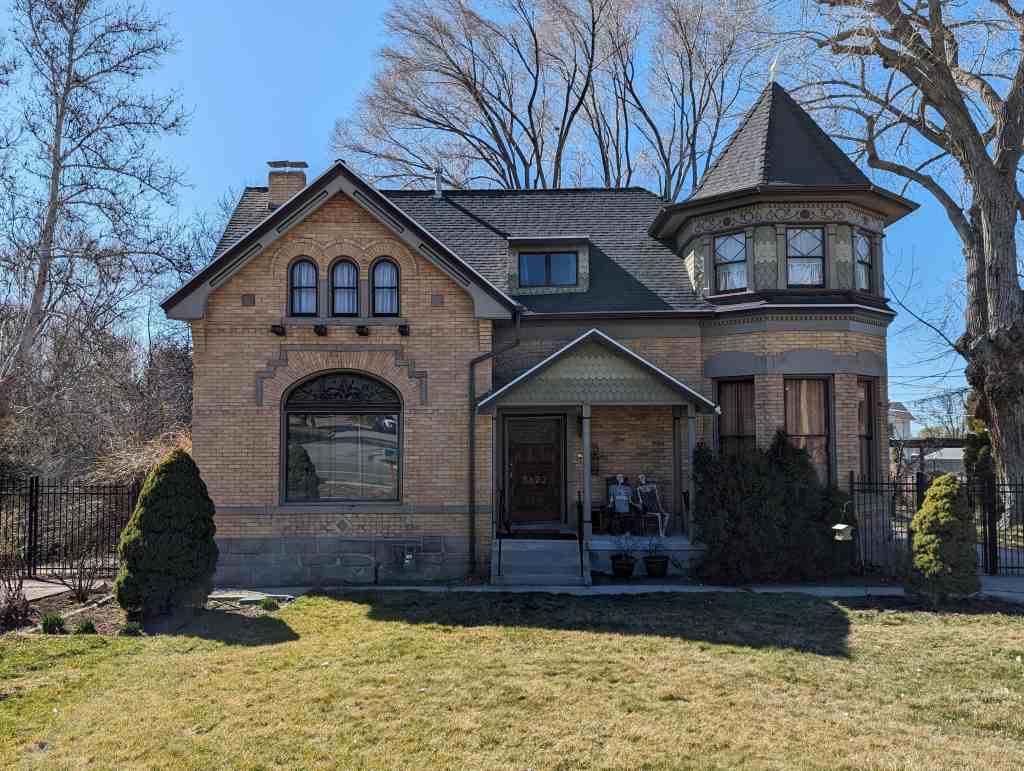
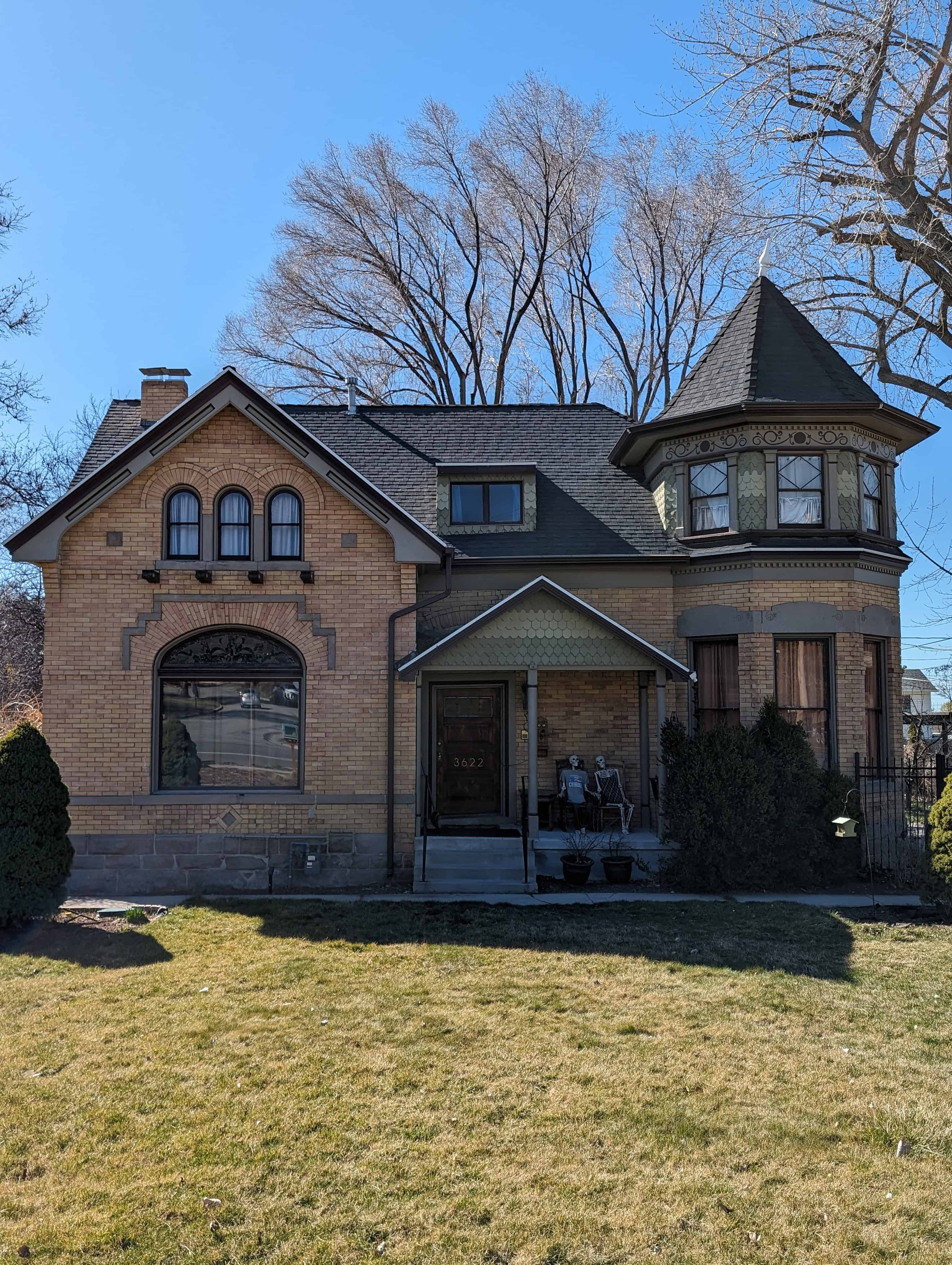
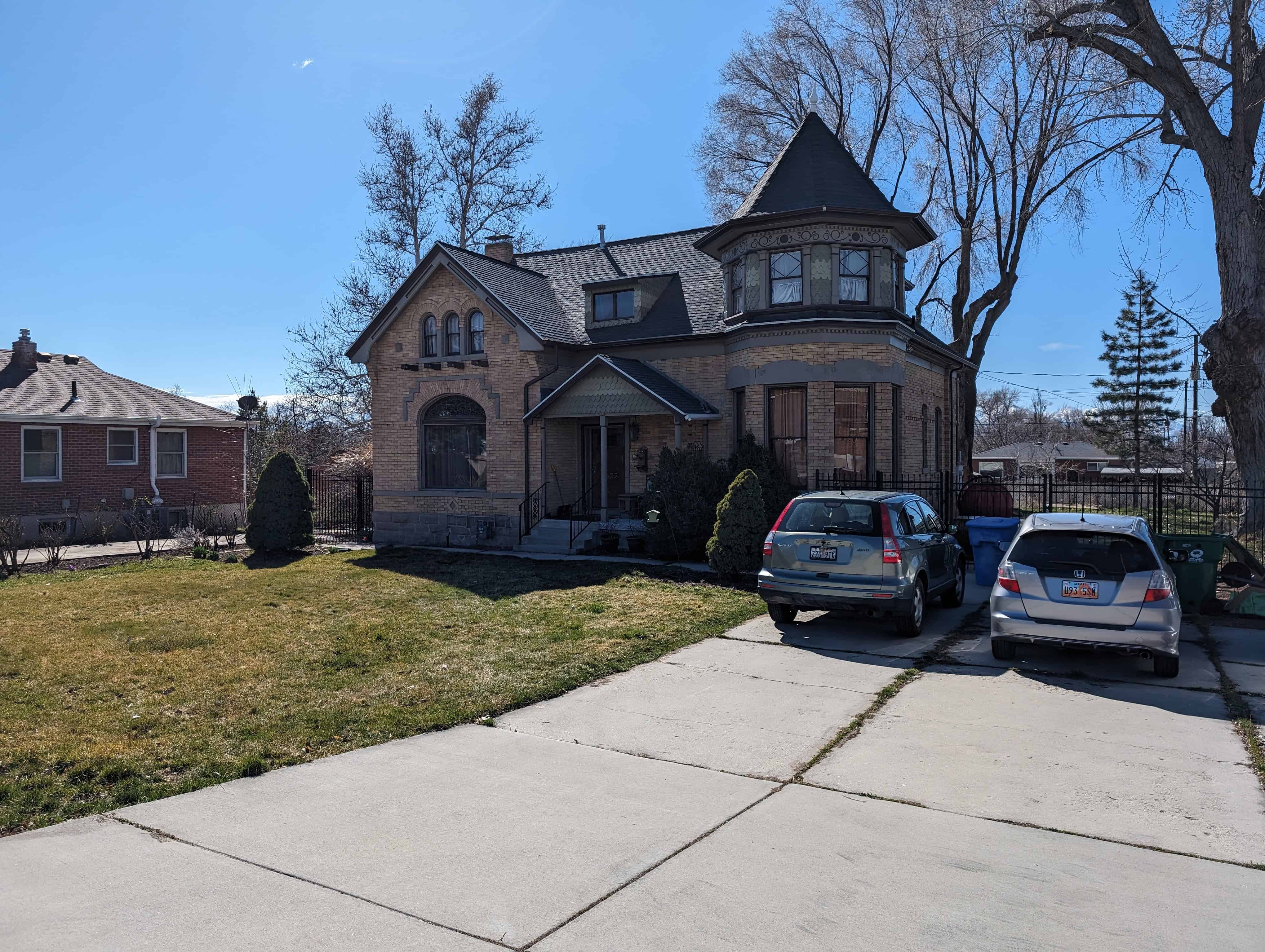
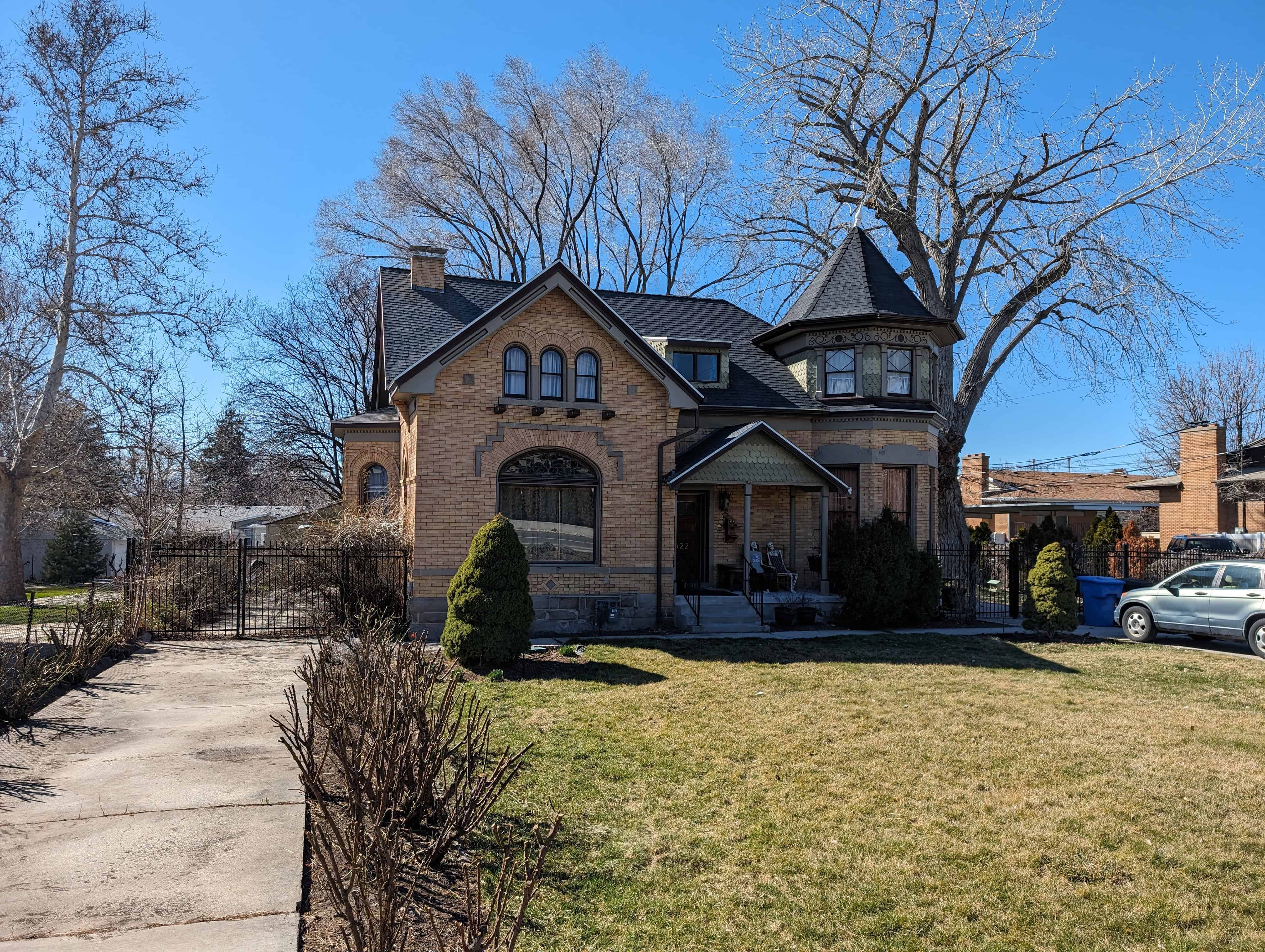
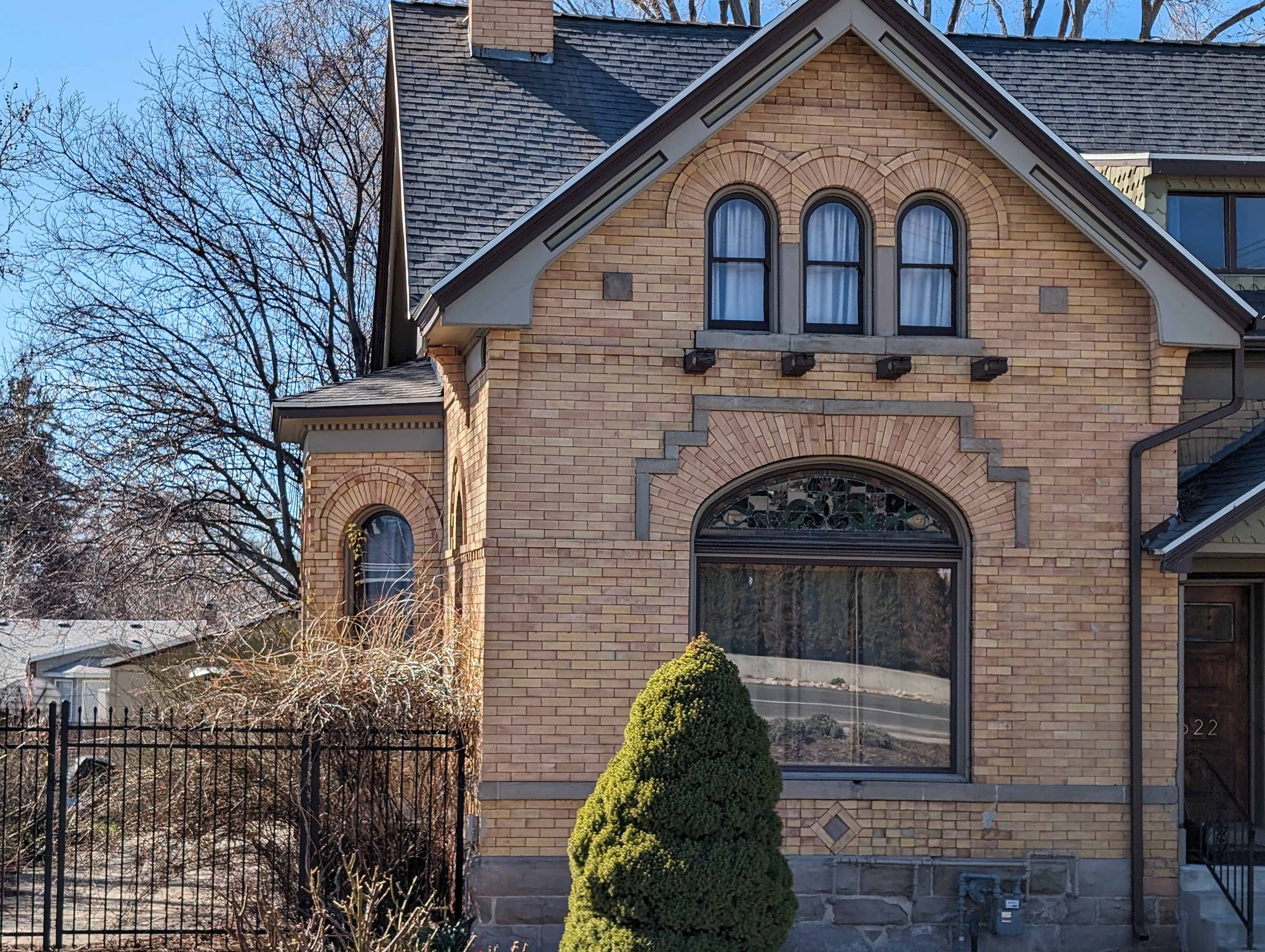
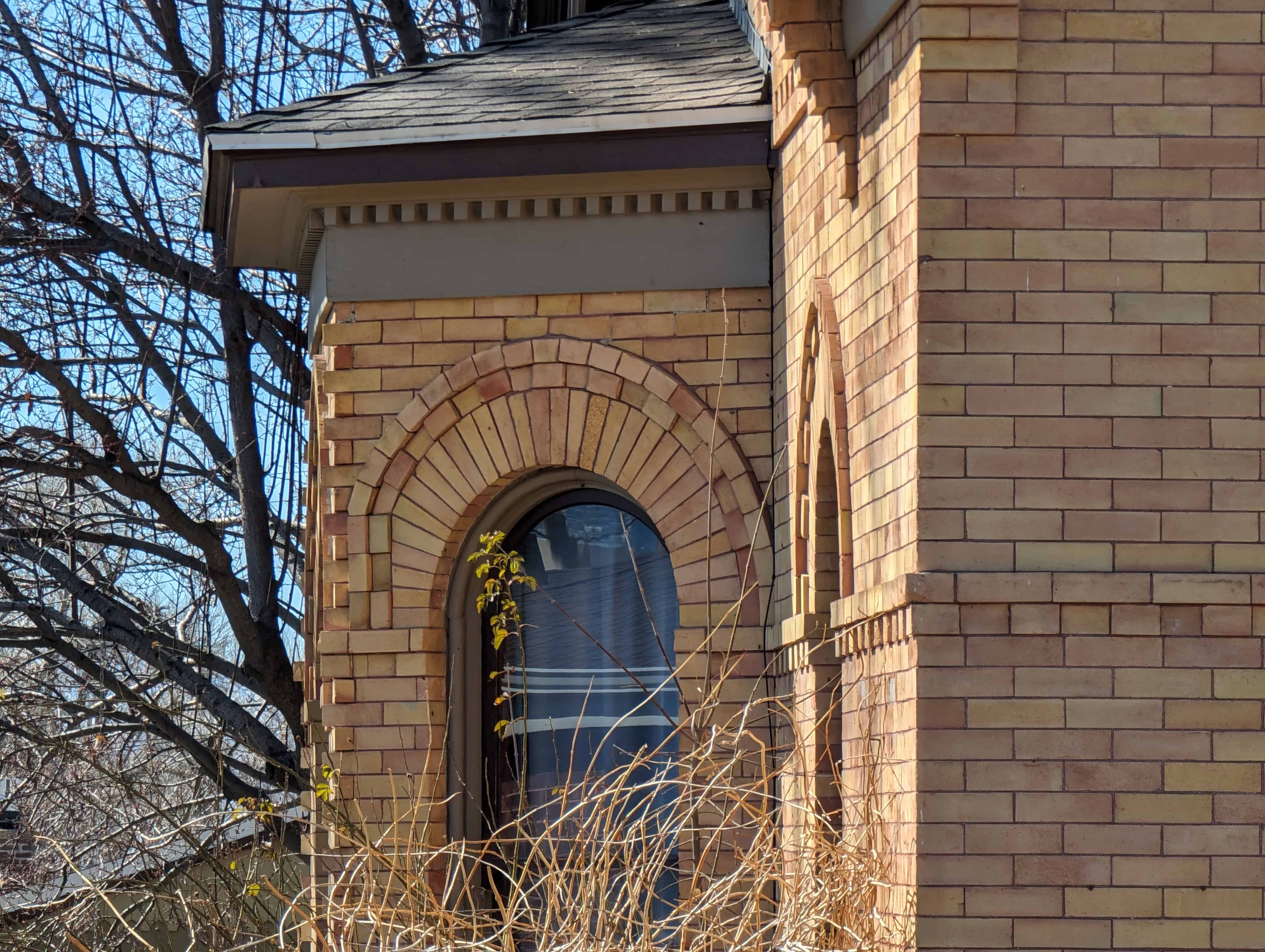
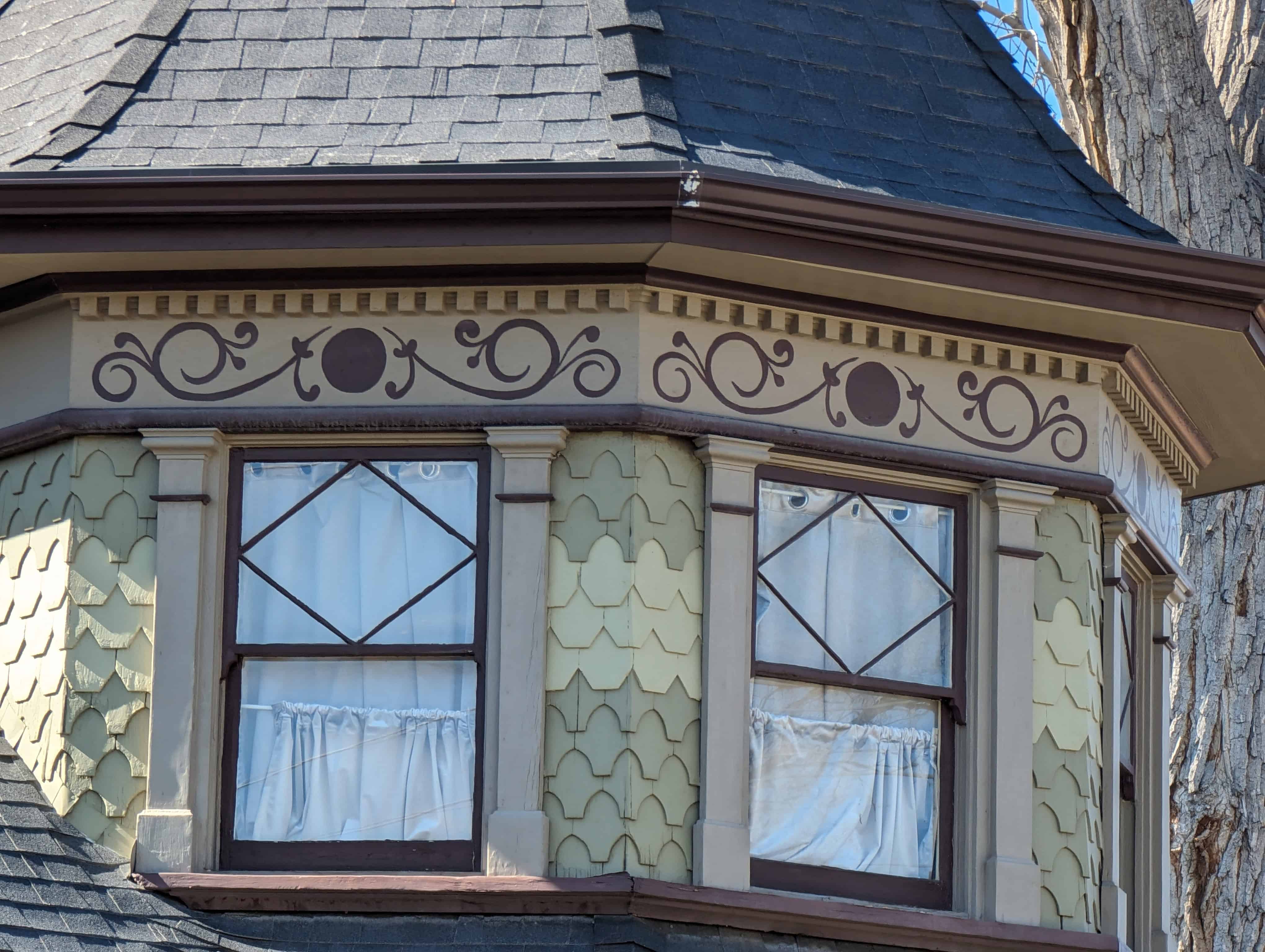
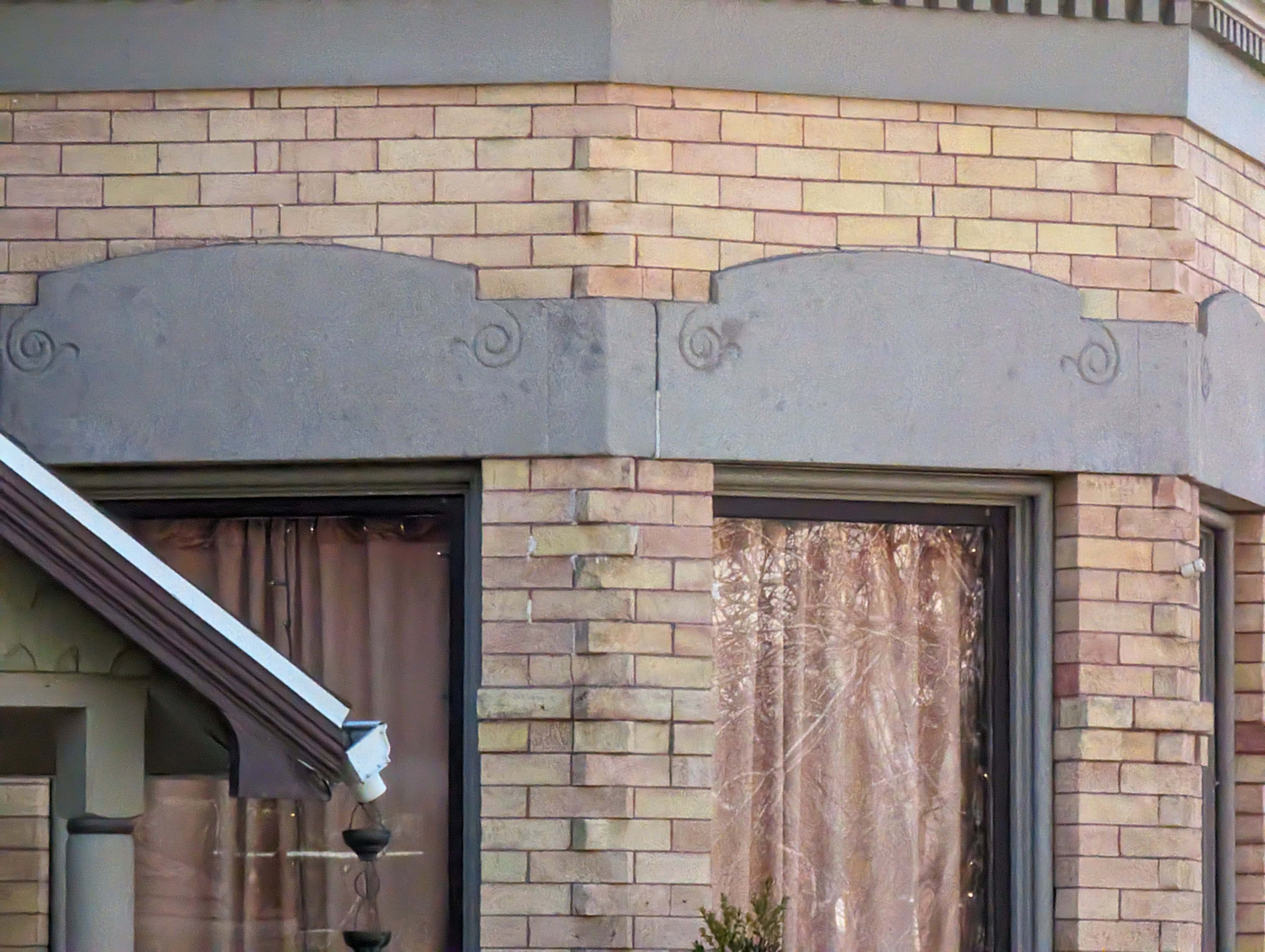
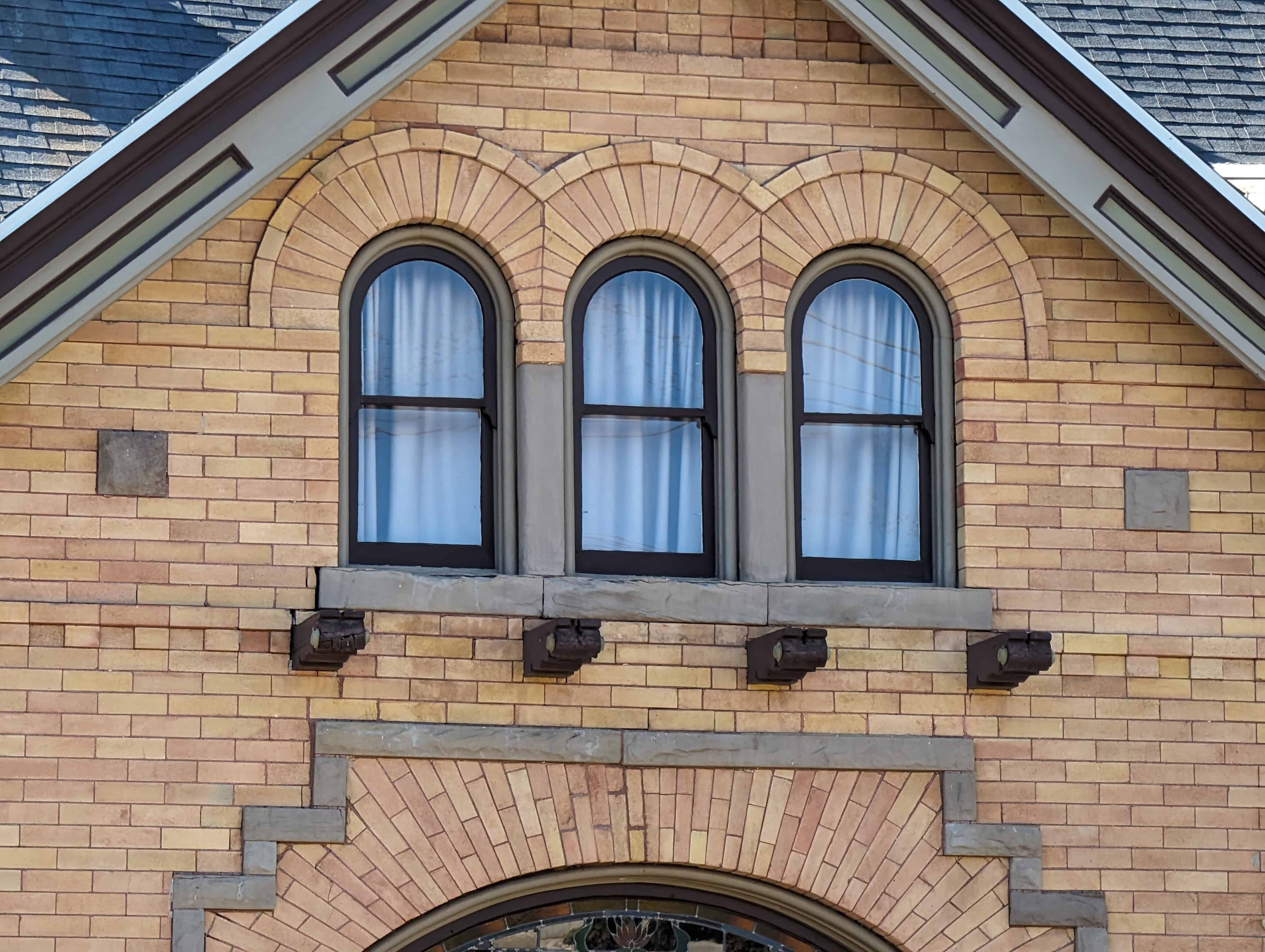
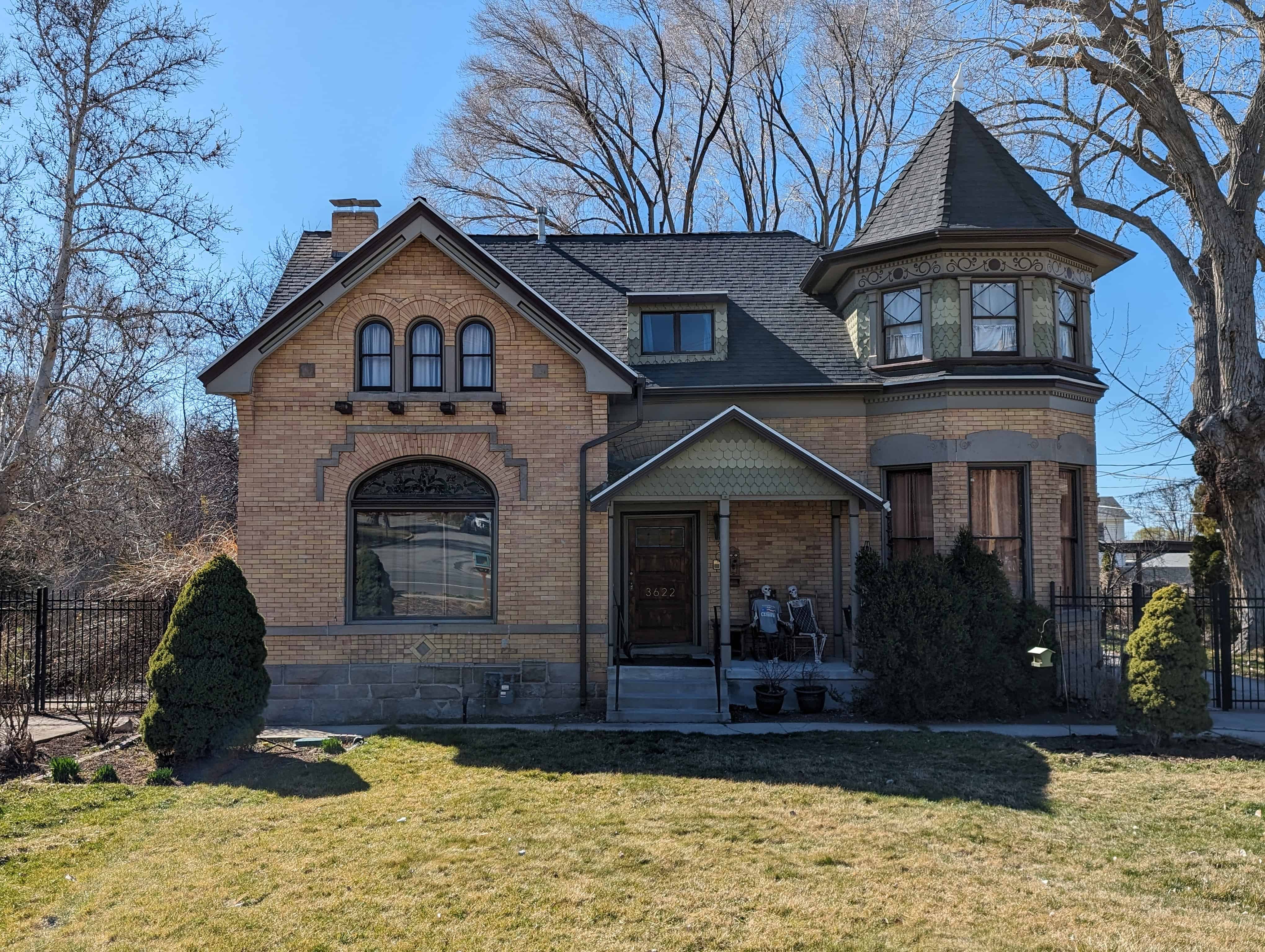
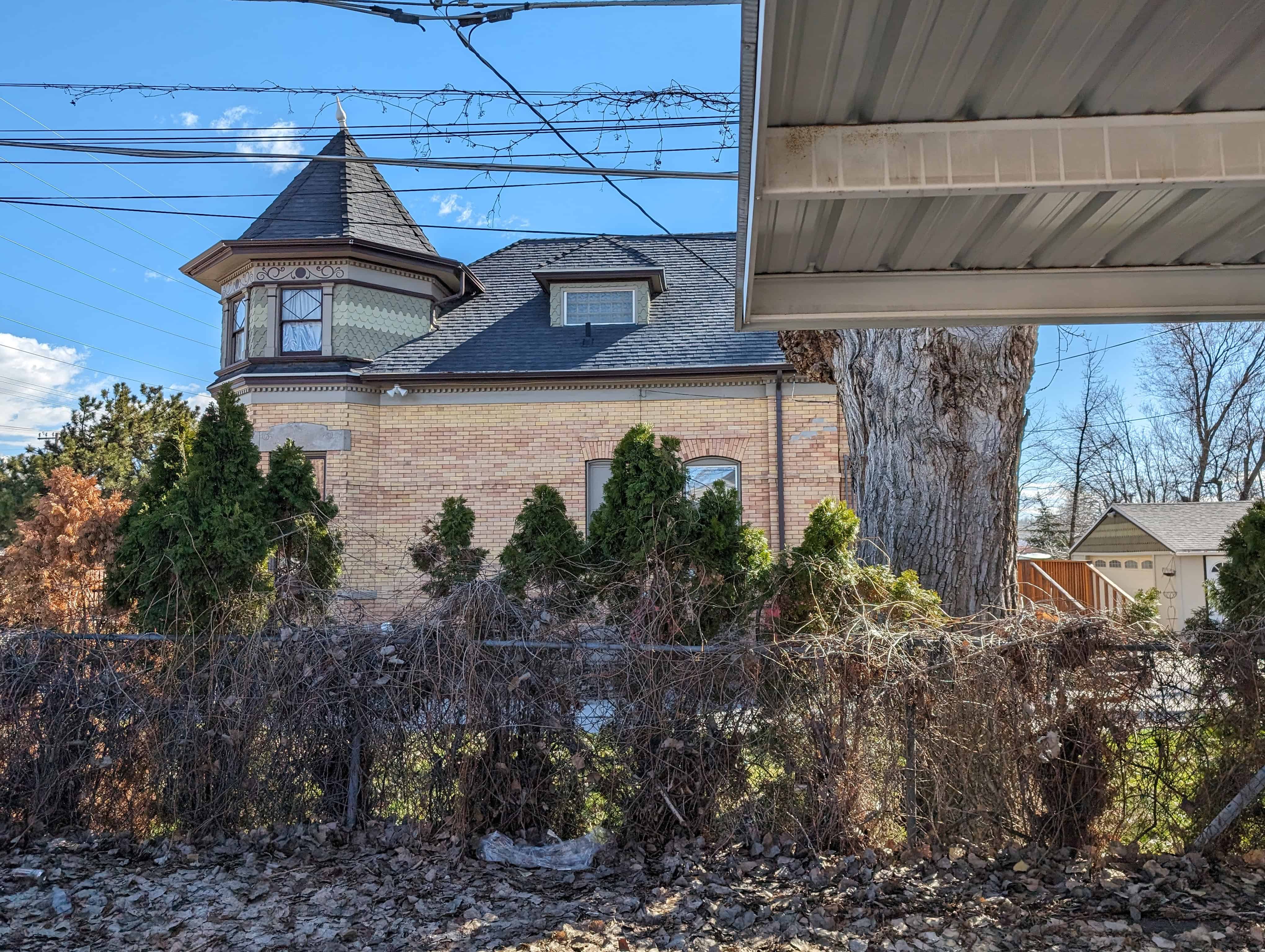
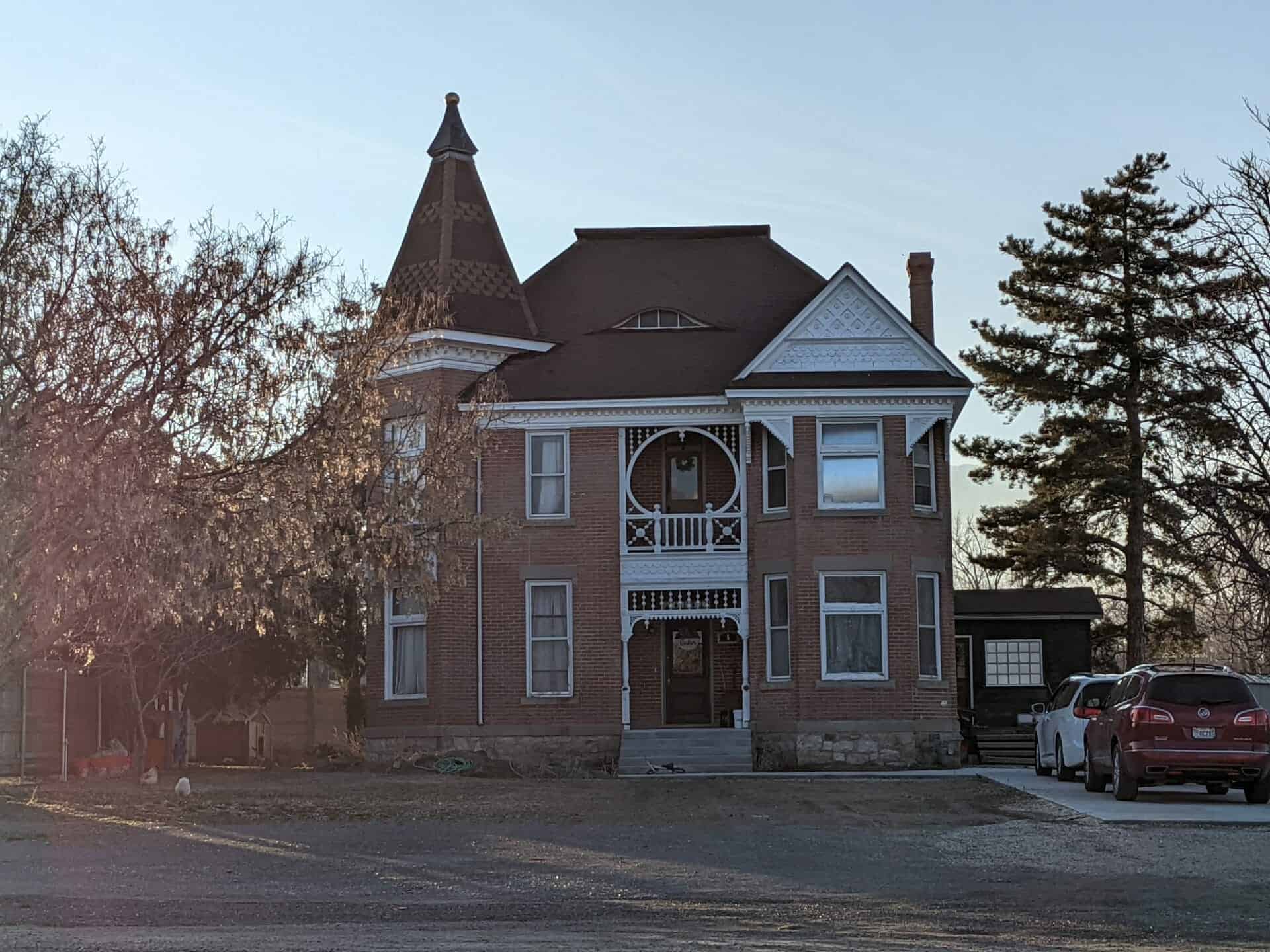
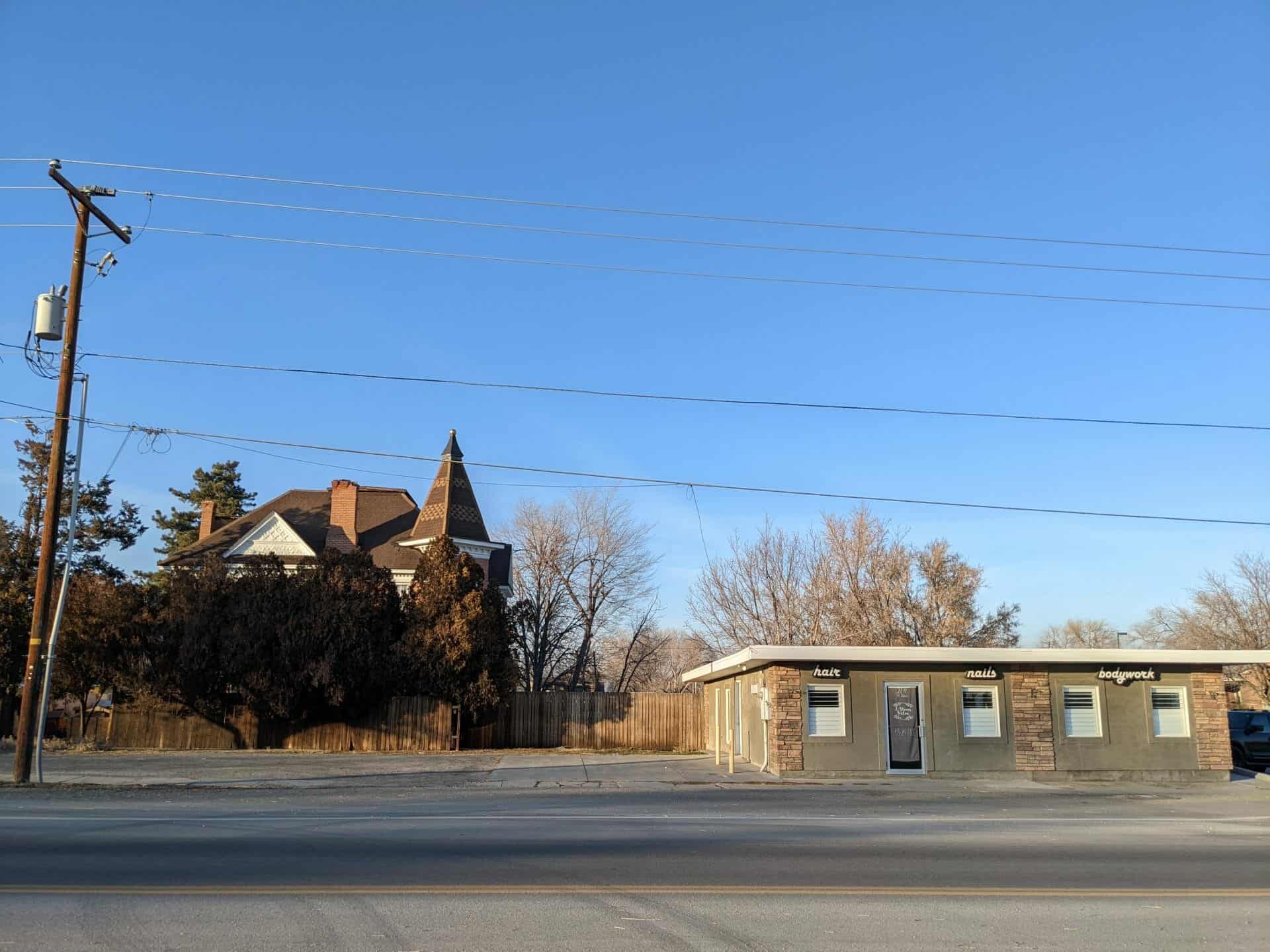
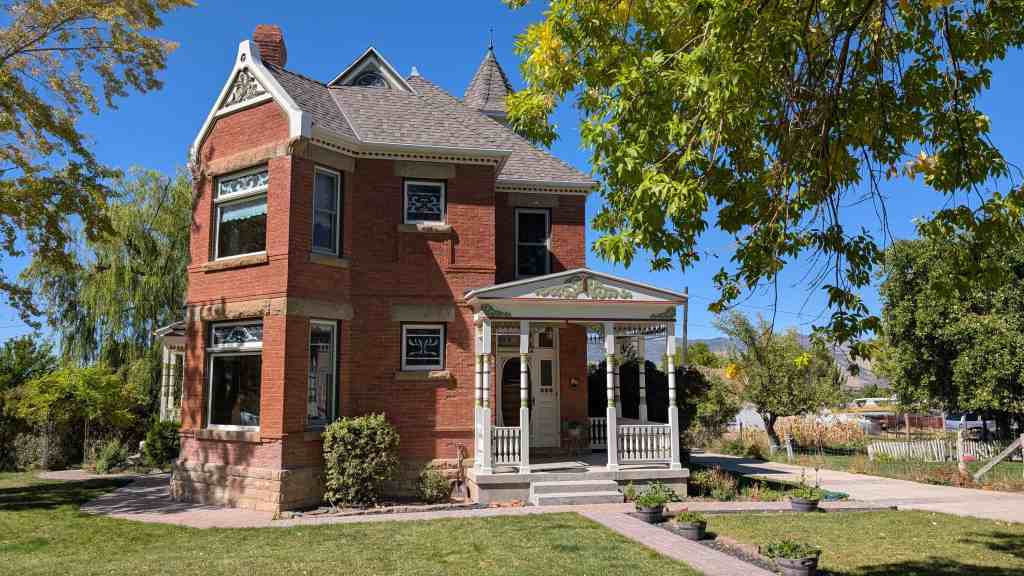
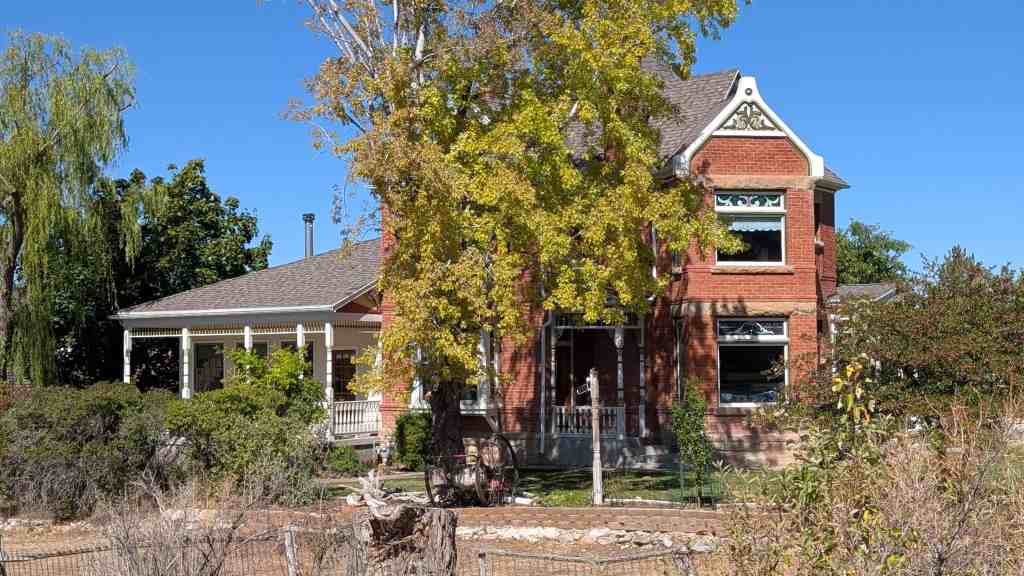
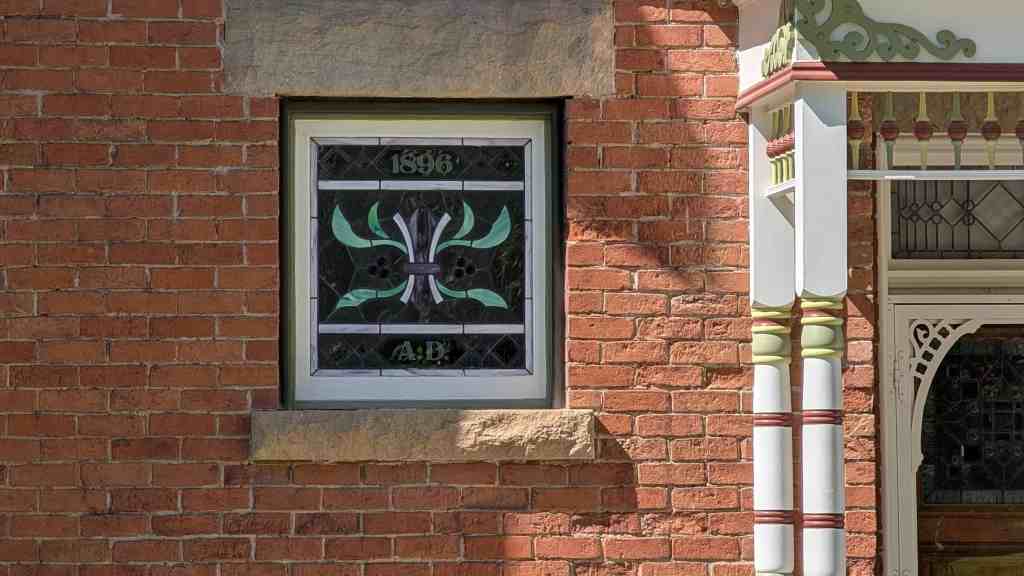
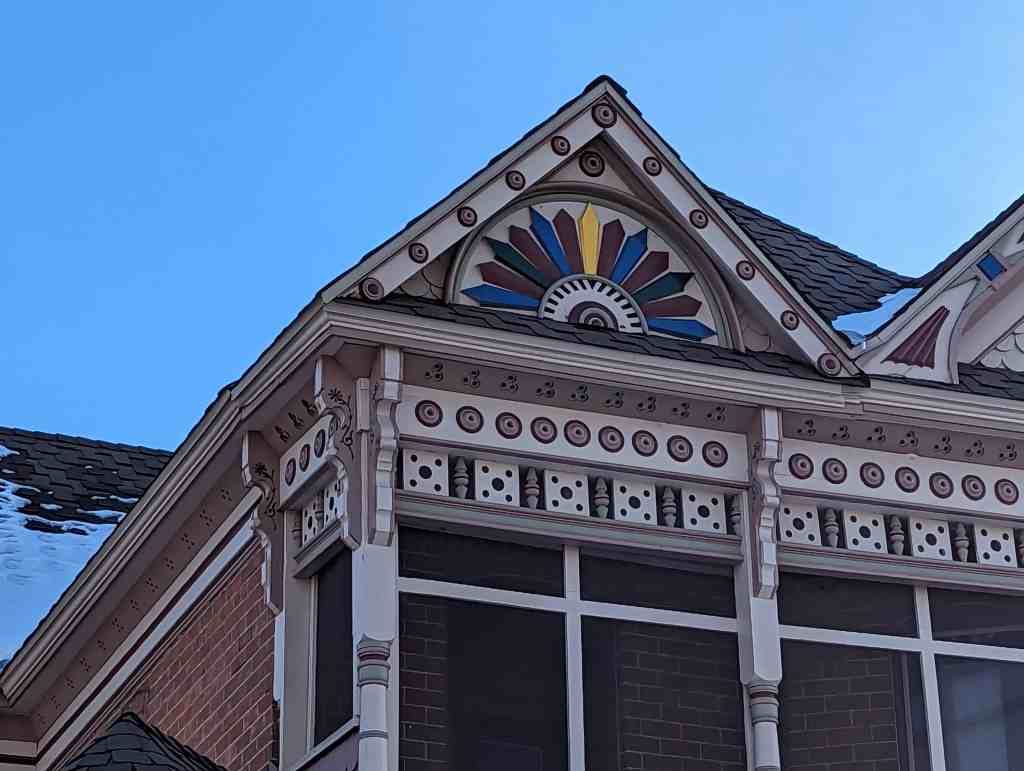
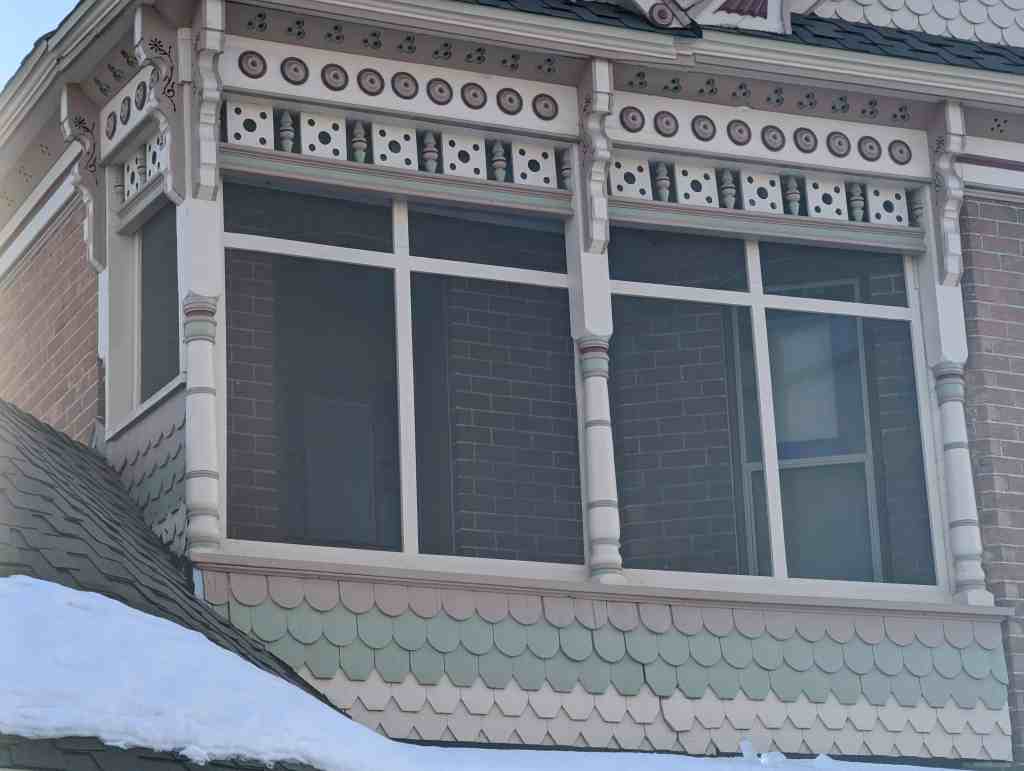
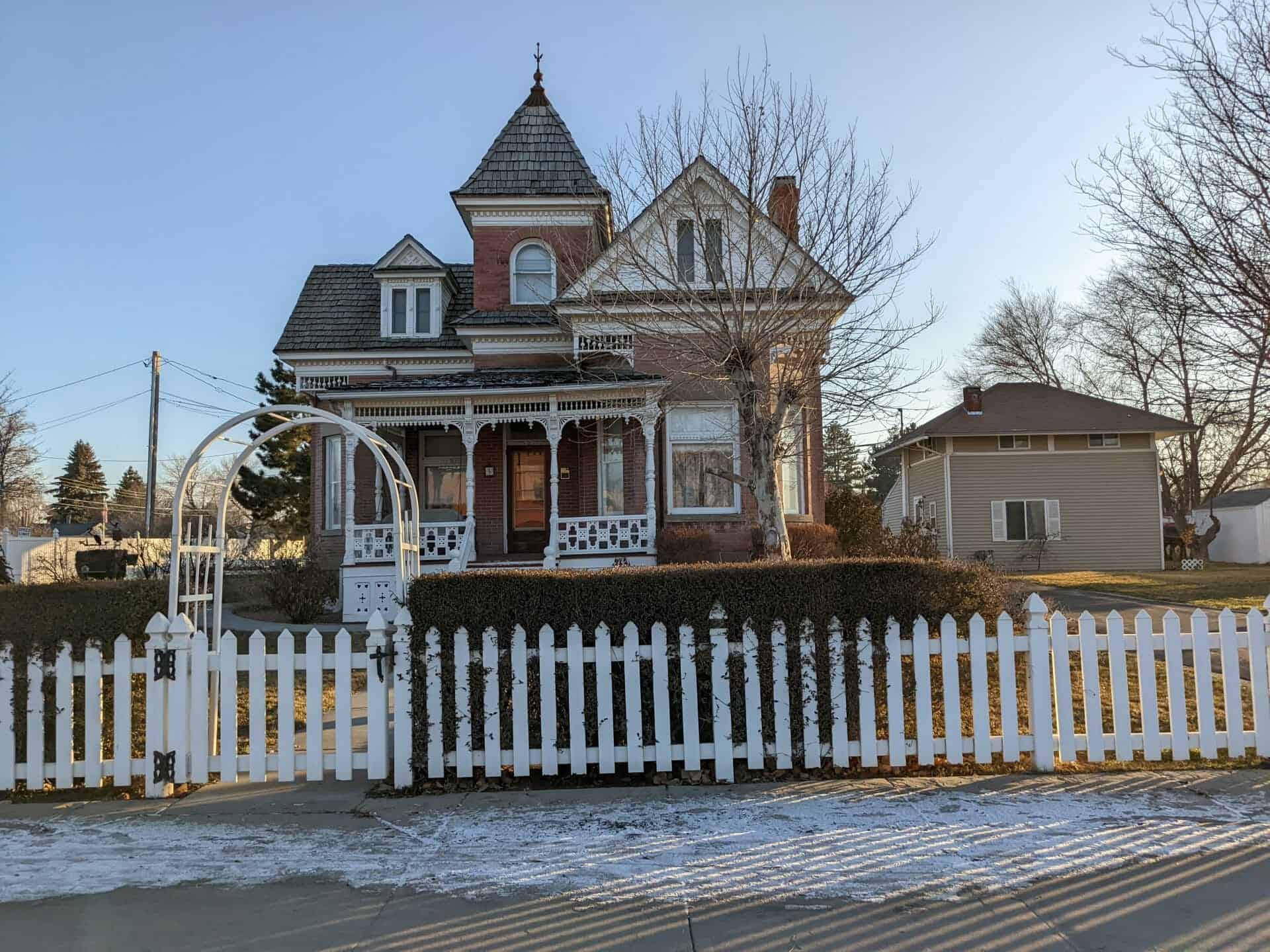
Completed in 1894 this two-story brick house was constructed for David L. Murdoch. A native of Cronbury, Ayr Scotland, David L. Murdoch joined The Church of Jesus Christ of Latter-day Saints in Scotland and came to Utah in 1878. He and his wife, Elizabeth Pinkerton Thyne, settled first in Heber City then moved to Salt Lake City in 1883. David Lennox Murdoch was the Chief Accountant for Z.C.M.I. and managed the 20th Ward Cooperative Store.
The nomination form for the national historic register mentioned the home here: While they account for less than one percent of all residences, the very large, often architect-designed homes in the Eastlake, Queen Anne and Shingle styles, and later the Prairie and Craftsman styles greatly influence the visual character of the Avenues. Some of the state’s best examples of residential architectural styles were built there, including the William Barton house, 231 B Street, (vernacular/Gothic); the Jeremiah Beattie house, 30 J Street, (Eastlake); the David Murdock house, 73 G Street, (Queen Anne); the E.G. Coffin house, 1037 First Avenue, (Queen Anne); the N.H. Beeman house, 1007 First Avenue, (Shingle style); the Vto. Mclntyre house, 257 Seventh Avenue, (Classical Revival); the James Sharp house, 157 D Street, (Craftsman); and the W.E. Ware house, 1184 First Avenue, (Colonial Revival).
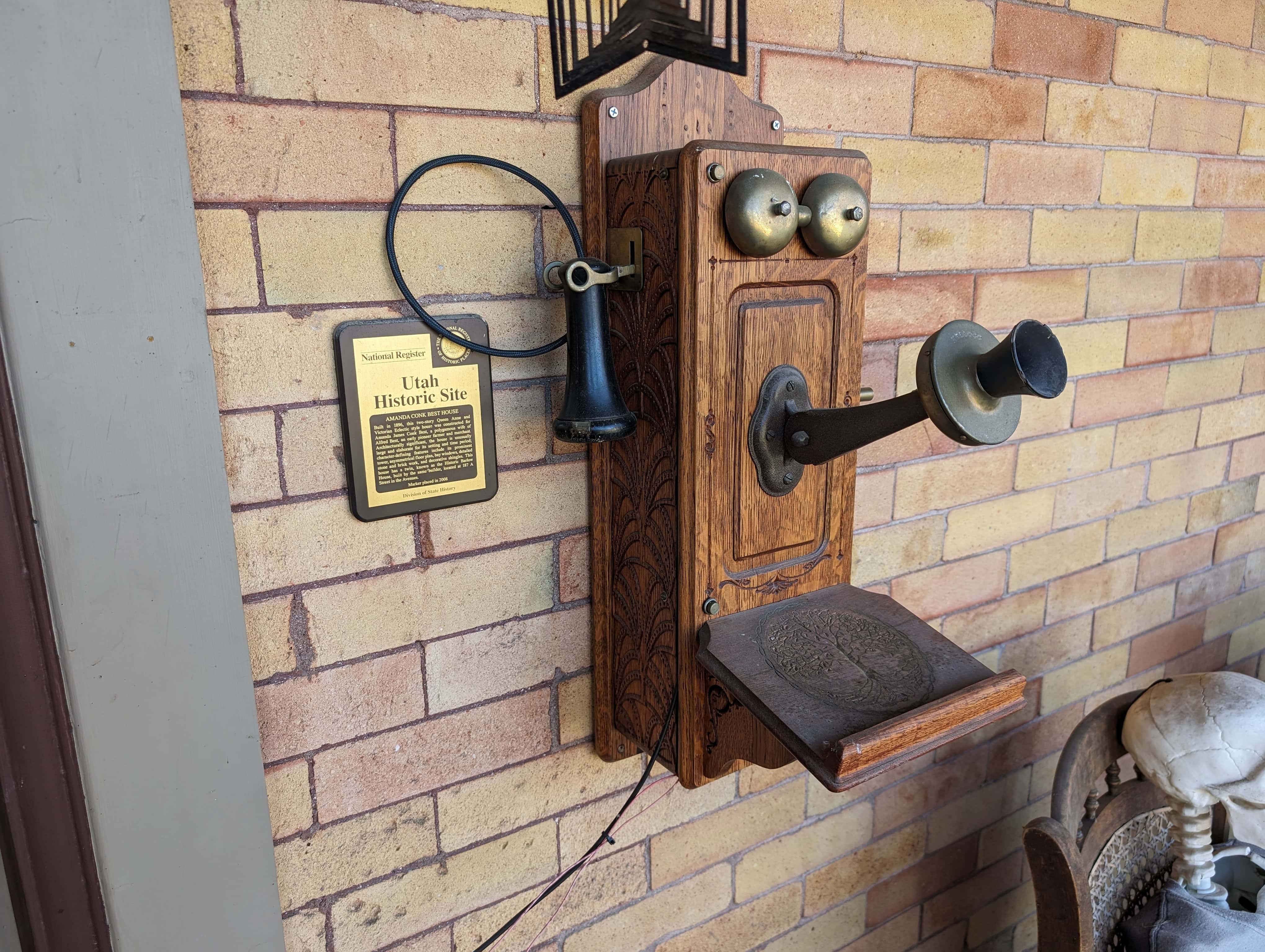
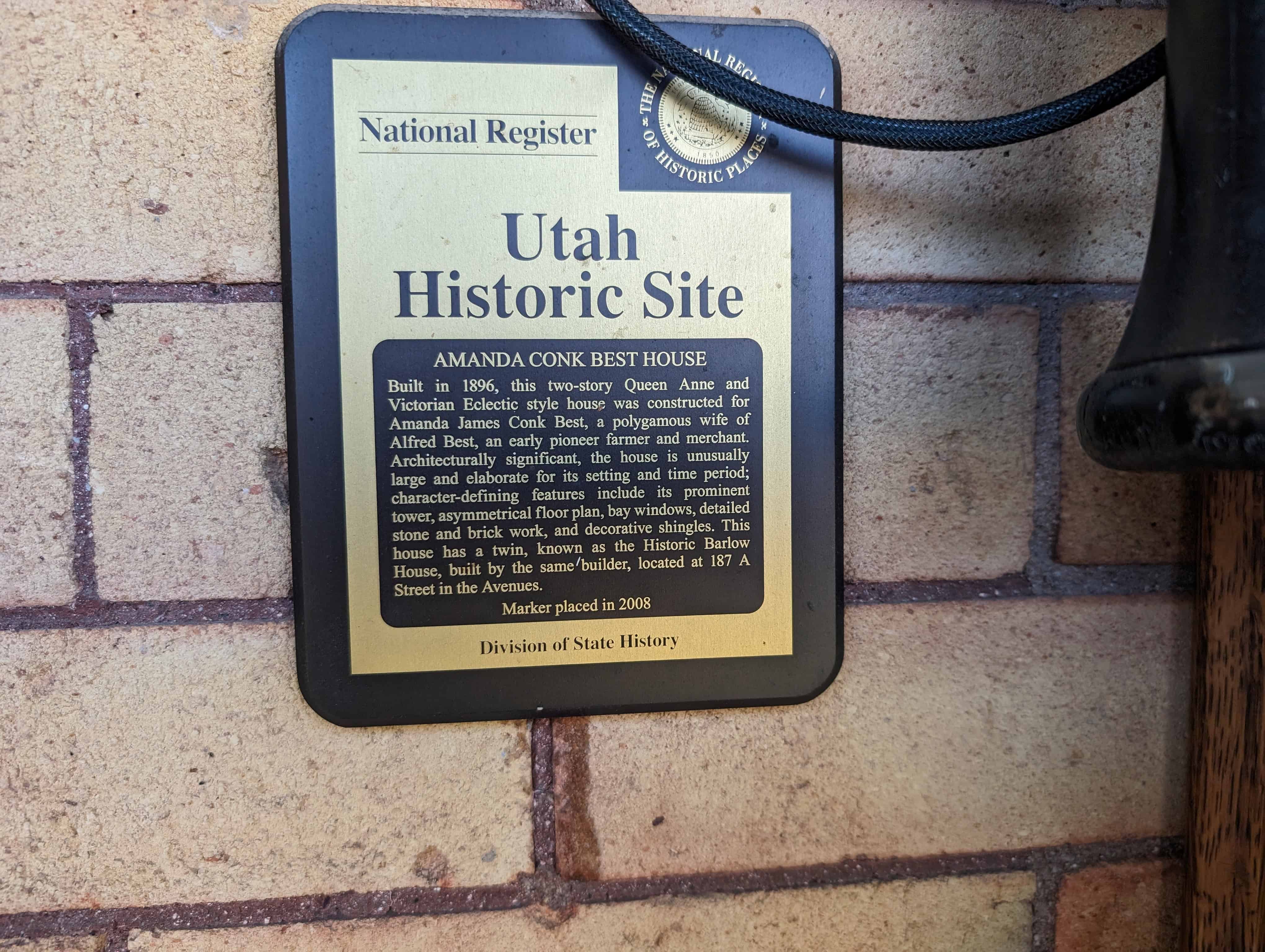
Built in 1896, this two-story Queen Anne and Victorian Eclectic style house was constructed for Amanda James Conk Best, a polygamous wife of Alfred Best, an early pioneer farmer and merchant. Architecturally significant, the house is unusually large and elaborate for its setting and time period; character-defining features include its prominent tower, asymmetrical floor plan, bay windows, detailed stone and brick work, and decorative shingles. This house has a twin, known as the Historic Barlow House, built by the same builder, located at 187 A Street in the Avenues.
Located at 3622 South 1100 East in Salt Lake City, Utah and added to the National Register of Historic Places (#08001154) on December 4, 2008.
The James and Penninah Wrathall House, built in 1898, is located at 5 North Center Street in Grantsville, Utah. The Wrathall House is a two-story central-block-with-projecting-bays type house. The house is constructed of brick with sandstone foundation, lintels and sills. The style and ornamentation is Queen Anne with an Eastlake style porch. The house has a wood shingle roof with the original decorative shingles on the turret roof. The house has a circa 1940s one-story frame addition at the northwest corner. The 0.84-acre lot includes two contributing outbuildings (a circa 1910 garage and a circa 1900 coop), and one non-contributing outbuilding (a circa 1980s shed). There is also a contributing structure, a circa 1950 metal Butler silo.
Though technically a central-block-with-projecting-bays type house, the footprint of the building is contained within a roughly 40 by 40 foot square. The one-story addition is located in a niche at the northwest corner and extends 12 feet to the north. The house was constructed of brick with a facing of fired red brick and an adobe brick lining on the interior. The brick is laid in a running bond with flush mortar joints. The tan-colored sandstone foundation is rough-faced ashlar blocks with concave mortar. A smooth sandstone stringcourse is above the foundation at the water table. Similarly smooth sandstone blocks provide the lintels and sills from most of the windows. The house faces Center Street to the east. The facade features an octagonal bay to the north and a projecting square turret tower to the south. The centerpiece of the fa9ade is the entrance, which features Eastlake details (spools, spindles, lathe-turned, brackets, etc.) above the main floor entrance and on the second-story porch. The concrete deck and steps, and the wrought iron rail are later additions (circa 1930s-960s).
The Wrathall House has an imposing presence. The attic space under the central truncated pyramidal roof is nearly a story-high. The roof is covered in square-butt wood shingles with a small eyebrow dormer above the main entrance. The slender turret roof is higher than the main roof by ten to twelve feet. It is covered with wood in an alternating pattern offish-scale and square-butt shingles, and is capped metal. The octagonal bay has a simple-gable roof. The bay’s gable trim combines paterae within a weave of wood and a base offishscale shingles. Other ornamentation includes both fan-shaped and scroll-shaped brackets with knobs, and a dentilated cornice. The windows are original (the smaller windows are covered in storm windows, date unknown). The larger windows are fixed frame with transoms. The horizontal mullions are notched with a centered paterae. The tall narrow windows are one-over-one, double-hung wood sash. The front door is original with Victorian carved ornamentation. The exterior wood work is painted grey with dark green accents.
The secondary elevations are less elaborate. Several of the narrow windows on these elevations have been shortened or blocked (circa 1940s to 1970s). The north elevation features a second eyebrow dormer and a leaded and colored-glass window, which lights the staircase. There are corbelled brick chimneystacks on the north and south elevations. The south and east elevations are relatively plain and not easily visible due to the mature trees near the house. The circa 1940s addition at the northwest corner is a one-story frame structure covered in shiplap siding on a concrete foundation. The addition has a concrete stoop on the east side. There are doors on the east and west elevations. The east elevation door is half-glass (with multiple panes). The window also is a multi-pane wood sash window. The west door is at grade level.
( This was added to the National Register of Historic Places (#05001629) on February 3, 2006 and is located at 5 North Center Street in Grantsville, Utah )
On the interior, the house has approximately 2,700 square feet of space divided between the two floors. The full-height attic is expansive, but the basement is only 20 percent excavated. Though a central-block house, because it has a square footprint, the interior feels more like a foursquare. The central entrance has a foyer. The semi-open stair is on the north side. It features a ball and spindle balustrade, knobs, brackets, square newel posts, and a curved rail. At the stair landing, the stained glass window glows in colors of rose and gold. With the exception of the stair rail, the woodwork in the foyer has been painted white. The interior doors are all original with hopper window transoms. The door and window casings feature fluted stiles and paterae. The room in the octagonal bay is to the north. The parlor is on the south in the projecting turret tower. The parlor is the most intact room. The oak woodwork is in excellent condition. The room features an elaborate two-tier mantel featuring columns acanthus-leave capitals, a mirror inset, and a tile surround. The tall oak pocket doors lead to a large dining room in the southwest corner of the house. The kitchen is in the northwest corner. The house has a total of thirteen rooms with four bedrooms and a bath on the second floor. The interior was painted and re-papered in the 1950s.
The Wrathall House is on the south half of a 0.84-acre rectangular parcel. A 0.12-acre portion at the corner of Main and Center Streets was divided from the main property and a one-story commercial building (circa 1970s) sits right at the corner. There is a concrete sidewalk leading from Center Street to the main entrance. A wood fence at the rear separates the house from the Main Street property. The landscaping is overgrown and the mature trees near the house obscure views of the secondary elevations. For many years, two 100-year old evergreens obstructed the façade view, but these trees were cut down recently. North of the house is a large field where the outbuildings are located. They include a contributing wood garage with a simple gable roof. This building was built circa 1900 to 1910 and originally may have been an agricultural outbuilding. South and west of this building is a contributing shed or coop (circa 1910), which is partially dilapidated. There is also a non-contributing circa 1980 wood shed. The round metal Butler silo (circa 1950) is a contributing structure. The James and Penninah Wrathall House is in good condition and contributes to the historic resources of Grantsville, Utah.
The James and Penninah Wrathall House, built in 1898, is significant under National Register Criteria A and C for its association with the development of Grantsville and its contribution to the architectural resources of the rural Utah community. The owners, James and Penninah Wrathall were prominent second-generation members of the community. The property is eligible within the Multiple Property Submission: Historic and Architectural Resources of Grantsville, Utah, 1850-1955. The history of the house spans all of the historic contexts: “Mormon Agricultural Village Period, 1867-1905,” “Impact of Technology and Transportation Period, 1905-1930,” and the “Economic Diversification Period, 1930-1955.” The Wrathall House is architecturally significant as an unusual and well-preserved example of the Victorian style known as Queen Anne. The design shows the influence of design books, particularly in the Queen Anne and Eastlake details, but the execution by local builder, Charles Z. Schaffer, is unique. The imposing residence is a landmark at the corner of Main and Center Streets. The Wrathall House is a contributing historic resource in Grantsville, Utah.
The community of Grantsville was settled on October 10, 1850, three years after the first settlement of the Salt Lake Valley by members of the Church of Jesus Christ of Latter-day Saints (LDS Church or Mormon Church). After several altercations with the nomadic Native Americans who camped in the area, the Grantsville area was settled and known as Willow Creek. In 1852 a town site was surveyed and in 1853, the town was renamed Grantsville in honor of George D. Grant, who led a company of the territorial militia to protect the settlement. In April of 1890, James L. Wrathall bought Lots 1 & 2 of the Grantsville survey’s Block 3 from fellow Grantsville pioneer John Eastham (1820-1893). At the time a small Victorian cottage was located in the southeast corner of Lot 1. The Wrathall family lived in the cottage while their substantial brick home was construction. The local newspaper pinpointed the construction year in an article dated November 25, 1898, which read: “Bishop Wrathal’s [sic] fine home is nearly completed, all of the latest modern design, and shows the skill and fine machanical [sic] labor of C. Z. Schaffer, the builder.”
James Leishman Wrathall was born in Grantsville on September 22, 1860. He was the son of prominent Grantsville pioneers, James Wrathall (1828-1896) and Mary Leishman Marston (1822-1871), English immigrants who came to Utah in 1850. On February 2,1882, James L. Wrathall married Penninah Hunter. Penninah Susan Hunter was born in Grantsville on January 14, 1862. She was the daughter of Edward Hunter (1821-1892) and Mary Ann Whitesides (1825-1914), who were also English immigrants. James and Penninah had ten children, with the last two born after they moved into their new house.
James Wrathall’s early life was spent herding his father’s cattle and sheep on the plains of Tooele County. He saved and invested, eventually becoming the owner of several large herds of sheep and cattle. He also acquired over 4.000 acres of farm and ranchland. He raised hay and sugar beets. He had a large fruit orchard, which included apples and other small fruits. As a prosperous rancher and farmer, he had numerous business interests: North Willow Irrigation Company, president; Richville Milling Company (flour mill in Tooele), president; Utah-Idaho Sugar Company, stockholder; Consolidated Wagon & Machine Company, stockholder; etc. James Wrathall was a member of the Grantsville City Council. He also served on the Grantsville School Board for thirteen years and on the Tooele County Board of Education for seventeen years. He held numerous leadership positions in the LDS Church, including serving as Grantsville’s bishop between 1890 and 1906. A biographical sketch of James L. Wrathall written in 1919, began: “There is no name perhaps that figures more conspicuously and honorably in connection with the business development of Grantsville and Tooele County than does the name of Wrathall. James L. Wrathall is now extensively engaged in farming in this section of the state and he is also at the head of various important business enterprises which constitute a dominant factor in the general development and progress of the district in which he lives.”
An earlier biographic sketch, noted that “He makes his home in Grantsville, where he erected, in 1898, a beautiful home of twelve rooms. The house is a two-story brick, and modern in every respect.” According to Lisa Miller, “The Wrathall house was known as one of the most elegant residences in Grantsville. Local citizens still remember the rosettes that adorned the ceilings in the original parlor and dining room and a grand stairway that features a beautiful stained glass window. The house is also believed to be the first residence in Grantsville to have acquired electricity.” Hazel Johnson, the youngest daughter of James and Penninah, remembers the silverware (which she had to polish every Sunday) and the napkins had the family’s initials on them.
At the age of seventy-three, James L. Wrathall gathered his family around him at home and predicted his death. He died the following day, November 29, 1932. In addition to raising ten children, Penninah Wrathall served in the Relief Society and Primary organizations of the LDS Church. She also served as the president of her local Daughters of Utah Pioneers organization. Penninah Hunter Wrathall died on November 16, 1934.
A portion of the property (Lot 2) had been deeded to a son, Morris Y. Wrathall, in 1931. After Penninah’s death, the remainder went to Irene Wrathall Page in 1936. Irene Page was listed as living with her parents on the 1930 census enumeration. Irene was born on February 13, 1890 in Grantsville. She married George W. Page in 1918. He died in 1936. It is not known how long Irene lived in the house, but she did rent it out for a few years. In 1944, she sold the property to her sister, Hazel Wrathall Johnson. Irene Page died in Missouri on April 5, 1973. Hazel Wrathall was born on July 18, 1905, the youngest child of James and Penninah. She married Milan Johnson on November 17, 1921. Milan “Mike” C. Johnson was born on October 5, 1903, in Grantsville. They had eight children. The Johnsons remodeled the house and restored portions of the downstairs in the 1950s. They lived in the home until their deaths. He died on September 22, 1978, and she died on August 24,1993. In 1994, ownership was transferred to their daughter, Janice Johnson Sommerfeld, and her husband Sigmund Sommerfeld, who are the current owners.
The Wrathall House is architecturally significant as an imposing and unique adaptation of the Queen Anne style. The Queen Anne style was popularized by the 19th century British architect, Richard Norman Shaw. It was the most picturesque of the various Victorian Eclectic style popular in America in the late 19th century. Variations of the style were popular in Utah between 1884 and 1905. Residential examples are characterized by their asymmetrical façade, irregular plans, and variety in materials. The most common house type for Queen Anne residences was the central block with projecting bays. The Wrathall House is an unusual example: it appears as a block mass (almost a foursquare) flanked by a turret and an octagonal bay. The house includes a variety of juxtaposed materials: rough-faced and smooth stone, brick, wood shingles and other ornamentation. The Eastlake-style porch was adapted from a style book written and illustrated by English architect, Charles Locke Eastlake. Most Eastlake homes were constructed entirely of wood frame and shingle, and lacked the variety of materials of the Queen Anne style. The Eastlake style was popular in Utah between 1880 and 1900, but because Utah builders preferred brick, there are very few pure examples of the style. In Utah, as in the case of the Wrathall House, the Eastlake style is most often found on porches and decorative gable cornices in combination with Queen Anne and other Victorian Eclectic styles.
The builder of the Wrathall House was Charles Zephaniah Shaffer. 8 He was born in Pennsylvania on May 13, 1843. He was living in Grantsville at the time of his marriage to Ellen Barrus in 1895. He was listed as a “carpenter” in a 1900 business gazetteer. Charles Z. Shaffer is also known to have built the Alex and Mary Alice Johnson House at 5 West Main Street in Grantsville, listed on the National Register on December 13, 1995. The Johnson House was built in 1900, two years after the Wrathall House. Shaffer had probably gained confidence as a builder with his work on the Wrathall House. The Johnson House is a more exuberant expressive of the builder’s skill with extended bays and elaborate wrapping Eastlake porches, but it is also more typical than the Wrathall House. The Alex and Mary Alice Johnson House was listed on the National Register of Historic Places in 1996. It is not known whether Shaffer was responsible for other Queen Anne homes in the Grantsville area.9 Charles Z. Shaffer died in Grantsville on August 29,1904.
L. R. Anderson Home / Lewis and Clara Anderson House
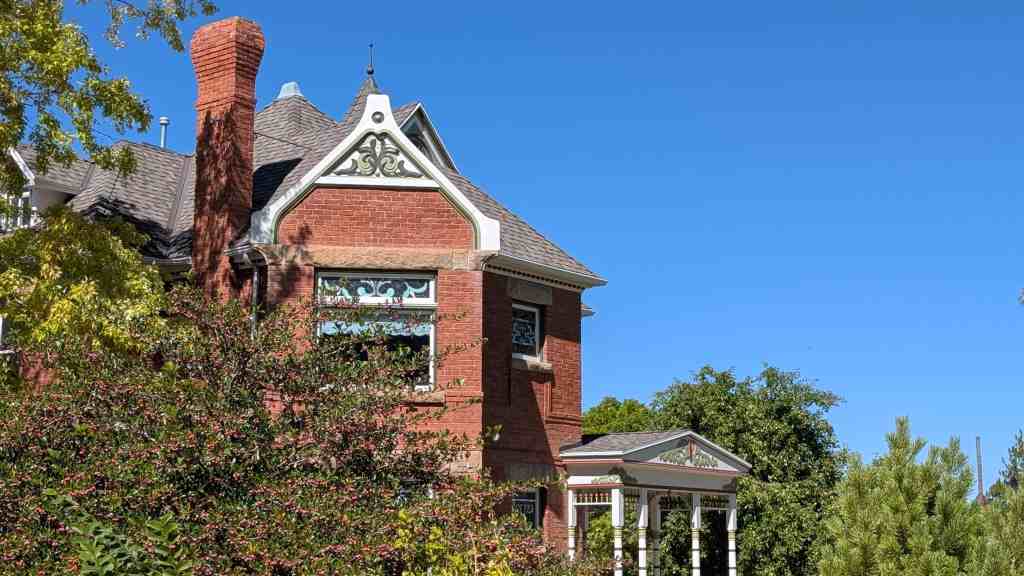
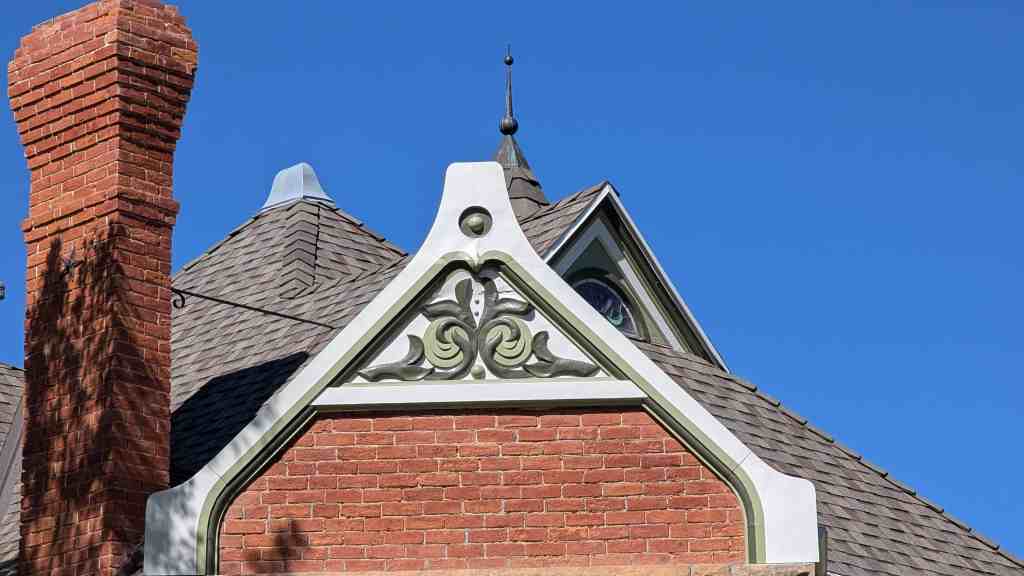
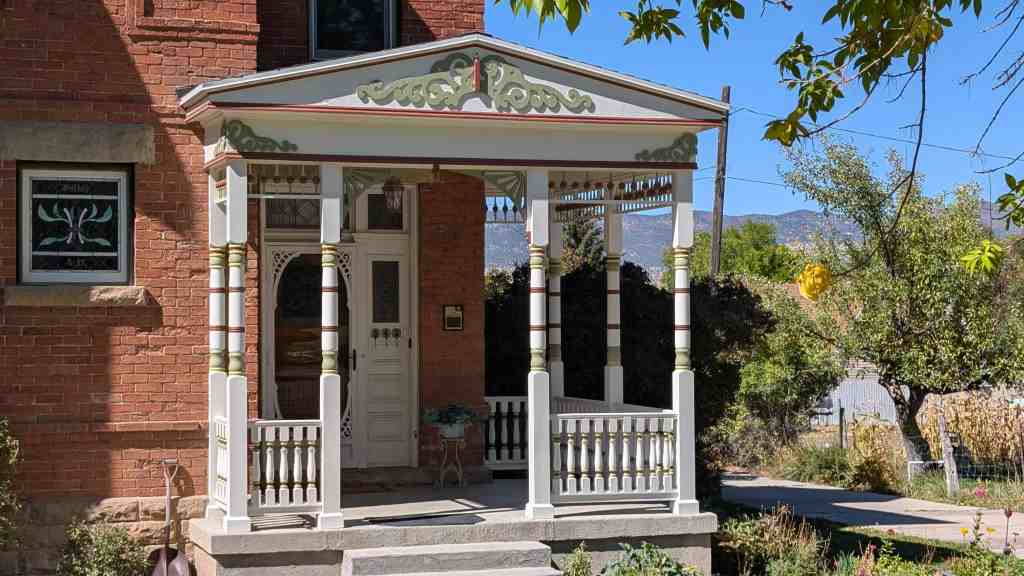
The Lewis and Clara Anderson House, built 1886-1915, is an excellent example of a Victorian Eclectic with Queen Anne detailing house style remaining from the historic period in Manti. This style of architecture documents an important period of growth in Manti and the Sanpete Valley. The design, though executed by a local builder influenced by pattern-books, combines a remarkable unity of composition with elaborate decoration. With its prominent position on Main Street, the Anderson house is one of the most distinctive architectural landmarks of Manti. Both the exterior and interior details of the home have been extraordinarily well-preserved. The Anderson house is also significant for its association with L. R. Anderson, a prominent church leader, politician, and rancher in the area. His leadership in the town of Manti was extensive and impacted the direction of its growth during the first part of the twentieth century.
The Victorian Eclectic style is reflective of changes that occurred in Utah near the turn of the century. The architecture in Utah was founded in American building traditions and the early builders had been, for the most part, isolated from the secular influences of much of the country and used established methods brought with them from their homes of origin. As Utah grew and became more integrated with non-Mormons, the architectural styles that were made popular through pattern books were readily available to Utah builders. The building boom of the 1880s and 1890s corresponded with the growth of the non-Mormon population in Utah and brought with it the opportunity to bring in new building traditions such as those published in the style books, popular in Utah during the late nineteenth and early twentieth centuries. With the introduction of plan books, “the former isolation of rural areas was no longer an obstacle to building due to the widespread dissemination of information and building materials.” Plan book Victorian stylistic features were based upon the use of multiple forms and elements and were probably influential in building the uniquely stylized, eclectic, Lewis and Clara Anderson. The Victorian Eclectic style was popular in Utah between 1885-1905.
Located at 542 South Main Street in Manti, Utah and added to the National Historic Register (#97001629) on January 12, 1998.
Anderson History
Lewis R. (L. R.) Anderson was born in Fountain Green on March 26,1872 to Lewis and Mary Ann Crowther Anderson. L. R. attended Snow College and Brigham Young Academy before becoming a wool broker and rancher. He worked with his father and brothers in the industry and in 1907, along with other investors, acquired ranches in Salina Canyon and incorporated the Manti Livestock Company. He was a prominent personality in the community. He served as mayor of Manti for six years (1902-08). He ran for mayor on a “no more floods program” platform. Under his leadership as mayor, the town of Manti petitioned President Theodore Roosevelt to create a national forest reserve on their mountain. President Roosevelt did so by executive order on May 29,1903. As a result livestock grazing and other use in Manti Canyon was placed under proper management, vegetation was restored on the steep slopes and no more serious floods occurred.
L. R. was an LDS stake president and temple president for 16 years (1943-59), performing the ordinances and ceremonies sacred to the Mormon culture. He and his wife, Clara, entertained LDS general authorities, civic leaders, and numerous businessmen in their home. L.R. served on the Utah State Legislature beginning in 1913 for two terms and was selected as the Speaker of the House of Representatives. During the legislative session, his family lived with him in Salt Lake City. His wife, Clara Maria Munk, was born in Manti on September 4,1873 to Peter Mikkel and Eunice Ann Brown Munk. She and L.R. were married in the Manti Temple on December 11,1895. During the first years of their marriage, L.R. was employed to run the Central Utah Wool Company for $75/month, and Clara was a school teacher for $25/month. L.R. and Clara raised four girls and three boys in this home. During the time L.R. was president of the Manti Temple, Clara was the matron. She also held many positions in the Relief Society, and was president of the Manti Camp of the Daughters of Utah Pioneers. Clara was interested in music and taught it to her children. She considered her primary responsibility to be homemaking, and she helped L. R. entertain the many dignitaries that visited their home.
L. R. began building this house in 1896. The house initially consisted of only two rooms. L. R. was called on an LDS mission for two years and when he returned he began construction on the staircase and upper bedrooms. He later added the back bathroom and kitchen, as well as the basement. Most of these additions were completed by 1899. In 1910, he fenced in the front yard with a wrought iron fence. The last addition to the house was made in 1915 when L. R. built a large bay window in the dining room to display Clara’s plants. In the 1920s, L. R. built a chicken coop and a brick carriage house in the back yard. The Andersons lived here until their deaths, L. R. on October 19,1968, and Clara on May 22,1978.
Ronald and Eleanor Mason Sessions purchased the house in 1992. Since then they have done extensive restoration work, such as removing the paint from the exterior brick, restoring the wood finishes throughout the house, and refinishing the floors. They have also reproduced leaded glass windows through the use of historic photos. They added the turret dormer on the north side of the house.
Manti History
Manti, the county seat of Sanpete County, was settled in late November 1849 by 224 men, women, and children, the first settlement south of Provo, Utah. Ute chief Walker invited President Brigham Young of the Church of Jesus Christ of Latter-day Saints (the Mormons) to send a colony of his people to join the encampments of Chief Sanpeetch’s people already in the valley. Jesse W. Fox surveyed the plat 1 for the “city” in the same summer, and Manti was incorporated in February 1851.
Pioneer subsistence agriculture soon gave way to the production of grain for the market. The Indian hostilities that had began in the 1850s ended in the 1870s opening. Adjacent mountain rangelands during the summer for a range livestock industry, mostly large sheep herds. Hay production increased subsequently. Then between 1889 and about 1905 most Sanpete Valley towns experienced annual summer floods, which followed cloudbursts on overgrazed lands at elevations over 8,000 feet. In the 1890s the Manti City Council put into effect the political action that by 1903 resulted in the protection of its watershed by the federal Forest Service: the Manti National Forest.
The railroad system was important to the town’s agricultural and ranching industries. The first into Manti was the Sanpete Valley Railway in 1880, from Nephi. The Denver and Rio Grande Western (D&RGW) completed its line to Manti from thistle Junction in 1890, and extended its operations beyond Manti the following year. The D&RGW purchased the Sanpete Valley Railway in 1910, and immediately abolished its section between Ephraim and Manti. The last passenger train left Manti for Salt Lake City in 1949.
The Church of Jesus Christ of Latter-day Saints is a significant part of the town of Manti and is closely tied to its leadership. The Mormon temple, begun in 1877 and dedicated in 1888, is an important part of the community’s cultural makeup and is a central focus of the town. The LDS concept of the relationship between this world and the next is related to the sacred ceremonies of the temples. Only active Latter-day Saints may enter the temples. Mormons attend the temples to perform baptism, “endowment,” marriage, and “sealing,” and other ordinances for themselves and vicariously in behalf of the dead, especially loved ones and ancestors, in the belief that the dead will hear the gospel preached, that these earthly ordinances must be performed for them, and that they will have their own opportunity to accept or reject. The site of the Manti Temple is where over 100,000 people come yearly to witness the “Mormon Miracle Pageant”.
L.R. & Clara Anderson House
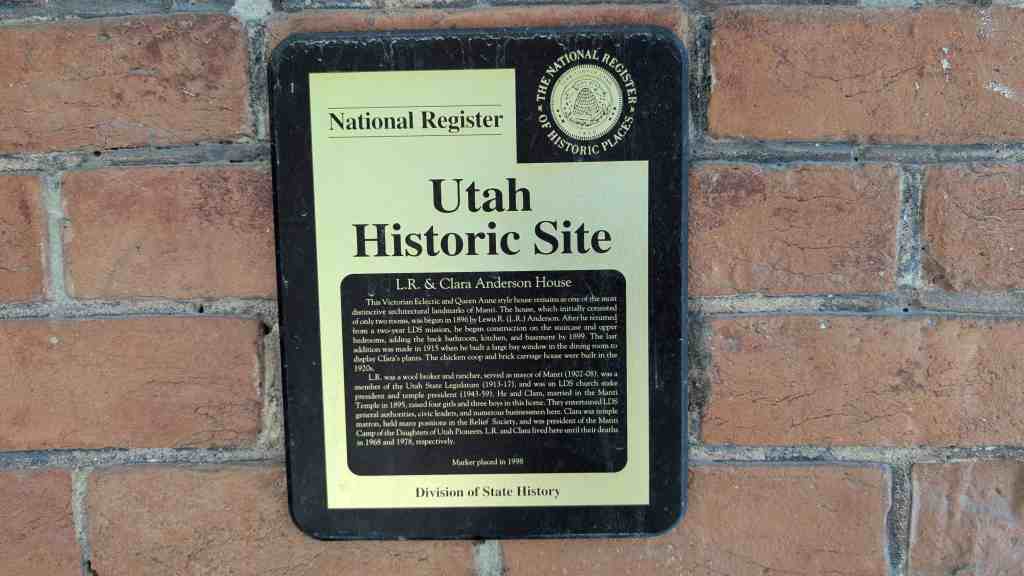
This Victorian Eclectic and Queen Anne style house remains as one of the most distinctive architectural landmarks of Manti. The house, which initially consisted of only two rooms, was begun in 1896 by Lewis R. (L.R.) Anderson. After he returned from a two-year LDS mission, he began construction on the staircase and upper bedrooms, adding the back bathroom, kitchen, and basement by 1899. The last addition was made in 1915 when he built a large bay window in the dining room to display Clara’s plants. The chicken coop and brick carriage house were built in the 1920s.
L.R. was a wool broker and rancher, served as mayor of Manti (1902-08), was a member of the Utah State Legislature (1913-17), and was an LDS church stake president and temple president (1943-59). He and Clara, married in the Manti Temple in 1895, raised four girls and three boys in this home. They entertained LDS general authorities, civic leaders, and numerous businessmen here. Clara was temple matron, held many positions in the Relief Society, and was president of the Manti Camp of the Daughters of Utah Pioneers. L.R. and Clara lived here until their deaths in 1968 and 1978, respectively.
Built c. 1891, the Charles W. Cross House is architecturally significant as one of about fourteen well preserved, documented, extant examples of houses in the Ogden area that reflect the influence of the Queen Anne Style in that area. Of those fourteen, three houses are high style examples, and three are Queen Anne cottages. Eight of the houses are two story examples whose plans and designs, like those of the Queen Anne cottages, were probably either drawn from or influenced by house pattern books. As one of those eight houses, the Cross House is one of the best preserved examples. In addition, it is also more clearly tied to pattern book sources than are the other houses, because its plan and elevation are almost identical to 462 17th Street, the house across the street.
This home was added to the National Historic Register (#84002434) July 12, 1984 and is located at 451 17th Street in Ogden, Utah
Charles W. Cross was born at London, England in 1861. He came to Utah sometime in 1880. Cross was a harness maker and established a shop in Ogden, Utah. He had a frame building on stiles built to serve as his shop. About ten years later, apparently to expand his business, Cross had a two-story building constructed and took on his brother, Alfred Cross, as a partner. His brother died several years later and Cross continued on with the business. Cross apparently acquired a large holding of Ogden area property. An obituary that appeared in the Deseret News states, “It is believed that he was the heaviest taxpayer for his years in the city [Ogden].” In addition to his harness and saddlery business Cross managed his real estate interests.
Cross married Annie Cave and they had five children. In 1900 Cross was elected as an Ogden City councilman and was re-elected in 1901. He served as the chairman of the committee on public buildings and grounds as well as on “several other important committees, where he rendered conspicuous service.” Cross was serving on the city council when he died , at the age of 44, on April 29, 1903 in the house on 17th Street.
In 1903, after Cross’s death, the harness and saddlery company was incorporated with his son, Charles Cross Jr., his mother, Avis Cross, and his sister listed as the owners. The business continued to operate under the name of the C.W. Cross Company and is now known as the Cross Western Store.
The Cross house is significant as an example of the type of houses that were built during Ogden’s early 1890s boom period which resulted in the building of numerous houses and the formation of many additions and subdivisions. Ogden newspapers indicated that in 1890 the area was experiencing a building boom and a proliferation of subdivisions and additions. On March 19, 1890 The Semi-Weekly Standard commented, “The question of house room is becoming too serious. Unless the builders get more force into the field, tents will be in demand.” Later, on July, 19, 1890 another article on the building situation was headlined, “The Building Boon Our Residence Supply Fearfully Inadequate-Demand For Houses Is Enormous.”
The growth of the city was attributed to the publicity that the city had been receiving. The publicity was probably of a promotional nature since local businessmen and eastern investors were interested in seeing the area grow. From interviews with real estate men in the city it was claimed that each company was receiving twenty calls per day and that if housing the were available it would be immediately rented or purchased.
One means of meeting the need for more housing was shipping in 11 ready-made” houses by train from St. Paul. These houses were substantial buildings. They cost from $600 to $5,000 and were two stories with four rooms on the first floor and two rooms on the second. The company putting up the buildings promised a foundation that was 18 inches deep, two coats of plaster, two coats of paint, outhouses in the rear, a board fence around the lot, and a picket fence in front of the house.
On June 25, 1890, the Semi-Weekly Standard announced, in a regular article, that the Riverside Park addition, the area where the C.W. Cross house was built, was open for sale by the Utah Loan and Trust Company. The N. Farr Land, Loan and Trust Company served as the agents for the addition. The advantage of the Riverside Park addition was its proximity to the center of town. Since such property was scarce the addition was felt to be valuable. However, it appears that only several houses were built in the addition at this time. The Cross House and the house across the street, 467 17th Street, are the only identified houses in the vicinity that date from this period. By 1892 C.W. Cross was living in the house. It is not known whether Cross had the house built or whether the house was built by the developers of the Riverside Park addition. The similarity of the Cross house with the one across the street, 467 17th Street, might indicate that the area was developed according to a plan and that the developers relied on house pattern book sources.
Built in 1890-91, the Charles W, Cross house is a two story example of the typical expression of the Queen Anne style in Utah. It is likely that the design for this house was derived from pattern books of the late nineteenth century. It is a brick house with an irregular plan, a stone foundation, and a pyramid roof off of which three gable roof cross-wings project. The house is oriented north, and the cross-wings are on the east, west and north sides. Each of the cross-wings terminates in a three part bay topped by a decorative gable. The main double door entrance is on the east half of the north façade. The porch over the entrance wraps around the northeast corner of the building, and is distinguished at the corner by a conical roof which caps a circular projection of the porch floor. A second smaller entrance opens off the porch into a panel of the east façade three part bay. Fluted columns support the porch roof, and there is a lathe-turned balustrade. There is a small second story screen porch over the main entrance which is topped by a small gable roof projection off the main roof. That porch is connected to the east panel of the north façade three part bay.
Double hung sash windows pierce each of the panels of the three part bays. There is a single double hung sash window per story on all panels of each window bay. The relieving arches of the first story windows are accented by decorative brickwork, compared with the simple arches of the second story windows. A band of stained glass lights frame the upper sash of each window the three part bays. The pediments of the gable section over each three part window bay are highlighted by fish-scale patterned shingles, a bargeboard into which a decorative pattern has been incised, and a small rectangular window with a simple pediment over it. Large decorative brackets intersect below the corners of each pediment. Decorative posts support the second story screen porch, and a unique spindle band spans the spaces between posts. A sunburst decorative element fills the pediment of the porch gable.
A one story brick kitchen wing is attached to the rear of the house. It is more elaborate than most extensions of this type, resembling a small Victorian cottage. It has a multi-hip roof which terminates in a gable projecting over a three part bay at the rear of the house. The use of diamond patterned shingles in the gable section reflects an attempt to visually tie the rear extension with the rest of the house. A back entrance opens off a small open porch which is attached to the east side of the three part bay. The windows of the kitchen wing are the double hung sash type. Some of them are Distinguished by rough cut red sandstone sills. The sills of the main section as well as those of the first section of the kitchen have smooth concrete sills. It is possible that the rear section of the kitchen wing was added some time after the construction of both the main body of the house and the first section of the kitchen wing. A slight difference between the color of the brick of the two story section and that of the kitchen wing suggest that the entire kitchen wing may not be original. If not original, however, the wing was probably built soon after the original construction, and complements the house in materials, style, decorative elements and massing. A one story gable roof extension was added to the west side of the kitchen extension. It has asbestos siding, and was probably added in the 1950s. Because of its scale and location it is an unobtrusive alteration which does not affect the original character of the building.
The organization of rooms on the interior of the house is typical of Victorian design. The plan is asymmetrically arranged with a hall on the east side, from which a staircase rises to the second floor. Behind the hall is a dining room. On the west side of the house are two parlors, one behind the other. Upstairs, two bedrooms are aligned one behind the other over the parlors, and there is a third bedroom over the dining room. There is no hall on the second story, except for the foyer where the stairs come up from the first floor. The rooms merely open one into the other. All of the original moldings are intact. They are grooved moldings with distinctive corner blocks typical of Victorian design. The moldings in the front parlor, which flanks the hall, are hand grained, and are accented with gold leaf. The fireplace in that room has an ornate oak mantel with a distinctive hearth of decorative tiles. The kitchen wing consists of three rooms built within the historic period, and three rooms that are in the asbestos sided wing. The three rooms in the brick section include an entry hall flanked by a small room behind which is a large kitchen. A second set of stairs rises from that room to an attic section which has been converted to several small bedrooms, and connects with the second story of the main section of the house. A bathroom, one long hall, and a single work room occupy the space of the asbestos sided addition.
This house is a fine example of Utah’s expression of the Queen Anne style. Typical of the Queen Anne style is the asymmetrical composition, and the variety of materials, texture, and color. Brick was used instead of wood, the common building material for examples of the style in other parts of the country, because it was probably the most readily available material. The brick, however, contrasts with the stone of the foundation and the wood of the gable sections and porches. An active visual image was created by topping the irregular form with a hip roof from which several gable sections project in various directions. The decorative brickwork over the windows and along the major chimney flue, in combination with the patterned shingles and bargeboards of the gable sections and the stained glass panels of the window sashes provide a variety of textures and patterns. Two colors have been combined on the gable sections and contrast with the red bricks. The conical roof on the porch, the multi-planed roof, the fish-scale shingles on the gable sections, the stained glass lights around the upper sashes of the windows, the bargeboards, and the wrap around porch are elements that are typical of the Queen Anne style.
It is likely that the basis for the plan and design of the Cross house probably originated in popular plan books. The Cross house was built at a time when there was a nation wide trend to own a home in the suburbs. Architectural pattern books provided the source of inspiration for the prospective suburb homeowner who desired a home that would meet personal needs, announce financial and social aspirations, and be a singular and personal expression of taste and preference.’ Because the Cross House is very similar to the house across the street, 462 17th Street, and the plan of the house is similar to other houses whose designs have been attributed to pattern book sources, it seems probable that the design of the Cross house is in part the product of a pattern book design.
The Charles W. Cross home was built in 1891 as one of the first homes to be constructed in the newly platted Riverside Addition to the City of Ogden. The Home incorporates many of the best elements of the late Victorian Ecclecticism, seen in the broad use of color and texture and in the extensive efforts to achieve visual variety and interest.
C.W. Cross, Sr. was a local harness maker, with a store located on Washington Boulevard. He was serving as an Ogden City Councilman at the time of his death in 1903.
The elaborate Queen Anne front porch was added by Mr. Cross in an effort to out-do his neighbor, fellow entrepreneur and long-time rival William Craig. Mr. Craig had built his family home at 462 17th Street, across the street. The original Cross porch looked very similar to the Craig front porch, before it was altered. In the spirit of competition Mr. Craig sold this property and built a second family home directly across Adams Avenue.
The Alex and Mary Alice Johnson House is located at the corner of Main Street and Hale Street in Grantsville. It is a one-and-one-half story brick home in the Queen Anne style built in 1900. The plan of the main floor gives the impression of a cross-wing house with a square tower at the intersection of the wings. However, more substantial than a typical cross-wing, it may also be considered a modified central-block with projecting bays. The house is on a one-half acre property with three outbuildings that retain their historic integrity but do not contribute to the historic significance of the house.
The house sits on a coursed rubble foundation. The masonry consists of two types of brick. It is faced with a fired red brick and lined with adobe. The courses are laid in a running bond with 4″ projections at the corners of the octagonal bays. The lintels, sills, and water table are of sandstone. The main floor fenestration is a combination of large fixed sash windows with transoms and smaller double-hung windows. There are paired double-hung windows in each of the four gable ends and the two small dormers. The tower has round arched windows, brick voussoirs, and decorative brick-work at the imposts. The tower’s pyramidal roof is capped with a metal finial.
Probably the most striking part of the house is the decorative woodwork, which according to one source, has always been painted white. 1 The gable trim includes octagonal shingling with lozenge patternwork in the peak. Engaged pilasters with bracket “capitals” flank the windows. Similar details occur on the dormers. Dentils are found on the main cornice completely surrounding the house, as well as on the tower cornice. Corner brackets with lathe-turned spools and spindles occur at either side of the bays. The north and east porches are particularly elaborate. Each consists of lathe-turned columns and console brackets which support a spool and spindle frieze. Other decorative elements on the porches include dentils, fan-shaped brackets, pendants, and paterae. Scroll-cut woodwork is found on the balustrades and the base enclosure.
The principle elevations of the building have remained virtually unaltered since its construction. Minor alterations have been made to the rear, or south elevation, and concrete steps have been added to the east porch. A porch which spanned the length of the rear elevation was enclosed probably within a decade of the original construction. The east half of the porch was screened and the west half was fully enclosed to form a room. A doorway was cut from the main house to this room. In the 1950s, both the room and the screened porch were removed. They were replaced by a concrete porch supported by simple metal columns. Two other changes occurred in 1993: the cellar stair enclosure on the west elevation was repaired and the mid-century asphalt roof was replaced with wood shingles.
( This was added to the National Register of Historic Places (#95001433) on December 13, 1995 and is located at 5 West Main Street in Grantsville, Utah )
The interior of the house consists of several large well-lighted rooms with eleven-foot high ceilings. A small entrance foyer is at the base of the tower and contains separate doors to the dining room and parlor. The two rooms are also connected by a set of double doors. A large kitchen runs the east length of the house, with an enclosed staircase parallel to it. A second set of cellar stairs is found under the main staircase. The west side is separated into two smaller rooms: one was probably used as a bedroom, while the other was the family bathroom (the house was reportedly one of the first to have indoor plumbing in Grantsville). On the second floor there are four bedrooms, a nursery and a small office in the tower. The attic can be accessed from a trap door near the stairs.
Except for some changes in wallpaper and paint, the interior is in good historic condition. Some woodwork has been painted, however, most of the panelled doors, window casings, and other woodwork are stained and varnished. With one exception, both interior and exterior doors have working hopper transoms and all original hardware. Decorative elements at the doors and windows include corner blocks and paterae. Most of the glass appears to be original.
The house has a full fireplace in the parlor and stove-pipe flues in the kitchen and main floor bedroom. The parlor boasts a tall mirrored mantel with Ionic columns and a carved festoon/wreath. The interior is remarkably well-preserved. In the 1950s the kitchen was partitioned to create a laundry room and new appliances were added. There was also some work done to the kitchen in the 1970s. However, the original wainscotting is still visible on two sides of the room and only the lattice at the top of the partition seems out of period. The bathroom also contains fixtures from the 1950s remodel and includes the blocked door to the missing back room. Other than paint, wallpaper and new flooring, the second floor has seen little modification since a second bathroom was added in the 1950s. The house is still heated by its original boiler and radiators.
The site has three outbuildings which were used by the original household. The small pumphouse at the rear most likely dates to the original construction and supplied water to the house. A small chicken pen has been added to the pumphouse. In the southwest corner of the property sits a large framed three-car garage, built sometime after 1910. The garage also includes a room originally used as an icehouse. A two-story frame summerhouse sits west of the house, and was probably built after the garage (around 1915-1920). The main floor of this building served as a laundry and the upper floor was used for bedrooms. This building has been partially covered with aluminum siding and is currently rented as a residence. An L-shaped asphalt driveway covers a large portion of the property, but the remainder consists of trees, lawns, and flower beds. A rock garden and fountain have been built near the east porch. Sidewalks run from the perimeter to the north and east porches. The property has a combination of picket, post, and chain-link fences.
The Alex and Mary Alice Johnson House, built in 1900, is an excellent example of the Victorian Queen Anne style. This style of architecture documents an important period of growth in Utah. The design, though executed by a local builder influenced by pattern-books, combines a remarkable unity of composition with elaborate decoration. With its prominent position on Main Street, the Johnson House is one of the most distinctive architectural landmarks of Grantsville. Both the exterior and interior details of the home have been extraordinarily well-preserved. The house meets National Register Criterion C in the area of Architecture as the most outstanding example of a Queen Anne house in the community.
Alexander Johnson began construction on the home in 1899, just after his marriage to Mary Alice Anderson. Both were natives of Grantsville, born in 1870 and 1878 respectively. His parents were Charles Johnson and Charlotte Erickson, Swedish immigrants to Grantsville in 1863. Her parents were John Anderson and Mary Ann Clark. Alex and May built their house on the property was just south and across Main Street from the Deseret Mercantile (Johnson Hall) built in 1898, where Alex was engaged in the family business with his father and brothers. During his lifetime Alex also raised sheep, cattle, and horses. A successful businessman, he served as the director of the Grantsville Deseret Bank. He and his wife Alice were both members of the Church of Jesus Christ of Latter-day Saints (Mormon) and served the community in both church and civic positions.
The builder of the Johnson House was Charles Zephaniah Shaffer. He was born in Pennsylvania in 1842, listed as a carpenter in the 1900 business gazetteer, and died in 1904. Shaffer also constructed a Queen Anne home at 5 North Center Street. It is not known whether he was responsible for other Queen Anne homes in the Grantsville area. 2 The Johnson house contains all the characteristics of the style: an asymmetrical plan and façade, a variety of materials and textures, decorative shingling and brick, elaborate woodwork, and a tower.
Great care was taken in the construction of the house. According to Mildred J. Conway, a daughter of Alex and Mary Alice, each red brick, imported from California, came individually wrapped in paper. When completed in 1900 at a cost of $4,500, the home was one of the most elegant and modern (with its indoor plumbing) in the community. The ornate mantelpiece cost $75.
Alex and Mary Alice Johnson raised ten children in the home. In addition, they also took in Alex’s three nephews and a niece, who had been orphaned. The already spacious home was augmented by the building of the summerhouse, c.1920. The three-car garage was reportedly built for the four Model-T Fords the Johnsons acquired to transport their large family. Alex’s mother also lived with them and a room was built on the back porch for her. The home was literally at the center of community life in Grantsville. From his office at home in the second floor tower, Alex could view his mercantile business just across the street, known as Johnson Hall, and also used as at various times as the town’s bank, post office, and dance hall.
During the depression, with most of their children grown, Alex and Mary Alice took in boarders. Throughout the thirties and forties, the house was called the Lone Pine Tourist Home after the large pine tree in the front yard. Its distinctive architecture, its proximity to the Lincoln Highway, and a scarcity of housing near the Tooele Army Depot insured the lodge never lacked tenants.
Alex died in 1943 and Mary Alice in 1952. The Johnson’s daughter, Mildred J. Conway, moved into the house after her mother died. The few alterations which have made to the house were done while Mildred was the owner. She lived in the house until 1989 and died in 1991. In November of 1989, the house was sold to Grantsville natives, Gary and Janet Fawson. The Fawsons only lived in the house one month before moving to California. It was then used as a rental property. It was sold to Francis and Betty Menalis in October 1992. Betty had seen the house several years earlier and was determined to purchase it if ever it became available. She and her husband are committed to preserving and restoring the original appearance of the house, including re-roofing the house in 1993 with wood shingles. Betty has also been able to purchase some of the original furnishings and return them to the house.
Despite its use as a boarding house and a rental property, the Alex and Mary Alice Johnson house is in excellent condition and retains its historic integrity. This is due in part to its remaining in the same family for eighty-nine years, as well as the appreciation of subsequent owners of the artistic value of the architecture.
The Victorian Queen Anne style is reflective of changes that occurred in Utah near the turn of the century. The architecture in Utah was founded in American building traditions and the early builders had been, for the most part, isolated from the secular influences of much of the country and used established methods brought with them from their homes of origin. As Utah grew and became more integrated with non-Mormons, the architectural styles that were made popular through pattern books were readily available to Utah builders. The building boom of the 1880s and 1890s corresponded with the growth of the non-Mormon population in Utah and brought with it the opportunity to bring in new building traditions such as those published in the style books, popular in Utah during the late nineteenth and early twentieth centuries. With the introduction of plan books, “the former isolation of rural areas was no longer an obstacle to building due to the widespread dissemination of information and building materials.” Plan book Victorian stylistic features were based upon the use of multiple forms and elements and were probably influential in building the uniquely stylized, eclectic, Alex and Mary Johnson residence. The Queen Anne style is one of the most picturesque of the late-nineteenth-century styles and became the most popular style of the period in America. It was popular in Utah between 1885-1905.
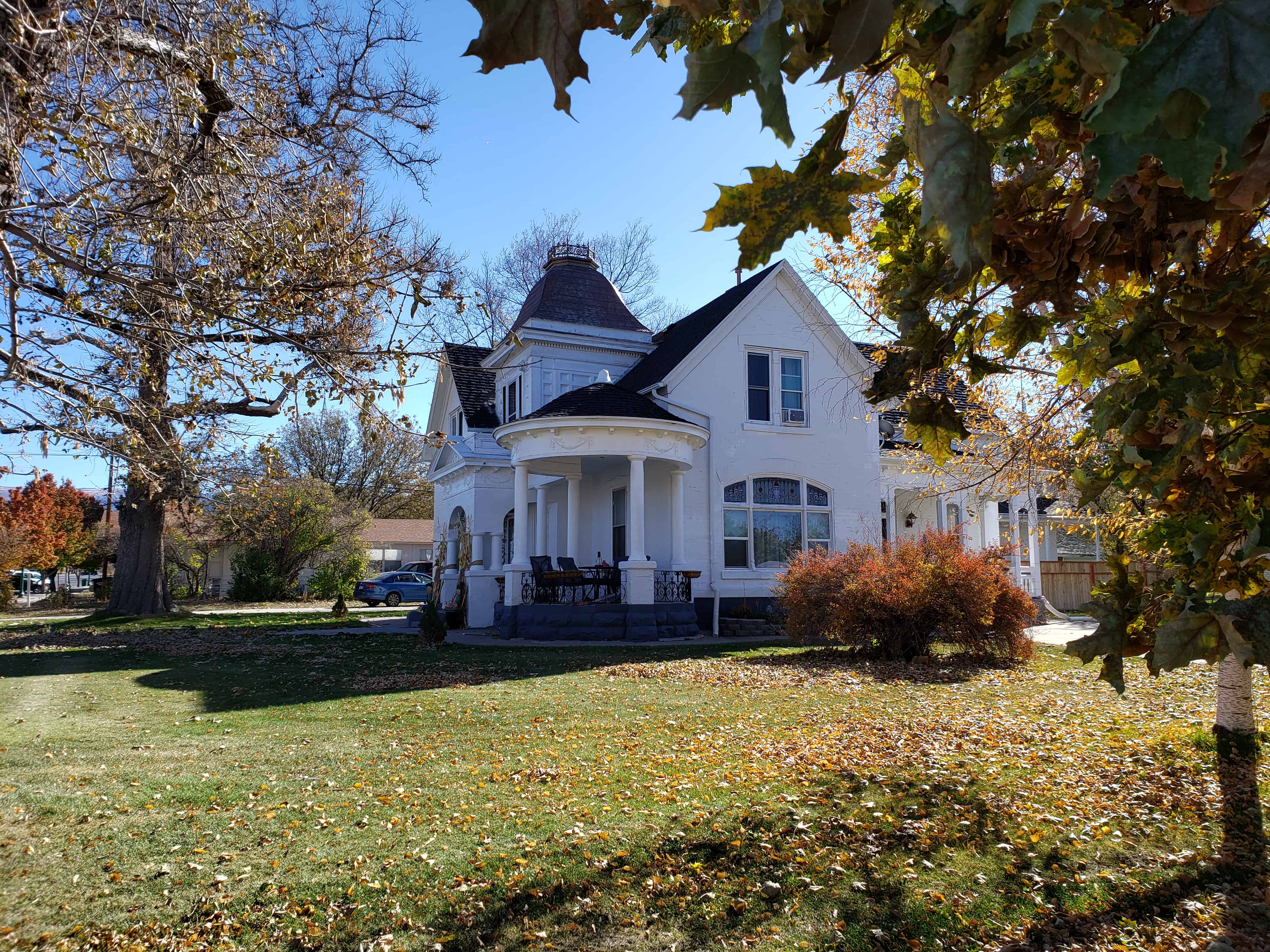
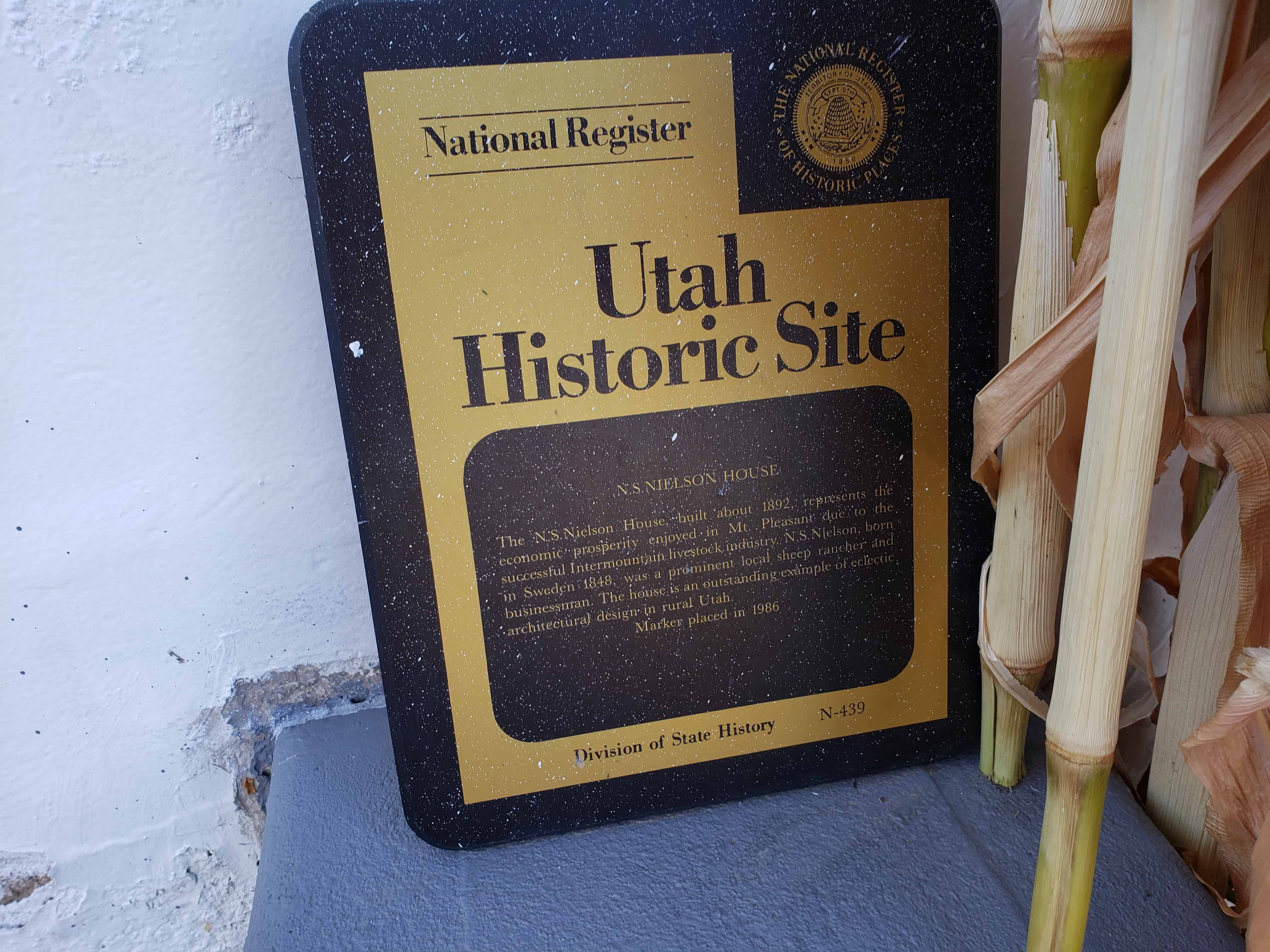
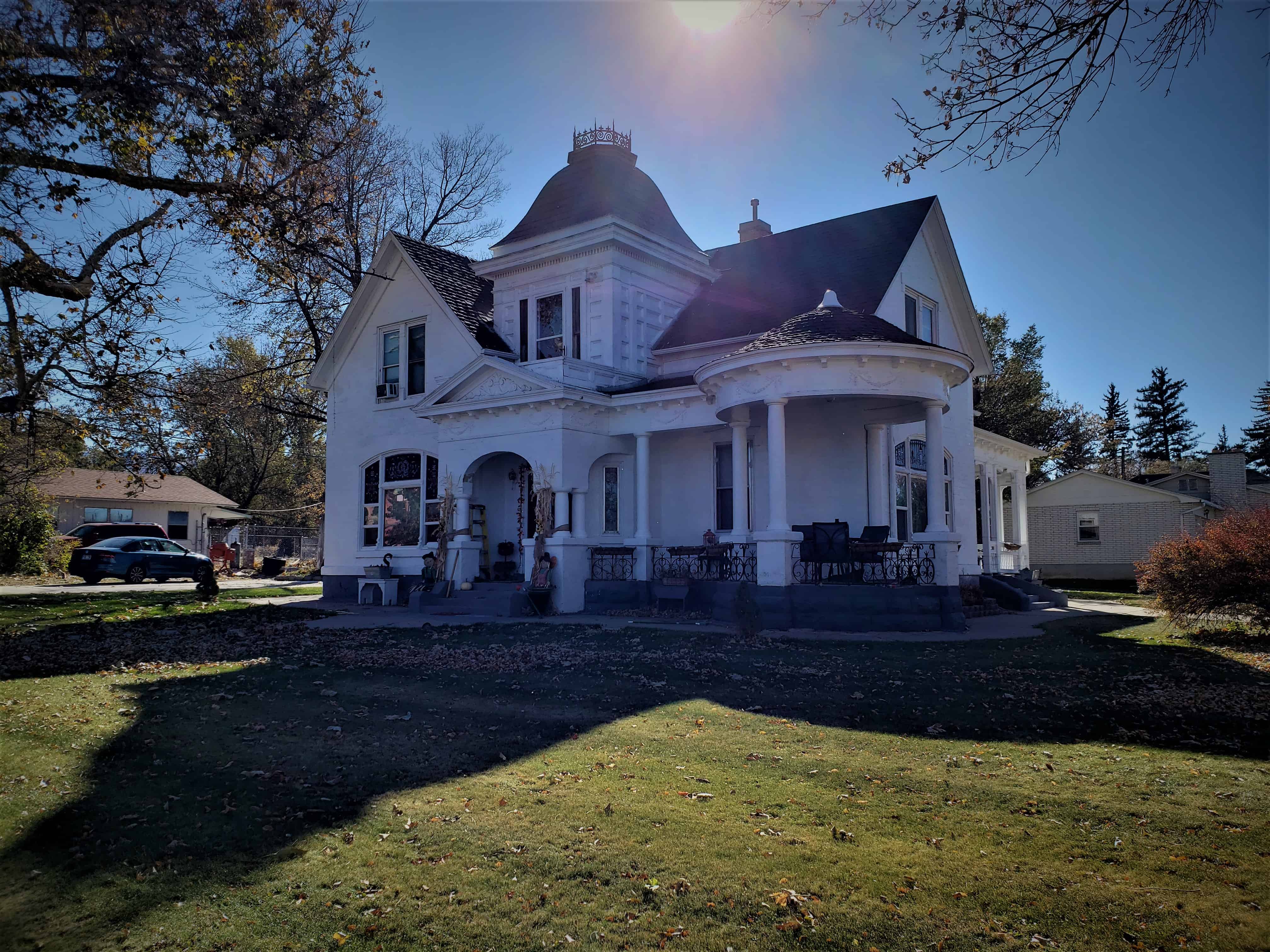
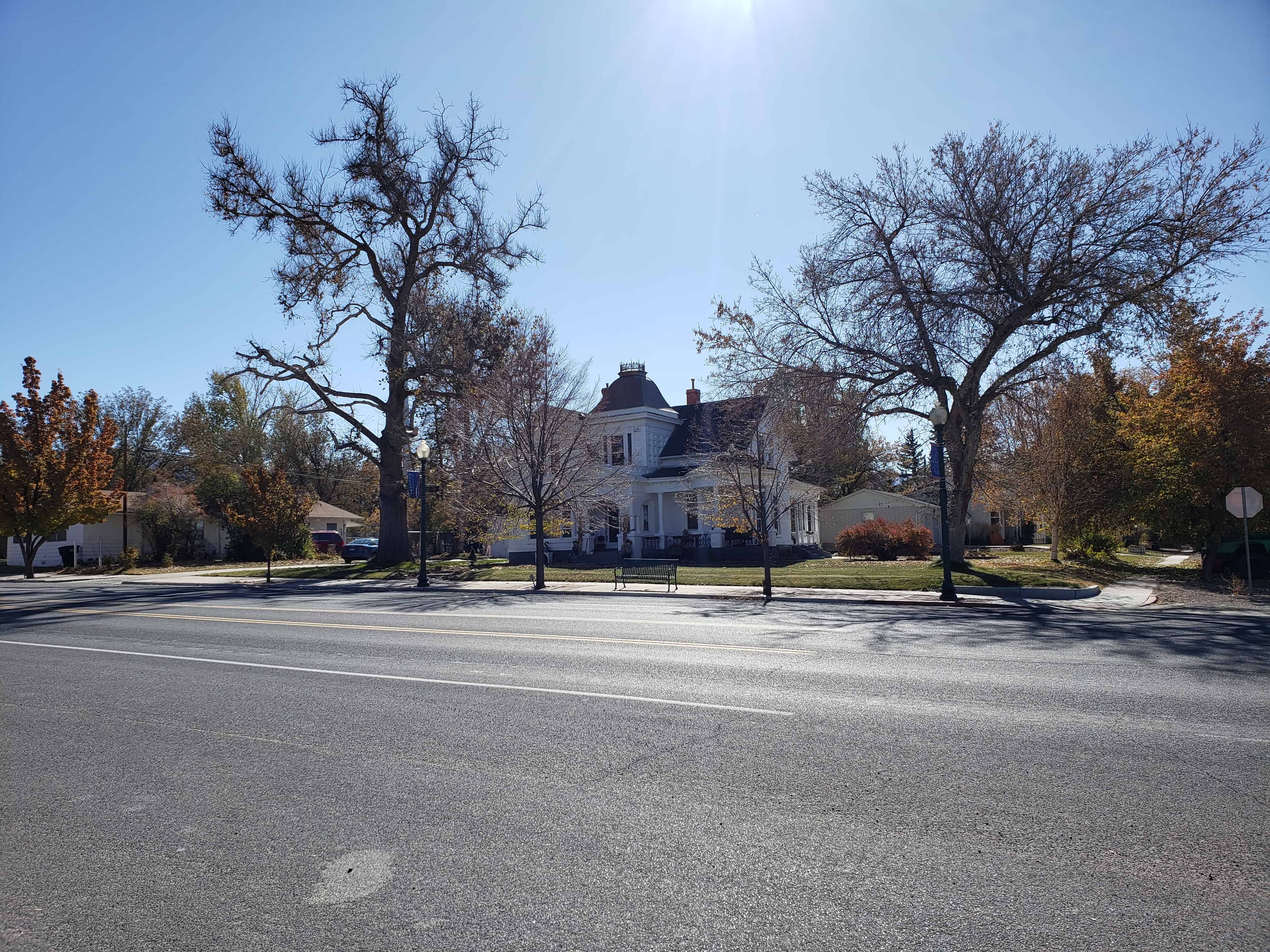
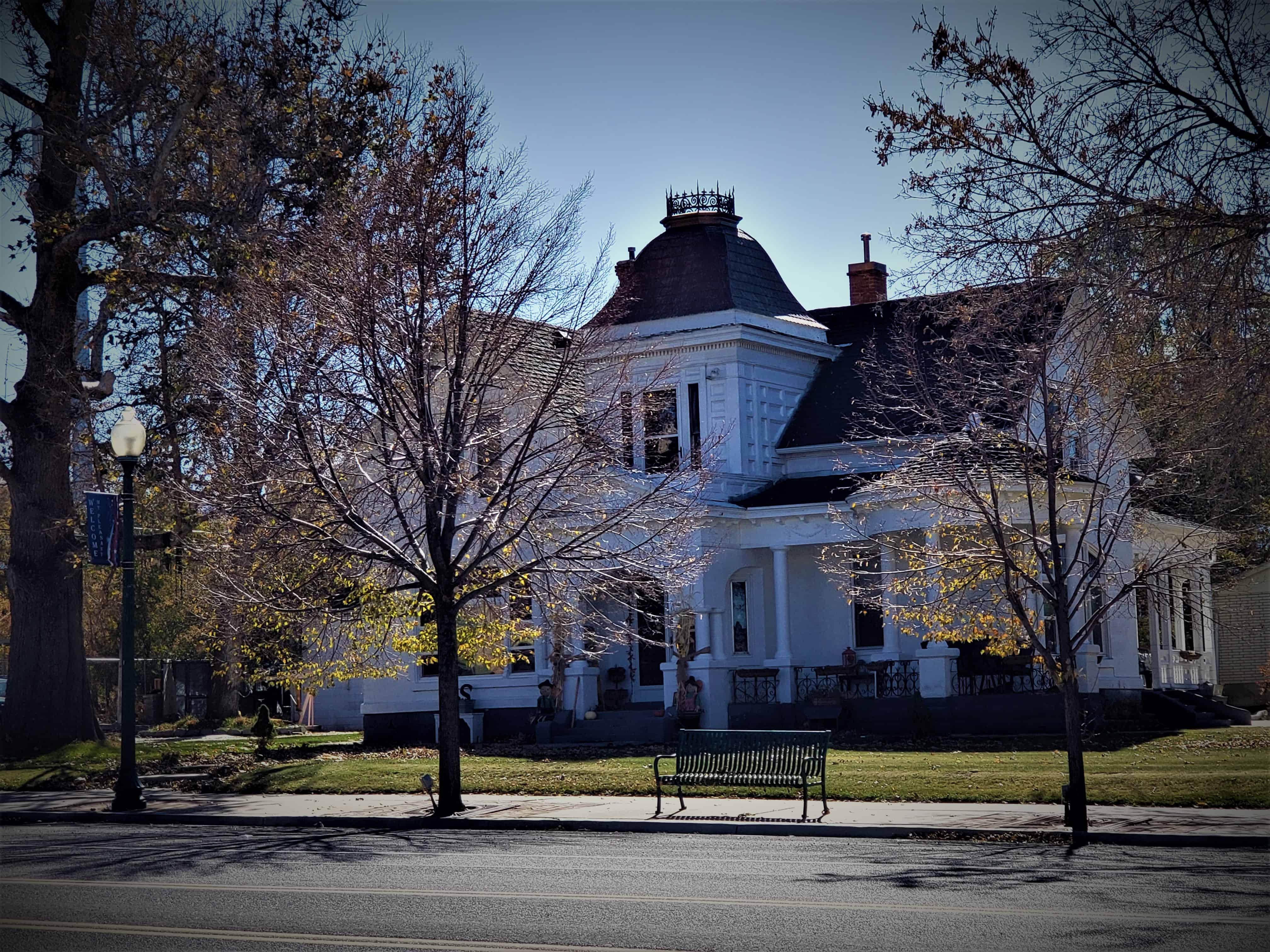
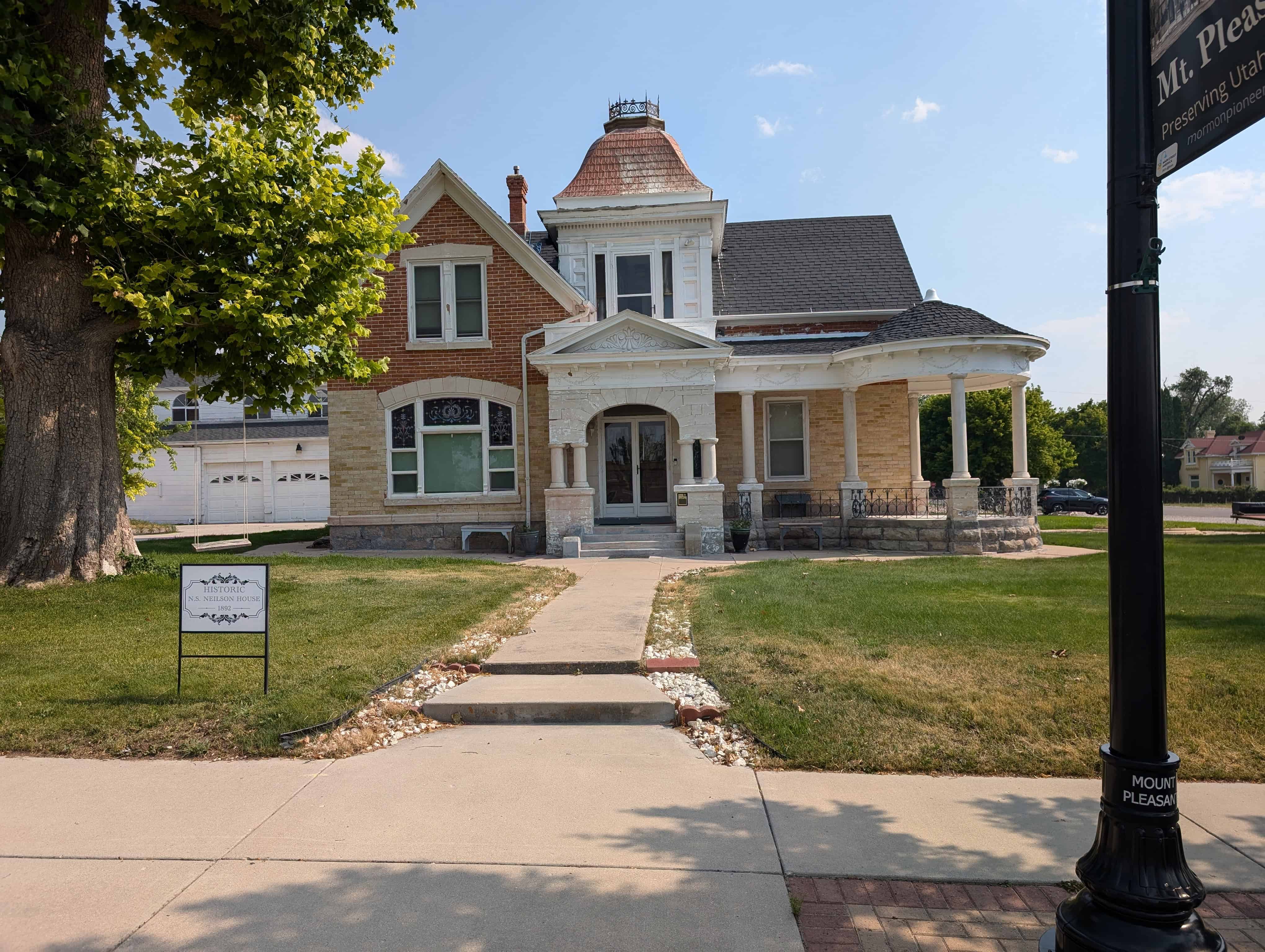
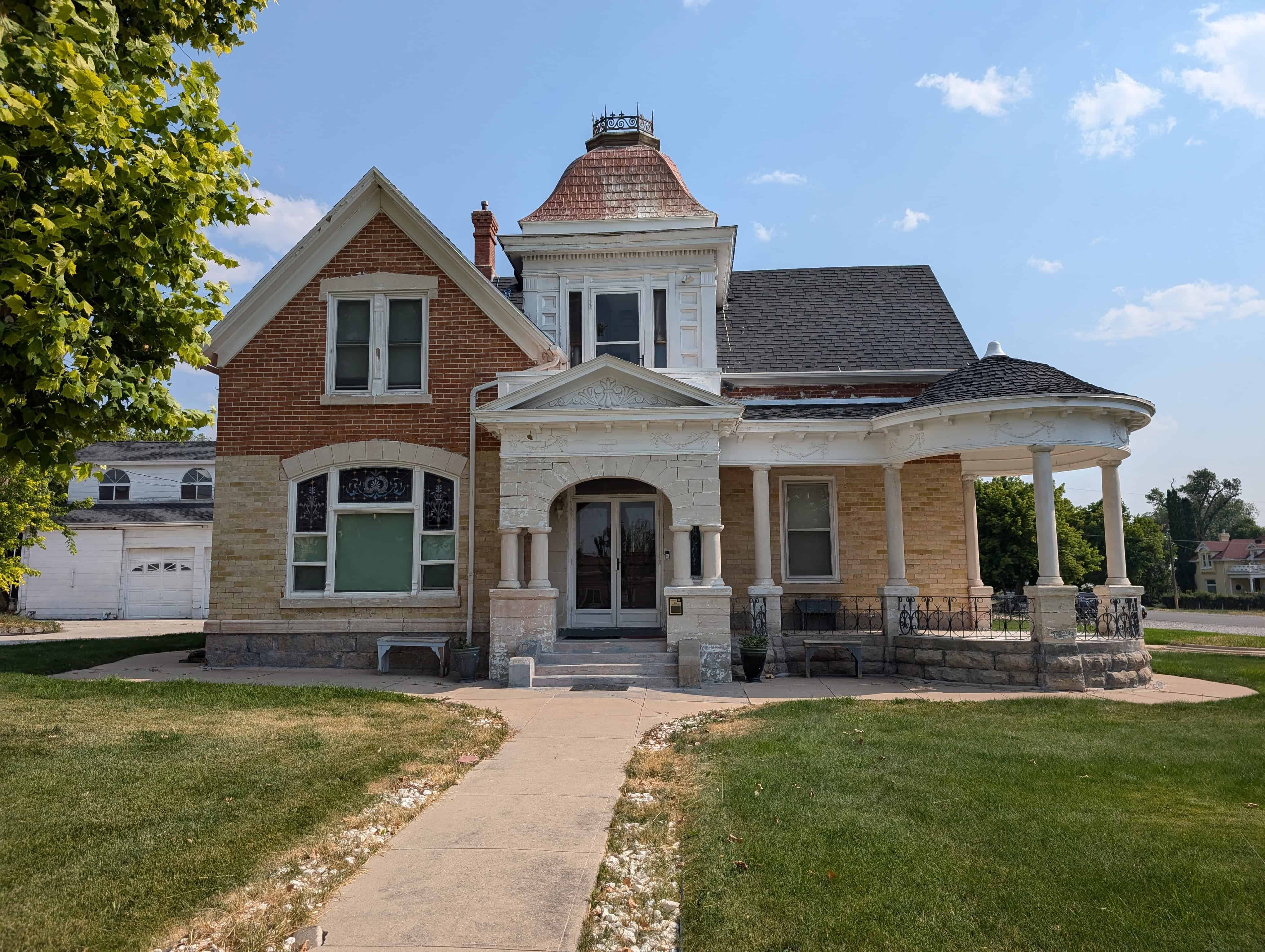
The N.S. Nielson House, built in 1890, represents the economic prosperity enjoyed in Mt. Pleasant due to the successful Intermountain livestock industry. N.S. Nielson, born in Sweden in 1848, was a prominent local sheep rancher and businessman. The house is an outstanding example of eclectic architectural design in rural Utah.
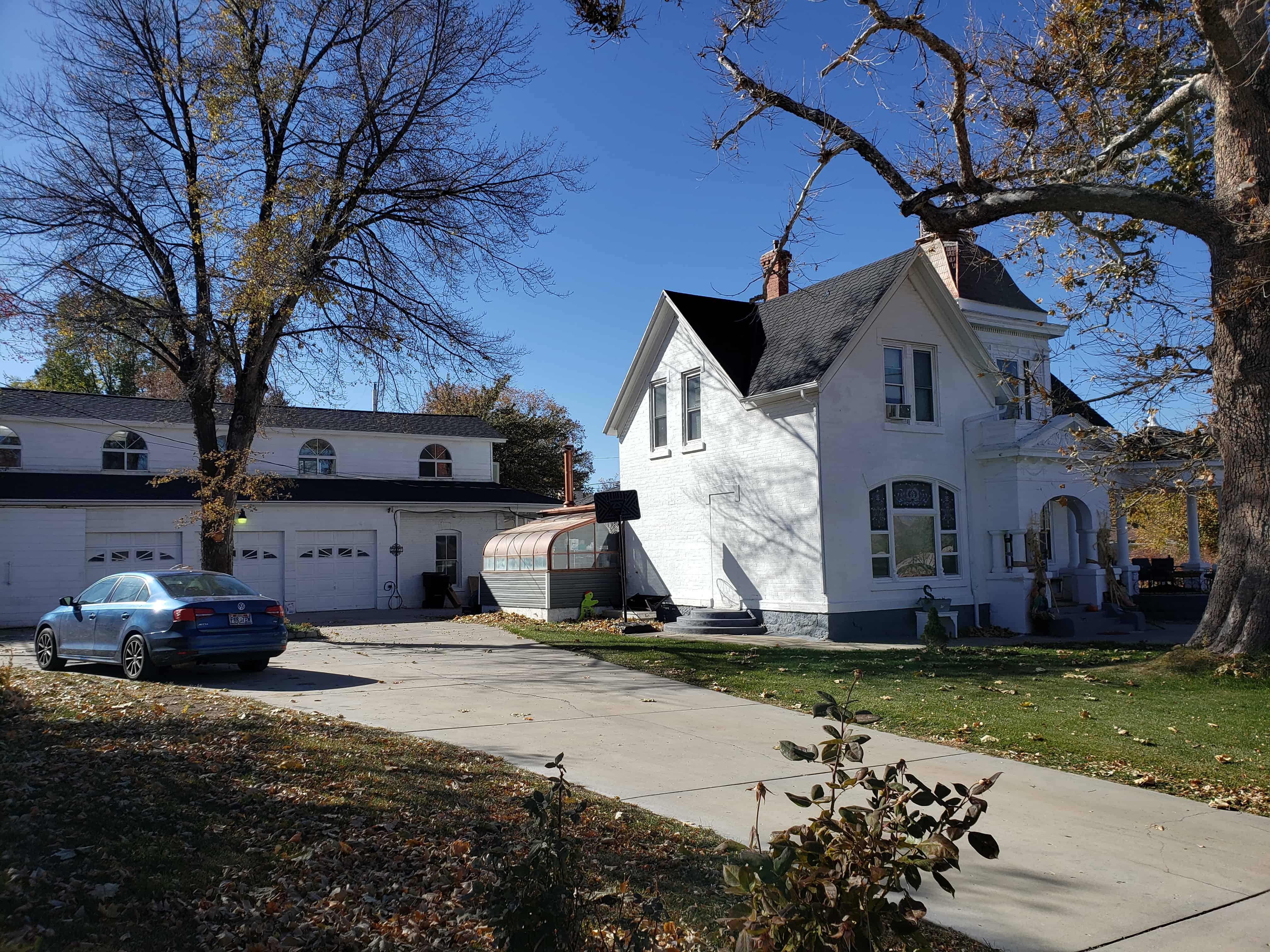
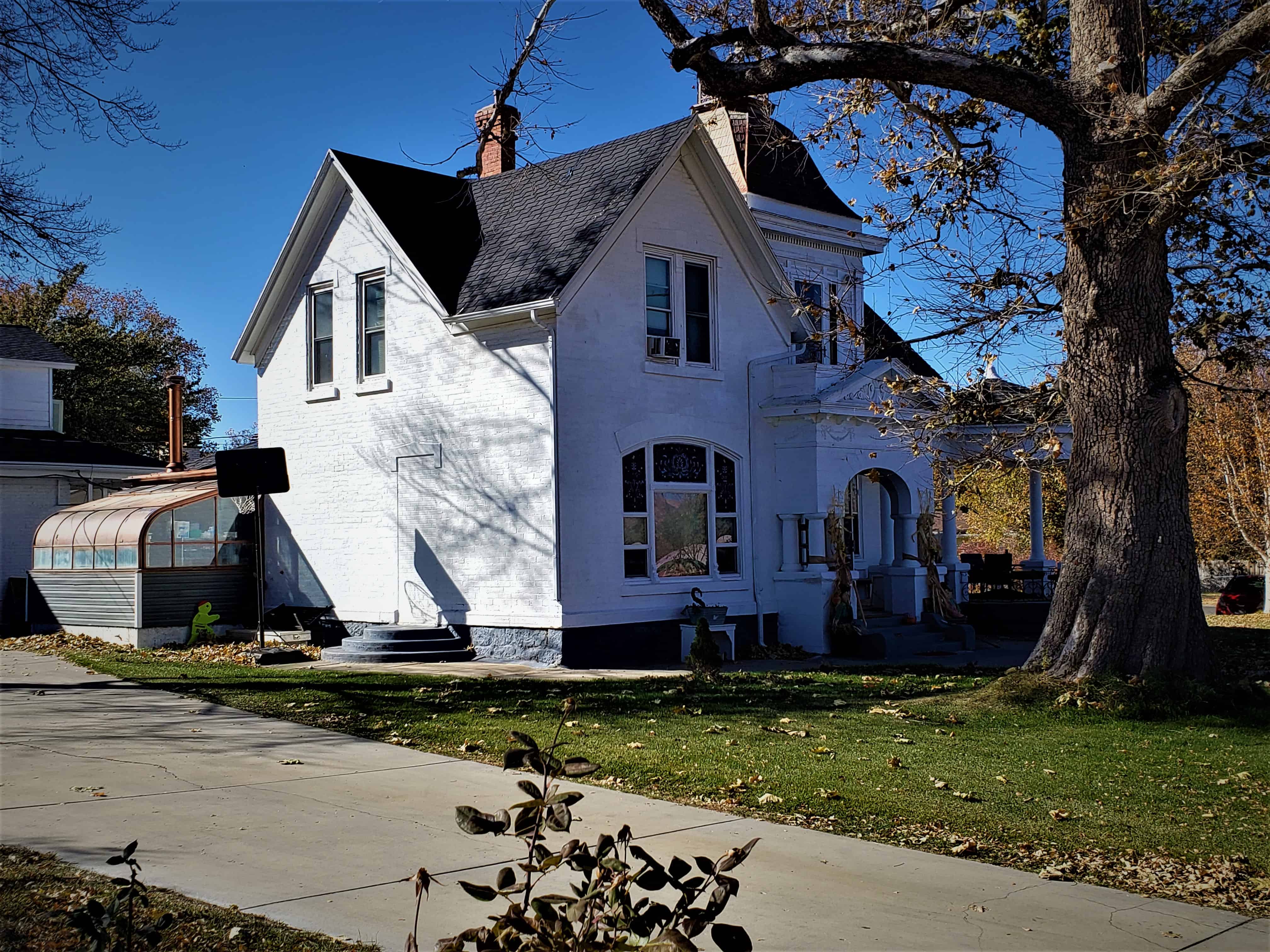
This elaborate, Queen Anne Style, one-and-one-half-story, brick home was built in 1890 by N.S. Neilson. It is a flamboyant example of Victorian massing and detailing as applied to a cross-wing house plan. The house was built in two stages; the first was completed about 1890 as a single cross-wing house; the second in 1892 creatively combined various new stylistic components such as the round portico, and square Mansard-roofed tower. There are five stained-glass windows, a variety of window and roof types, a formal main entry and classical ornament. This house has beautifully painted ceilings done by Carl Anderson who painted the Salt Lake City Play House.
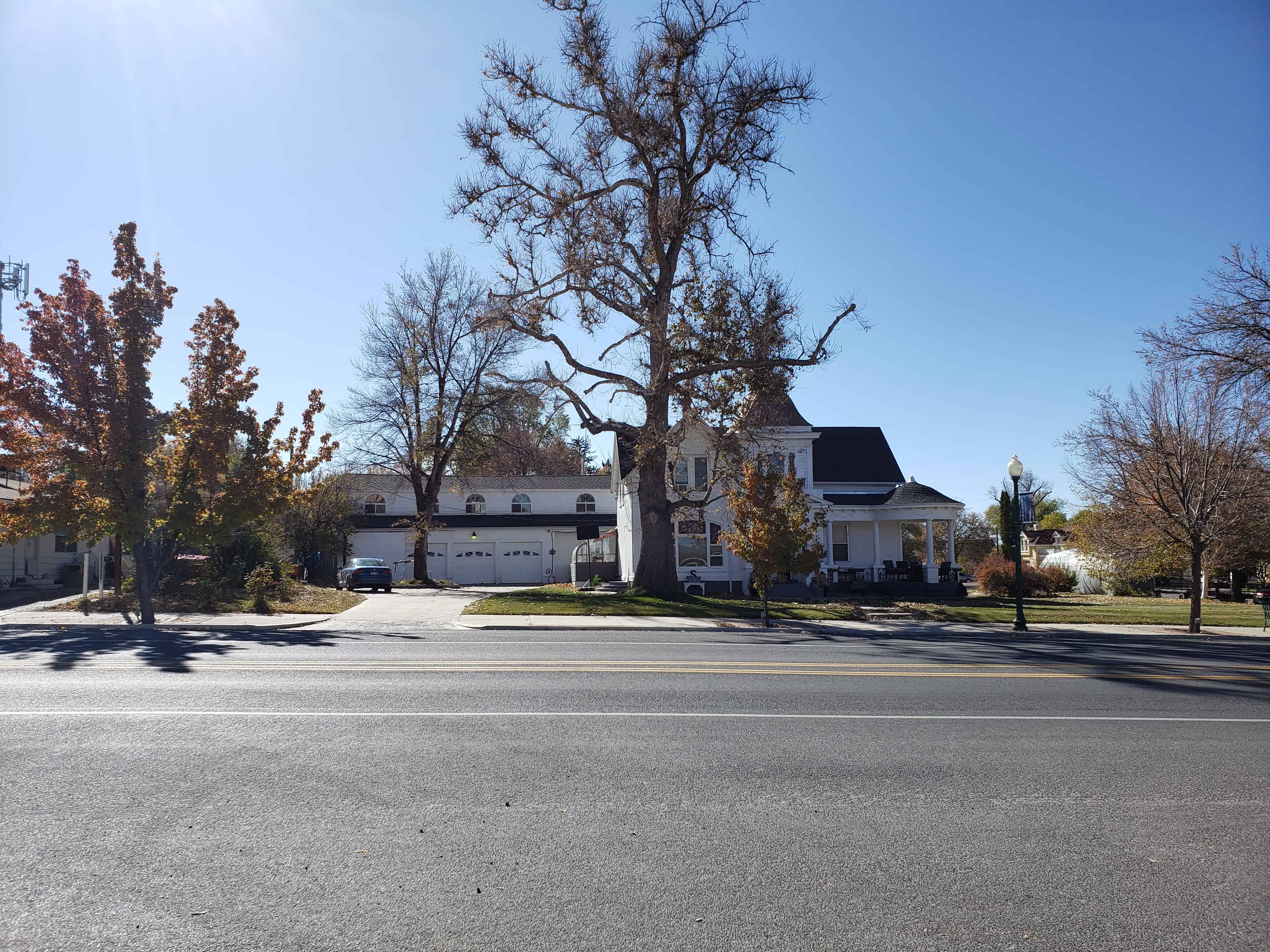
N.S. Neilson was a Swedish immigrant; previously, he had been a serf in Sweden who worked for royalty. Neilson achieved the American dream after coming to Utah. He became a wool grower and prosperous local merchant, owning acreage and this fine house. Years later, this home was sold by Ruth James to Jay and Ethel L. Winkelman. The couple renovated the home and converted the carriage house to a four-car garage with a large recreation room on top. Later the home became a bed and breakfast called the Main Street Inn.(*)
N.S. NEILSON HOUSE
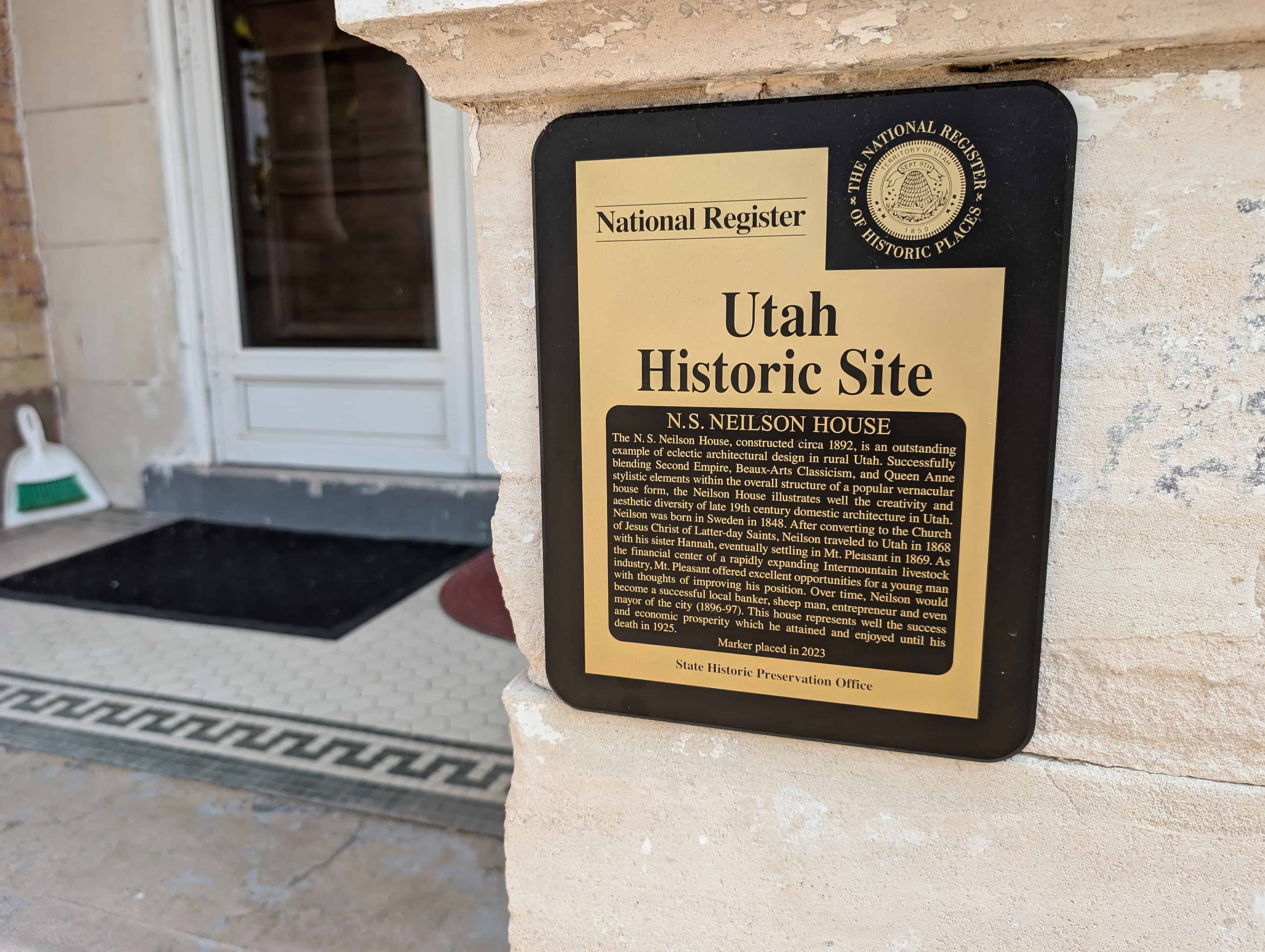
The N. S. Neilson House, constructed circa 1892, is an outstanding example of eclectic architectural design in rural Utah. Successfully blending Second Empire, Beaux-Arts Classicism, and Queen Anne stylistic elements within the overall structure of a popular vernacular house form, the Neilson House illustrates well the creativity and aesthetic diversity of late 19th century domestic architecture in Utah. Neilson was born in Sweden in 1848. After converting to the Church of Jesus Christ of Latter-day Saints, Neilson traveled to Utah in 1868 with his sister Hannah, eventually settling in Mt. Pleasant in 1869. As the financial center of a rapidly expanding Intermountain livestock industry, Mt. Pleasant offered excellent opportunities for a young man with thoughts of improving his position. Over time, Neilson would become a successful local banker, sheep man, entrepreneur and even mayor of the city (1896-97). This house represents well the success and economic prosperity which he attained and enjoyed until his death in 1925.