
Tags
Historic Homes, Hotels, NRHP, Pleasant Grove, utah, utah county

Beers House-Hotel
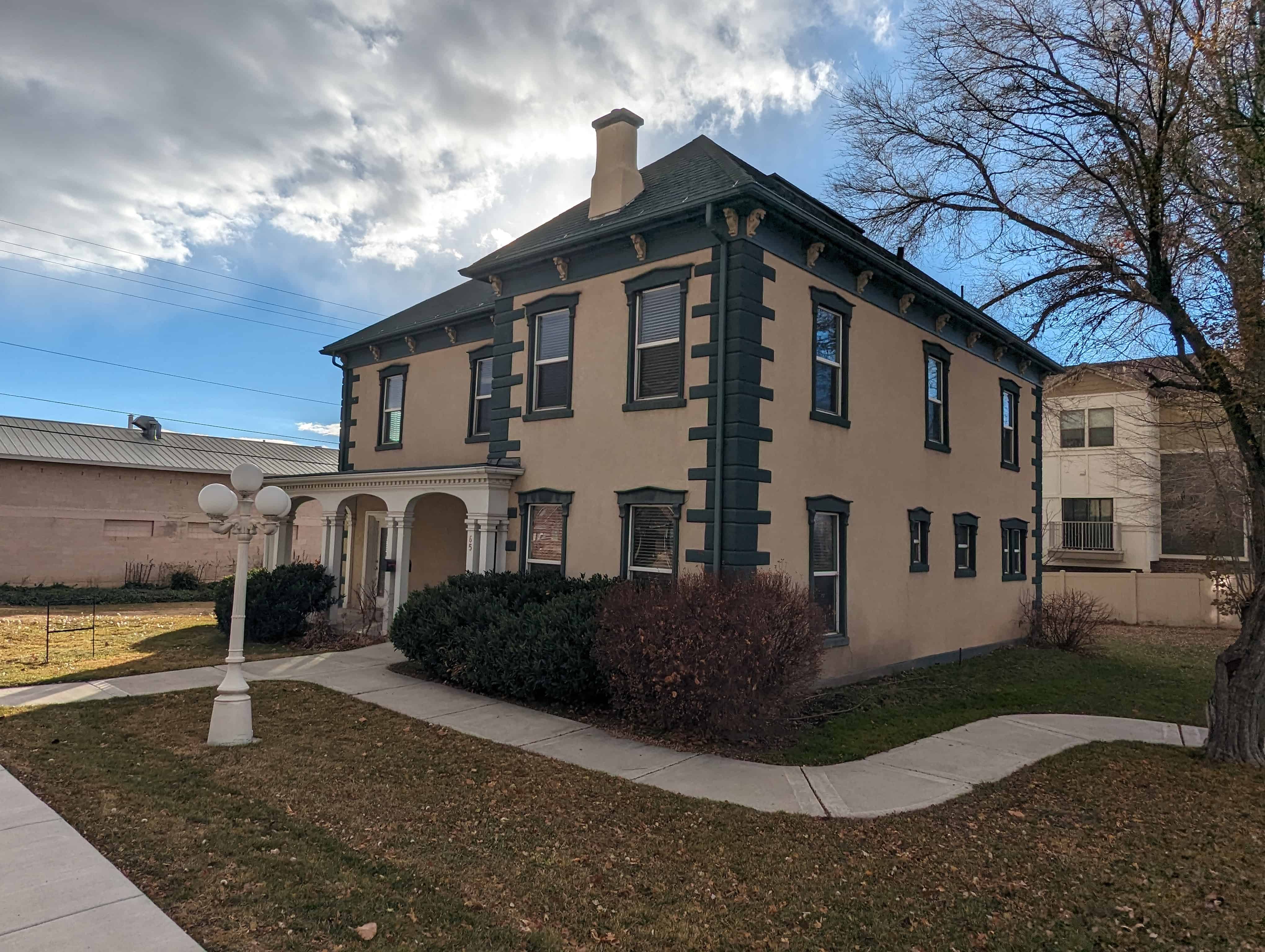
The Beers House/Hotel is both historically and architecturally significant in the community of Pleasant Grove. Franklin and Elizabeth Beers had this Italianate style house constructed in 1885 to serve as a hotel and residence for their family. This hotel identifies with the development of Pleasant Grove as a stopping place for many travelers passing through and for immigrants trying to establish homes. The Beers Hotel is significant architecturally as one of only two Italianate buildings constructed in Pleasant Grove and because it retains the character-defining features and integrity of this ornate style.
Located at 65 North 100 East in Pleasant Grove, Utah and added to the National Historic Register (#94000296) on April 7, 1994. The text on this page is from the national register’s nomination form.
The Beers House/Hotel is located on 100 East, a major thoroughfare in Pleasant Grove. The town’s first school and city hall were also built on 100 East, a road that extends north to American Fork. The Beers House/Hotel was within a diffused central core that included a railroad depot to the west, the Mormon tabernacle to the east and the Presbyterian Church to the north.
The Beers House/Hotel was one of three hotels in the city of Pleasant Grove during the late 19th and early 20th centuries. The Hawley House, the first hotel in Pleasant Grove, was built of soft rock in 1870 by Captain Hawley (and was demolished in the 1960s). The Mayhew House, a one and one-half story frame house built c.1860, was run as a boarding house by Elijah and Sarah Young Mayhew in the late 1890s and early 1900s, and is one of the oldest remaining houses in Pleasant Grove.
The residential scale of these three house/hotels was common for travel accommodations. Multiple use of a residential building was also common and is illustrated by the fact that the Beers House/Hotel was not only known as the Pleasant Grove Hotel, it was later called Beers’ Hall. Other similar establishments combining hotel and hall may be seen in the example of Fairfield Hotel and Amusement Hall of the same period.
Pleasant Grove was first settled by Mormon pioneers in the summer of 1850. Farming was a mainstay from the town’s settlement and to irrigate the various parcels of ground a crude dam c.1851 to carry the water to their lands. A large influx of settlers occurred and the first school was built in 1852. After the Golden Spike was driven to complete the transcontinental railroad at Promontory on May 10, 1869, a new era of development began in the West. The influx of new people attracted by the mining industry also encouraged growth through this region. In 1873, Pleasant Grove’s first train arrived at their station.
Pleasant Grove’s development was further encouraged by individuals providing accommodations and supplies for travelers as well as residents of the community. In addition to building one of the first hotels in Pleasant Grove, Franklin Beers developed a mercantile store with a butcher shop, tin shop, tailor shop, and shoe store with livery stable attachments. Franklin and Elizabeth built this hotel/residence in 1885 near his general merchandise store. “Frank Beers, our enterprising merchant, is finishing up a very fine dwelling house just north of his store. B will keep travelers.
In 1885, Thomas Featherstone, a mason from Lehi, laid the adobe bricks and is believed to have plastered the interior walls. William L. Hayes, a 15 year-old clerk in the Beers Mercantile, carried the hod (a mason’s tool or tray). E. J. Ward, who operated a planing and finishing mill at 200 South 200 East in Pleasant Grove, was hired to do the carpentry and finish work. The wood came from Mr. Ward’s sawmill in American Fork Canyon. All interior and exterior woodwork was done by Mr. Ward and his two sons, Charles O. and Joseph H. Ward.
Franklin Beers was born August 16, 18439 in New York when his parents were traveling from England to Nauvoo, Illinois. In 1848 he and his mother, Susan Gazy Beers, crossed the plains with a group of Mormon pioneers arriving in Salt Lake City in the fall of that year (his father had previously returned to the East). They moved to Pleasant Grove in 1850.
Beginning at an early age Franklin took an active part in the settlement and financial growth of Utah. He participated in the Blackhawk Indian War and traveled across the plains numerous times to assist the immigrant pioneers. His step-father often sent him with the wagon to act as an escort for Brigham Young on his early trips to southern Utah.
Elizabeth Glines Beers was born in Harris Grove, Iowa on March 13, 1852, the daughter of James Harvey and Elizabeth Ann Myers Glines. She arrived in Salt Lake City with her family on October 4 of that same year. They made their home in Cedar Fort, Utah County in April 1853. Franklin Beers was Elizabeth’s teacher at Cedar Fort school prior to their marriage on April 26, 1869 in the Endowment House in Salt Lake City.
She assisted Franklin in his mercantile business that he and Benjamin Driggs bought from George H. A. Harris in 1879. They sold stock in this business and operated as the Battle Creek Co-op. Owners of the Pleasant Grove Co-op sued Driggs and Beers and the Battle Creek Co-op was dissolved. Beers then built his own modern two story mercantile shop (no longer in existence) c.1884 on the corner of Center Street and 100 East. This mercantile business is considered a forerunner to the department store because it included a shoe shop, butcher shop, tailoring shop, a millinery run by Elizabeth and their daughters, an upstairs dance hall, and a livery stable at the rear. Elizabeth Beers managed the hotel while raising their nine children in the house.
The Beers operated both businesses successfully until 1895–the 1893 financial panic and the extension of credit had begun to make their merchandise business unprofitable. They retained ownership of the Pleasant Grove properties, but moved to Vernal in 1895, where Elizabeth’s father had moved. In Vernal, Franklin established a mercantile in which his wife and daughters again operated a millinery shop. Beers introduced the first bee industry in the Uintah Basin. From this business, he shipped the first railroad car loads of honey from Utah to the eastern states.
In a very short time, they recouped their losses and moved to Provo where they built a home on Academy Avenue. Elizabeth and her daughters established a millinery shop in Provo. Franklin Beers passed away, July 28, 1905, owning considerable property in Vernal, Pleasant Grove, and Provo. Elizabeth and their daughters retained ownership of the Pleasant Grove hotel until 1925. The hotel/residence was rented during the years they lived in Vernal and Provo.
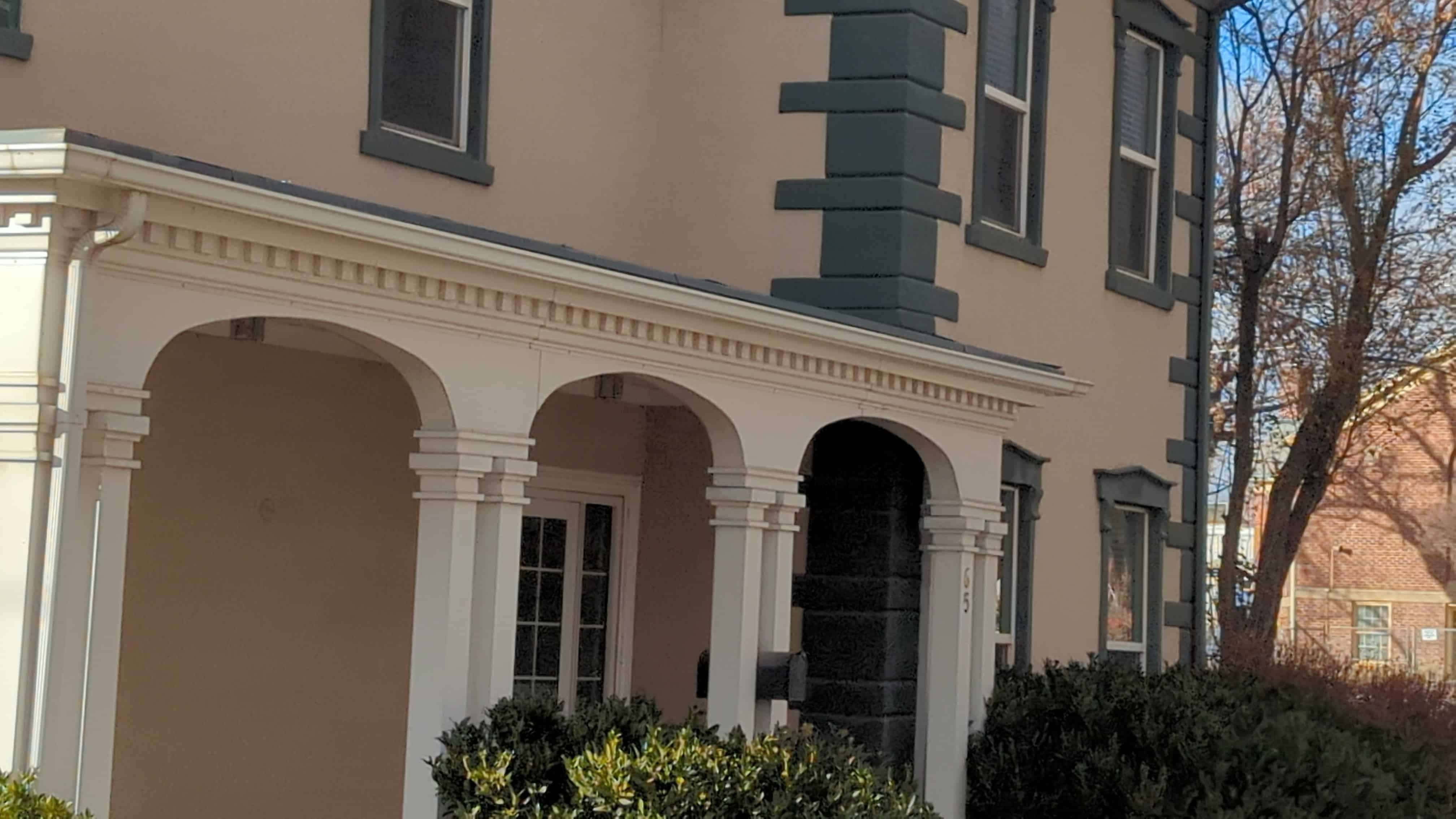
The hotel/residence was purchased by Eleroy and Lois West in 1925. In 1930, under the direction of Fred Markham, a prominent Provo architect, the Wests had the small porches removed, the exterior walls stuccoed and quoins added. Other alterations on the façade included the installation of French doors, side-lights flanking the front door and a balcony porch with balustrade. Plumbing and electrical wiring were installed, closet and storage spaces were added, a basement was excavated under the southwest rooms, and archways were opened and a fireplace installed between the southeast and southwest living rooms.
The Wests were natives of Pleasant Grove, having both attended school there and graduated from Brigham Young University. They were married on June 2, 1920, and raised five children. Both were prominent members in the community, the local Mormon Church, and in education. Lois West was born October 23, 1897. She taught school in Pleasant Grove and Nevada for 18 years, was an accomplished musician, and organized the first PTA in the community as well as the first school lunch program. She was a member of Utah Federated Women. Eleroy West was born January 2, 1895. He earned a degree from the University of Utah as well as BYU, taught school for 35 years in Utah, and worked for the U.S. Forest Service during summer months. He served in France in WWI. Eleroy was instrumental in forming the National Guard in Utah County and served as commanding officer for all counties from Utah County to the southern border of Utah. He served in the United States during WWII with the National Guard; after serving 27 years, he retired with the rank of Colonel. Lois passed away July 8, 1991, and Eleroy died March 5, 1993 having lived in the house for 66 years.
A grandson of Lois and Eleroy, William G. West, purchased the building, refurbished it, and moved his two businesses, EBS Electronic Business Systems and Knight West Construction, into the spacious building. William is a native of Pleasant Grove and is currently serving as an elected Pleasant Grove City Councilman.
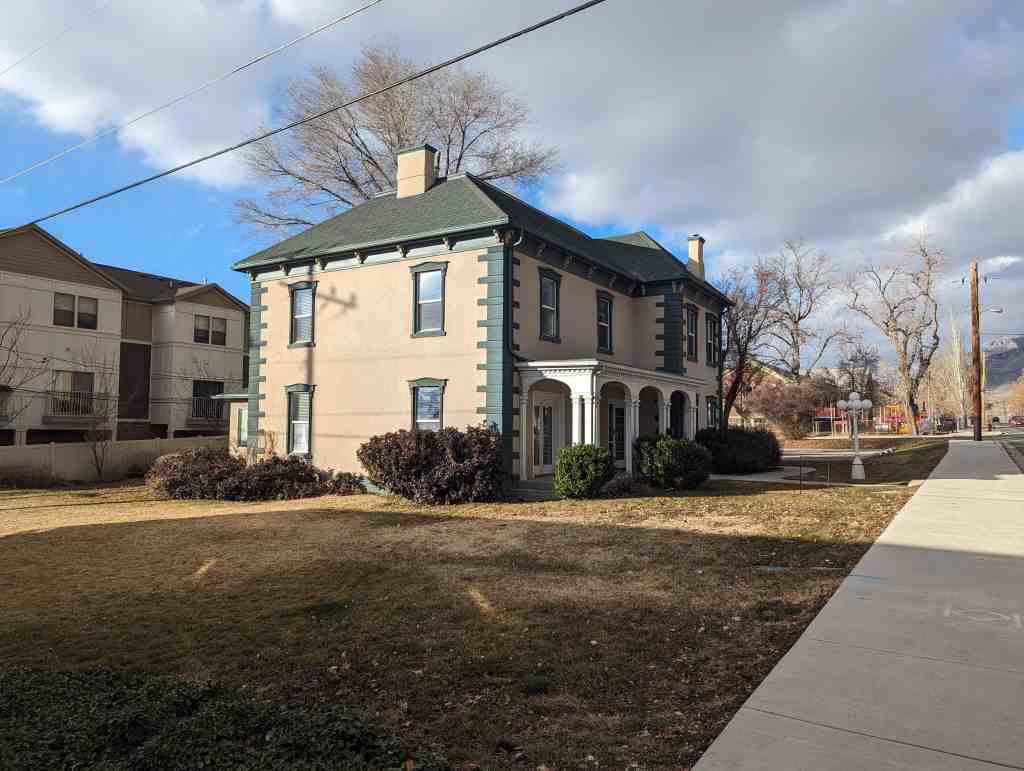
The Beers Hotel is significant architecturally as one of only two Italianate style buildings constructed in Pleasant Grove. The Italianate style did not become popular in Utah until after the Civil War and was not common in outlying communities until the 1880s. The Beers Hotel takes the shape of the commonly used cross-wing form and is characterized by a low-pitched hip roof, overhanging eaves, bracketed cornices and hooded window heads. Other characteristics include an asymmetrical plan and façade. The changes made to the building in the 1930s, including the stuccoed exterior with quoins and the balcony porch, are in keeping with the Italianate style. This hotel/house retains its character and contributes to the community’s architectural heritage.

The Beers House/Hotel, constructed of adobe in 1885, is a two-story cross-wing Italianate style house with a hip roof. Stucco was applied to the exterior walls as a part of a 1930 remodeling. A 1993 remodeling involved other minor alterations to the exterior and interior, but overall the house retains a high degree of its original integrity. The house is located on a residential lot one block east of Main Street in the heart of the town. The building maintains its historic character and continues to contribute to the architectural heritage of Pleasant Grove.
The adobe bricks are 12 x 5 x 4 inches and are laid two wythes thick. Italianate features include an asymmetrical plan and façade, a low hipped roof, and bracketed eaves and cornices. The paired, tall, narrow windows include pedimented lintels with rosettes in the centers. In 1930, small porches were removed, the exterior walls were stuccoed and quoins were added. French doors, side-lights flanking the main front door, and a balcony porch with a balustrade were other changes made to the facade that are in keeping with the original style. Plumbing components and electrical wiring were installed. Closets and storage spaces were added and a basement was excavated under the southwest rooms. Twin archways were opened between the southeast and southwest living rooms and a fireplace was added between the archways.
In 1993, the building again underwent renovation that included rewiring and replumbing. The front wooden door was replaced with a metal door of like appearance. The side-lights were replaced with solid glass side-lights of the same size. The twelve-light French doors were replaced with single-light metal doors. No other changes to the façade or exterior have been made. Uneven plaster walls on the interior were covered with a layer of sheetrock, bringing the walls flush with the interior woodwork. No changes to interior wall placement or ceiling height have occurred.
Pingback: Historic Buildings in Pleasant Grove | JacobBarlow.com
Pingback: Historic Homes in Pleasant Grove | JacobBarlow.com