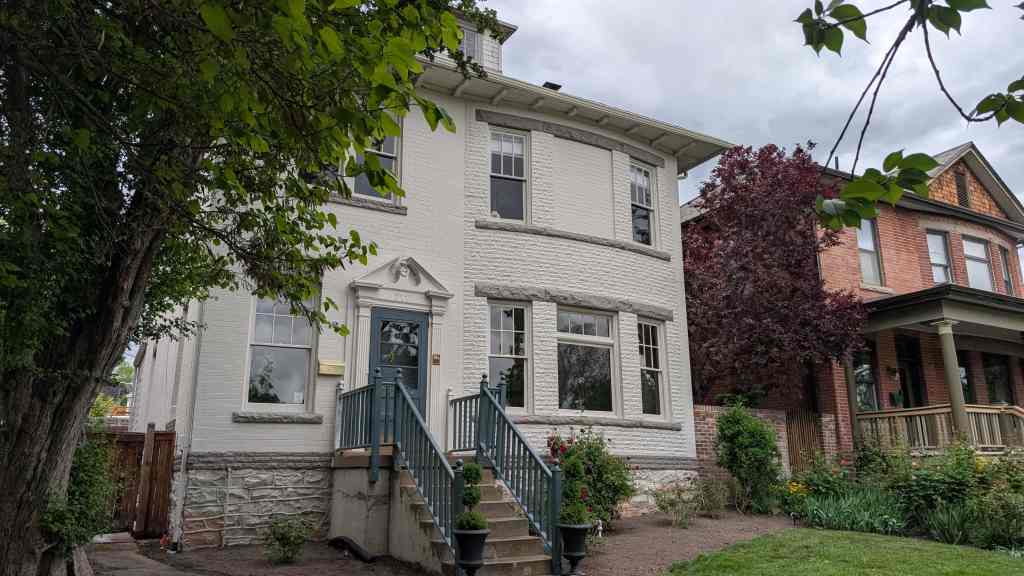
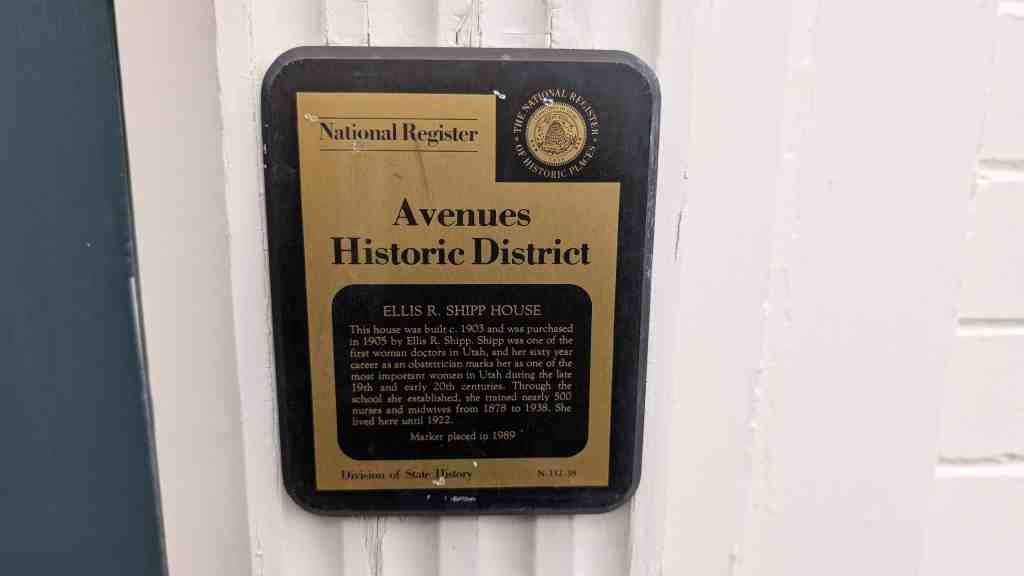
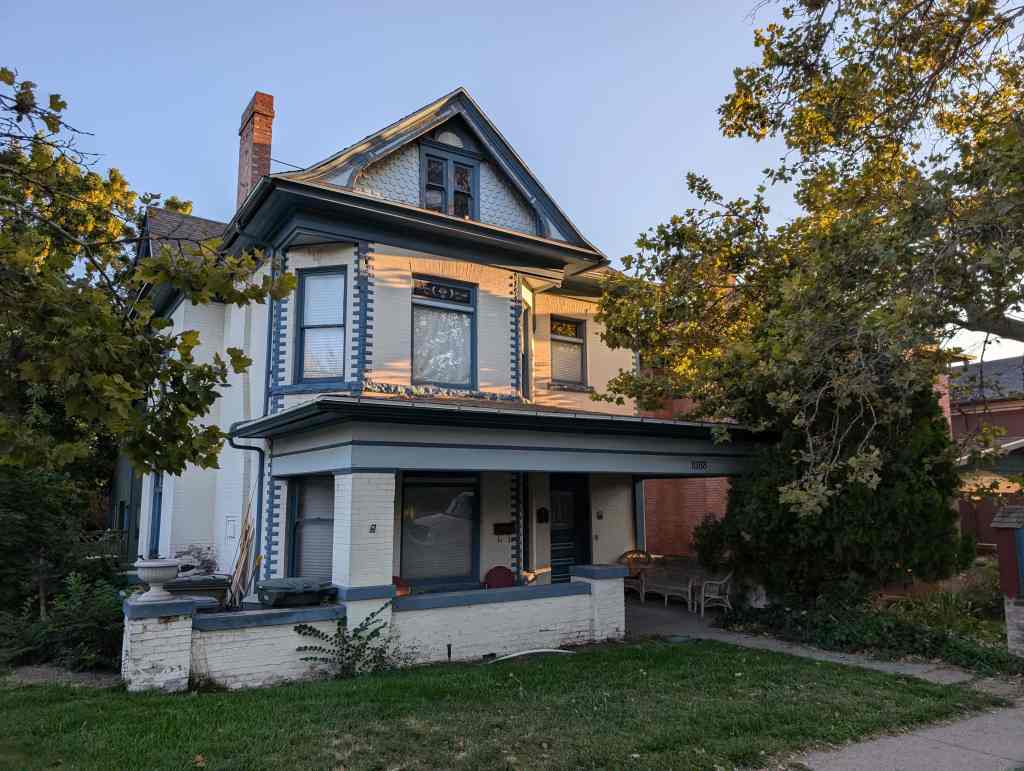
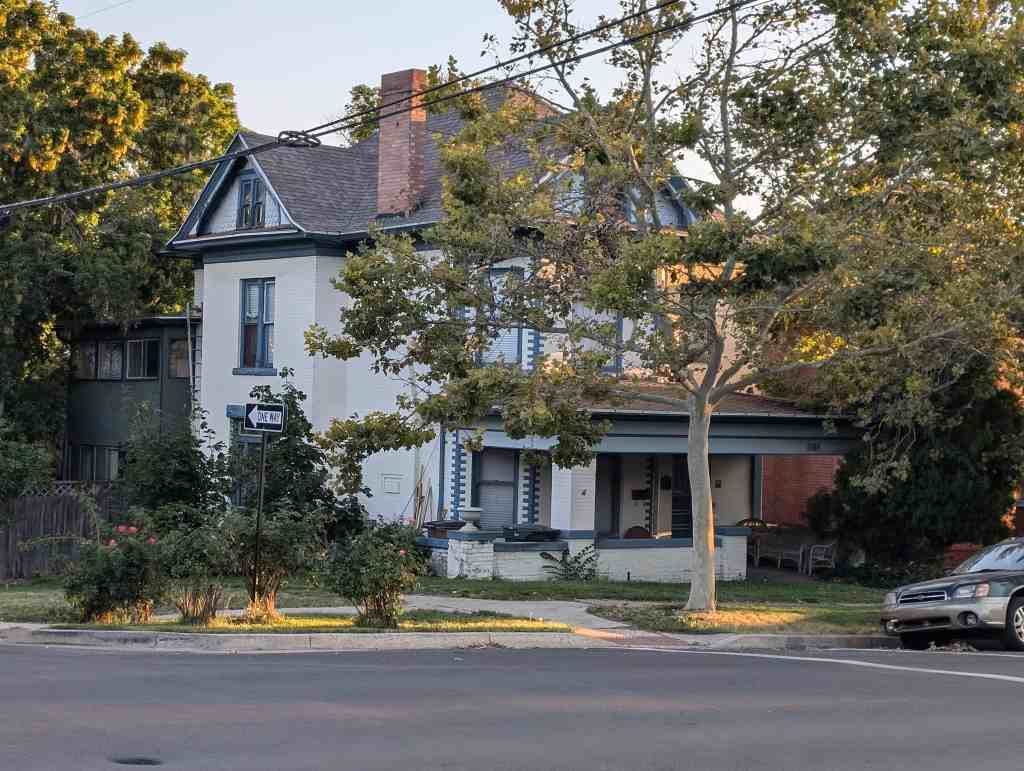
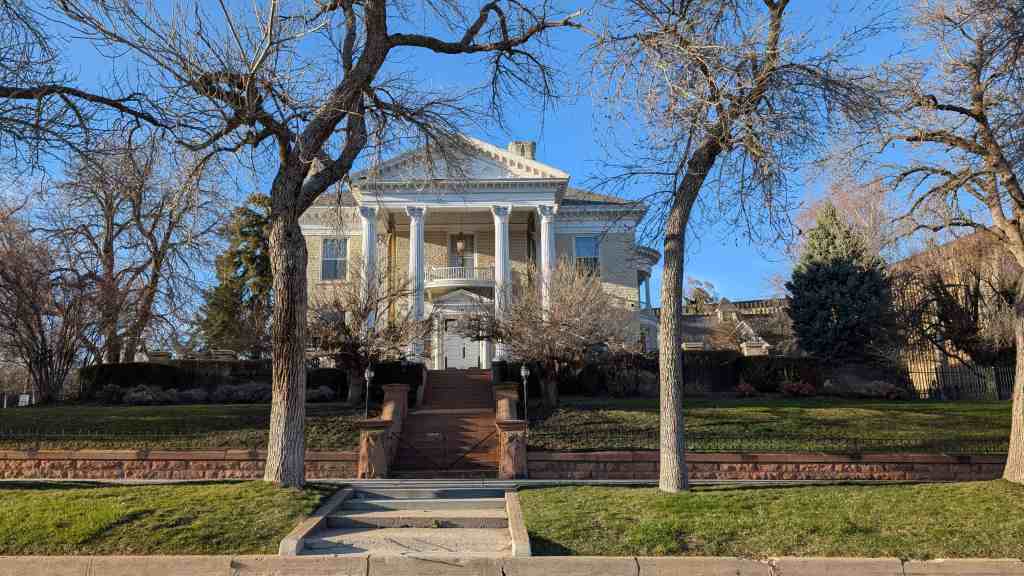
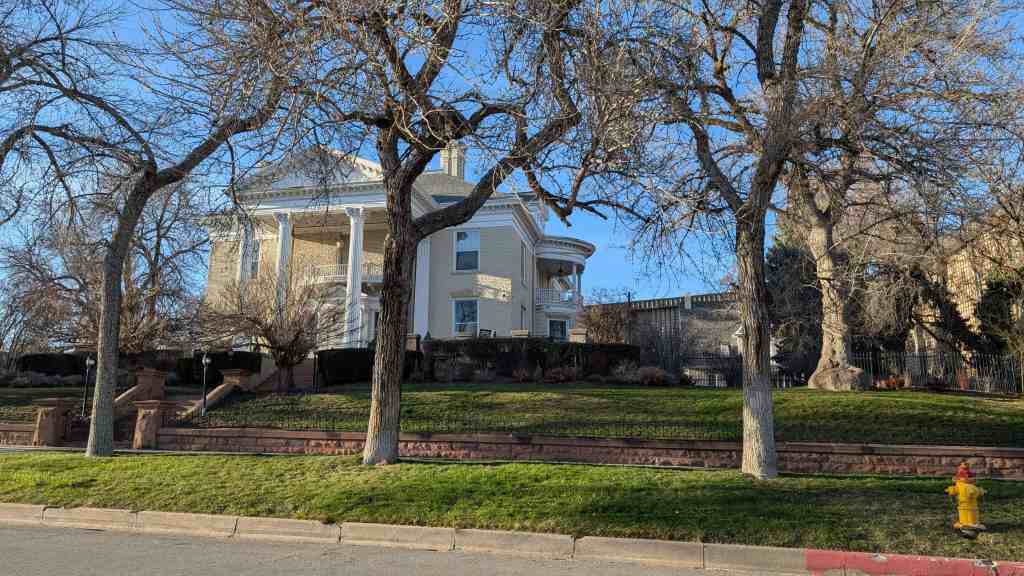
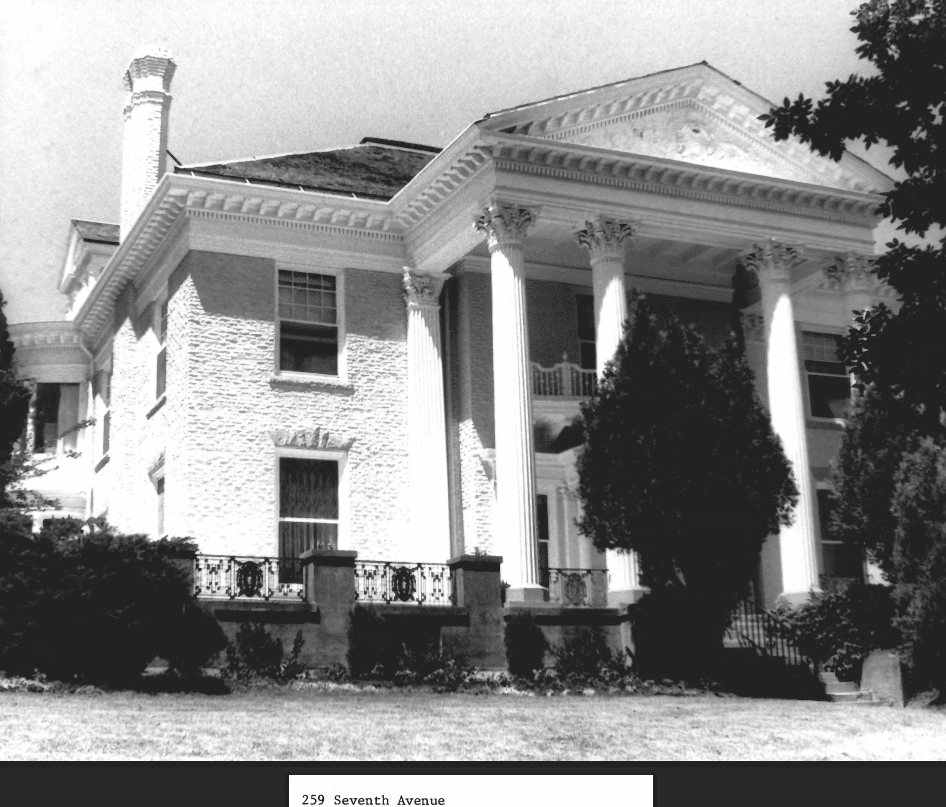
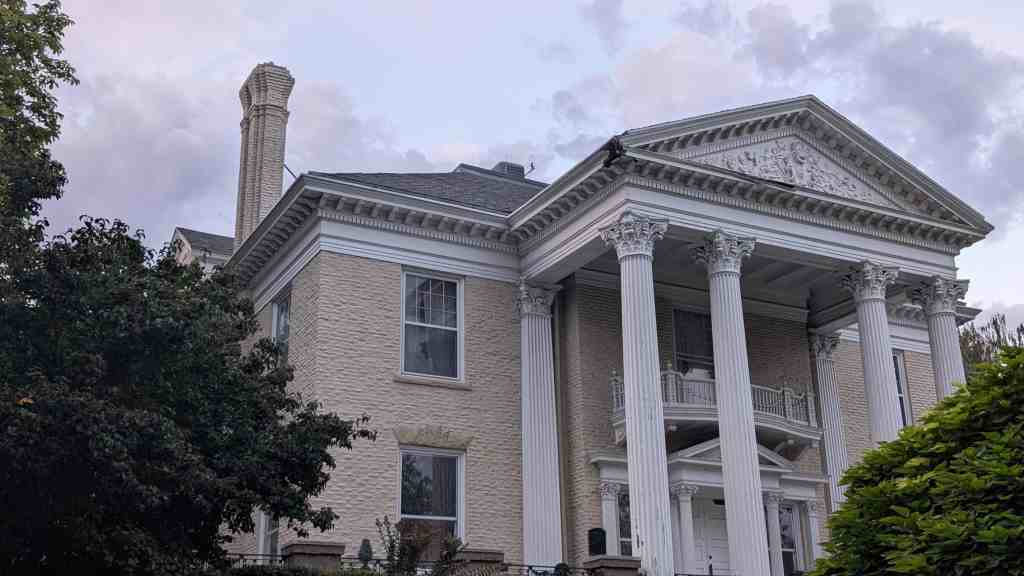
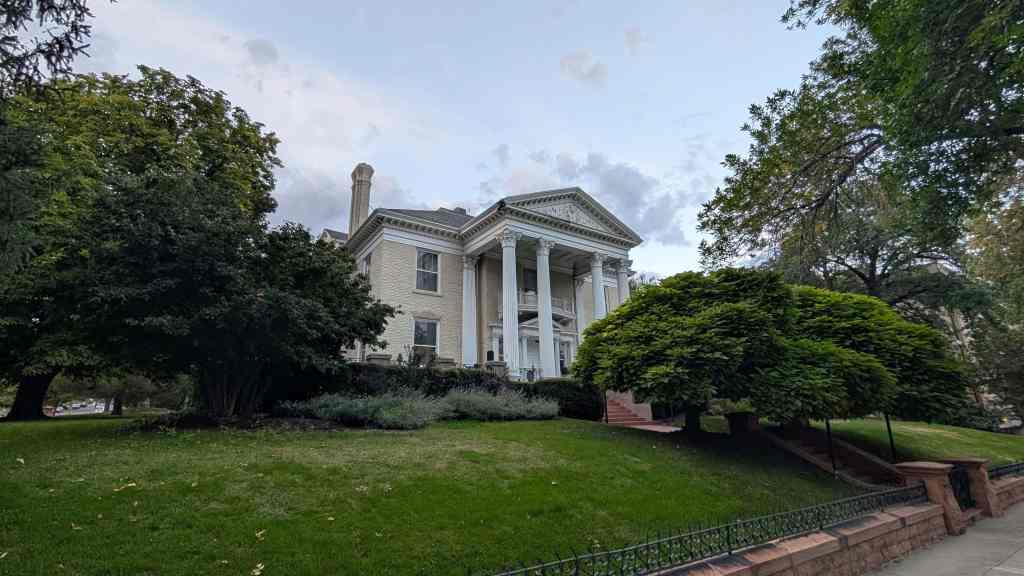
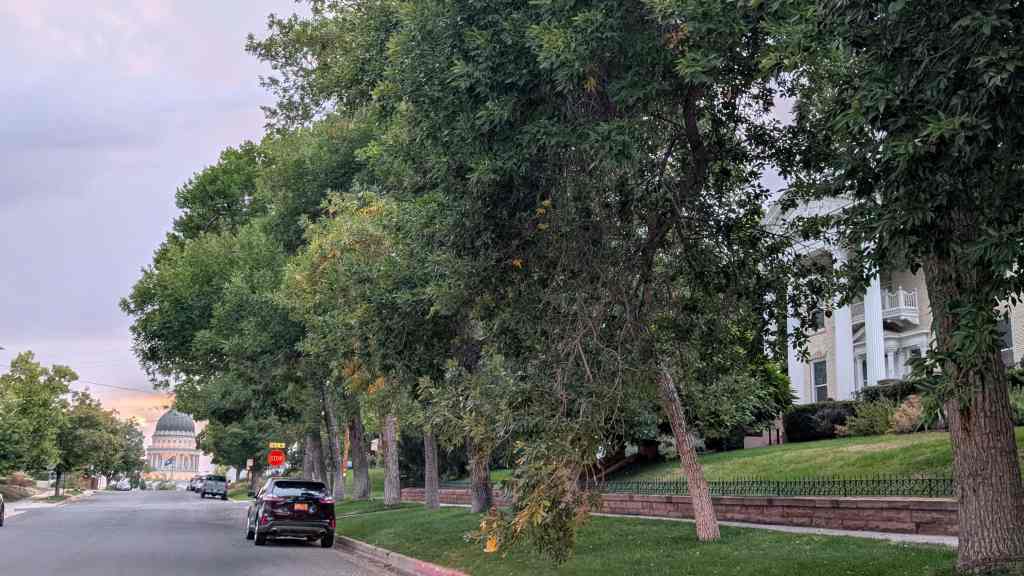
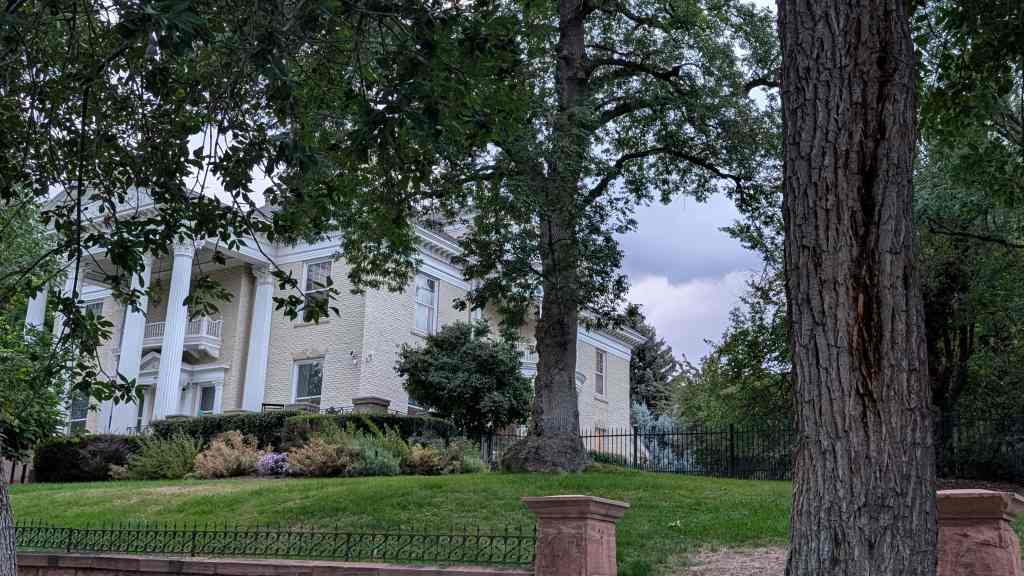
This house was built c. 1903 and was purchased in 1905 by Ellis R. Shipp. Shipp was one of the first woman doctors in Utah, and her sixty year career as an obstetrician marks her as one of the most important women in Utah during the late 19th and early 20th centuries. Through the school she established, she trained nearly 500 nurses and midwives from 1878 to 1938. She lived here until 1922.
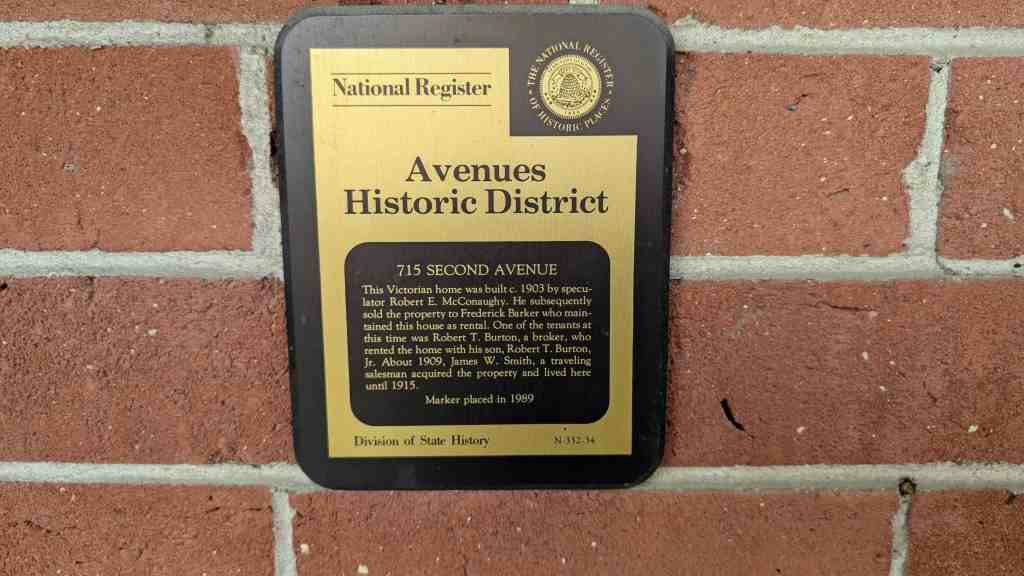
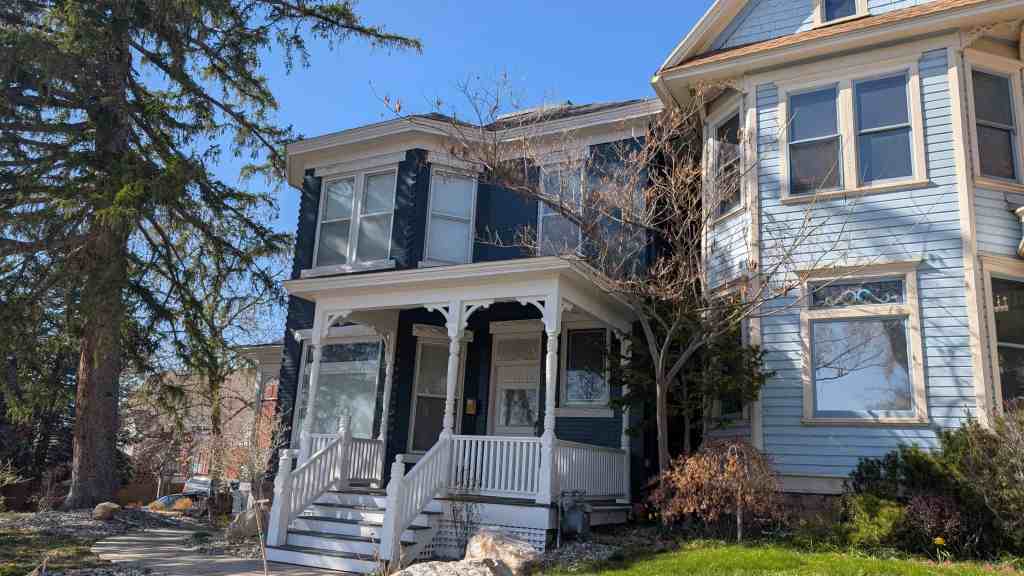
This Victorian home was built c. 1903 by speculator Robert E. McConaughy. He subsequently sold the property to Frederick Barker who maintained this house as rental. One of the tenants at this time was Robert T. Burton, a broker, who rented the home with his son, Robert T. Burton, Jr. About 1909, James W. Smith, a traveling salesman acquired the property and lived here until 1915.
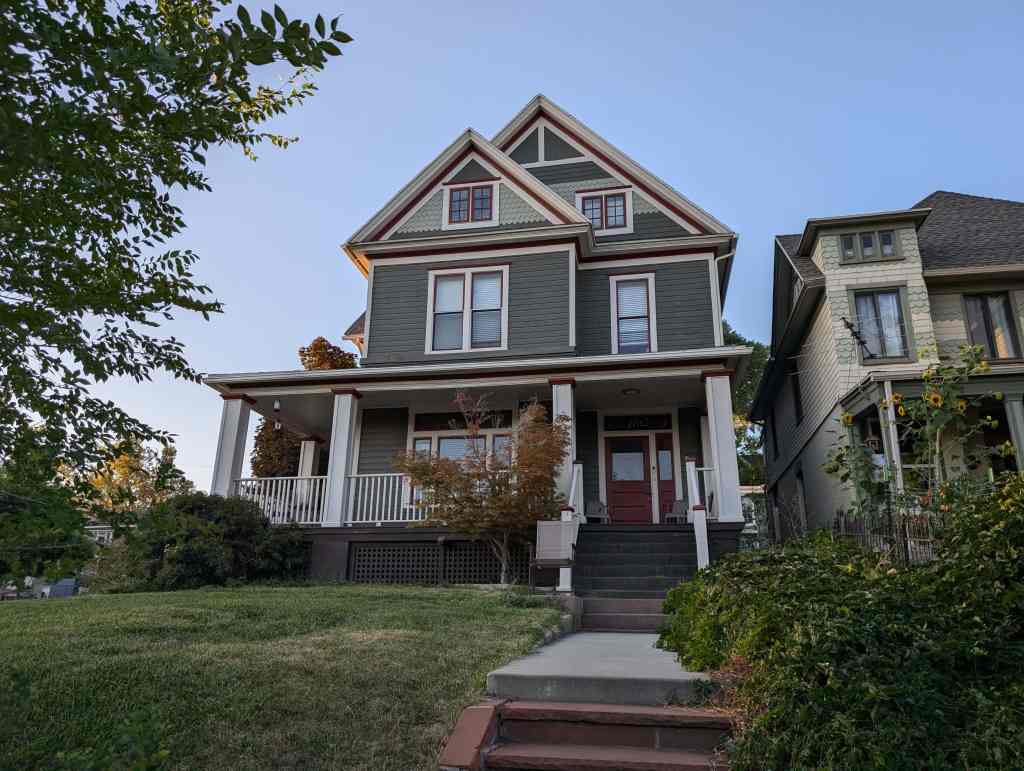
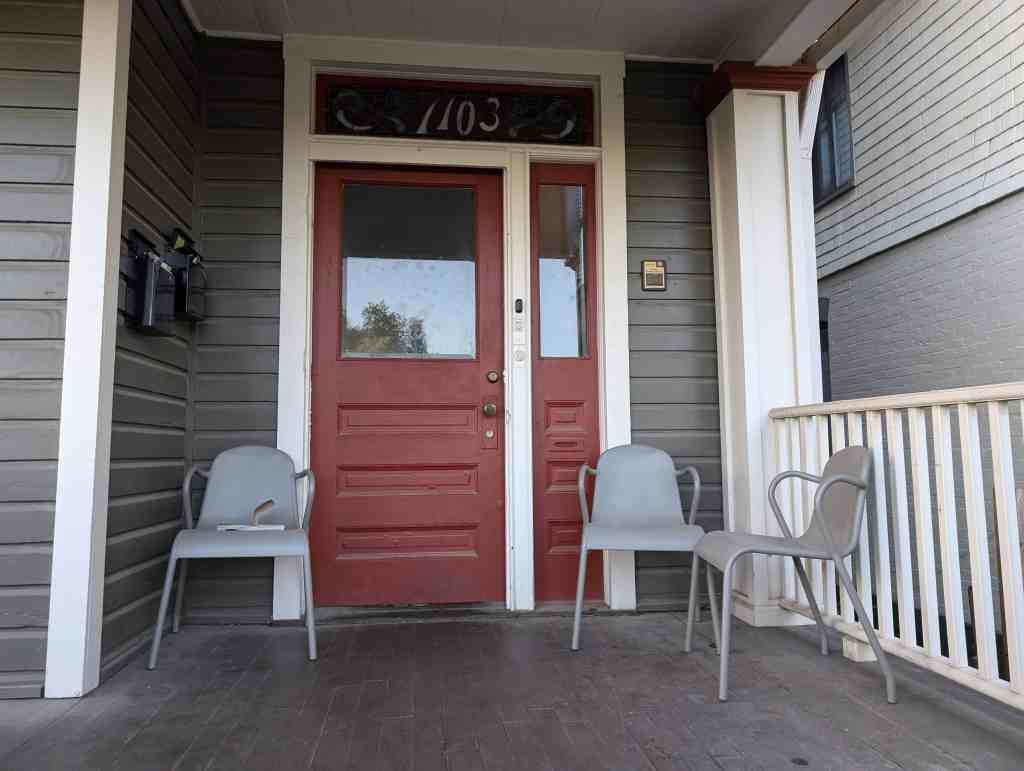
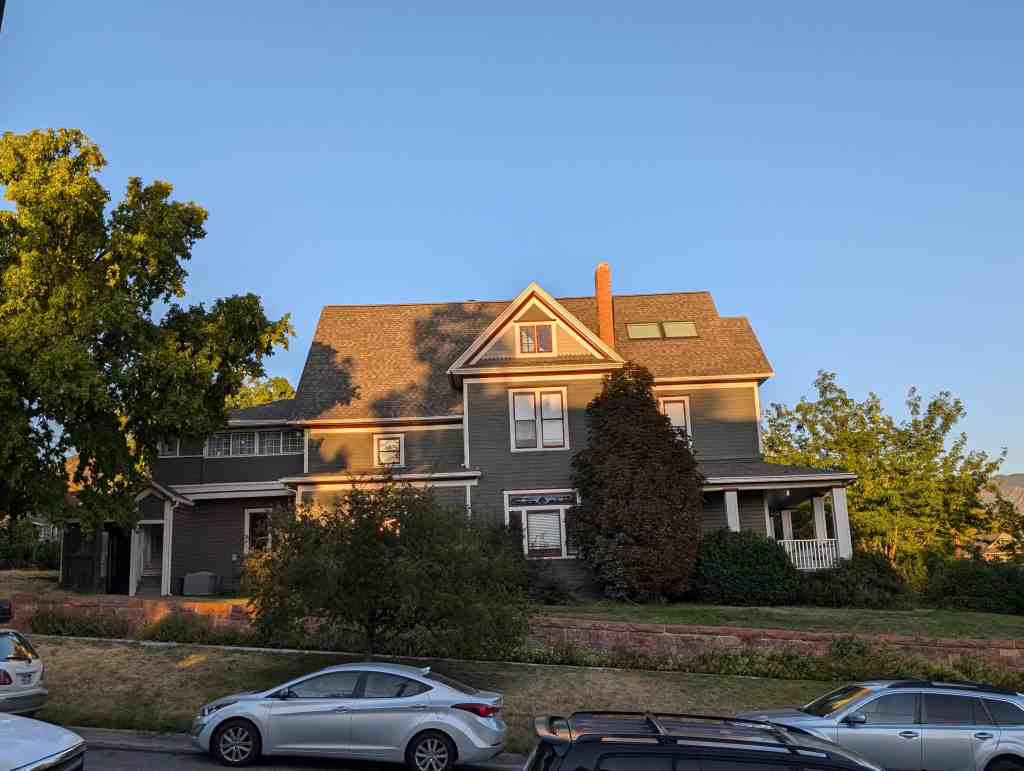
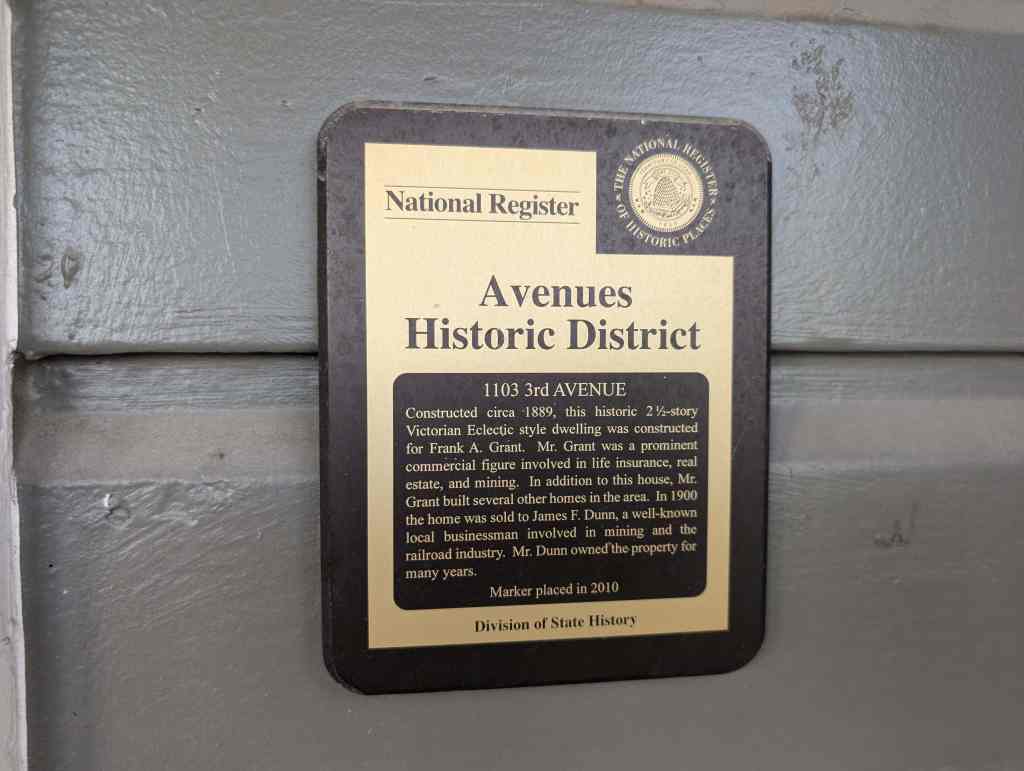
Constructed circa 1889, this historic 2 1⁄2-story Victorian Eclectic style dwelling was constructed for Frank A. Grant. Mr. Grant was a prominent commercial figure involved in life insurance, real estate, and mining. In addition to this house, Mr. Grant built several other homes in the area. In 1900 the home was sold to James F. Dunn, a well-known local businessman involved in mining and the railroad industry. Mr. Dunn owned the property for many years.
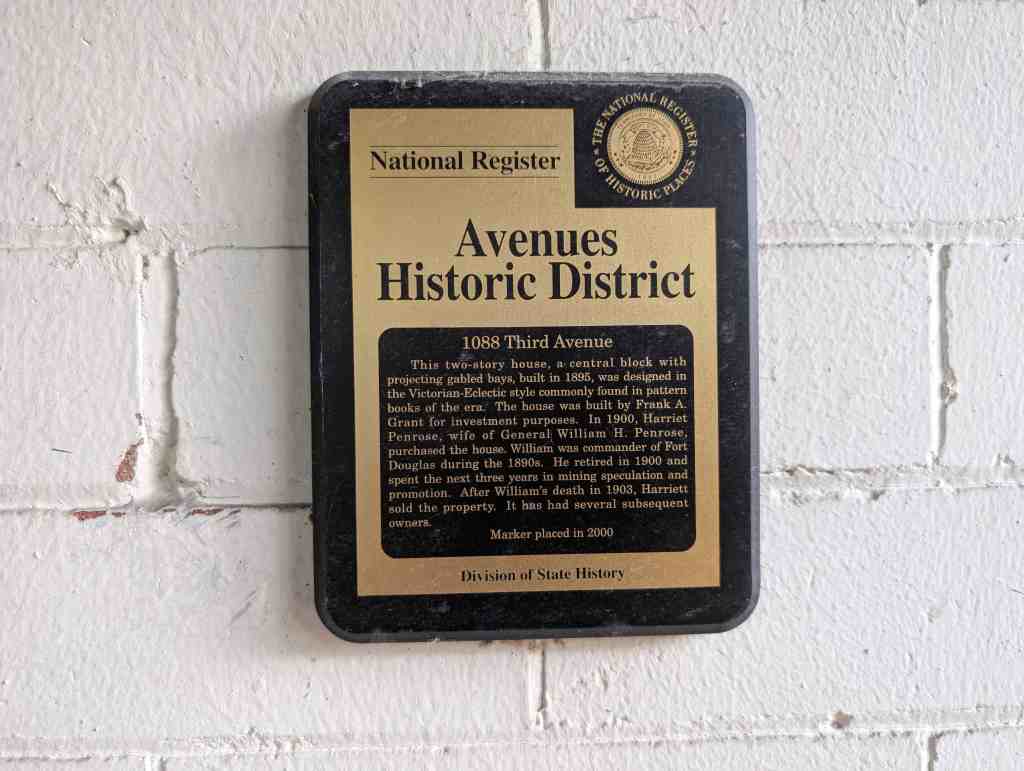
This two-story house, a central block with projecting gabled bays, built in 1895, was designed in the Victorian-Eclectic style commonly found in pattern books of the era. The house was built by Frank A. Grant for investment purposes. In 1900, Harriet Penrose, wife of General William H. Penrose, purchased the house. William was commander of Fort Douglas during the 1890s. He retired in 1900 and spent the next three years in mining speculation and promotion. After William’s death in 1903, Harriett sold the property. It has had several subsequent owners.
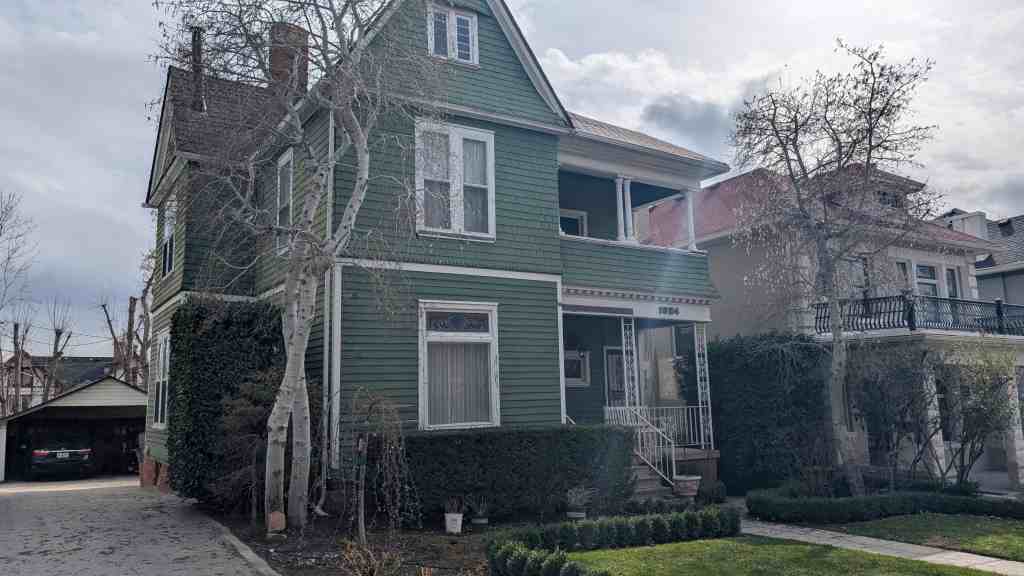
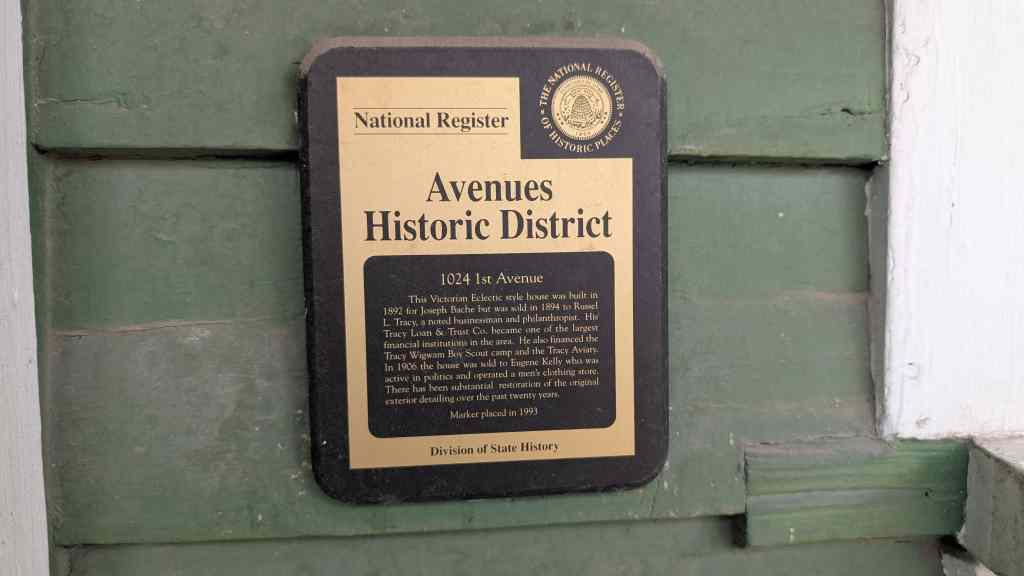
This Victorian Eclectic style house was built in 1892 for Joseph Bache but was sold in 1894 to Russel L. Tracy, a noted businessman and philanthropist. His Tracy Loan & Trust Co. became one of the largest financial institutions in the area. He also financed the Tracy Wigwam Boy Scout camp and the Tracy Aviary. In 1906 the house was sold to Eugene Kelly who was active in politics and operated a men’s clothing store. There has been substantial restoration of the original exterior detailing over the past twenty years.
This two-story Victorian house of pattern-book design is historically significant because of its association with Russel L. Tracy and Eugene W. Kelly.
It was built in 1892 for Joseph P. Bache, an apparently interesting person about whom it would be nice to know more. Unfortunately, the only information available about him is found in Salt Lake City Directories. According to them, at the time he built the house he was “Utah Territorial Librarian” and “Clerk, Supreme Court.” Bache evidently held the house as rental property until 1894 when he sold it to Russel L. Tracy. According to his obituary, he was “a noted Salt Lake financier and philanthropist.” Tracy was born in Mansfield, Ohio, December 10, 1860. In 1883 he moved to Cheyenne, Wyoming, and in 1884 founded the Tracy Loan and Trust Company. In 1892 he moved to Salt Lake City and transferred headquarters of the company here. Eventually, the business became one of the largest of its kind in the Intermountain West. In addition to coimnercial affairs, Tracy was active in community affairs. He financed the Boy Scout camp, known as Tracy Wigwam, in Millcreek Canyon, and funded the Tracy Aviary in Salt Lake’s Liberty Park. Tracy was a member of the Congregational Church.
In 1906 Tracy moved to a larger house in Salt Lake City (1285 Military Way) and sold this one to Eugene W. Kelly. He was born in Fillmore, Utah in 1873, received his schooling there and remained in the town until coming to Salt Lake City in 1902. Active in politics , while in Fillmore he served as it s mayor, in the stat legislature, and as chairman of the Utah State Republican Committee. Upon coming to Salt Lake City he founded Rowe and Kelly Men’s Clothing Store, later Mullett-Kelly, and continued his involvement in politics, in the 1930’s he was twice an unsuccessful candidate for the office of Salt Lake City Mayor and in 1936 unsuccessfully sought the Republican nomination for Governor. He was
also widely known for editorials appearing in local newspapers boosting Utah. In 1923 he sold the house to Zora W. Phinney. She was not listed in Salt Lake City Directories, and was evidently an out of town investor. She held the house for two years, and in 1925 sold it to a commercial painter named John T. Fomander. Three years later, in 1928, he sold it to Thomas A.C. Bruce and his wife Chloe. They held it as a rental property until 1936 when they lost it in a tax sale. For the next ten years, Zion’s Benefit Building Society was the owner. In 1946 the company sold it to Lillia n M. Taylor, an insurance salesperson. She lived in it until the late 1950’s. In the early 1960’s the house was converted into a number of small apartments. When the present owner bought it , he converted it back into a single family residence.
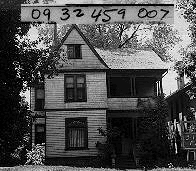
This is a two-story Victorian home, probably of pattern-book design. Most of it s original details were removed or covered when the house was sided wit h asbestos shingles, probably in the 1950’s. The tall front gable was probably covered with wood shingle siding, as was the second floor, which is flare d out over the first. The second floor porch still has the original wooden paired columns, while those on the first are gone. Above the large firs t floor front window is an art-glass transom.
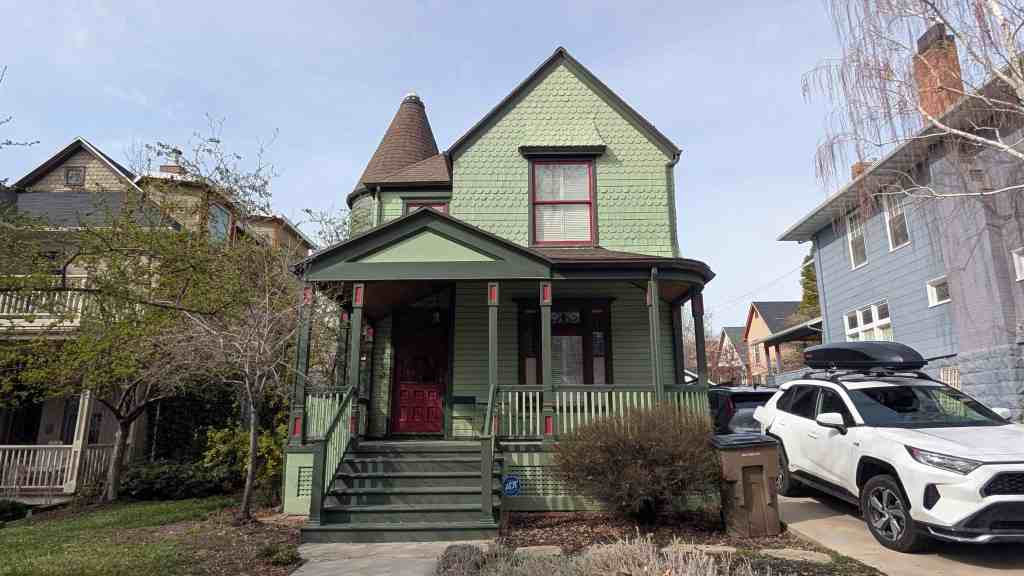
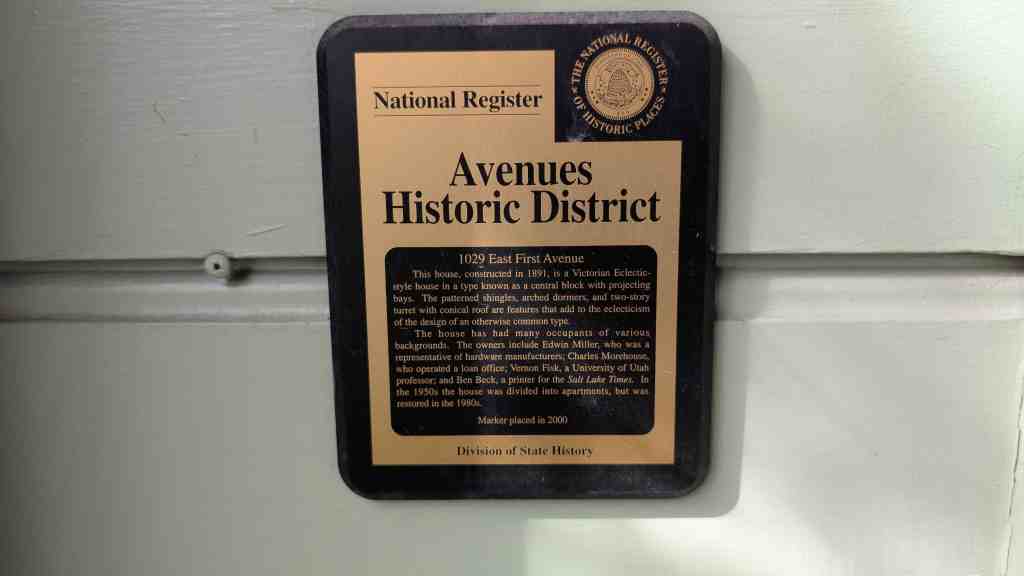
This house, constructed in 1891, is a Victorian Eclectic style house in a type known as a central block with projecting bays. The patterned shingles, arched dormers, and two-story turret with conical roof are features that add to the eclecticism of the design of an otherwise common type.
The house has had many occupants of various backgrounds. The owners include Edwin Miller, who was a representative of hardware manufacturers; Charles Morehouse, who operated a loan office; Vernon Fisk, a University of Utah professor; and Ben Beck, a printer for the Salt Lake Times. In the 1950s the house was divided into apartments, but was restored in the 1980s.
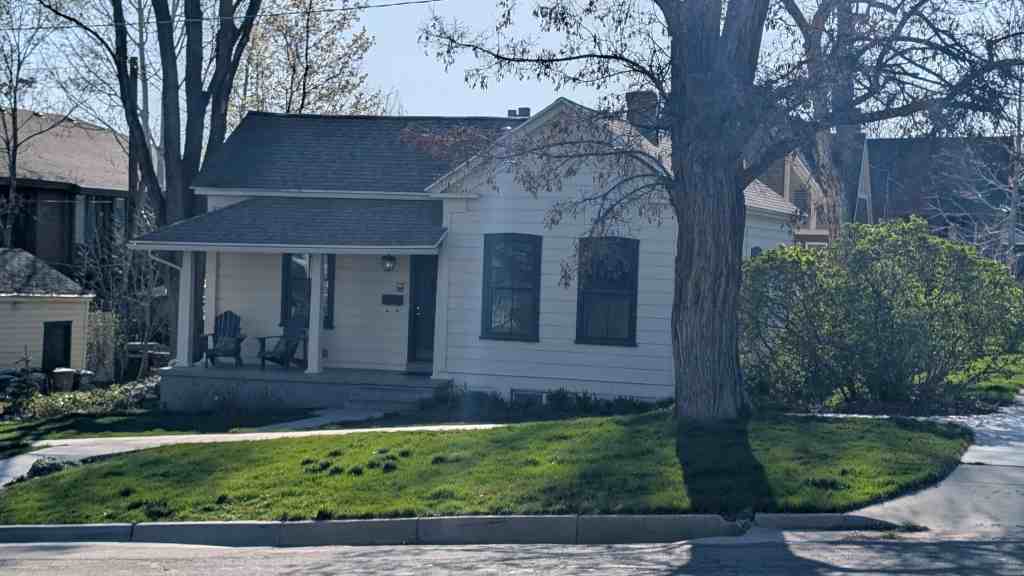
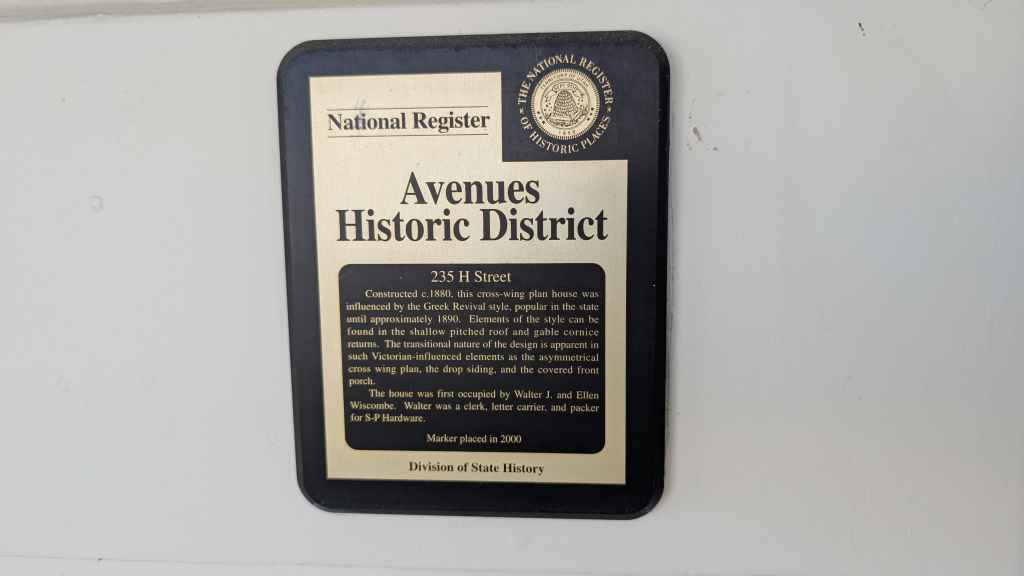
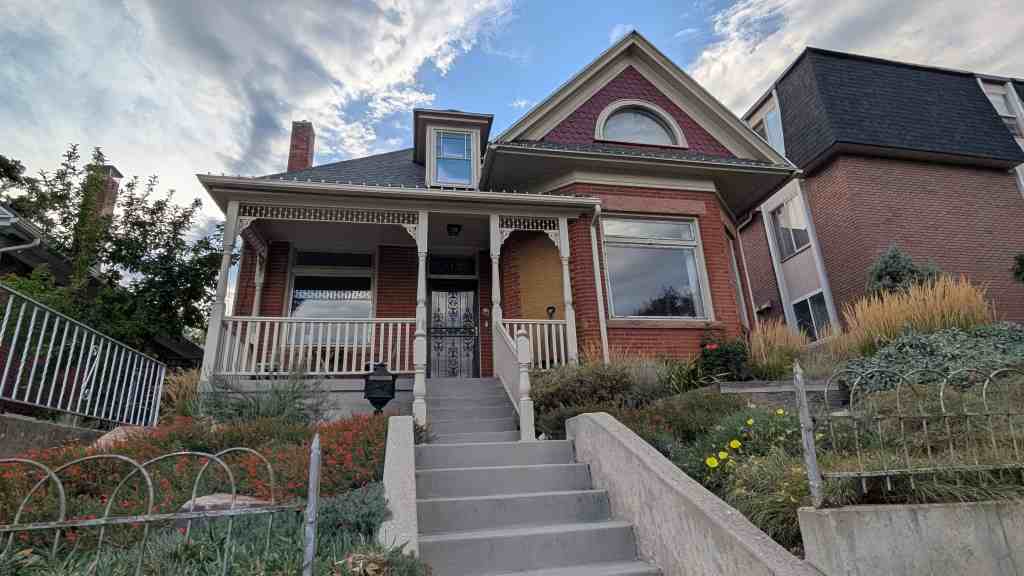
Constructed c.1880, this cross-wing plan house was influenced by the Greek Revival style, popular in the state until approximately 1890. Elements of the style can be found in the shallow pitched roof and gable cornice returns. The transitional nature of the design is apparent in such Victorian-influenced elements as the asymmetrical cross wing plan, the drop siding, and the covered front porch.
The house was first occupied by Walter J. and Ellen Wiscombe, Walter was a clerk, letter carrier, and packer for S-P Hardware.
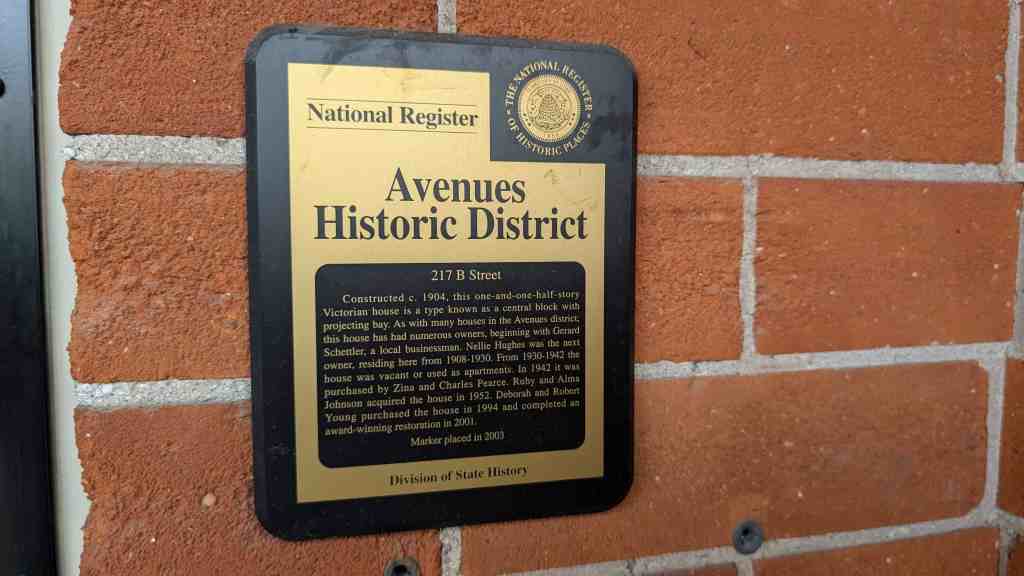
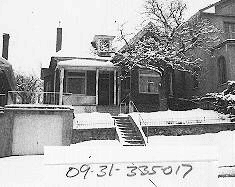
Constructed c. 1904, this one-and-one-half-story Victorian house is a type known as a central block with projecting bay. As with many houses in the Avenues district, this house has had numerous owners, beginning with Gerard Schettler, a local businessman. Nellie Hughes was the next owner, residing here from 1908-1930. From 1930-1942 the house was vacant or used as apartments: In 1942 it was purchased by Zina and Charles Pearce. Ruby and Alma Johnson acquired the house in 1952. Deborah and Robert Young purchased the house in 1994 and completed an award-winning restoration in 2001.
The property on which the McIntyre House sits was registered to C. J. Sandbech on June 27, 1874, as lot 2, Block 101, Plat D. The lot was purchased by Gill S. Peyton on January 26, 1894, for a price of $2,500.00.
The structure was designed by architect Fredrich Hale and was first inhabited in 1898 and was called Payton Hall. The property, house, and carriage house was sold to Henry w. Brown on July 18, 1900, for a price of $15,000.00.
William H. McIntyre acquired the house on December 5, 1901 for a price of $19,000.00 and the adjacent lot (Lot #2) for a price of $2,000.00. From this date on the structure has been known as the Mclntyre House.
Service connections are recorded as being made on April 17, 1906 and additional services and repairs were made August 8, 1910.
William H. Mclntyre died on August 20, 1926. Mrs. Phoebe McIntyre resided in the house until her death in 1945. William H. McIntyre came to Utah as a boy from Texas and his adventurous life was bound up with the development of the Utah cattle business. In later life Mr. McIntyre developed large holdings in Alberta, Canada, where he established the McIntyre Ranch but he retained many interests in Utah and spent his last years there; dying in Salt Lake City in 1926 at ‘the age of ‘seventy-eight.
He was born in Grimes County, Texas about forty miles, north of what is now the city of Houston, in the year 1848, the son of William McIntyre who was of Scotch-Irish descent.
William’s brother, Samuel, along with William traveled to Texas about 1870 to sell some property owned by, t;heir father. After the sell was completed they bought cattle and made the long trek back to Utah. In the spring of the next year, they sold the cattle for more than five times what they had paid. This gave them enough money to buy more cattle in Omaha and drive them to Utah. This partnership continued until sometime in the 1880s and gave the two brothers enough money to enter into several ventures, including the Mammoth Mine at Mammoth, Utah which then developed into a successful operation.
During the 1880s, William had hard times in the cattle business losing almost an entire herd in the winter of 1886-87. In 1891 to 1894 William began investigating the possibility of purchasing land and in 1894 he purchased a full section of land near Cardston in Alberta, Canada. Ranching began shortly after the purchase.
William H. McIntyre was married to Phoebe, Ogden Chase. She was the granddaughter of Isaac Chase, the first flour miller in Utah. Liberty Park was once the Isaac Chase farm, later passing to Brigham Young. Phoebe Chase was torn at the caretaker’s house which still stands on Liberty Park.
Mentioned in the national register’s nomination form: While they account for less than one percent of all residences, the very large, often architect-designed homes in the Eastlake, Queen Anne and Shingle styles, and later the Prairie and Craftsman styles greatly influence the visual character of the Avenues. Some of the state’s best examples of residential architectural styles were built there, including the William Barton house, 231 B Street, (vernacular/Gothic); the Jeremiah Beattie house, 30 J Street, (Eastlake); the David Murdock house, 73 G Street, (Queen Anne); the E.G. Coffin house, 1037 First Avenue, (Queen Anne); the N.H. Beeman house, 1007 First Avenue, (Shingle style); the Vto. Mclntyre house, 257 Seventh Avenue, (Classical Revival); the James Sharp house, 157 D Street, (Craftsman); and the W.E. Ware house, 1184 First Avenue, (Colonial Revival).
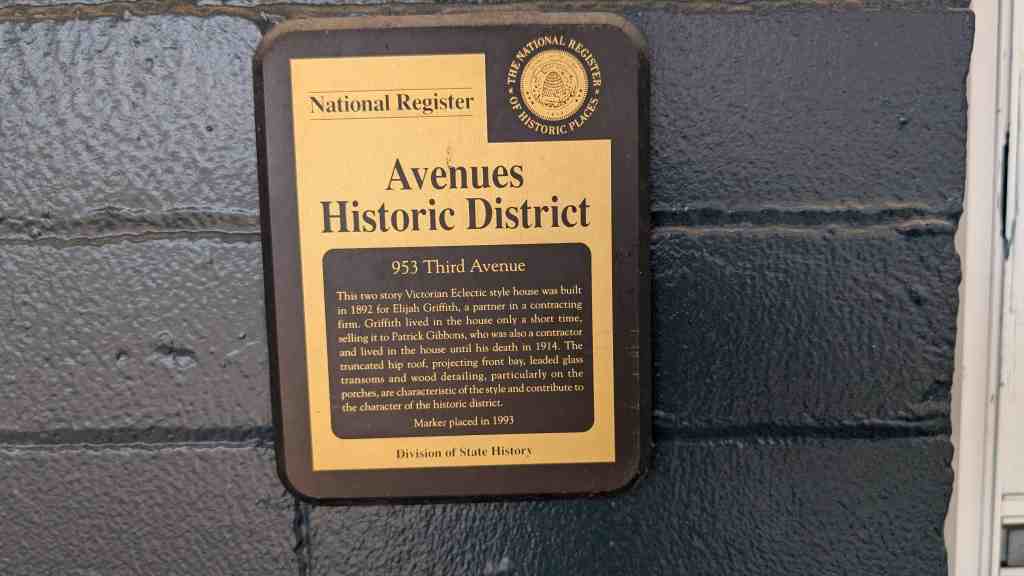
This two story Victorian Eclectic style house was built in 1892 for Elijah Griffith, a partner in a contracting firm. Griffith lived in the house only a short time, selling it to Patrick Gibbons, who was also a contractor and lived in the house until his death in 1914. The truncated hip roof, projecting front bay, leaded glass transoms and wood detailing, particularly on the porches, are characteristic of the style and contribute to the character of the historic district.