This building of sawed logs, cement, and stucco was constructed by James and Mable Ellett in 1947 and operated as the Ellett Theatre.
On March 19, 1956, the Elletts deeded 30 percent interest of the building to Edwin (Ted) and Alberta Oldroyd. Together their families operated the theater until TV came into Wayne County. Until 1971, John and Maida Giles and Stanley and Hilma Brinkerhoff also worked in the business.
The Brinkerhoff family purchased the business in October 1971 and renamed it Wayne Theatre. With the help of others, they operated it until September 1994. James and Nanette Anderson purchased the business, changed the old projection machines to a one-reel operation, and improved the building. Later they obtained a grant from the Utah Historical Society and remodeled the building which is being successfully operated as a movie theater.
Bicknell is a small town along State Route 24, in Wayne County, Utah with a population of about 300 people. Bicknell was originally called Thurber for A.K. Thurber but in 1914 Thomas W. Bicknell, a wealthy eastern author, historian, and Education Commissioner for Rhode Island, offered a thousand-volume library to any Utah town that would rename itself after him.*
Bicknell was originally called Thurber, or “Thurber Town”, for A.K. Thurber, who in 1879 built the first house in the area. In 1897 the town moved to a new location due to sandy soil and poor water conditions.
In 1914 Thomas W. Bicknell, a wealthy eastern author, historian, and Education Commissioner for Rhode Island, offered a thousand-volume library to any Utah town that would rename itself after him. The town of Grayson also wanted the library prize, so in a compromise in 1916, Grayson took the name of Blanding, Mr. Bicknell’s wife’s maiden name, as a tribute to her parents. The two towns split the library, each receiving 500 books.
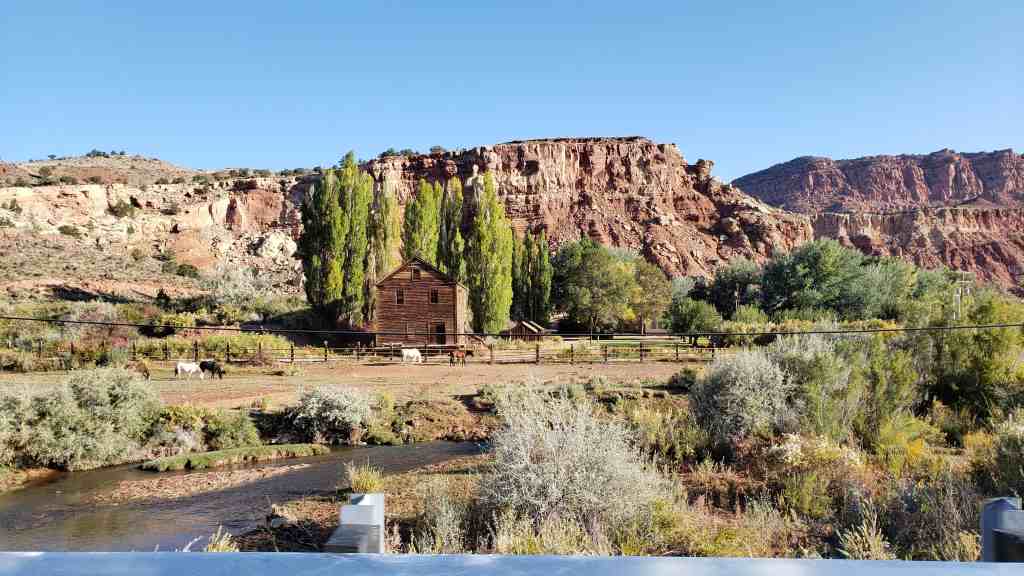
The Nielsen Grist Mill is located at the foot of the Thousand Lake Mountain on the edge of the scenic country referred to by ancient Indians as “The Land of Sleeping Rainbow.” Constructed around 1893 for Hans Peter Nielsen by his son-in-law, Niels Hansen, the mill was known as the Thurber Rolling Mills. Water for powering the mill was channeled from the Fremont River and dropped 22 feet through a wooden pope to the turbine that ran the mill.
The mill still has a double stand of Wolf Rolls and two double stands of McNalley Rolls with scalpers under each that are spouted to the various elevator legs. Sixteen elevators with five reels for flour milling are found in the mill. The Barnard and Leas dust collector and the turbine with belting still have the pulleys made of native wood, ready for use. Old models of Howe Scales, one for weighing wheat and one for weighing flour sacks, still exist. All equipment is in good shape, including the cash register. The mill produced flour, germade, shorts, and bran, each coming from individual sprouts.
farmers would receive one sack of flour for each three sacks of wheat. All 48-pound bags of flour were sewn by hand. The space between the ears was sewn with a long, sharp needle with a built-in thread cutter.
The mill made flour for the surrounding area for 40 years. Improved roads, constructed in the 1930s, spelled the beginning of the end for the Thurber Rolling Mills. Since Wayne County could not grow hard wheat, which made the best bread, it became just as east to truck in flour as hard wheat.
The Hans Peter Nielson Gristmill was added to the National Register of Historic Places (#75001835) on June 18, 1975. The following text is from the national register’s nomination form:
The Bicknell Gristmill was constructed in 1890 for Bans Peter Nielson, a miller born in Denmark who came to Utah in 1863, The mill was constructed by Niels Hansen, also born in Denmark and a carpenter by trade, Mr. Nielson ran the mill until his death in 1909, Prom 1910 to 1921 the mill was operated by -three brothers, Ernest, Jesse and Clinton Syrett, The mill was operated by several men until 1935 and since that time has remained idle,
Gristmills were constructed in almost every Mormon community and village and were an essential part of the agriculturally-based economy, two gristmills, the Isaac Chase mill built in Salt Lake City in 1852 and the E. T. Benson built 1849-50 in Tooele Valley, have been listed on the National Register. The significance of the Bicknell gristmill is that it illustrates how after 40 years the gristmill was such an important element in the economy of the Mormon village and, when compared with the E. T. Benson mill, how little the construction and architectural style of the gristmill has changed in forty years. Also of significance is that the Bicknell mill is the only gristmill in Utah in which the original machinery and equipment is still intact.
The Hans Peter Nielson gristmill is a two-story rectangular frame box with a gabled roof. The tall sandstone foundation wall provides some usable area in the crawl space for operating the roller and. bolting machinery. In some areas, the foundation wall has been pulled away to give access to the mechanical systems of the mill. A post and beam system supports the two-story superstructure above. The posts and beams are roughly hewn, but are fastened with mortise and tenon connections, It is significant that all of the original parts of the mill are still intact. These include the stone burrmills, slatted wooden flumes, water turbine and connecting gears and drive shafts- roller and bolting machinery and, in short, all of the original workings of the pioneer flour mill.
In appearance, the building is tall and imposing and beautifully situated in a meadow near a stream lined with poplar trees. The building is sided with wooden planks or clapboard. The cornice is boxed and has a slight return. The frieze ss plain. Windows are 6/6 double-hung sash and the doors feature diagonal siding. A wooden loading platform surrounds two sides of the mill, Two shed-roofed wings connect to the rear of the building. These are also wood sided and appear to have been added just after initial construction of the main mill. All roofs are covered with wood shingles. Plain boards situated vertically at the building’s corners and framing the windows are the only trim elements. The only existing chimney is made of brick.
The very pristine character of the old mill is due to the fact that its wood and stone show no evidence of paint or other elements of finish and refinement. Though built strictly as a utilitarian structure, the Hans Peter Neislon flour mill is nevertheless a thing of unassuming beauty.
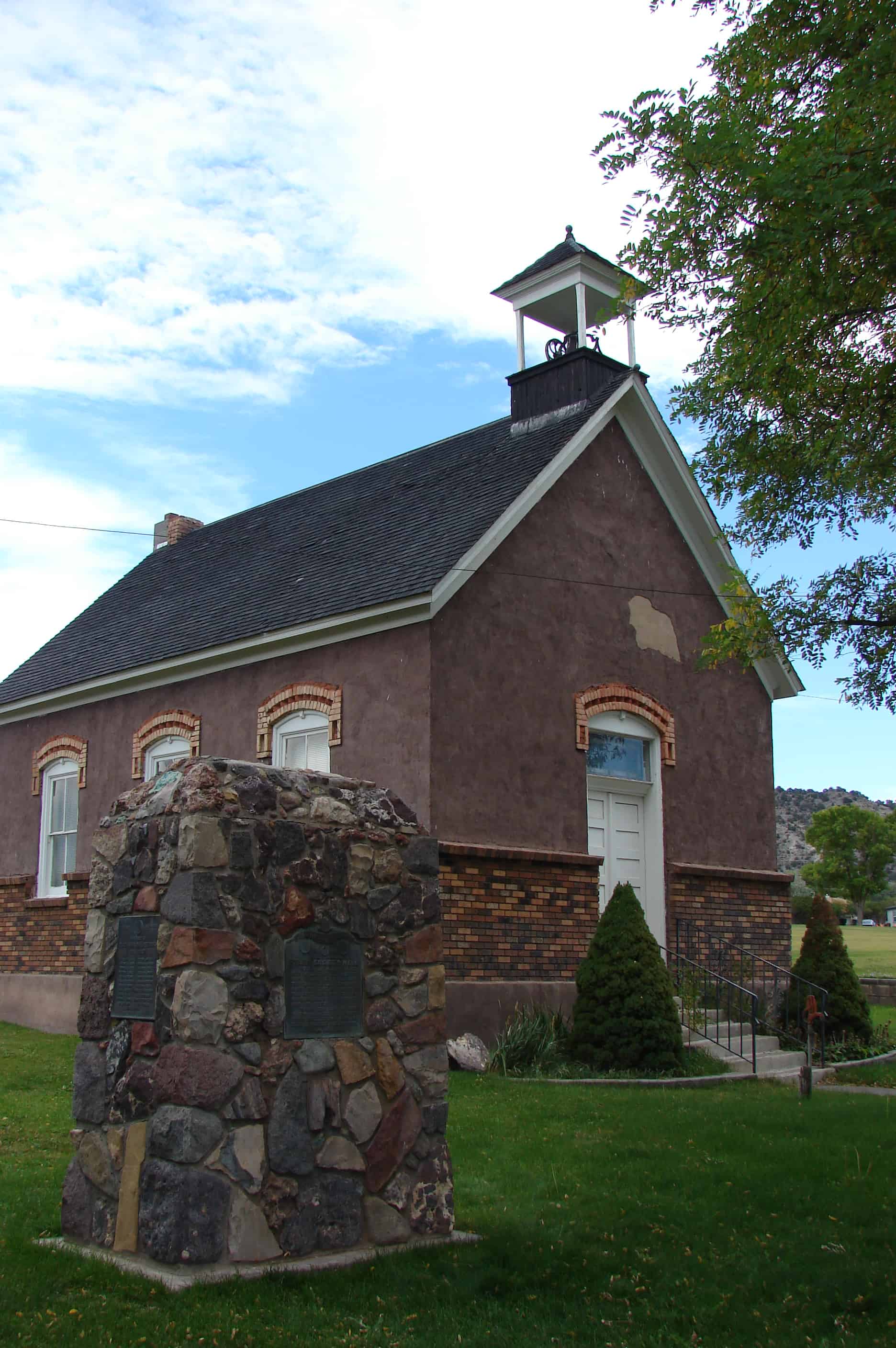
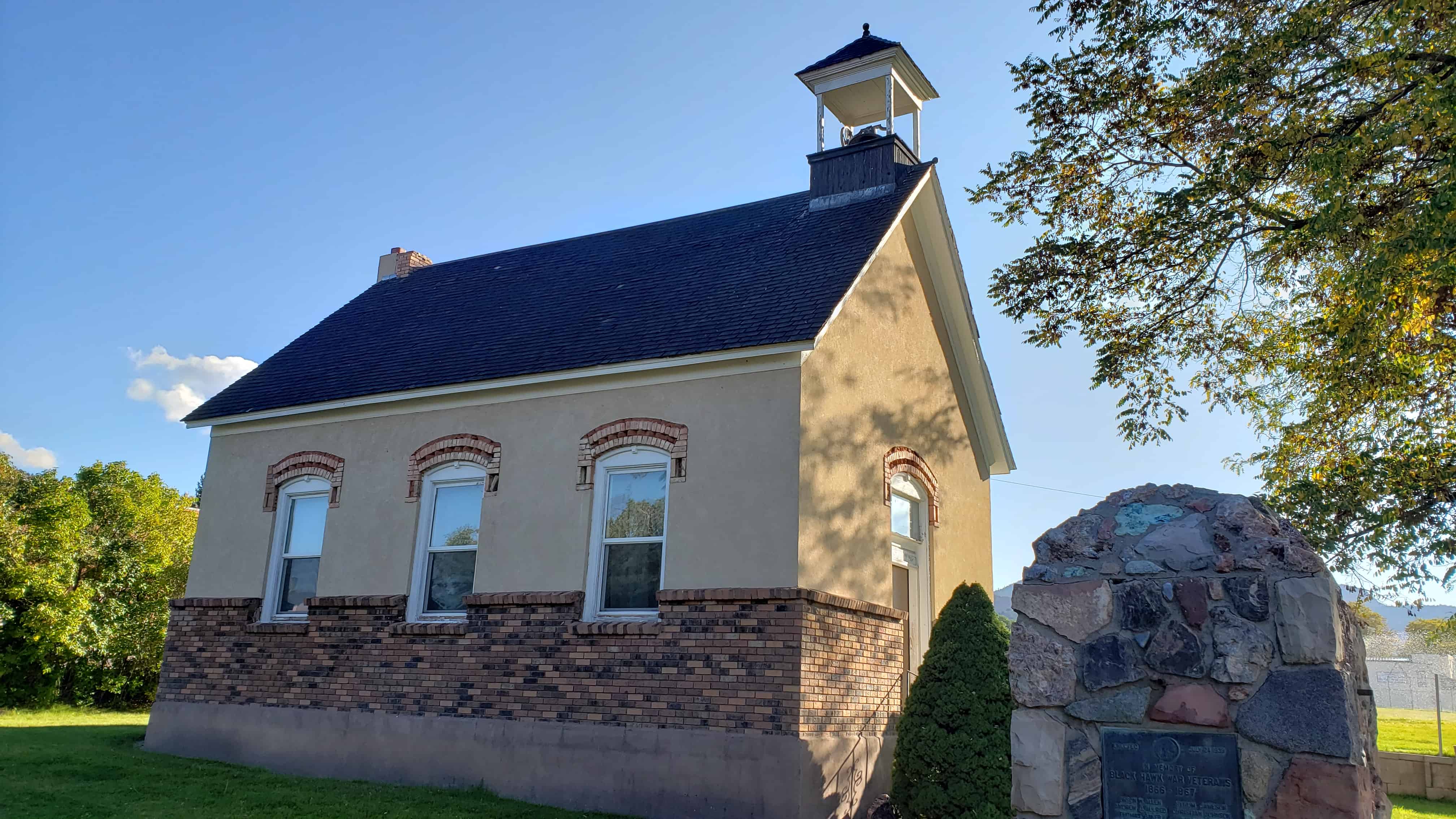
Built by the women of Thurber under the leadership of Sarah Gardner Meeks, President; Mary H. Bullard, 1st Counsellor; Eliza Jane Brinkerhoff, Amanda Haws Durfey, 2nd Counsellors; Viola Cutler Brinkerhoff, Secretary; Mary A. Gardner, Asst. Secretary; Melissa Meeks Snow, Treasurer. Building began June 1, 1897 when the town was moved to its present location. Completed September 19, 1899 and dedicated by President Willis E. Robinson.