
Smithfield Fire Station, built in 1940 and located at 71 North 100 West in Smithfield, Utah
Related:


10 Sunday Mar 2024
Posted in Uncategorized
Smithfield Fire Station, built in 1940 and located at 71 North 100 West in Smithfield, Utah
Related:
10 Sunday Mar 2024
Posted in Uncategorized

Build in 1895 and located at 91 West 100 North in Smithfield, Utah
Related:


09 Thursday Mar 2023
Posted in Uncategorized
Tags
22 Tuesday Feb 2022
Posted in Uncategorized
Tags
1870s, Cabins, Cache County, Cache Valley, DUP, Historic Markers, Lewiston, utah

Pioneer Home and Granary
This cabin was used as a family home from 1876 to 1956. It was the home of George and Hannah Wheeler and their ten children.
George Walton Wheeler headed west in 1854 with his father, Levi, bringing the first steam engine and sawmill west of the Missouri River. George was ten years old.
Hannah was born December 18, 1846, in Gloucester, England, daughter of George and Harriet Harding Humphries. The family came west with the Willie Handcard Company in 1856. Walking alongside the handcart were six children, ages eighteen, fourteen, twelve, nine, six and one. Hannah Humphries and George Walton Wheeler were married in 1862.
Logs were cut at the Wheeler Sawmill where they were floated miles down the Cub River. There the logs were taken from the river and hauled to the homestead. When Hannah and George moved into their little home in 1876, there was only enough flooring to go under the bed. A fresh water spring was near the cabin. A granary and a barn were also built. George Walton Wheeler made each building with full dovetail corners. Each square nail was made in his own blacksmith shop. From the cabin’s location, all of Cache Valley can be seen.
Related:
Located at 2668 West 2000 South in Lewiston, Utah


21 Monday Feb 2022
Posted in Uncategorized
Tags
Cache County, Cache Valley, DUP, Historic Markers, Lewiston, utah

Lewiston Pioneers
In honor of the noble men and women who pioneered “Poverty Flat”, later named Lewiston, for its first bishop William H. Lewis. First settlers arrived July 8, 1870.
Related:
Located at 65 West Center Street in Lewiston, Utah


26 Wednesday Jan 2022
Posted in Uncategorized

In memory of Ira Elias Merrill, first person buried in the Smithfield Cemetery, was born at Alder, Erie County, New York, in 1835, the son of Austin and Laura Wilder Harris Merrill. He was killed in an Indian attack July 23, 1860 as he and his brother Solyman were returning from the hills east of Smithfield with a load of brush to be used on the bowery for the community Pioneer Day Celebration. Hostilities between the pioneers and the Indians began near the site of this marker. A settler and several Smithfield pioneers were wounded.
This historic marker is S.U.P. Marker #M, located outside the Smithfield Carnegie Library at 25 North Main Street in Smithfield, Utah
Related:


24 Monday Jan 2022
Posted in Uncategorized
Tags
Cache County, Cache Valley, Historic Buildings, Historic Churches, NRHP, Smithfield, Tabernacles, utah, Yellow Brick of Smithfield

Smithfield Tabernacle
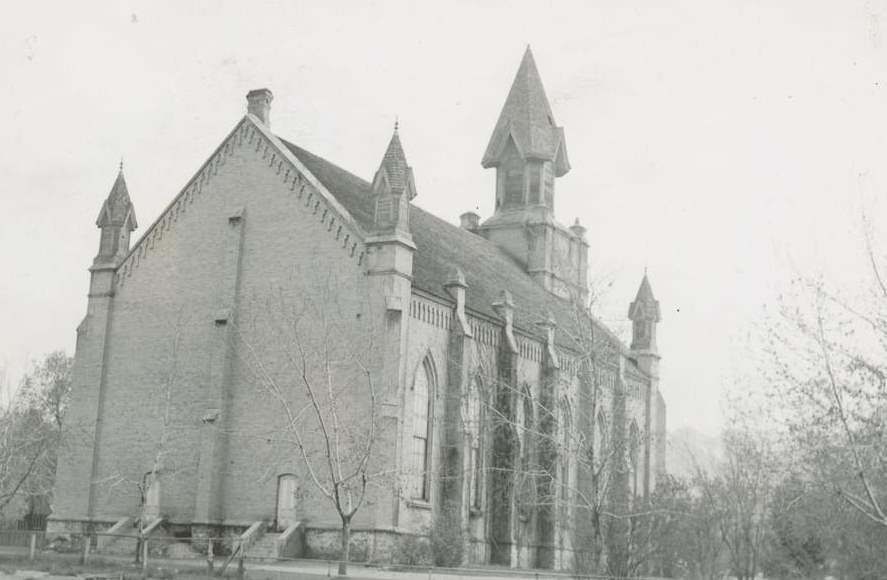
Construction for this large, Victorian Gothic style Smithfield Tabernacle began in 1883, was completed in 1902, and was renovated in 1955. The building is significant as it was the primary place of worship for the LDS community in Smithfield for many decades. The tabernacle was financed and constructed by the local Smithfield LDS Ward congregation. Constructing such a large edifice was unusual for a small congregation. The majority of LDS tabernacles were constructed by and for multiple LDS congregations to meet in a larger congregation called a Stake. The building is also important for its association with the planning and development of Smithfield City, specifically in the use of public space. Typical of early Mormon settlements in the Great Basin region, this large edifice was constructed on the public square to serve as the community center and to establish a feeling of permanence.
From the time of its construction, the Smithfield Tabernacle was the largest building in Smithfield and was the symbolic center of the community. Its distinctive yellow brick was locally manufactured in Smithfield. In addition to religious meetings, the building was used for all large community gatherings, including plays, concerts, graduation ceremonies, and political and agricultural meetings.
When the local LDS congregation outgrew the Smithfield Tabernacle in 1942 and out of concern for the deterioration of the unused building, residents found a new purpose for the building as a much-needed youth recreation center. It served as the only public recreation facility in Smithfield from 1955 until the construction of a new recreation center in 2000. Although some architectural details have been altered or were removed, the building still clearly reflects its original use as a place of worship while accommodating the more recent use as a recreation facility.
Located at 99 West Center Street in Smithfield, Utah and added to the National Historic Register (#100000509) on January 17, 2017
Related:



11 Tuesday Jan 2022
Posted in Uncategorized
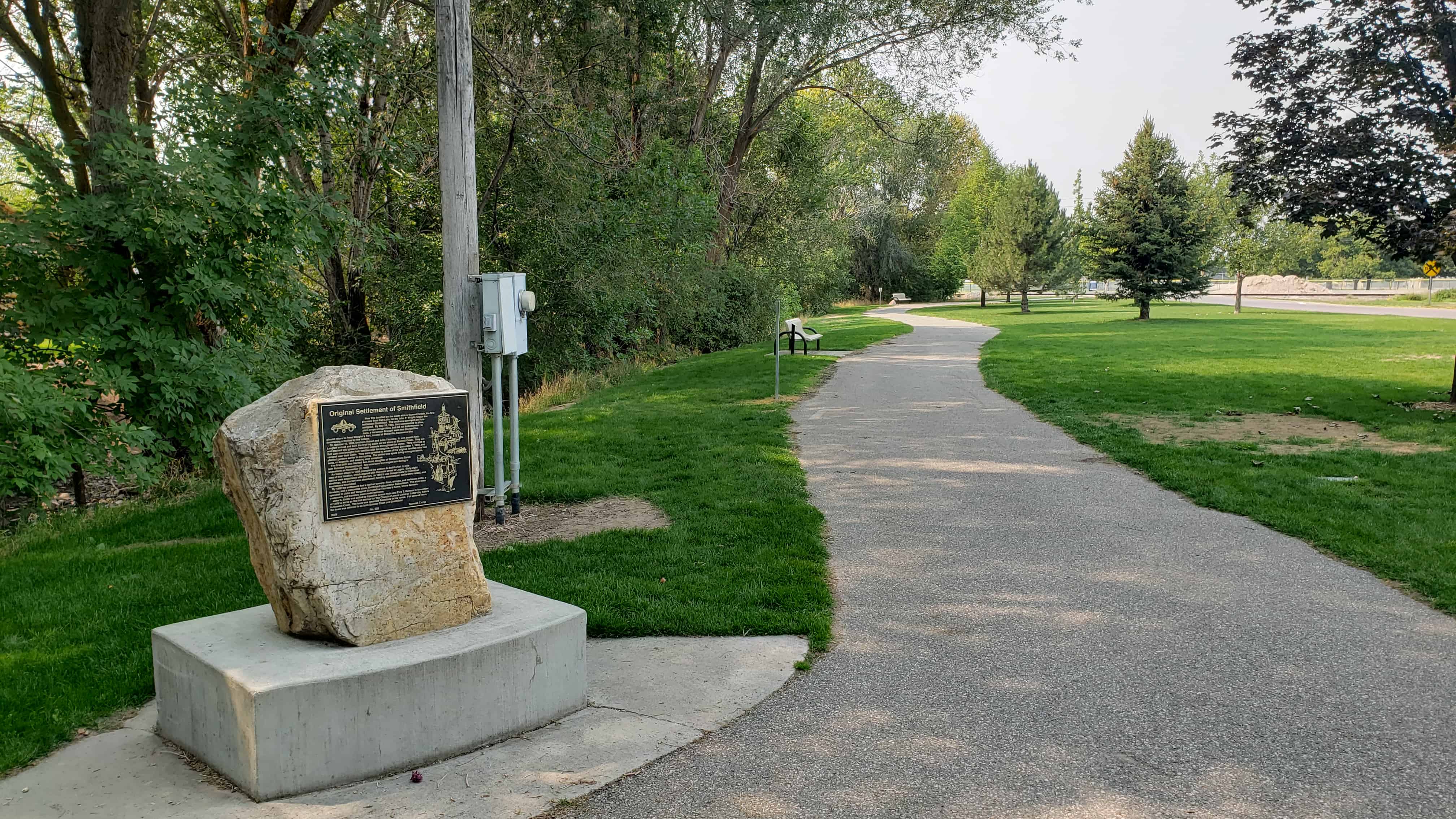
Near this location on the south side of Summit Creek, the first pioneers from Salt Lake, led by John P. Wright, began the settlement Smithfield. The land was surveyed and lots assigned. By May 10, 1859, they commenced to plow, plant crops and gardens, but did not build homes. In June, a horseman brought word that the families should return to Peter Maughn’s Fort, located at Wellsville, because of the threatening activities by the Indians.
On October 10, 1859, brothers Robert and John Thornley, Jr. and cousin Seth Langton arrived and built the first log cabin on the shore of Summit Creek. The cut and stacked wild grass to feed their animals throughout the winter. They returned to Salt Lake and brought their families with ten wagons, arriving December 1, 1859, and camped near their cabin. They were greeted by seven of the original families who had planted gardens earlier in the spring. The winter was spent living in wagon boxes, tents, or dugouts, and cooking over campfires.
The first birth was Harriet Ann Hunt, daughter of Marshall and Sarah Ann Runnion (Runyon) Hunt. She was born in a wagon box during a snowstorm on November 20, 1859.
An Indian attack in 1860 prompted the settlers to build a fort 1/2 mile east of this location, which aligned with the main street in Logan. Sixty-eighth cabins were associated with the fort. In 1864 it was thought safe for individual dwellings, and the fort was abandoned; farming commenced , cattle were raised, and businesses flourished.
By 1868 the settlement had a leather tannery; flour, shingle, and molasses mills; a limekiln; and a mercantile store, Smithfield Cooperative Association. The store was operated in John and Margaret Stringfellow Thornley’s home, where farmers, customers, and travelers were made welcome.
John G. Smith was called by Apostles Orson Hyde and Ezra T. Benson in November of 1869 to serve as the first bishop for The Church of Jesus Christ of Latter-day Saints in Summit Creek. The town was renamed Smithfield in his honor. For several years, the town was referred to as both Summit Creek and Smithfield.
This is D.U.P. Marker #550 (see others on this page) and it is located on the Smithfield walking path in Heritage Park at about 335 West Center Street in Smithfield, Utah.


30 Thursday Dec 2021
Posted in Uncategorized

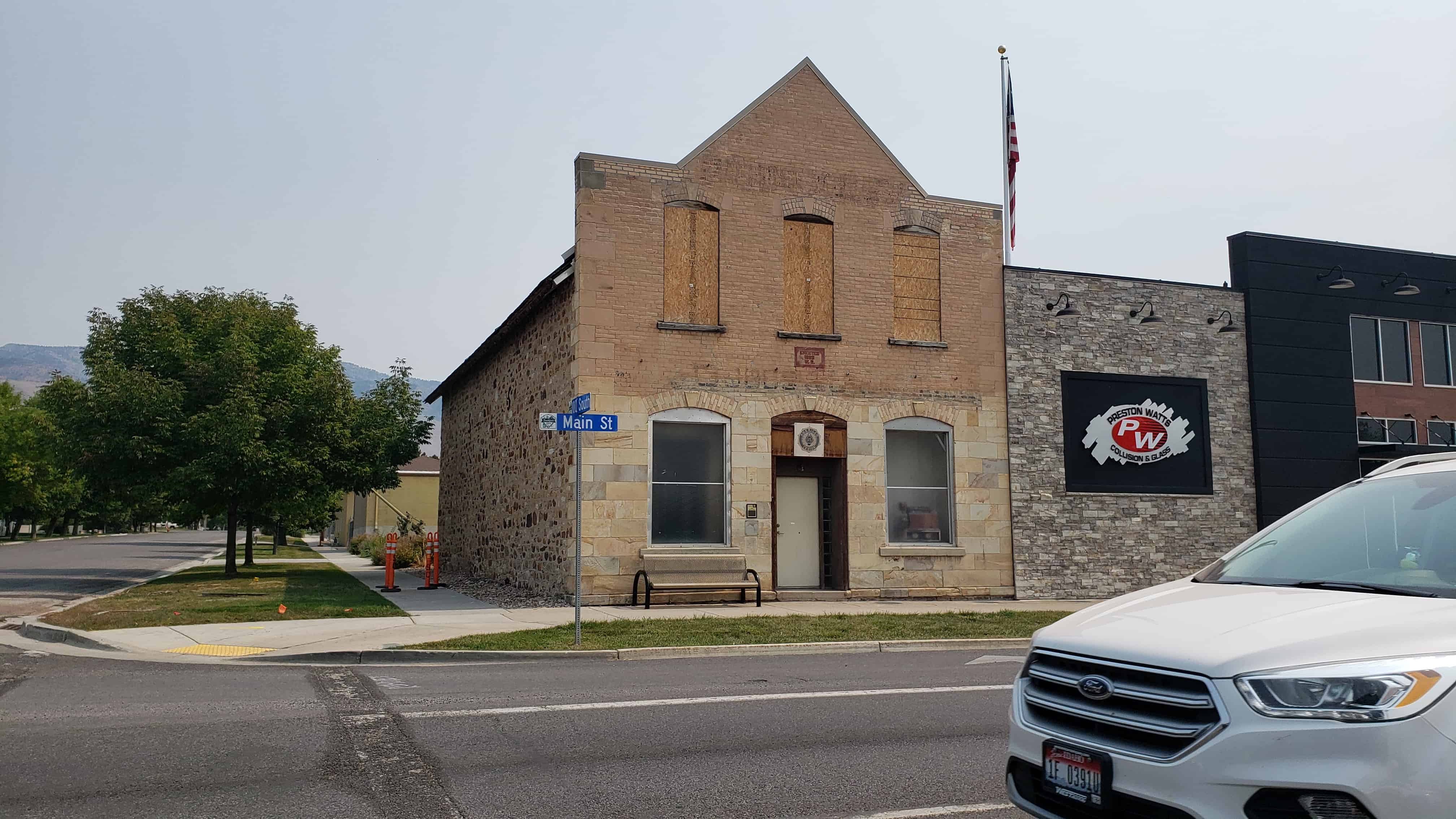
Built in 1883, the Douglas General Mercantile Store is locally significant as the oldest remaining commercial building in the town of Smithfield, Cache County, Utah. The town was founded in October 1859 as part of Cache Valley, which was itself settled in 1856 during the first stage of the Mormon colonization of Utah. William Douglas, who operated the store, began business in Smithfield in 1865, obtaining goods from the East and wholesaling them throughout the area. In 1883, when the building was constructed, it was one of only three such establishments in the town, and remains as the only physical structure tied to Smithfield’s early commercial history. The building has been associated with the commercial activity in the town through the firms of Douglas Mercantile, James Cantwell & Son, and the Union Merc Company since 1883. In addition, the building is the second oldest mercantile building identified to date that is located outside Utah’s heavily populated area known as the Wasatch Front, which comprises four of Utah’s twenty-nine counties. The oldest building is the Ephraim United Order Cooperative Building constructed in 1871-71. Also, the building gains added importance in the history of Smithfield because of its unique construction, the only one of its type in the town. Stone was used for the rear and two side walls in a rubble construction technique, while brick was utilized on the upper half of the façade and coursed sandstone for the
lower half. Thus, the building represents the use of four different building materials as wood was also utilized.
Located at 101 South Main Street in Smithfield, Utah and added to the National Historic Register (#82004113) on August 4, 1982.
Related:



The town of Smithfield in Cache Valley, Utah, was tied to the early Mormon colonization of Utah. Part of what has been labeled “the inner cordon of settlements,” Cache Valley was itself settled in 1856, and Smithfield in 1859. As an agricultural region in northern Utah, Cache Valley aided in the supplying of goods not only to northern Utah, but also to mining regions in Idaho and Montana. Smithfield, which began as a settlement of dugouts and wagons, in 1860 became a village with houses arranged in “fort style” (forming a square where the rear portions of the buildings constituted the walls of the fort). It had been named Smithfield in 1859 for John Glover Smith, the first Mormon bishop, who exercised power in both church and civic affairs.
William M. and Cyntheann Merrill Douglas arrived in Smithfield in 1862. Douglas was born in Scotland in 1839, came to Utah in 1854 as a convert to the Mormon church, and settled in Salt Lake City. He established a general store in Salt Lake in partnership with Thomas Richardson. It was with Richardson that Douglas operated a store in 1865 in Smithfield. Goods were hauled from Chicago, Illinois to Ogden, Utah (about 35 miles north of Salt Lake), then to Smithfield by team. There, these goods would be wholesaled to nearby towns such as Richmond and Logan (eventually the Cache County seat). According to one local source, the indication was that Douglas and Richardson served as early distributors of general merchandise for the entire Cache Valley area.
William Douglas and Thomas Richardson were both called to serve missions for the LDS church in 1869, closing the store. In 1871 Douglas reopened his business in a frame structure. By 1883 business was such that the merchant could afford to construct the present wood, stone, brick, and sandstone building. Architecturally, the Douglas General Mercantile represents a unique type of construction in Smithfield, utilizing four different building materials–the only one of its kind in town.
In 1897 Douglas sold the structure and business to James Cantwell, who had settled in Smithfield in 1862. Cantwell served as the town’s postmaster and city councilman for nearly 20 years. The store operated as James Cantwell & Son until 1910, when it was sold to William L. Winn and Lorenzo Toolsen, who established the Union Mercantile corporation. Thus, the building served as a main commercial establishment for the agricultural town of Smithfield, and as it is the only remaining commercial building from the town’s early history, gains local significance and importance. Since 1964 the Smithfield American Legion Post has occupied and used the building. No immediate plans have been
made to rehabilitate or restore the building.
18 Saturday Dec 2021
Posted in Uncategorized
Tags
1850s, Cabins, Cache County, Cache Valley, DUP, Historic Markers, Mendon, utah

Ole Peder Sorensen Pioneer Cabin
This original log home was first constructed as a part of the Mendon Fort in 1859. It was owned by Ole Peder (Peter) Sorensen (from Denmark), one of the first settlers of Mendon.
The two rows of 25 log homes in the fort were built close together, facing each other. Peter with his wife, Fredrrika (Rikke) Andersen Sorensen, and three children lived in this home and then moved it to a lot one block south of here when the Mendon Fort was dismantled in 1864.
The logs came from the mountains west of Mendon and were hewn by hand, utilizing a 90 degree V notching system. Small wood branches were tightly wedged between the large logs, and the remaining gap was filled with a lime and clay daubing mortar. The top two logs on the east and west ends of the home were spliced with wooden dowels, as the constructors apparently ran short of logs of sufficient length.
Originally the home had a dirt floor and a sod roof. The home served for 130 years as the kitchen/cooking area for the Sorensen’s framed home. The last person to live in the log home was Peter’s daughter, Hannah (Ann), who moved out in 1964. In 1992 the home was dismantled and the logs were stored. In 2013 the original logs were carefully assembled in their correct order on the present location.
Three of the original logs had to be replaced, and a new roof was built to replace the earlier that had been altered over the years.
Located at approximately 115 West 100 North in Mendon, Utah, just behind the James G. Willie House.
Related:


