One of the oldest homes in Utah, the Wood-Harrison House at 310 S. 300 West in Springville, Utah was built in 1853 and expanded in 1877. It was listed on the National Register of Historic Places in 1983.
The original 1853 home was adobe, a one-story rectangular cabin-type house. By 1877 it had been sold and two-story house was added to the end of the original building, making it a hall-and-parlor I-house. This reflects general economic prosperity of the times. The house was identified in a 1981 architectural survey of Springville as being “the best known and more carefully documented residence reflecting this historical transition.”
The John T. Reynolds/Henry T. Reynolds, Jr., House, constructed in 1910, is significant as one of approximately six well-preserved houses in Springville which document the period of growth and prosperity of the town as it changed from a tranquil agrarian community to a thriving commercial center at the turn of the century. The wealth and prosperity that came to the town was the result of the success that several local construction companies experienced and is documented in the large homes built within the first decade after the turn of the century. The Reynolds House is one of the best preserved and more impressive examples of these homes. The Reynolds House is also architecturally significant as a local example of a transitional building which combines the irregular massing and some decorative features of the Victorian design with the proportions, roof pitch and decorative features of the Craftsman period. At the turn of the century it was quite common to combine Victorian Eclectic and classical features within a single design, but Victorian Eclectic and Craftsman combinations are rare in Utah. The Reynolds House is one of three houses of this type in Springville. The Reynolds House is also historically significant for its association with Henry T. Reynolds, Jr., a prominent local business and civic leader, who lived in the house for over 35 years.
The house was built in 1910 for John T. Reynolds. Lew Whitney was the architect and Ed Child did the brick work.2 John sold the house in 1919 to his nephew, Henry T. “Harry” Reynolds, Jr. The house was occupied by Harry and his family from 1919 until the death of his widow in 1983. The house was purchased in early 1985 by Allen and Marty Young, who have plans to convert the house into an art gallery.
John T. Reynolds was a contractor in Springville for a time, but in 1913-14 he was listed as the manager of H.T. Reynolds & Co., a local mercantile store owned by his brother, Henry T. Reynolds, Sr. John Taylor Reynolds was born in Springville on November 3, 1877, the last of eight children. His parents emigrated from Yorkshire, England, and his father was a tailor. John and his wife, Edith Berry Reynolds, moved to San Francisco soon after selling this house to his nephew in 1919. John died there in 1958.
Henry “Harry” Taylor Reynolds, Jr., was born July 23, 1888, in Springville to Rebecca Porter Reynolds and Henry Taylor Reynolds, Sr. Following in his father’s footsteps, he established himself as a prominent civic and business leader in Springville and Utah County. He served as vice-president and director of Utah Wholesale Grocery, president of Kolob Lumber Company, president of Associated General Contractors of Utah, and as partner, with his brother Ernest, in Reynolds Construction Company. Harry Reynolds also served a term as city councilman in Springville and as a national committeeman of the American Legion. He died in Springville September 4, 1955.
Reynolds Construction Company (also known for a time as Reynolds/Ely Construction Company) was one of several major construction companies based in Springville. Though only a small town of a few thousand people, Springville surpassed both Salt Lake City and Ogden, the largest cities in the state, as a center for the contract construction industry. The industry gained its start in Springville in the late 1870s when a number of local men became extensively involved in freighting. That activity, in turn, led to railroad construction. Many of those early construction firms have continued in operation up to the present, and the town is still regarded as a center of construction activity.
The success of the construction industry in Springville brought unprecedented economic growth to the community. This new-found wealth was reflected in the emergence of fine, large homes, such as the Reynolds House, that were built around the turn of the century. The Reynolds House is one of the most impressive houses of the period, and is one of the best preserved examples of the type built at that time.
The architect, Lewis Jothan Whitney, was born June 18, 1874, in Springville. He was the son of Leonard J. and Tryphena Perry Whitney. During his life in Springville he was active as an architect, and as a road, bridge and home contractor. Lew Whitney died in September 1954 of a heart ailment. Lew designed an built a number of homes in the Springville area and in southern Utah, though none besides this one have yet been specifically credited to him. The Roylance House, located one block east of the Reynolds House, was probably designed by Whitney, judging from its very similar appearance. It, however, has been extensively altered by a large addition when it was converted into a mortuary.
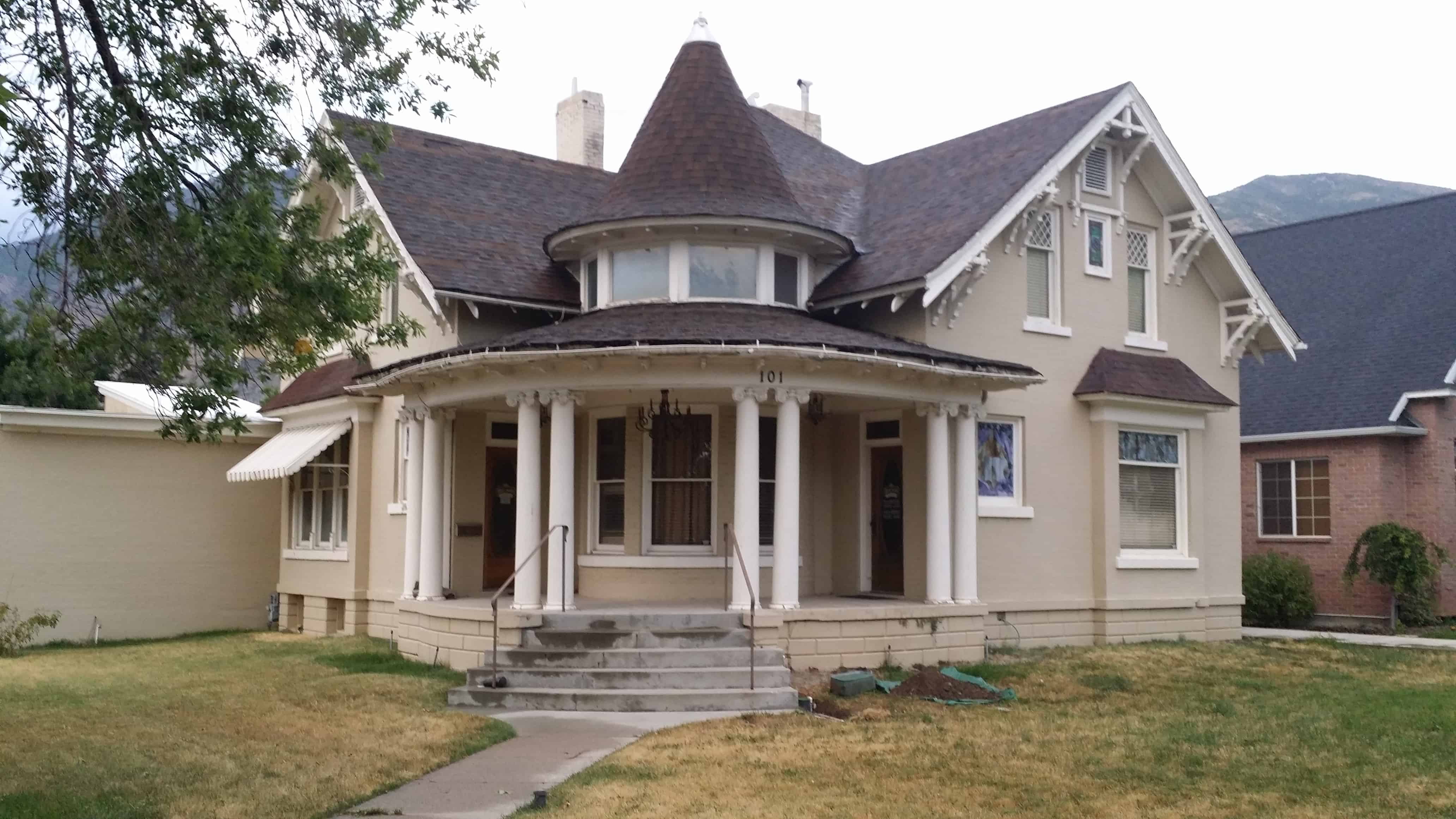
At 101 South 400 East in Springville is the Thomas E. Child Home, a beautiful classic. This home is located two houses south of the Richard Palfreyman Home.
The James P. and Lydia Strang House, at 293 E 400 N in Springville, Utah, was built in 1895. It was listed on the National Register of Historic Places in 1998.
The Milan Crandall Home is one of my very favorites in Springville. Located on the Southeast corner of 400 North and 100 East, I have had many people bring up this home when I tell them I’m from Springville.
The 1891 Yard-Groesbeck House is significant in the broad patterns of Springville history as an example of the larger, more substantially constructed homes built in Springville during the late nineteenth and early twentieth centuries. As detailed in the “Historic Resources of Springville City” Multiple Property Submittal, these buildings reflect the growing prosperity and sophistication that the arrival of the transcontinental railroad (in 1869) and other links to communities outside Utah brought to Springville. The first owner of the house, Edward J. Yard, was a lumber dealer in Springville. The later owners, Nicholas H. and Rhoda S. Groesbeck, were a prominent family in late nineteenth century Springville. Successful first in the mercantile business and then in mining, Nicholas H. Groesbeck bought a house in Springville commensurate with his station in the community. Contact with the outside world brought awareness of popular architectural styles to Springville. Buildings such as the Yard-Groesbeck House were the result of such awareness.
Springville City, in Utah County, Utah, was settled in September, 1850 by a company of pioneers of the Church of Jesus Christ of Latter-Day Saints (LDS or Mormon Church) led by Aaron Johnson. The colonizing families had crossed the plains during the summer as part of a train of 135 wagons captained by Johnson. Upon arriving in Utah, they were called by church leader Brigham Young to establish a permanent community on the banks of Hobble Creek, in Utah Valley. The suitability of the area for settlement and agriculture had been noted earlier by William Miller and James Mendenhall, who had traveled the length of Utah Valley during the winter of 1849.
The pioneering period of establishing Springville as a viable community was followed by an era of growth and diversification of industry and commerce. Promotion of the organized cooperative movement may have helped to initiate this new phase of development. The greatest impact, however, was brought by the railroad. Completion of the transcontinental rail line in 1869 ended Utah’s geographic isolation, linking the state to the products and markets of the entire nation. It made goods from the outside more readily available, created new markets for Utah-produced commodities, stimulated commerce and the development of new industries, and brought in more settlers together with more outside influences. The pioneer period, with its emphasis upon basic essentials of community survival, self-sufficiency, and cooperative group effort, was brought to a final close.
By the early 1900s, Springville had grown to a city of approximately 3,500. The 1911 R.L. Polk & Co. Directory shows Springville to have two banks, fourteen grading contractors, three hotels/rooming houses, one flour mill, one canning factory, and a municipal electric power plant. There were four general stores in operation: G.S. Wood Mercantile Co.; Deal Bros. & Mendenhall Co.; Packard Bros. & Co.; and IT. Reynolds & Co. Principals in the latter three firms also were prominent in the field of railroad contracting. Springville was served by two railroads: the Denver & Rio Grande Western, and the San Pedro, Los Angeles & Salt Lake Railroad of the Union Pacific system.
According to current owner Margaret B. Conover, 157 W. 200 South was built in 1891 by Edward J. Yard, who was a lumber dealer at the time.4 Mr. Yard reportedly operated his lumber business out of the home, with offices in the lower front rooms. He originally built the house as a single story dwelling, adding the second story at a later date. The home’s frame construction, an uncommon building material for substantial buildings of this time in Springville, is consistent with Mr. Yard’s profession. The arrangement of an additional front entrance on the front-facing cross gable of the house is also consistent with Mr. Yard using rooms of his house as his offices.
Official title records list Mr. Yard as actually owning the parcel on which 157 W. 200 South stands only for a brief period in 1892. Little information is available regarding James D. Davis and George W. Snow, each of whom briefly owned the property prior to its purchase by Mr. Yard. Initially, Edward J. Yard owned a large portion of Lot 3, subsequently selling off sections to Anna S. Ingalls in 1892, Nettie K. Groesbeck in 1895, and George P. Thompson in 1899.
Rhoda Sanderson Groesbeck was the first wife of Nicholas Harmon Groesbeck. She was born in England in 1846, to John and Rebecca Wood Sanderson. The family came to Utah in 1856 with the David H. Cannon company of Mormon immigrants and settled in Springville in 1861. Rhoda Sanderson and Nicholas H. Groesbeck were married in Springville on December 16,1892. Nicholas Harmon Groesbeck was born in Springfield, Illinois in 1842. He was the oldest child of Nicholas and Elizabeth Thompson Groesbeck. The family emigrated to Utah in the summer of 1856, settling in Salt Lake City.
In 1858, members of the Groesbeck family moved to Springville as part of the temporary migration of northern Utah Saints south to Utah County to escape the approaching Federal troops of General Albert Sydney Johnston’s Army. Nicholas Groesbeck (Sr.) opened a small dry goods store in some rooms of the old fort row. The business later moved into a building on Main Street and First South. Prior to coming to Utah, Groesbeck had been a prominent merchant and businessman of Springfield, Illinois. He subsequently established himself as a leading merchant, mining man and real estate investor in Salt Lake City.
Nicholas H. Groesbeck continued to live in Springville after the family’s return to Salt Lake City in 1858. In 1861, he built the Groesbeck Theater, of which he was owner and manager, on Main Street between Center and First South. He outfitted the theater with fixtures obtained from the army’s Camp Floyd (near Fairfield, in northern Utah County) theater, which closed down when troops returned east at the outbreak of the Civil War.
In 1863, Nicholas H. Groesbeck bought out his father’s interest in their Springville Mercantile business. When the cooperative movement was organized in 1868, he sold the business to the new co-op. The LDS Church’s cooperative economic system, adopted some years earlier by certain Utah communities, was significantly expanded during 1868. In that year, Zion’s Cooperative Mercantile Institution (Z.C.M.I.) was organized at Salt Lake City. The cooperative system had its basis in LDS church doctrine, and was encouraged by church leaders, most notably Lorenzo Snow. It espoused the principle of an independent, self-reliant society in which members would work for the common good rather than personal gain. The early success of Springville’s cooperative system was destined to be short-lived, however. As was the case in other Utah communities, the cooperative ideal fell victim to increasing competition from private concerns and the reluctance of the cooperative’s members to participate fully in the communitarian system.
Turning his attention to mining, Groesbeck joined with his father and brothers to develop the Flagstaff Mine, which became a major producer in the Little Cottonwood Mining District, outside of Salt Lake City. Groesbeck left Utah in 1871 to serve an LDS Church mission in Kentucky, Ohio and Illinois. Upon returning to the west, he purchased mining properties in Montana, which he then sold in 1876 to the Packard brothers of Springville. Taking the Packard Bros. Springville store as partial payment, he re-entered the mercantile business for several years until leaving on a second LDS Church mission, this time to New Zealand, in 1880. After returning from his second mission in 1882, Groesbeck, remained engaged in mining ventures and also entered the real estate business. His first of three wives, Rhoda Sanderson Groesbeck, resided at 157 W. 200 South until her death in 1932. During her life in Springville she was active in LDS Church and charity work, and was a member of the daughters of the Utah Pioneers. She and Nicholas H. were the parents of ten children, five of whom were surviving at the time of her death.
In 1935, Harrison and Margaret Bird Conover moved into 157 W. 200 South. Mrs. Conover is the granddaughter of Nicholas H. and Rhoda S. Groesbeck. Her parents were Martin W. and Mary Groesbeck Bird. Title abstracts show the Birds inherited the house in 1937. However, they appear not to have lived in the house. In 1939, the Conovers gained ownership of the property.
William Harrison Conover was a prominent publisher, state legislator and county official during his career. Born in 1907 in Provo, he married Margaret Bird in 1933. He was president of Art City Publishing in Springville from its founding in 1933 to 1983, publisher of the Sprinqville Herald newspaper from 1939-1967, and Utah County Assessor from 1967 until his death in 1983. He was a member of the Utah House of Representatives from 1957-1959. Mrs. Margaret Conover has continued to reside in the house since her husband’s death, as she has for over fifty years. The house has remained in the family through three generations of ownership spanning 96 years.
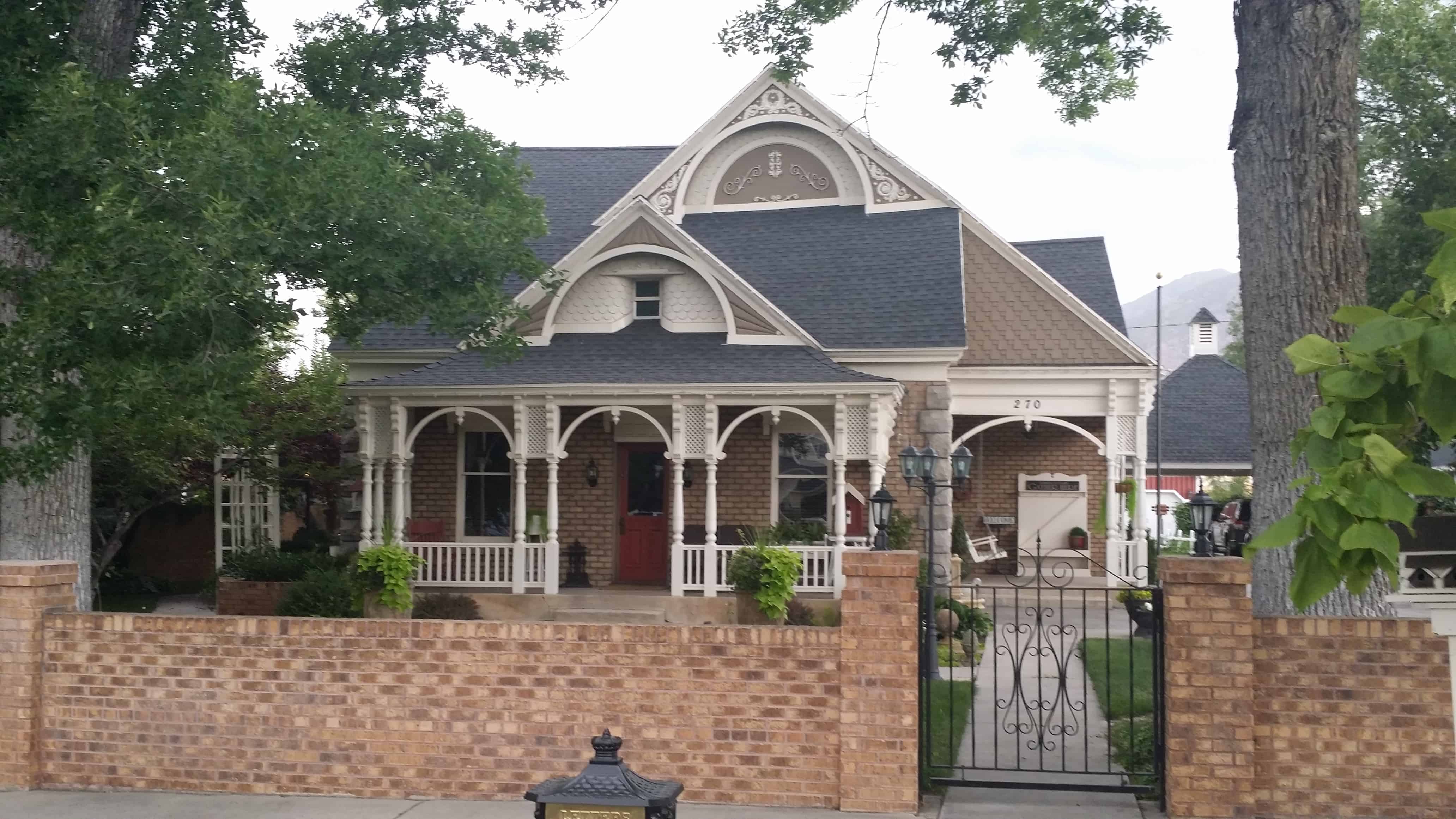
The Henry T. Reynolds, Sr.,and Rebecca Reynolds House, built c.1875 and c.1891 (nominated as part of the “Historic Resources of Springville City” Multiple Property Submittal), is significant in the broad patterns of Springville history as an example of the larger, more substantially constructed homes built in Springville during the late nineteenth and early twentieth centuries. These buildings reflect the growing prosperity and sophistication that the arrival of the transcontinental railroad (in 1869) and other links to communities outside Utah brought to Springville. The first owner, Henry T. Reynolds Sr., was one of the most prominent and successful citizens in Springville. As such, the Reynolds family was able to build a home commensurate with their station in the community. The earlier, simpler, more utilitarian building, was renovated c.1891 with Victorian Eclectic stylistic features. Contact with the outside world brought awareness of popular architectural styles, such as the new eclectic Victorian styles exhibited on the Reynolds House, to Springville. Buildings such as this house were the result of such awareness.
The home at 270 West 200 South consists of an original brick hall parlor portion built with Classical stylistic influences, which was subsequently expanded with substantial Victorian style additions. The precise date of construction of the original portion is difficult to establish. It is constructed of brick, which was first produced locally during the 1860s but which did not attain widespread use until somewhat later. The hall-parlor plan and remaining Greek Revival stylistic elements indicate initial construction prior to the arrival of the picturesque styles in Utah. Evaluation of the construction materials, house type and original stylistic elements suggests that initial construction occurred between c.1870 and c.1880. The subsequent structural additions and application of Victorian Eclectic decorative trim likely was undertaken c.1891.
The original hall-parlor house was first owned by either Joseph Allan, a pioneer blacksmith of Springville, or Loren Harmer, who purchased the property from Mr. Allan in 1876.6 Mr. Harmer was engaged in farming and gardening locally. In 1881 the property was purchased by George M. Nelson. A carpenter by profession, Mr. Nelson conceivably could have been the original builder of 270 W. 200 S., although this implies a relatively late date of construction.
The principal owners of the home were Henry T. and Rebecca Reynolds, who acquired the property in It was during the Reynolds’ ownership that the major Victorian additions to the home were undertaken. Henry T. Reynolds, Sr. was among the most highly prominent of Springville’s early citizens. He was born in Springville in 1860, a son of pioneer settlers Joseph D. and Elizabeth Taylor Reynolds. Upon graduating from Brigham Young University in 1880, Mr. Reynolds engaged in farming for several years but soon turned his attention to merchandising and other business enterprises. In 1882 he co-founded the H.T. Reynolds & Co. mercantile business, of which he became president and principal owner. The business quickly grew into one of the most prominent and successful mercantile concerns in the state. After locating initially in two smaller stores, Reynolds built the H.T. Reynolds & Co. commercial block on the corner of Main Street and 200 South in 1892. Said to have been the largest general store south of Salt Lake City, it remains the dominant building on Springville’s Main Street. Mr. Reynolds served as president of H.T. Reynolds & Co. into the 1920s.
Also active in various other business enterprises and community affairs, H.T. Reynolds, Sr. was a cofounder in 1891 of the Springville Banking Co., serving initially as vice president and later succeeding Romanzo A. Deal as president of the institution, holding that office from 1903 until close to the time of his death in 1929. A member of Springville’s corps of road construction contractors, Mr. Reynolds founded and headed the Reynolds-Ely Construction Co. The firm was a major builder of railroads in the western U.S., and carried on (as Reynolds-Ely Construction Co. and later as Reynolds Construction Co.) as a highway contracting concern through the 1930s into the 1940s, during which time it was headed by Reynolds’ sons Henry T., Jr. (Harry T.) and J. Ernest. Some sources indicate that H.T. Reynolds, Sr. first became involved to some degree in the contracting business even before he entered the mercantile field, working as an early builder of wagon roads and later of railroad grades.
Other business interests pursued by Mr. Reynolds included the Utah Wholesale Grocery Co., of which he was president, which carried on trade throughout Utah and other western states. He was vice president of the Springville-Mapleton Sugar Co., which built a beet sugar refinery near Springville c.1918. The company was one of only a few independent producers to operate in a region dominated by the Utah-Idaho Sugar Co. Springville-Mapleton Sugar Co. was turned over in 1928 to an investment company which then sold the operation to Utah-Idaho Sugar Co. in 1932.
Politically active throughout his life, Henry T. Reynolds, Sr. served on the Springville City council for 13 years. He held the office of mayor for two terms. At the state level he was a member of the Utah legislature, serving one term in each of its houses. Mr. Reynolds also occupied the office of Utah County Commissioner for one term.
Henry married Rebecca (Reba) Porter in 1887, about two months after his acquisition of title to this house. Rebecca was born in Mt. Pleasant in 1866, the daughter of James B. and Mary Ann Porter. After her father died when she was seven years old, Rebecca moved to Springville with her family. She converted to the Mormon church about one year later. Rebecca served as treasurer, teacher and president, and counselor of various auxiliaries associated with the local ward (parish). She and Henry had eight children.
In 1928, Mr. Reynolds was forced to move to California due to III health, at which time title to 270 W. 200 S. passed to Reynolds’ son, J. Ernest. The following year H.T. Reynolds, Sr. was able to return to Springville, where he died on September 23,1929.8 The family residence at that time was 109 North Main Street, where Rebecca continued to live (together with a daughter, Helen) following the death of Mr. Reynolds, and lived there until her death in 1958. The property at 109 N. Main St. was first purchased by H.T. Reynolds in August, 1925.
Available records do not indicate whether J. Ernest Reynolds resided at 270 W. 200 S. during his adult life, though he held title to the property for some 14 years. Directory records show him as residing in Provo after at least 1935. J. Ernest occupied the position of secretary-treasurer of Reynolds-Ely Construction Co. He remained with the firm when it later became Reynolds Construction Co., and continued in the contracting business throughout his life until retiring in the early 1960s. During this time he made his residence in Provo, together with his wife, Ruth. For many years they lived at 357 N. 400 E. in Provo. Following Mr. Reynolds’ retirement, the family moved to 729 E. 2730 N. in Provo.
From 1942 until 1944, title to 270 W. 200 S. was held by Abbie Ashcraft. Directory records show that she and her husband, Don, took up residence in the home some years before that, perhaps renting from J. Ernest Reynolds. Don Ocean Ashcraft was born in Provo in 1874, a son of James E. and Lamina Fullmer Ashcraft. He married Abbie Wordsworth in 1698, and that same year embarked upon a career In railroading. For 36 years, until being retired in 1934, he was employed by the Denver & Rio Grande Railroad, being a locomotive engineer for 26 of his years with the company.
After residing initially at various Utah localities, the Ashcraft family settled in Springville in 1918. Between 1920 and 1935 Mr. Ashcraft and his four sons maintained a large farming operation near the city. Don Ashcraft died in 1940. Abbie Ashcraft, who had resided in Springville prior to marrying Mr. Ashcraft, remained in the community following her husband’s death. She hold title to 270 W. 200 S. between 1942 and 1944. at which time she sold the home to Arthur J. and Pearl L. Rich.
Prior to moving to Springville, Mr. Rich was employed as an engineer with Geneva Steel and had his family residence at 432 E. 600 N. in Provo. Available records do not provide occupational information for Mr. Rich during his time in Springville. He and his wife, Pearl, resided at 270 W. 200 S. into the 1960s. The home appears to have been vacant for a short time c, 1965, after which it was evidently rented to Ashel H. Tanner, a seminary teacher at Springville Junior High School. He occupied the home c. 1967 with his wife, Donna.
Between 1965 and 1969, title to 270 W. 200 S. was held by Donald I. and Esther B. Rich, who subsequently sold to James Ruel and De Ann J. Plowman. Mr. Plowman was involved in the auto repair business. The Plowmans resided at 270 W. 200 S. for only a short time before selling in 1970 to Bahe Billie, an Instructor at Brigham Young University, and his wife Florence. They likewise were resident only briefly.
Control of the property was acquired in 1974 by Brigham W. and Mary Mitchell, who resided in Orem. Directory records list 270 W. 200 S. as Vacant’ between 1972 and 1977. Title was next obtained c. 1977 by Bill and Delia Mitchell, who moved into the home and performed extensive restoration work on the interior, which had not fared well in the years that the house was vacant. The Mitchells were resident until about 1983.
270 W. 200 S. was subsequently rented briefly by Grant and Fran Roylance, c. 1985, then owned and occupied by Lynn and Signe Hale. The home was acquired by current owners Calvin and Linda McCausland in 1992.
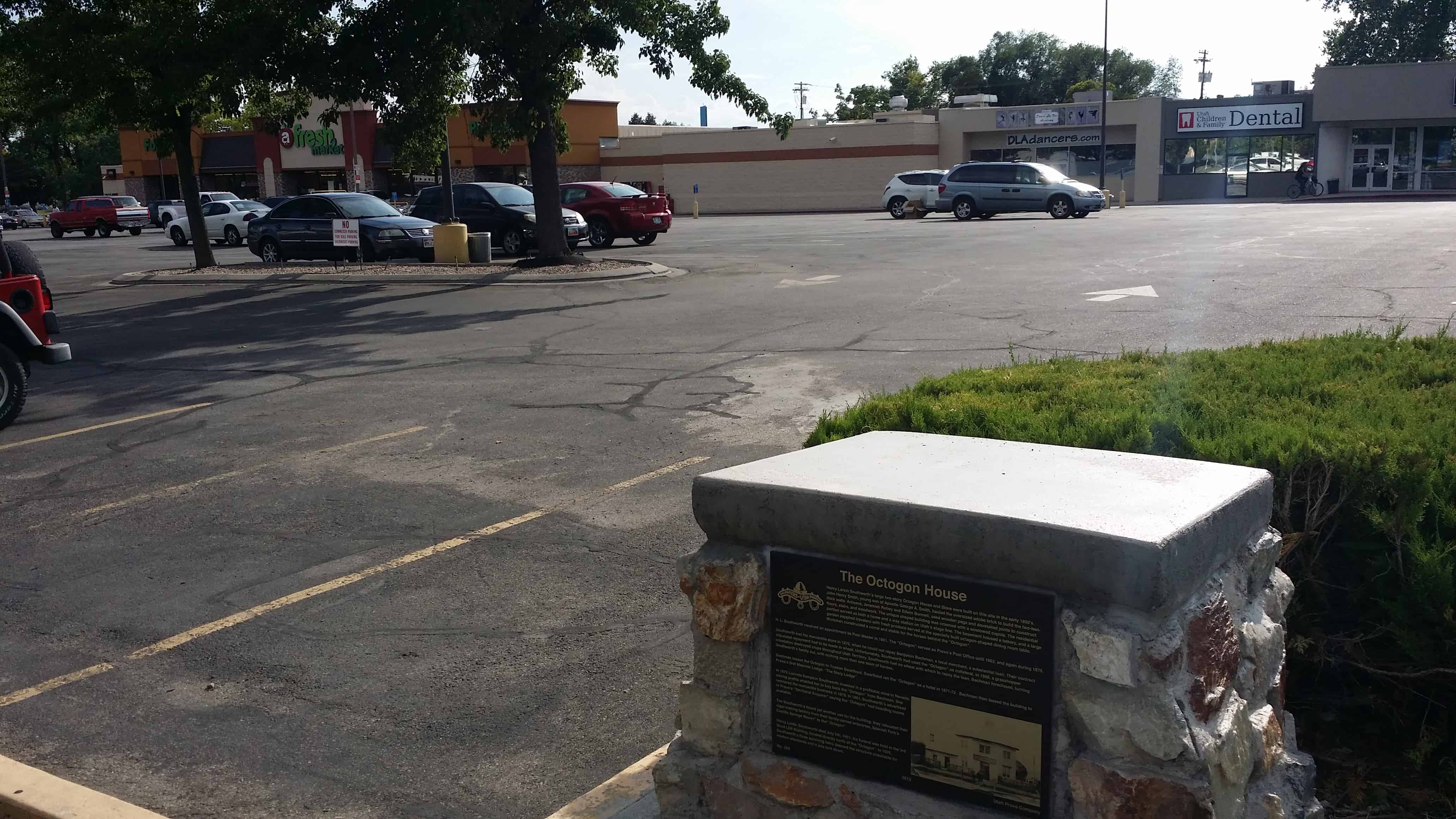
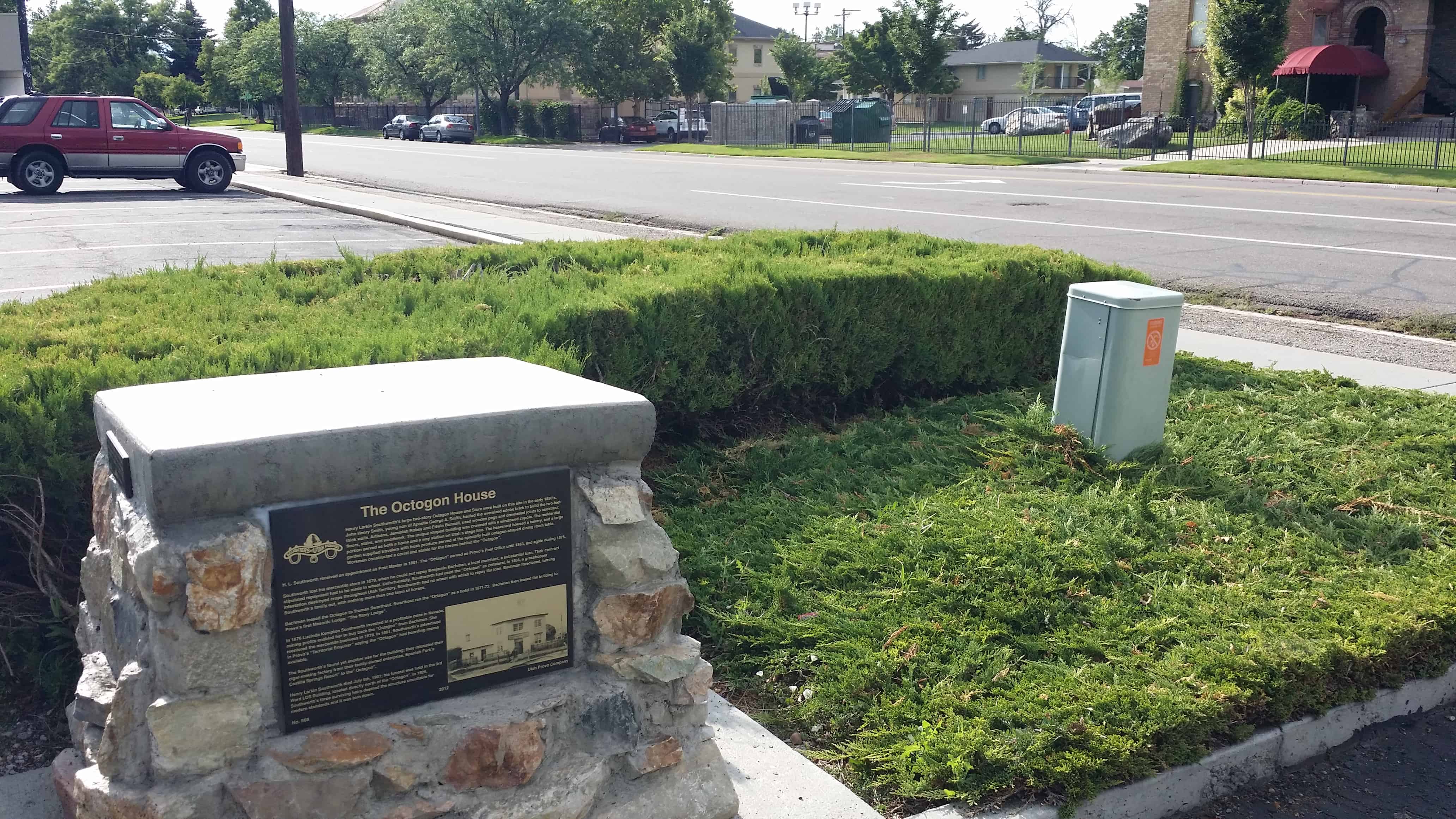
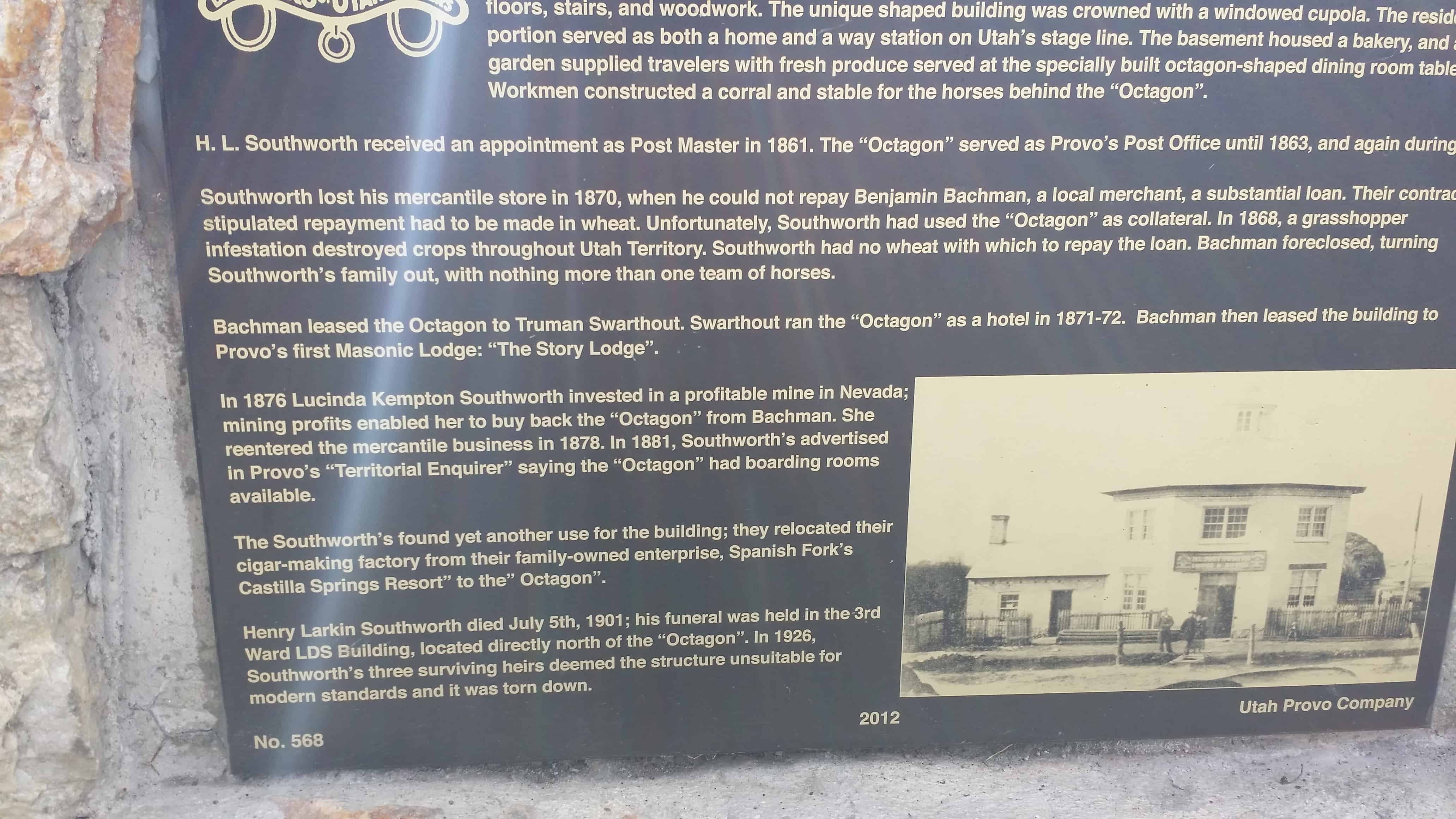
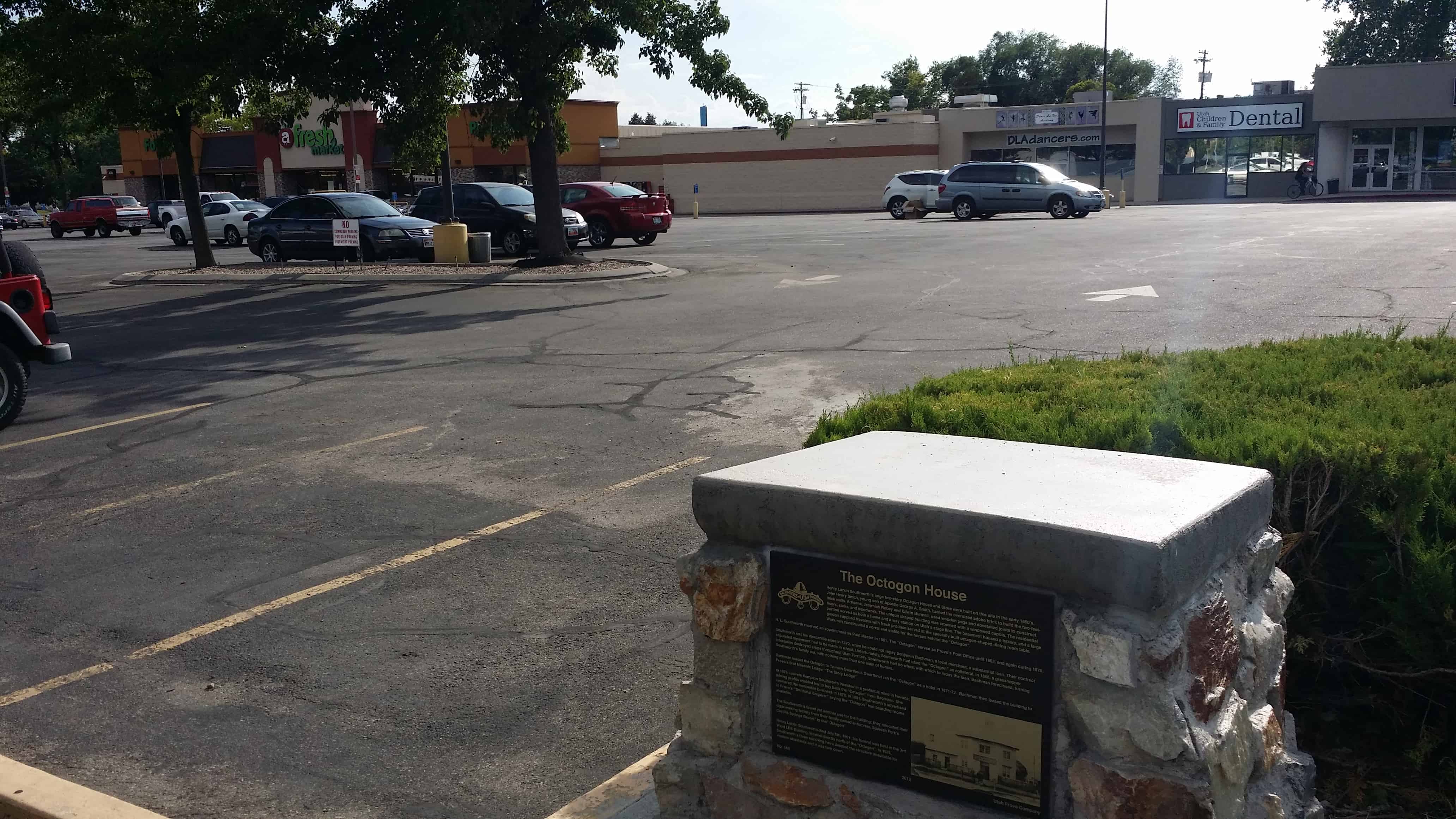
Henry Larkin Southworth’s large two-story Octagon House and Store were built on this site in the early 1850’s. John Henry Smith, young son of Apostle George A. Smith, hauled the oversized adobe brick to build the two-feet-thick walls. Artisans, Jeremiah Robey and Edwin Bunnell, used wooden pegs and dovetailed joined to construct floors, stairs, and woodwork. The unique shaped building was crowned with a windowed cupola. The residential portion served as both a home and a way station on Utah’s stage line. The basement housed a bakery, and a large garden supplied travelers with fresh produce served at the specially built octagon-shaped dining room table. Workmen constructed a corral and stable for the horses behind the “Octagon”.
H.L. Southworth received an appointment as Post Master in 1861. The “Octagon” served as Provo’s Post Office until 1863 and again during 1875.
Bachman leased the Octagon to Truman Swarthout. Swarthout ran the “Octagon” as a hotel in 1871-72. Bachman then leased the building to Provo’s first Masonic Lodge: “The Story Lodge”.
In 1876 Lucinda Kempton Southworth invested in a profitable mine in Nevada; mining profits enabled her to buy back the “Octagon” from Bachman. She reentered the mercantile business in 1878. In 1881, Southworth’s advertised in Provo‘s “Territorial Enquirer” saying the “Octagon” had boarding rooms available.
The Southworth’s found yet another use for the building; they relocated their cigar-making factory from their family-owned enterprise, Spanish Fork’s “Castilla Springs Resort” to the “Octagon”.
Henry Larkin Southworth died July 5th, 1901; his funeral was help in the 3rd Ward LDS Building, located directly north of the “Octagon”. In 1926, Southworth’s three surviving heirs deemed the structure unsuitable for modern standards and it was torn down.