• About JacobBarlow.com
  • Cemeteries in Utah
  • D.U.P. Markers
  • Doors
  • Exploring Utah Email List
  • Geocaching
  • Historic Marker Map
  • Links
  • Movie/TV Show Filming Locations
  • Oldest in Utah
  • Other Travels
  • Photos Then and Now
  • S.U.P. Markers
  • U.P.T.L.A. Markers
  • Utah Cities and Places.
  • Utah Homes for Sale
  • Utah Treasure Hunt

JacobBarlow.com

~ Exploring with Jacob Barlow

JacobBarlow.com

Tag Archives: Sweetwater County

Burial on the Trail

21 Wednesday Mar 2018

Posted by Jacob Barlow in Uncategorized

≈ 1 Comment

Tags

Historic Markers, Sweetwater County, Wyoming, Wyoming Historic Markers

2018-01-05 15.08.38

Burial on the Trail

Death on the trail did not allow for the fineries of the funerals back home. Emigrants made do with materials available. Black would adorn the clothes of mourners, and care would be taken to provide the best funeral possible. The most travelers could provide was often just a shallow trench beside the trail and no coffin for the deceased.

Many emigrants worried about the lack of propriety of a simple grave on the windswept prairie and vowed to return and provide a “proper” resting place.

Few of the thousands of emigrant graves have been located. The wind and snow soon obliterated any evidence of them. Markers disappeared, and in some cases, wild animals scavenged the graves. Stories of family members later returning to search for a loved one’s final resting place are common, but the searches were usually fruitless.

2018-01-05 15.11.00

2018-01-05 15.09.50

This historic marker is located on a walking path loop on Highway 28 just west of Farson, stopping here you can see all these markers:

  • Continuing the Journey West
  • Pilot Butte & “Graves” of the Unknown Emigrants
  • Emigrant/Indian Relations
  • First Transcontinental Telegraph
  • Pilot Butte
  • Death on the Trail
  • “Graves” of the Unknown Emigrants
  • Burial on the Trail

Simpson’s Hollow

20 Tuesday Mar 2018

Posted by Jacob Barlow in Uncategorized

≈ 1 Comment

Tags

Historic Markers, Sweetwater County, The Utah War, Wyoming, Wyoming Historic Markers

2018-01-05 15.03.43

One of only three significant engagements of the Utah War, the incident at Simpson’s Hollow played a key role in the conflict. The Utah War (1857-1858) was the result of a lack of communication between the U.S. Government and the Utah Territory concerning Brigham Young’s power as governor of Utah and as head of the Church of Latter Day Saints. To resolve this conflict of interest, President Buchanan appointed a new governor, Alfred Cumming. However, fearing Utah’s citizens would not calmly accept the replacement of Young, Buchanan canceled mail service to Utah and sent out a military force of 2,500 men to safely escort Cumming to Salt Lake City. Captain Lew Simpson, for which the site is named, and his troops, were part of this military force sent to Utah on the Oregon Trail.

Upon notification of the approaching troops, Young and other Mormon leaders assumed, because they had not been notified of the administrative changes, that the army’s intent was religious persecution. Young deployed the Utah Militia, also known as the Nauvoo Legion, to slow the U.S. troops.

In October 1857, a wagon train under the command of Captain Simpson was surrounded by the Utah Militia and forced to surrender its wagons. The Militia, led by Lot Smith, released the livestock and burned all but one supply wagon, resulting in damages estimated at over $85,000. In addition to the incident at Simpson’s Hollow, the Militia burned two other wagon trains, forcing the entire army to winter near the recently burned Fort Bridger.

In the spring, Thomas L. Kane, long-time friend of the Mormons, negotiated a settlement that allowed U.S. troops to peacefully enter Salt Lake City. Young stepped down from his position and created a diplomatic relationship with Governor Cumming.

There are four historic markers here:

  • Burning Wagons
  • Simpson’s Hollow
  • Simpson’s Hollow
  • The Utah War

2018-01-05 15.03.56

2018-01-05 15.05.05

2018-01-05 15.05.09

Burning Wagons

20 Tuesday Mar 2018

Posted by Jacob Barlow in Uncategorized

≈ Leave a comment

Tags

Historic Markers, Sweetwater County, The Utah War, Wyoming, Wyoming Historic Markers

2018-01-05 15.03.43

Brigham Young sent the Utah Militia, also known as the Nauvoo Legion, to harass the Federal troops and delay their approach. In the early hours of October 4th, Major Lot Smith of the Utah Militia and 40 men captured and burned two supply trains, totaling 52 wagons, west of here near the Green River.

The next day Smith and his men struck again near where you are now standing. Militiaman Newton Tuttle, wrote in his journal:

“Mond 5 We went on to the Sandy got breakfast then we went up to the road & found 24 waggons we burnt 22 of them & took 7 mules and 2 saddles we then went off from the road …”.

Wagonmaster Lewis Simpson led the supply train and ever since the wagon burning episode this little valley has been called Simpson’s Hollow.

Wagon train owners Russell, Majors, and Waddell valued the damage at more than $85,000. The only casualty of both wagon incidents was when one of Lot Smith’s men who was wounded by Smith when his pistol discharged accidentally.

The loss of three months rations and livestock, as well as an early, bitter winter stalled the army at Fort Bridger. The severe weather kept the militia and the army apart. During this lull in action, intermediary Thomas Kane negotiated a peaceful settlement of the conflict. In the spring of 1858, the army peacefully entered Salt Lake City and Alfred Cumming was installed as Utah Territorial Governor.

There are four historic markers here:

  • Burning Wagons
  • Simpson’s Hollow
  • Simpson’s Hollow
  • The Utah War

2018-01-05 15.04.13

2018-01-05 15.05.05

2018-01-05 15.05.09

The Utah War

20 Tuesday Mar 2018

Posted by Jacob Barlow in Uncategorized

≈ Leave a comment

Tags

Historic Markers, Sweetwater County, The Utah War, Wyoming, Wyoming Historic Markers

2018-01-05 15.03.43

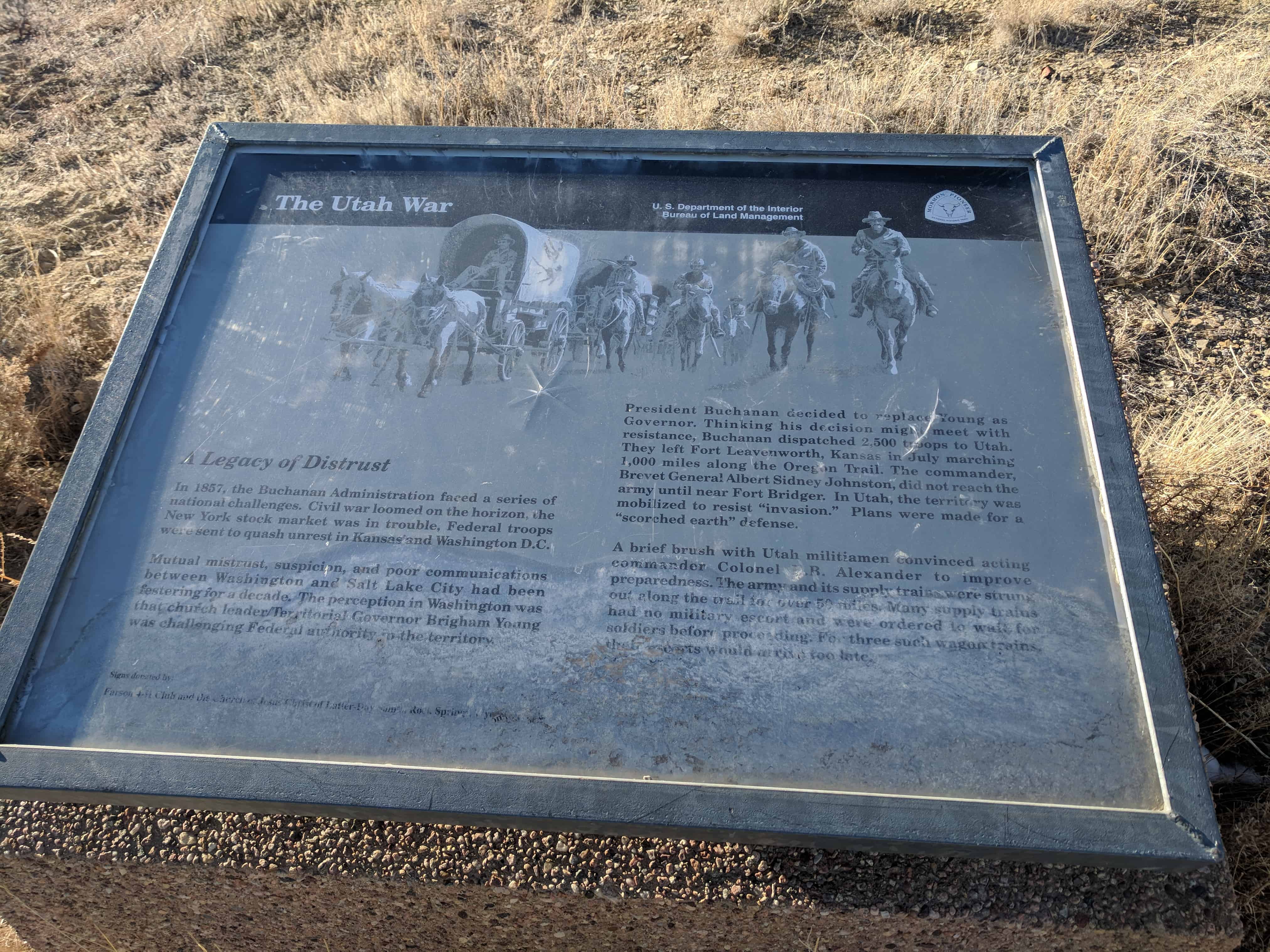
A Legacy of Distrust

In 1857, the Buchanan Administration faced a series of national challenges. Civil war loomed on the horizon, the New York stock market was in trouble, Federal troops were sent to quash unrest in Kansas and Washington D.C.

Mutual mistrust, suspicion, and poor communications between Washington and Salt Lake City had been festering for a decade. The perception in Washington was that church leader / Territorial Governor Brigham Young was challenging Federal authority in the territory.

President Buchanan decided to replace Young as Governor. Thinking his decision might meet with resistance, Buchanan dispatched 2,500 troops to Utah. They left Fort Leavenworth, Kansas in July marching 1,000 miles along the Oregon Trail. The commander, Brevet General Albert Sidney Johnston, did not reach the army until near Fort Bridger. In Utah, the territory was mobilized to resist “invasion.” Plans were made for a “scorched earth” defense.

A brief brush with Utah militiamen convinced acting commander Colonel F.B. Alexander to improve preparedness. The army and its supply trains were strung out along the trail for over 50 miles. Many supply trains had no military escort and were ordered to wait for soldiers before proceeding. For three such wagon trains, their escorts would arrive too late.
There are four historic markers here:

  • Burning Wagons
  • Simpson’s Hollow
  • Simpson’s Hollow
  • The Utah War

2018-01-05 15.04.06

2018-01-05 15.05.05

2018-01-05 15.05.09

California/Mormon/Oregon/Pony Express Trail.

Simpson’s Hollow

29 Sunday Oct 2017

Posted by Jacob Barlow in Uncategorized

≈ 2 Comments

Tags

Historic Markers, Sweetwater County, The Utah War, Wyoming, Wyoming Historic Markers

e1809295-ba01-43c8-80bb-d2036fc938c3

2018-01-05 15.03.43

Here on Oct. 6 1857 U.S. Army Supply wagons led by a capt. Simpson were burned by a Major Lot Smith and 43 Utah Militia Men.  They were under orders from Brigham Young, Utah Territorial Governor, to delay the army’s advance on Utah.  This delay of the army helped affect a peaceful settlement of difficulties.

The day earlier a similar burning of 52 army supply wagons took place near here at Smith’s Bluff.

There are four historic markers here:

  • Burning Wagons
  • Simpson’s Hollow
  • Simpson’s Hollow
  • The Utah War

2018-01-05 15.04.18

2018-01-05 15.05.05

2018-01-05 15.05.09

afc9bc1b-32af-42eb-a513-cabc58a2ee5a

2d8c1fdc-ab7f-4f89-a70a-4fd215917909

Little Sandy Crossing

14 Monday Nov 2016

Posted by Jacob Barlow in Uncategorized

≈ 3 Comments

Tags

Farson, Historic Markers, SUP, Sweetwater County, UPTLA, Wyoming, Wyoming Historic Markers

  • 2018-01-05 14.52.51

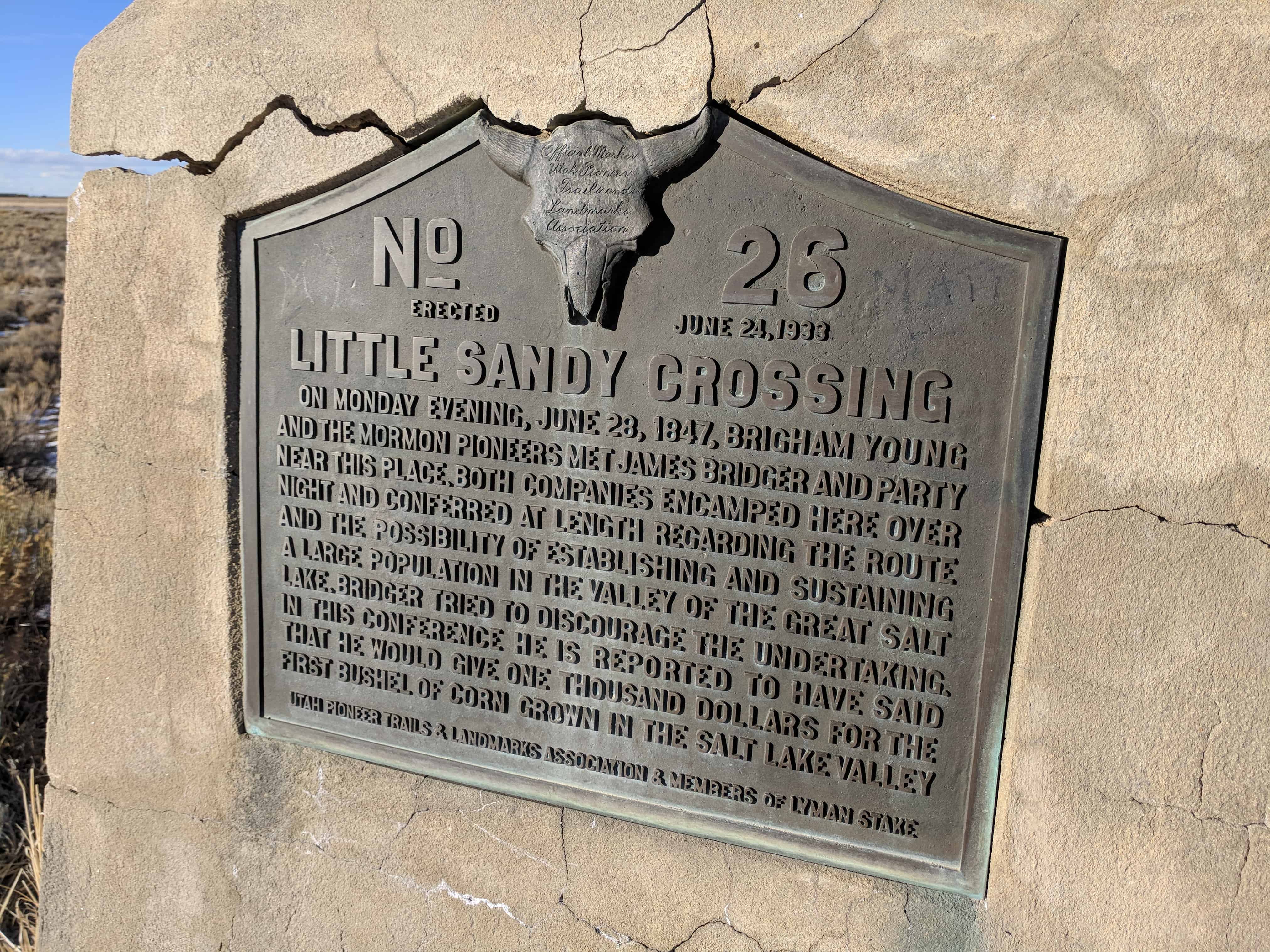
Little Sandy Crossing

On Monday evening, June 28, 1847, Brigham Young and the Mormon Pioneers met James Bridger and party near this place.  Both companies encamped here over night and conferred at length regarding the route and the possibility of establishing and sustaining a large population in the valley of the Great Salt Lake.  Bridger tried to discourage the undertaking.  In this conference he is reported to have said that he would give one thousand dollars for the first bushel of corn grown in the Salt Lake Valley.

2018-01-05 14.52.57

See other historic markers in the series on this page for UPTLA/SUP Markers.

picture2aug07-017
picture2aug07-018

Farson, Wyoming

14 Monday Nov 2016

Posted by Jacob Barlow in Uncategorized

≈ 2 Comments

Tags

Farson, Sweetwater County, Wyoming

picture2aug07-011

Farson is a census-designated place in Sweetwater County, Wyoming, United States. The population was 313 at the 2010 census.

Related posts:

  • Big Sandy River
  • Little Sandy Crossing
  • Pony Express Station – Big Sandy

picture2aug07-012
picture2aug07-013
picture2aug07-014
picture2aug07-015
picture2aug07-016
picture2aug07-017
picture2aug07-018
picture2aug07-019
picture2aug07-020
picture2aug07-021
picture2aug07-022
picture2aug07-023
picture2aug07-024
picture2aug07-025
picture2aug07-026
picture2aug07-027
picture2aug07-028
picture2aug07-029
picture2aug07-030

2018-01-05 14.51.27

Pony Express Station – Big Sandy

15 Thursday Sep 2016

Posted by Jacob Barlow in Uncategorized

≈ 2 Comments

Tags

Farson, historic, Historic Markers, Pony Express, Sweetwater County, Wyoming, Wyoming Historic Markers

180cd54a-c46a-4f4d-a5ca-267bfeed4866

See also, Pony Express Stations.

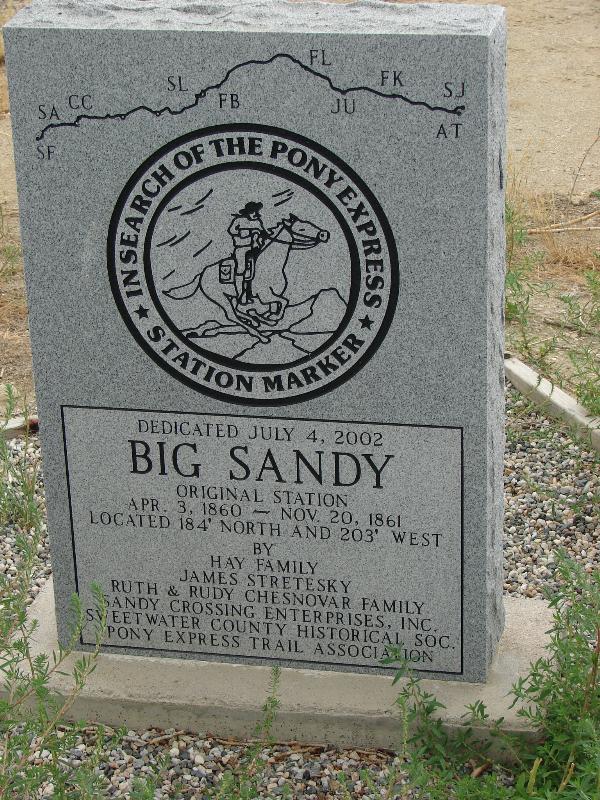
Located 13 miles from Little Sandy Station and 15 miles from Big Timber Station at west edge of the town of Farson and east of Big Sandy Creek. (Henderson) Burned by Indians in 1862. The Sandy and Little Sandy flow past on the west and south. (Wyoming Guide) The Big Sandy was a stage station on the Overland route which was destroyed by the Indians when they set fire to several stage stations and farm houses in 1864. On the eastern division of the stage line, between Big Sandy and Thirty Two Mile Creek, every station but one was burnt by the Indians. Nearly every ranchman’s house between old Julesburg and Big Sandy was deserted. Big Sandy, Little Sandy and Old Dry Sandy were stage stations which were named from the creeks in that region. (WPA)

Cross Miry Creek. Road down Pacific Creek; water scarce for 20 miles. After 11 miles, “Dry Sandy Creek ;” water scarce and too brackish to drink ; grass little; sage and greasewood plentiful. After 16 miles, “Sublette’s Cut-off,” or the “Dry Drive,” turns N.W. to Soda Springs and Fort Hall: the left fork leads to Fort Bridger and Great Salt Lake City. Four miles beyond the junction is “Little Sandy Creek,” 20-25×2; grass, timber, and good camping-ground. Eight miles beyond is “Big Sandy Creek,” clear, swift, and with good crossing, 110×2. The southern route is the best; along the old road, no water for 49 miles. Big Sandy Creek Station.(*)

9f43766d-c2c8-4050-b756-bf882b5d479d

b400cbf4-7133-4543-878b-efc0ceb216c1

f75fa329-a959-42d8-8641-72a609902aad

More photos from another time stopping by, in January 2018.

2018-01-05 14.49.35

2018-01-05 14.49.56

2018-01-05 14.50.00


2018-01-05 14.50.06.jpg

2018-01-05 14.50.11

2018-01-05 14.51.27

Newer posts →

Follow Jacob

Follow Jacob

Blog Stats

  • 2,031,760 hits

Social and Other Links

BarlowLinks.com

Recent Posts

  • This is the Place State Park
  • Eyes Westward
  • Wellsville Relief Society Meetinghouse
  • Angels Are Near Us
  • Hiram Clawson Silver

Archives


Loading Comments...