On July 29, 1776, Fathers Francisco Atansio Dominguez and Silvestre Velez de Escalante led an exploration party of ten horsemen from Santa Fe, New Mexico to establish an overland route to Monterey, California while spreading the Catholic faith to the native peoples they hoped to meet along the way.
On October 14, the expedition camped at San Hugelino in present day Toquerville. The previous day, the two Indian guides, suspicious and afraid of the Spaniards, led them into the hills west of Ash Creek Canyon and disappeared, leaving the padres to find their way out the best they could. The Spaniards found their way back to Rio del Pilar 9Kanarra Creek) with great difficulty and camped there at San Daniel.
Two days later, as the party traveled south near present day Hurricane they came upon three small corn fields, watered by irrigation ditches Since they had nothing left but two slabs of chocolate, this meant provision could be secured on the return trip to Santa Fe. The community orientation of these Indians also meant that the chances for success in teaching Christianity to them were good.
Although the expedition never reached California, they covered some 2,000 miles of challenging terrain, adding greatly to the knowledge of the geography and the native inhabitants of the Spanish domain now called the American Southwest.
This marker is located just outside the Hurricane Pioneer Museum in Hurricane, Utah
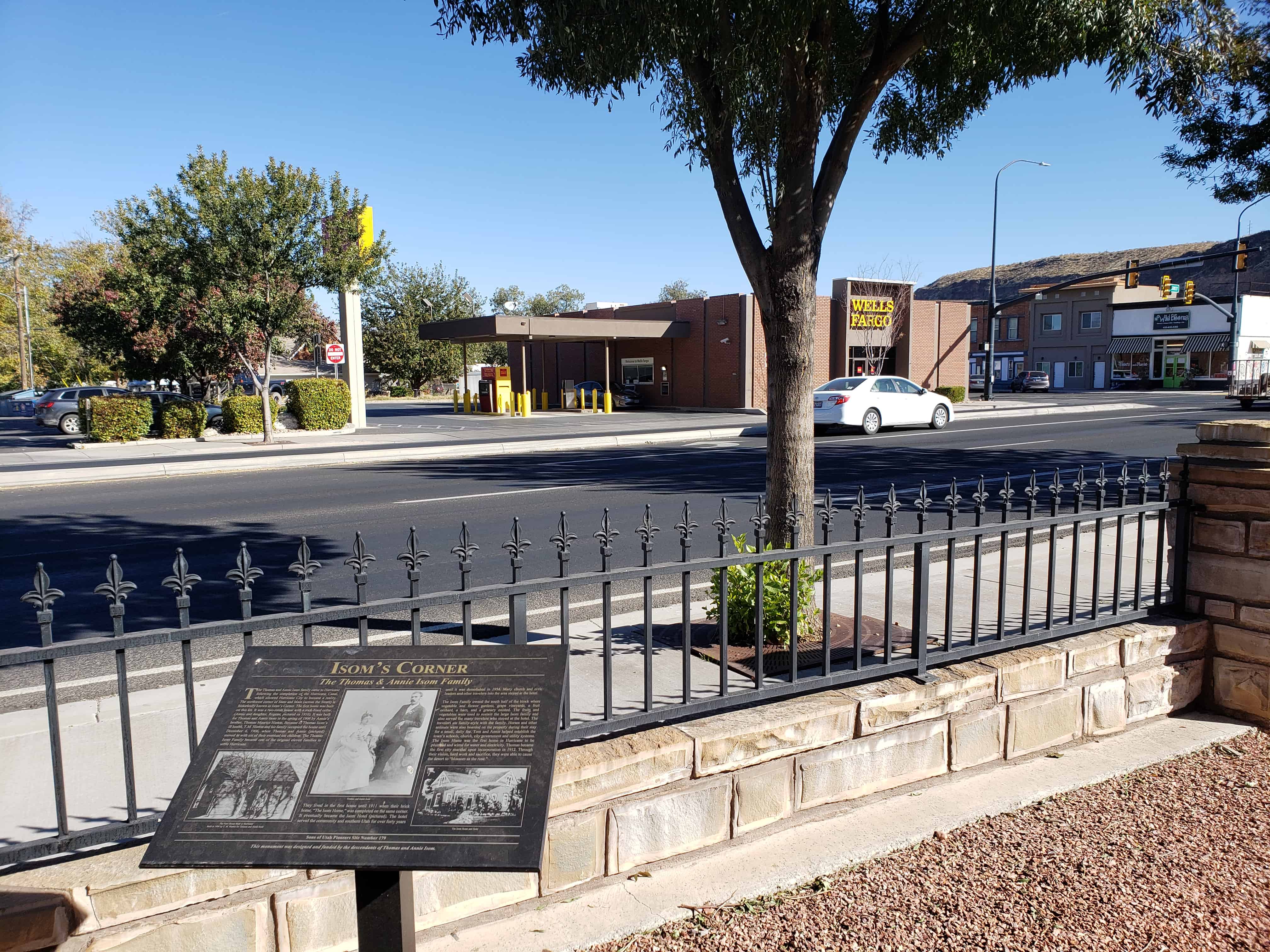
The Thomas and Annie Isom family came to Hurricane following the completion of the Hurricane Canal, which allowed the Hurricane Valley to become a reality. The northwest corner of State and Main (across the Street) is historically known as Isom’s Corner. The first home was built on this lot. It was a two-room house with a rock-lined cellar. (Annie and daughter, Regina pictured, ca 1910). It was built for Thomas and Annie Isom in the spring of 1906 by Annie’s brother, Thomas Maurice Hinton. Because of Thomas Isom’s ill health, T. M. Hinton and his family occupied the house until December 6, 1906, when Thomas and Annie (pictured) moved in with six of their eventual ten children. The Thomas Isom Family became one of the original ten families to settle Hurricane.
They lived in the first house until 1911 when their brick home, “The Isom House”, was completed on the same corner. It eventually became the Isom Hotel (pictured). The hotel served the community and southern Utah for over forty years until it was demolished in Many church and civic leaders and other travelers into the area stayed at the hotel.
The Isom family owned the south one half of the block where vegetable and flower gardens, grape vineyards, fruit orchard, a bam and granary existed. The fruits and vegetables were used to sustain the large Isom family and also served the many travelers who stayed at the hotel. The travelers ate family-style with the family. Their horses and other animals were also boarded on the property during their stay for a small daily fee. Tom and Annie helped establish the town’s schools, church, city government and utility systems. The Isom House was the first home in Hurricane to be plumbed and wired for water and electricity. Thomas became the first city marshal upon incorporation in 1912. Through their vision, hard work and sacrifice they were able to facilitate the desert to “blossom as the rose”.
When Claron Bradshaw was asked by the Heritage Park Foundation Committee if he would sponsor the expense of casting the “Pioneer Gratitude” statue in bronze and placing it on the monument in the park, he responded —
“I appreciate my Dixie Pioneer
Heritage! I will do it!”
Claron is the grandson of Ira Elsey Bradshaw and Marian Hinton Bradshaw who built the first permanent home in Hurricane. When Hurricane City was colonized in 1906, they moved down from Virgin City and lived in this home. The Bradshaws let the community use their front room for school, social and religious services until other facilities were built. The home was also used as a hotel for many years.
Claron’s father, Sherwin, was born December 29, 1905 in Virgin City and came with his folks to Hurricane in 1906. His mother, Maree Wood Bradshaw was born in Cedar City, Utah which her progenitors hepled colonize.
The historic Bradshaw home still stands on the southwest corner of the block across the street east from the Heritage.
Two Important Pioneer Trails Lie to the South of Here
Historic Temple Trail The Temple Trail, which has two parts, was used during the years 1874-1876 to bring lumber by ox-team from two sawmills at Nixon Springs on the south face of Mount Trumbull to St. George, eighty miles away, for constructing the L.D.S. Temple. Forty-five volunteers from local communities constructed the roadways during April and May of 1874. Over a million board feet of lumber were produced by the sawmills which operated during the warmer months only. Much of the production went along the main trail that drops down over the Hurricane Cliffs about twenty miles south of here and on to St. George, the trip taking seven days. Part of it was taken to Antelope Springs via the alternate trail and then hauled on to St. George when winter snows stopped sawmill work. The latter route descends the Hurricane Cliffs twelve miles to the south of us through a declivity that was later used by the Honeymoon Trail.
Historic Honeymoon Trail The Honeymoon Trail had a number of points of origin, but mainly one destination: the St. George Temple. For some, it started at the Mormon settlements in Arizona such as Snowflake and St. Johns. It crossed the Colorado River at Lee’s Ferry, went through Pipe Springs and followed the winter leg of the Temple Trail on down the Fort Pierce Wash and into St. George. Utah residents, such as those living in Orderville or Glendale picked it up as it passed south of Kanab. Following dedication of the St. George Temple in 1877, groups of young couples, with chaperones in tow, would make the trek to St. George by wagon or by buggy to exchange wedding vows in the Temple. Spring and Fall were the favored times; the weather was mild and they could be better spared from farm work. The trip might take six weeks or more. It was arduous, but for those who were young and in love, it was a great honeymoon.
“We commemorate this plaque to the great pioneers, Who made Hurricane home in those early years. The Temple and Honeymoon Trails together, In historic memory will live here forever.“
The Wilkinson family, featured here, only typifies the staunch characteristics of most other Dixie Pioneers and their progeny.
This plaque was sponsored by the Joseph T. Wilkinson, Jr. extended family
to honor their parents and great-grandparents.
Joseph T. and Annie Webb Wilkinson “They were steadfast and immovable in keeping the commandments of God.” (Alma 1:25)
Steadfastness was demonstrated when two days after their marriage, they went on a three and one-half year “honeymoon” serving as missionaries to the Tahitian Islands. While there they participated in the development of the written Tahitian language. Under church direction they published a monthly newsletter and translated the L.D.S. hymnbook into Tahitian.
Upon returning, they settled in Hurricane for six years. Joseph was principal of the Hurricane school during the 1911-1912 and 1915-1916 school years. They took a homestead at Cane Beds where they taught school, ran the Post Office, and operated a small cattle ranch.
Joseph and Annie were dedicated to family, church and music. Their six children who lived to maturity, along with most of their progeny, have responded to gospel teachings, married in the Temple, and fulfilled their church callings and civic responsibilities. By 1995, sixty-seven had served as L.D.S. missionaries throughout the world.
George O. Cornish did not charge for the hundreds of hours he used sculpting “Pioneer Gratitude.”
He visualized a Utah’s Dixie pioneer family with physical stamina and undaunted spiritual strength who faced unpredictable calamities, tragedies, hardships, and food scarcity that honed characters of calm, stoic dignity.
The father toiled many cold, grueling, winter months in the deep Timpoweap Canyon that was carved by the turbulent Rio Virgin through the Hurricane Cliffs between the communities of Hurricane and La Verkin, Utah.
He worked with pick, shovel, crowbar, and wheelbarrow building the Hurricane Canal along ledges, through tunnels and across side canyons on flumes. When the canal came out of the west end of the canyon into the Hurricane Valley, it was clinging to the face of the hazardous cliffs several hundred feet above Pah Tempe Hot Mineral Springs that gurgle into the Rio Virgin near the mouth of the canyon.
While the father was working in the canyon during the week, his wife and son took care of the many chores at home. Saturday evening, the father came home to worship with his family on the Sabbath.
The family represented in this statue a feeling of the joyful satisfaction of a bountiful harvest from a new farm they helped pioneer in the fertile Hurricane Valley.
Brother Cornish has written: “They pause in their work and thank God. Heads are bowed and eyes closed as they speak to the Creator. They are grateful too, for the newborn infant on the mother’s arm.
“The father has his feet widespread and firmly planted. His pose and stature represent the physical and inner strength of those who conquered the desert with its searing summer heat and piercing winter cold. The father’s and mother’s fingers are touching softly. They have not forgotten courtesy, or tenderness, or love!
“This lovely woman represents the great spirit of those who worked beside their men; kept their homes; bore, and with love, trained their children.”
Studebaker, McCormick and Bain wagons were popular in Utah’s Dixie.
The white canvas covered wagons were used by Dixie Peddlers to haul Dixie Sorghum and Dixie Fruit and other farm products to mining and farming communities in the north. Then, trade goods were hauled back to Dixie.
Huge bags of wool were hauled in these wagons to the railroads for shipment to the markets in the East.
Freight wagons were used to haul freight from the railroad in Marysvale, York, Lund, Milford and Modena to the merchants in Dixie.
Several loads of juniper and pine wood were hauled from mountains and mesas to each home for use in their wood-burning cook stoves, fireplaces and heaters. Many young men, from twelve to eighteen years of age, hauled several loads of wood down steep, dangerous dugways each year.
This covered wagon was donated to the Heritage Park by Woodrow Jepson, a son of one of Hurricane’s founders.
Between June 9, 1856, and July 6, 1860, ten separate Handcart Companies left Iowa City, Iowa, or Florence, Nebraska to their land of Zion in the Utah Territory. There were 653 handcarts and 50 wagons.
Nearly 3,000 souls, some with babes in arms, and grandparents in their 70’s, pulled their worldly possessions and their fervent hopes across 1,400 miles of treeless prairie, lonely desert, icy rivers and rugged mountains. They came undaunted in their fragile two-wheeled carts, powered and fueled by muscle, unwavering faith and determination.
The first three and the last five of the handcart companies made the journey without suffering any unusual hardship or death, but the fourth company of 500 people, under the leadership of Captain James G. Willie and the fifth company of 576 people, under the leadership of Captain Edward Martin, suffered excruciating agony through hunger, fatigue, dysentery, and death.
“If raw courage and endurance make a story; if human kindness, helpfulness and brotherly love in the midst of raw horror and tragic suffering are worth recording, this never-to-be-forgotten episode of the Mormon Handcart migration is one of the great tales of the west and of America.” -Wm. Stenger
A Warning Unheeded
Upon returning from a four-year mission to Siam, India, Levi Savage, Jr. arrived in Iowa City, Iowa where the Willie and Martin handcart companies were preparing to leave for Salt Lake City. He was chosen as a sub-captain over 100 immigrants in the Willie company. These immigrants had started late from Liverpool, England and they were delayed in Iowa City while handcarts were constructed for them from unseasoned wood. They were delayed again in Florence, while they repaired the handcarts and made other last-minute preparations. Levi could see that they were far too late in the season to start across the plains to Salt Lake.
At a meeting in Florence, Levi tried to persuade the immigrants to stay in Florence until spring, but being naive and unacquainted with the hazards they would face, and anxious to reach Salt Lake, they voted him down.
Levi savage then said, “Brethren and Sisters, what I have said I know to be true; but seeing you are to go forward, I will go with you, will help you all I can, will work with you, and if necessary, will die with you; but you are going too late. May God in his mercy bless and preserve us.“
Tragedy Strikes
For most there was the joy of fulfillment, as they reached the Salt Lake Valley, to join others who had come by ox teams and covered wagons in earlier years. For the Willie and Martin companies there was heartbreaking tragedy. Caught in the grip of an early severe winter, in the Wyoming plains, they were brought to an ill-prepared delay in a fierce blizzard. Faced with deep snow, freezing weather and an exhausted food supply, they were forced to await a most heroic mass rescue the frontier had ever witnessed.
Handcarts West
Courage dared them rise And face each dawning day. Faith, it was their blanket As at the close of each they prayed. Courage got them moving As ever west they went. Faith kept them moving Their courage and strength long spent. And so with weary windworn hearts They reaped as they had sown. Faith and courage – tempered strong And from this land, a home. Built with courage, cemented in faith It would survive time’s sands. Then somewhere, somewhen, somewhy They placed it in our hands.
Rescue Parties Sent Out by Brigham Young
When word reached Brigham Young, during October Conference in Salt Lake City, he dismissed the General Conference and immediately called for volunteers. By the end of the week two-hundred-fifty wagons, loaded with food, clothing and bedding, were on the way to give relief and to bring these destitute souls to Zion. However, without food or shelter, a staggering toll of deaths occurred before help arrived.
Of these two companies, nearly 250 died of fatigue, disease and exposure. They were buried along the way in shallow graves. Some would have to have frozen limbs amputated, while others bore the scars of this arduous journey the rest of their lives.
A Scene to Remember
The desperate plight of these immigrants was recoreded by a traveler in these words.
“A condition of distress met my eyes that I never saw before or since. The train of handcarts was strung out for three or four miles. There were old men pulling and tugging carts, sometimes loaded with a sick wife or children; women pulling along sick husbands; little children struggling through the mud and snow. As night came on the mud would freeze to their clothes and feet. There was no fuel to burn, except wet sage brush, and their clothing and bedding now altogether insufficient to protect them from the bitter cold. Several who pulled handcarts by day would be placed in a mass grave the next morning.“
The leaders and members of the Willie and Martin handcart companies have left a glowing legacy of faith, tenacity, and integrity to innumerable stalwart descendants who helped colonize historic Utah’s Dixie and are included among its residents today.
Levi Savage, Jr. 1820-1910 “Let no man be afraid to lay down his life for my sake; for whoso layeth down his life for my sake will find it again.” Doctrine and Covenants 103:27
Levi savage, Jr. was born on March 23, 1820 in Greenfield, Huron County, Ohio. He was the second of 15 children born to his parents.
Levi joined the Mormon Battalion in 1846 and was part of its historic march through the southwest and on to San Diego.
Levi moved to Toquerville, Washington County, Utah in 1865 and lived there with his three wives and family for 45 years, until his death in 1910. He was laid to rest in the Toquerville Cemetery.
The Savage Crossing on the Rio Virgin
Levi Savage, Jr. owned farmland in Toquerville and La Verkin, Utah. Some time before Hurricane and La Verkin were colonized, Levi dug a ditch along the south side of the Rio Virgin and irrigated a farm about a quarter of a mile west of where La Verkin Creek and Ash Creek join the Rio Virgin.
The area that he used to cross the river became known as the “Savage Crossing.” Sheepmen and cattlemen used this crossing to take their wagons and herds to the Arizona Strip. They Honeymoon Trail branched at the foot of the Hurricane Cliffs and the west branch went to Washington and St. George, Utah and the north branch crossed the Rio Virgin at the Savage Crossing and ran north through Toquerville and on to Salt Lake City.
This Pioneer Handcart plaque and funds to help with the perpetual care of Heritage park were donated by the Levi Savage, Jr. descendants. The handcart illustration was drawn by Susan Savage, a great-granddaughter of Levi Savage, Jr. The poem, “Handcarts West” was written by Derek Naegle, a great-grandson.