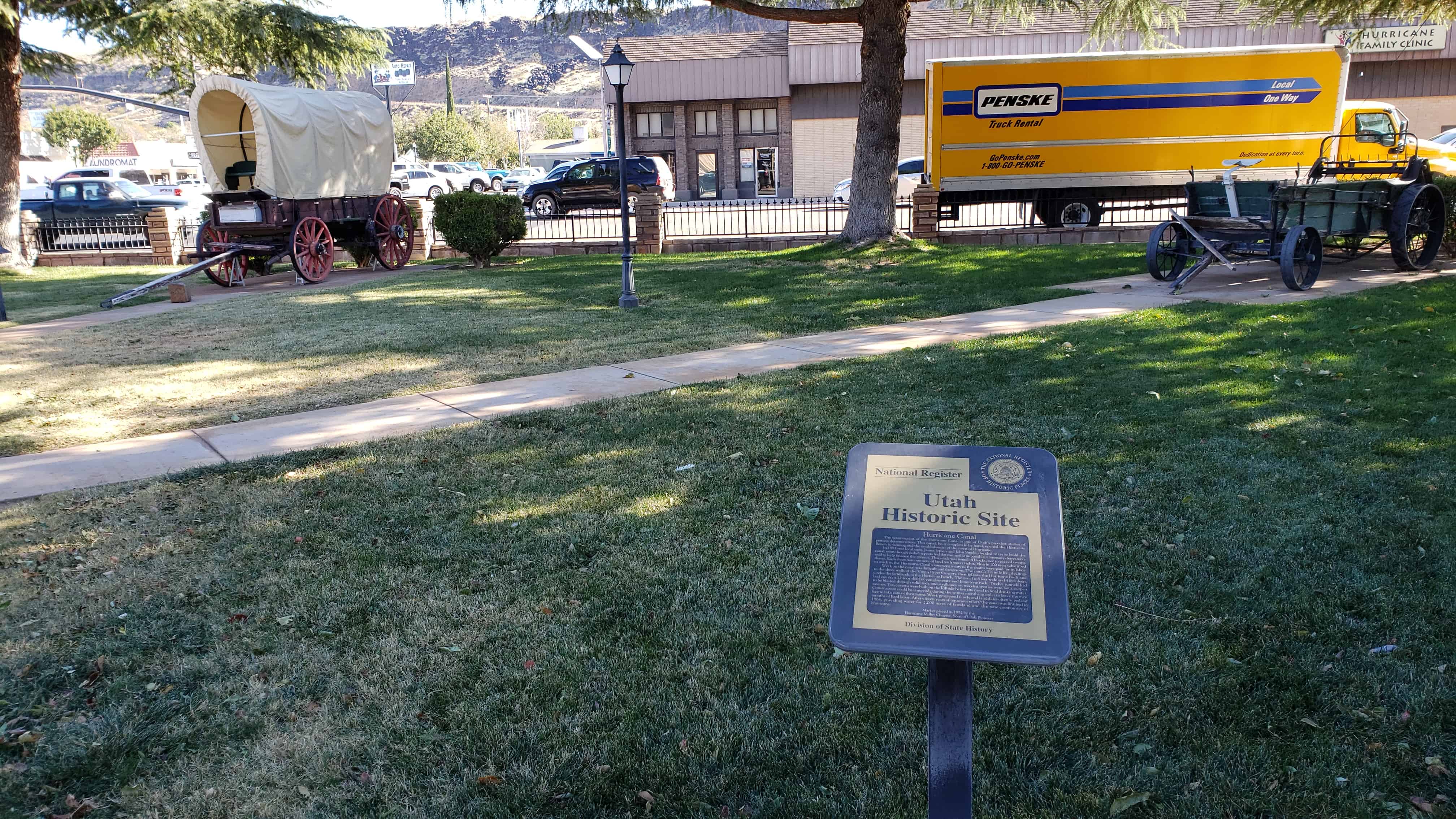
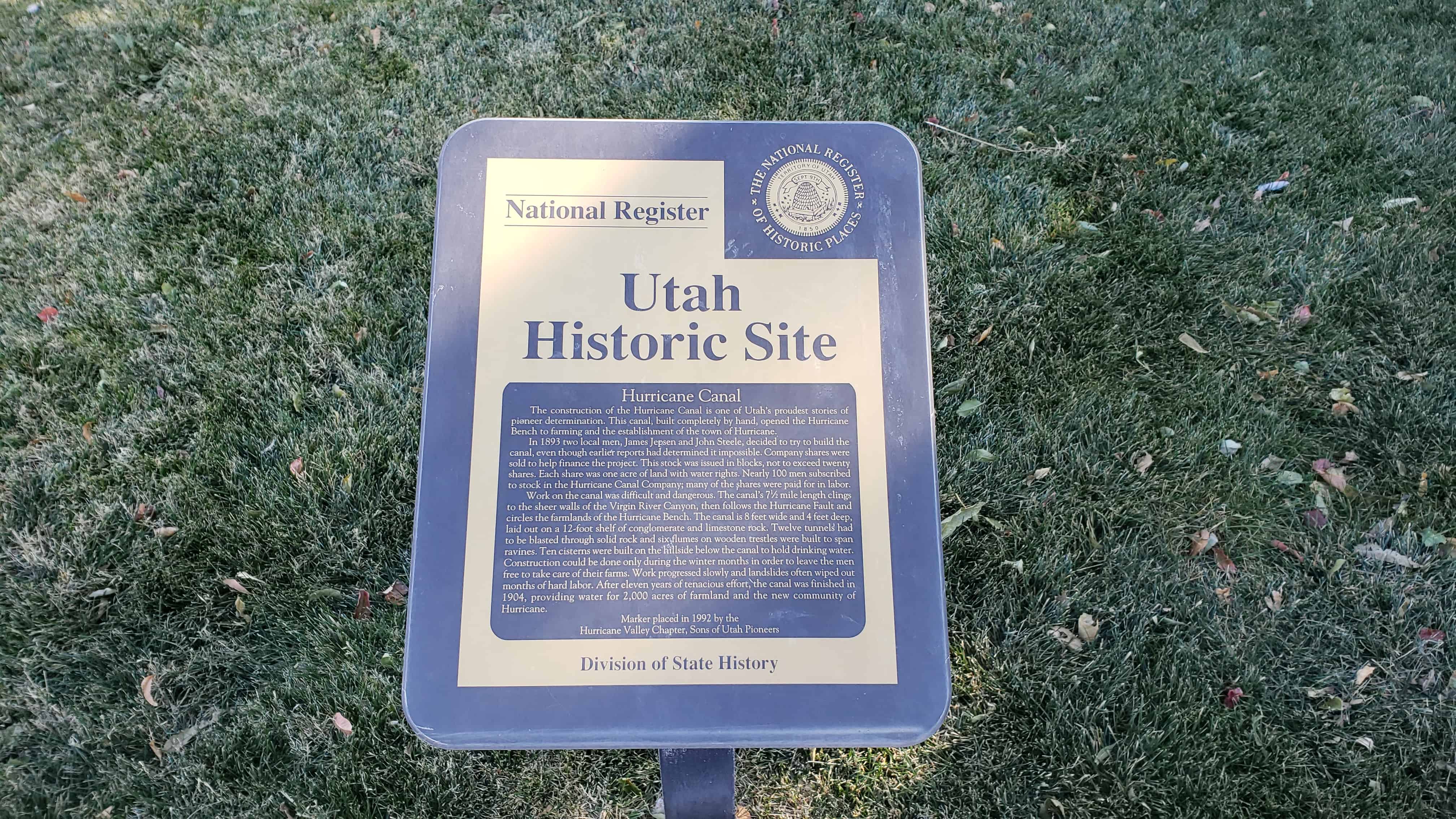
The construction of the Hurricane Canal is one of Utah’s proudest stories of pioneer determination. This canal, built completely by hand, opened the Hurricane Bench to farming and the establishment of the town of Hurricane.
In 1893 two local men, James Jepsen and John Steele, decided to try to build the canal, even though earlier reports had determined it impossible. Company shares were sold to help finance the project. This stock was issued in blocks, not to exceed twenty shares. Each share was one acre of land with water rights. Nearly 100 men subscribed to stock in the Hurricane Canal Company; many of the shares were paid for in labor.
Work on the canal was difficult and dangerous. The canal’s 7-1/2 mile length clings to the sheer walls of the Virgin River Canyon, then follows the Hurricane Fault and circles the farmlands of the Hurricane Bench. The canal is 8 feet wide and 4 feet deep, laid out on a 12-foot shelf of conglomerate and limestone rock. Twelve tunnels had to be blasted through solid rock and six flumes on wooden trestles were built to span ravines. Ten cisterns were built on the hillside below the canal to hold drinking water. Construction could be done only during the winter months in order to leave the men free to take care of their farms. Work progressed slowly and landslides often wiped out months of hard labor. After eleven years of tenacious effort, the canal was finished in 1904, providing water for 2,000 acres of farmland and the new community of Hurricane.
Marker placed in 1992 by the Hurricane Valley Chapter, Sons of Utah Pioneers
The warm, comfortable, productive climate in the sheltered valleys along the meandering Rio Virgin and its lower tributaries in Washington County became known as “Utah’s Dixie”.
The rugged pioneer colonizers and their descendants are known as “Dixieites” and the stalwart men and women who took hundreds of covered wagon loads of “Dixie Sorghum”, “Dixie Fruit”, “Dixie Wine”, nuts, dried fruit, figs, pomegranates, etc. northwards to sell and barter in communities as far north as Salt Lake City became known as “Dixie Peddlers!”.
Cotton was grown in “Utah’s Dixie” in the late 1800’s. Fruit crops matured three weeks earlier in “Utah’s Dixie” than similar crops in the Provo area.
The perservering Pioneers of the communities of “Utah’s Dixie” were constantly having their integrity honed by the heart-breaking hardships of adversity. These rare qualities of integrity have been carried throughout the world by leaders throughout the world by leaders who have their family roots in “Utah’s Dixie!”.
This 1924 photo shows the east side of Main Street in Cedar City. Wagons loaded with sacks of wool from Gould’s Shearing Corral, near Hurricane, are being taken to the railroad for shipment in Lund, Utah.
This historic plaque sponsored by the family of Verl and Margaret Sanders, owners of Sanders Construction, Inc., Henderson, Nevada, in honor of Verl’s parents, Moroni and Mildred “Millie” Zabriskie Sanders.
Moroni was born Oct. 18, 1903 in LaVerkin, Utah. He was the first boy born in this pioneer community and later served 16 years as City Mayor. He was also a Dixie Peddler.
Moroni and his brothers Bill and Ervil were Pioneer turkey growers and hatchery owners for many years in Utah’s Dixie. Moroni’s father and mother, William and Sara Amelia Wilson Sanders, were Dixie Peddlers and Dixie Sorghum makers and members of the first LaVerkin L.D.S. Ward organized June 23, 1904.
Moroni’s wife, “Millie”, was a talented musician and Grand Daughter of James C. Snow who owned Snowfield and was the first School Teacher in Bellevue, a prominent camping spot for Dixie Peddlers, at the south end of the Black Ridge.
The toughest, heartbreaking barrier to the colonization of “Utah’s Dixie” was the Black Ridge between New Harmony and Pintura, north of Toquerville, Utah.
A deep, rough, lava flow clogged the valley from the base of the towering Hurricane cliffs on the east, to the foothills of Pine Valley Mountain on the west.
The jolting rocks subjected the pioneer wagons, animals, and human tempers to a terrific strain. There were broken axles, broken wheels and fellies, broken kingbolts and run-off rims, to try the patience of the weary travelers who were forced to resort to their own ingenuity in making repairs, being miles away from any possible relief.
Apostle George A. Smith, for whom St. George was named, proclaimed this road to be “The most desperate piece of road that I have ever traveled in my life, the whole ground being covered for miles with stones, volcanic rock, cobbleheads – and in places deep sand.”
This old pioneer trail and Peter’s Leap Road, were both used until 1869, when the winding road was constructed along the east side of Ash Creek. Many Dixie peddlers and freighters traveled this road daily with wagons.
Peter’s Leap
Peter’s Leap, two and and one-half miles north of Pintura, was no doubt the worst part of the route that ignited Apostle Smith’s ire.
The road followed a long-used Indian Trail, crossed Leap Creek Canyon, a 165 foot gorge cut in lava rock, at a point approximately one and one-half miles west of where Leap Creek joins Ash Creek.
Peter Shirts, a Cedar City pioneer, inspired the name. Shirts was paid $300.00 by the Washington County Commission, to build a road along the old Indian Trail on the west edge of the Black Ridge.
When asked how wagons would get across the deep canyon that barred the way, he replied, “We’ll Leap It!” The 165-foot canyon-crossing became “Peter’s Leap.” The stream became “Leap Creek.”
The road leading into the gorge from the south could be built at a somewhat reasonable grade of 15 percent. Down the north face, however, the dugway grade was a dizzying 30 percent grade.
A sturdy windlass was erected on top of the north canyon wall. The wagons coming from the north were stopped here. The cargo was lashed securely to the wagon box. The teams were unhitched and led down the winding trail to the canyon bottom. Then the wagons were eased down the canyon wall. The teams were then hitched to the wagons and they were pulled out of the canyon, up a gradual slope through a break in the south canyon wall. The distance between the top of the north canyon wall to the point where the road leveled out on the south, was 1000 feet.
Freighters and peddlers coming from the south, unhitched their teams in the bottom of the canyon and the windlass pulled their loaded wagons up the face of the cliff.
In 1869, the Territorial Legislature appropriated $1000.00 to build a good surveyed road along the skirt of the Hurricane Cliffs, east of Ash Creek. This road was well-graded and wound in and out of the ravines. It was a single track, with turnouts to let traffic pass.
This road was used as a main route from Salt Lake City to Utah’s Dixie, and to California from 1869 to 1925.
In 1925, a two-lane graveled road was built over the Black Ridge. Many years later this road was replaced by Interstate 15.
Peter’s Leap Indian Cave
The early pioneers discovered an Indian Cave, near the top of the canyon wall, at Peter’s Leap. It is accessible from the south rim, by following a narrow trail down the face of the cliff to an opening over 100 feet above Leap Creek.
Early settlers found woven yucca sandals, arrowheads, spearpoints, bone awls and other items in the Cave, as well as deposits of bat dung or guano.
In January of 1858, a group of workers went to Peter’s Leap Cave and excavated the bat droppings. Nitrate was leached out and combined with sulfur and sagebrush ashes. The result was saltpeter, the main ingredient of old-fashioned gunpowder. Production cost: twenty-five cents per keg.
Sylvan was born in 1917 to Joseph and Ellen Wittwer, who were among the Early Settlers of this Valley. He graduated from Hurricane High School in 1935, from Utah State Agricultural College in 1939, received his Doctors Degree from the University of Missouri in 1943, and was Director of the Michigan State University Experiment Station from 1965 to 1983.
Sylvan is recognized as a world authority on Greenhouse Culture; has published books and scores of scientific papers in this field; and has been invited to participate in major food conferences all over the world.
He has served with distinction on the most prestigious national committees, appointed by the U.S. Congress, Secretary of Agriculture, and the National Academy of Science.
Probably no horticulturist in the past 50 years, has done as much to promote the cause of technological agriculture and agricultural research on a world-wide scale, than has Sylvan H. Wittwer. He has received countless world and national awards in the field of Agriculture. His fame and success has not altered his great dedication to God, church, and country. He is Patriarch, past Stake President and Bishop in Lansing Michigan L.D.S. Stake, and has actively served as a leader and supporter of the Boy Scouts of America.
We salute Sylvan as a noble native son with a rich heritage in Utah’s Dixie!
Kolob By Owen Sanders When lassitude tugs at your body And robs you of zest to exist Come with me to Kolob And walk through the mild morning mist.
Huddle at dawn on a hillside
And scan the green valley below;
Listen to snapping and crackle of twigs
And thumping of hooves on the go!
When shots re-echo at daybreak
Your pulse starts pounding anew
As you search to locate your quarry
And forget the breathtaking view.
Come back with me to Kolob It’s fun to be with you up there Sluff off the work-a-day worry In the sparkling, clear mountain air!
Kolob is a majestic jewel in an awesome setting of rare scenic charm. It is one mile higher than Hurricane City and can be reached in a few minutes by driving constantly upward from plateau to plateau through spellbinding beauty at every turn in the road.
Pioneers who colonized Toquerville, Virgin City and Grafton, also ranched on Kolob. They hobbled and milked scores of half-wild cows, fresh from the lush, green pastures of Kolob and the desert rangeland far below. From the milk and cream, they made many crocks and barrels of butter and zesty cheese which was then hauled by wagon down the steep mountain road and sold or traded to merchants in Cedar City, St. George and the mining towns of Silver Reef, Frisco, Newhouse, Pioche and Delemar.
From Kolob Peak, Zion Canyon can be seen far below and the St. George Temple is visible 50 miles away and one mile below. For over fifty years, a pole gate swung between two giant ponderosa pines in Black Canyon on the road to Kolob. Until this gate was opened, livestock could not drift from the lower range onto Upper Kolob. Sheer sandstone cliffs formed a high natural barrier.
From the West and South, several massive pinnacles jut out from Kolob and rise several thousand feet from their base like fabulous “Islands in the Sky.” Some of these have a surface area of several hundred acres. By fencing across a narrow neck of connecting land, cattle and sheep could be held on this land.
Descendants of Kolob ranchers helped colonize The City of Hurricane in 1906. Now, Their descendants have homes and cabins on these ranches. Visiting Kolob is an exhilarating and unforgettable experience!
This Plaque sponsored by James Allen Ballard and his wife Joan Webb Ballard In honor of their pioneer progenitors, the Ballard and Webb Families, Who helped colonize the city of Hurricane!
These three buildings were originally built on this town square.
1912 School
Used as school, seminary, church and Relief Society Building.
1917 School
Hurricane School – elementary through high school built in 1917.
Hurricane Church
L.D.S. Stake center built in 1937.
Heritage, by Owen Sanders
Some were weak in spirit
And had not faith to try;
Some were weak in body
And left the trail to die.
While those who trudged the dusty trails
And suffered grief and pain
Were destined by their efforts,
to gain eternal fame.
We who bask in glory
Of our distinguished past
Must know, that all this glory,
Without effort, cannot last.
Our pioneer names ring down the years
In leadership and zeal;
Let’s help them ring forevermore
A vibrant, valiant peal!
“For the Lord shall comfort Zion: he will comfort all her waste places; and he will make her wilderness like Eden, and her desert like the garden of the Lord; joy and gladness shall be found therein, thanksgiving, and the voice of melody“. – Isaiah 51:3
This is S.U.P. Marker #23-B, see other S.U.P. Markers here.
See Mollies Nipple–Climb Mollies Nipple By Owen Sanders
This pinnacle piercing the skyline On the crest of the Hurricane Cliffs Is a vivid, visible landmark That has sparked many frontier tiffs.
The playful pioneer naming the nipple Was lost in the annals of time But Mollies who winced at jabbing jests Survive in sparkling rhyme!
Breathtaking vistas of awesome charm Can be seen from the Nipples crest And silently vie with any view That is lauded throughout the West!
To clamber like goats to the Nipples Nib Takes vigor of muscle and wind And laggards with fleeting devotion Are left on the trail far behind!
The magic of mind to climb for the crown Is the goad for gaining a goal; Should your body grow weary from climbing Consider the gift to your soul!
Mollies Nipple as seen driving West from Zion National Park. It rises 400 ft. above the crest of the Hurricane Cliffs.
Mollies Nipple as seen entering Hurricane City and the Hurricane Valley from California. The historic Nipple rises 1353 feet above the fertile Hurricane Valley.
Mollies Nipple was given its historic name by pioneer colonizers of Toquerville, Virgin City, Grafton, Rockville, Springdale and other communities along the Rio Virgin. The unique symmetry of this visible Dixie landmark is protected from rapid erosion by a massive capstone of volcanic rock.
Indian throwing sticks for hunting small game, and hardwood fire tongs used to pick up hot stones from camp fires and drop them into pitch lined baskets for cooking purposes, were found in small caves at the base of the Hurricane Cliffs below Mollies Nipple.
Hundred of hikers have climbed to the crest of Mollies Nipple to view a vast circle of breath-taking, colorful, geologic and historic wonders, unmatched by any view in the world!
Pottery shards were found by hikers on top of this butte, indicating Indians likely used this landmark to send up smoke signals to hunting and seed gathering parties.
On August 6, 1904, pioneer families from Virgin City, Grafton, Toquerville, La Verkin, Rockville and Springdale, met in the shade of a bowery and watched the Virgin River water gurgle out of the Hurricane Canal on the fertile, parched soil of this valley. Finally, the Rio Virgin was conquered! At that joyful celebration the city they had dreamed about for many heartbreaking years, was named Hurricane from the historic Hurricane Cliffs. In 1906, the first homes were built here.
This is S.U.P. Marker #23-D, see other S.U.P. Markers here.
My father dug the ditches And tilled the stubborn soil; What have I, his son, to show For all his years of toil? My Mother gnarled her tender hands And suffered for my weal; What have I, her son, to show For all her faith and zeal?
Their faith and love of God was strong Their zest for life sincere; What have I, their son, to show For what they held so dear?
My folks have sketched a pattern And blazed a vivid trail; They have earned their Golden Goal Only, I, can fail!
In Hurricane, Utah – next to the old library/city hall is the Hurricane Valley Pioneer Heritage Park. It has many displays and historic plaques and markers describing a lot of the local history.