Tags
historic, NRHP, Salt Lake City, Salt Lake County, Schools, utah

Rowland Hall – St. Mark’s School is significant as one of the oldest established schools in Utah as well as for the architectural and historical importance of the individual buildings that comprise the campus. Schools sponsored by the Episcopal church began operating here in 1867 with the establishment of St. Mark’s School for Girls was established. In 1880, Rowland Hall, a boarding school for girls, was opened in the home built in 1862 by George D. Watt, an early Mormon pioneer. For a time, the two girls’ school were operated independently. At the turn of the century, St. Mark’s Grammar School for Boys was closed. It was reactivated in 1956 and merged with a Rowland Hall in 1964. Since 1880, the campus has expanded from one house to five buildings.
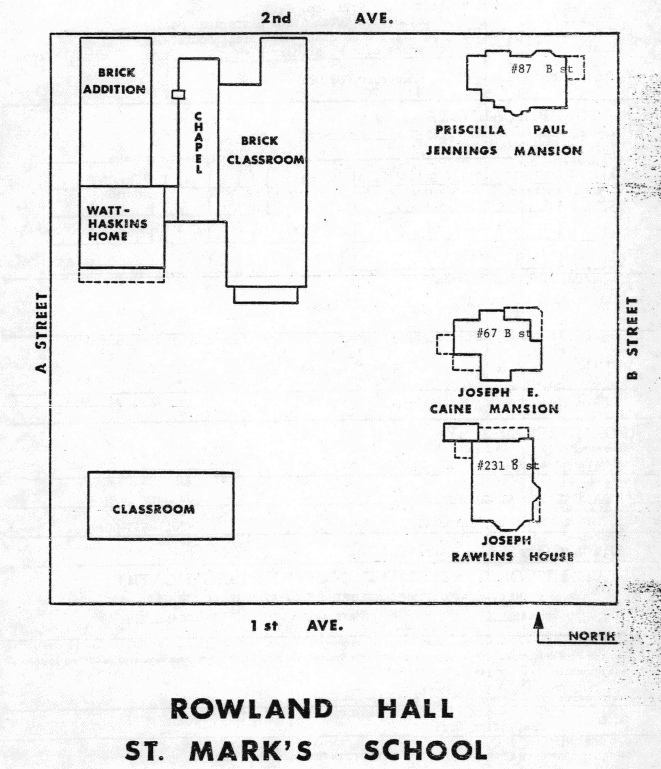
Located at 205 First Avenue in The Avenues of Salt Lake City, Utah – Technically located on the block that is between A and B Street and 1st and 2nd Avenue in The Avenues of Salt Lake City, Utah. Technically the entire block is one piece of property (76 A Street) and contains among other things:
- Rowland Hall-St. Marks School
- 67 B Street – Joseph E. Caine Home
- 75 B Street – Caine Home
- 87 B Street – Priscilla Paul Jennings House
- 233 1st Avenue – Joseph L. Rawlins Hous

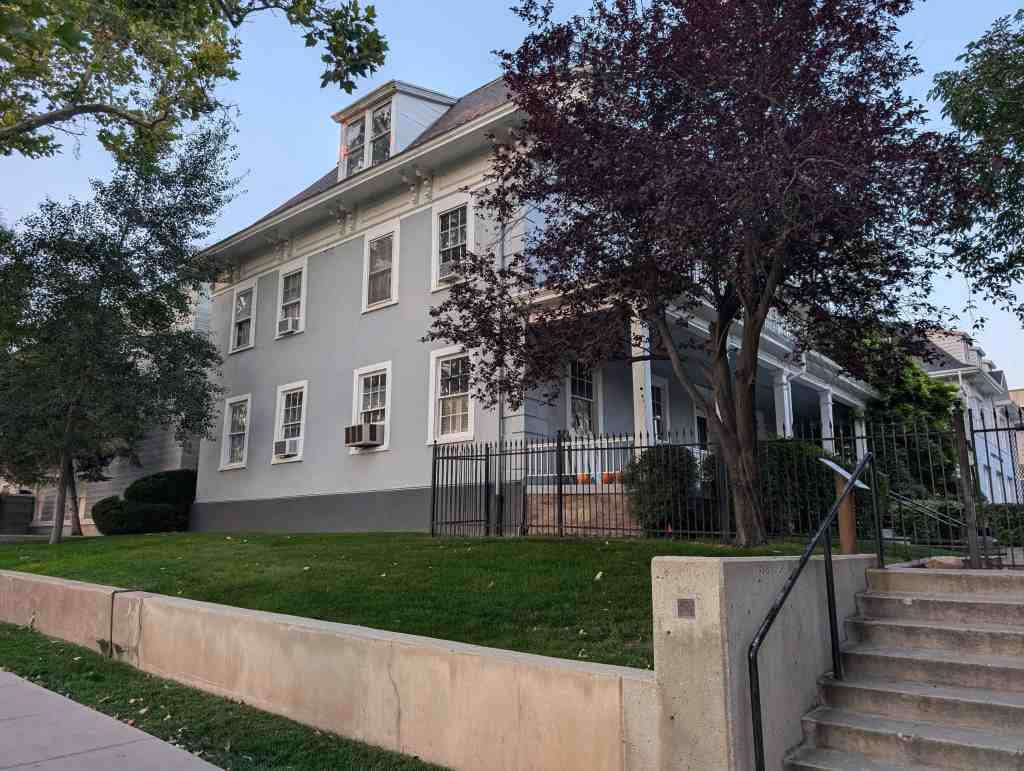

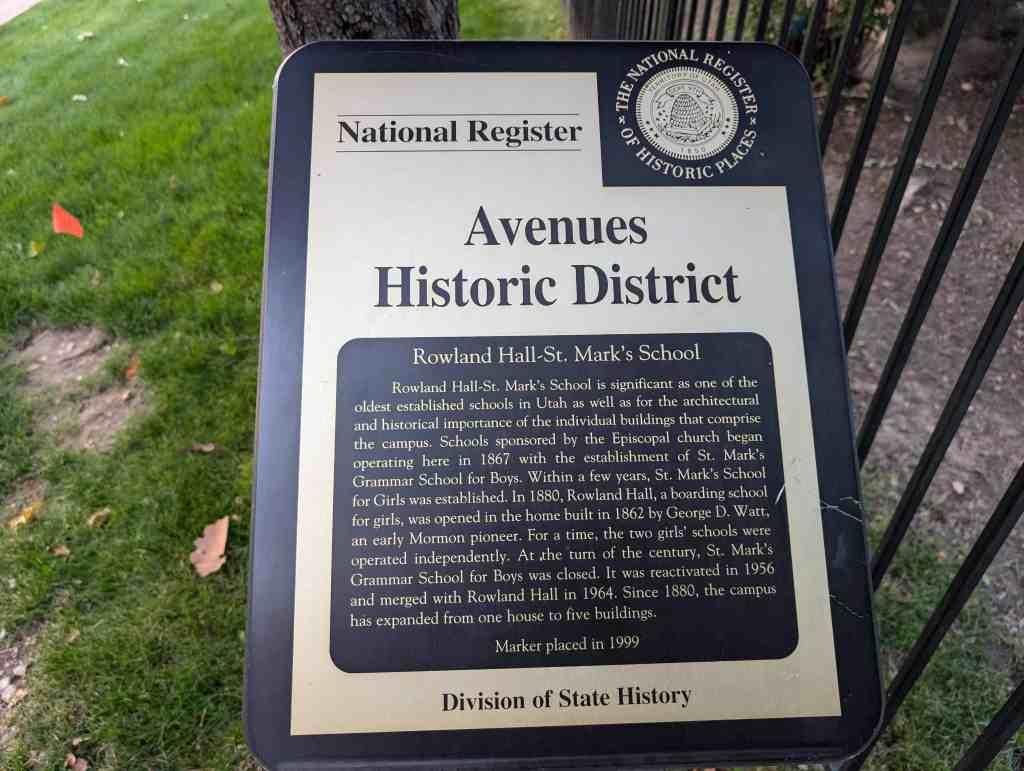
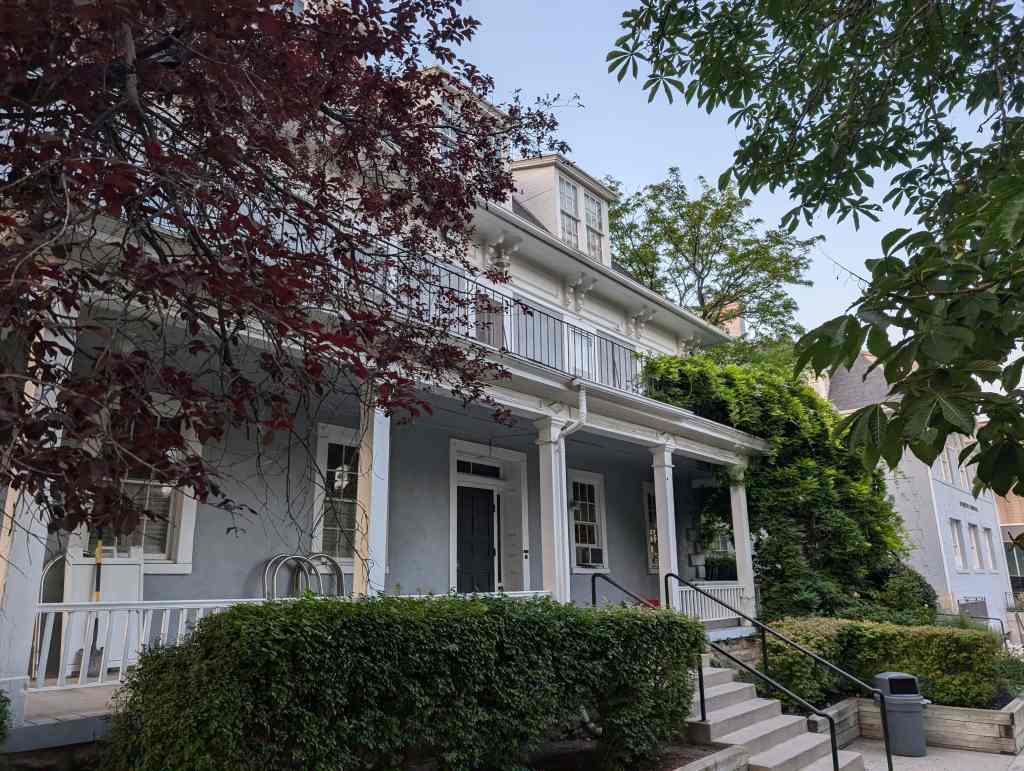
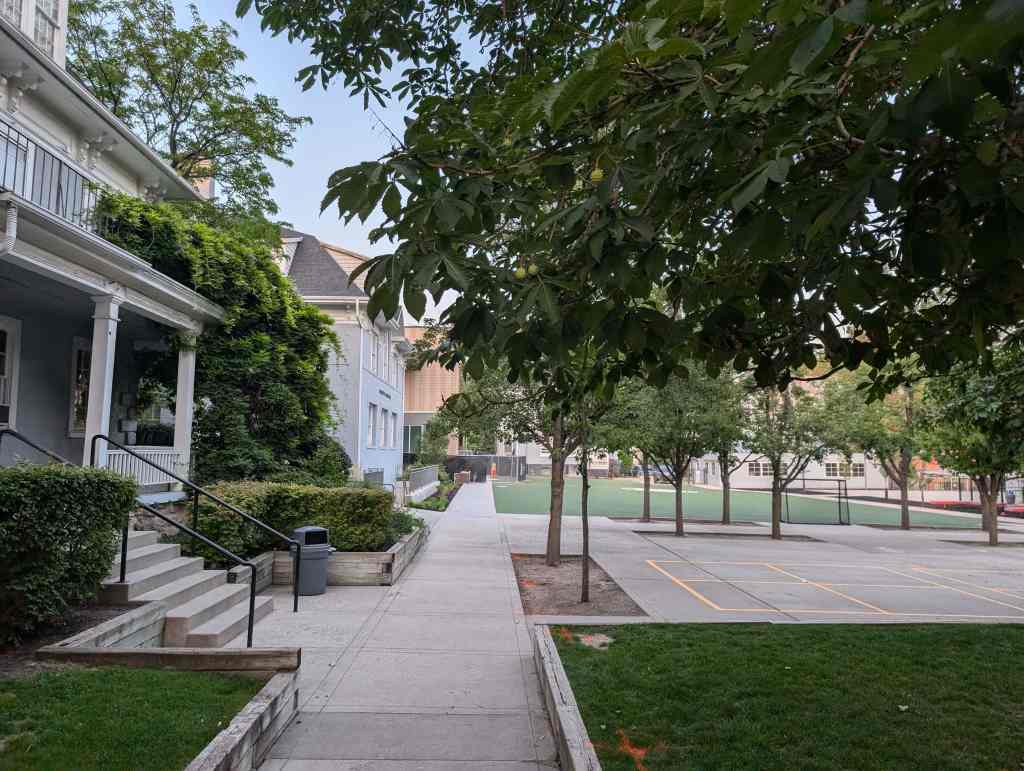
Rowland Hall-St. Mark’s School occupies a distinct niche in Utah’s educational and religious history, and its significance as an institution has additional merit because of the individual architectural and historical interest of the buildings that comprise the campus.
Rowland Hall-St. Mark’s has antecedents that make it one of the oldest established religious schools in Utah. The Episcopal Church has never been numerically strong in Utah, although it was among the first non-Mormon religious to assign clergymen in the area. Unlike the other Protestant churches, however, the Episcopal Church has never adopted a program of evangelizing the Mormons. Their school program was established to serve the needs of Episcopal communicants and of those seeking a superior college preparatory education for their children. By contrast, the Presbyterian and Methodist Churches established mission schools that subsidized the education of Mormon children. The intent, openly avowed, was to wean the children away from Mormonism. Episcopal educational and religious policy was to maintain a low profile in the Mormon/Gentile conflict, and to concentrate on providing education for the middle and upper classes.
Episcopal education commenced with the arrival of George Foote and Thomas W. Haskins, in May 1867. Taking over a Sunday School program from a departing Congregationalist minister, they moved on to create the St. Mark’s Grammar School of Boys, which met in a bowling alley. This was followed by the St. Mark’s School of Girls, which was operated independently for ten years. In 1880 an Episcopal lay woman, visiting in Salt Lake City, felt that there was a need for improved educational facilities, especially for girls growing up in mining camps and on ranches. So a boarding school for daughters of the nouveau riche entrepreneurs of Utah’s mines and ranches was endowed and named for her husband, Benjamin Rowland.
For a time the two schools operated separately, with Rowland Hall being exclusively for boarders and St. Mark’s School for Girls serving day students. Economy eventually determined that the two schools merge, and . Rowland Hall continued on to serve both types of student. Its generous endowment also allowed it to flourish even during those difficult years when free public education became generally available throughout Utah in 1896, causing the demise of most religious schools. The St. Mark’s School for boys did not survive this period, and was not re-established until 1956. The two schools have now been combined, and offer some of the finest private education in the state.
The Rowland Hall-St. Mark’s Campus has four houses, a classroom section, a chapel and a new classroom building. The homes were originally built as single family residences and belonged to several prominent Utahns. The other buildings and numerous additions to the original home were built for the school.
George D. Wall-Thomas W. Haskins House
The original Rowland Hail was m a home that was built by George D. Watt. Watt, a Mormon convert from England, came to Nauvoo, Illinois, in 1842. Just before the Marmons ^vere driven out of this area, George was called cn a mission to England. In 1850 he was released from his mission and he and his family came to Utah.
George worked for the Deseret News, the Mormon newspaper, after he came to Salt Lake City. He was hired by Brigham Young as a clerk and as a reporter for the Utah legislature in 1853. Watt also published a journal which included the speeches of the Mormon leaders. He continued to publish Journal of Discourses until 1868 when he left the office of Brigham Young. Watt also was one of the main promoters of the Deseret alphabet, a phonetic alphabet that was to help the immigrants learn English easier and the sencultural industry in Utah.
In 1868 Watt, who had been one of the strongholds in Young’s office, left the employ of the church. He set up a mercantile business with Robert Sleater and William Ajax. According to family tradition, the store eventually went out of business because the Mormon leaders advised the church members not to patronage it because it had “gentile” business connections in Chicago.
In 1869 Watt became interested in the Godbeites, a group of Mormons who had broken off from the main body partially because of a dispute over the role that Brigham Young, a prophet, should play in temporal affairs. His interest in the Godbeites grew and by 1874 he was a member of that group.
This house was built in approximately 1862 on some property that Watt had received from Brigham Young. During that year Watt was working in Young’s office and he received credit for some carpentry work and some lime from the church. He was probably building this adobe house then with these materials. Watt lived in this house until about 1869 or 1870 when he moved his family to Kaysville. Watt sold the home and property and by 1870 Warren Hussey, the banker who persuaded Bishop Tuttle to come to Utah, owned the house. He sold it in 1871 to Thomas W. Haskins, one of the Epscopal missionaries.
Thomas might have lived in this house for about the next three years. According to Tuttle, Haskins had been living in the rectory while Tuttle was in Montana and Idaho. When he returned to Salt Lake in 1871 Haskins moved so Tuttle could have the house, but Tuttle does not say where Haskins lived. During the period that Haskins lived here he was the principal of the St. Mark’s School which met at the nearby St. Mark’s Church. For a while he was the chaplain at Fort Douglas. In about 1873 he left Salt Lake and by 1891 he was in Los Angeles.
Haskins probably maintained the George D. Watt House, but he enlarged it. To increase the floor space, he removed the gable roof and added a section on to the rear of the house. He then put a truncated roof on the house. According to the photographs at the Utah State Historical Society, this change took place in about 1871 when Haskins acquired the property.
In 1880 Reverend Kirby received title for the property on behalf of his mother-in-law, Mrs. Rowland. The title was then put in the name of Bishop Tuttle. The property is now in the name of the school but if for any reason the school is closed, the property would be returned to the Episcopal diocese of Utah.
The George D. Watt-Thomas W. Haskins House was the original home of Rowland Hall. It was used for classes and for boarding the teachers and students. Since 1870 the school has made several additions to the house including opening up the top of the house for a third floor and the addition of two brick sections to the rear of the house. These sections are the same height as the adobe house and the entire building is painted the same color so the brick sections blend in with the adobe house.
Classroom Section and Chapel
There was constantly a need for more rooms for the school. The school officials made several plans to build on the block but they were never carried out because there were no funds available. In 1900 Felix Brunot, a man from Philadelphia, donated $35,000 to the school. With the new funds. Bishop Abiel Leonard hired an architect, Theodore Davis Beal, to design a new school house. Beal made plans to add a chapel and a classroom building on the original house and by 1906 the plans were ready. Beal suggested that the $35,000 was not enough to finish the work and that the classroom building be completed first.
A three-story brick and frame building that appears an the 1898 Sanbom map was probably torn dovn in 1906 to build the new classroom. The cornerstone of the new school was dedicated on October 17, 1906, by the new bishop, F. S. Raiding. The new building increased the space at the school but left the church school with an enormous debt. In 1909 the school sent out an appeal for mcmey to overcome the debt and to help construct the chapel.
The appeal for money was successful and provided enough funds to build the chapel. In 1910 Bishop Spalding signed an agreement with David R. Smith and George A. Smith of Smith Brothers to build the chapel. The chapel was completed that year and a pipe organ was added in 1911.
Since 1910 several additions have been made to the rear of the classroom building. Since the additions are to the rear and are painted the same color as the 1906 building, they do not detract from the historic character of the building.
Joseph L. Rawlins House
The Joseph Rawlins House was built in 1887. Rawlins, the original owner, is significant in Utah politics. An attorney, he helped form the Democratic party in 1894. In 1893 he was a delegate to Congress and was instrumental in legislation passed to return Mormon property to the L.D.S. Church and to enable Utah to be admitted to the Union. Rawlins was also one of the first senators to the United States Congress from Utah. He held that office from 1377 to 1903. Rawlins lived here until 1907. Rowland Hall bought this house in 1922 for additional classroom space.
Joseph E. Caine House
This house was built in 1888 for Joseph E. Caine. Caine was prominent in Salt Lake businesses. He was manager of the Caine and Hooper Company, an insurance company, Sidney E. Hooper was president and Caine’s father, John T. Caine, was vice-president of the company. Joseph resigned that position to because a cashier at Utah Savings and Commercial Bank. He later became the secretary and manager of the Commercial Club in Salt Lake. In 1913 he moved to Oakland where he was secretary of the Oakland Chamber of Commerce. When St. Mark’s School was opened again in 1956, the Episcopal Church bought this house for additional classroom space.
Priscilla Paul Jennings House
Priscilla Paul Jennings, the second wife of William Jennings, was the original owner of this house. William Jennings owned a meat market and then expanded into the mercantile business in Salt Lake. In 1869 he built the Eagle Emporium and he was instrumental in the founding of Zions Cooperative Mercantile Institution, the leading Mormon business in Salt Lake City. He was elected mayor of Salt Lake City in 1882. He died in 1886. Jennings built the Devereaux Mansion. For many years it was the social entertainment center of Salt Lake. William and Priscilla entertained the dignitaries that came through Salt Lake City in that house.
Priscilla had the house built about fourteen years after William’s death. She lived here until she died in 1918. Priscilla was active in the Mormon Church. She served on the Relief Society general board, the governing body for the LDS Church’s women’s organization.
In 1956 the house was sold to Rowland Hall. Since then it has been used as a home for school officials and classrooms.
Pingback: Avenues Historic District | JacobBarlow.com