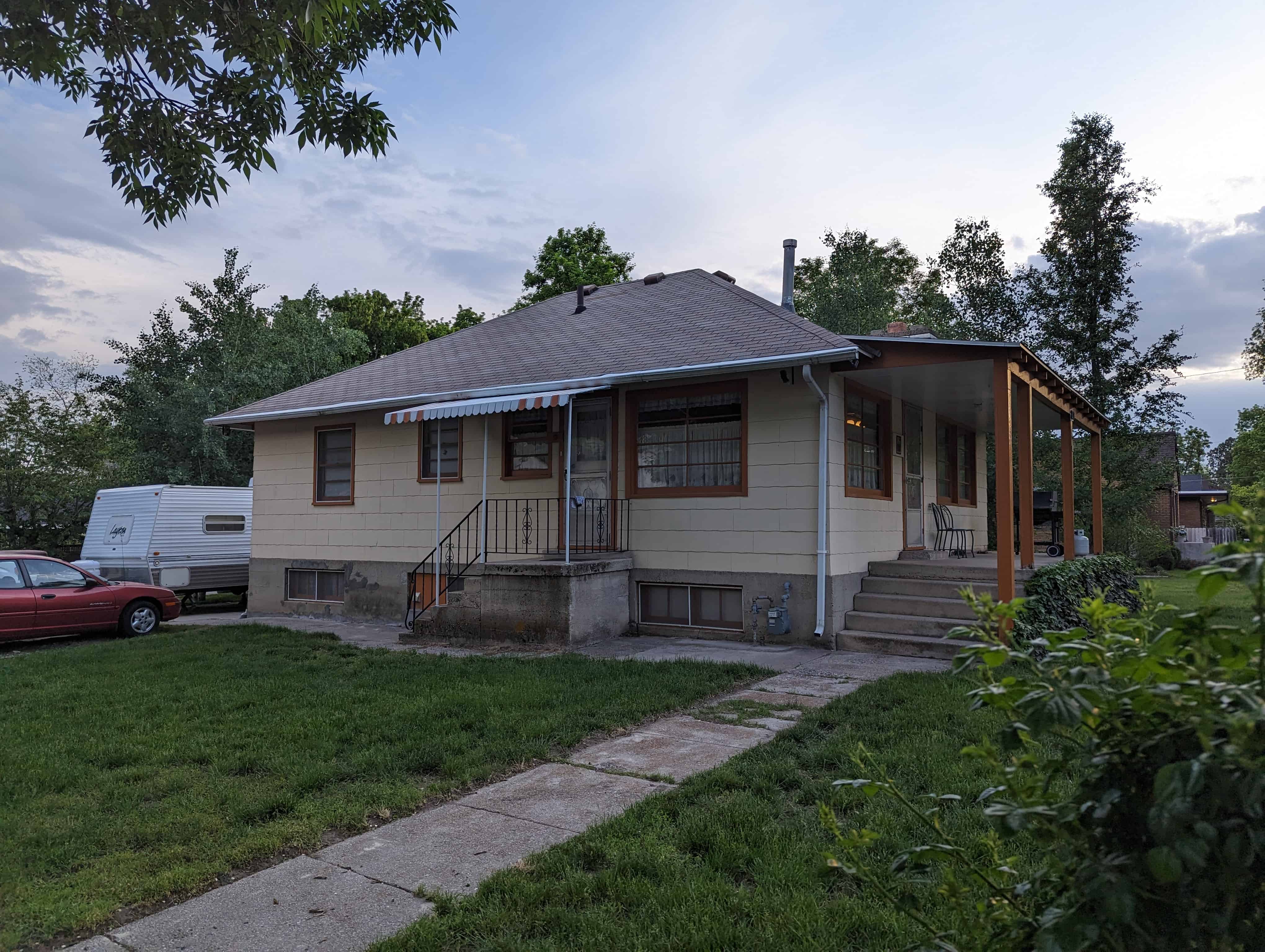
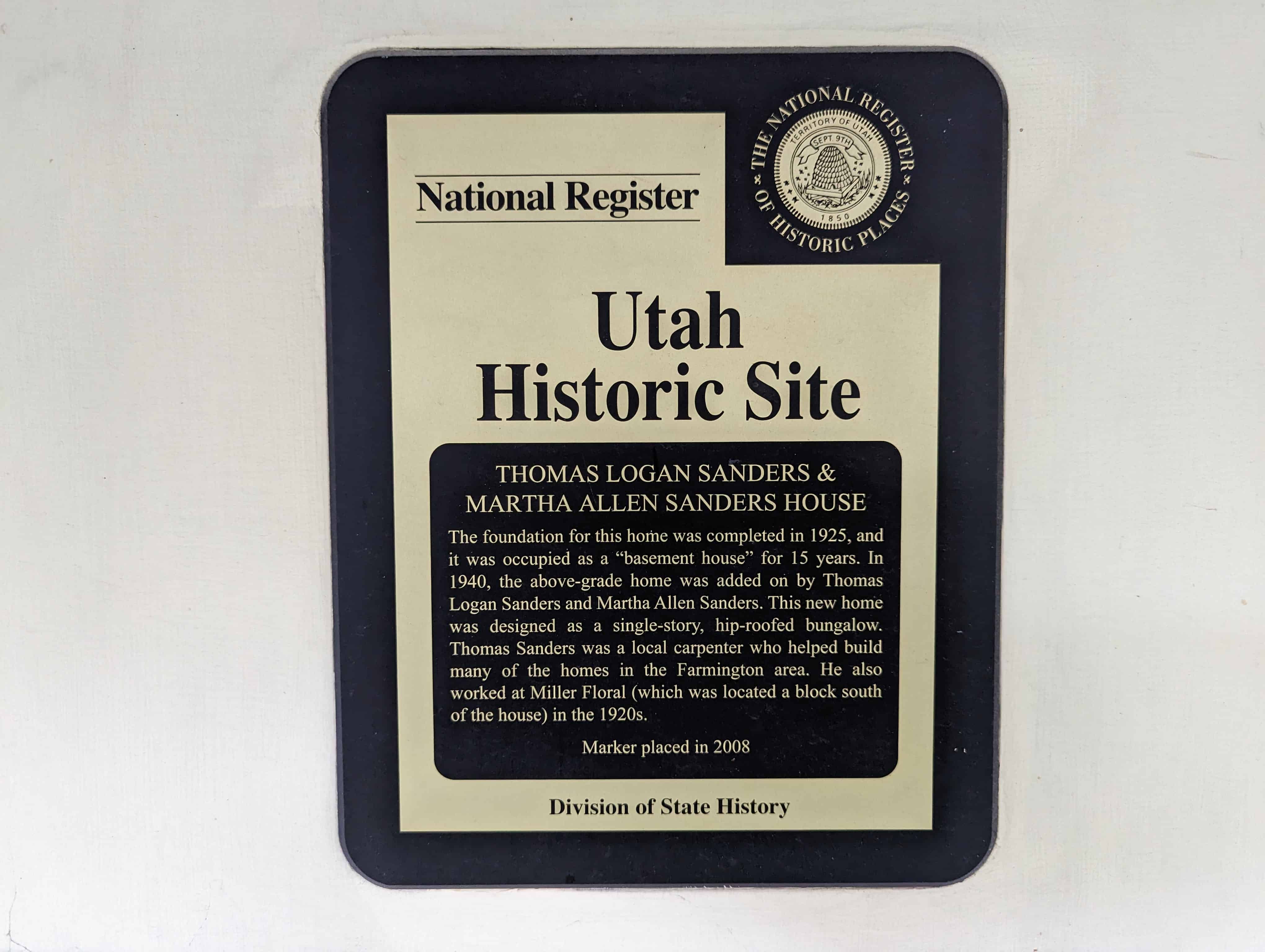
The foundation for this home was completed in 1925, and it was occupied as a “basement house” for 15 years. In 1940, the above-grade home was added on by Thomas Logan Sanders and Martha Allen Sanders. This new home was designed as a single-story, hip-roofed bungalow.
Thomas Sanders was a local carpenter who helped build many of the homes in the Farmington area. He also worked at Miller Floral (which was located a block south of the house) in the 1920s.
The George W. Layton house, built in about 1897, is significant as one of a very limited number of houses designed by the Kaysville architect William Allen, that is virtually unaltered. William Allen was the only architect in Davis County at the time that the Layton house was designed, and continued to be the leading architect in the county until the 1920s. The Layton house also documents the use of pattern book house types in the late nineteenth century, and it is the same pattern that Allen used in the John Henry Layton house in West Layton, and possibly in the Joseph Adams house in East Layton. Of the three houses the George W. Layton house received the most ornate program of ornament, and thereby records one extreme of the stylistic possibilities of pattern book design. The complexity of the brick and wood ornamentation, and its unaltered and well preserved condition make the George W. Layton house one of the most distinctive Victorian pattern book houses in Utah. In addition, Layton, who is credited with the resident’s actual construction, served in a number of capacities within the community.
Located at 2767 West Gentile Street in Layton, Utah and added to the National Historic Register (#82004123) on February 11, 1982.
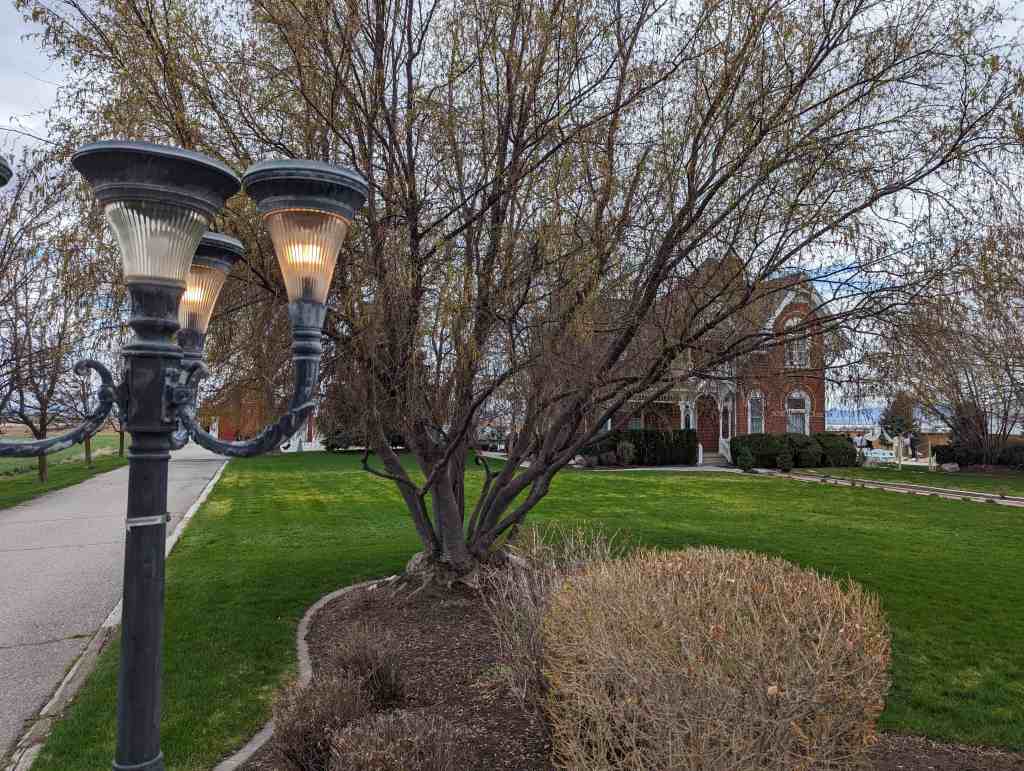
The George W. Layton Farm House, in West Layton, was built c. 1897. According to Vera Louise Layton Merrill, a daughter of Layton, the house incorporated an earlier three-room structure. The house was designed by William Alien, a prominent Davis County architect, and the actual construction of the residence is credited to Layton himself. The George W. Layton house is a two story red brick house with a stone foundation that was designed by the Kaysville architect, William Alien. It is a pattern book design with an impressive program of East lake and Queen Anne ornamentation. The pattern Alien chose for this house is almost exactly the same as the one he used for the John Henry Layton house which is several miles east on West Gentile Street. The John H. Layton house has longer proportions, but in general massing it is the mirror image of the George W. Layton house.
In 1851, Joseph (Cap) Hill “I” homesteaded at the mouth of Kay’s Creek. In 1862, James Sevens built a house on the south side of Kay’s Creek. Seven years later, Christopher Layton and some of his sons and sons-in-law cleared six sections of land to be dry farmed. This dry farm and the adjacent areas became known as West Layton. The early settlers of the area were sons and daughters of people who had settled in Kaysville and other areas of Davis County.
George Willard Layton was born November 11, 1863, in Kaysville, Utah. He was a son of Christopher and Rose Ann Hudson Layton. George W. spent his early years in Kaysville. It was there that he met and married Jeanette Maria Hill on December 18, 1884. Layton purchased 82 acres of land located in West Layton in 1891 from William and Aaron Call. At that time, there was a three room structure located on the site, and in about 1897 Layton had Allen design the present structure, with Layton himself involved in its construction.
Layton’s activities were not limited to farming. He has been characterized as being involved in “everything from baseball diamonds to banking.” He raised cattle and livestock and also grain to provide feed. He was president of the First National Bank of Layton and was a major stockholder in the Layton Sugar Company and the Ellison Cattle Ranch. He is also credited with building eleven other houses, in addition to his own. The Laytons were members of the LDS Church and were active in church activities. The couple had eight children, two of whom died in early infancy.
In the early 1900s the Laytons moved from the farmhouse to a house located nearer to the town of Layton. The farmhouse was used as the residence of the hired farmhand. This enabled George W. to take care of his responsibilities at the farm and in town. The children loved the new location because it was located nearer to the train station which provided transportation to Lagoon, a popular resort.
Mrs. Layton died in 1933. George lived eleven years after her death, passing away on January 10, 1944.
The house was deeded to Glen Seymour Layton and other members of the family in 1931. In 1961, the property was acquired to Sheron Layton Ahlstrom and Patricia Layton Evans, who presently (1980) own the property. The house is being used as rental property.
The John H. Layton farmstead, dating from the 1880s, is significant as one of few well preserved examples of a homestead in Utah, a pattern of settlement that developed after 1869 which diverged from the typical plan of a Mormon community. The house, erected in the late 1890s, summer kitchen, well house, granary, and barn have received few alterations, and as a unit are representative of a way of life, the family farm, that is becoming obsolete. This cluster of buildings is also significant as the physical remains of one of Layton’s prominent farmers, John Henry Layton, son of Christopher Layton, the pioneer after whom Layton was named. The house itself is particularly significant because it was designed by William Allen, the only architect in Davis County at the time of its design, and the leading architect in the county until the 1920s. It is one of a very limited number of houses designed by William Allen that has not been dramatically altered. It is of pattern book design, one that may have been used by Allen in the Joseph Adams House in East Layton, and repeated in the George W. Layton house in West Layton. Because the house has received few major alterations it stands as a well preserved example not only of a type that was preferred by Allen, but also one that was considered suitable for a prominent farmer. With some variation in the treatment of ornamentation this type suited a wide range of tastes. The condition of the interior of the house is particularly noteworthy. It is one of few older houses in Utah in which the original woodwork is completely intact. It is a superb example of the technique of wood graining, a procedure by which an inferior wood, pine, for example, was painted to resemble a more high quality wood.
Located at 683 West Gentile Street in Layton, Utah and added to the National Historic Register (#82004123) on February 11, 1982.
The John H. Layton farmstead was first occupied after 1883 when John Henry Layton purchased the land from his father, Christopher Layton. The family originally occupied a two room adobe house that stood in the location of the present summer kitchen. The two story brick house that is presently the focus of the farmstead was built in the late 1890s. The Abstract of Title does not indicate the exact date of construction, but the house was occupied as early as January of 1898. At that time Frankie Josephine Layton Dickson, the twelfth child of John Henry and Hannah Maria Layton, the original owners, is reported to have been born in the house. The house was designed by William Allen, the only architect working in Davis County at the time.
John Henry and Hannah Layton are reported to have been among the first settlers in West Layton, arriving in 1880. John Henry, son of Christopher Layton and his fifth wife, Isabella Golightly, was born in Grantsville in 1855. He was the eighth of thirty-one sons born to Christopher Layton from ten marriages. Christopher Layton was the pioneer after whom Layton was named, and one who made significant contributions to the establishment and growth of several Mormon communities. John Henry and Hannah were married on January 30, 1879 in Salt Lake City. Hannah was the daughter of Edward Phillips, one of the first settlers in Kaysville. John Henry made a living by farming; growing club barley, hay, and sugar beets, and by raising livestock; cattle, sheep and hogs. He and his wife were members of the West Layton Ward of the LDS Church. Although John Henry was not an active church member, Hannah did much to encourage musical activities in the ward and served as ward organist. She also served as the first counselor to the Young Ladies Mutual Improvement Association of the West Layton Ward, and was a member of the Davis Stake Primary Association for twenty-five years. John Henry and Hannah had thirteen children, ten of which were raised to maturity on the Layton farm.
John Henry’s activities in the business world included participation as one of the organizers of the First National Bank of Layton, serving as the director of the Ellison Ranching Company, and owning stock in the Layton Sugar Company, the Farmer’s Union Store, the Davis and Weber Counties Canal Company, and the Kays Creek Irrigation Company.
The Layton farm can be considered as a late example of a homestead, a pattern of settlement that developed after the Homestead Act was passed in 1869. Homesteading was the first significant development away from the Mormon plan which consolidated homes as a nucleus in a town, and designated fields on the perimeter of the town for farming. John H. Layton’s farm, however, was not the typical homestead in that John Henry did not acquire the typical parcel of 160 acres, but rather purchased his land from his father. He was a homesteader in that he chose to live and farm large areas of land that were remote from the principal area of settlement.
The Layton farmstead was not only a local center of farm activities, but it was also a guest house for those Layton relatives who traveled from Arizona to Utah to be married in the temple in Salt Lake City.
John Henry died in 1920, and Hannah Layton continued to live on the farmstead until her death in 1939. The estate passed from Hannah to her children who divided it among themselves. The house and land immediately surrounding it passed to Lottie Jane Layton and Luella Layton Humphries. They lived in the house until their deaths. Luella left her half interest in the house to her son, Richard Humphries, and Lottie left her portion to other members of the family. Richard Humphries eventually bought Lottie’s half of the property and lived in the house until 1973. At that time lie sold the property to the Lakewood Investment firm. A real estate contract indicates that the house and several acres of land were then sold to Spencer Lynn Nunley for $38,000. Nunley was a house painter from Salt Lake City who bought the house to redecorate and resell. Sharon and E. Keith Slatore bought the property from tile Nunley’s in 1974, and are the current owners. Mr. Slatore is a civil engineer.
William Allen, the architect who designed the Layton House, was originally from London, England. He settled in Kaysville at the age of thirteen and worked as a brick mason. After having completed a correspondence] in architecture he became the leading architect in Davis County. The Kaysville Tabernacle, the Kaysville Presbyterian Church, the Kaysville City Hall, the Kaysville Elementary School, the Barnes Block in Kaysville, and the Davis County Courthouse in Farming ton were among his major works. He also designed a significant number of large brick residences throughout the county.
Veterans Park is located between 155 West and 175 West Gentile Street on the east side of the Union Pacific Railroad tracks. The park is an irregular shaped plot, planted with grass and trees. The park is maintained by the Layton City Parks Department, but the area is owned by the Oregon Short Line/Union Pacific Corporation.
The Oregon Short Line/Union Pacific railroad ran along Main Street in Layton. The Layton depot and railroad tracks were moved from downtown to a new right of way west of Main Street in 1911-1912. A new, larger freight and passenger depot was built on the east side of the tracks about 350 feet south of Gentile Street. The railroad property also included the piece of property where the park is located.
From the time it was built until the mid-1940s the Layton depot was an important gathering place, particularly during World War I and throughout the 1920s. At that time freight and passenger trains made regular stops in Layton. Crowds would gather there to meet or bid farewell to passengers, pick up or receive freight, or visit the station just to see the trains pass by. In addition to the station there was an area planted in the grass and surrounded by a combination wire fence. The fence was necessary then because herds of cattle and sheep were frequently driven up and down Gentile Street. The fence also kept stray horses and cattle from grazing on the lawn. The stationmaster was probably responsible for the care of the fence and lawn. Since the railroad station was the focal point for the town, the grass areas next to Gentile Street was regarded as a public park. In 1921 four trees were planted in this park as a memorial to four young men from Layton who died during or very shortly after World War I.
Due to railway expansion in 2008 one of those memorial trees was removed and replaced with a new tree in this location.
P F C David Day Serial No. 4269347
David Day, son of James W and Elizabeth Day, was born May 1, 1897, in Layton, Utah
He was inducted into service in Company M, 8th Infantry, under Captain Graves, August 9, 198. He trained for three months in Camp Fremont and the Camp Mills. While on his way to overseas assignment he was involved in a troop train accident in Geneva, Illinois. He was slightly injured and spent the night of the accident exposed to the rain. He was stricken with flu and died of pneumonia at Camp Mills, New York on November 3, 1918.
He was the first World War Hero to be buried in Davis County.
P F C Hubert Henry Layton Serial No. 2780989
Hubert Henry Layton, son of Orson and Ruth E. Layton, was born March 22, 1891, in Layton Utah.
He was married to Dora Jane Dunyon and they had one daughter, Jane Ruth Layton.
Hubert Henry Layton was a graduate from University of Utah and practiced law as an attorney.
He was inducted into service in Battery B of the 348th Field Artillery, April 27, 1918. Three months were spent in training a Camp Lewis and he sailed overseas July 27, 1918.
He was stationed a Clearmont Ferand, France, where he died of typhoid fever, October 19, 1918. He was buried in the American cemetery but was later returned home for final burial in the Wasatch Lawn cemetery at Salt Lake City, Utah.
David Lane Jones, son of Thomas R. and Carrie Mabel Jones, was born February 15, 1899, in Fairfield, Utah but he was raised in Layton, Utah.
He volunteered for service October 3, 1918. He was assigned to Company D. Student Army Training Camp, University of Utah for a few weeks. He was sent home on account of influenza epidemic but was recalled to Fort Douglas, November 18, 1918. He died at Fort Douglas, Utah of influenza, December 1, 1918.
William Clyde Layton, son of Charles A. and Victoria J Walker Layton, was born July 11, 1895, in Davis County, Utah.
He was inducted into service September 19, 1917 and was assigned to Machine Gun Company 362nd Infantry, 91st Division. He trained a Camp Lewis, Washington, and Camp Merrit, New Jersey.
In March, 1918 he was granted furlough. He came home and was married to Meldon Kirkham, who returned with him to Washington state. He sailed overseas July 5, 1918.
On the night of July 23rd near Bonnieres-sur-Seine, France a small village about forty miles north of Paris, a troop train on which his company was riding was struck by a heavy freight train. William C. Layton was among those who lost their lives in the wreck. He was killed instantly.
This site was once part of a railroad station where servicemen and servicewomen said “good-bye” to friends and families before departing to serve in the U. S. Armed Forces. This monument, designed by Layton High School student Jyana Messenger, was dedicated November 11, 2000, to honor those Layton citizens who have served their country in the U. S. Army, Navy, Air Force, Marines and Coast Guard and to keep alive their memory for future generations. The circle of connected hands represents the give service branches and the give armed conflicts of the 20th century. It symbolizes stability and strength between fellow servicemen and servicewomen and also serves as their link to future generations.
Four trees were planted in the park in 1921 in memory of four young men who died during World War I. The site was donated to Layton City by the Union Pacific Railroad and named “Veterans Park” on November 11, 1991.
The park has become a deeply meaningful memorial for the people of Layton, Utah.