Tags
Elsinore Sugar Factory / Weight Station Inn
The Elsinore Sugar Factory is significant as the single most important agri-business in Sevier County history. The factory’s economic and social impact on local communities, as assessed by a recent county wide historical survey, exceeds that of any other business enterprise for the years 1911 to 1928. Also, the Elsinore plant is significant as a good representative of the overall sugar beet industry in Utah and as an excellent example of the Utah-Idaho Sugar Company’s contribution to the history of the state.
The Elsinore Sugar Factory is located at approximately 2905 North Highway 118 in Elsinore, Utah and was added to the National Register of Historic Places (#80003959) on June 17, 1980.

The first attempt at refining sugar from beets in Utah occurred in the early 1850 ‘s under the auspicious of the Deseret Manufacturing Company. With the strong financial and social support of Brigham Young, and with imported French machinery, a sugar beet factory was erected in Provo. This primitive plant was unable to recrystallize the sugar from the beet juice. With the company near ing financial ruin, it was purchased by the Mormon Church. After removing the machinery to Salt Lake City, the church tried anew, and again the process failed. This second attempt was the last try at refining sugar in Utah until 1891.
During these thirty plus years the MDrmon desire for economic self-sufficiency kept alive the “sugar beet hope”. Experimentation with sugar beets reached Sevier County in 1878 as William Seegmiller and C.A. Madsen each produced a few high quality plants. Local soil conditions were discovered to be excellent and with improved irrigation systems, large yearly crops were predicted. The improved refining techniques used by E.H. Dyer at his California plant that resulted in the production of a high quality sugar, helped revive the sugar beet interests in Utah. With increased tariffs on sugar that came with the Merrill Act, 1883 and the McKinley Act, 1890, the atmosphere for the “sugar business” improved.
The Mormon desire hope for financial autonomy now had the technological means, the capital and the interest to form the Utah Sugar Company in 1889. Two years after incorporation a sugar beet refinery was erected in Lehi under the direction of E.H. Dyer. As in the 1850 ‘s the Mormon leadership strongly endorsed the enterprise. Church wards encouraged local farmers to plant sugar beets in the spring for processing in the fall. The refinery was from the beginning a technical success but it took time for utahns to accept the fact that beet sugar was as good as cane sugar.
As the financial success of the sugar beet enterprise became apparent, it accelerated the proliferation of other sugar beet refineries. In 1898 sugar produced from beets made up 2% of the American sugar out-put, by 1901 it was 7% and rising. At this time that the American Sugar Refining Company, which controlled 98% of sugar cane market decided to buy stock in western sugar beet companies. In 1902 ASR purchased 50% interest in the Utah Sugar Company the result of which liquified assets for investment in new sugar beet refineries.

Around this same time the farmers of Sevier and San Pete Counties began to agitate for the location of a plant there. In 1906 the Utah Sugar Company promised to help build a factory at Moroni and towards implementing this offer a local sugar company was incorporated. An infestation of “curly-top”, a sugar beet disease, and opposition to the San Pete County location by Sevier County farmers, killed the proposed plant. The next year, 1907, the Utah-Idaho Sugar Company was created by the merger of Utah Sugar, Idaho Sugar and Western Idaho Sugar companies. The new corporation, as a result of increased assets and decreased competition, was able to increase its factory building program.
After getting a promise from Sevier County farmers to raise at least 6000 tons of sugar beets, a factory site was selected east of Elsinore and North of Monroe, near a small settlement named Frogs Jump. The land was purchased in 1910 and the construction of the rail spurs and beet silo sheds were begun. The following summer the main structural elements of the factory were completed so that by the fall of 1911 the first sugar beet campaign was carried out in Sevier County. The Elsinore plant like the one in Lehi was erected by the E.H. Dyer and Sons Construction Company. It was built at a cost of 620,000 dollars. In 1916 and again in 1925 the factory was enlarged to handle an ever greater number of beets. In its lifetime the Elsinore plant produced 1.9 million, 100 pound bags of high quality sugar.
The impact of the new enterprise on Sevier County was immediate and profound. From a steadily widening area of expenditures, through workers wages and payments to farmers, new homes, barns and schools were built, and new farm machinery purchased. The influx of technicians needed to operate the plant settled in Frogs Jump, changing the scattered community into an organized company town which was renamed Austin. In addition to the direct impacts of the plant, one must consider an important secondary economic consequence of sugar beet production. Local livestock interests were able to use the beet tops, pulp and unrefined molasses to feed both sheep and cattle. Southern Sevier County became Central Utah’s center for fattening livestock.
In 1926, one year after increasing the beet capacity at the Elsinore factory, the plant was forced to shut down. It reopened in 1927 but the sugar production was so low that U & I officials closed it for good in 1928. There
have been four explanations advanced for the plant’s failure. The first justifies closure by the recurring infestation of the “curly-top” disease in the Sevier Valley. Competition for locally grown beets by the erection of the Gunnison Sugar Beet Factory in 1918 is offered as the second; and the third argues that the relationship between the farmers and U & I officials continued to decline as both struggled to stay alive during the agricultural decline of the 1920’s. The fourth explanation argues that low tariffs on sugar confoined with a 20 million dollar mortgage hanging over U & I properties did not allow for keeping marginal factories in operation.
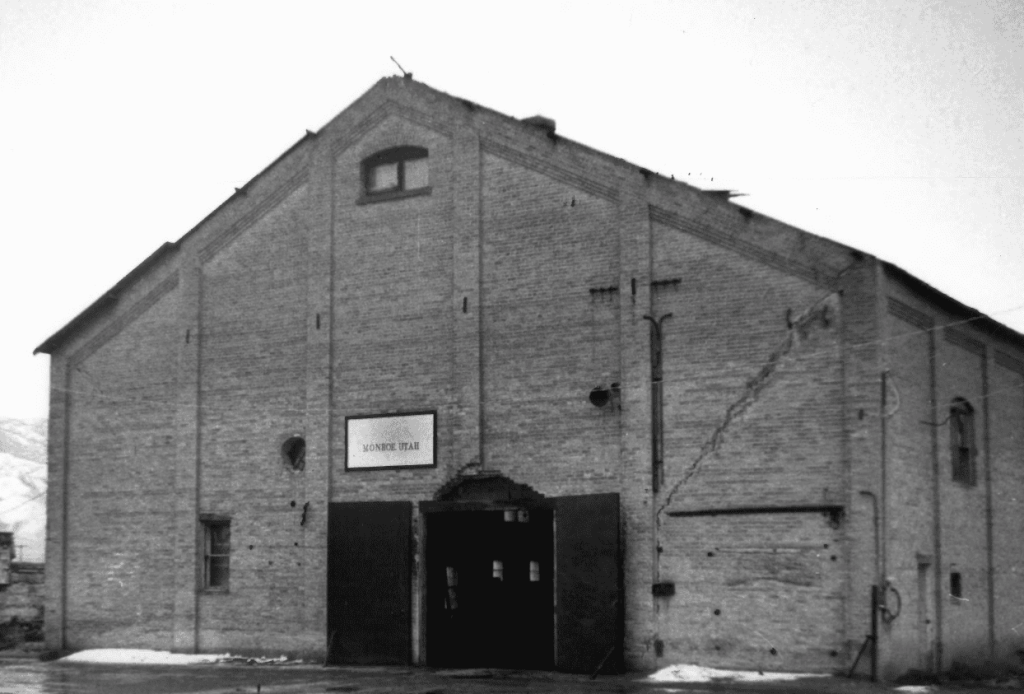
In 1928 the beet processing machinery was sold to a firm in Quebec. Fourteen years later, in 1942, the factory’s main structural elements were dismantled leaving only the office and sugar warehouse intact. At the end of World War II the warehouse was converted into a drying plant for potatoes from which a flour was made and then shipped to Europe. The operation was owned by Utah Food Products Cooperative and was a locally owned concern. In 1945 the business was forced to sale the property because it had failed to meet its mortgage payments. American Food Products Corporation bought the site but it suffered the same fate as the Utah Company. After a series of owners the Elsinore Sugar Factory property was purchased by Wilson Milburn. He has converted the office into a home and hopes to reuse the sugar warehouse as a local shopping mall.

Only two buildings of the Utah-Idaho Sugar Company’s factory complex in Elsinore, Utah are extant. The warehouse is a large brick building of symmetrical rectangular plan with a gabled roof. Piers divide the elevations into bays. Brick corbelling at the roof line creates the effect of a cornice. All openings have segmental arches.
Most of the houses in Austin were built by the sugar beet factory for workers. They were all variations of a similar pattern of modest, detached single family dwellings typical of the period, ca. 1910. The different configurations of this building may reflect its different function and location near the factory. The factory office occupies the ground floor. Rooms on the upper floor undoubtedly served as temporary accommodations for seasonal employees.
The factory office and rooming house is a gable roofed rectangular structure. The ground floor of the 1 1/2 story building is brick while the upper level is frame with shingle siding. Piercing of gable end facades is symmetrical. The broad sides exhibit asymmetrical piercing and paired shed dormers. Ground floor openings have segmental arches. The original window configuration was a two-over-two scheme. A balcony and porte cochere have been extended from the main façade. A small gable roofed portico shelters the entrance of the rear elevation.
The boundaries of the nomination encompass almost the same acreage as was purchased by the Utah-Idaho Sugar Company in 1910 for their Elsinore factory. Its addition to the two standing structures, the office/boardinghouse and sugar warehouse, the foundations of the main factory, the boiler and machine shop, the beet sheds and, the numerous pulp silo storage pits are included.