Tags

Beckstead-Butterfield House
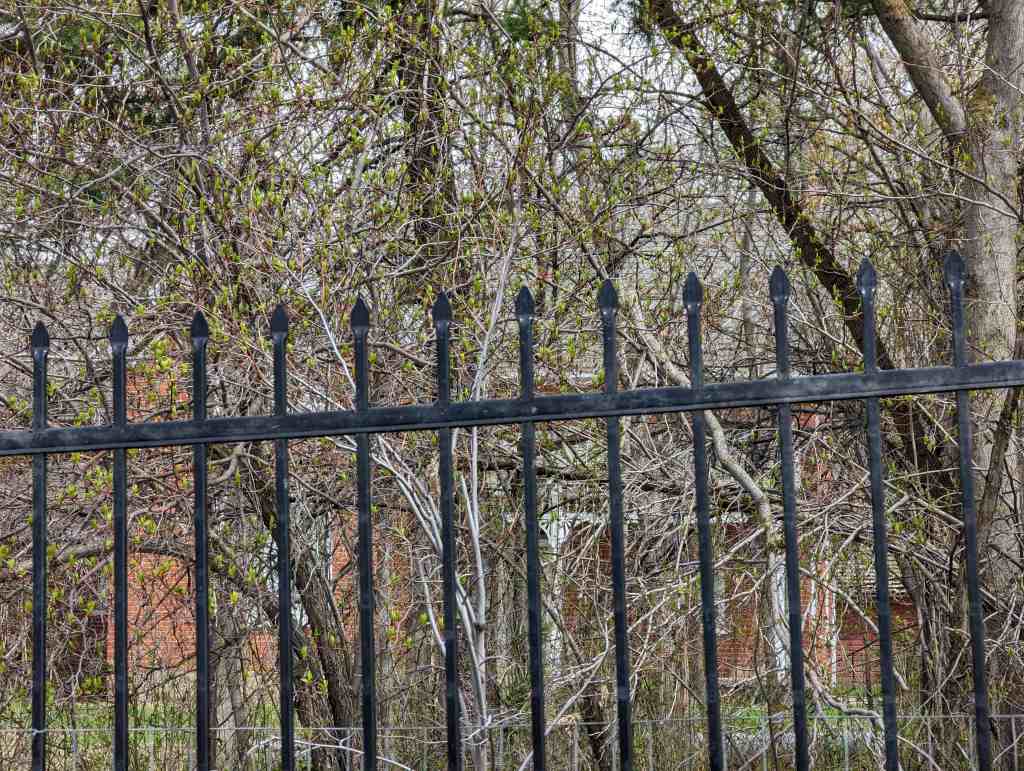
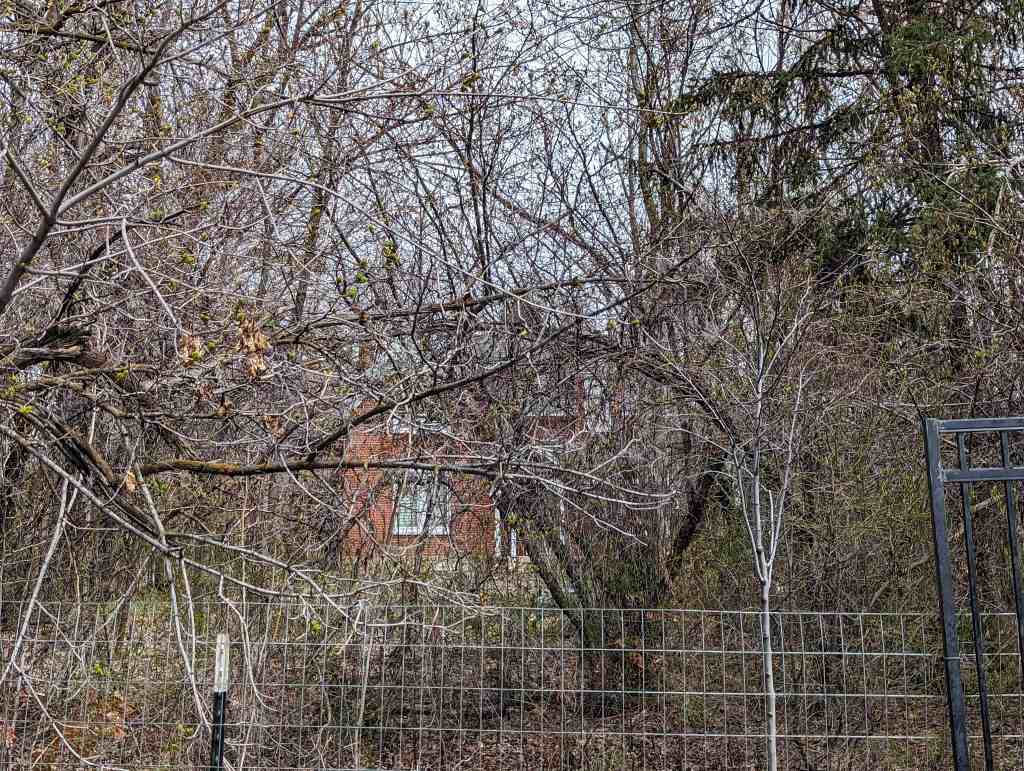
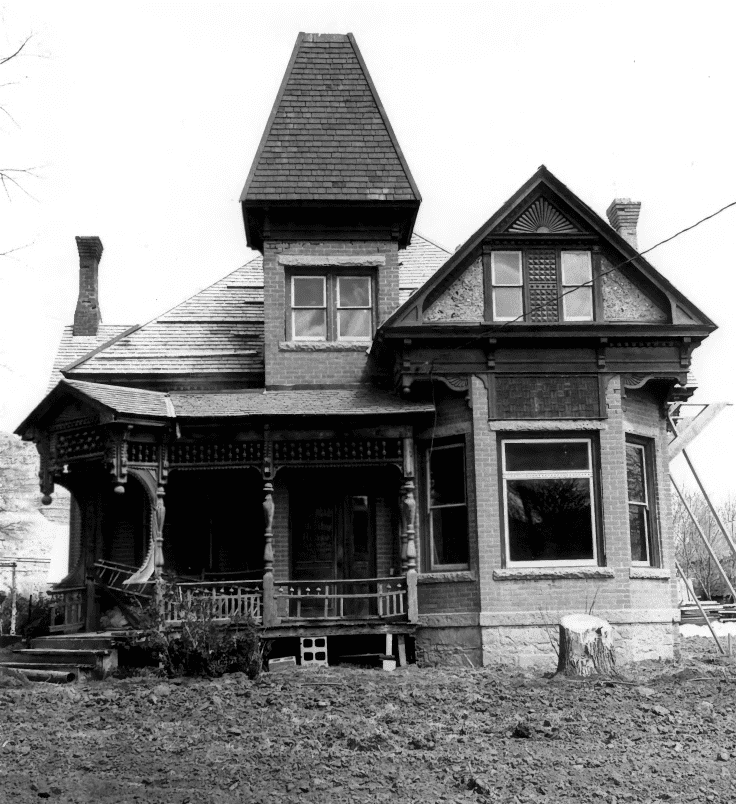
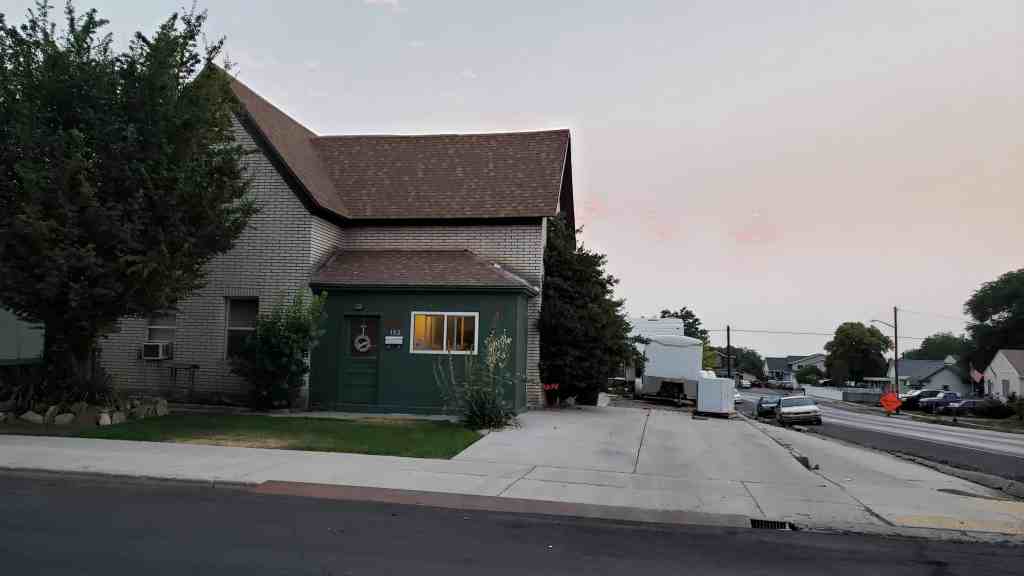
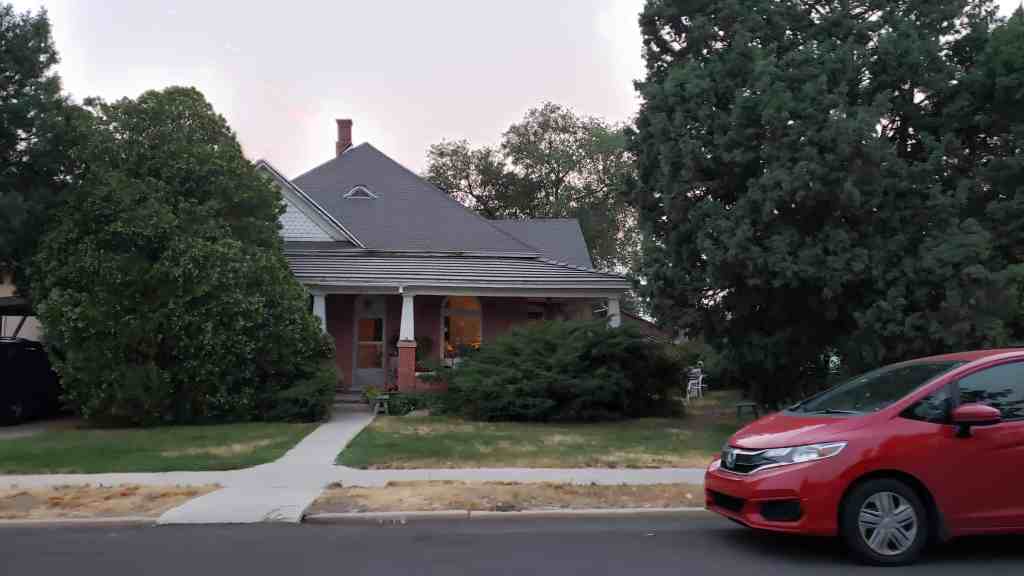
The Beckstead-Butterfield House, constructed in 1897, is a 1½-story brick Victorian Eclectic residence on Redwood Road in Riverton, Utah. The house is locally significant under Criterion C in the area of Architecture as the most ornate and largest surviving example of a Victorian Eclectic-style central-blockwith-projecting-bays type house in Riverton. Although not a fully realized Queen Anne-style house, the Beckstead-Butterfield House has many Queen Anne details such as octagonal bays, an asymmetrical façade, irregular floor plan and colored glass sashes in the upper windows. The house was associated with three members of the Beckstead family, who were sheep ranchers in Riverton. The longest owner/occupants were members of the Butterfield family, who operated one of the largest farms in Riverton on the property between 1906 and 1950. The historic name has been chosen to reflect the ownership by both the Beckstead and Butterfield families. Both names are still associated with the house as a landmark in the local community. The farmhouse property has been reduced to 0.52 acres by late-twentieth-century development in the area. In the area of Architecture, the period of significance spans the original construction in 1897 to 1900 when the matching rear addition was believed to have been constructed. The construction of both the original house and the addition is attributed to the local builder, Carl Madsen. The exterior of the house has good historic integrity with some minor alterations that were reversed during the recent rehabilitation using state and federal tax credits.
Located at 13032 South Redwood Road in Riverton, Utah and added to the National Historic Register (#100006389) on April 12, 2021.
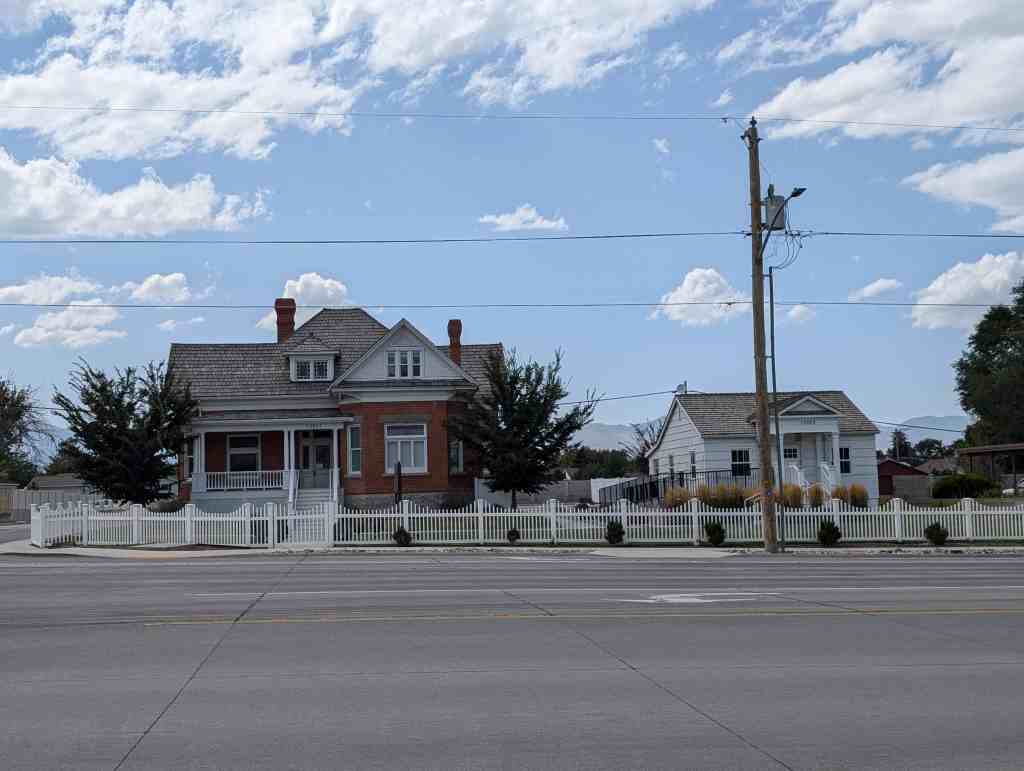
The Beckstead-Butterfield House is locally significant under Criterion C in the area of Architecture as the most ornate and largest surviving example of a Victorian Eclectic-style central-block-with-projecting-bays type house in Riverton. Riverton is located approximately 30 miles south of Salt Lake City and remained a sparsely settled farm community until the 1990s when a population boom and suburban sprawl reached the town. Only about a dozen central-block type houses are estimated to have been built in the community. In 2004, a survey prepared for the Utah State Historic Preservation Office’s database found only five extant farmhouses identified with the Queen Anne style. Four of the five houses in the database were on or near Redwood Road, the main north-south corridor through Riverton and the prime location for commercial development. Two of the houses were recently demolished when the street was widened. Another house was remodeled into a commercial space with new windows, doors, and a façade ADA ramp. The fifth house is still eligible but does not appear to have had any Queen Anne details. A sixth house was not identified as Queen Anne style in the 2004 but was identified as Queen Anne in a 2016 survey of Redwood Road in Riverton. None of the six had towers or turrets, and of the five, only the Beckstead-Butterfield House has any other salient characteristics of the Queen Anne style.
The Beckstead-Butterfield House, built in 1897, is the last surviving Victorian-era central-block-withprojecting-bays type house in Riverton with Queen Anne-style details. The Beckstead-Butterfield House is more elaborate than most Victorian Eclectic-style houses in Riverton. The Victorian period marked two important changes in domestic architecture in Utah. The first was an end to Utah’s relative isolated as the coming of the railroad brought new materials to Utah. The second was the introduction of architectural style books that popularized the complexity and irregularity of the Victorian Eclectic domestic architecture. While the cross wing introduced asymmetry into Utah’s domestic architecture, the central-block house with its projecting bays produced the desired external irregularity while making the principal rooms larger and brighter (i.e. more window area). The floor plan of the original Beckstead-Butterfield House is an unusual variation by a local builder that had projecting bays on all four elevations, but no window openings in the south elevation bay.
The Victorian Eclectic was popular in Utah between 1880 and 1910. The Queen Anne style, as a variation of the Victorian Eclectic was popular between 1885 and 1905. Domestic examples are characterized by asymmetrical façades, tower/turrets, irregular floor plans, octagonal bays, dormers, and ornate woodwork. The Beckstead-Butterfield House is not a true Queen Anne because it lacks a tower. The house originally has a variety of materials, textures, and even colors, as seen in a 1906 photograph. The most distinctive characteristic of the Queen Anne style found on the Beckstead-Butterfield House are the multilight sashes. Surviving Queen Anne sashes are rare, particularly in rural communities like Riverton. The Beckstead-Butterfield House features three varieties of Queen Anne sashes: 1) multi-light upper sash, 2) perimeter square lights in a traditional window, and 3) a unique example of perimeter lights in a semicircular window.
As noted in the Riverton Multiple Property Submission (MPS), within the Enterprise and Rural Development Period, 1882-1899, Riverton dairy farmers and wool growers became the most prosperous families in the community and were able to build more substantial and elaborate homes than most area famers. Most were located along Redwood Road. Local builder, Carl Madsen, built two large brick houses at 13217 S. Redwood Road (1893) and 13030 S. Redwood Road (1897) for the Charles Nokes (a dairyman) and George Beckstead (a sheep herder), respectively. Carl Madsen also built a massive brick barn for George Beckstead that was more ornate than the house.
The exterior of the Beckstead-Butterfield House has good historic integrity in the qualities of design, materials, and workmanship. Minor alterations such as the front porch enclosure and missing south porch were reversed during the 2019-2020 rehabilitation. Although the interior was substantially modeled over the years, the recent rehabilitation preserved as many extant historic features as possible. During the rehabilitation, the missing Victorian fireplace, staircase, and pocket doors were replaced with historically appropriate features. The property has good location, feel and association integrity, but the original farm setting has been somewhat compromised by recent development in the neighborhood. For this reason, the property is being nominated for Architectural, but not Agricultural significance.
Additional Historic Context: History of the Beckstead-Butterfield House
Riverton was settled in the 1850s by members of the Church of Jesus Christ of Latter-day Saints (LDS or Mormon Church). The first residents lived in dugouts or crude log cabins near the Jordan River. A communal water project, the South Jordan Canal (begun in 1870 and completed in 1876), opened up the bench lands for agriculture. At the time the settlement was named Riverton in 1879, there were about one hundred residents living in scattered farmsteads on a bluff west of the Jordan River. After the completion of the larger Utah and Salt Lake Canal in 1881, as more settlers arrived, the community coalesced and expanded along Redwood Road. Redwood Road was the community’s main thoroughfare, in addition to being one of only two north-south transportation routes linking the north and south ends of the Salt Lake Valley at the turn of the twentieth century (the oldest route is the former Territorial Road, today’s State Street). It was named for the redwood stakes used to survey the road. In the late 1890s and early 1900s, a small commercial district developed at Redwood Road and 12400 South in Riverton.
The first owner of the land where the Beckstead-Butterfield House is located was James C. Hamilton, who received the first patent in 1883. A 30-acre portion of the homestead was acquired by Christian and Minnie Peterson, who sold it to W. W. and Mary Jane Beckstead in 1896. William Warren Beckstead was born in Riverton, on March 26, 1870. His parents were early settlers of Riverton, George Wesley and Eleanor Davis Beckstead. George W. Beckstead was a prosperous sheep rancher, whose assets were divided between his children at his death in 1890. In December 1891, W.W. Beckstead married Mary Jane Berg, who was born in Provo, Utah, on March 2, 1871. The Becksteads constructed a large brick eight-room home on Redwood Road in 1897. On November 22, 1897, Riverton’s local correspondent for the Deseret News reported on the progress of the new house:
W.W. Beckstead of Riverton has moved into his new residence. It is hardly yet completed—just enough to accommodate his family for the present. When finished it will no doubt be one of the finest in the vicinity. We want to see a few more such residences erected by our better able townsmen in the near future, as it adds greatly to the appearance of our settlement and displays the faith of its inhabitants in its future prosperity.
W.W. Beckstead farmed on his property in Riverton and managed sheep ranches in Idaho and Wyoming with his eldest brother, George F. Beckstead, and their sister, Mamie’s, husband Ed Harding. Two children were born to Mary Jane and W. W. before they built the brick house and two were built while they lived in the house. After just three years in the house, they decided to move to Rexburg, Idaho, to be closer to the ranches. The property in Riverton reverted to Christian and Minnie Peterson, who sold 10 acres to W.W.’s brother, George F. Beckstead. W.W. and Mary Jane Beckstead moved to Logan, Utah, in 1923. William Warren Beckstead died on February 2, 1954. Mary Jane Berg Beckstead died in California on July 18, 1968. They are buried in Logan.
Within the community of Riverton, the Beckstead house is more often associated with its second owners, George F. and Charlotte Beckstead. This is due to the fact that George F. Beckstead had a large brick barn built on the property soon after they acquired the house in 1900. The two-story barn sat slightly south and west of the house. It was built of brick with an ashlar granite foundation. The elaborate architecture of the barn included round towers at the front corners, a wide arched entrance, a stained-glass rose window, castellated parapet, and hard wood floors. The initials “G.F.B.” were installed above the entrance [Figure 3]. The castle-like, brick barn was a landmark in the community until its demolition in 1968. The George F. Beckstead barn was built by Carl Madsen, the most prolific Riverton builder of the period. Madsen is also believed to be the builder of the Beckstead house a few years earlier, and probably built the 1900 addition to the house for George and Charlotte.

Carl Madsen was born in Denmark in 1857. As a young man, he was apprenticed to a carriage maker. In 1881, Carl immigrated to Utah. Carl began working for a home builder in South Jordan in 1884. Carl and his wife, Anne Crane, moved to Riverton in 1889. His career as a builder lasted almost sixty years. Carl made was one of the building supervisors of the Riverton LDS Ward meetinghouse, designed by Richard Kletting, the architect of the Utah State Capitol. The building was nicknamed the Riverton domed church. It was built in 1899 and demolished 1940. Carl Madsen died in Riverton in 1947.
George Francis Beckstead was born on March 25, 1860 in Provo, Utah. He married Charlotte Emeline Hamilton in 1881. Charlotte was the sister of James C. Hamilton. George and Charlotte were the parents of nine children. Soon the death of George W. Beckstead in 1890, George and Charlotte moved into his father’s house in Riverton. In 1900, they moved one mile south on Redwood Road to W.W. and Mary Jane’s house. George F. had acquired a number of sheep herds by then. In her biography, Charlotte describes her husband as “the biggest sheep man in the state.” George F. also raised horses and the elaborate barn was built as a showcase for his horses. Charlotte brought George’s mother back from Salt Lake City to live with them in Riverton because they had “plenty of room.” Eleanor Davis Beckstead lived with them until her death in 1902. In 1906, the Beckstead family decided to move to Provo to help further the education of their almost grown youngest children. George Francis Beckstead died on January 5, 1916. Charlotte Emmeline Hamilton Beckstead died on June 7, 1953. They are buried in the Provo Cemetery.
Although the Becksteads did not move to Provo until 1906, on December 2, 1902, George and Charlotte deeded 80 acres of property, including the house, to Edward T. Harding, George’s sheep business partner and the husband of his sister, Mary Elizabeth Beckstead Harding. Edward Thomas Harding was born in Provo in 1860. Mary Beckstead was also born in Provo in 1866. They were married in 1886. It appears the Harding family remained in Provo and never lived in the Riverton house. On September 8, 1906, they sold the Riverton property to Almon T. Butterfield, a Riverton farmer. Edward T. Harding died in 1922. Mary Beckstead Harding died in Salt Lake City in 1944.
Though the early occupants of the house were members of the Beckstead family, the family of Almon T. Butterfield owned the property between 1906 and 1950, making them the longest owners. Most Riverton residents old enough to remember the landmark brick barn, also remember Almon replacing the initials “G.F.B.” with his own “A.T.B.” over the barn’s entrance. Almon Thomas Butterfield was born in Herriman, Utah, on July 5, 1868.
As a boy, Almon Butterfield herded sheep and later went into the sheep business. Almon married Sarah Jane Crump in 1896. Sarah Jane Crump was born in Herriman on September 2, 1873. They had four children in Herriman before moving to Riverton where four more children were born. While Almon was serving a mission for the LDS Church between 1908 and 1911, Alvin Miller helped run the farm for Sarah Jane. In addition to the 80 acres of property around the house and barn, Almon T. Butterfield had 500 acres of irrigated land, making him one of the largest farm holders in Salt Lake County. Almon T. Butterfield was among the founding members of a number of corporations in Riverton: Riverton Pipe Company, Riverton Canning Company, Riverton Drug Company, and the Riverton Livestock Company. He was the president of the Jordan Valley Bank for 26 years. Almon T. Butterfield served a term in the Utah state legislature.
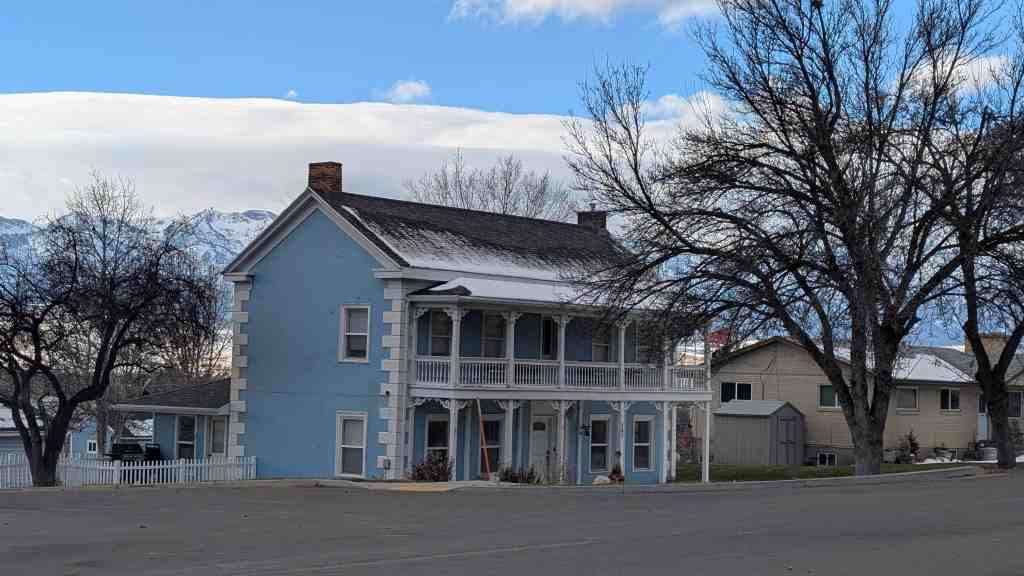
Almon T. Butterfield died on September 18, 1940. Around this time, the frame cottage was built to the north of the brick house. Sarah Jane may have lived there until 1950 when the property was sold to Decker Farms. Sarah Jane Crump Butterfield died on March 14, 1963 in Riverton. Almon and Sarah Butterfield are buried in Herriman, Utah. Between 1950 and 1953, the property was owned by Decker Farms. In the 1960s, the agricultural land was divided for subdivision development and changed hands several times. In 1979, the house was sold to R. L. and Beth Webster. The Websters had a large extended family and ran a home school in the house. The current owner, Barbara Catron, acquired the vacant house and property in 2017. Between 2019 and 2020, a full rehabilitation was completed as a mixed commercial-residential use.