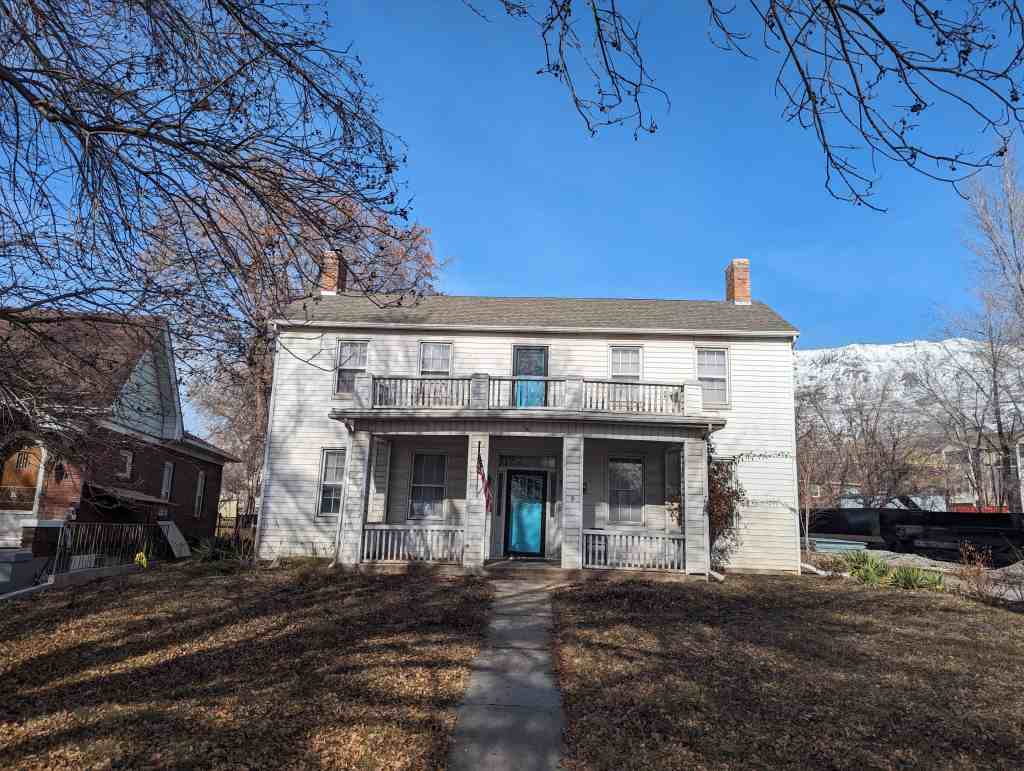
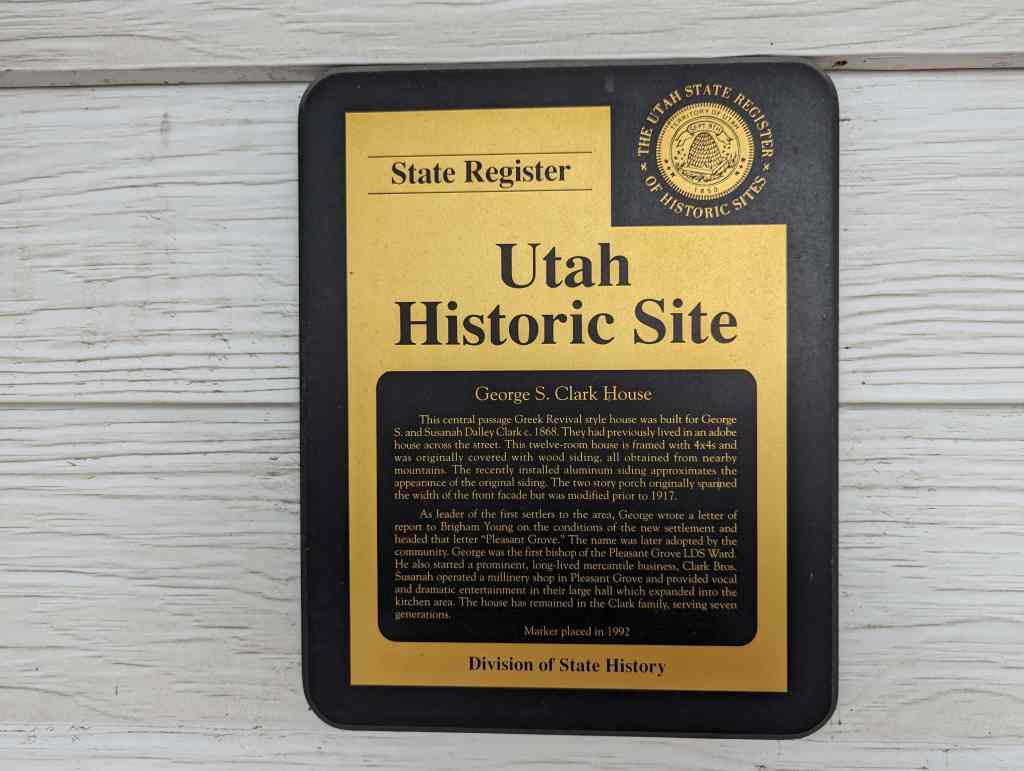
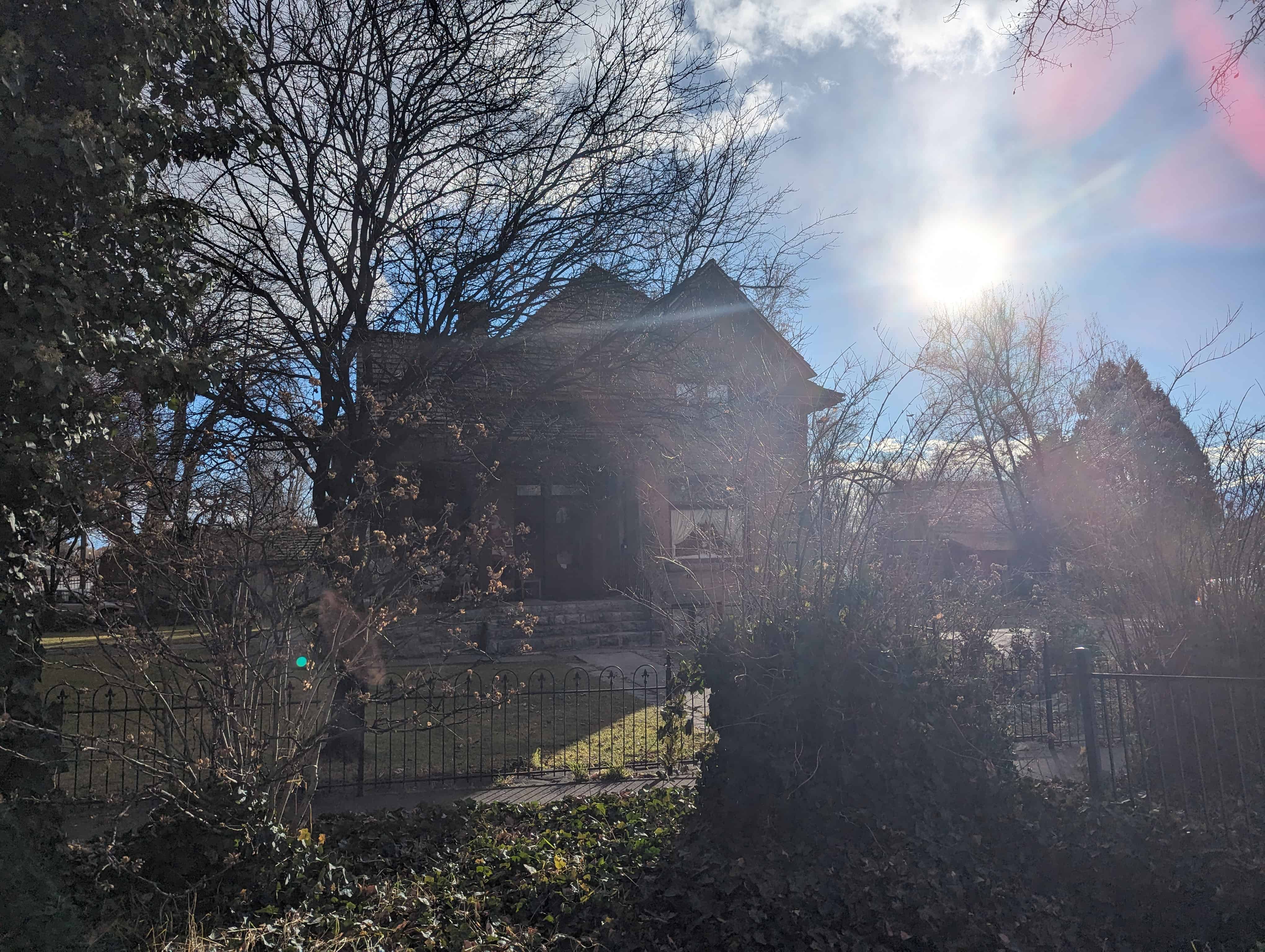
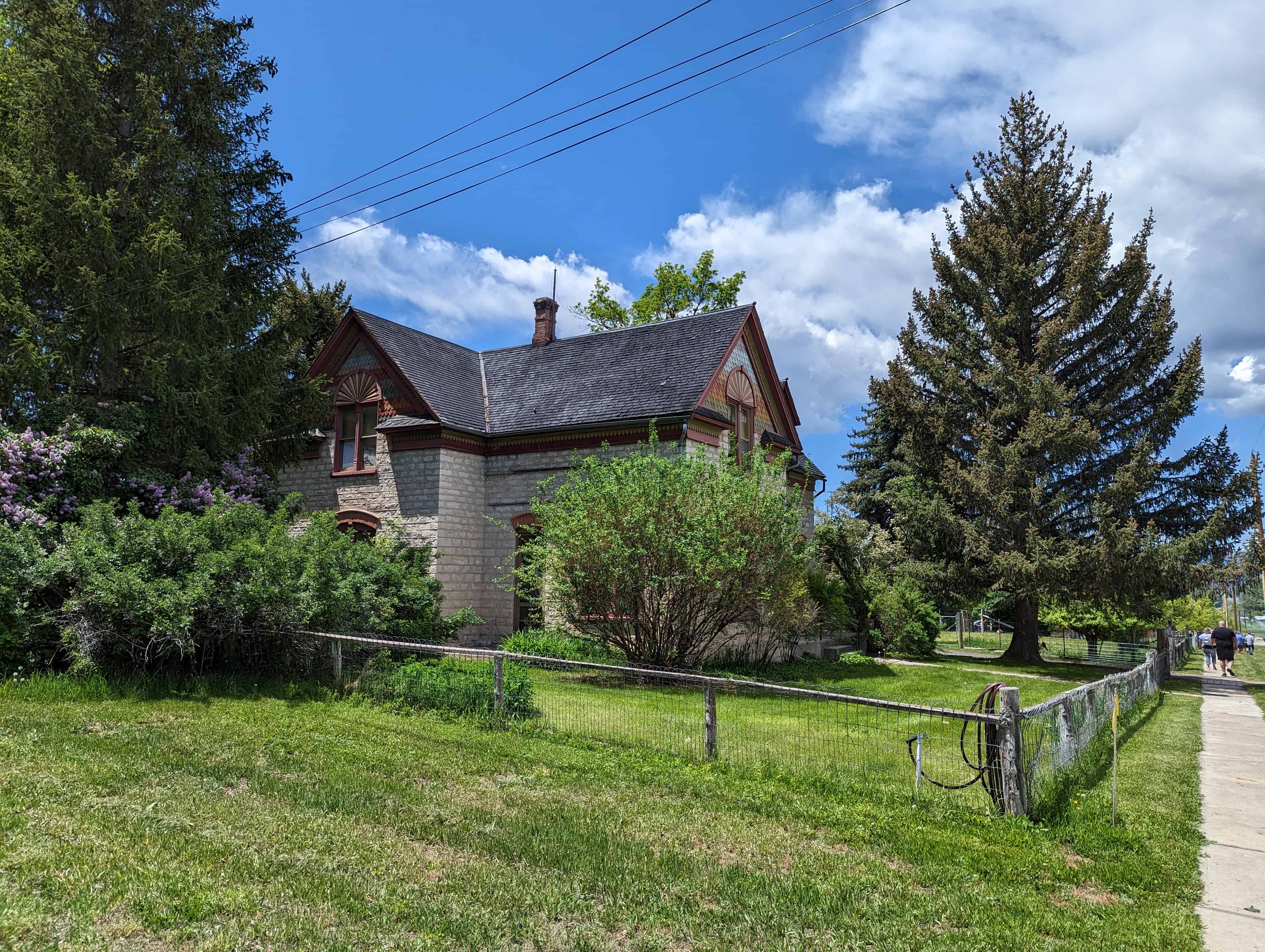
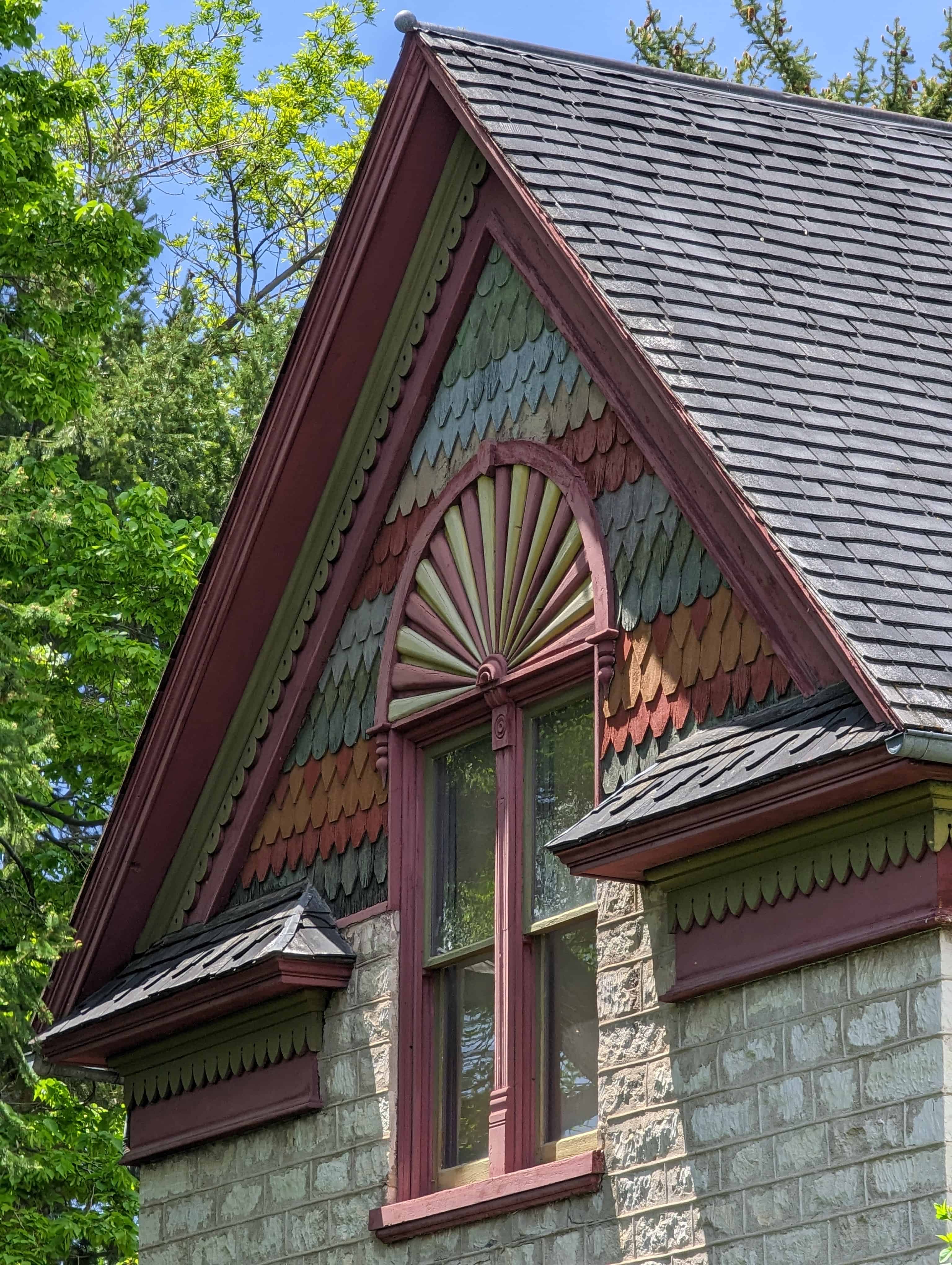
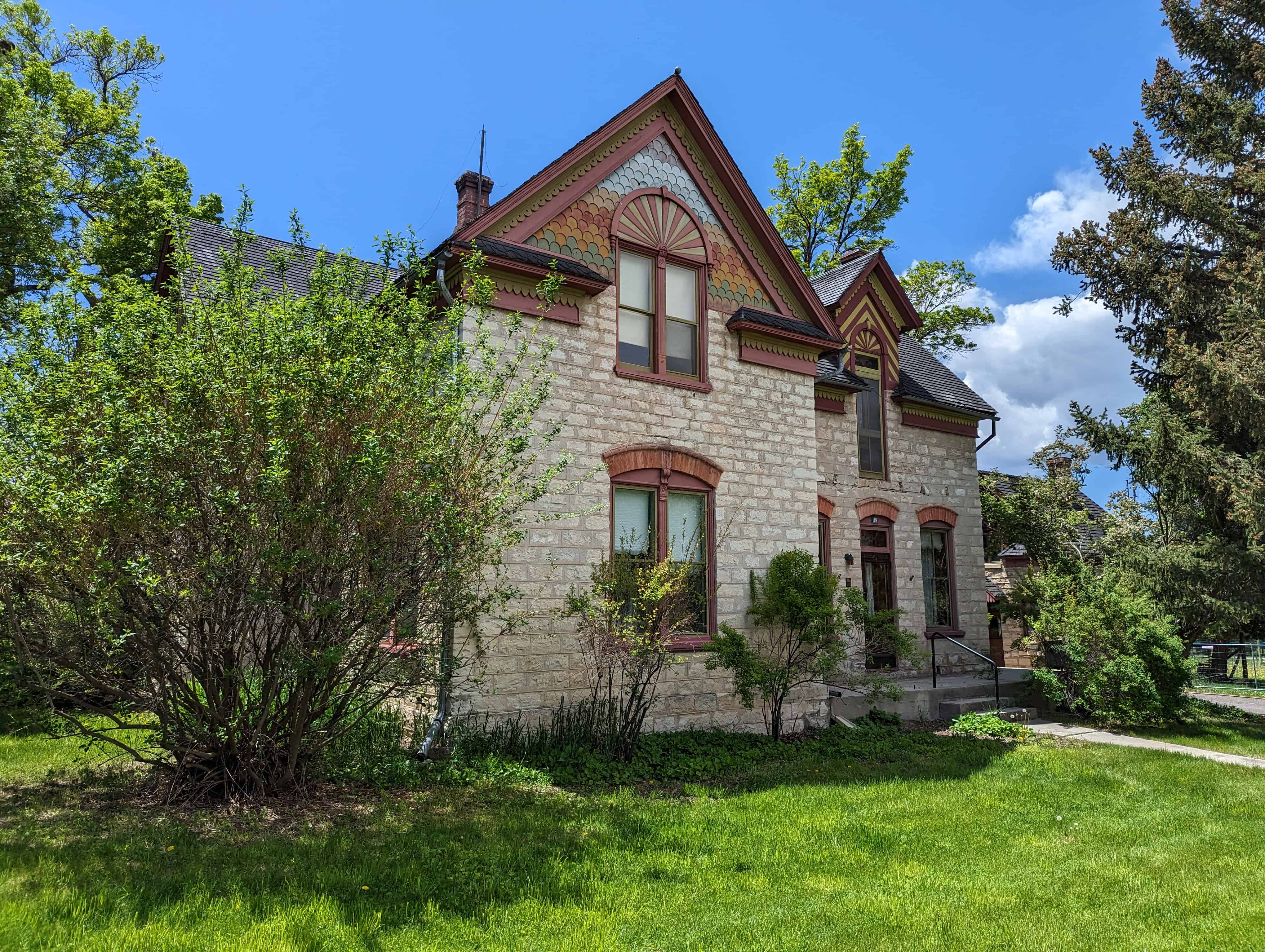
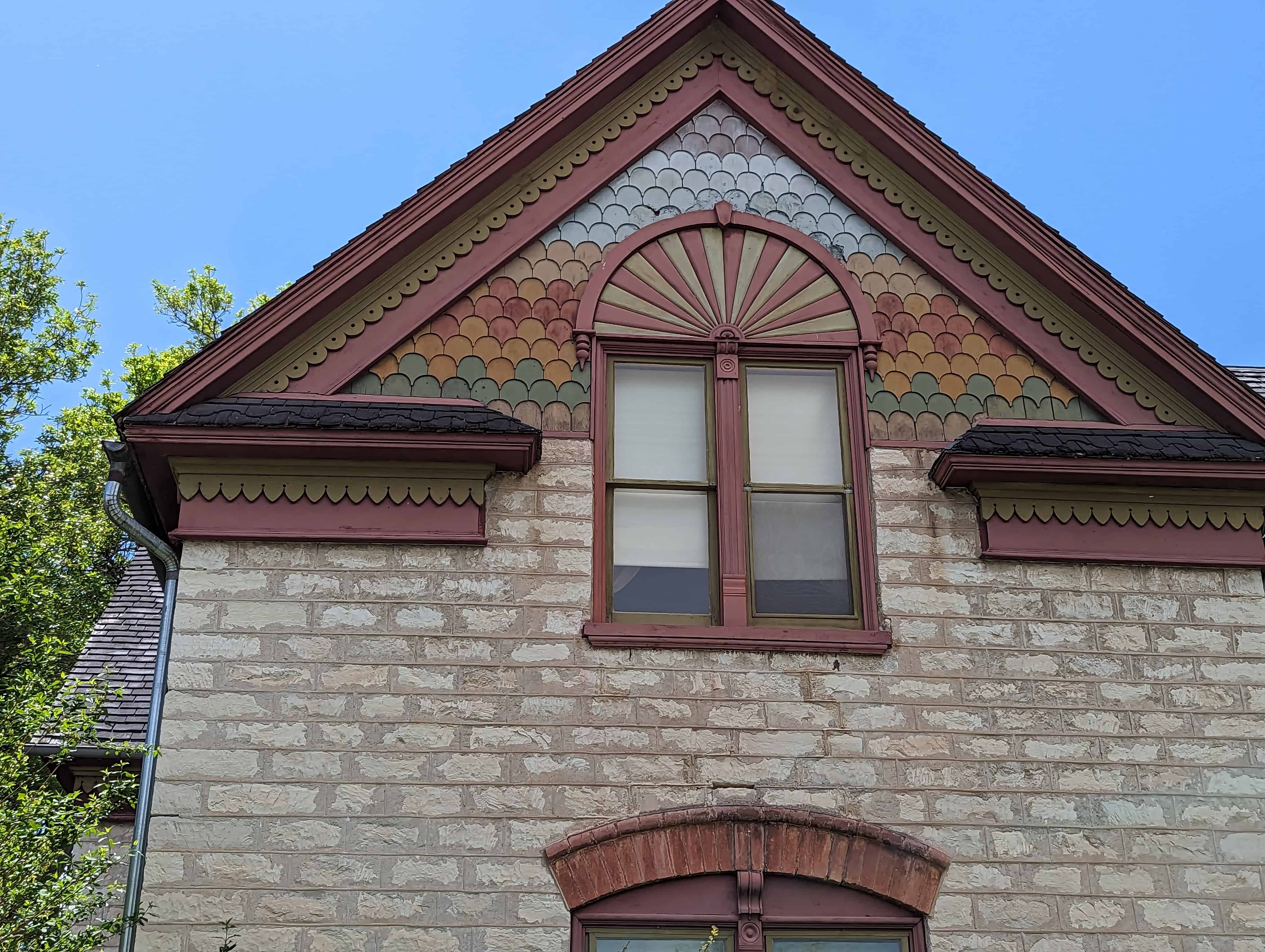
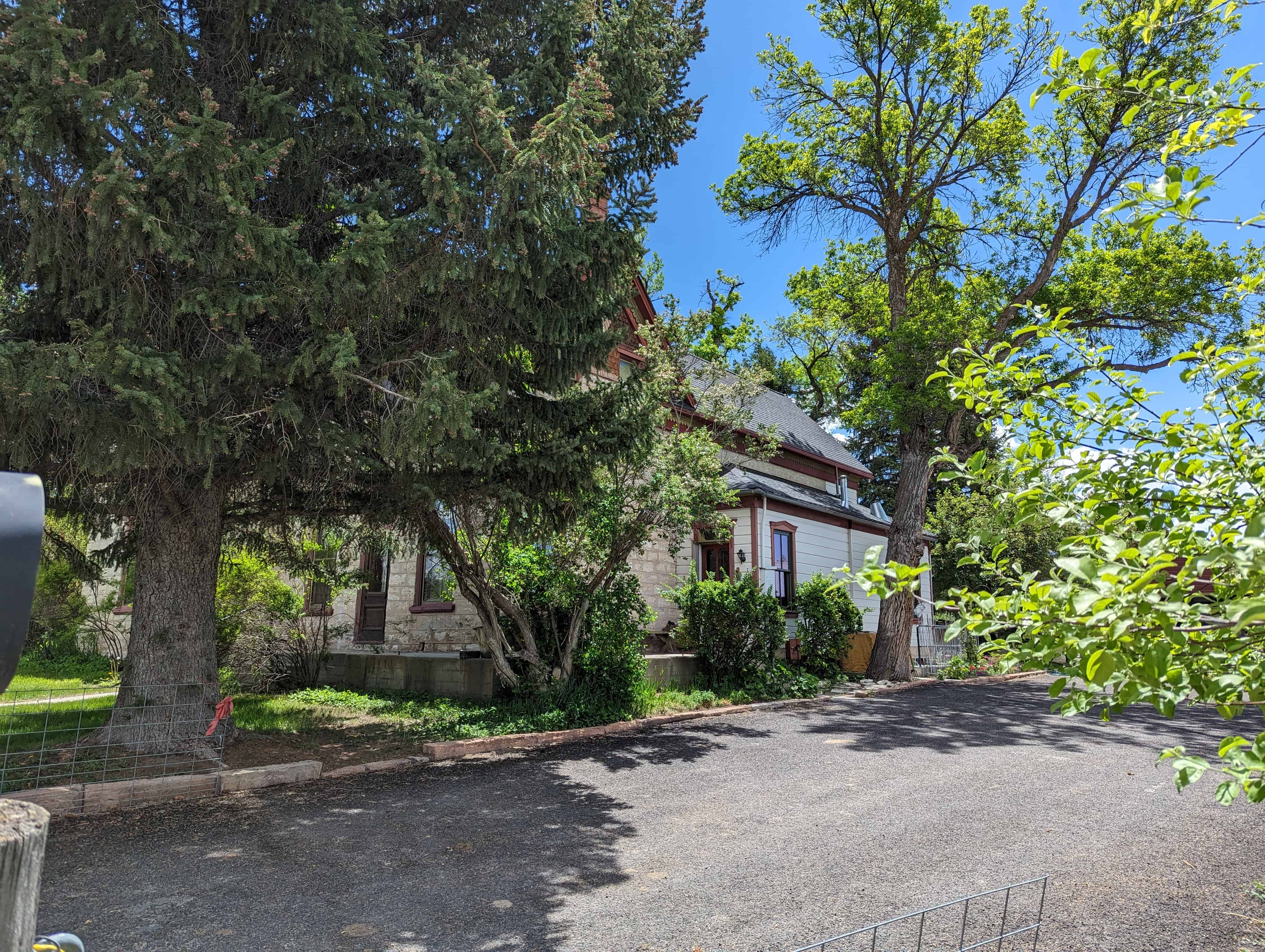
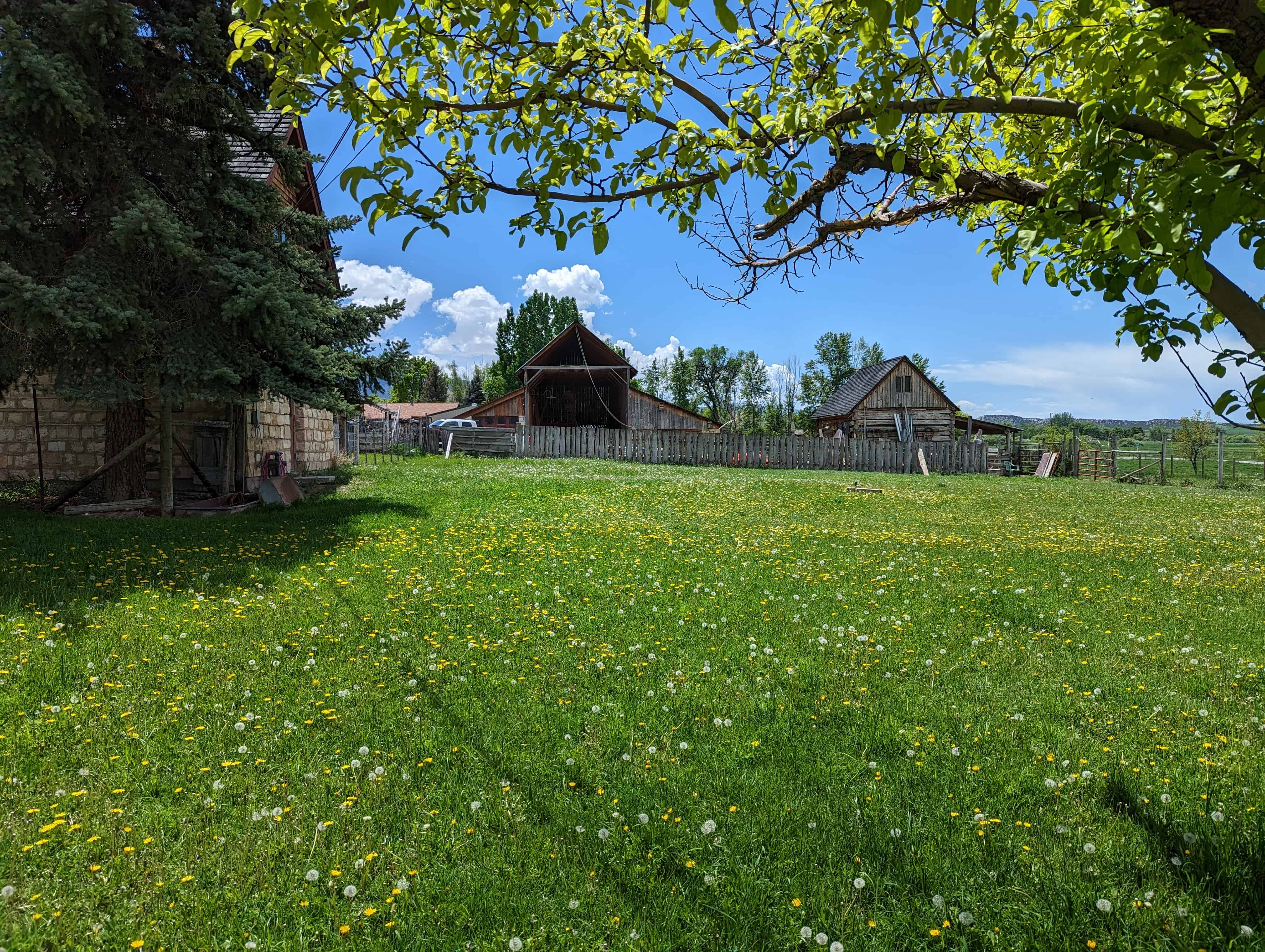
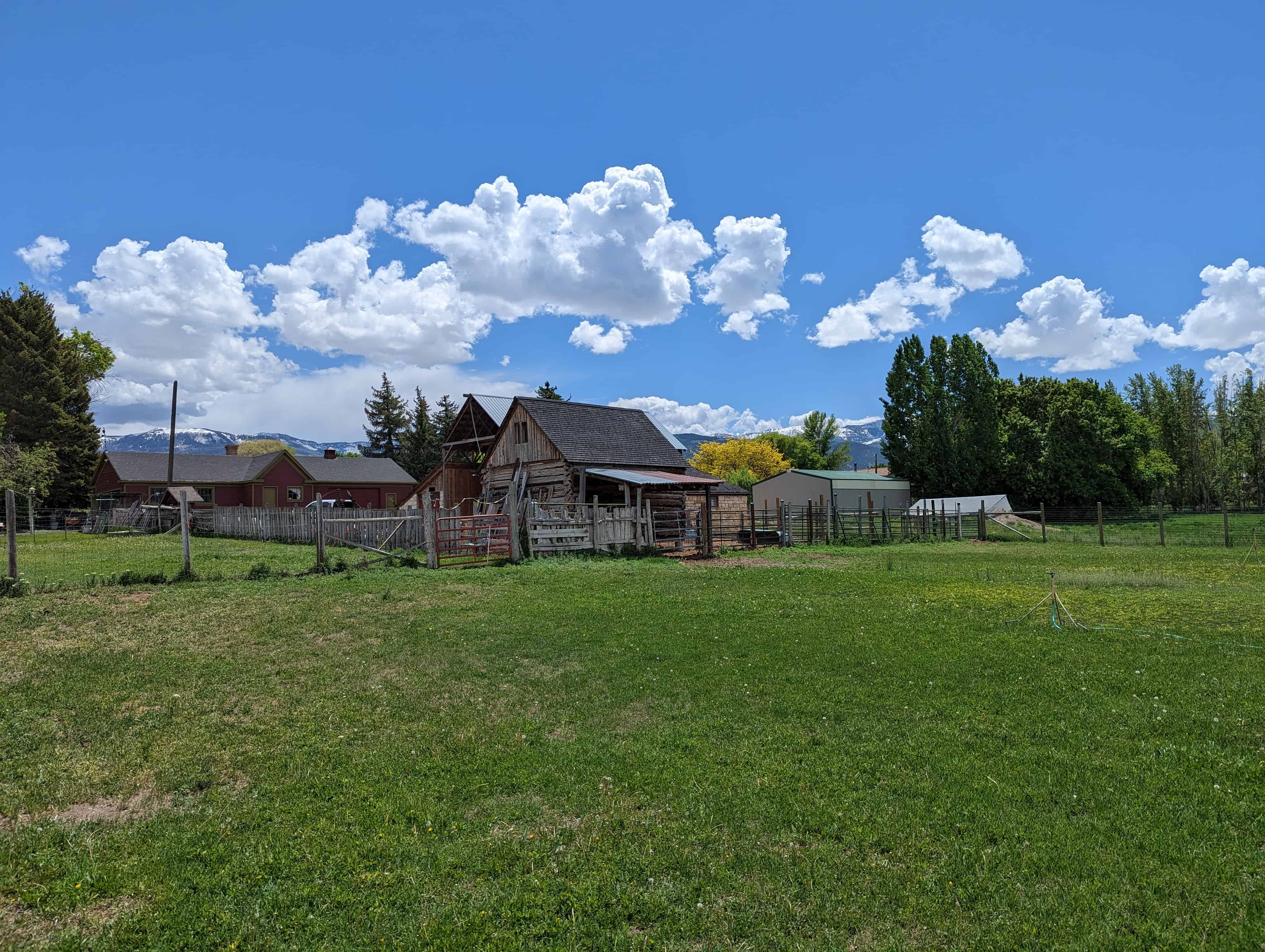
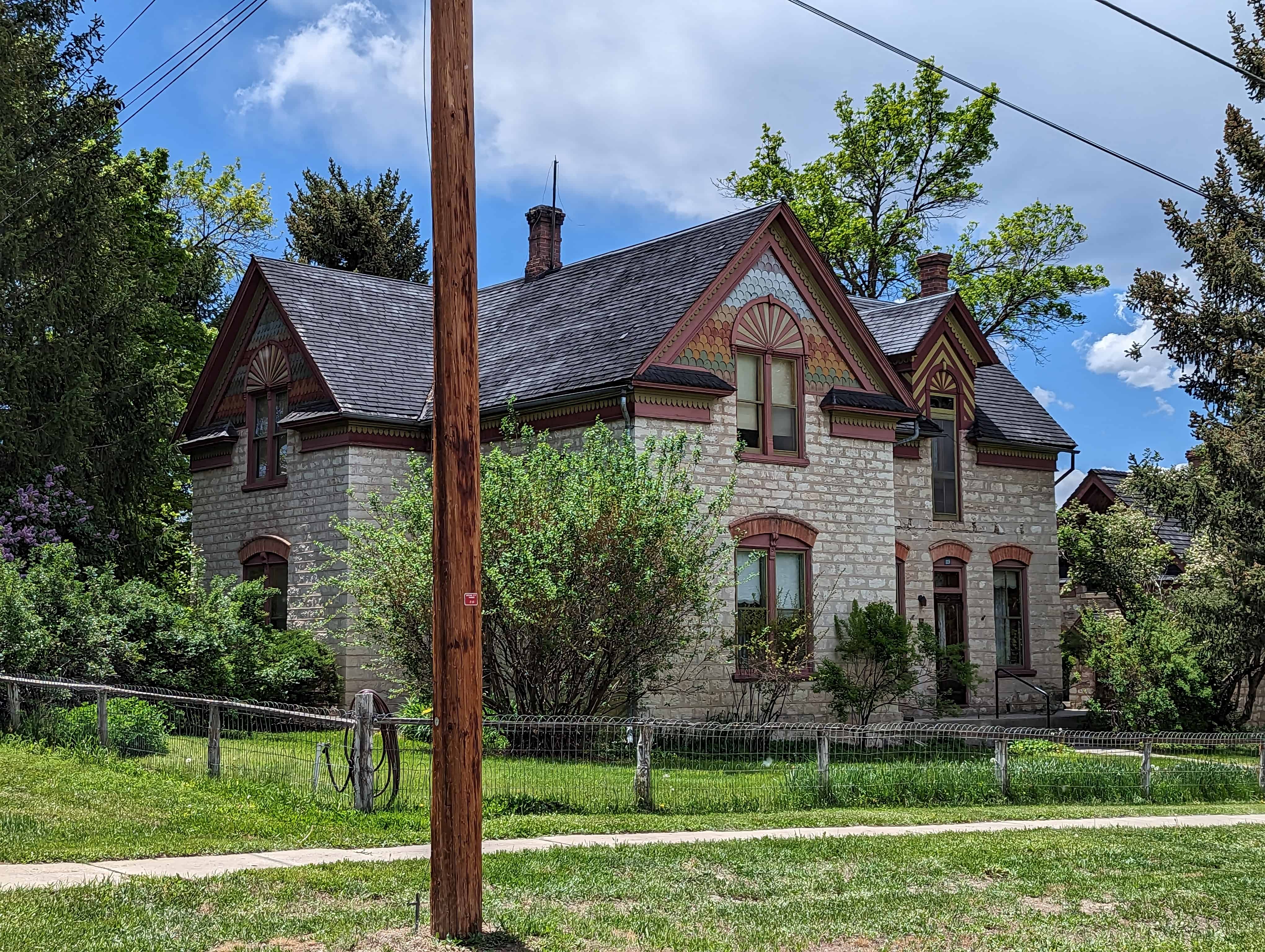
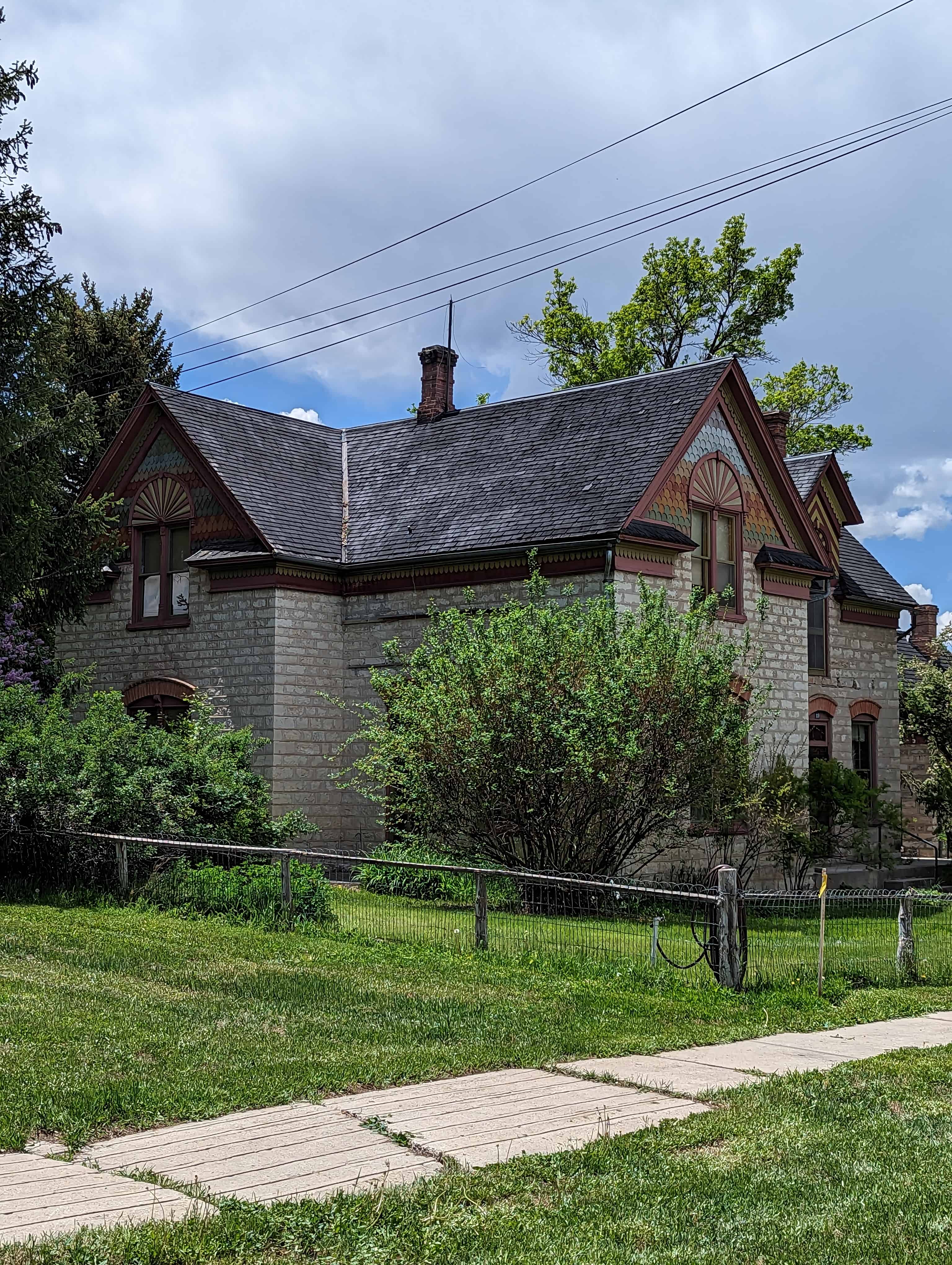
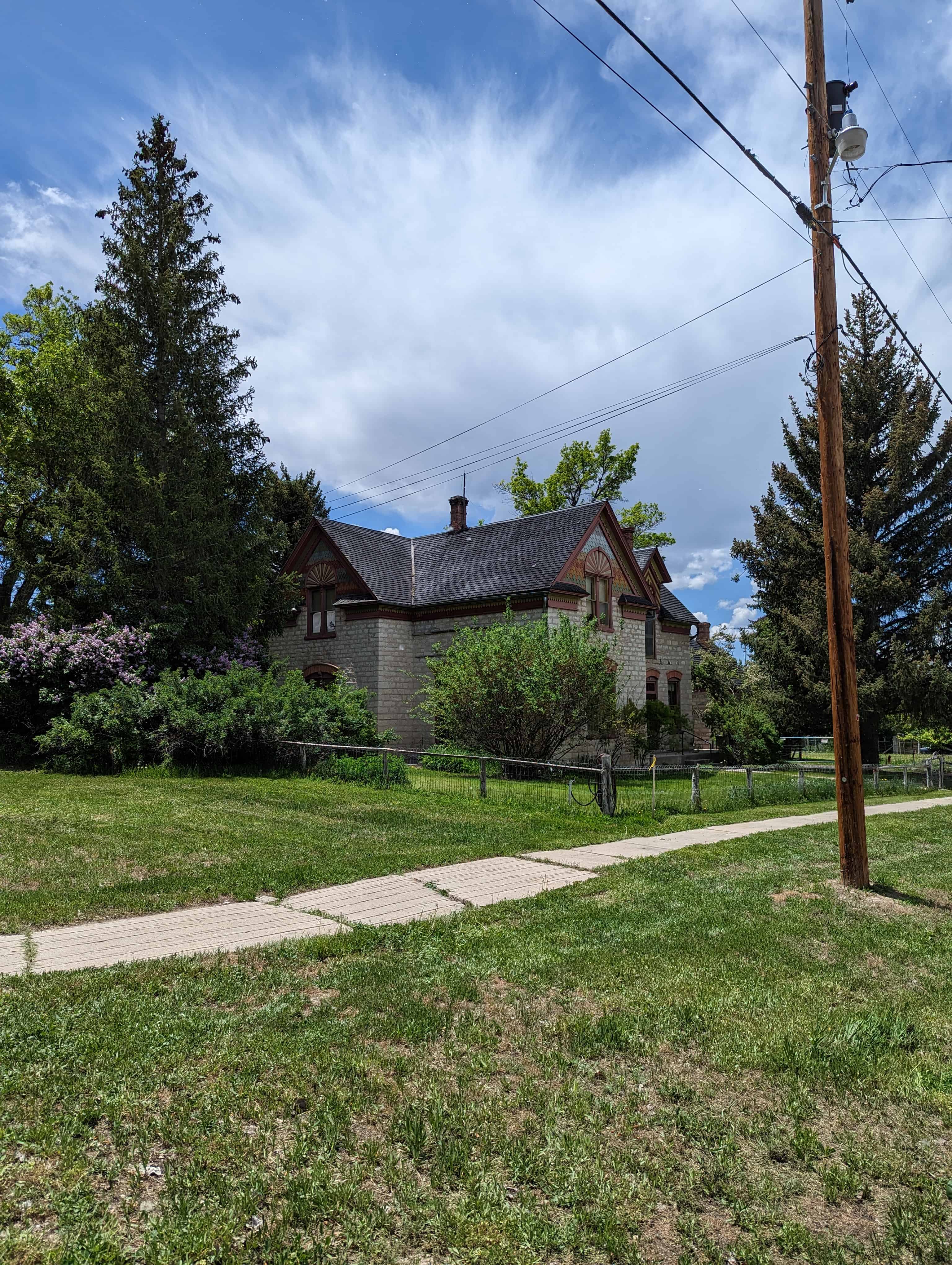
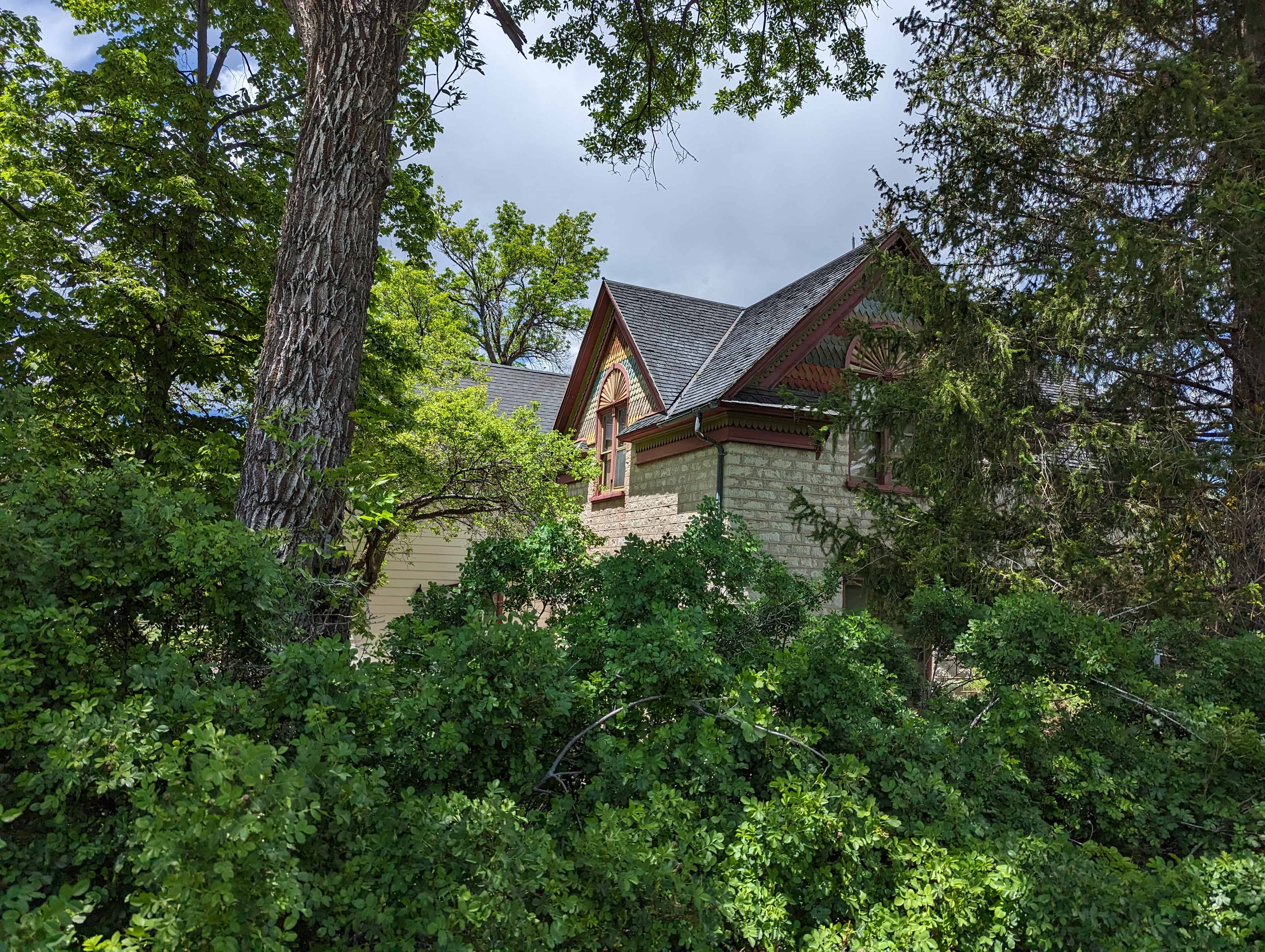
This central passage Greek Revival style house was built for George S. and Susanah Dalley Clark c. 1868. They had previously lived in an adobe house across the street. This twelve-room house is framed with 4x4s and was originally covered with wood siding, all obtained from nearby mountains. The recently installed aluminum siding approximates the appearance of the original siding. The two story porch originally spanned the width of the front facade but was modified prior to 1917.
As leader of the first settlers to the area, George wrote a letter of report to Brigham Young on the conditions of the new settlement and headed that letter “Pleasant Grove.” The name was later adopted by the community. George was the first bishop of the Pleasant Grove LDS Ward. He also started a prominent, long-lived mercantile business, Clark Bros. Susanah operated a millinery shop in Pleasant Grove and provided vocal and dramatic entertainment in their large hall which expanded into the kitchen area. The house has remained in the Clark family, serving seven generations,
The John M. Whitaker House is significant for its association with its original owner, occupant and namesake, John Mills Whitaker, a man important for his contributions to his church, business, educational and political community. His voluminous journal and papers are a valuable local history resource.
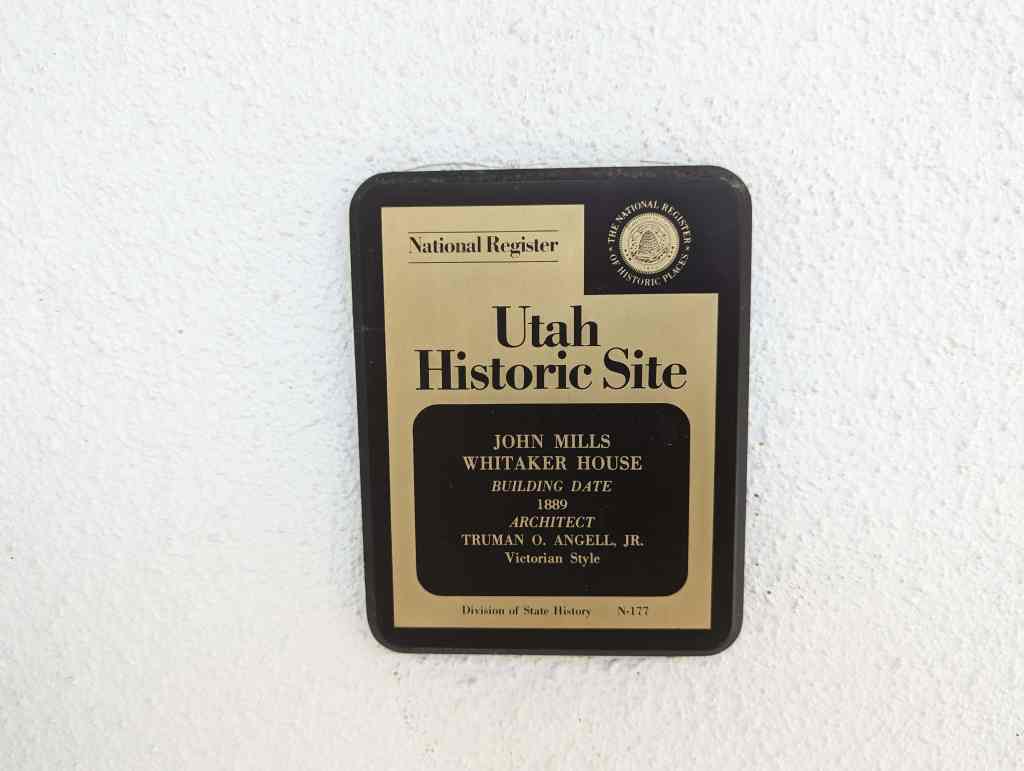
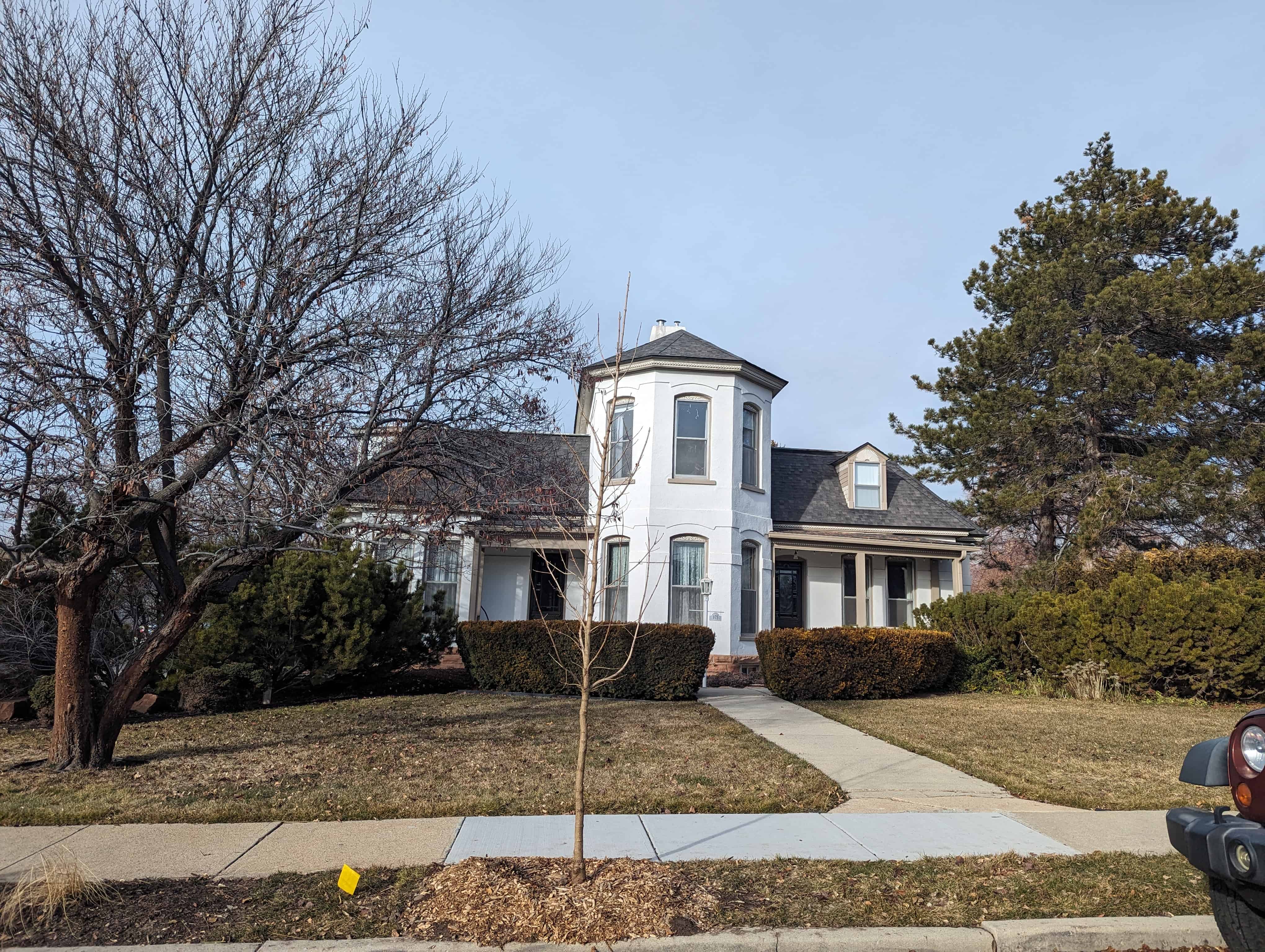
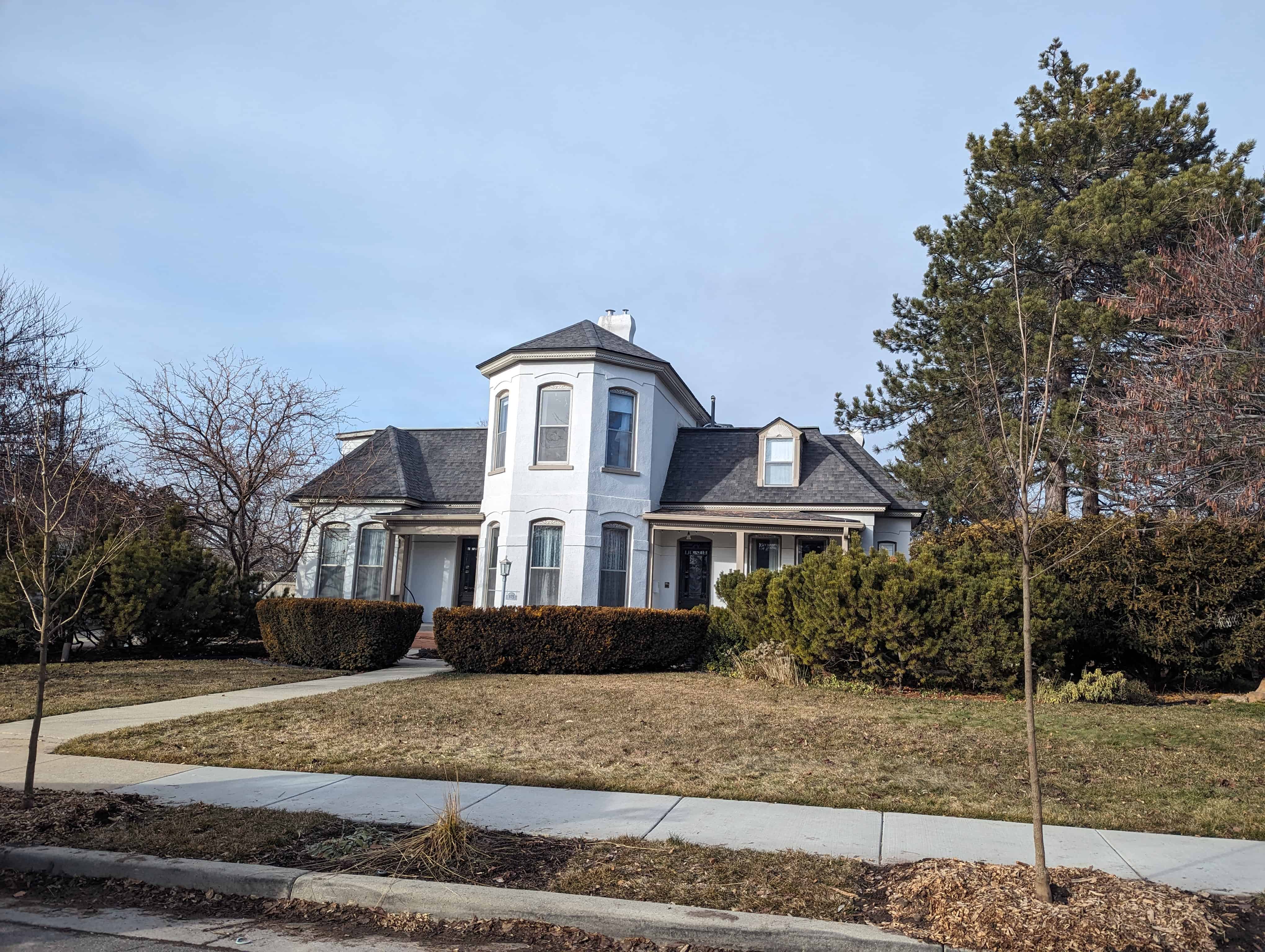
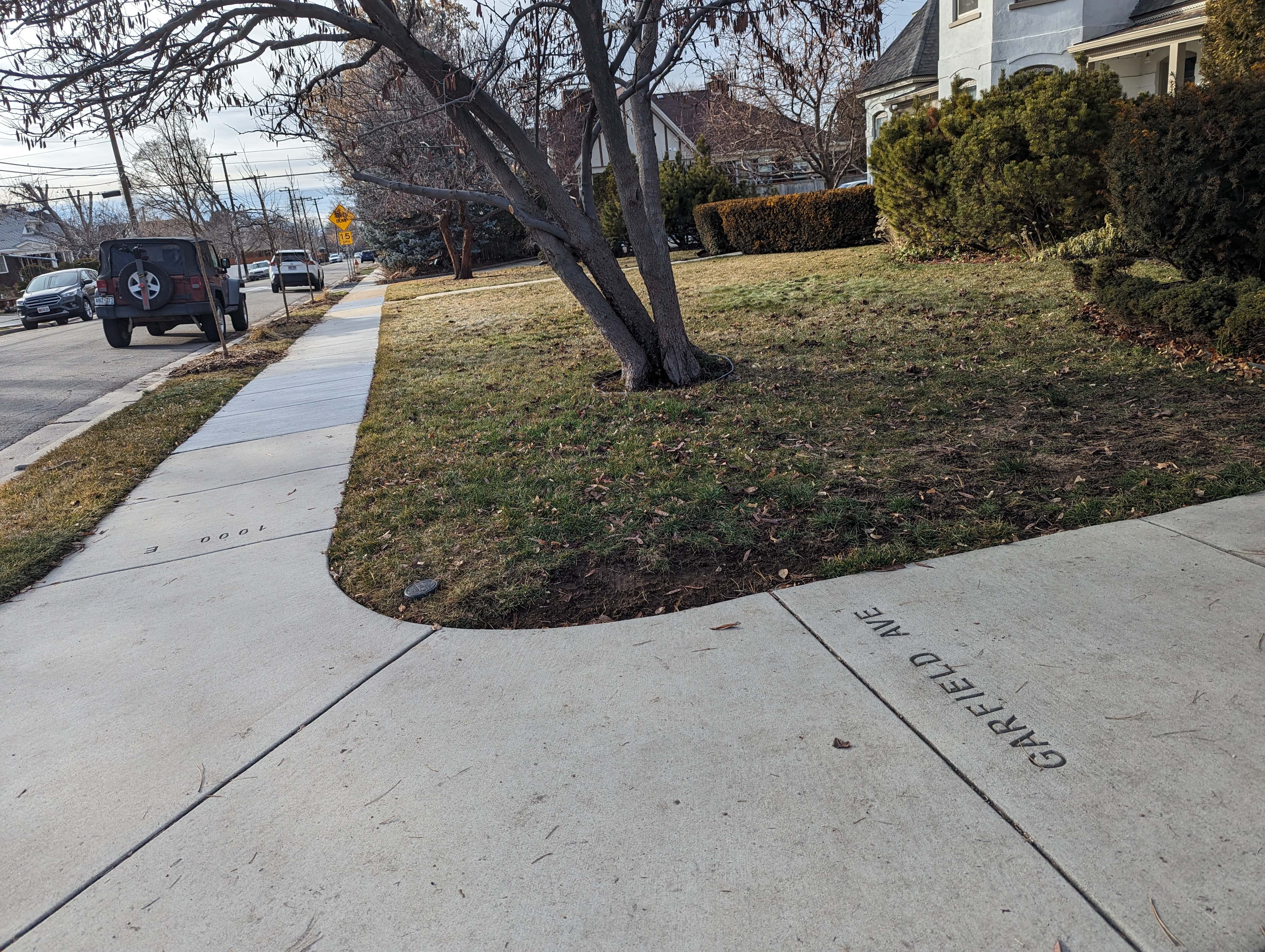
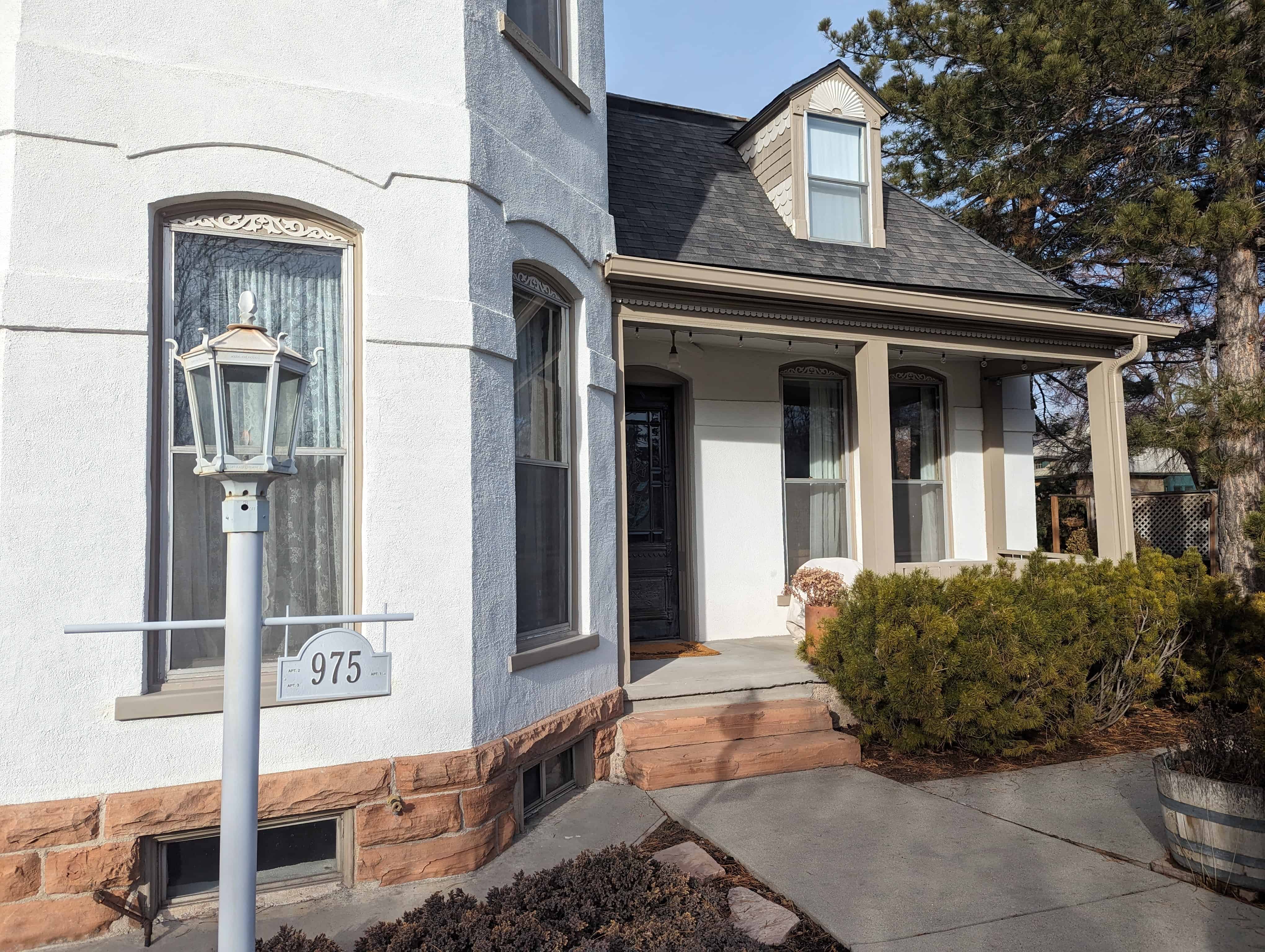
Built in 1889 and located at 975 East Garfield Avenue in Salt Lake City, Utah and added to the National Register of Historic Places (#78002684) on March 30, 1978. The text on this page is from the nomination form when it was added.
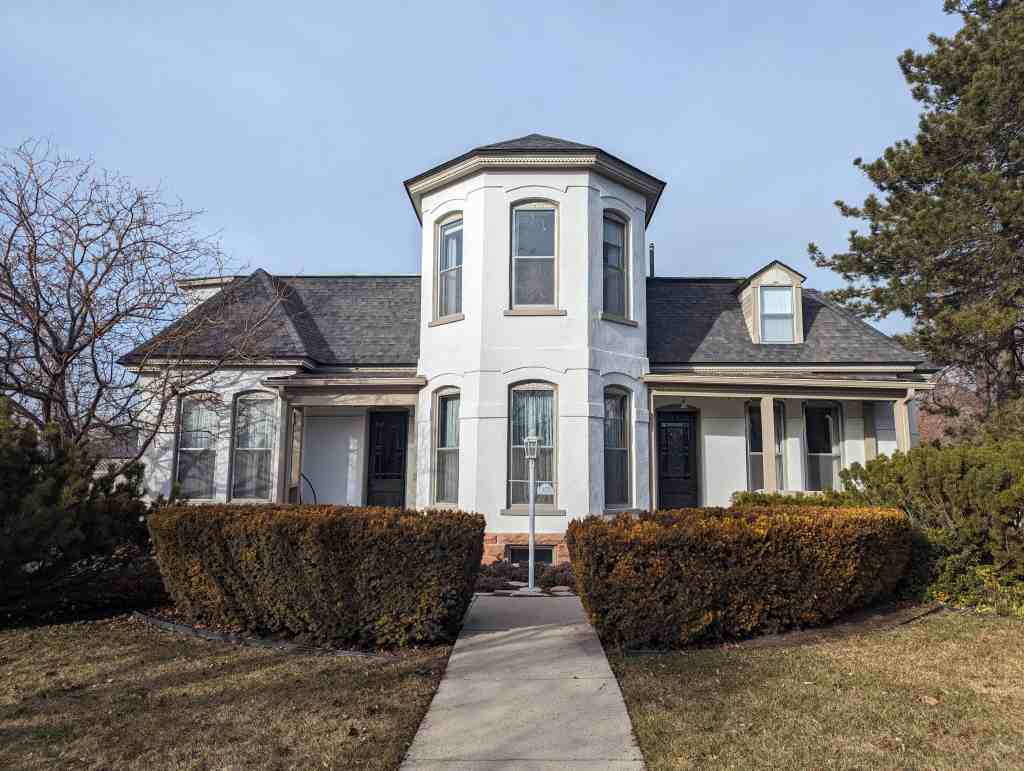
The John M. Whitaker House is a two-story building constructed of brick with stone trim in 1889. The residence follows the High Victorian Italianate style and is well preserved, excepting the stucco sheathing over the exterior brick–an alteration which conceals the original color and texture of much of the exterior. Inside, however, the house is very much intact.
Typical of Victorian era floorplans, the plan of the Whitaker House is irregular, yet it is almost symmetrical with both the east and west wings of the building being identical as to types and layouts of rooms. Each wing has separate front entries. The plan has all of the aspects of a two-family residence or perhaps a “polygamy house.” The central wing of the house has pent corners and is fully two stories tall, while the side wings are one-and-one-half stories in height.
The building has a hip roof and boxed and moulded cornice. The window bays are tall, segmentally arched and contain one-over-one operable sash windows. The wings have shallow, square bay windows. The foundation wall is sandstone. All major entries to the home are recessed and covered by wooden porches which feature carved wooden trim. The original landscaping is intact, the trees and shrubbery now being fully matured and very large. A photograph of the building taken shortly after construction shows the original appearance of the home and its yard.
Of its architectural features, the interior of the Whitaker House is most impressive Several fireplaces with ornamental wood mantels and front pieces, tile hearths, and stamped metal hoods are extant. A variety of Eastlake doors, as well as window and base trim are intact. The heavy Eastlake stair rails and balusters, high ceilings, wood floor and original hardware also remain in most areas of the building.
The original contract with T. O. and T. J. Angell, October 17, 1889, is extant and specified the “best of materials, Oregon pine studs, and maple, walnut or mahogany banister.” The contract also mentions a spring, a well, and plumbing and indicated “the house will be built at a cost of $4,575.”
John M. Whitaker was an active and prominent member of the Church of Jesus Christ of Latter-day Saints during its early years in the Salt Lake Valley. During his lifetime he saw the church emerge from the trying pre-manifesto days to its present condition. As a young man Whitaker knew intimately men whose lives reached back far beyond Civil War days. He was acquainted with Mormon Church President John Taylor and married his daughter Ida in 1886. He worked with John Young, son of Brigham Young, on some of the great railroad projects of Utah. Whitaker witnessed the dedication of the Salt Lake Temple and saw Utah enter into statehood. As one of the early residents of the Sugarhouse area, Whitaker developed what came to be known as the Verona Water System, the earliest supply of water in that location.
The papers of John M. Whitaker contain the many facets of his long life: missionary, bishop, patriarch, teacher and speaker in the L.D.S. Church as well as horticulturist, builder, educator, politician, businessman and diarist.
His business life included employment as the secretary of John W. Young and the building of the Salt Lake and Eastern Railway, manager of the Taylor Brothers Real Estate Company, assistant secretary and ticket and passenger agent of the Utah Light and Railway Company. He later became head of the office of the Utah Light and Railway Company (Utah Power and Light) , manager of the Deseret Employment Bureau, and Civic Employment Bureau and paymaster for the Civic Works Administration.
Whitaker was best known for his role in church activities and administration. He faithfully recorded what he saw and heard, and carefully preserved written information of all kinds. For fifty years he recorded for the press all the General Conferences of the Church of Jesus Christ of Latter-day Saints. He also initiated the tremendous growth of the seminary movement in the Mormon Church. His seminary teaching, the establishment of a Free Public Library which later became the Salt Lake Stake Library and his activities during the depression with unemployment in church and state marked the beginning of the ward, stake, and general welfare program of the Mormon Church.
During the polygamy persecutions when several church officials went into hiding Whitaker absorbed some of their responsibilities in their absence. This resulted in his work in the L.D.S. Church Historian’s Office and his long involvement recording and editing church history.
After the passage of the Edmunds-Tucker Law in 1887 the L.D.S. Church was disincorporated and Whitaker was out of work. He began employment with the Salt Lake Herald, the Cannon Brothers Real Estate Company, and gave private shorthand lessons, being an expert in that field.
In 1889 Whitaker was appointed to several prestigious offices in his church. It was also at this time that he became interested in politics. He worked for Senator Reed Smoot and made great efforts with lectures and press articles to defend B. H. Roberts in his fight to gain a seat in the United States Congress. He also defended and proselyted for Mormonism and became active in the prohibition movement, helping to organize the Utah Federation of Prohibition and Betterment League, later becoming its president in 1914. In addition, Whitaker was the first deputy treasurer of Salt Lake County. Whitaker’s last few years were concerned with seminary teaching, the initiation of the Church Welfare Plan and gardening. On April 2, 1960, John Mills Whitaker died at the age of 96.
The following chronology outlines the life and accomplishments of John M. Whitaker:
October 16, 1863. He was born at Centerville, Utah, the son of Thomas William Whitaker and Elizabeth (Oakden) Mills Whitaker. His youth was spent in Centerville and Ogden working with his father farming and in carpentry and building. At this time he began his study of Pittman shorthand. His first lessons were from his father.
December 17, 1879. He received a Territorial prize at the Deseret Agricultural and Manufacturing Society Fair for his wood carving of the Lord’s prayer. He was very proficient in carving and scroll work.
1883. He worked in a bank in Ogden for H. S. Young.
August, 1883. He went to Salt Lake City with his father to work in the building trades. He joined the Delta Phi Debating Society at the University of Deseret. He was made secretary. During the evenings he gave shorthand lessons to students. Also he started recording speeches, sermons and the conferences in the Tabernacle, which activities he continued throughout most of his life.
November 7, 1882. He met Ida Taylor, daughter of John Taylor, president of the L.D.S. Church, and Mary Oakley Taylor.
January, 1884. He registered at the University of Deseret as a Normal student. He earned money by giving shorthand lessons, recording sermons and speeches. He was also employed on a part time basis as instructor in phonography (phonetics, shorthand, typewriting and commercial letter writing). He also helped his father. He attended the 14th Ward where he met many Church leaders, contacts which were of benefit to him later.
July 7, 1884. Franklin D. Richards, L.D.S. Church Historian, offered him a part time job which he accepted. During the time of the polygamous persecutions when Richards had to be away, Whitaker was responsible for all the office business.
April 28, 1886. His father, Thomas W. Whitaker, died suddenly of a heart attack in Salt Lake City.
June, 1886. He received his two-year Normal degree.
September 22, 1886. He married Ida Taylor. They lived at the Gardo House for a time-while President Taylor was in hiding during the time of polygamy period.
February 23, 1887. He began efforts to establish a Free Library and Reading Room in the Salt Lake Stake.
July 23, 1887. John and Ida’s first child was born. She was named Ida Taylor Whitaker.
July 25, 1887. President John Taylor died while still in hiding over polygamy.
The Church offices closed because of federal pressures. The L.D.S. Church was disincorporated as a result of the Edmunds-Tucker Law passed March 1887. Whitaker was out of work. He was offered part time employment for the Salt Lake Herald, which position he accepted. He also worked for the Cannon Brothers Real Estate Company and other establishments. He continued to give private shorthand classes. At this time he became actively interested in politics. Through his efforts the Salt Lake Stake Library was established.
February 29, 1888. He was asked by John W. Young, owner and manager of the Salt Lake and Fort Douglas Railway to work for him. He became his private secretary and was managing secretary for the railroad. August 30, 1888. He became the purchasing agent for the Salt Lake and Eastern Railway also. This necessitated giving up the University and other work except some reporting for F. D. Richards. September 3, 1888 he was put in charge of the new offices, and on September 22 was made director. October 3 he was in charge of all affairs of John W. Young while Young was in the East.
September 22, 1888. His daughter Mary Taylor was born. She died November 28, 1888.
January 24, 1889. He was called to New York by Young to assist him there.
June 11, 1889. He purchased an acre of ground in Sugarhouse area.
June 24, 1889. He assisted Young in the organization of the Utah-Western Railway Company. He became one of the directors and stockholders.
July 11, 1889. He became secretary and general treasurer of the First Council of Seventy of the Church of Jesus Christ of Latter-day Saints. He was also a member and the secretary of the Sunday School Union Board and secretary to the General Superintendency of the Sunday Schools.
1889. He continued private shorthand classes and wrote out blessings of missionaries for the extra income. During August he taught a class at the University of Utah. He taught the first Commercial course given at the University of Utah.
1889. He was assistant secretary of the Bullion Dust Mining Company.
September, 1889. He turned over to others the work of the Free Library.
October 17, 1889. He let the contract for the building of his home at 975 Garfield Ave.
January 5, 1890. His daughter Elizabeth Taylor was born.
September, 1890. The family moved to their new home in Sugerhouse Ward.
1890. He became very active in promoting learning among the young people. He was soon elected a trustee of the Twenty-ninth School District.
August 18, 1891. His daughter Marguerite Taylor was born.
1891. He was still actively interested in politics. He also recorded many speeches of visiting celebrities.
June 3, 1893. He received his teaching certificate from the University of Utah.
November 6, 1892. His son John Taylor was born.
1895. He was one of the reporters for the Constitutional Convention. He voted “Yes” for Utah to become a state.
February 23, 1896. His son Leon Taylor was born. Died, April 13 of whooping cough.
November, 1896. He cast his first vote for the President of the United States.
May 5, 1897. His daughter Janette Taylor was born.
August 18, 1897. He was called on a mission to the Eastern States Mission. He left December 3, 1897.
1898. He was in charge of the elders of New Jersey. He lectured, wrote press articles and his first pamphlet, “The Plan of Salvation.” May 1898. He was appointed president of the New England Conference. He organized the first L.D.S. Sunday School in Providence, Rhode Island.
May, 1899. William H. Smart, president of the Eastern States Mission, called John Whitaker to Boston to act as his assistant. His assignment was to systematize the Mission records, write histories of the conferences and also a general history of the Mission. During all this time he made great efforts with lectures and press articles to defend B. H. Roberts in his fight to gain his seat in Congress. He also did the same in defending and proselyting for Mormonism.
January 20, 1900. He was released from his mission after 25 months in the field.
November 24, 1900. His son Eugene Taylor was born.
February 1900. He was appointed second counselor to the bishop of Sugarhouse Ward. January 1902. He was appointed first counselor.
February 7, 1901. His son John T. Died of diphtheria.
1902. He became the first deputy treasurer of Salt Lake County.
1903. He was a worker for Reed Smoot, Senator. He was one of the committee to go to Washington to plead the case.
July 26, 1904. His son Edison was born.
January 1905. He was made bishop of Sugarhouse Ward.
March, 1905. He became assistant secretary and ticket and passenger agent of the new Consolidated Light and Railway Company. Later he became head of the office of the Utah Light and Railway (Utah Power and Light Company).
February 9, 1907. He resigned this position to become manager of the Taylor Brothers Real Estate Company. In 1908, Taylor brothers Real Estate was agent in this area for the King Hill Irrigation Project, King Hill, Idaho. Whitaker was actively involved in its preliminary promotion. He and members of the family bought into it.
May 1911. He first expressed his interest in prohibition. He became active in the movement and helped organize the Utah Federation of Prohibition and Betterment League. In 1914 he became its first president.
March 1914. He was released as bishop of the Sugarhouse Ward when it was divided and reorganized. He was selected to be a patriarch.
1915. He was appointed by Frank Y. Taylor as the instructor for the L.D.S. Granite School Seminary. He reorganized the whole curriculum and procedure. With Adam S. Bennion, superintendent of Church Education, George H. Brimhall, president of B.Y.U., and others, he helped develop the church seminary system and curriculum.
April 1917. He proposed having the Seminary students speak in the wards, which activity has continued.
June 10, 1919. He received his Bachelor of Science in Education and his High School Life Diploma from the University of Utah. He continued taking courses in evolution, psychology, science and modern thought under visiting professors.
July 1920. As chairman he conducted the Lecture Program for Seminary Teachers at the B.Y.U. Aspen Grove Summer School. He delivered many of the lectures himself.
June 1921. He was again responsible for the lecture program on “Doctrine of the Church” at B.Y.U. Summer School.
January 15, 1925. He was made chairman of the new Editing Committee on Church History and Doctrines with Sidney B. Sperry, David A. Broadbent, and Enoch Jorgensen.
July-August, 1927. He taught the course “Science and Religion” at B.Y.U. Aspen Grove Summer School.
June 1929. At age 65 he retired from seminary teaching.
November 1927. The family moved from the old home at 975 Gargield where they had lived for 27 years to the newly completed home at 1536 South 13th East.
December 13, 1929. He became the manager of the Deseret Employment Bureau. He immediately put into it the same enthusiasm, systematizing efforts, innovations and hard work as in all his endeavors.
Fall of 1930. He also managed the newly created Civic Employment Bureau. It closed in the spring of 1931, reopened in the fall of 1931, and closed again the next spring of 1932.
August 1932. The Deseret Employment Bureau was placed under the Presiding Bishop’s Office. He was designated as “contact officer.” He also received the tithing in produce under David F. Smith, manager of Growers’ Exchange. Continued through 1936.
1933. He was paymaster for Civic Works Administration. He also taught some seminary classes. 1936. The Welfare Plan of the Church of Jesus Christ of Latter-day Saints was initiated. Whitaker was invited to meet and help in its organization and development. Much of his past work became a basis for its development.
1937. His mother, Elizabeth Mills Whitaker, died in Centerville, at the age of 98 years
1939. The Federal reform program was becoming a program of recovery. This brought about the end of the work with the Presiding Bishop’s Office.
June 1942. He and Ida became members of the University of Utah Emeritus Club. June 7, 1943. He was made its president.
May 22, 1946. On this date occurred the death of his wife, Ida Oakley Whitaker, at their home. She was 86 years old, the last surviving daughter of President John Taylor. He lived alone until 1954. He worked in his garden, with his sons, attended church, did ward teaching, gave blessings, had fireside meetings in his home. He began to organize and write his transcript journal from his many notes, letters, and diaries.
1951. He made a trip to the H. E. Huntington Library at San Marino, California, to see Leslie E. Bliss who was interested in the Whitaker journal. He made arrangements for them to make photostatic copies.
1954. His daughter Bessie and husband Nelson G. Hunt moved in with him. Mr. Hunt died soon after.
1958. He made arrangements with Mr. L. H. Kirkpatrick to send his library and collection of papers, letters, diaries, etc., to the University of Utah Library. Some were turned over to them in 1959 and some were to be given later. The last were received by the Library in 1969.
July 29, 1959. He made his last journal entry.
April 2, 1960. He gave his last blessing. Three hours later he died at his home on 13th East, age 96 years 6 months.
Whitaker’s house was designed by Truman O. Angell, Jr. and built by the Angell Brothers. Angell is best known as architect of the Logan Temple and Temple ton Building The Whitaker House, built in 1889, is High Victorian Italianate in style.
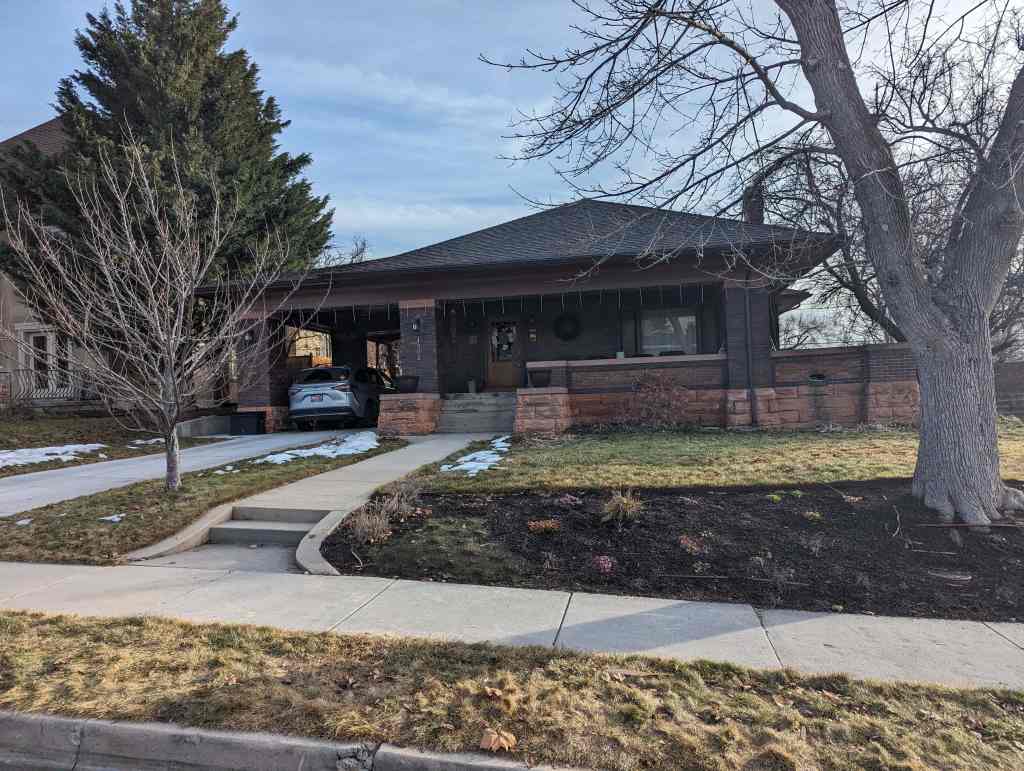
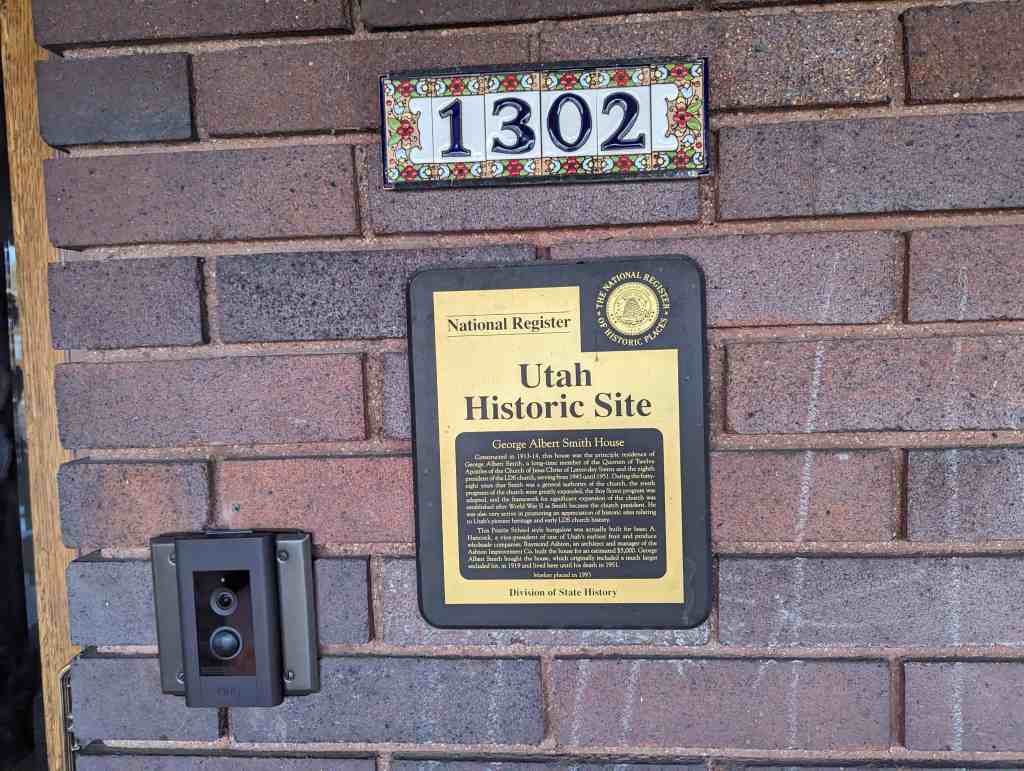
Constructed in 1913-14, this house was the principle residence of George Albert Smith, a long-time member of the Quorum of Twelve Apostles of the Church of Jesus Christ of Latter-day Saints and the eighth president of the LDS church, serving from 1945 until 1951. During the forty-eight years that Smith was a general authority of the church, the youth programs of the church were greatly expanded, the Boy Scout program was adopted, and the framework for significant expansion of the church was established after World War II as Smith became the church president. He was also very active in promoting an appreciation of historic sites relating to Utah’s pioneer heritage and early LDS church history.
This Prairie School style bungalow was actually built for Isaac A. Hancock, a vice-president of one of Utah’s earliest fruit and produce wholesale companies. Raymond Ashton, an architect and manager of the Ashton Improvement Co. built the house for an estimated $5,000, George Albert Smith bought the house, which originally included a much larger secluded lot, in 1919 and lived here until his death in 1951.
Located at 1302 East Yale Avenue in the Yalecrest Neighborhood and the Yalecrest Historic District in Salt Lake City, Utah and added to the National Register of Historic Places (#93000066) on March 12, 1993. The text above is from the plaque on the home, the text below is from the nomination form for the National Register.
Constructed in 1913-14, this house is significant for its association with George Albert Smith, long-time apostle of the Church of Jesus Christ of Latter-day Saints (LDS or Mormon church) and president of the church from 1945 until 1951. Smith bought the house in 1919 and remained here until his death in 1951. Though he lived in other residences prior to this one, this was his principal residence and the one most closely associated with his career as an important religious leader. As eighth president of the LDS church, George Albert Smith ranks as an exceptionally significant figure, thereby overriding the requirement that properties achieve their significance at least fifty years ago.
The George Albert Smith House was actually constructed for Isaac A. Hancock, vice-president of Hancock Brothers Fruit Company, which was one of the earliest wholesale fruit and produce companies in Utah. Hancock obtained a building permit for the house on November 26, 1913. The estimated cost of construction was $5,000, and the builder was listed as Raymond Ashton. Mr. Hancock lived in the house until 1919, when he sold it to George Albert and Lucy Emily Smith and moved up the street to 1340 Yale Avenue. Raymond Ashton was the manager of Ashton Improvement Company and was also an architect, suggesting that he may have been involved in the design of the house. Raymond Ashton was also associated with Edward M. Ashton (his brother) and Edward M. Jenkins, developers of Yale Park subdivision and other east side, Salt Lake residential areas.
At the time the Smiths purchased this house, George Albert was vice-president of Utah Savings and Trust Company and a member of the Quorum of the Twelve Apostles in the Church of Jesus Christ of Latter-day Saints. The Quorum of the Twelve is the governing body of the church directly under the president and his councilors. Members of the Quorum and other top church officials, known as general authorities, held positions with church-owned companies as a means of financial support; their primary occupation, however, was church work. George Albert Smith had been appointed to serve as an apostle in 1903 at the relatively young age of 33. Both his father and grandfather had also served as apostles. His occupation prior to his call to the apostleship was as receiver for the Land Office of Utah, having been appointed by U.S. President William McKinley in 1897 and reappointed by Theodore Roosevelt in 1902. Smith served as an apostle in the LDS church until his selection as eighth president of the church on May 21, 1945, after the death of president Heber J. Grant. He was 75 years old at the time. He remained president of the church until his death on April 4, 1951.
George Albert Smith’s career as an apostle and president of the LDS church spanned 48 years and was marked by several significant achievements. He was particularly active in programs for the youth of the church. He was a member of the general board of the church’s Young Men’s Mutual Improvement Association (YMMIA) from 1904 until 1921, then served as general superintendent of that organization from 1921 to 1935. In that role he was influential in setting policies, establishing programs, and directing youth activities throughout the church. Smith was impressed with the Boy Scout program and recommended its incorporation into the YMMIA program after it was introduced in the United States in 1910. The church adopted the program with such enthusiasm that Utah and the church emerged as world leaders in the percentage of boys enrolled in scouting programs. Smith directed the scouting program in the church and in 1931 was appointed to the advisory board of the National Council of Boy Scouts of America. In 1932 he was awarded the Silver Beaver, and in 1934 the Silver Buffalo, two of scouting 1 s highest awards.
Smith was also very active in promoting awareness and appreciation for historic sites related to church and Utah pioneer history. He was instrumental in acquiring property and erecting a monument in upstate New York in recognition of church founder Joseph Smith and in 1937 organized the Utah Pioneer Trails and Landmarks Association. That organization erected hundreds of historic monuments are markers along the Mormon Trail (from Nauvoo, Illinois, to Utah) and throughout the west, including the “This Is The Place” monument at the mouth of Emigration Canyon east of Salt Lake City, which was erected in 1947 on the 100-year anniversary of the arrival of the Mormon pioneers to the Salt Lake Valley.
During George Albert Smith’s tenure as church president the church began expanding its presence in the United States and throughout the world. His appointment as president in 1945 coincided with the end of World War II, which afforded new opportunities for church expansion. The church’s missionary program was revitalized as the number of missionaries rose to over 5,000, an unprecedented high. There was a marked increase in the number of wards (congregations) and stakes (groups of congregations) organized, some 200 new meetinghouses were built, new hospitals were constructed and old ones enlarged, and a new temple was completed in Idaho Falls, Idaho. Growth of the church in subsequent decades would be even more dramatic, but the pattern for much of that later growth was established in the years after World War II while George Albert Smith was president.
When the Smiths purchased the home from Isaac Hancock in 1919, they were attracted by its location and large lot. The house is situated on the east bench of Salt Lake City, a new and desirable residential neighborhood at the time. They had been living downtown near Temple Square (21 N. West Temple, now demolished), a neighborhood that was rapidly losing its residential character. An especially attractive feature of the new house and lot was Red Butte Creek, which ran through the back of the property. The creek was far below the level of the street and house, and offered a secluded natural retreat for the family. The large size of the property–large enough for three additional houses added to the sense of seclusion that the Smiths enjoyed. They envisioned a family compound, with all three of their children constructing houses on the property. This dream was only partially realized. The two married daughters built homes nearby, one to the south across the creek and the other to the east, but their son Albert chose to remain in the East after completing his schooling at Harvard. The lot earmarked for his home, directly east of the parents’, was instead used as a garden area for outdoor entertaining. One notable event celebrated in the Smith’s yard was a dinner party for 400 guests, including the governors of forty-six states, their wives, and other dignitaries on July 15, 1947. This was one of the key events in the pioneer centennial celebration that culminated on July 24, 1947.
After George Albert Smith’s death in 1951, the house was held in trust by his family until 1953, when it was sold to Warwick Lamoreaux, an attorney. During Lamoreaux’s ownership, a number of minor changes were made to the house and a duplex was built next door in the garden area. Two other houses were also built on the property down near the creek; these are now separate properties. The current owners of the Smith House, Dennis M. Greenlee and Diana G. Pounder, purchased it in 1989 and have returned much of the house to its original condition.
Description:
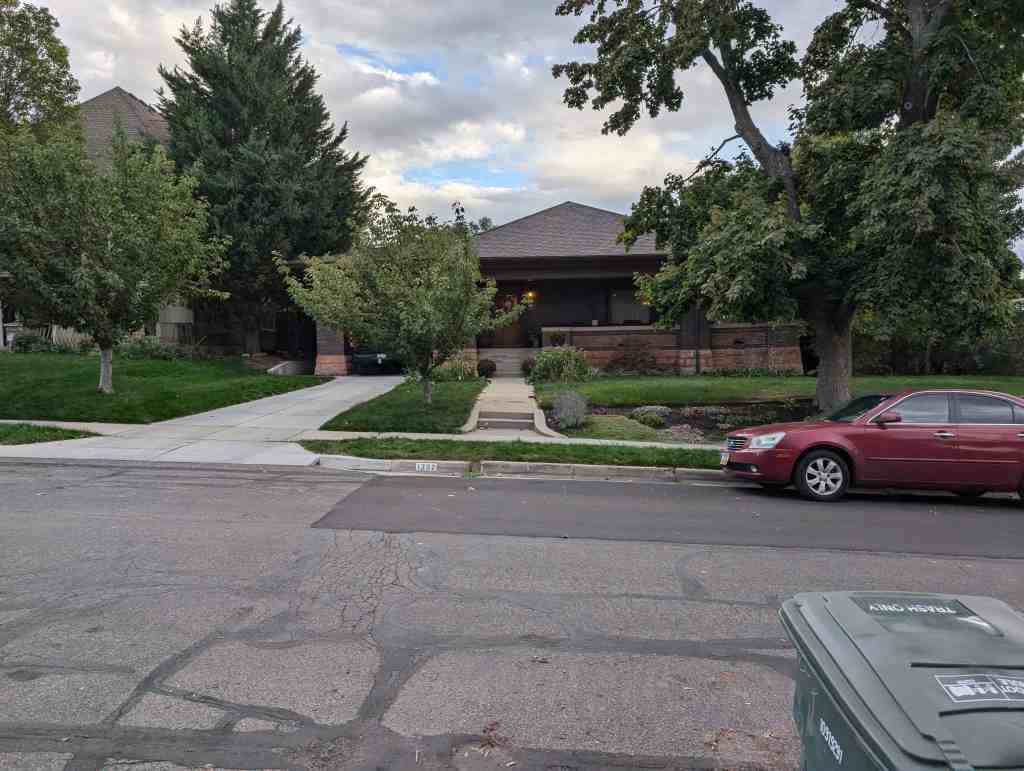
The George Albert Smith House, built in 1913, is a one-story brick bungalow with a hip roof, sandstone foundation, and Prairie School stylistic influences. No major alterations have been made to the house, though a few minor changes have been made on both the exterior and interior. Overall, however, it retains a high degree of its original integrity.
The house is slightly elevated above and east of 1300 East Street and is on the corner lot on the south side of Yale Avenue. The house is approximately 41 feet wide (plus the 13 foot wide porte-cochere) and 70 feet long with the more narrow front end facing Yale Avenue. The original property included both the lot directly east of the house as well as the lot directly south of the house adjoining Red Butte Creek. The side lot was used as a rose garden and the back lot was a terraced wooded area down to the creek. The east lot now has a brick duplex on it, and the south lot has two more contemporary residences overlooking the creek. These are no longer part of the Smith House property and are not included in the nomination.
Typical of Prairie School bungalows, the house has a low, horizontal emphasis. This horizontality is created by the low-pitched hip roof with wide eaves, the fullwidth, wrap-around front porch with a brick railing wall, and the porch cochere which extends the overall width of the house to the east. The house appears very heavy and large (a total of over 4000 square feet on the main floor and basement combined). It rests on a large rusticated sandstone foundation, and the exterior walls are a very dark reddish-brown fired brick, still in very good condition. The use of these natural materials and earthen colors are typical of the Prairie style home. These brick walls support a low hip roof which overhangs the walls by nearly two feet, again typical of the Prairie style homes. On the east side of the house is a porte-cochere with steps leading to the porch and front entrance. The porch extends across the entire front of the house and about a third of the way down the west side. The porte-cochere and porch are supported by heavy brick columns.
On either side of the front door and on the columns by the stairs are light fixtures with a hand-crafted appearance, similar to those found in Greene and Greene’s Gamble House in Pasadena, CA. The fixtures flanking the door have simple red and green stained glass flower figures in them, whereas those mounted on the columns of the porte-cochere have no stained glass work. The front door and the side door to the dining room (from the porch) are heavy oak doors with Arts and Crafts type brass hardware and beveled glass inserts on the top half.
There are a variety of window types used in the house. Many of the original windows are casement type, the most interesting of which are the stained glass windows on either end of the living room mantel and in the front bath (formerly a part of the entry hall). These stained glass windows have a more curvilinear and organic design than is typical of the Prairie School style, which tend to be geometric patterns, and are highlighted with green and gold colors. The bookcases flanking the fireplace are also encased with leaded glass doors which have a more elaborate geometric pattern. There are two large picture windows, one each in the living room and dining room. The east side bedrooms and the kitchen contain standard single hung windows, whereas the back of the house contain large casement type windows with small panes in them. Some are hinged on the top, swing into the room and hooking on the ceiling for a “porch-like” effect. (The exterior storm windows were added in recent years.) A shed-roofed carport extension has been added on the rear of the porte-cochere (probably post-1960s), but it is barely visible from the front of the house.
The large living and dining areas are open to each other with only a third-height wall separating the two spaces midway down on the west side of the room (see floor plan). Markings on the original quarter-sawn oak floors and salvaged red gum woodwork found in the attic suggest that the two rooms were formerly separated by built-in bookcases enclosed with leaded glass doors on either side of the living/dining dividing wall. George Albert Smith’s granddaughter, Margaret Hatch, reports that the living and dining areas were also separated by full-length folding glass doors that stretched between the built-in bookcases.
The dining area also originally had a built-in buffet cabinet on its south wall with a pass-through to the kitchen. Other gumwood detail including a large plate rail about two-thirds up the wall height were removed during Mr. Lamoreaux’s occupancy (post-1953). These former and present wood accents would have been typical of a Prairie bungalow home. Much of the original woodwork has been painted, but the entry hall “divider,” the fireplace mantel, stained glass windows, bookcase leaded glass doors, and the doors in the living/dining area are refinished red gum wood. The entry/living/dining floors are quarter-sawn oak. Other floors in the house are currently carpeted, but have cedar floors beneath them. The entry hall and dining room also have matching copper-colored chandeliers with a hand-crafted geometric appearance.
The kitchen is immediately south of the dining area and is appointed with almost all of the original cabinet work, including the original built-in ironing board and potato bin. Only slight alterations have been done to accommodate more modern appliances. The flow or movement between the kitchen and dining room was probably made easier by use of the original pass-through to the built-in dining room cabinet, though the pass-through is closed off now.
There is a clear distinction in the floor plan between public and private space. The living, dining, and kitchen areas are on the west side of the house nearer 1300 East Street, whereas the bedrooms and baths are on the more private east side of the house. The bedrooms are a comfortable size and have unusual built-in closets/cupboards with glass front doors, all of which are original to the house. The hallway also has similar built-in cupboards. The walls of the bedrooms as well as all other rooms are the original plaster, all of which is in very good condition. The main bath is appointed with most of its original fixtures, including a claw foot tub, built-in vanity cabinet, and white hexagonal ceramic floor tiles.
The home is well-built and well-preserved, with only minor changes in its design. The house is still heated with the original furnace (converted to gas) and original steam heated radiators. The only major alterations have been in the basement, where the floor plan has been altered to accommodate a basement apartment.
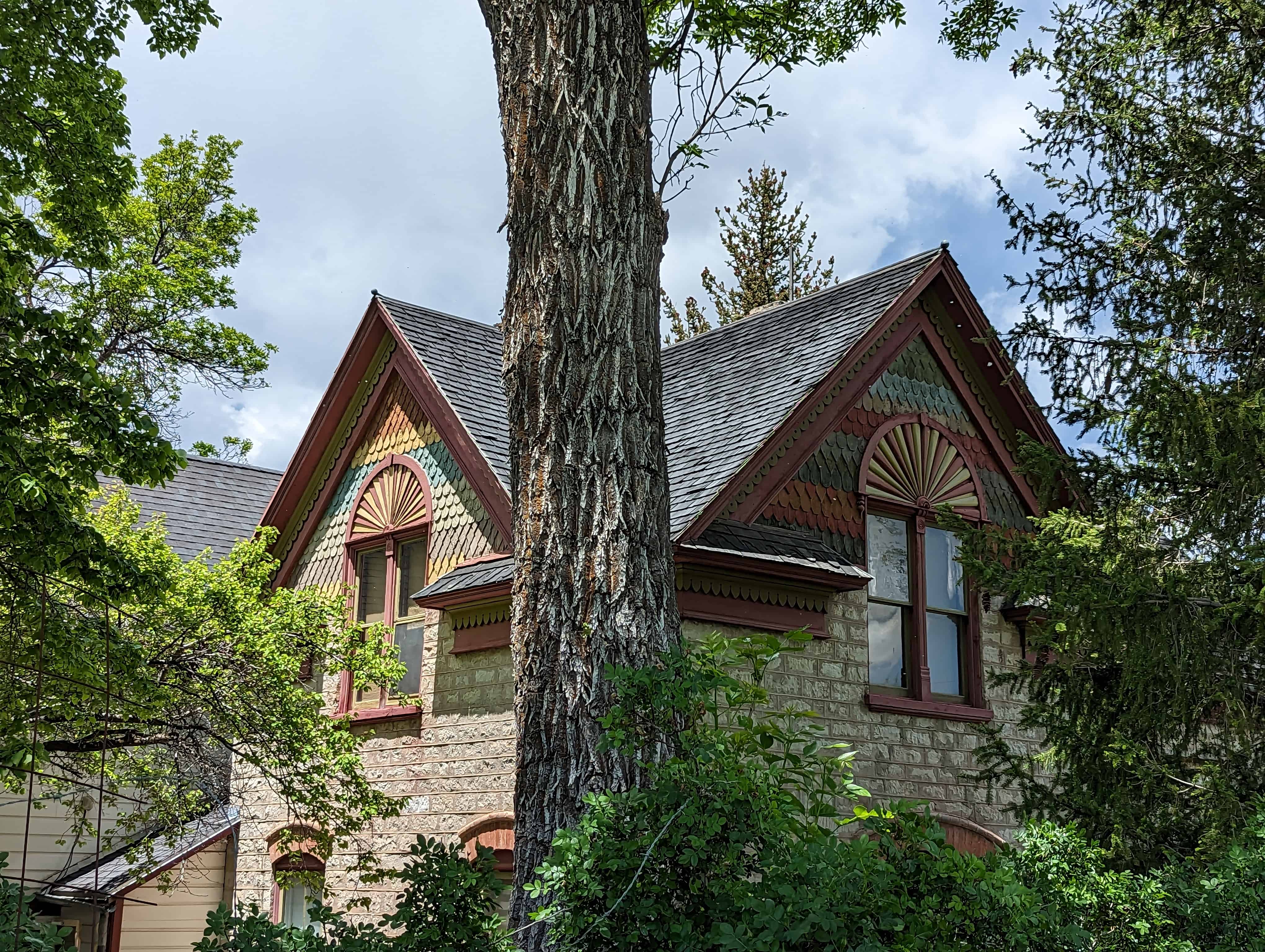
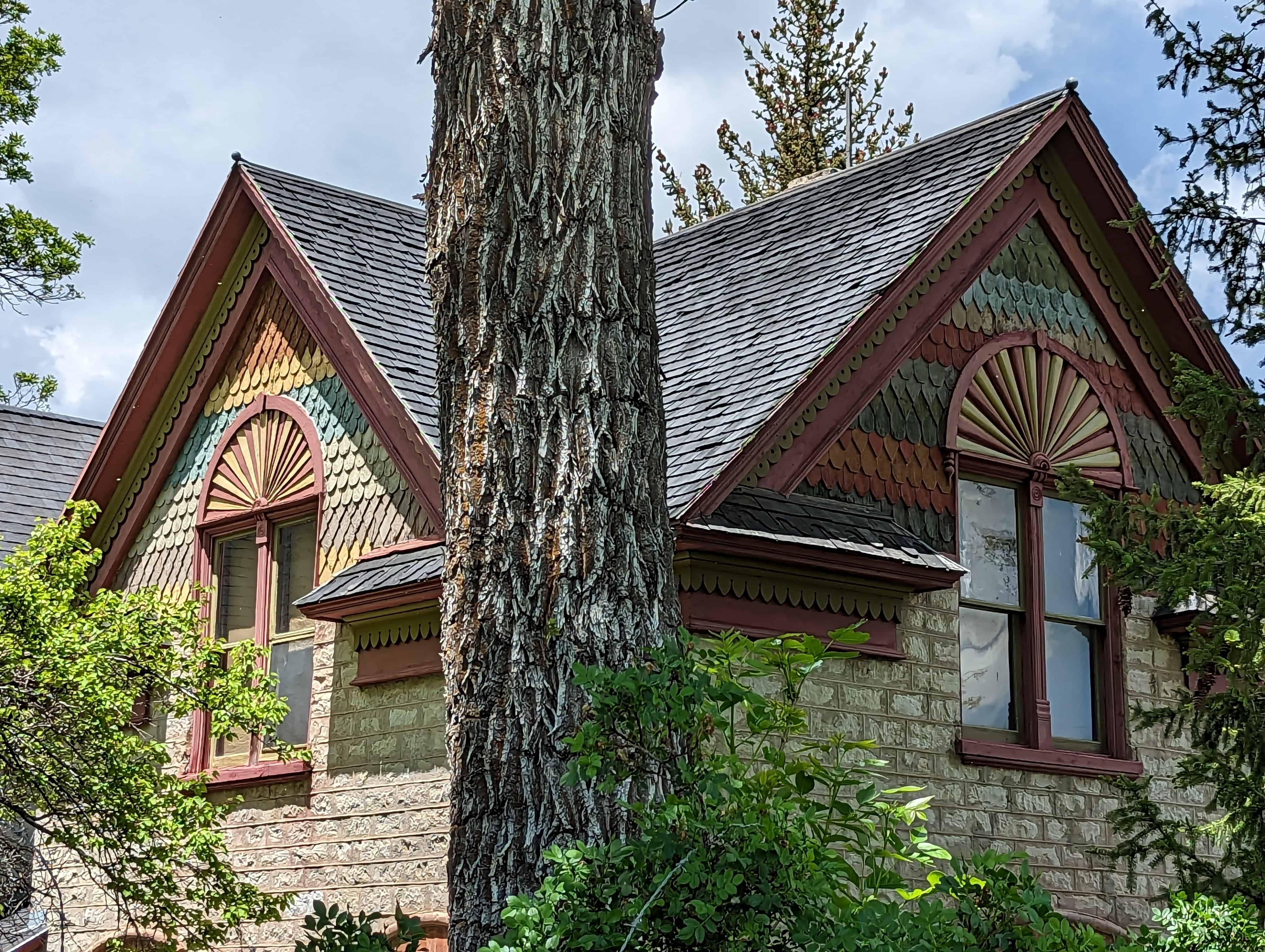
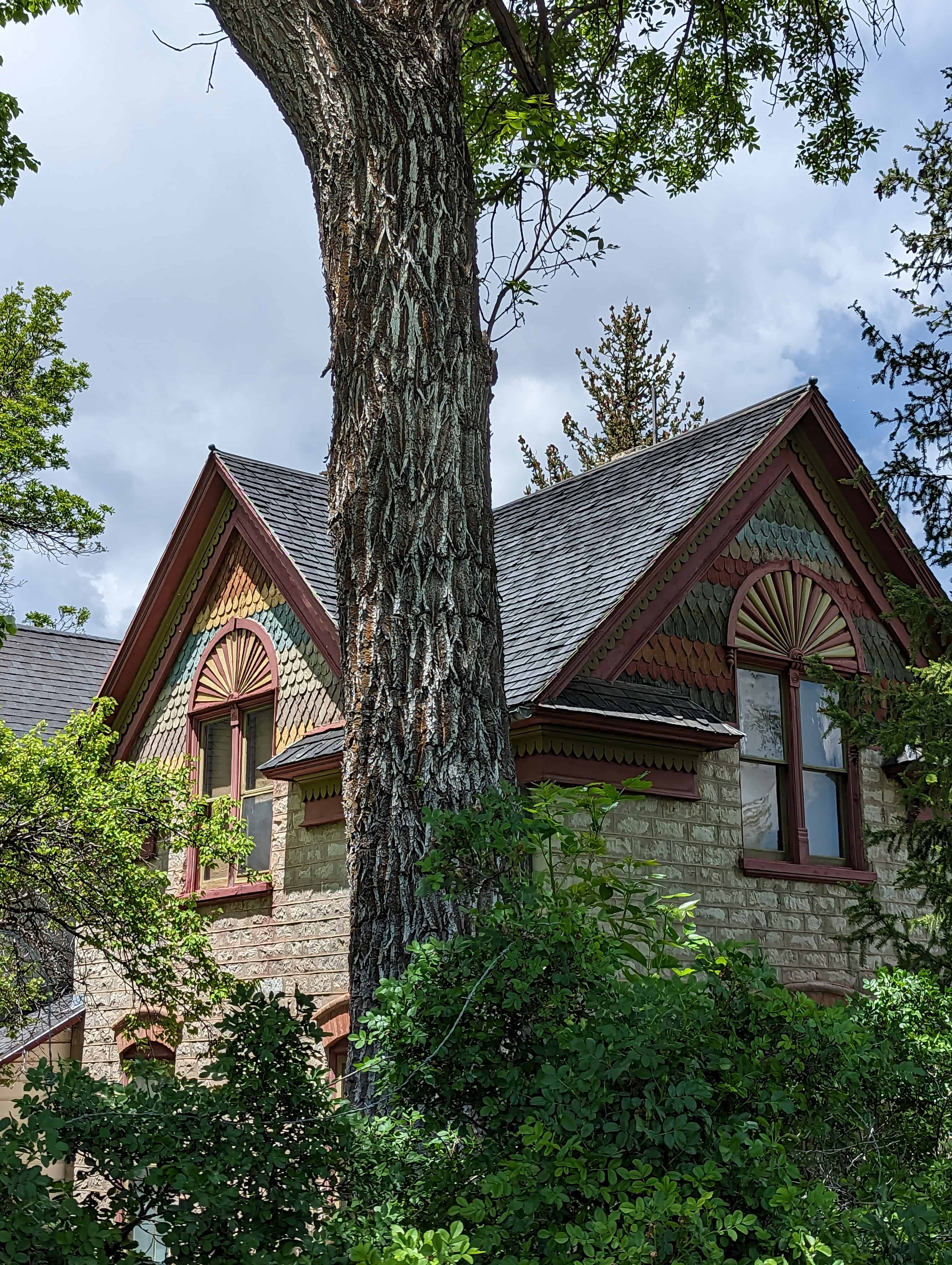
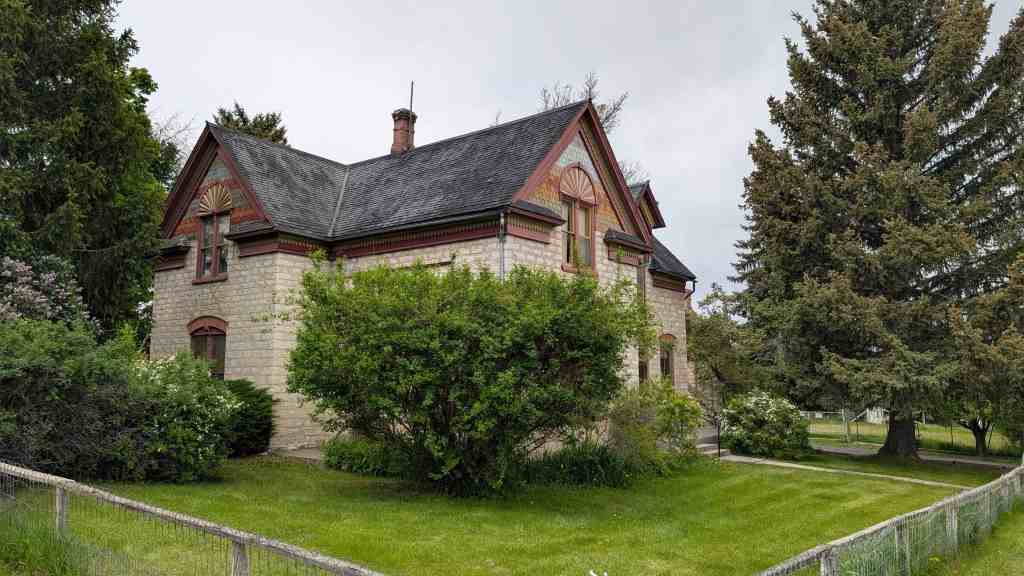
Built in 1869 of soft-rock this one and one-half story house with a steeply pitched cross-gable roof illustrates the subtle use of Gothic Revival styling for a vernacular house type. The Hawley house is representative of several houses built near that year. With these houses an attempt began to stylize vernacular house types in Pleasant Grove. Before this year, gable-roofed houses were lower-pitched and undecorative. Near the 1890s, a frame lean-to attached to the rear of the house was replaced by the existing two-story section. At that time Victorian porches were added to the back and front, a second story walk-out porch placed above the front porch, the soft-rock stuccoed and splotched with black paint to resemble granite, and corner quoins scored. The house was extensively renovated and restored in 1984; new decorative wood replaced the old, using the elaborately saw-cut ornamental originals as patterns. All original outbuildings were removed from the property at that time.*
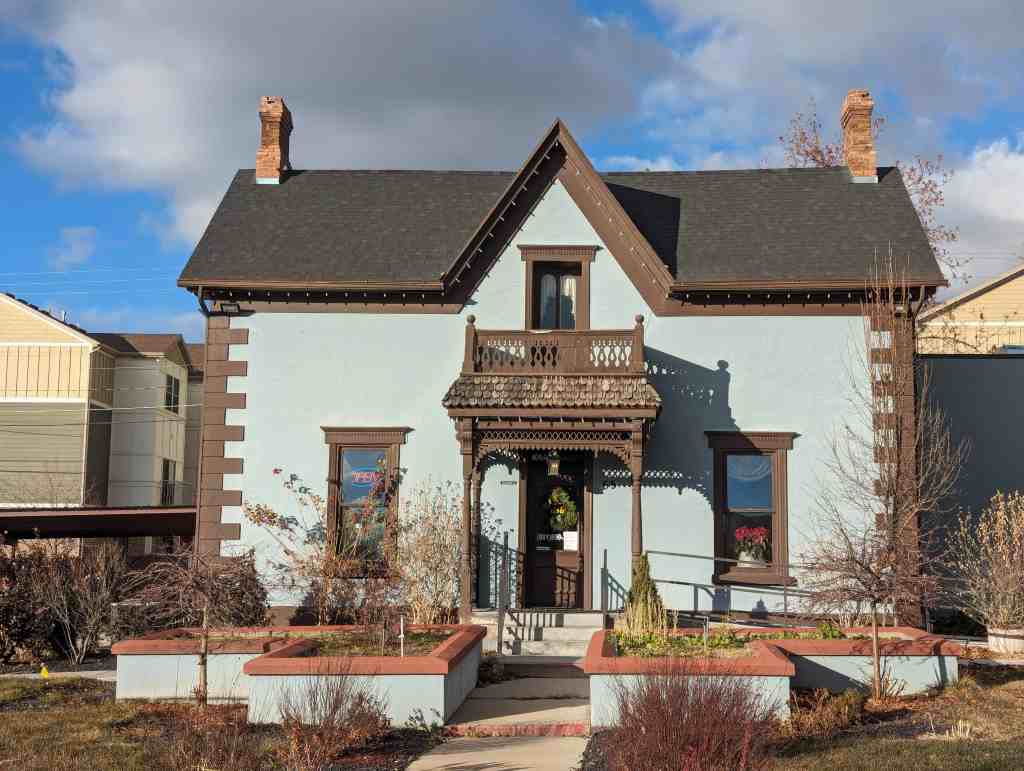
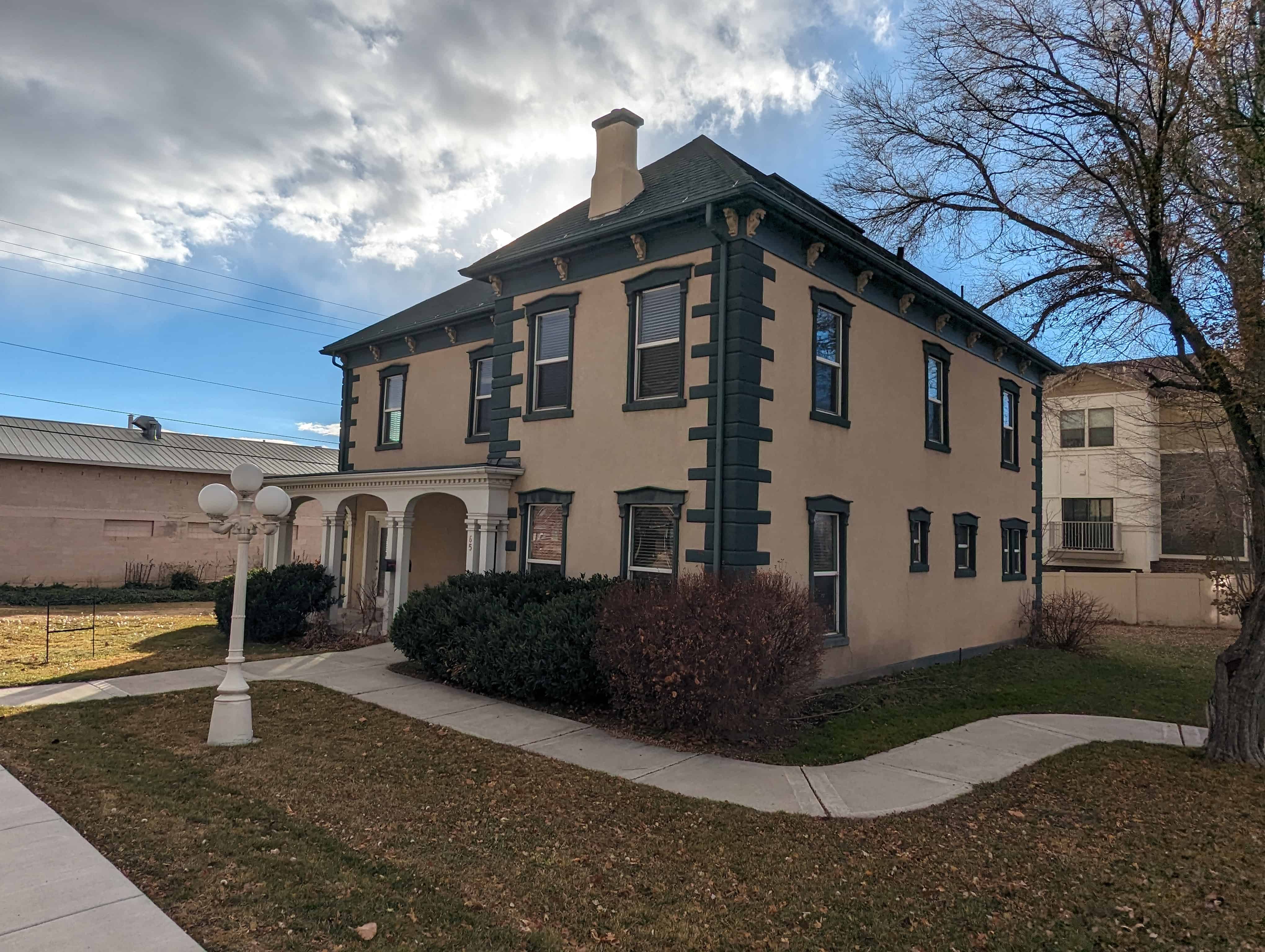
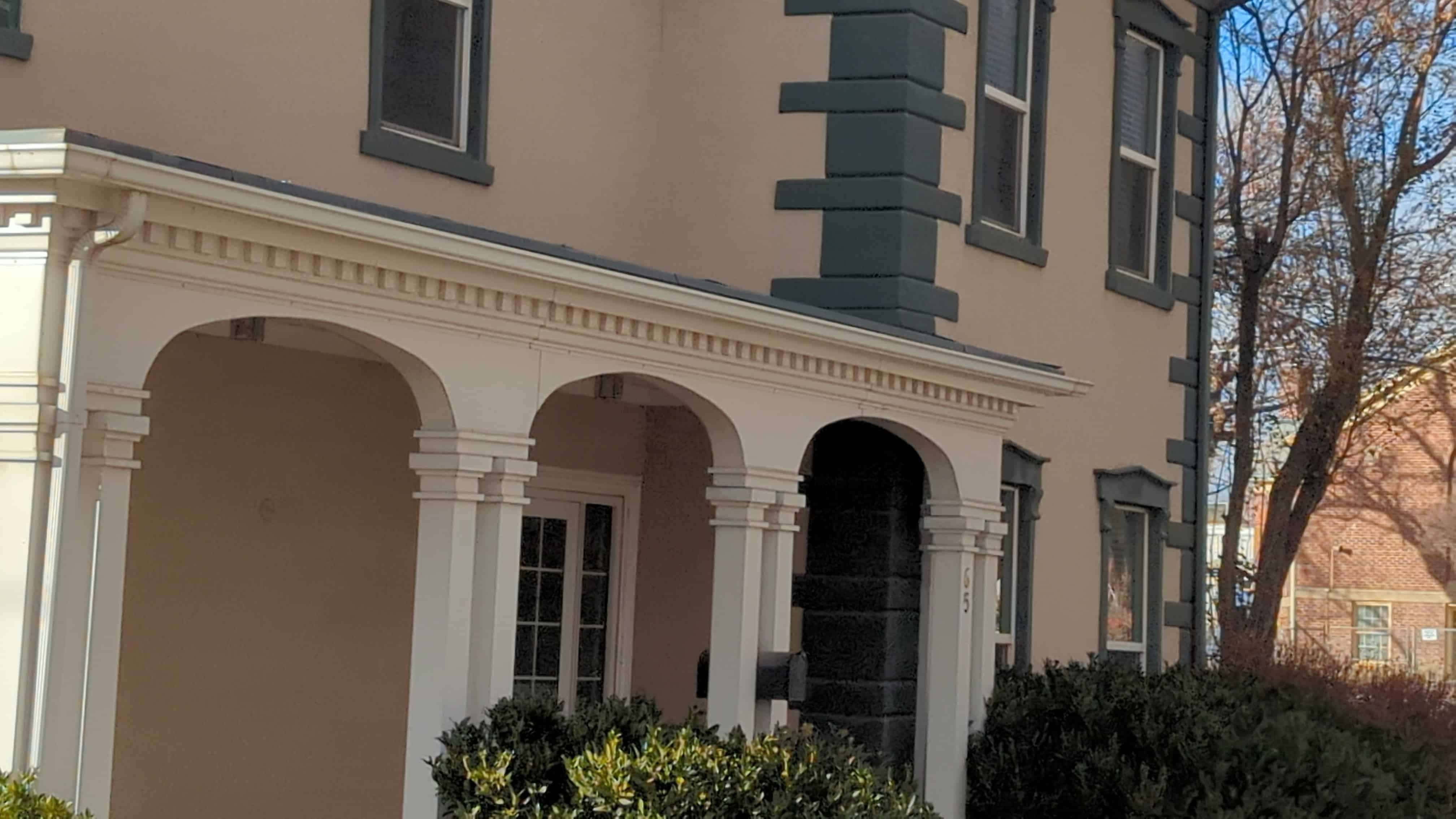
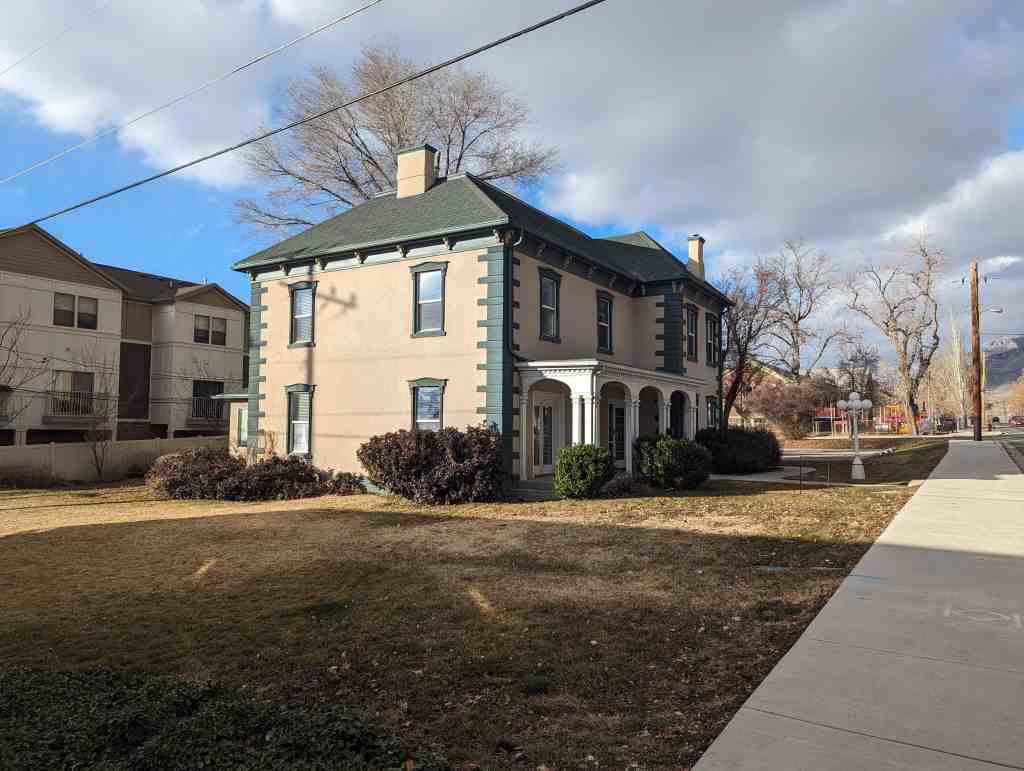
The Beers House/Hotel is both historically and architecturally significant in the community of Pleasant Grove. Franklin and Elizabeth Beers had this Italianate style house constructed in 1885 to serve as a hotel and residence for their family. This hotel identifies with the development of Pleasant Grove as a stopping place for many travelers passing through and for immigrants trying to establish homes. The Beers Hotel is significant architecturally as one of only two Italianate buildings constructed in Pleasant Grove and because it retains the character-defining features and integrity of this ornate style.
Located at 65 North 100 East in Pleasant Grove, Utah and added to the National Historic Register (#94000296) on April 7, 1994. The text on this page is from the national register’s nomination form.
The Beers House/Hotel is located on 100 East, a major thoroughfare in Pleasant Grove. The town’s first school and city hall were also built on 100 East, a road that extends north to American Fork. The Beers House/Hotel was within a diffused central core that included a railroad depot to the west, the Mormon tabernacle to the east and the Presbyterian Church to the north.
The Beers House/Hotel was one of three hotels in the city of Pleasant Grove during the late 19th and early 20th centuries. The Hawley House, the first hotel in Pleasant Grove, was built of soft rock in 1870 by Captain Hawley (and was demolished in the 1960s). The Mayhew House, a one and one-half story frame house built c.1860, was run as a boarding house by Elijah and Sarah Young Mayhew in the late 1890s and early 1900s, and is one of the oldest remaining houses in Pleasant Grove.
The residential scale of these three house/hotels was common for travel accommodations. Multiple use of a residential building was also common and is illustrated by the fact that the Beers House/Hotel was not only known as the Pleasant Grove Hotel, it was later called Beers’ Hall. Other similar establishments combining hotel and hall may be seen in the example of Fairfield Hotel and Amusement Hall of the same period.
Pleasant Grove was first settled by Mormon pioneers in the summer of 1850. Farming was a mainstay from the town’s settlement and to irrigate the various parcels of ground a crude dam c.1851 to carry the water to their lands. A large influx of settlers occurred and the first school was built in 1852. After the Golden Spike was driven to complete the transcontinental railroad at Promontory on May 10, 1869, a new era of development began in the West. The influx of new people attracted by the mining industry also encouraged growth through this region. In 1873, Pleasant Grove’s first train arrived at their station.
Pleasant Grove’s development was further encouraged by individuals providing accommodations and supplies for travelers as well as residents of the community. In addition to building one of the first hotels in Pleasant Grove, Franklin Beers developed a mercantile store with a butcher shop, tin shop, tailor shop, and shoe store with livery stable attachments. Franklin and Elizabeth built this hotel/residence in 1885 near his general merchandise store. “Frank Beers, our enterprising merchant, is finishing up a very fine dwelling house just north of his store. B will keep travelers.
In 1885, Thomas Featherstone, a mason from Lehi, laid the adobe bricks and is believed to have plastered the interior walls. William L. Hayes, a 15 year-old clerk in the Beers Mercantile, carried the hod (a mason’s tool or tray). E. J. Ward, who operated a planing and finishing mill at 200 South 200 East in Pleasant Grove, was hired to do the carpentry and finish work. The wood came from Mr. Ward’s sawmill in American Fork Canyon. All interior and exterior woodwork was done by Mr. Ward and his two sons, Charles O. and Joseph H. Ward.
Franklin Beers was born August 16, 18439 in New York when his parents were traveling from England to Nauvoo, Illinois. In 1848 he and his mother, Susan Gazy Beers, crossed the plains with a group of Mormon pioneers arriving in Salt Lake City in the fall of that year (his father had previously returned to the East). They moved to Pleasant Grove in 1850.
Beginning at an early age Franklin took an active part in the settlement and financial growth of Utah. He participated in the Blackhawk Indian War and traveled across the plains numerous times to assist the immigrant pioneers. His step-father often sent him with the wagon to act as an escort for Brigham Young on his early trips to southern Utah.
Elizabeth Glines Beers was born in Harris Grove, Iowa on March 13, 1852, the daughter of James Harvey and Elizabeth Ann Myers Glines. She arrived in Salt Lake City with her family on October 4 of that same year. They made their home in Cedar Fort, Utah County in April 1853. Franklin Beers was Elizabeth’s teacher at Cedar Fort school prior to their marriage on April 26, 1869 in the Endowment House in Salt Lake City.
She assisted Franklin in his mercantile business that he and Benjamin Driggs bought from George H. A. Harris in 1879. They sold stock in this business and operated as the Battle Creek Co-op. Owners of the Pleasant Grove Co-op sued Driggs and Beers and the Battle Creek Co-op was dissolved. Beers then built his own modern two story mercantile shop (no longer in existence) c.1884 on the corner of Center Street and 100 East. This mercantile business is considered a forerunner to the department store because it included a shoe shop, butcher shop, tailoring shop, a millinery run by Elizabeth and their daughters, an upstairs dance hall, and a livery stable at the rear. Elizabeth Beers managed the hotel while raising their nine children in the house.
The Beers operated both businesses successfully until 1895–the 1893 financial panic and the extension of credit had begun to make their merchandise business unprofitable. They retained ownership of the Pleasant Grove properties, but moved to Vernal in 1895, where Elizabeth’s father had moved. In Vernal, Franklin established a mercantile in which his wife and daughters again operated a millinery shop. Beers introduced the first bee industry in the Uintah Basin. From this business, he shipped the first railroad car loads of honey from Utah to the eastern states.
In a very short time, they recouped their losses and moved to Provo where they built a home on Academy Avenue. Elizabeth and her daughters established a millinery shop in Provo. Franklin Beers passed away, July 28, 1905, owning considerable property in Vernal, Pleasant Grove, and Provo. Elizabeth and their daughters retained ownership of the Pleasant Grove hotel until 1925. The hotel/residence was rented during the years they lived in Vernal and Provo.
The hotel/residence was purchased by Eleroy and Lois West in 1925. In 1930, under the direction of Fred Markham, a prominent Provo architect, the Wests had the small porches removed, the exterior walls stuccoed and quoins added. Other alterations on the façade included the installation of French doors, side-lights flanking the front door and a balcony porch with balustrade. Plumbing and electrical wiring were installed, closet and storage spaces were added, a basement was excavated under the southwest rooms, and archways were opened and a fireplace installed between the southeast and southwest living rooms.
The Wests were natives of Pleasant Grove, having both attended school there and graduated from Brigham Young University. They were married on June 2, 1920, and raised five children. Both were prominent members in the community, the local Mormon Church, and in education. Lois West was born October 23, 1897. She taught school in Pleasant Grove and Nevada for 18 years, was an accomplished musician, and organized the first PTA in the community as well as the first school lunch program. She was a member of Utah Federated Women. Eleroy West was born January 2, 1895. He earned a degree from the University of Utah as well as BYU, taught school for 35 years in Utah, and worked for the U.S. Forest Service during summer months. He served in France in WWI. Eleroy was instrumental in forming the National Guard in Utah County and served as commanding officer for all counties from Utah County to the southern border of Utah. He served in the United States during WWII with the National Guard; after serving 27 years, he retired with the rank of Colonel. Lois passed away July 8, 1991, and Eleroy died March 5, 1993 having lived in the house for 66 years.
A grandson of Lois and Eleroy, William G. West, purchased the building, refurbished it, and moved his two businesses, EBS Electronic Business Systems and Knight West Construction, into the spacious building. William is a native of Pleasant Grove and is currently serving as an elected Pleasant Grove City Councilman.
The Beers Hotel is significant architecturally as one of only two Italianate style buildings constructed in Pleasant Grove. The Italianate style did not become popular in Utah until after the Civil War and was not common in outlying communities until the 1880s. The Beers Hotel takes the shape of the commonly used cross-wing form and is characterized by a low-pitched hip roof, overhanging eaves, bracketed cornices and hooded window heads. Other characteristics include an asymmetrical plan and façade. The changes made to the building in the 1930s, including the stuccoed exterior with quoins and the balcony porch, are in keeping with the Italianate style. This hotel/house retains its character and contributes to the community’s architectural heritage.
The Beers House/Hotel, constructed of adobe in 1885, is a two-story cross-wing Italianate style house with a hip roof. Stucco was applied to the exterior walls as a part of a 1930 remodeling. A 1993 remodeling involved other minor alterations to the exterior and interior, but overall the house retains a high degree of its original integrity. The house is located on a residential lot one block east of Main Street in the heart of the town. The building maintains its historic character and continues to contribute to the architectural heritage of Pleasant Grove.
The adobe bricks are 12 x 5 x 4 inches and are laid two wythes thick. Italianate features include an asymmetrical plan and façade, a low hipped roof, and bracketed eaves and cornices. The paired, tall, narrow windows include pedimented lintels with rosettes in the centers. In 1930, small porches were removed, the exterior walls were stuccoed and quoins were added. French doors, side-lights flanking the main front door, and a balcony porch with a balustrade were other changes made to the facade that are in keeping with the original style. Plumbing components and electrical wiring were installed. Closets and storage spaces were added and a basement was excavated under the southwest rooms. Twin archways were opened between the southeast and southwest living rooms and a fireplace was added between the archways.
In 1993, the building again underwent renovation that included rewiring and replumbing. The front wooden door was replaced with a metal door of like appearance. The side-lights were replaced with solid glass side-lights of the same size. The twelve-light French doors were replaced with single-light metal doors. No other changes to the façade or exterior have been made. Uneven plaster walls on the interior were covered with a layer of sheetrock, bringing the walls flush with the interior woodwork. No changes to interior wall placement or ceiling height have occurred.
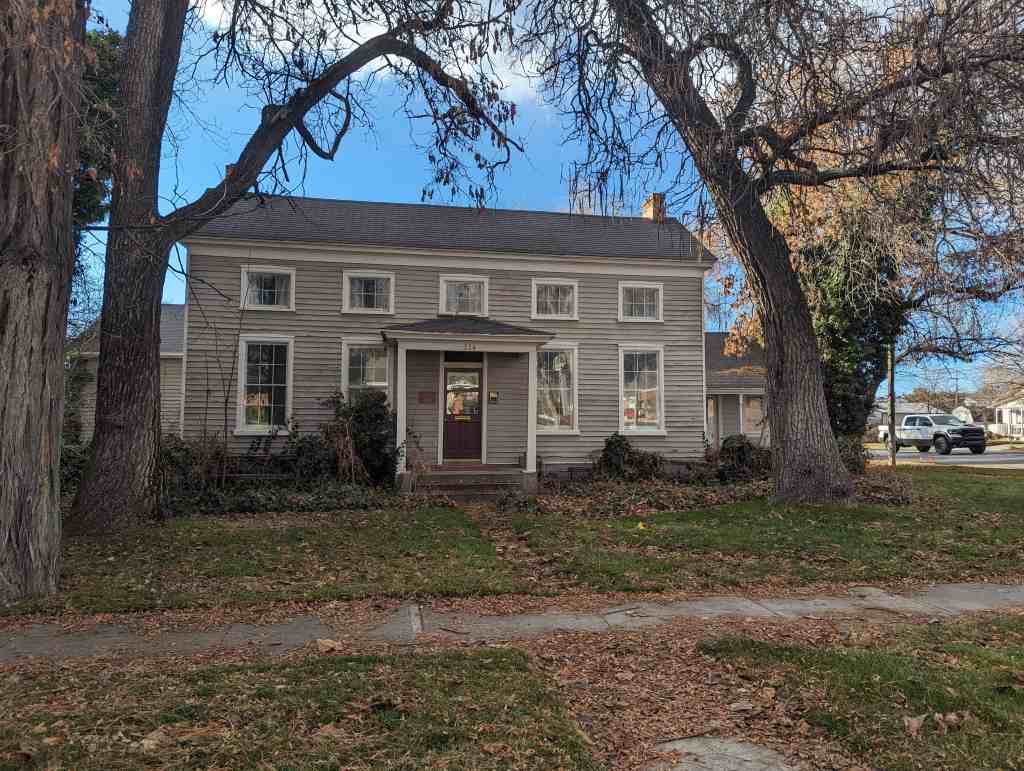
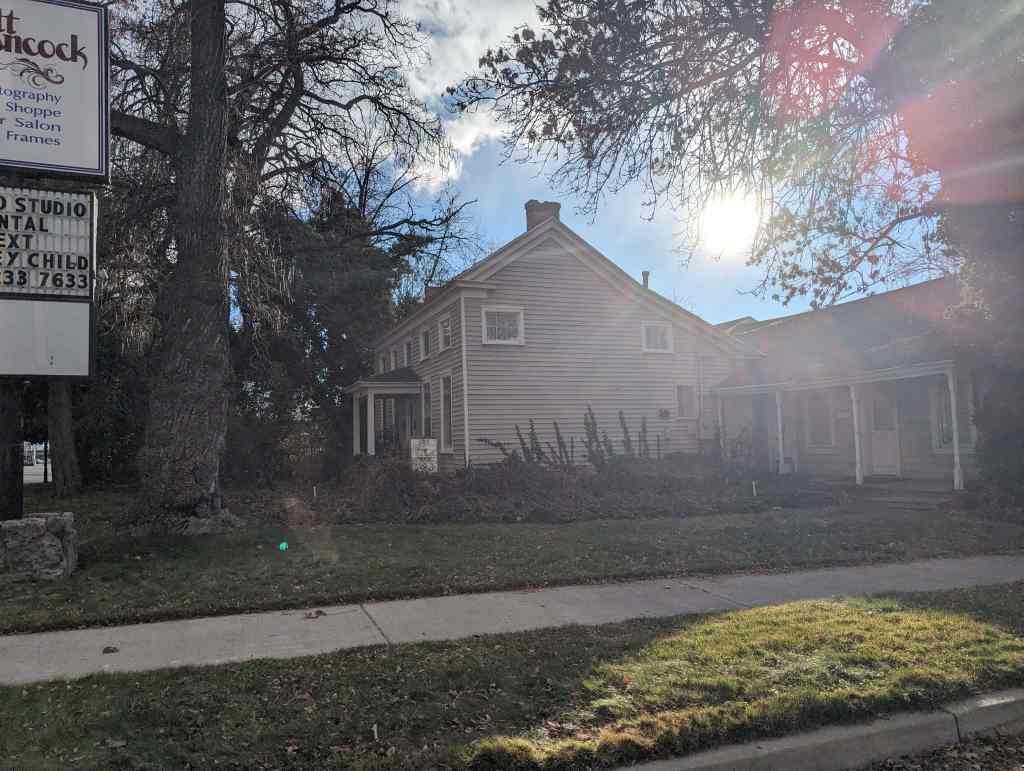
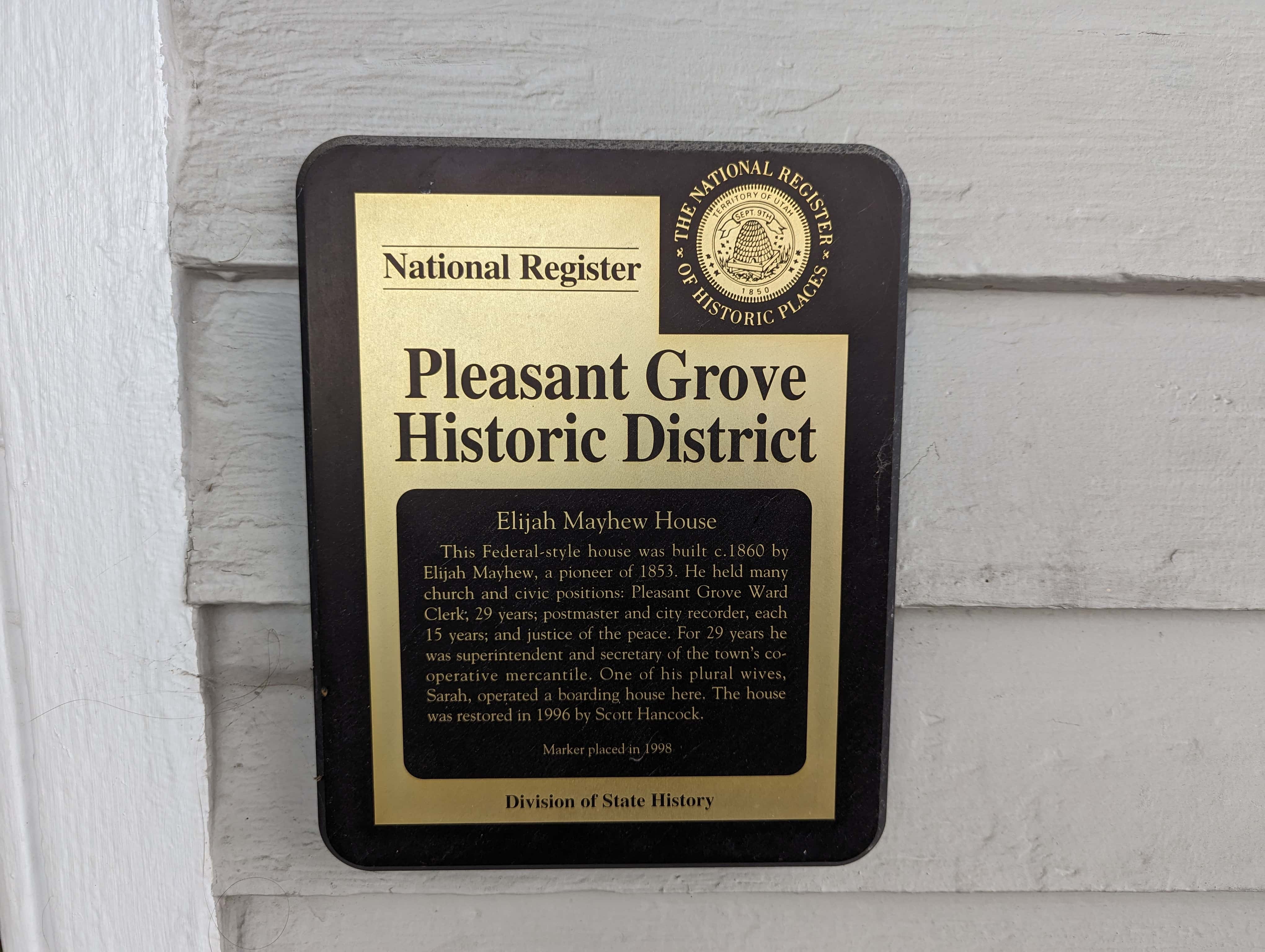
This Federal-style house was built c.1860 by Elijah Mayhew, a pioneer of 1853. He held many church and civic positions: Pleasant Grove Ward Clerk, 29 years; postmaster and city recorder, each 15 years; and justice of the peace. For 29 years he was superintendent and secretary of the town’s co-operative mercantile. One of his plural wives, Sarah, operated a boarding house here. The house was restored in 1996 by Scott Hancock.
Between the years 1902 and 1908, seven houses were built in Pleasant Grove that resemble each other. This house design is found almost exclusively in Utah County. Each of the seven homes has these features: 2 stories high, pyramid roof over the central block, gabbled sections projecting to the front and sides, round-arched or pyramid-arched windows on either the front or side roof slope, and usually a gabled porch.
Between the years 1902 and 1908, seven houses were built in Pleasant Grove that resemble each other. This house design is found almost exclusively in Utah County. Each of the seven homes has these features: 2 stories high, pyramid roof over the central block, gabbled sections projecting to the front and sides, round-arched or pyramid-arched windows on either the front or side roof slope, and usually a gabled porch.
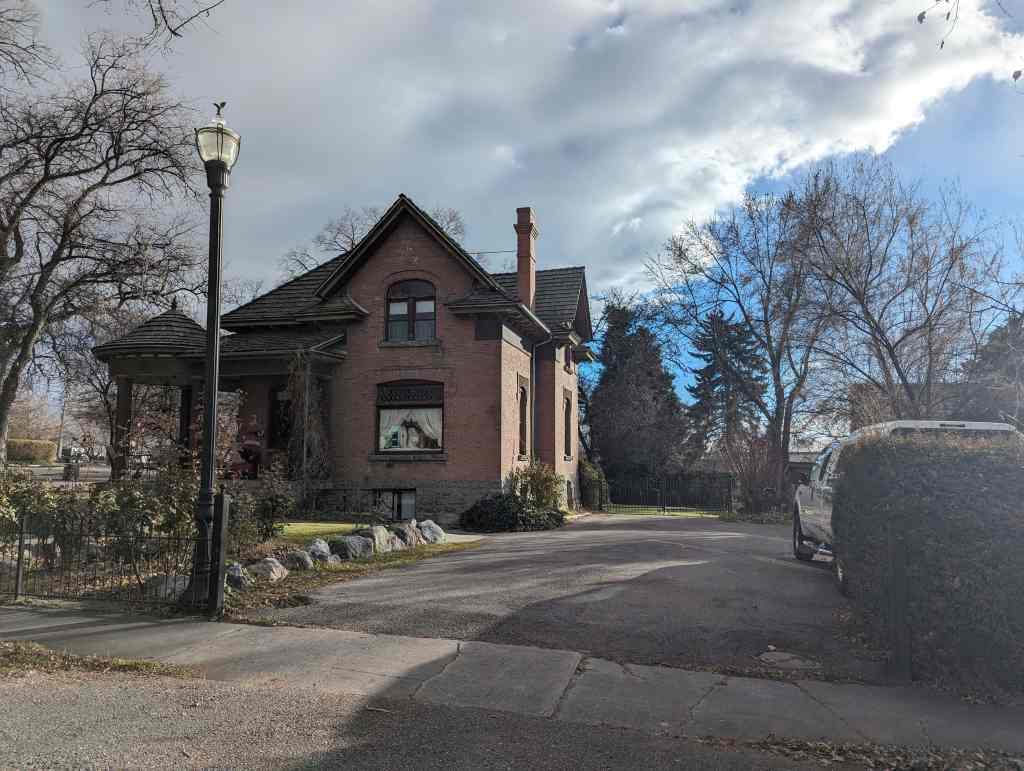
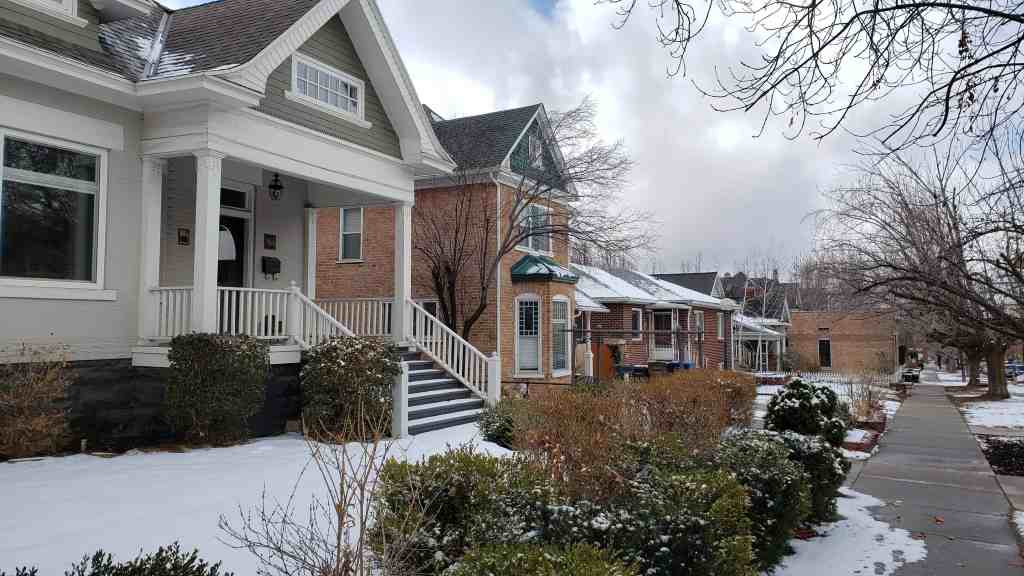
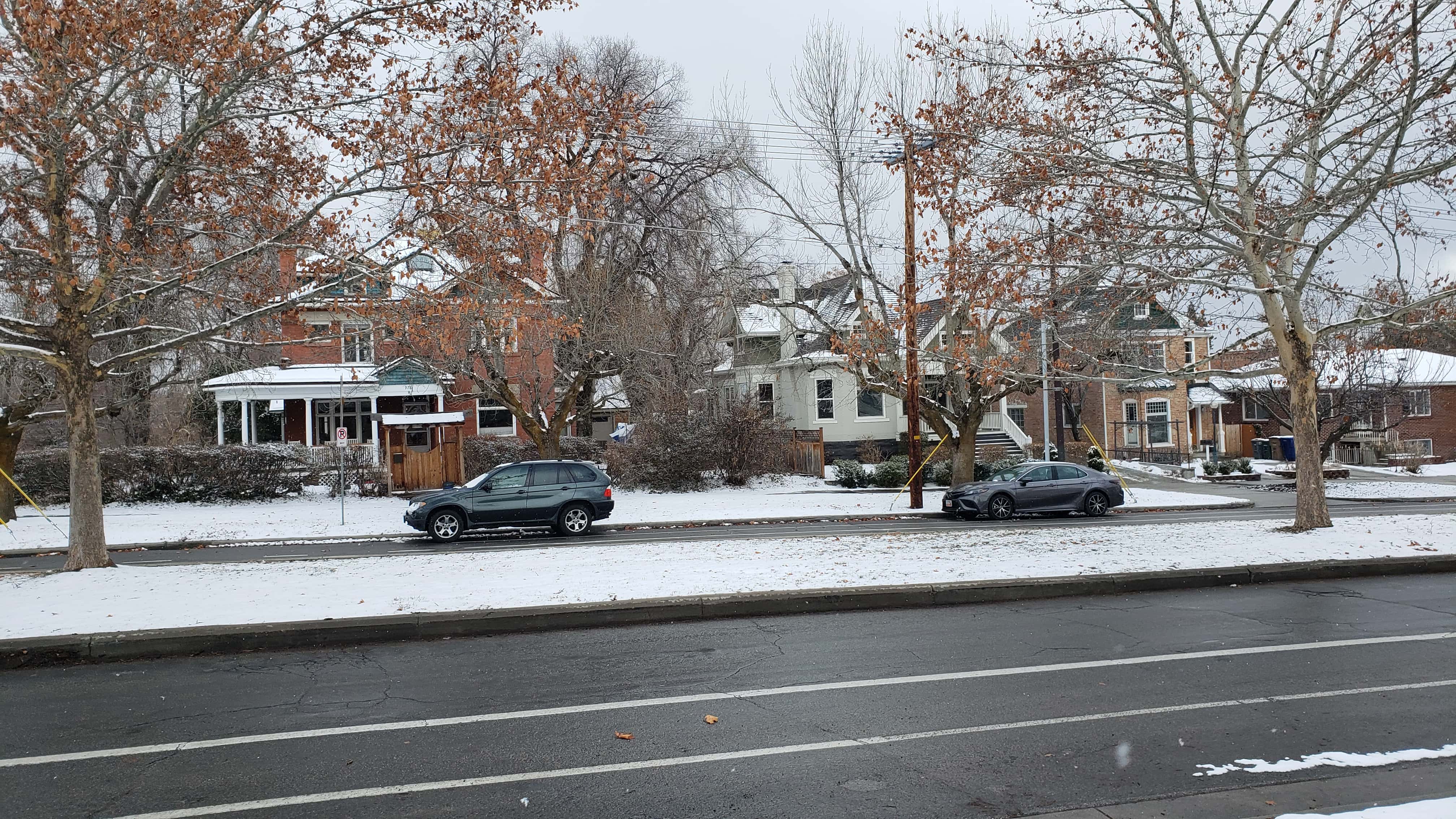
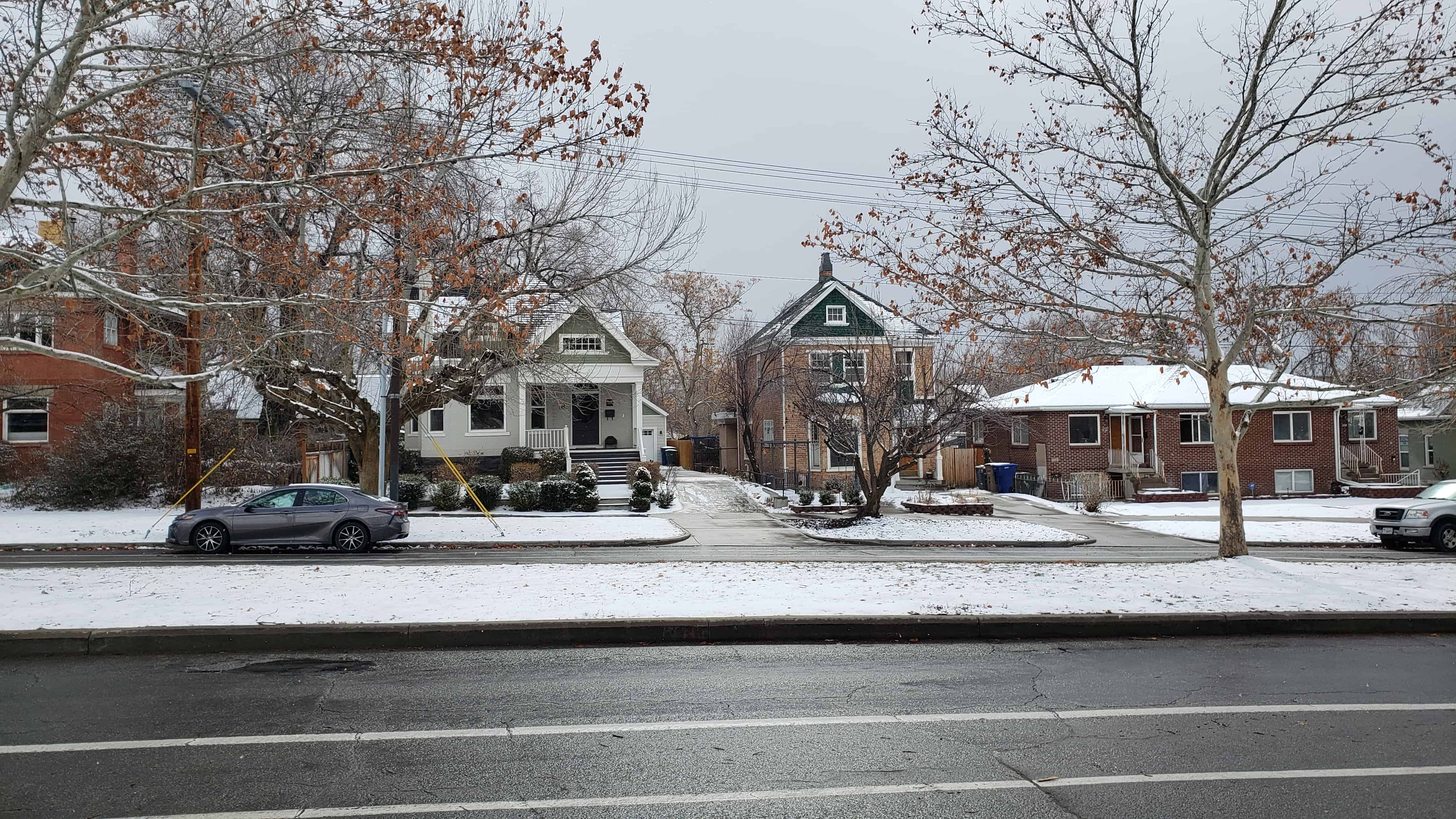
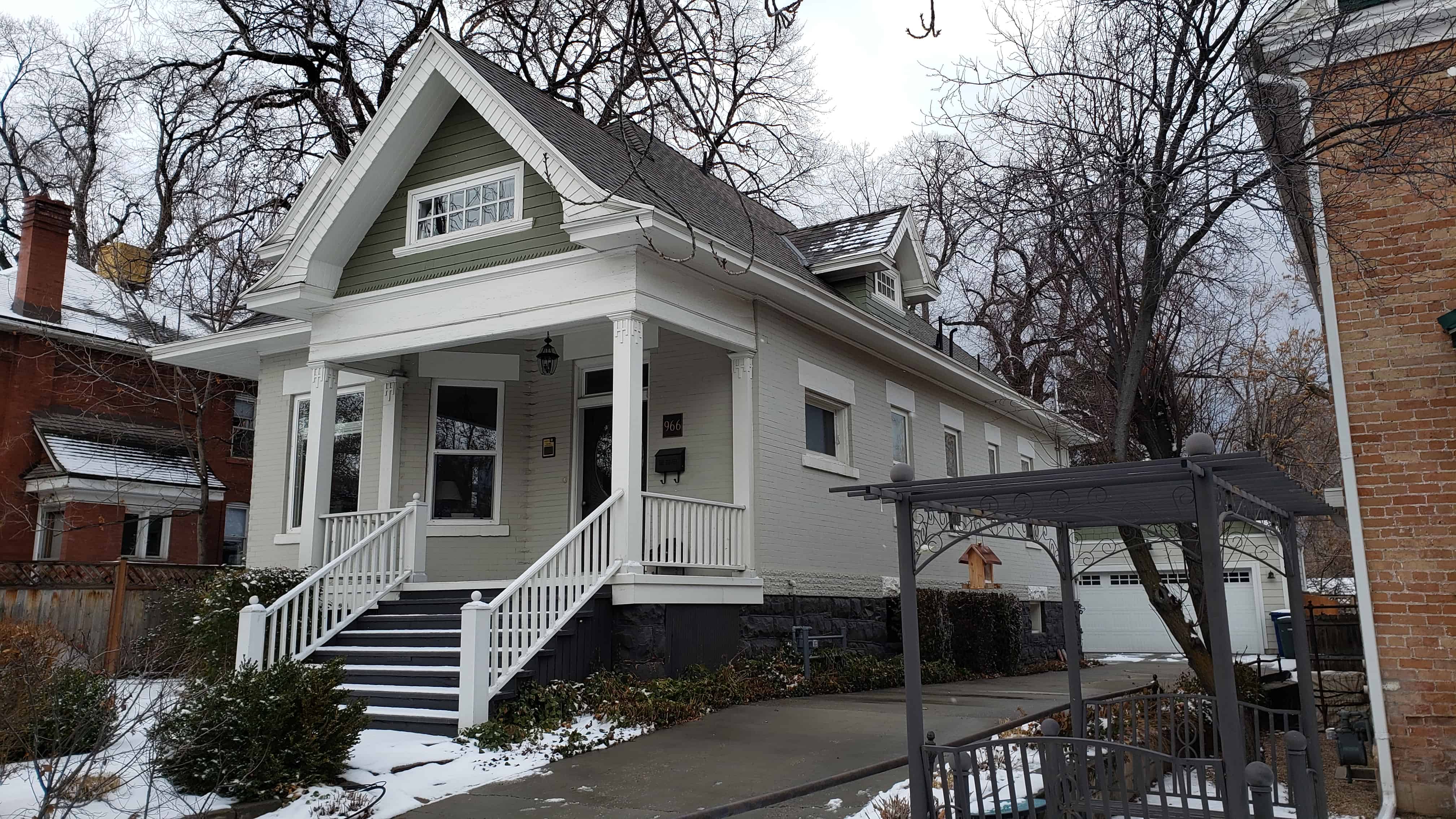
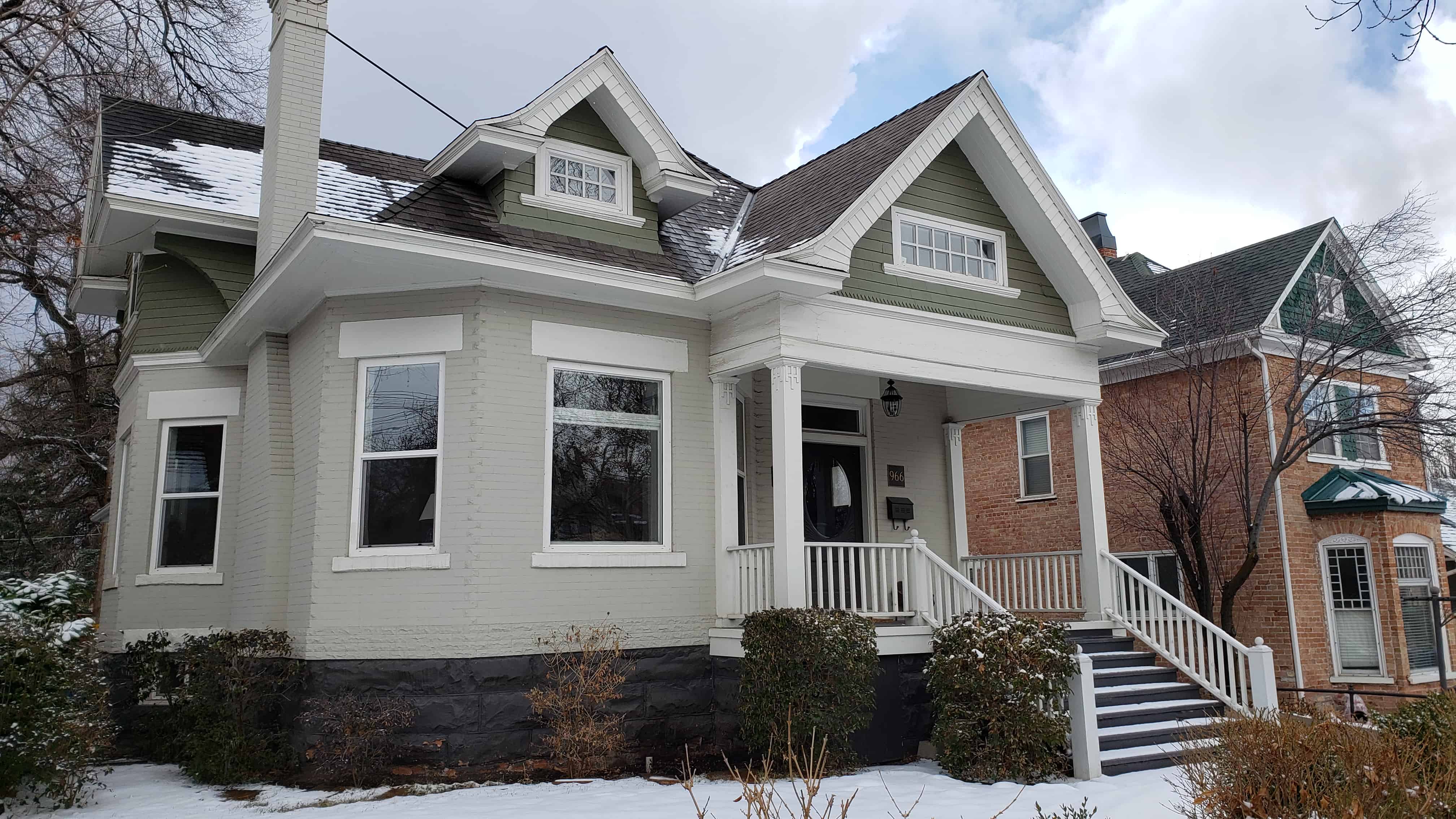
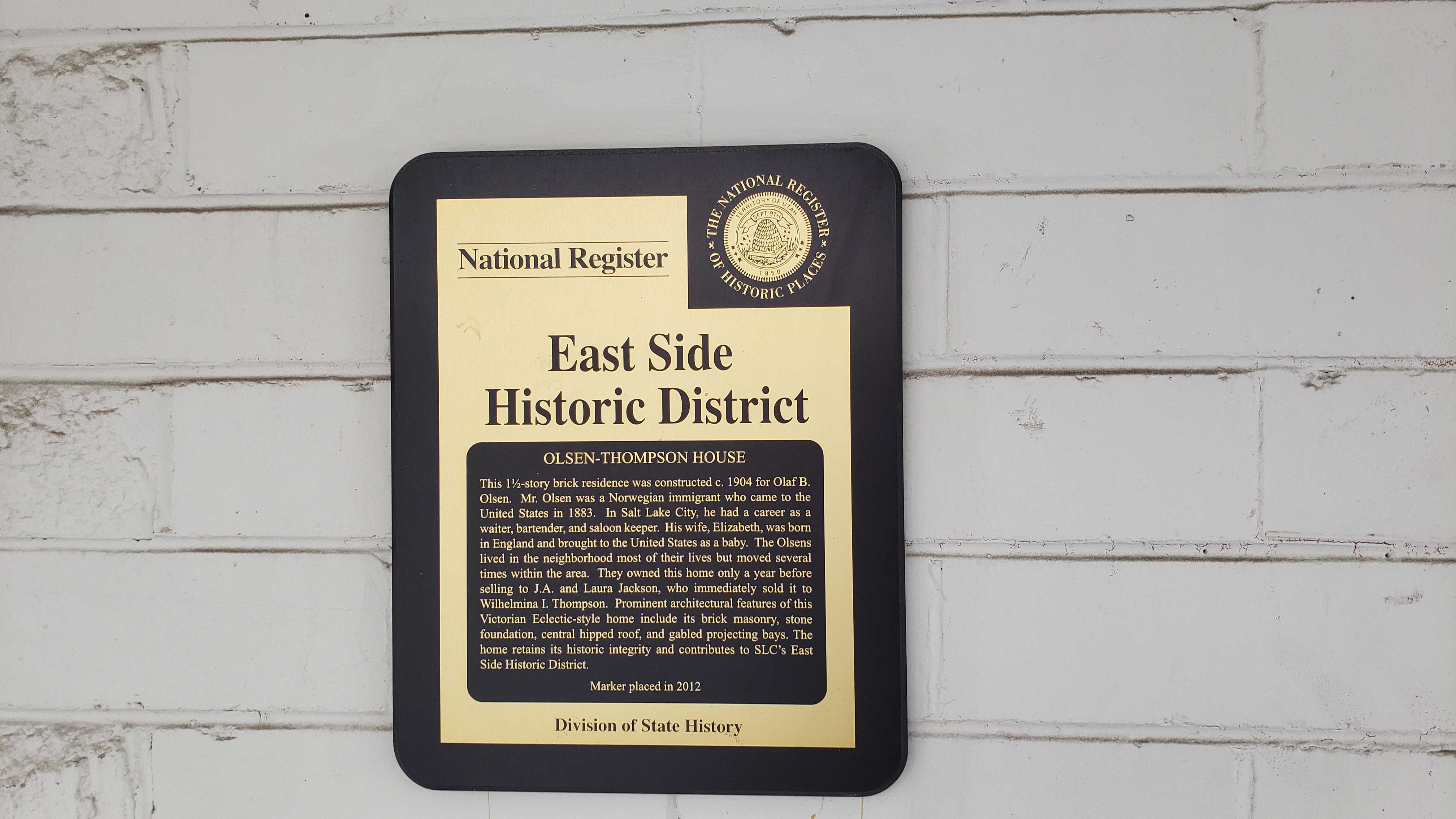
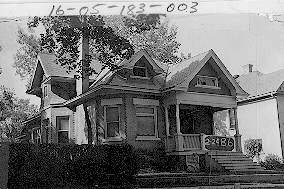
This 1 1/2-story brick residence was constructed c. 1904 for Olaf B. Olsen. Mr. Olsen was a Norwegian immigrant who came to the United States in 1883. In Salt Lake City, he had a career as a waiter, bartender, and saloon keeper. His wife, Elizabeth, was born in England and brought to the United States as a baby. The Olsens lived in the neighborhood most of their lives but moved several times within the area. They owned this home only a year before selling to J.A. and Laura Jackson, who immediately sold it to Wilhelmina I. Thompson. Prominent architectural features of this Victorian Eclectic-style home include its brick masonry, stone foundation, central hipped roof, and gabled projecting bays. The home retains its historic integrity and contributes to SLC’s East Side Historic District.
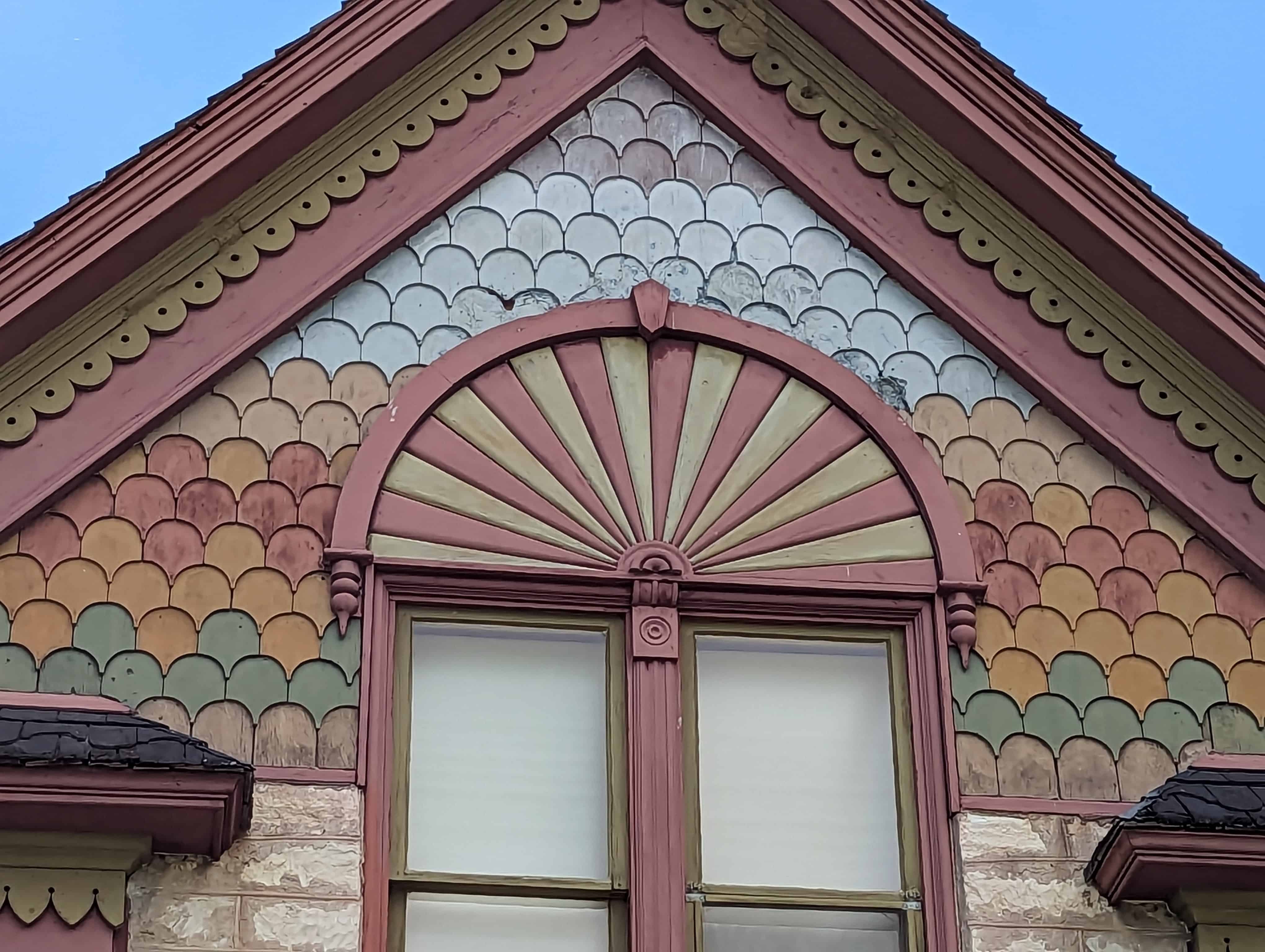
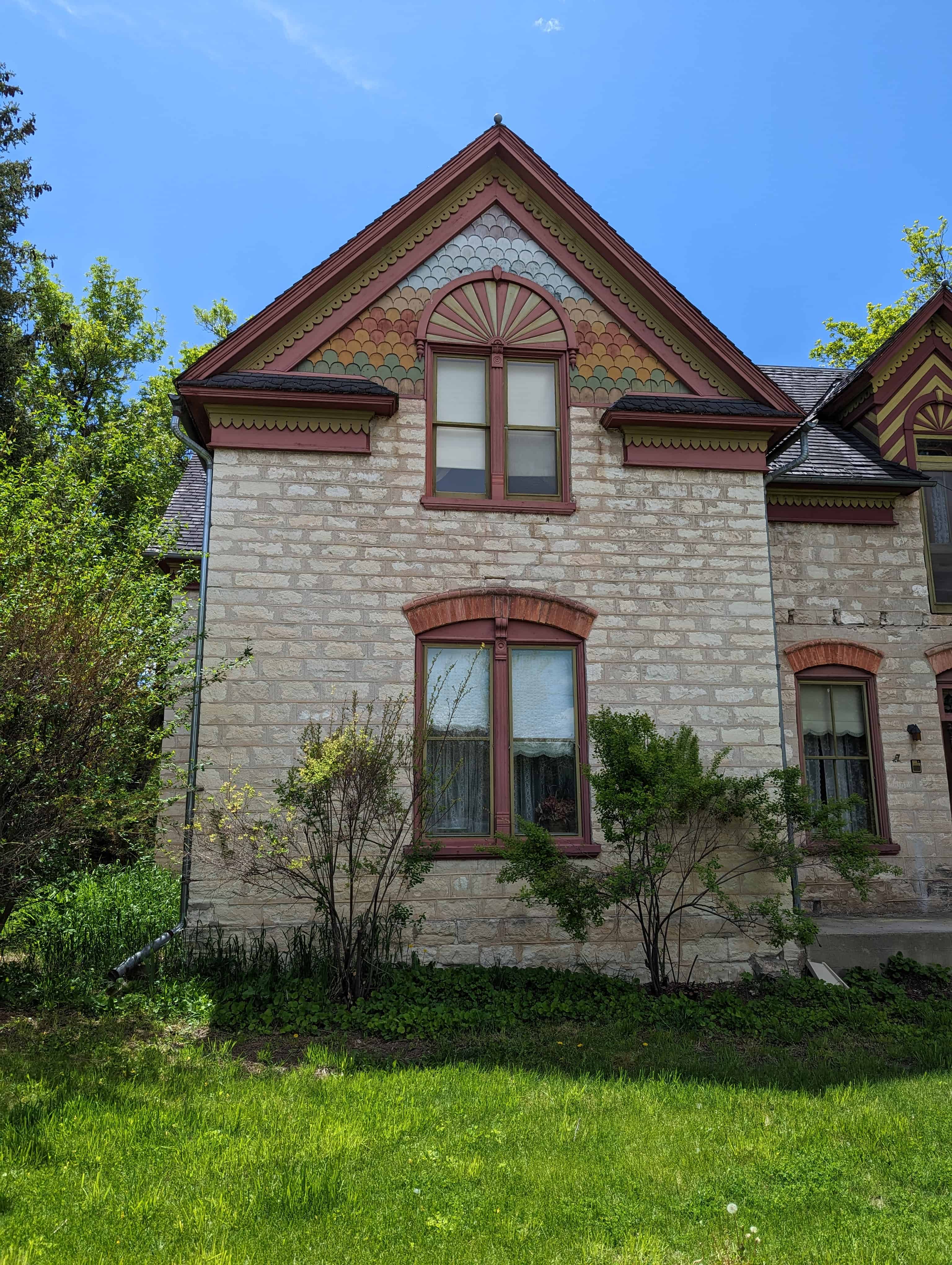
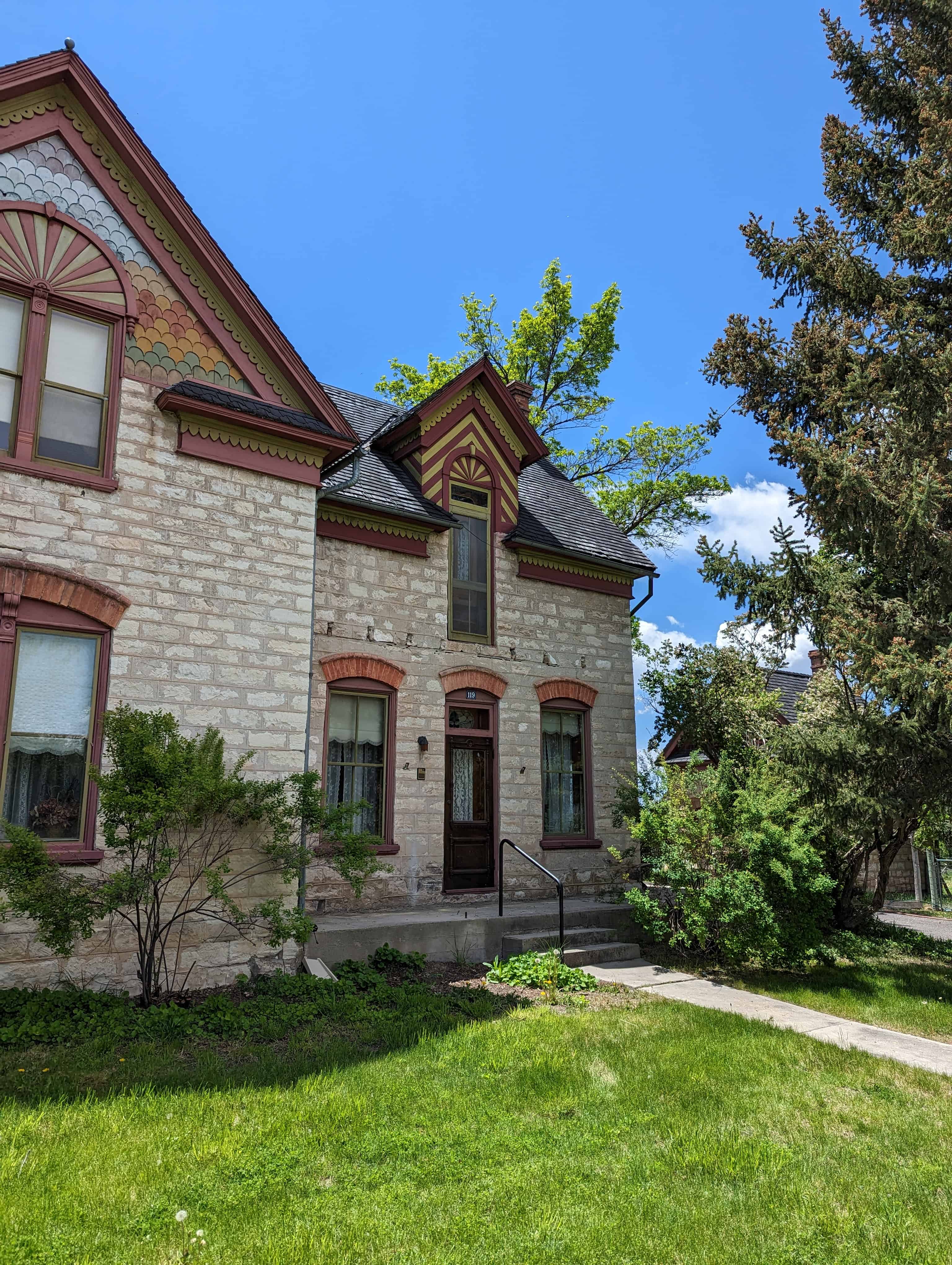
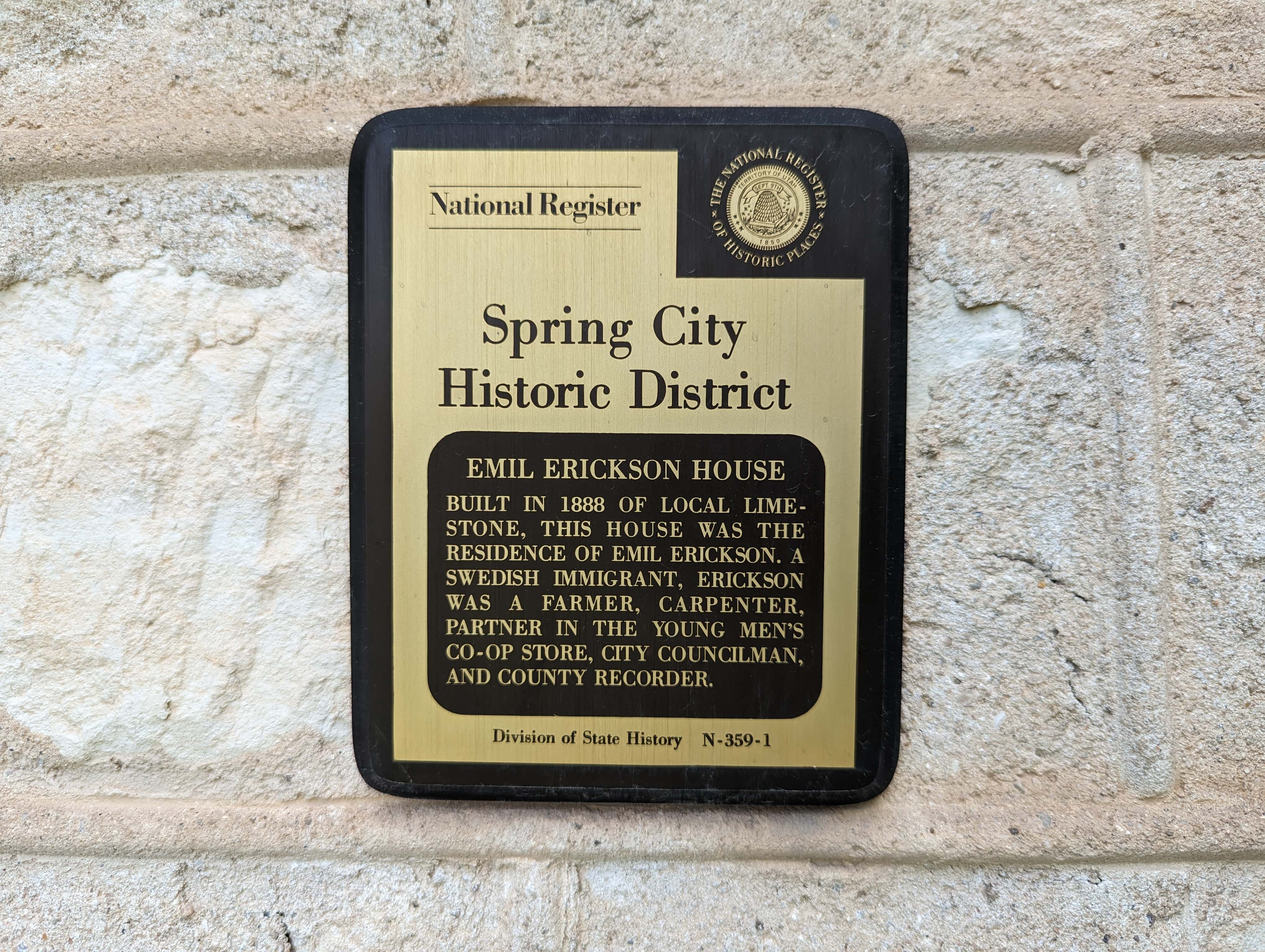
Built in 1888 of local limestone, this house was the residence of Emil Erickson. A Swedish immigrant, Erickson was a farmer, carpenter, partner in the Young Men’s Co-Op Store, City Councilman, and County Recorder.