Howell-Theurer House
The Howell-Theurer home, built in 1869, is historically significant for a number of reasons. It was the home of Joseph Howell, an early settler of Cache Valley, who later became a very successful businessman and politician. He served seven consecutive terms as the Utah representative to the U.S. Congress.
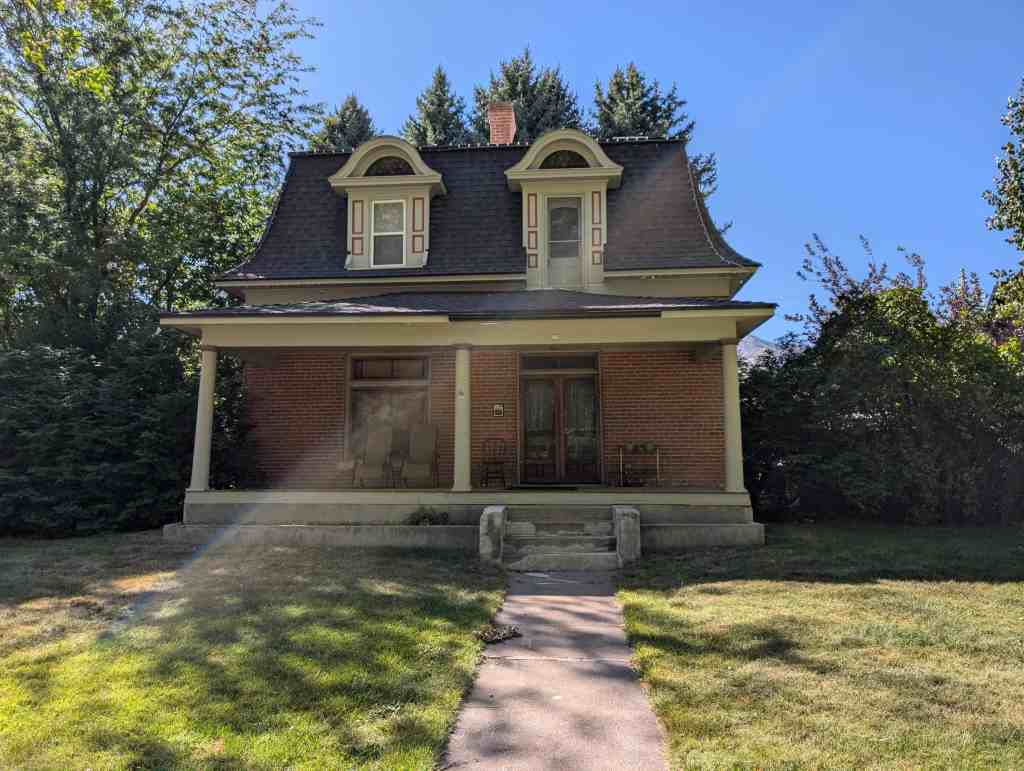
The structure itself if a two story, five opening I-form house. Made from locally quarried stone, and ornamented in a restrained style. It is a good example of the vernacular house type, influenced by the Federal and Greek Revivial styles, built during the Mormon pioneer period of Utah’s history.
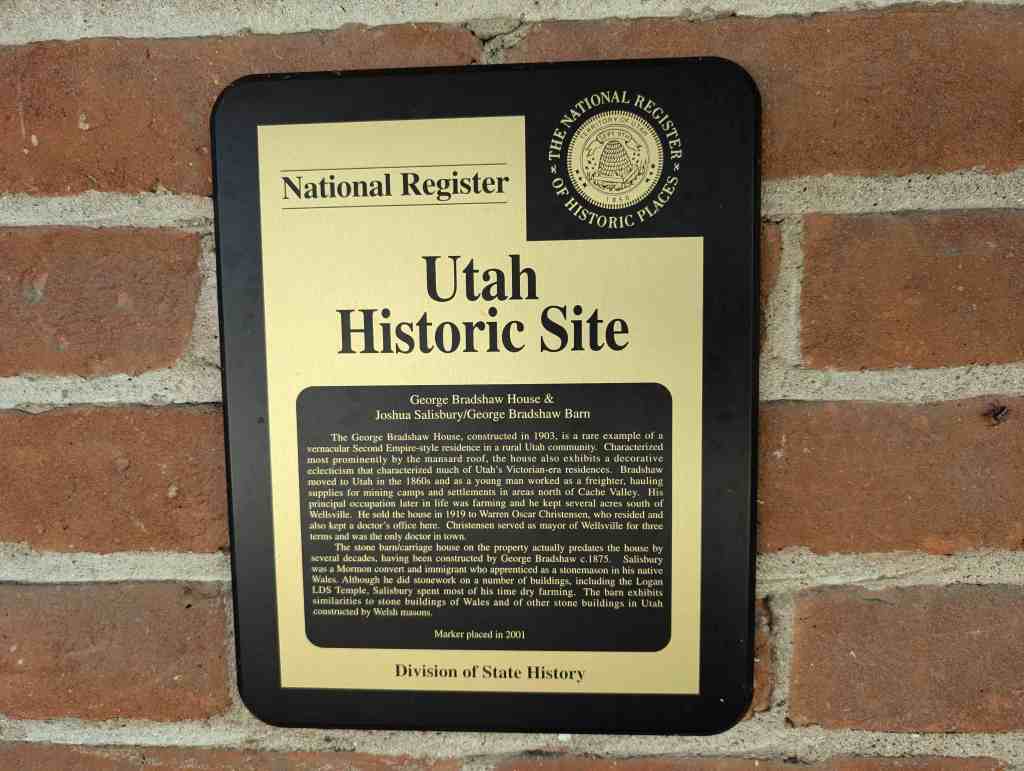
The Howell-Theurer House is located at 30 South 100 East in Wellsville, Utah and was added to the National Register of Historic Places (#79002490) on October 18, 1979.
Joseph Howell was born on February 17, 1857 in Honeyville to William Morgan and Martha Howell. Mrs. Howell was first married to a Mr. Howell in Wales. He died of cholera in the W.S. before moving out west. Mrs. Howell met William Morgan on her trip to the Utah Territory. He was the captain of their company. They were married after they arrived in Salt Lake by Brigham Young in 1855. Mr. Morgan began farming near Brigham City, and Joseph helped with the various tasks associated with the farm. “Reared amidst the most humble surroundings, his parents, friends, and neighbors never realized that the barefooted suntanned youth herding cows in the Box Elder hills was destined to become one of Utahs most capable and successful businessmen, an empire builder, and a representative of his fellow citizens in the largest and most distinguished peoples forum in the world-the United States Congress.”
There were difficulties in the marriage and Martha Howell and Mr. Morgan separated. In 1863, when Joseph was six years old his mother moved the family to Wellsville. It is not known exactly when the family moved into the stone house at 30 South 100 East, but Martha Howell was given the Townsite Deed for the property on September 16, 1872. She was quite wealthy in her own right from her fathers coal mining success, and was referred to as the elegant “Widow Howell”. Joseph Howell spent a portion of his childhood in this large home. After finishing public school he attended the University of Utah and the University of Deseret.
Mr. Howell spent; a few years after graduation as a school teacher, and established an enviable record in this regard. In 1878 Martha Howell deeded the stone home to Joseph Howell. He married Bishop William Maughan’s daughter Mary ( born August 12, 1856] and the couple lived for seven years with Martha Howell in the stone home. Joseph Howell became the manager of the Wellsville Mercantile Co-op. His powers and capabilities were recognized by Bishop William H. Maughan, who chose him as his counselor. In 1883, at the age of twenty five he was elected mayor of Wellsville. His wage was $50.00 a year.
The winter of 1885 was extremely severe. The task of fetching water from the outdoor well was durdensome for Mary Howell, who had four children at the time (She was to have ten total, five sons and five daughters). The family moved that winter to a wood frame house built by John Stoaddard, that had piped in water. The Howell’s retained ownerhsip of the stone home until 1905.
From 1886-1892 Mr. Howell served as member of the Territorial Legislature. He also served one term, from 1896-1900, in the Utah Senate. “Throughout all these activities he was the same commanding figure, wise in council, cool-headed keen and conservative in judgement, just and charitable, winning the respect and esteem of both friends and opponents alike.
The Howell family moved to Logan where, Mr. Howell became a business tycoon. He became a senior member of the Howell-Carbon Co., and the founder of the Howell Clothing Store. In ]909 he and David Eccles of Logan formed the Promontory-Curlew Land Co.. The feasibility of dry farming had just been discovered and several Cache Valley farmers were having great success. Eccles and Howell bought a half million acres in Box Elder, Cassia, and Oneida counties in Utah and Idaho. They offered grazing land, irrigated sites, and dry farm land for sale. By 1916 half of the land had already been sold to home seekers. It turned out to be a very profitable investment for both men. The new city formed as a result of this population influx was named Howell, Utah, in honor of Joseph Howell.
In the 1370’s and ,1880’s there was a tfreat deal of controversy in Utah concerning the question of polygamy and the separation of church and state. As the gentiles emerged as a significant body they demanded that polygamy be outlawed^ that the church must give up political activity through the Peoples Party, and that the church must cease directing the cooperative economic life for its community and open the doors to free competition. In 1890 the church terminated polygamy, and in 1891 disbanded the People Party. 1892 was the election year. To encourage the Saints to vote Republican, church leaders themselves took up the Republican standard. Joseph Howell, an active Mormon, was nominated U.S. Congressional candidate at the Republican State Convention in Ogden. He was selected over the non-Mormon incumbent George Sutherland, who many considered to be Utah’s greatest statesman and jurist. Riding on this strong anti-gentile sentiment, caused in part by the aforementioned events, Mr. Howell defeated the Democratic candidate William King by 6000 votes. This was the beginning of a fourteen year stint (1903-1917) as U.S. Congressman for Mr. Howell. He served seven successive terms, ever on the alert to promote Western interests. “While in Congress he may not of been frequently prominent upon the floor, but he was most active in committee work-shaping the policies of government. He had been instrumental in securing pensions for Indian War Veterans. Mr. Howell was also the senior Republican member of the Committee on Mines and Mining, and a member of the Committee of Agriculture.
Mr. Howell’s deep interest in the intellectual progress of the state was evidenced by his service as a member of the Board of Regents of the University of Utah and the Board of Trustees of Brigham Young University.
Mr. Howell returned to Logan after his distinguished career as a public servant He died suddenly at home due to a brain hemorrhage on July 18, 1918, at the age of sixty-one.
In 1915 Herman and Julia Theurer bought the stone home. Mr. Theurer opened a general merchandise store called the Golden Rule next to the home. The Theurer f s took exceptionally good care of the home, making many improvements on both the structure and the grounds. They lived in the house for forty-one years.
In summary, the life of Joseph Howell is the story of a self made man rising to prominence. He was a man of great energy and intellect. He achieved fame and recognition for his deeds from a state and national audience. His funeral drew “distinguished visitors from Salt Lake , Ogden, and elsewhere…and filled the tabernacle with a congregation of conference size.5” regardless of the accolades, Mr. Howell did not gorget his humble beginnings. He was receptive to ideas from any man. It was this combination of sensitive understanding and sophisticated intellect that made Mr. Howell such an accomplished public servant and successful businessman. It is this spirit that is exemplified by the Howell-Theurer house in Wellsville.