
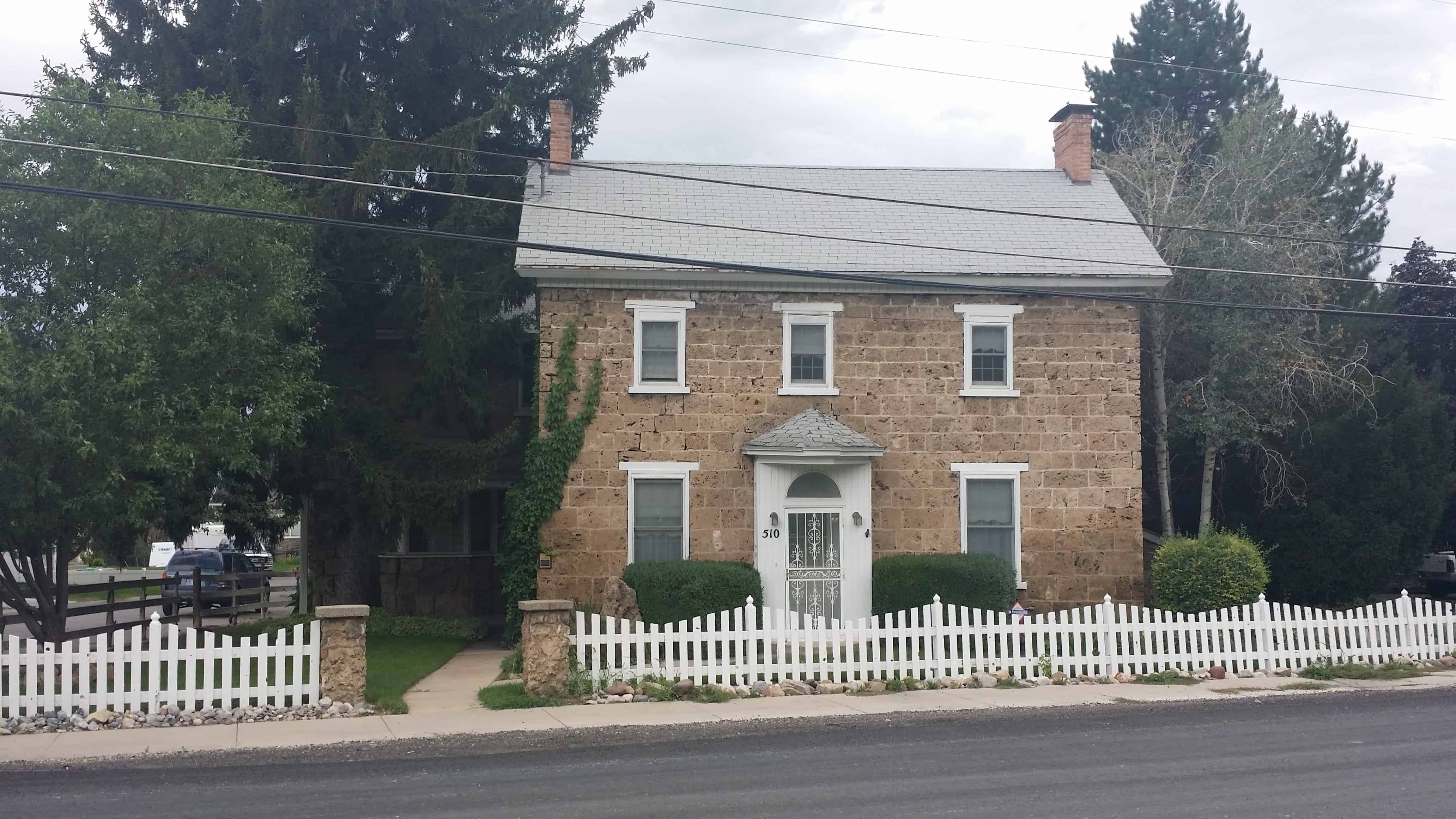
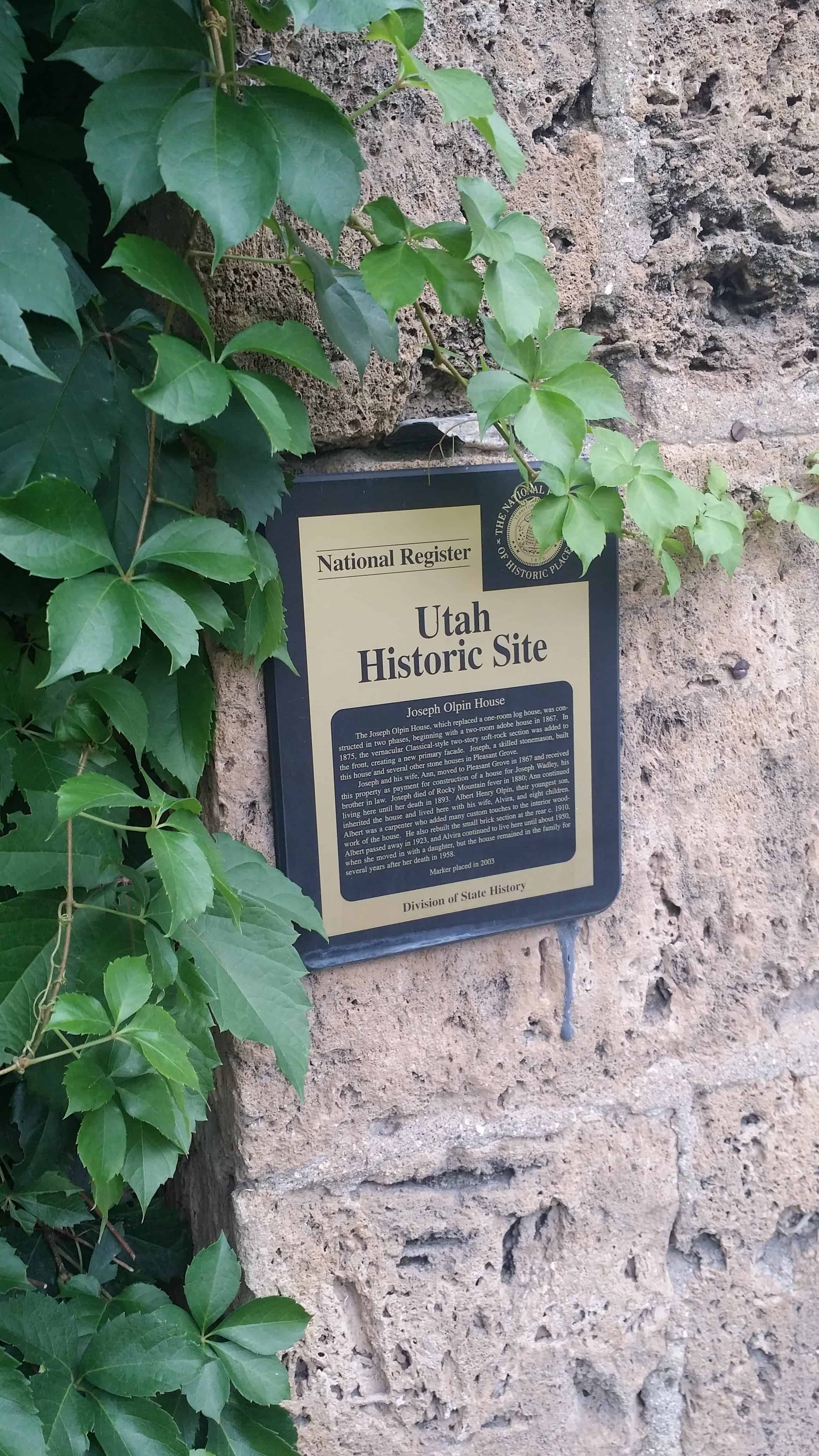
The Joseph Olpin House, which replaced a one-room log house, was constructed in two phases, beginning with a two-room adobe house in 1867. In 1875, the vernacular Classical-style two-story soft-rock section was added to the front, creating a new primary façade. Joseph, a skilled stonemason, built this house and several other stone houses in Pleasant Grove.
Joseph and his wife, Ann, moved to Pleasant Grove in 1867 and received this property as payment for construction of a house for Joseph Wadley, his brother in law. Joseph died of Rocky Mountain fever in 1880; Ann continued living here until her death in 1893. Albert Henry Olpin, their youngest son, inherited the house and lived here with his wife, Alvira, and eight children. Albert was a carpenter who added many custom touches to the interior wood-work of the house. He also rebuilt the small brick section at the rear c. 1910. Albert passed away in 1923, and Alvira continued to live here until 1950, when she moved in with a daughter, but the house remained in the family for several years after her death in 1958.
Located at 510 Locust Avenue in Pleasant Grove, Utah and added to the National Register of Historic Places (#77001320) on November 7, 1977.
Related:
- Utah’s oldest homes
The Joseph Olpin House, built ca. 1875 by the owner, a stone mason, is one of the early pioneer homes of Pleasant Grove. It is a fine example of Utah vernacular architecture and has historic associations with the Mormon religion and the development of education in the State.
Joseph Olpin was born in Gloucester, England, in 1839. His father joined the Mormon Church in that country, and Joseph was baptized by him in 1845. Joseph Olpin came to Utah in 1856 at the age of 17.
Olpin lived in Salt Lake City, until 1863, when he moved to Rockport. He remained there until moving to Pleasant Grove in 1867 at the suggestion of Joseph Wadley, his brother-in-law. Olpin received the land on which the house stands from Wadley as payment for construction of a house for him. Olpin originally built a one-room log house on the site, later replaced by a two-room adobe. Olpin’s skill as a stone mason was widely sought by residents of Pleasant Grove, and he built many of the stone houses still standing in the area.
Olpin built the two-story soft stone house in 1874 or 1875. He died January 17, 1880, in Pleasant Grove. The house passed to Albert Henry Olpin, the youngest of his four sons. Albert Olpin was a carpenter by trade and was responsible for much of the woodwork in the house, including the curving wooden staircase in the central hall. He also built the brick addition at the rear ca. 1908-1910.
While on a church mission to South Carolina in 1901-1903, Albert Olpin was severely beaten by a mob. This incident is symbolic of the anti-Mormon tensions which continued into the 20th Century.
Dr. A. Ray Olpin, past president of the University of Utah, is the oldest son of Albert and Alvira Olpin. He was born in the house in 1898. Dr. Olpin headed the University from 1946 to 1964. During these years the institution experienced tremendous growth, enrollment increasing from c. 7,000 to c. 18,000 over the period.
The house remained in the Olpin family until 1943, when the President’s mother sold it. The home is currently the private residence of Mr. and Mrs. Edward Platt who wish to complete its restoration.
The Joseph Olpin Home is a two-story rectangular building of stone with a one-and-a-half story rear addition of brick. The front and sides are coursed ashlar, while the foundation and back are of nibble construction. The front is symmetrical, three bays wide, with wooden lintels above six-over-six windows. Two single stack, banded brick chimneys, recessed slightly from each gable end, straddle the ridge.
At the rear of the original stone building is a one-and-a-half story brick broken salt-box addition, with a hipped roof porch. The addition is of stretcher bond. The rear door and window bays of the ground floor of the addition have segmented arches. The rear bays have corbeled voussoirs. The two smaller windows of the upper story of the addition have plain wooden lintels which break into the frieze. Both the addition and original building have a plain boxed cornice with simple mouldings and a plain frieze. The addition has two single stack brick chimneys, one at the peak of the ridge, recessed from the gable end, and the other on the shallow slope of the roof.
Both the original structure and the addition are of vernacular styling. The condition of the building is good and the integrity is excellent. The plan consists of two rooms flanking a central hall on the first floor of the main building. The addition houses a kitchen and pantry area. The original curving wooden staircase still stands in the hall. The upper floor served as bedroom space.