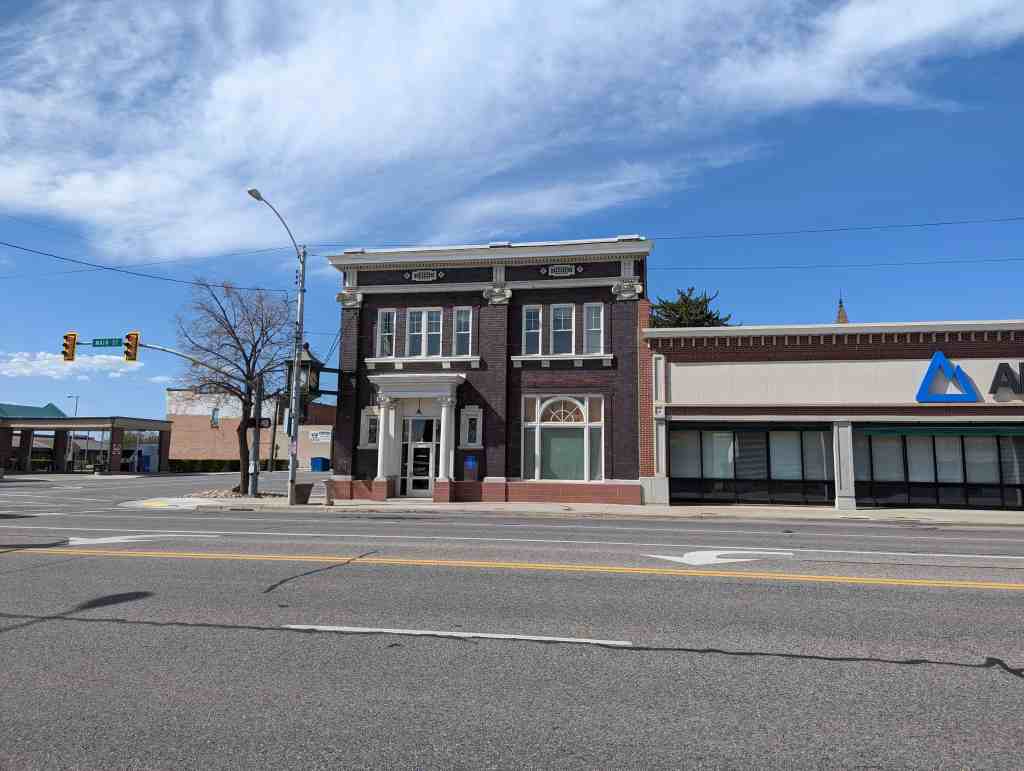
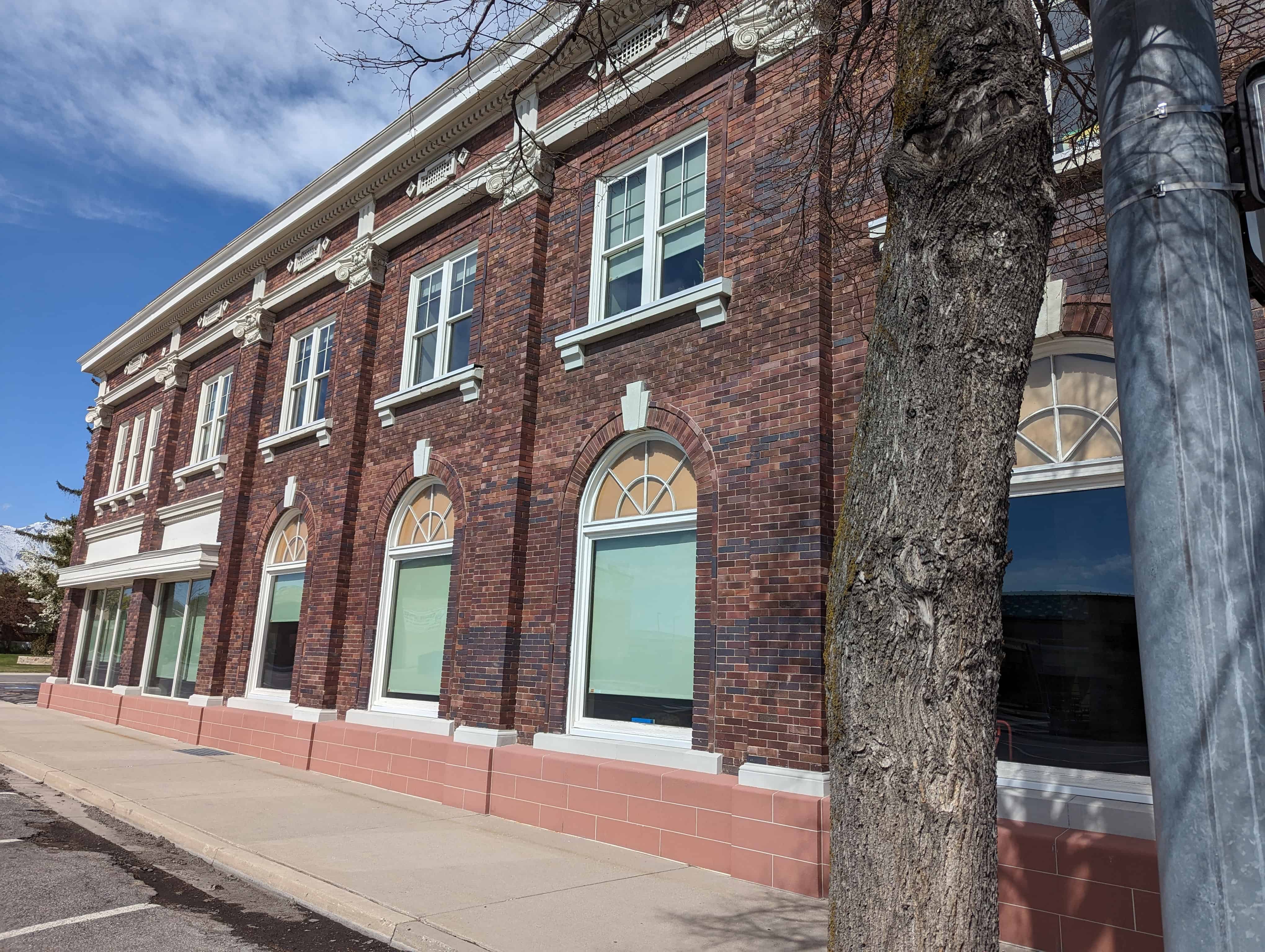
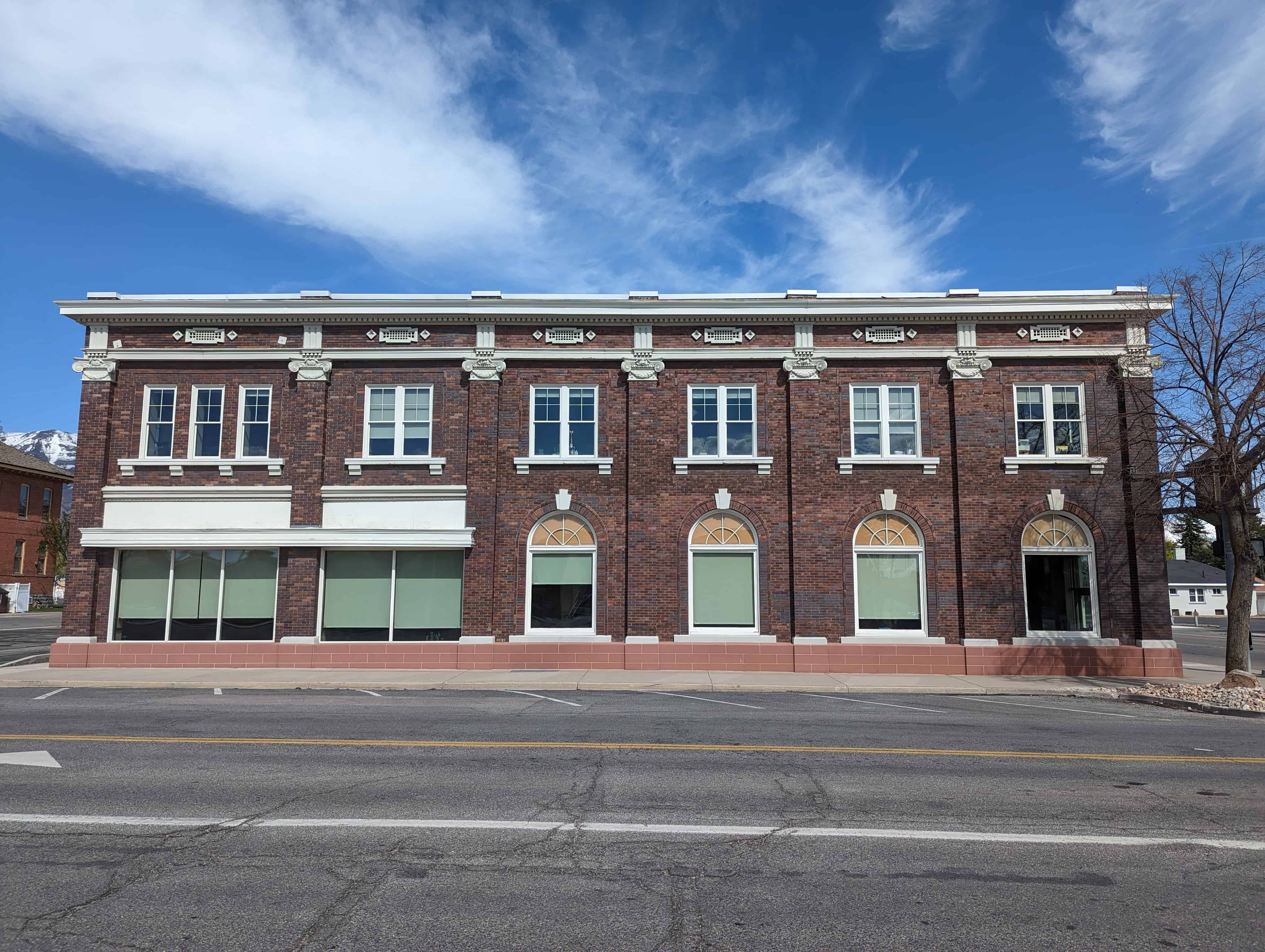
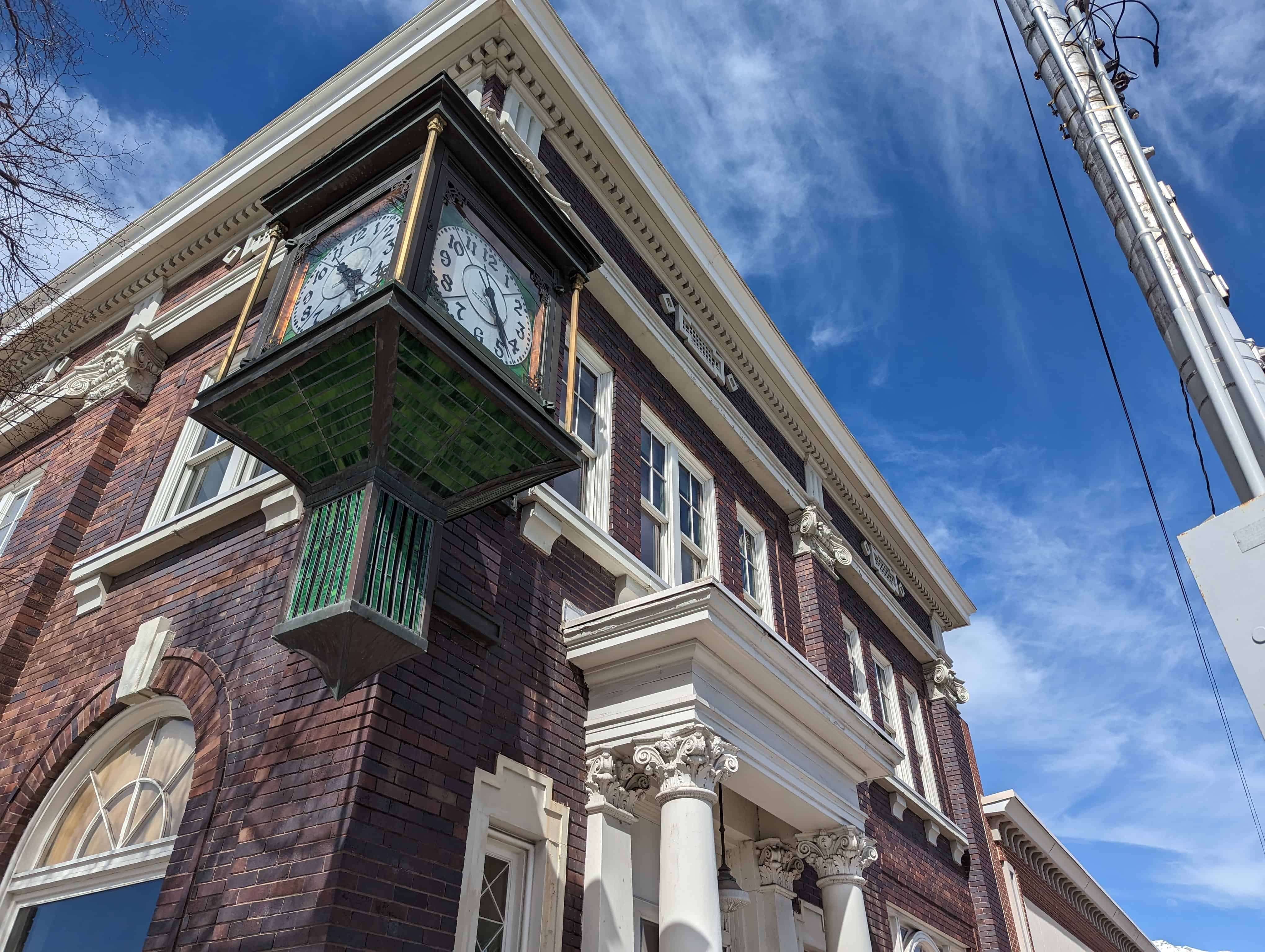
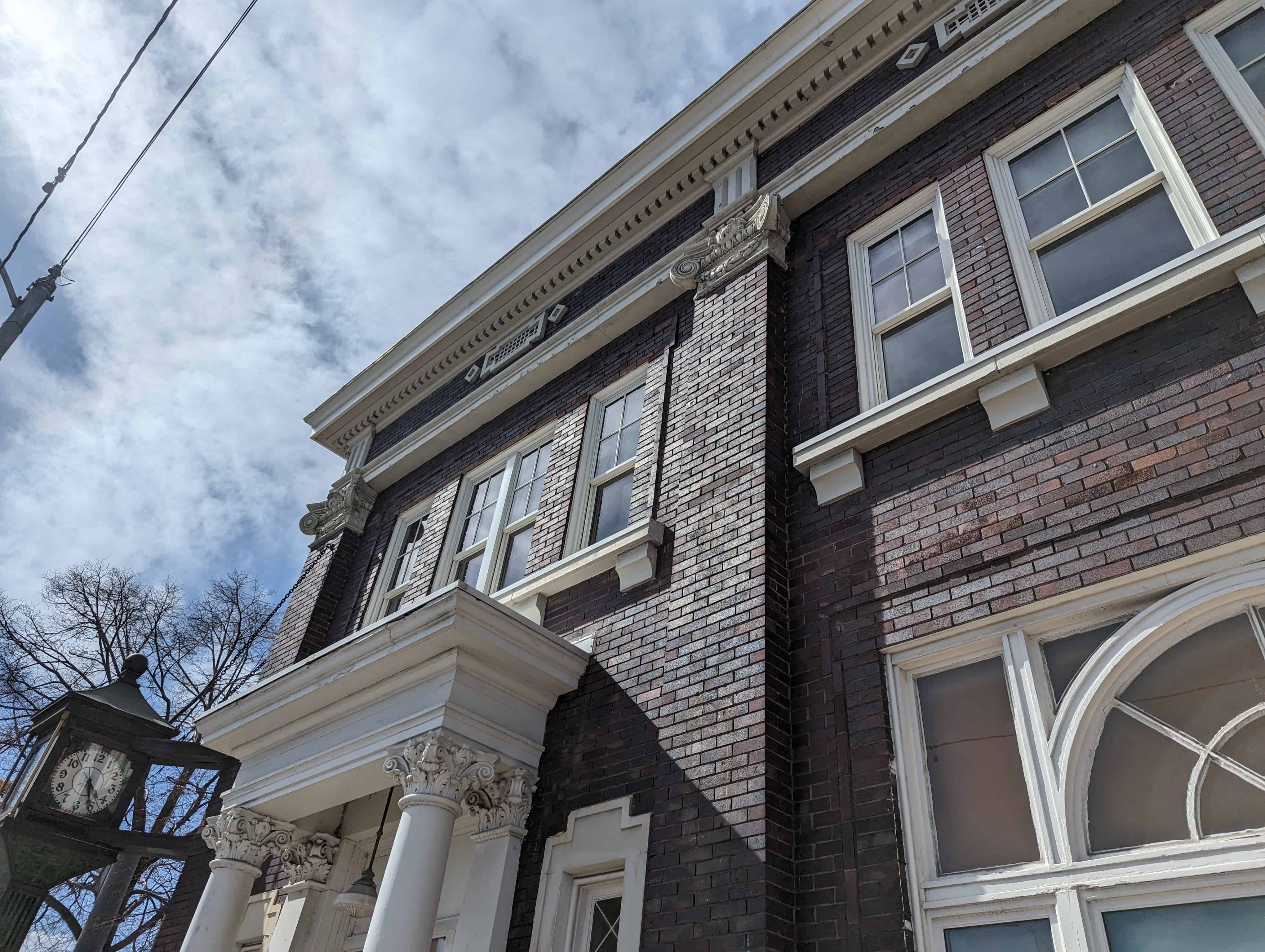
Located at 33 East Main Street in American Fork, Utah
The text below is taken from the historic marker on the building:
This build, originally named the Progress Building, has housed prominent local businesses since the late 1800’s. The architect for the building was James H. Pulley.
In January of 1913 the People’s State Bank of American Fork was formed by local citizens with capitalization of $25,000. The bank was originally located immediately east of this site.
In the mid 1920’s the bank moved into this building. The bank shared the building with the United States Post Office until the Post Office moved out in 1951.
The building was remodeled on a number of occasions to meet the growing needs of the bank. Major remodels occurred when the bank expanded to the north, then later two spaces west, formerly occupied by Taylor Drug and the Mint Bar. The current configuration of the bank was completed in the 1990’s.
In August of 1963 the name of the bank was changed to the Bank of American Fork. In 1998 a holding company, People’s Utah Bancorp was formed, which owns 100% of the bank. The building is home to the corporate offices of People’s Utah Bancorp and the bank which now operates throughout the state of Utah. The bank is proud to serve the posterity of those early founders and the current citizens of out community.
This Victorian Eclectic Style, 1 1⁄2 story, brick home was constructed c. 1908 by Joseph Webb and Lillian King Brown. Lillian’s parents, Robert Edson and Margaretta Lemon King, lived until 1922, across the street on the current site of the American Fork Library. Margaretta Lemon King was an original 1847 pioneer, and in 1864 the Kings built the first cabin outside the old American Fork Fort. Lillian King was born in this cabin in 1873. Joseph and Lillian owned and operated a large farm one mile south of this house. Joseph died in 1913 at age 43. Lillian, widowed at age 40, raised their 10 children in this home. She worked as a nurse and served for many years as the LDS First Ward Relief Society President. Her sons continued to operate the family farm. Lillian died in 1941. The home was the residence of her son, Robert “Milt” Brown, until his death in 1986. “Milt” was a talented American Fork musician and farmer. The home was restored in 2010 by D.R. Gardner, a grand-nephew of Lillian King.
This building was constructed in 1905 on the northeast corner of the main intersection in the heart of American Fork’s commercial district to house a bank established by Gay Lombard in July of 1891. This, the Bank of American Fork was the town’s first full-service professional bank. It operated here until the mid-1930’s when it was taken over and dissolved by the consolidated holding company only only to be later re-established in another location. The building here has since served as a retail store and office building.
Neo-Classical in style, the construction is of iron oxide bricks with wood columns, ionic and composite capitals, arches with limestone keystones, entablature, sills, brackets and extensive ornamental pressed metal trim. The original Bank of American Fork building here has retained most of its original fabric and is significant example of historic commercial architecture. Its presence along Main Street recalls the economic vitality of the early twentieth century.
Located at 1 East Main Street in American Fork, Utah
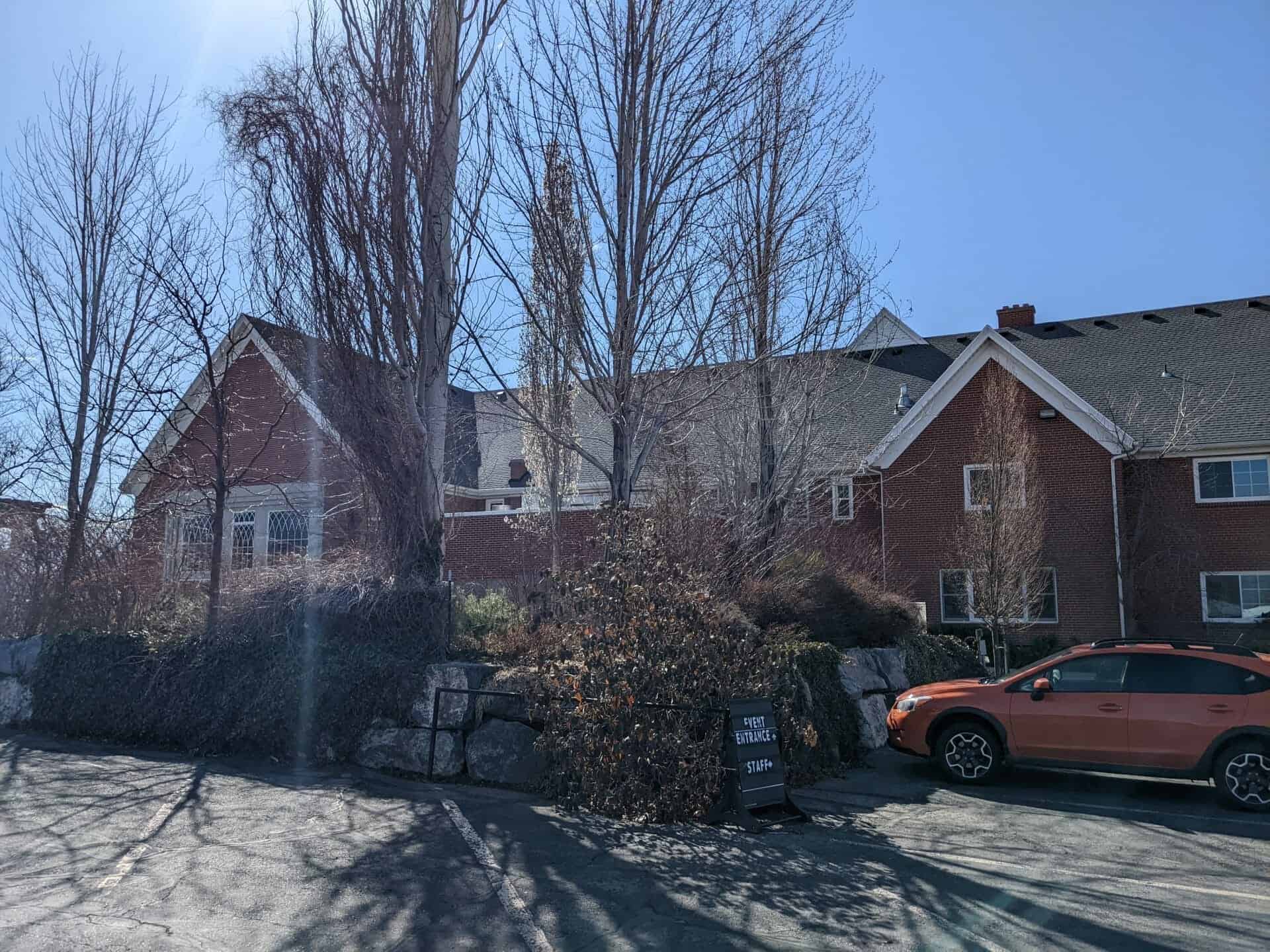
On 13 July 1901, the American Fork 2nd ward of The Church of Jesus Christ of latter-day Saints was created along with the 1st, 3rd, and 4th wards of the new American Fork Stake on 9 October 1902, Joseph H. Storrs, who served as bishop from 1901 to 1942 announced that brick had been contracted for a new meetinghouse. James H. Pulley designed the architecture in the Victorian Gothic style. The cornerstone was laid in April 1903, and the first meeting was held in the unfinished chapel on 31 January 1904. Robert L. Ashby, teacher of woodworking at the high school, took charge of the interior woodwork, and upon completion reported that he wanted no fee. Pres Anthon H. Lund dedicated the building on 17 February 1907. Total cost was $10,000.
On 15 June 1929 major alterations and additions totaling $48,555 were commenced under the direction of Don Carlos Young, church architect. The original brick architecture was carefully preserved and matched by the new construction. On account of a $15,000 donation by John (Jack) Firmage, the new recreation hall became known as Firmage Hall. Dedication was by Pres. Heber J. Grant on 4 September 1932.
Vacated by the church in October 1979, the building was purchased in May 1984 by M. L. Bigelow & Co., Inc., Organ Builders. It has housed the pipe organ shop and Michael Bigelow’s residence since that time. (text from plaque on site)
Note: The wards were actually part of the Alpine Stake originally, unlike what the plaque says. In 1963 the Stake was split.
Olive Chipman sold this property to the church for $400.
Located at 130 West 100 South in American Fork, Utah and added to the National Historic Register (#92000101) on March 10, 1992.
From the NRHP Nomination Form: The American Fork Second Ward Meetinghouse is significant as the only intact example of the eclectic Gothic Revival architecture once employed widely throughout the community by the LDS church during a period of ecclesiastical expansion after the turn of the century. It was one of four ward (congregation) meetinghouses constructed in the city around 1903-04. Each was a tall, brick, late Gothic Revival edifice with a corner steeple tower. Each had a combination of Gothic and Romanarched windows, corbeled brick ornamental motifs, art glass transoms and accent windows, stone foundations, steeply pitched gable roofs, and other shared features. The Second Ward Meetinghouse is the only one of those four churches to retain its architectural integrity. The large, well-matched 1929-30 addition to the meetinghouse is also significant. It documents two important changes in LDS church architecture after about 1920. First, it reflects the influence of the church’s newly created centralized architectural department and its emphasis on standard plans. Second, it illustrates the church’s new policy of including all church auxiliaries and their functions in a single building rather than in separate structures. The addition is a successful blending of functional and aesthetic considerations. It provided the necessary space for the ward’s varied activities and did so in a manner that conformed with both the new standard plan and the original eclectic Gothic Revival design.
Historical Background:
The town of American Fork was founded in 1850 by members of the Church of Jesus Christ of Latter-day Saints (Mormon or LDS church). This was just three years after the Mormons immigrated from the Mid-west and began establishing their new home in the Utah territory. American Fork was one of several towns established in Utah Valley by the Mormons during the 1850s. Agriculture was the principal local industry throughout the 19th century, though the coming of the railroad in 1873 and mining in the nearby mountains also influenced the local economy. The town, always predominantly Mormon, grew slowly but steadily and by 1900 the population was estimated to be over 2300.
Growth in the community was sufficient by 1901 to prompt the division of the single Mormon ward (congregation) into four separate wards. The process of dividing wards was common in many Mormon communities at this time, brought on by population growth, the death of many long-time local leaders, and changing church policies.
The Second Ward, along with the other three wards, soon felt the need for its own building. In a ward council meeting of 29 September 1901, Second Ward Bishop Joseph H. Storrs proposed that the ward begin efforts to provide a new building. He named a committee of five to recommend a building site. This was accomplished by November 1901, but planning for the construction continued for nearly a year. At a special meeting on 9 October 1902, the Bishop reported that they had taken upon themselves the responsibility of contracting for the brick and obtained the members’ approval. The bishop appointed a finance committee, and James H. Pulley, a local carpenter/ builder, presented a plan for the building. Pulley had recently been given the assignment to “get the plans” for the city hall, which was also being built at the same time. It also seems likely that Pulley designed the other three ward meetinghouses, given the similarity of their appearances.
Each of the four wards in American Fork were building new meetinghouses during this period and found “they could get brick cheaper in large quantities, so they all ordered their brick together, thus all the four ward chapels were constructed of the same color red brick.” According to the ward minutes, all the required brick was on hand by 5 July 1903 and “the masons would finish their work in a few days and the material was on the ground for the roof. Ward members all working together were doing a fine job, but it was slowed down for lack of finances.”
The ward began using the meetinghouse on January 31, 1904, even though all of the work on the building was not completed. By June of 1904, the ward still owed $700.00 and needed an additional $1,050.00 to finish the building and the tower. The tower, easily the most distinctive feature of the building, included a special room for Mormon prayer circles. That same month, Robert L. Ashby, a high school woodworking teacher, moved into the ward building to work on the interior woodwork. When he finished, Ashby rejected attempts to pay him for his work. Other members of the ward similarly donated labor and money to the project, which cost a total of $10,000.20. After the final debts were paid, the Second Ward Meetinghouse was dedicated on 17 February 1909.
The American Fork Historic District is locally significant, both architecturally and historically, because it represents the social, economic and architectural history of American Fork, Utah. The district is significant under Criterion C for its concentration of intact examples of residential buildings built during the major construction periods in the town’s history, from 1868-1940. The district accurately represents the wide range of architectural styles, types, and construction materials found in American Fork. The district is also locally significant under Criterion A as a reflection of American Fork’s residential settlement patterns and community growth through 1940. Founded by members of the Church of Jesus Christ of Latter-day Saints (LDS, or Mormon church) in 1850, American Fork experienced steady growth as an agricultural community, and later as a commercial center for northern Utah County through the arrival of the railroad in American Fork in 1873. This growth has continued into the twentieth century and up to the present.
Mormon Settlement 1850-1867
The site of American Fork was first considered as having potential for settlement by two early pioneers, Arza Adams and Stephen Chipman, who camped in the vicinity while traveling to Provo in the summer of 1850. Favorably impressed, Adams and Chipman asked permission from Brigham Young to establish a cattle ranch in the area, but instead were instructed to undertake a survey. Two sections of land were laid out in what was known as the “Big Survey,” encompassing the early townsite and the riparian area along American Fork Creek. The town of Lehi, a few miles northwest, had recently been surveyed, and this was used as the baseline.
Three aspects of the community’s inception differ from that associated with traditional Mormon settlement, two of which are noted by Lowry Nelson in The Mormon Village. First, the intention of Adams and Chipman to establish a large ranch was a departure from the usual pattern of Mormon settlement in which land was subdivided into small tracts. Second, many families constructed a house and lived on their farms, rather than reside in the village and travel to their land. Finally, settlers first lived on along the creek, where they had proximity to water, rather than in the orderly lots laid out in even blocks that characterized Mormon villages.
The threat of unrest between the settlers and the Indians in 1853 ended any dissimilar patterns. Residents were instructed to construct a fort and move within its walls. The pioneers’ log homes were moved within the fort but as the Indian danger dissipated, enthusiasm to complete the fort faded and it was never completed. From 1853 on, settlement was less dispersed and the plan of the village followed that of the fort.
During the 1850s and 1860s life in American Fork centered on survival. Farming and raising livestock was the basis of the economy. Small businesses and stores, such as the glass and crockery store established by Richard Steele in 1851 existed, but the exchange of goods transpired through trade and little cash was used. These decades were spent in building the community’s economic and physical infrastructure, and establishing the institutions that the settlers had known elsewhere. George Shelley describes the early accomplishments:
Among these were the gathering of the people together from their various locations along the creek into a compact community surrounded by a wall, the assuming of the distribution of the irrigation water… the allotment of land to the settlers, the making of roads and bridges…
The subsistence standard of living, the lack of materials and sophisticated tools and the isolation from national markets affected the community’s architecture. The first homes were constructed of logs, (some of hewn-log construction), chinked with chips and covered with mud mortar.
The next phase of construction was characterized by the use of adobe bricks. Residents found a good quality of clay in the wetlands southwest of the community and constructed an adobe mill. Adobe provided a more comfortable dwelling and allowed for stylistic forms and embellishments. In 1860 a new meetinghouse was built out of adobe with a granite foundation; later photographs indicate that the building had the moderately-pitched gable roof and cornice returns associated with the Greek Revival style in Utah. This building also served as a school.
Stability and Growth, Construction of Railroad through American Fork, 1868-1880
By the late 1860s life in American Fork was stable enough for residents to strengthen municipal institutions, support mercantile trading, and create more substantial and style-conscious structures. In 1867 the Deseret Telegraph Company opened an office in American Fork, providing access to communication on a national scale. Also in this year territorial legislation was passed giving local governments the right to maintain free public schools through taxation; this bill was sponsored by Leonard Harrington, American Fork’s first mayor, LDS bishop and Utah County legislative representative. After the bill passed, American Fork residents voted in favor of this option and became the first community in the territory to fund public education. A road and a narrow gauge railroad were constructed in the 1870s in American Fork Canyon to service mining activity. This, along with the construction of a mill with a circular saw at the mouth of the canyon, provided a much greater supply of lumber. Mining also brought in an influx of cash and helped the growing mercantile base in the town. Most significantly, the Utah Southern Railroad Company opened transportation through American Fork in 1873.
These developments affected the architecture and the physical appearance of the town. Residential architecture began to reflect national trends. Although the Greek Revival style, which had died out nationally by 1840, remained popular in American Fork and throughout Utah through the 1880s, the Victorian Eclectic style was used in American Fork by 1875. The William-Abner Chipman House at 269 S 100 W (c.1875) is a prime example of the Victorian influence. Homes in this style exhibited cross-wing, side-passage and central block plans. Adobe continued to be used but fired brick became the predominant material. An example of adobe house remaining in American Fork is the Greek Revival George & Mary Spratley House (c.1875) at 29 E 100 South. These trends are reflected in the surviving buildings of the district.
Two new schoolhouses, serving the neighborhoods east and west of the creek, were constructed. The 1860 adobe church was expanded in 1877 by a 30 x 50 foot addition and was thereafter known as “the Science Hall.” Bate Hall, a community recreation center, was built out of rock in 1876. A Gothic Revival Presbyterian Church was constructed the next year.
Once American Fork had rail access, its history and architecture were very much in keeping with the rest of Utah and the nation. Its location, between Provo and Salt Lake City, meant that it had a steady stream of travelers and access to outside markets and culture. The community continued to mature during the 1880s and through the first decade of the twentieth century. In 1883 rail service expanded with the extension of a Denver and Rio Grande Railroad line through American Fork. In the early 1890s municipal services improved: new streets were opened, a new survey was undertaken, city government became more structured and uniform city ordinances were established. Electric street lights were installed in 1901, the houses were numbered in 1905, and a fire station was constructed on Main Street in 1913. In 1899 the American Fork Co-op built “a commodious brick store” on Main Street, contributing to the town’s prosperous appearance. The Co-op was established in 1873 as part of Brigham Young’s efforts to keep mercantile business in Mormon hands. Closing in 1930, it had outlasted other co-ops in the state. In 1892 the Chipman Mercantile company was founded and became the largest retail operation in Utah County. The opening of the sugar beet factory in Lehi in the 1890s augmented the agricultural base in the county. This commercial growth in American Fork is reflected in the homes of the district. There are many large homes from this period still extant on Main Street including the Victorian Eclectic J. Chipman, Jr. House (c.1893, 121 W Main), the Greek Revival Emeline Sykes House (c.1905, 184 W Main), and the Queen Anne Vance/Walton House (c.1902, 195 W Main). Many homes built in the district were by families newly prospering from the City’s commercial growth. Often these owners were members of established American Fork agricultural families branching out into new commercial and industrial interests.
In 1901 a general reorganization of the LDS Church in Utah County took place. The original Utah Stake of Zion, (the LDS “stake” is equivalent to a diocese) which once encompassed Mormon wards (equivalent to parishes) in all of Utah County, was divided into three Stakes. American Fork became part of the new Alpine Stake. The single ward in American Fork was divided into four congregations, necessitating four new chapels. All four, two of which were in the district, were of built of brick in a Gothic Revival style. The Alpine Stake Tabernacle, found within the district boundaries at 110 E. Main St., is another significant LDS structure of this time. It reflects a new era of church building in a variety of revival and modern styles.
In 1914 Jesse M. Walker began raising white Leghorn hens for egg production on a commercial scale, marking the beginning of a prosperous poultry industry for American Fork. This seems to have had a great effect on the town, both economically and physically, as it was an enterprise that many people could participate in because it did not involve a large capital investment. The large lots of 1.25 acres (eight to a block) were conducive to the growth of this industry; Lowry Nelson writes that the space provided in this area was often sufficient for a poultry business large enough to supply a family’s livelihoods. This resulted in an expanded agrarian overlay to a community in which keeping livestock on property within the city was not unusual. Even today many henhouses and outbuildings associated with the poultry business are extant.
Progressive-Era Ideals and Economic Depression, 1900-1940
Beginning about 1910, domestic architecture moved away from the prevailing Victorian Eclectic style and bungalows became popular. The 1987 architectural survey indicates that this house type was used as early as 1901 but had become very popular in the next decade. Bungalows in American Fork are generally simple brick structures with a rectangular form and a hipped roof; more elaborate examples have Prairie School and Arts and Crafts elements. A few larger, Prairie style foursquare plan houses were also constructed in American Fork during this time, including the Chipman/Firmage House at 6 S. 100 West, and the Chipman/Robinson House at 208 W Main Street. Frame Craftsman bungalows, with brackets, clipped gables, and clapboard siding, offered an alternative for a small, modest house. Period Revival cottages of English Tudor styling were built beginning in the teens and through the 1930s and 1940s.
American Fork continued to benefit from the progressive ideals characteristic of the turn of the century. The city purchased land for a city park in 1920 and received a grant from the Carnegie Foundation and constructed a library designed by Ware and Treganza in 1923. School consolidation occurred in 1915. In 1929 state legislation was passed establishing several institutions assisting the mentally and physically disabled; American Fork was chosen as the site for the State Training School for mentally retarded citizens. By 1945 the school had 659 students and 86 full-time employees — a boost for the local economy.
During the 1930s American Fork experienced the hardships of the Depression but received some relief through the Works Progress Administration. WPA projects within the district included the improvement of City Central Park and graveling and hard-surfacing the streets. Outside the district boundaries, an amphitheater and wall at the State Training School, a stone wall around the cemetery, and an addition to the Harrington School designed by Provo architect Joseph Nelson of Nelson and Ashworth were all WPA projects that had a lasting influence on the physical fabric of the city.
Recent Development and Influences, 1940 – present
In the early 1940s the Geneva Steel plant was constructed to meet the demands of World War II. Several large subdivisions, including Columbia Village, Thornwood and Richland Park, were constructed to meet the related housing demand. Although located outside the district boundaries, these subdivisions had a lasting impact on the physical surroundings comprising the setting of the district area, and diminished the surrounding farmland that many residents of the district once owned as farmland. Architecturally these subdivisions represent one of the state’s “Levittowns,” in the sense that the homes were almost identical and small with compact floor plans. Their design lent them well to cost-effective and speedy construction. These subdivisions, along with those more recently constructed, have disrupted the pre-1940s layout and appearance of American Fork.
Probably the most significant post-World War II change to the physical character of this community was the construction of an interstate highway along the western edge of the city during the early 1960s. The resulting bypass of traffic has negatively affected Main Street businesses, as have the more recent construction of regional shopping malls. American Fork is no different from all communities along the Wasatch Front, in that maintaining a distinct identity, rather than acting as a bedroom community for Provo, Orem and Salt Lake, has become difficult.
The American Fork Historic District is an important historical resource because it represents the settlement and development of American Fork, Utah. The district is locally significant as a physical reflection of the residential architectural and historical development. The houses and outbuildings within the district provide a complete representation of the wide range of architectural styles and plans popular in the city between 1870 and 1940.
The district excludes the downtown commercial district including a city hall, a school, the old dance hall and more because of their lack of integrity.
Narrative Description
American Fork is located in Utah Valley near the north end of Utah Lake, fifteen miles north of Provo, the Utah County seat, and thirty miles south of the State Capital, Salt Lake City. The city contains a central historic commercial and residential core area, which is surrounded by suburban subdivisions built on what was once agricultural land.
The American Fork Historic District is located in the historic core of the city and is built upon a grid of five acre blocks separated by wide streets. Following the original Plat of Zion as envisioned by Mormon church founder Joseph Smith, each block was originally divided into eight lots, though every block within the district has since been subdivided and open space filled with new construction. All of the streets are paved and are lined with curb and gutter and sidewalks. Large, mature trees line the streets and shade residential lots throughout the district.
Residential Buildings: The district is irregularly shaped, and includes only portions of twelve downtown blocks, wrapping around the commercial area that no longer retains its integrity. The primary east-west axis of the district runs along 100 South, while the north-south axes are 200 West, 100 West, Center St., and 100 East. The district is almost exclusively residential in character, and contains a variety of houses from four general building phases: 1868-1880, 1880-1910,1910-1940, and 1940-present. Although out-of-period and altered structures are found throughout the downtown area, the district retains its overall integrity of feeling and association.
No properties dating from the earliest period of American Fork’s settlement (1849-1868) are contained within the district. The earliest properties in the district date from the late 1870s, around the last years of American Fork’s pioneer settlement, before the arrival of the railroad. The remaining examples from this time are single-story, symmetrical hall-parlor or crosswing type, gable-roofed houses, in simple vernacular classical styles. Decorative details, when present, are inspired by the Greek Revival. These houses are generally constructed of adobe or soft fired brick and are most often covered with stucco.
The bulk of the district’s buildings (approximately 67) date from the period 1880-1910. These are primarily Victorian Eclectic and late Greek Revival crosswing or central-block-with-projecting-bays houses, usually one or one-and-a-half stories in height. Fired red and putty colored brick is the most common building material of buildings of this time, though wood frame houses are also found. The Victorian houses are characterized by asymmetrical façades, prominent front gables, and substantial one-story porches with Classically inspired turned columns. Foundations are most often coarsely laid sandstone, though concrete came into use toward the end of this period. Roofs are a mix of gabled and hipped types. Windows on the front elevations consist of large single panes with fixed transoms, or one-over-one double-hung sash types.
Houses of the period 1910-1940 fall into two distinct types: the bungalow and the period cottage. The bungalow appears frequently in the district; approximately twenty-eight houses in the district are bungalows, or variations thereof. Two variants of the bungalow style, most examples of which were built in the first half of this period, were commonly found in the district: the more popular dark reddish brown brick version with a low-pitched hipped roof and broad front porch embellished with battered concrete columns; and the more modest frame, side gabled dwelling with clipped, or jerkinhead, gables. Both are distinguished by simple, rectangular footprints and wide, low slung eaves. Often both types were adorned with arts and crafts details such as roof brackets and exposed rafters and purlins. A few examples of the Prairie School style of bungalow can also be found in the district. Stylistic features include the wide overhanging eaves, a low hipped roof, horizontal banding, and geometric ornamentation.
Approximately 18 Period Cottage houses built during this period are located in the district. This house type encompasses several different period revival styles. By far the most frequently occurring style of period cottage in the district is the brick Tudor Revival cottage, in which a relatively simple rectangular cottage is elaborated upon by a steeply pitched entrance gable intersecting the side-gabled roofline.
Approximately 29 out-of-period buildings comprise the rest of the properties in the district. These consist of post-WWII cottages and modern ranch houses. Although such out-of-period buildings are found throughout the district, they are compatible in scale and materials with the historic buildings and do not detract overall from the character of the district.
Outbuildings: Several historic outbuildings are found scattered throughout the district. These are largely wood frame granaries and sheds and wood frame and brick automobile garages. Many out-of-period outbuildings are also present. Like the out-of-period houses, these outbuildings are compatible in scale and materials with the historic buildings and outbuildings and do not detract overall from the character of the district.
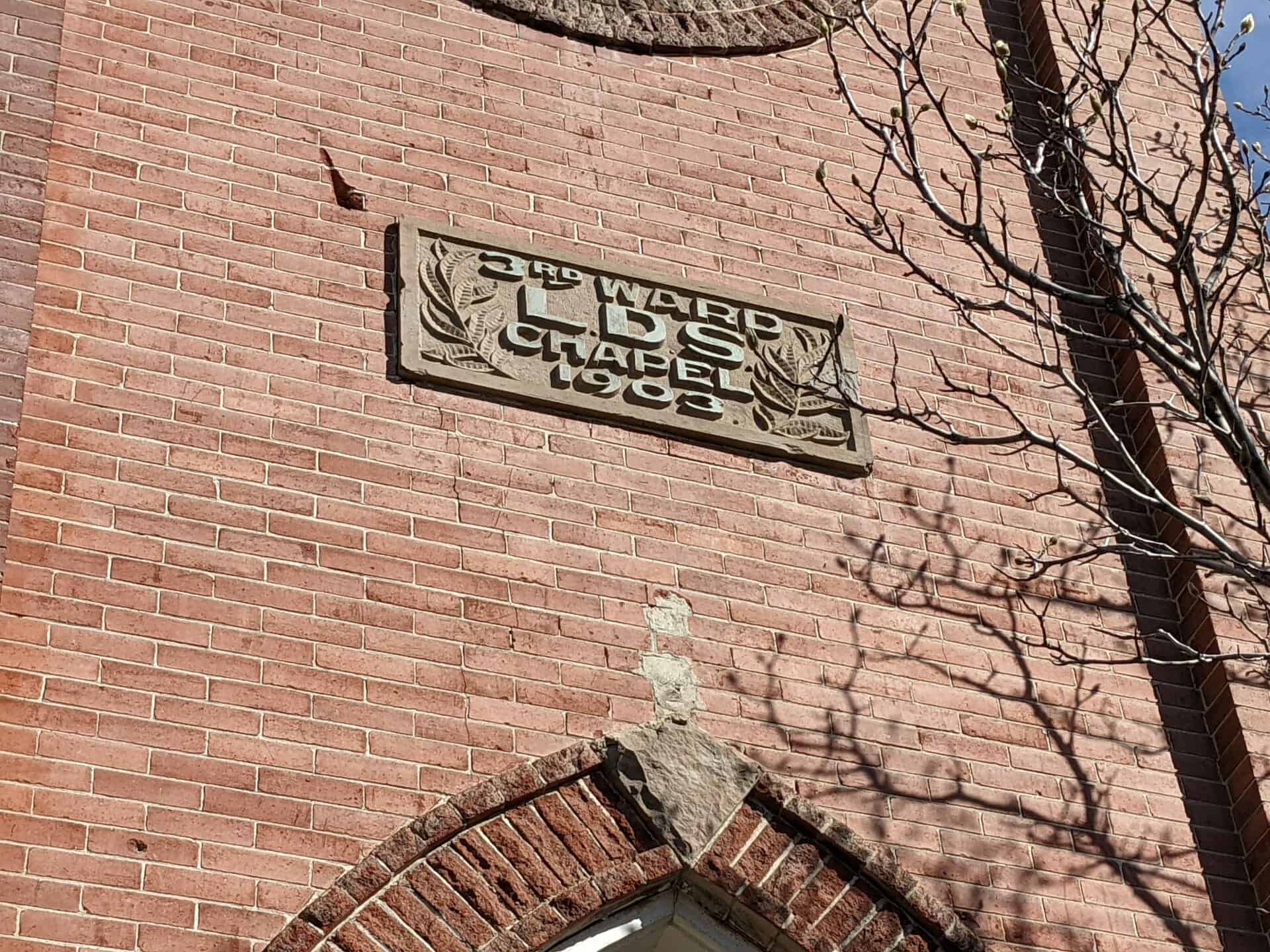
The American Fork 3rd Ward Meetinghouse, constructed in 1903 and expanded in 1938 and in the 1950’s, is significant for its association with the growth of The Church of Jesus Christ of Latter-day Saints (LDS or Mormon Church) in northwest American Fork and for its importance to the community and the patterns of social life seen in its use.
Architecturally, the building is significant as an artifact documenting evolution of and influences on architectural styles and customs of the LDS Church during the first half of the century. This era, when the church (officially) established standardized design for its church buildings, is believed by architectural historians to be the golden age of Mormon meetinghouse architecture.
This building is one of four meetinghouses designed and built by local craftsmen and ward members in American Fork, and it reflects the popularity of the Gothic Revival and Victorian Eclectic styles in church buildings during this era. The 1938 addition of a Jacobethan Revival-style recreation hall and classroom wing, designed by the church architectural department, reflects the church’s policy of including all church functions under one roof; previously separate amusement halls had been the policy. The 1958 addition and interior renovation, designed by Clifford Evans Architects, was a conservatively modern attempt to adapt the original structure to a growing ward membership.
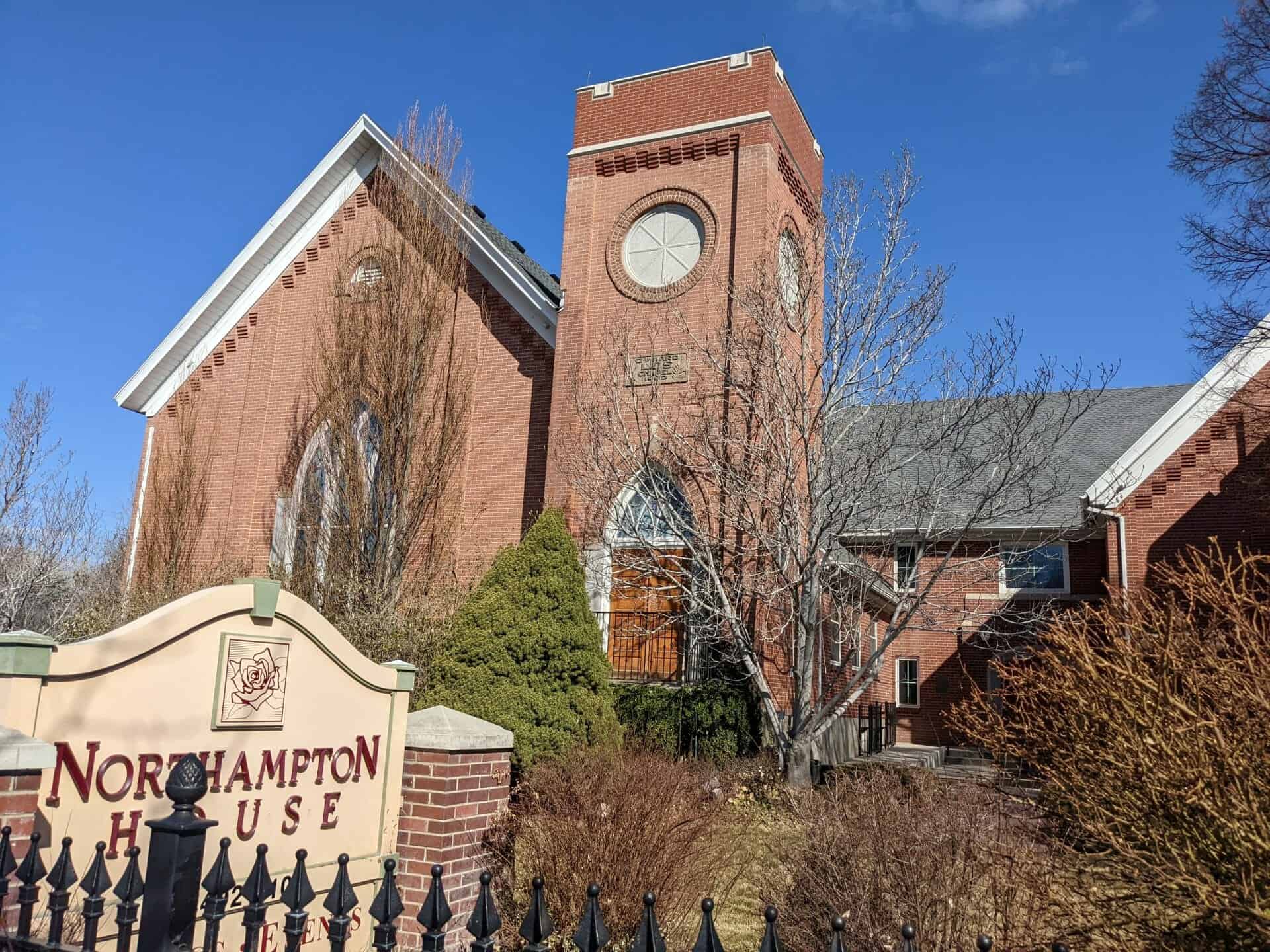
The church sold the building in 1995 due to its limited size. After being a daycare center, it was purchased in January 2001 by the Hawker family, who then initiated the extensive renovation, working closely with the National Historic Register to preserve its historic value. The grand opening of Northampton House, a wedding, banquet, and reception hall, took place in October 2001.
Located at 198 West 300 North in American Fork, Utah and added to the National Register of Historic Places (#02001554) in 2003.
Narrative Statement of Significance
The American Fork Third Ward Meetinghouse, built in 1903 and expanded in 1938 and the 1950s, is significant under the “Meetinghouses & Tabernacles” context of the Mormon Church Buildings in Utah: 1847-1936 multiple resource nomination, for its association with the growth of the Church of Jesus Christ of Latter-day Saints (LDS or Mormon Church) membership in the northwest portion of American Fork, Utah. The building is significant under Criterion A for its importance to the community and the patterns of social life seen in its use. The building is also significant under Criterion C as an important document of the influences on and changes in architectural styles and customs of the LDS Church during the first half of the twentieth century. The original 1903 chapel is one of four churches, designed and built by local craftsman and ward members, and reflected the popularity of the Gothic Revival and the Victorian Eclectic in turn-of-the-century church construction. The1938 addition of a recreation hall and classroom wing, designed and directed by a strong church central architectural department, was Jacobethan in style and reflected the church’s policy of including all church auxiliaries and functions under one roof. The 1958 addition and interior renovation, designed by a Salt Lake firm with ties to the church, was a conservatively modern attempt to adapt the original structure for a growing membership. Between January and September 2001 the American Fork Third Ward Meetinghouse was extensively rehabilitated to adapt the building for use as a reception center. This work was being completed as a historic tax credit project, and included the restoration of several original features. The building is in excellent condition and is a contributing historic resource of American Fork.
HISTORY OF THE AMERICAN FORK THIRD WARD MEETINGHOUSE
In the summer of 1850, three years after members of the Church of Jesus Christ of Latter-day Saints arrived in the Salt Lake valley, pioneers camped in the area now known as American Fork while traveling to Provo, fifteen miles to the south. Impressed by the area, Arza Adams and Stephen Chipman asked permission from Brigham Young to establish a cattle ranch, but were instructed to survey several tracts for settlement. The initial pattern of settlement in 1851 differed from the traditional Mormon villages because the settlers chose to first live and farm along the creek where they had access to water rather than build on the small orderly town lots. Indian unrest resulted in the construction of a fort in 1853, and from then on the settlement was less dispersed and the town grew within the town site. For most of the 1850s through 1870s, American Fork residents relied on ranching and subsistence farming, lived in simple log and adobe homes, and held meetings in an adobe building, also used as a school. The city was incorporated on June 18, 1853, as Lake City, and later the name was officially changed to American Fork in 1860.
Economic growth came in the late nineteenth century as the city became stable enough to strengthen municipal institutions and support mercantile trading. The Deseret Telegraph Company established an office in American Fork in 1867. By 1870, a narrow gauge railroad was built to the nearby canyon to support mining activity, and a major event occurred in 1873 when the Utah Southern Railroad extended its service to American Fork.
Mining brought cash to support a growing mercantile base, and brickyards and lumber mills allowed residents to construct more substantial and stylish homes and businesses. When the Denver & Rio Grande Railroad reached American Fork in 1883, the city was experiencing intensive commercial growth and municipal maturity. Between 1890 and 1900, the population of the city grew from 1,942 to 2,732.
The American Fork Ward of the LDS Church was organized on May 5, 1851, and was the social focus of the practically the entire town for fifty years. On January 13, 1901, a general reorganization of the LDS Church in Utah County took place. The original Utah Stake of Zion (a stake is equivalent to a diocese), which once encompassed all LDS wards (equivalent to parishes) in the county, was divided into three stakes. The northern portion of the county, which included American Fork, became the new Alpine Stake. Six months later, on July 14, 1901, the American Fork Ward was divided into four wards, each comprising a quadrant of the city. A committee was appointed in each of the four wards to locate a site on which to building a ward chapel. The four buildings were completed by 1905, and all were rectangular buildings with towers at one corner and Gothic Revival details. Local carpenter, Arthur Dickerson (1874-1949) designed the Third Ward. The four ward bishops bought the brick together because they could get a good price for such a large quantity. All four chapels were later expanded (1920s-1930s) to include recreation hall and additional classrooms. Of the four buildings, only two are extant: the Second Ward Meetinghouse, which was listed in the National Register of Historic Places in 1992, and later incorporated into the American Fork Historic District in 1998; and the Third Ward building. The Fourth Ward building was destroyed by fire on June 28, 1975, and the First Ward was demolished in the late 1960s.
The American Fork Third Ward included all the members living in the northwest quadrant of the city. A corner lot at 190 West 300 North belonging to the Thomas Shelley (1822-1903) family was acquired by John R. Hindley (1863-1947), first bishop of the Third Ward, for the sum of four hundred dollars in May 1902. On October 3rd, Hindley transferred the deed to the American Fork Third Ward to be administered by him as bishop and by his successors. Excavation on the building commenced in April 1903. Members began holding services in the basement as soon as the first room was finished. The chapel was completed by 1905. With few exceptions, the labor to build the edifice was donated by ward members. The building was completed at a cost of $9,099.75. Both the Third and Fourth Ward chapels were dedicated on March 17, 1907. A photograph taken on that Sunday morning indicates a crowd of more than 200 in attendance at the Third Ward service. An interior photograph taken that year shows the chapel with metal frame, theater-type seats, elaborate woodwork in the podium-pulpit area, and a large coal burning stove to provide heat. A second smaller stove was located in the basement. According to Ellen Tracy, historian of the Third Ward, the “grounds were lovely with grass and trees. North of the building were hitching posts for those who had to come with horse and buggy or wagons. And back of the hitching posts was a grove of trees and grass where many socials were held.” The manuscript history of the ward notes a second dedication on September 3, 1908, by Joseph F. Smith.
The ward grew steadily and by July 1915, the northern-most portion of the ward boundaries was given to the Highland and Alpine Wards, with a transfer of 95 members. The ward continued to grow, but for many years the original chapel was more than adequate especially since extremely large groups could by accommodated in the Alpine Stake Tabernacle, built between 1909 and 1914. In 1929, with a ward membership of 659, a committee was formed to discuss the building of an amusement hall. During the previous decade the LDS Church had instituted a policy of including all ward auxiliaries and functions under one roof. For example, the Third Ward Relief Society (the ladies’ auxiliary) converted an old school house to a Relief Society Hall in which they held meetings for eighteen years. The anticipated construction was postponed; however there appears to have been some minor renovation work in the chapel and basement by contractors of the Chipman Mercantile Company completed in 1929. By 1932, the ward was paid off the debt for this work and began again to consider an addition. In June 1937, the ward approved plans for a new recreation hall and classroom block provided by the church architectural department, and work commenced exactly one year later. The general contractor for the project was again Chipman Mercantile of American Fork. Electrical work awarded to Samuel F. Grant of American Fork, and Utah Fuel Supply of Salt Lake City was awarded the heating contract. Work proceeded so quickly that by October 1938, the building committee was able to report the brickwork was complete and the shingling nearly complete. The building was mostly finished by 1939 and more than double the existing floor space. The recreation hall included a basketball court, stage area, and projection room (movies were a popular ward social event in the 1930s and 1940s). The classroom wing included twelve classrooms, a Relief Society room, bishop’s office and kitchen. Other amenities included new restrooms, a cloakroom, and remodeling of the basement.
Though the project was not completely finished until 1942, the majority of work took less than a year partly because more paid labor was used than in previous projects. Final cost was about $30,000, with the general church fund providing sixty percent of the cost and the ward financing forty percent. This left the ward with a hefty debt on the building. Several methods of fond raising were used. The ward held benefit banquets, including a January 1939 dinner held for the general public in the basement of the tabernacle. In 1940 the Relief Society raised funds by sewing a quilt featuring the names of all the officers who had served in various ward capacities since 1901. One enthusiastic member issued a challenge to the priesthood that he would match dollar for dollar all funds donated by other ward members. The amount was considerably more than he anticipated, but he came through and paid up. The completion of the new wing raised enthusiasm in the ward. The year 1939 was a banner year for perfect attendance awards.
Throughout the first half of the twentieth century, American Fork was a primarily agrarian community. Though only a few residents participated in large-scale agricultural production, most families supplemented their employment by having vegetable gardens, small orchards, and chicken coops on their large lots. Growth in the community was slow, the population of American Fork increased by less than 700 between 1910 and 1940. World War II brought the Geneva Steel Plant and thousands of defense workers to Utah County. Many stayed in the area, and by 1950, the population of American Fork had jumped to 5,126. The large lots within the Third Ward boundaries began to be subdivided to accommodate the post-war housing boom. In January 1950, with a ward membership of 1,022, the Third Ward was divided creating the Eighth Ward whose members lived on the east side of 100 West. The division necessitated staggering meeting times in order to share the building. The Eighth Ward later moved into a new building with the Sixth Ward.
In April 1956, a committee was organized to study possible additions and renovations to the Third Ward building. The accepted proposal was projected at a cost of $48,850. Dal Allred of Clifford Evans Architects, a Salt Lake firm with long-standing ties to the LDS Church designed the classroom-office wing to the west, and a substantial remodel of the chapel. Renovation work began on February 29, 1957, when the men and boys of the ward removed the original chapel seats. Meetings were held in the Alpine Stake Tabernacle during the construction. The ward held seven building-fund banquets and other entertainments to help defray construction costs. Virtually all of the building received some type of renovation, but the most significant alteration was made in the chapel where the original podium pulpit was removed and a new one built at the opposite end. All new landscaping and expanded parking facilities were also included in the project. The final cost of the 1957-1958 work was estimated at $85,885.77. Four hundred fifty members (out of a ward population of 940) attended dedication services on December 14, 1958.
The design of the renovation was intended to accommodate two wards in the building, which occurred in March 1959 when the ward was again divided. The new Tenth Ward took all members north of 500 North. A new chapel for the Tenth Ward was built in 1964. In October 1973, the Third Ward was combined with parts of the Seventh Ward to form a new Sixteenth Ward, an event that Ellen Tracy describes as “a real blow to the older 3rd ward members.” The building continued to be used by members of the LDS Church until it was sold in October 10, 1994, when it was deemed inadequate. The Briar Rose Preschool acquired the property and immediately remodeled the building for school use. The building was sold in 1999 to the Chapel Hill Academy, and in January 2001 was acquired by the current owner. In September 2001, a complete adaptive reuse renovation of the building was completed as an historic preservation tax credit rehabilitation project. The building is currently known as the Northampton Reception Center.
ARCHITECTURE
The first meetinghouse in American Fork was a vernacular Greek Revival-style hall, built of adobe brick in 1861 (now demolished). The four ward meetinghouses built between 1901 and 1905 represent a period of change during which the LDS Church, following the pattern of other Christian denominations, considered the Gothic Revival style appropriate for church buildings.2 The character defining features of these Gothic-style meetinghouses were asymmetrical facades, crenellated towers, and pointed-arch windows with wooden tracery. In plan, the meetinghouse was typically a rectangular hall with classrooms and offices located in a wing or in the basement. The church hierarchy usually employed local builders (often members of the ward) when professionally trained architects were not available. James H. Pulley (1856-1934), a local builder-carpenter, is known to have designed the Second and Fourth Wards. Arthur Dickerson, a local builder and member of the ward’s building committee designed the Third Ward building. Arthur Dickerson was born in American Fork in 1874. He is listed on the 1900 census of American Fork as a carpenter. According to his obituary, Dickerson was an “inventor, building contractor and musician.” In addition to designing and constructing buildings, he also made violins and guitars, and dabbled in poetry. He died in Idaho in 1949.
The practice of employing local builders and architects for meetinghouse designs was common in the church until 1920. After World War I, due increasing membership and building expenses, LDS Church leaders created a centralized architectural department where standardized plans could be produced in order to erect meetinghouses more quickly and less expensively. The plans for the 1938 addition were generated by the LDS Church Architectural Department and reflect the influence of head architect Joseph Don Carlos Young (1855- 1938), who designed for the church from the 1890s to his retirement in 1936. Between 1921 and 1936, his influence permeated the design of most LDS meetinghouses produced during this period. Young used a wide range of architectural vocabulary in his designs. Most of the meetinghouse designs were based on his innovative design of a U-shaped chapel and amusement hall. This standard plan was used in a number of wards and was nicknamed the “Colonel’s Twins.” Decoration on the buildings varied, but usually incorporated Georgian and Federal-style architectural motifs. The American Fork meetinghouses were an adaptation of the U-plan to existing chapels. The Third Ward’s Jacobethan Revival (a style based on 17th century English architecture) ornamentation is subtle and complements the Gothic-style of the original chapel. The 1958 addition and renovation, while just outside of the historic period, is also an important feature of the building. The west wing is somewhat of an aberration in the church’s architectural department of the 1950s. Standardized plans, most featuring Colonial Revival exteriors and modern interiors, were available in a range of sizes and configurations to accommodate variations in membership numbers and sites. Adapting and renovating older buildings was becoming increasingly rare, as the church was embarking on an ambitious program of chapel building. The three building phases of the Third Ward represent changes in LDS Church architecture throughout the twentieth century.
Narrative Description
The American Fork Third Ward Meetinghouse is a two-story, brick church building, constructed in three phases between 1903 and 1958. The original chapel space, constructed in 1903-1905, was designed in an eclectic Gothic Revival style. In 1938, a recreation hall and classroom wing was constructed to the east and north with modest Jacobethan decorative elements. The building was again expanded in 1958 in a wing to the west and north. Through the years minor alterations have been made to the exterior of the building, none of which substantially affect the building’s overall architectural integrity. The interior was extensively remodeled during the construction of the 1958 addition. The building is currently undergoing a major rehabilitation for adaptive reuse as a reception center. This work, which is a historic preservation tax credit project, is designed to restore many of the original features of the building as well as adapt the building to a new use.
The original 1903 footprint was a 53 feet x 80 feet rectangle with a square tower and entrance vestibule at the southeast corner. The 1903 building sits on a rock-faced, ashlar, stone foundation. The brick is red tap brick laid in a running bond with flush mortar joints. Decorative brick elements included corbelling at the cornice line, square colossal pilasters (projecting above the roofline for a slightly castellated effect), and rock-faced brick accenting the window hoods and round tower windows. Windows and door transoms were pointed, gothic-arches. A large stained-glass window was located on the south elevation. The upper tower windows had a floral design. The main floor of the sanctuary was above a raised basement. Steps leading up to multi-panel, double doors were located on the tower’s south elevation, and the north end of the east elevation. A grade-level entrance to the basement was located on the east side of the vestibule. Sandstone was used for lintels, sills, impost blocks, keystones, and the date block above the tower entrance. The cornice was plain and the eaves of the simple gable roof were slightly belcast. The roof of the tower was pyramidal with patterned shingles. On the interior, the sanctuary featured a raised podium and pulpit at the north end. The podium featured Victorian-gothic ornamentation such as a lathe-turned balustrade and gothic-designs in the woodwork. Metal frame theater-style seats were used (instead of pews), and a large pot-bellied stove was mounted next to the podium to heat the space. Ward histories indicate in 1929, the basement, originally used for classroom space, was expanded and remodeled.
In 1938, the first major addition was built to the east and the north. This addition effectively doubled the floor space of the original building, with a recreation-social hall to the east, a two-story auxiliary wing (classrooms, restrooms, and kitchen) to the north, and a foyer connecting the new space to the old. The new addition is constructed on a concrete foundation with no basement. The brick is laid in common bond with headers every sixth course. The south elevation of the addition features corbelled brick and pilasters similar to the 1903 building, but the decorative elements are Jacobethan rather than Gothic Revival. The south elevation of the social hall features a projecting entrance wing with a crenellated parapet and cast concrete window and door surrounds. A second, recessed entrance (also with a cast concrete surround) leads into the connecting foyer. On the interior the foyer has stairs to the second floor classrooms and a cloakroom. The hall is open with a stage to the north and a projection room (above the projecting entrance wing). The classrooms, restrooms, kitchen etc. are located at the rear of the building and can be accessed either from the foyer or the rear entrance.
Both the north and east elevations of the 1903 building were significantly impacted by the 1938 addition. In addition, the pilaster caps and belcast eaves were probably removed at this time when a new roof was installed on the structure.
In 1958, a major remodeling took place when the west wing was added. The 1958 wing is also two stories, and construction included additional excavation of the original basement. The wing sits on a raised concrete foundation and is constructed of red brick laid in a common bond similar to the 1938 addition. Although the 1958 addition features pilasters, there is little ornamentation such as corbelling. The windows are steel-sash, multi-pane windows and the doors were multi-paneled wood. The wing sits sufficiently back from the south elevation and does not impact the main facades of the 1903 and 1938 portions. The main feature of the 1958 addition is the entrance on the west elevation. On the interior, the space is divided into an entrance vestibule, classrooms, offices, and a large mechanical room in the basement.
According to the construction drawings for the 1958 addition, the 1938 wing was left intact with little or no alterations. However, several significant changes were made to the 1903 portion of the building. On the exterior, the stone foundation was encapsulated in concrete and the steps to the tower entrance removed. The cornice was replaced and the roofline simplified. Louvers were installed in the attic vents. The tower roof was removed and replaced with a built-up roof deck, a new crenellated brick parapet, capped with cast concrete, and new metal steeple. New cast concrete panels replaced the original upper tower windows. A chapel annex (quiet room) was added to the chapel’s east elevation. The gothic windows on the west elevation were replaced with steel-sash versions of the same design. The wood sash of south elevation window and transom was left intact, however, the original stained glass was replaced with a blue-green, marble-patterned milk glass. On the interior, the changes were even more significant. All original finishes and furnishings in the chapel were removed. A new podium was built at the south end changing the orientation of the congregation and new pews were installed. The new design was modern, with simple lines and light, tan-colored woodwork.
About 1970, the stained-glass window and tower entrance were bricked-in, probably due to the difficulty of replacing broken glass. The aluminum soffits around the entire perimeter of the building were installed in the 1980s. A more major alteration was the replacement of the wood doors on all main elevations with glass and aluminum (probably 1970s or 1980s). Metal stairs were added to the west (supported by wing walls) and north elevations for additional egress from the second floor, and necessitated converting two windows into doors. When the property was sold in 1994, church officials had the steeple removed before transferring the deed. The building was used as a preschool between 1994 and 2000. Alterations made during this phase included the removal of pews and from the chapel space and the demolition of the stage area in the recreation hall. The steep stairs to the projection room were removed at an unknown date.
Between January and September 2001, the building was rehabilitated for use as a reception center. Alterations to the exterior were minor. Most were designed to restore the historic integrity of the building. The window-blocking brickwork from the south elevation was removed and a new stained glass window was installed in the original wood sash. Stained glass was also installed in several panes of the gothic windows on the west elevation, and the windows on the tower. The original entry doors in the tower were rehabilitated. New wood doors (designed with six panels similar to the tower doors) were installed on the south and west elevation entrances. All brick, sandstone and concrete was cleaned and repaired. The exterior metal stairs were removed. A new glass entrance was created on the north elevation where the original stage entrance and loading doors were located. Handicap access ramps were created on the south and north elevation, and also at a new basement entrance in the southwest corner of the building. A new cast concrete balustrade was created for the tower balcony and the southeast entrance. The exterior work has restored many of the lost historic features of the building.
On the interior, all 1958 and subsequent finishes were removed. The chapel and recreation hall were rehabilitated for use as reception hall (west and east halls respectively). The west hall (chapel) and annex rooms were given new paint, carpet and contrasting woodwork in the Victorian Eclectic style. A new staircase (designed with a lathe-turn balustrade similar in style to the original 1903 podium) was built at the north end. The east hall (recreation hall) is simpler in design with a rough stucco finish and a hanging lattice of flowers under the ceiling. Alterations to this area include partition walls at the south end and a new staircase on the west wall. The south foyer staircase (1938) was also rebuilt with a marble and wood mantelpiece installed in the foyer area. The west foyer was left intact with new finishes. A chair lift was installed in the corridor. The existing kitchen and bathrooms were upgraded. Existing classrooms were converted to bride’s rooms, office space and meeting rooms. The basement was refinished for use as meeting rooms, storage and a floral shop. All interior work was sensitive to and compatible with the original historic features of the building while addressing issues such as code compliance, egress, access and a new community-based usage.
The building faces south on a one-acre parcel of land. An additional parcel is used for parking to the east. A third parcel (to the north and east) was recently acquired by the current owner and will also be used for parking. A small brick utility shed (non-contributing circa 1980) sits on the northeast corner of the original parcel. The property is on the corner of 300 North and 200 West, with sidewalks and grassy parking strips along the streets. There are mature trees on all the landscaped portions of the property with sidewalks leading to the primary entrances. A number of shrubs and other plants are located at the base of the building. Exterior lighting, stone retaining walls and patio space was part of the landscape upgrades included in the adaptive reuse. The property is located in a hilly residential neighborhood just north of American Fork’s historic downtown. There is a mix of housing stock ranging from early adobe settlement homes (1870s & 1880s) to very recent residential construction. The American Fork Third Ward is in excellent condition and is a contributing historic resource of the neighborhood.
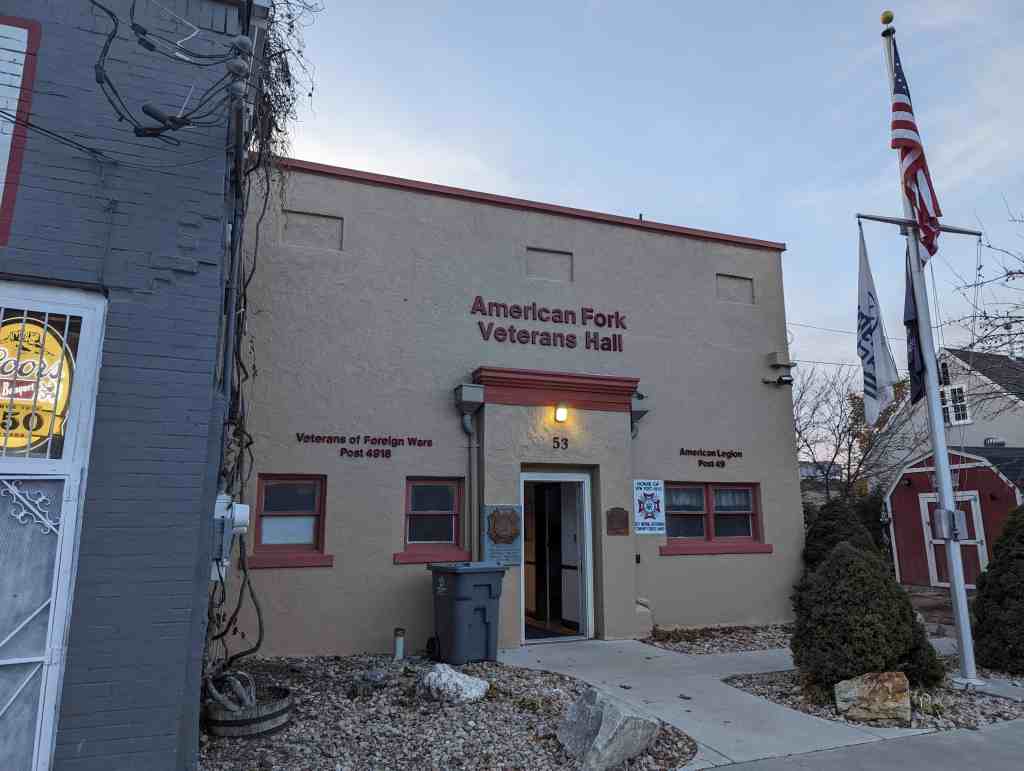
The Veterans Memorial Building, also known as the Legion Hall, was originally constructed as a commercial building sometime before 1932. In 1934 it was extensively remodeled as an early Public Works Project funded by three sources: A Civil Works Administration Grant (part of the New Deal Era Legislation), American Fork City, and the American Legion Post 49. American Fork Veterans, wanting to bolster public remembrance of their comrades who served and died in WW1, organized a small group of men and women who worked for years to establish a suitable memorial. Their efforts resulted in the remodeling of this structure to honor WW1 servicemen. As a result of their support and its use as a Legion Post it was commonly known as the Legion Hall.
The Building is a well-preserved local example of the “PWA” Moderne Style of architecture, which was used extensively during the 1930’s on government-funded buildings. It features smooth wall surfaces, flat roof, plain, narrow cornice, framed entrance, and metal sash windows. The interior maintains much of its original fabric such as wainscoting, staircases, crown molding, wall sconces, and 1930’s kitchen with elaborate cabinets, glass cupboard doors, and chrome plated hardware.
Located at 53 North Center Street in American Fork, Utah
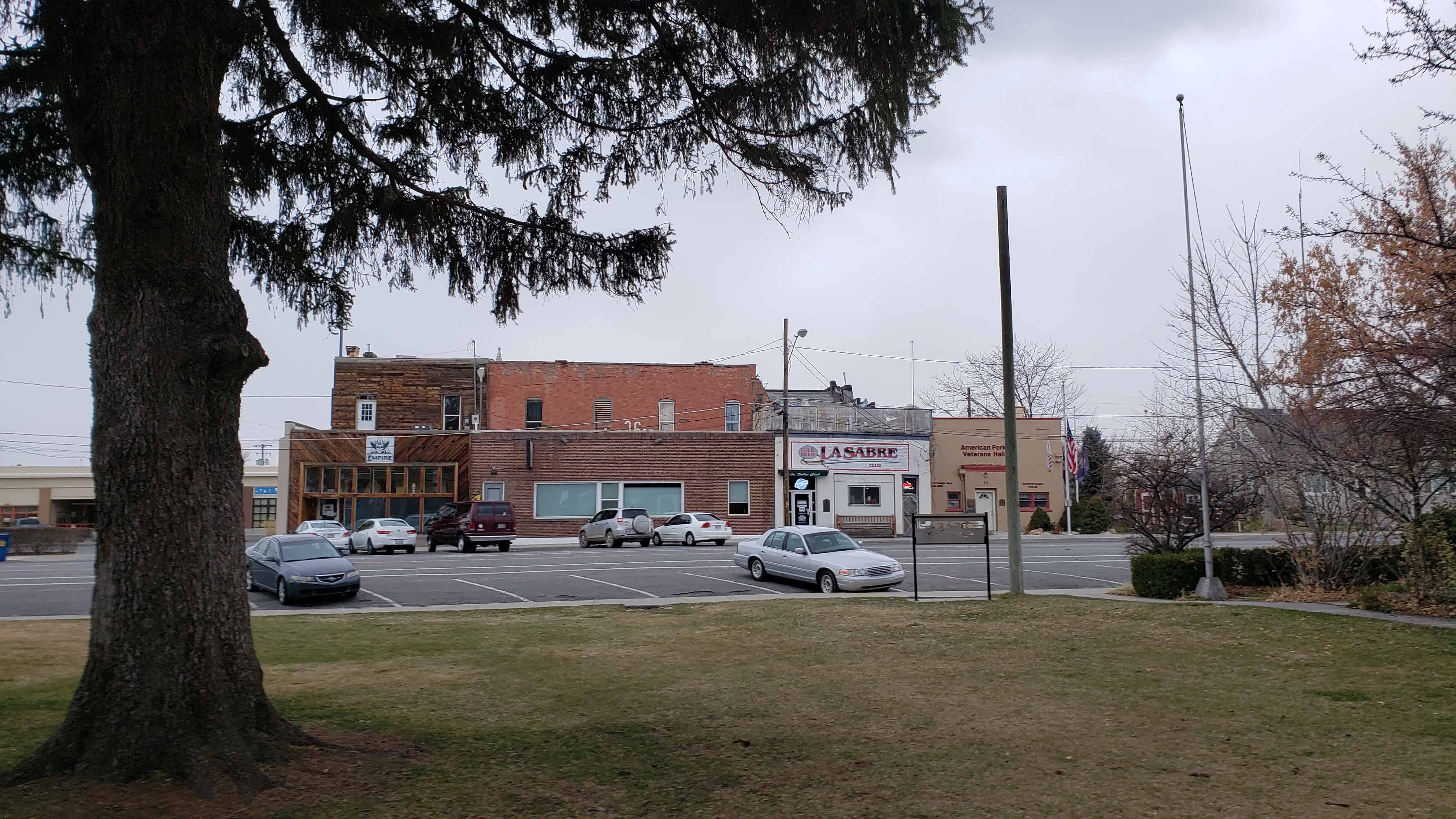
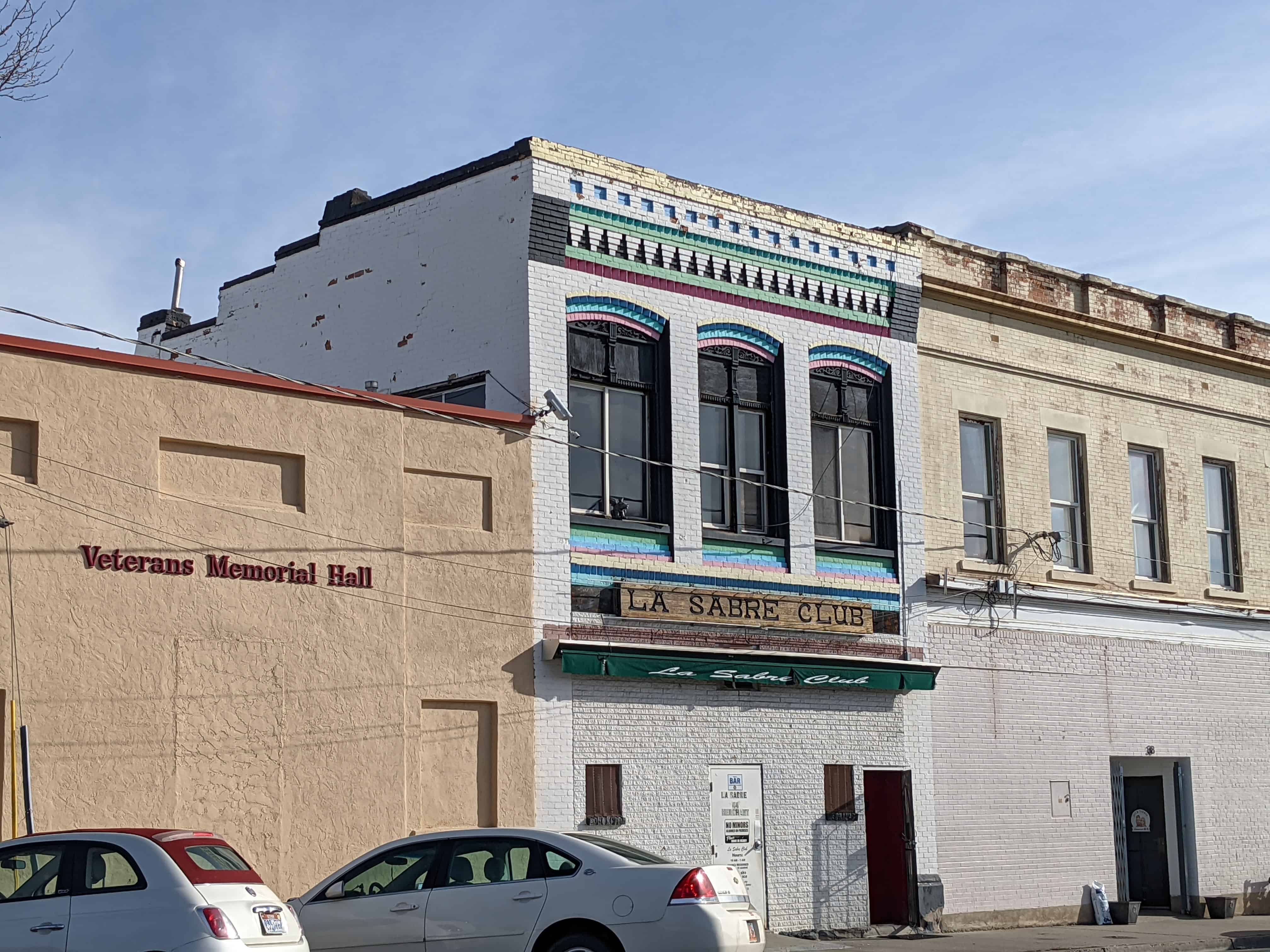
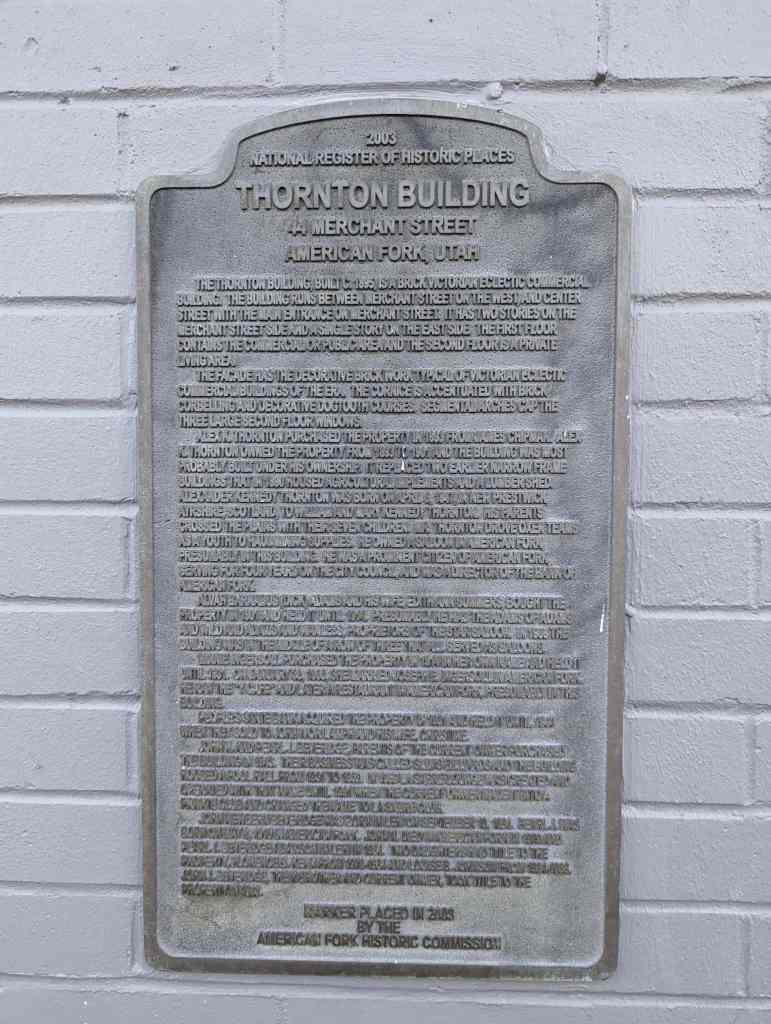
The Thornton Building built c. 1895 is a brick Victorian eclectic commercial building the building runs between Merchant Street on the west and Center Street with the main entrance on Merchant street it has two stories on the Merchant street side and a single story on the east side the first floor contains the commercial or public area and the second floor is a private living area.
The façade has the decorative brick work typical of Victorian eclectic commercial buildings of the era the cornice is accentuated with brick corbeling and decorative dogtooth courses segmental arches cap the three large second floor windows.
Alex K. Thornton purchased the property in 1893 from James Chipman Alex K. Thornton owned the property from 1893 to 1901 and the building was host probably built under his ownership it replaced two earlier narrow frame buildings that in 1890 housed agricultural implements and a lumber shed. Alexander Kennedy Thornton was born on April 6, 1847, in New Prestwick Ayrshire, Scotland to William and Mary Kennedy Thornton. His parents crossed the plains with their seven children. Mr. Thornton drove oxen teams as a youth to haul mining supplies. He owned a saloon in American Fork presumably in this building, he was a prominent citizen of American Fork, serving for four years on the city council and was a director of the Bank of American Fork.
Alvah Barnabus (Dick) Adams and his wife, Edith Ann Summers, bought the property in 1901 and held it until 1914. Presumably he was the Adams of Adams and Wild and Adams and Wanless, Proprietors of the Star Saloon in 1908. The building was in the middle of a row of three that all served as saloons.
Minnie Ingersoll purchased the property in 1914 in her own name and held it until 1931. On January 30, 1900, she married Joseph E. Ingersoll in American Fork. He ran the ‘Y Café’ and later a restaurant in American Fork, presumably in this building.
People’s State Bank acquired the property in 1931 and held until 1944 when they sold to John Ivor Lamph and his wife, Christine.
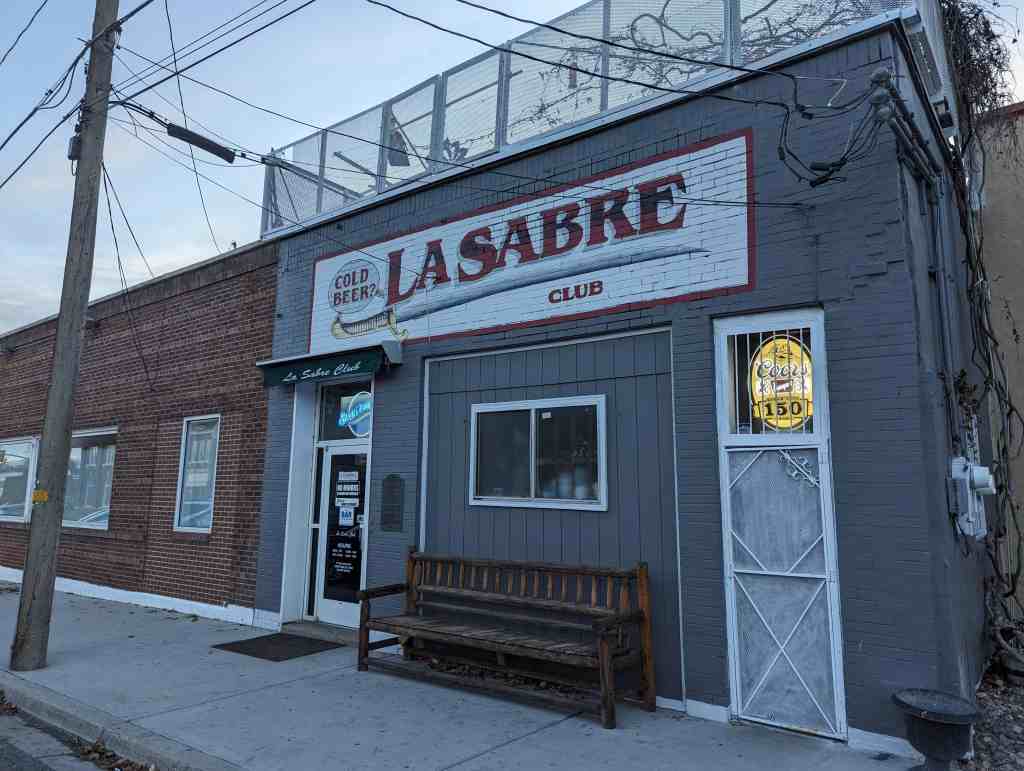
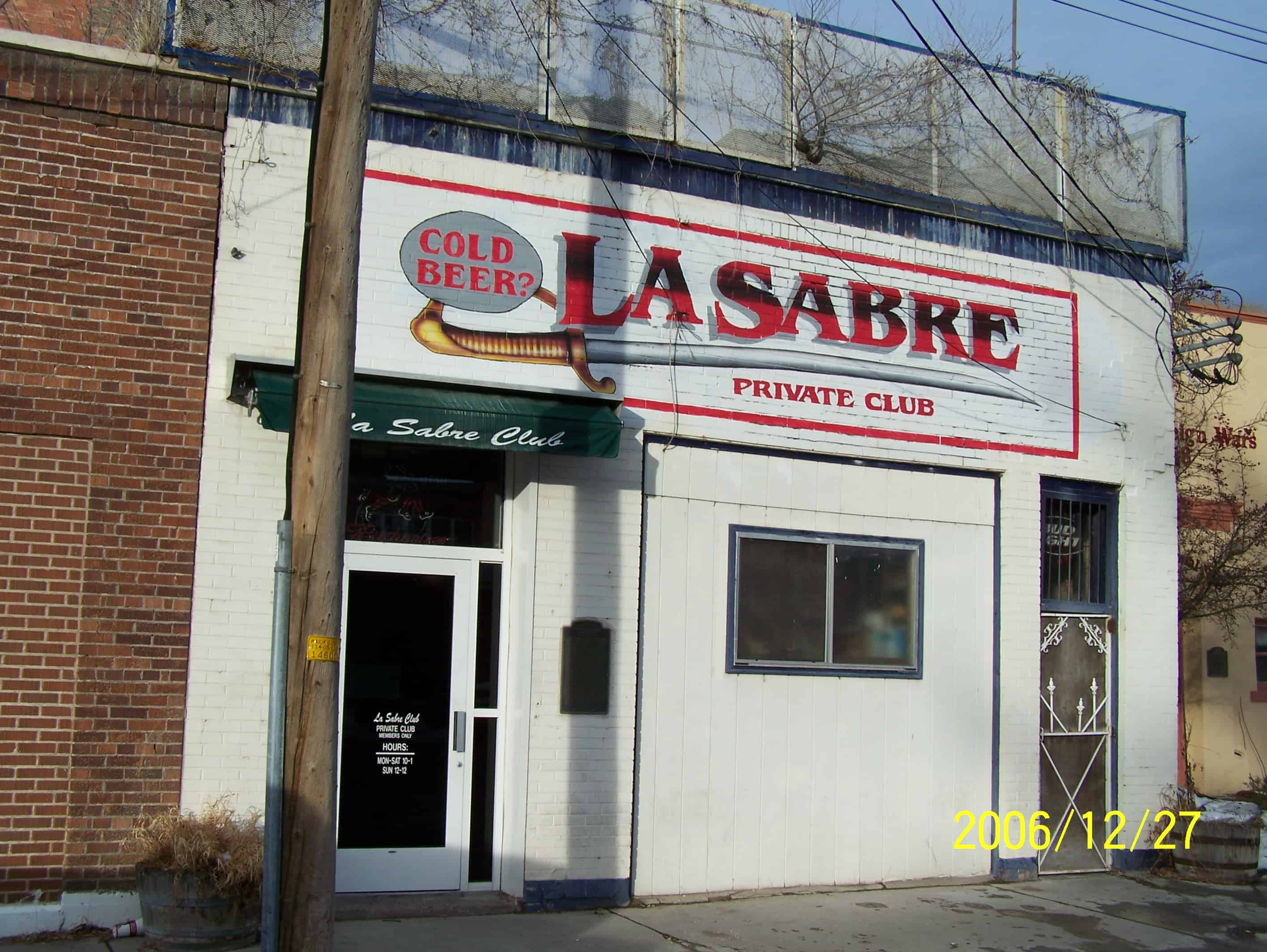
John W. and Pearl J. Beveridge, parents of the current owner purchased the building in 1943, their business was called Slim’s Billiards and the building housed a pool hall from 1931 to 1959. In 1953 La Sabre Lounge was created and opened with that name until 1991 when the current owner made it into a private club and changed the name to La Sabre Club.
John Newbern Beveridge was born in Lehi on September 19, 1894. Pearl J. was born on May 6, 1910 in American Fork. John N. died in American Fork in 1979 and Pearl J. Beveridge Adamson in Lehi in 1984. Two daughters had title to the property, Florence S. Kerr from 1979-1984 and Louise B. Johnson from 1984-1988. John J. Beveridge, their brother and current owner (2003) took title to the property in 1988.
Located at 44 North Merchant Street in American Fork, Utah
The photos below are borrowed from the county records:
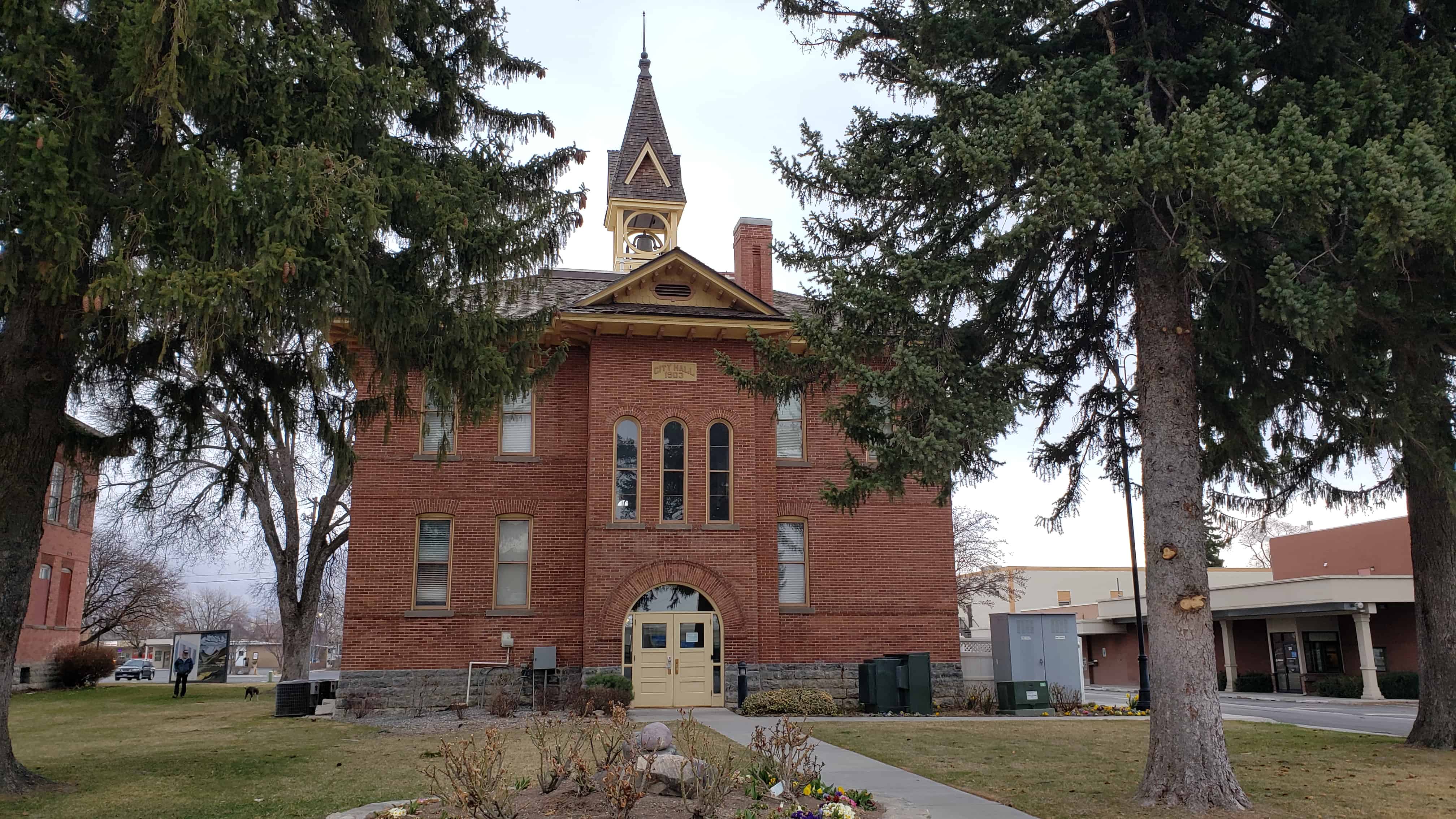
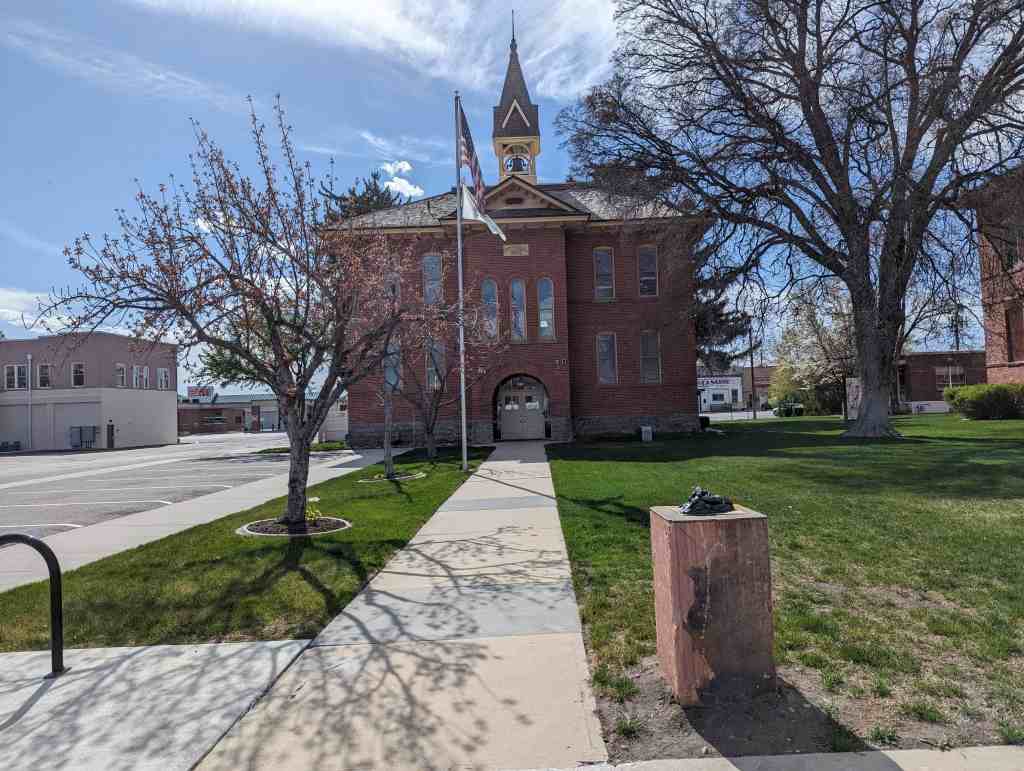
The American Fork City Hall is significant as the seat of city government from 1903 to the present. Moreover, it is located on the site where civic offices have been concentrated since 1861. The building also represents an important change in government in American Fork after the turn of the century. Civic and ecclesiastical functions that had been combined in multi-use buildings were physically and symbolically separated. The American Fork City Hall was the first of the town’s four municipal buildings to be used exclusively for governmental purposes.
This building was designed by local architect/builder James H. Pulley and constructed in 1903. Its Victorian Romanesque Revival style is characterized by round arched openings and a rough stone foundation. The room is topped with a small central deck which was once adorned with a wooden belfry (removed in 1959).
Located at 31 North Church Street in American Fork, Utah and added to the National Register of Historic Places (#94000298) on April 7th, 1994.