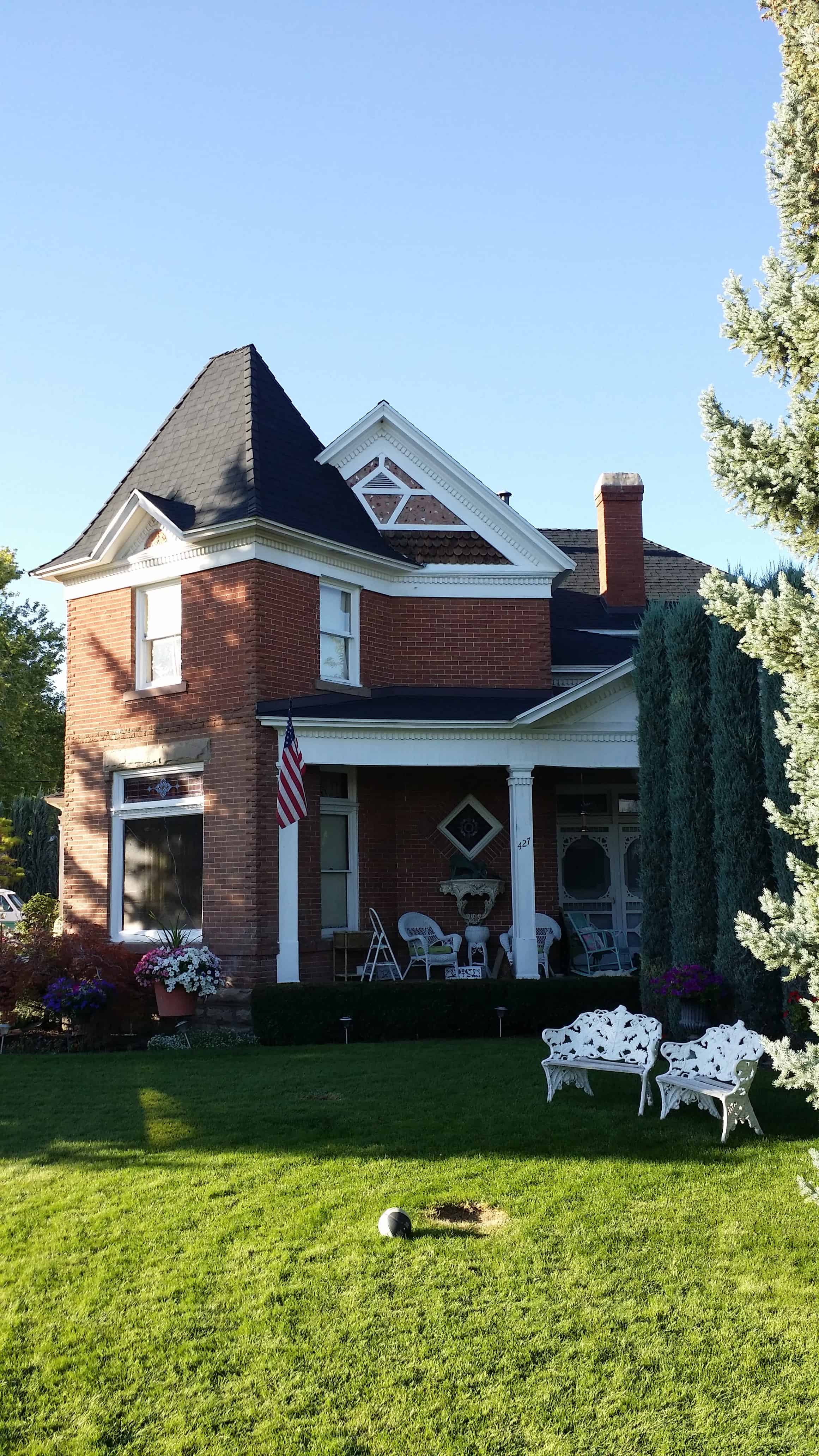
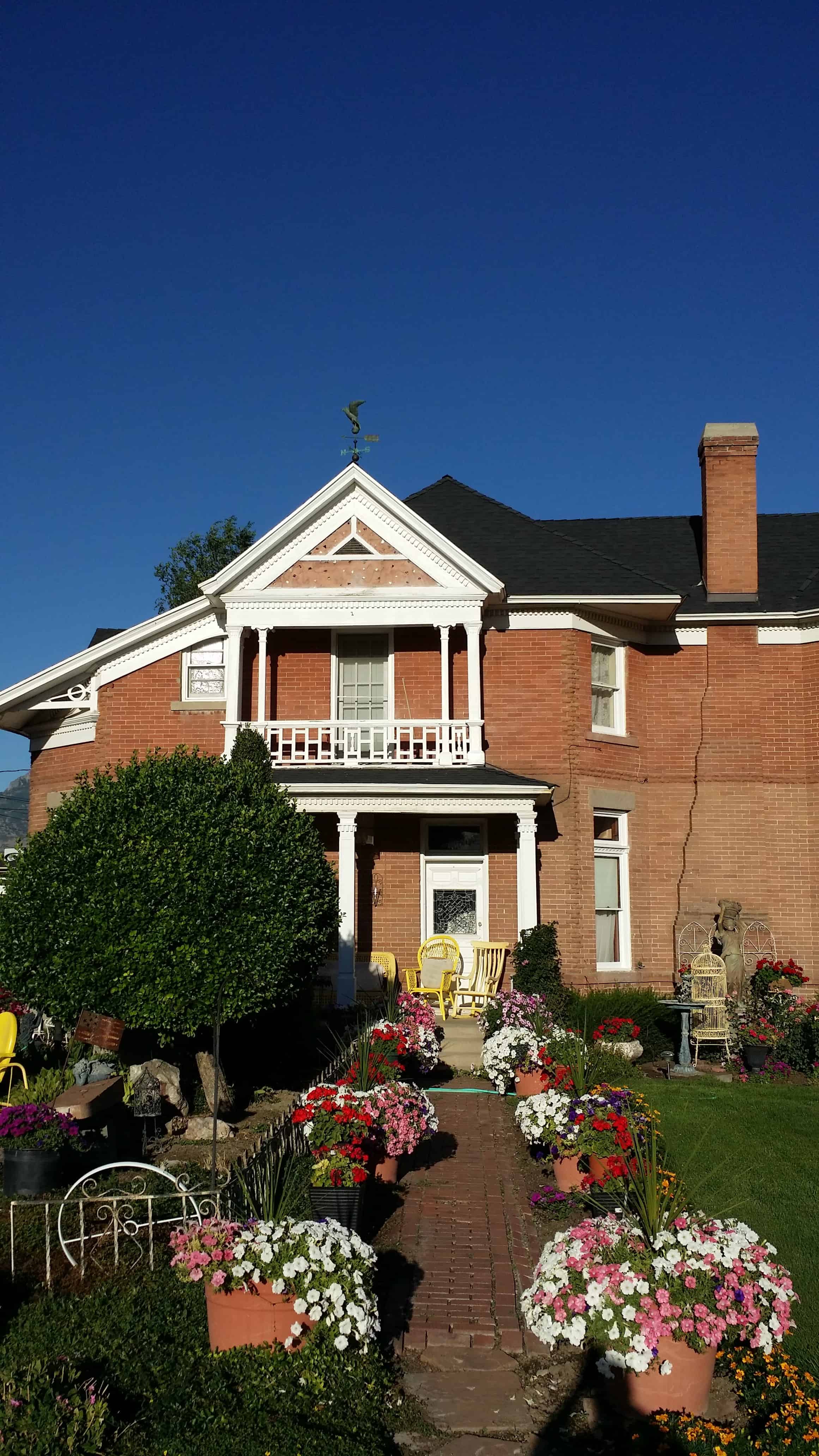
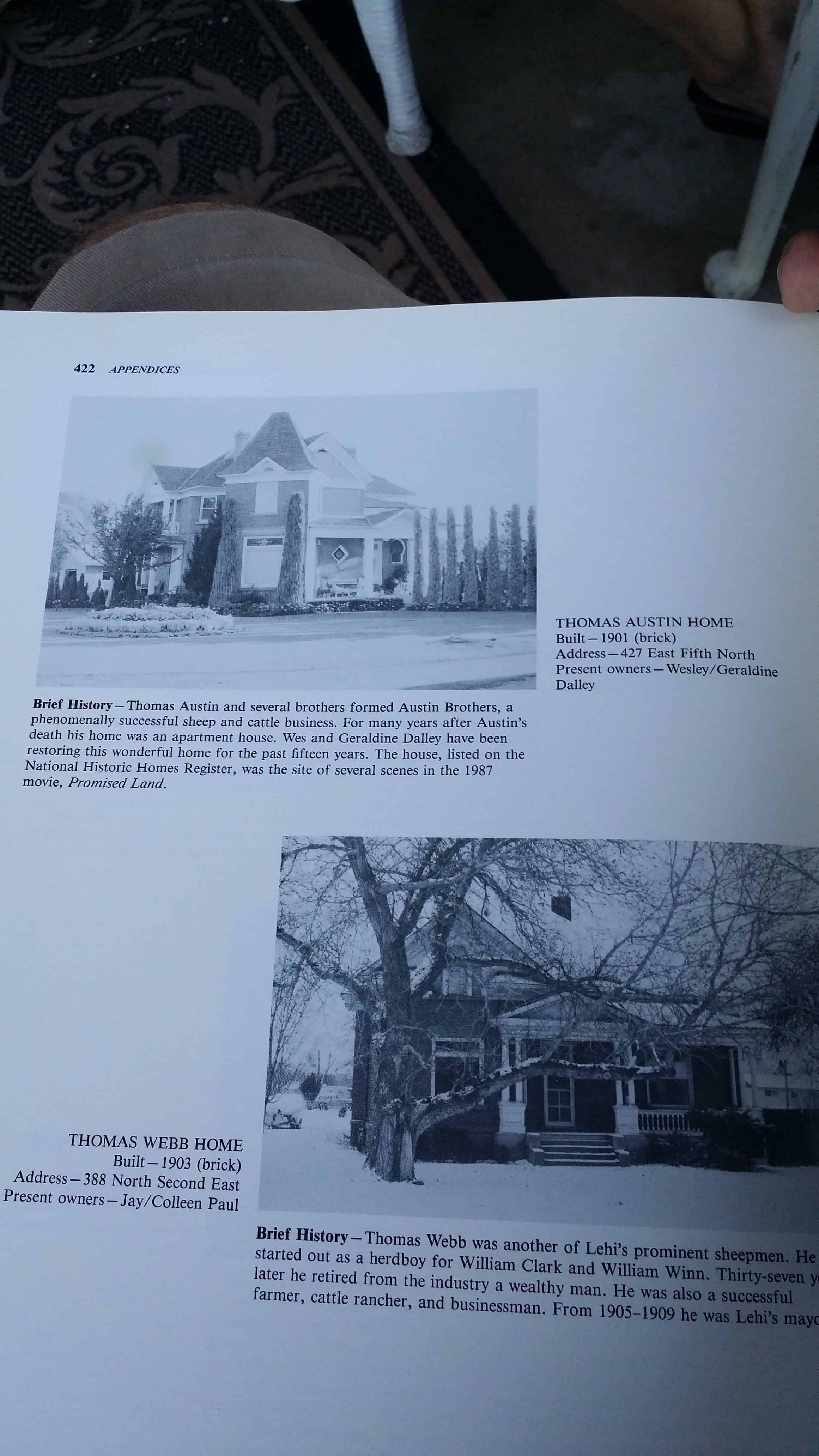
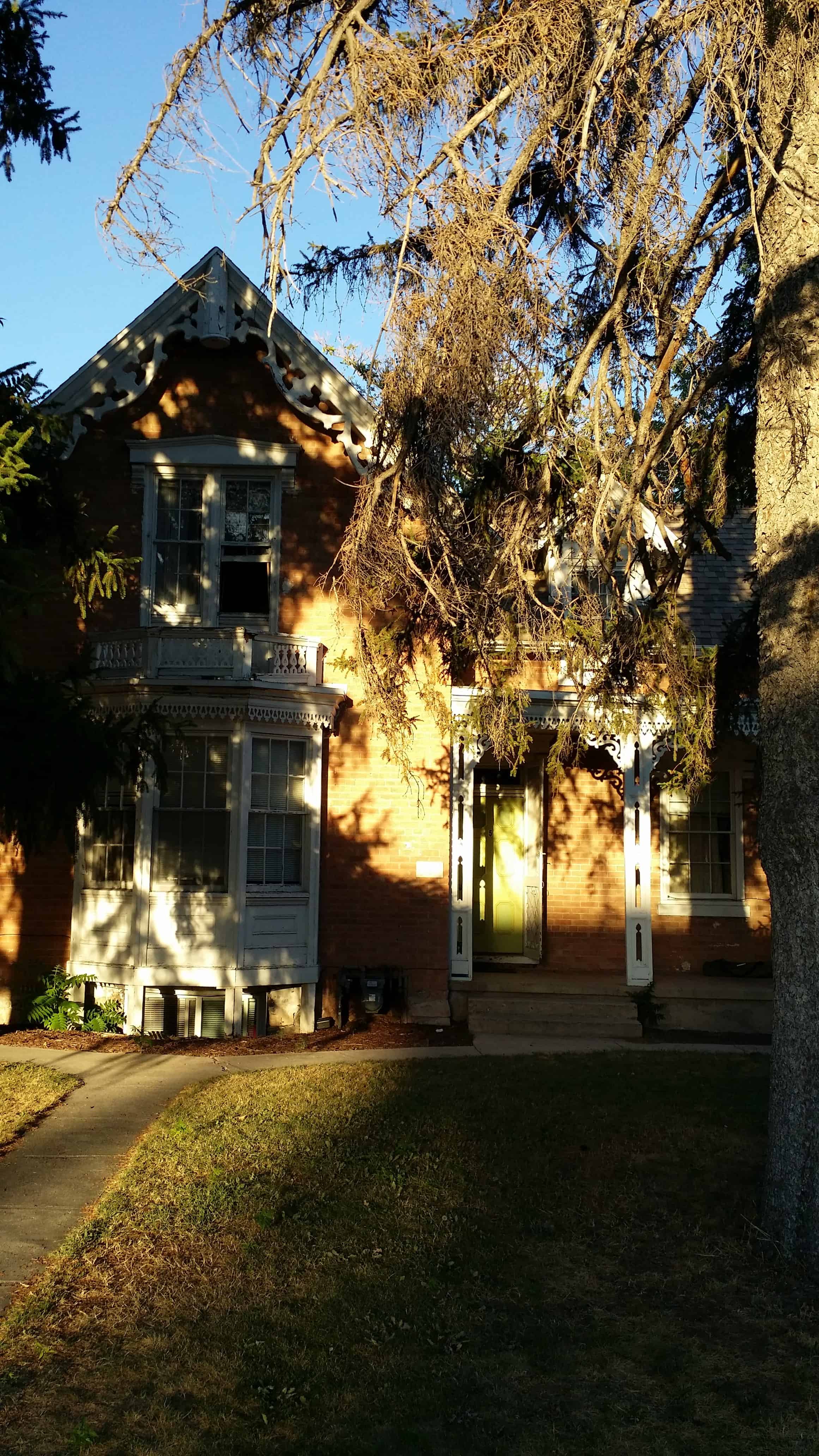
Located at 427 East 500 North in Lehi is the Thomas Austin House. The house was built for English-born local rancher Thomas Austin, for $4,000. According to its NRHP nomination, it is “the best example in Lehi of Victorian domestic architecture.” And: “At a time when eclecticism and irregularity in house design was at a premium, the Austin House projects an asymmetry of massing and mixing of historical details which is truly exceptional.”
Thomas Austin and several brothers formed Austin Brothers, a phenomenally successful sheep and cattle business. For many years after Austin’s death his home was an apartment house. Wes and Geraldine Dalley have been restoring this wonderful home over the more recent years. The house was the site of several scenes in the 1987 movie, Promised Land.
I had a great visit with Wes and Geraldine, they told me stories of the house, the store they own on Main Street and several other historic places in Lehi.
At 317 E. Main St. in American Fork is the Delbert and Ora Chipman House. This home is significant as the earliest known surviving example of the Tudor Revival Style in American Fork. The residence originated as a small, late-1870s adobe farmhouse on the outer edge of the city’s original plat. Radically remodeled and enlarged in the 1930d, the house has since remained virtually unchanged. The property, including the large frame sheep barn located on the site, is also significant as it documents the social and economic influence of sheep production in American Fork and Utah County prior to WWII, when it was the local economy’s most important industry. Delbert Chipman, whose career as a sheep raiser spanned several decades during the 20th century, was the third in his family line of prominent American Fork agri-businessmen.
Located on the eastern edge of Main Street, American Fork’s most prominent 19th and early 20th century residential street, the Delbert and Ora Chipman House is significant as the earliest known surviving example of the Tudor Revival Style in American Fork. This residence originated as a small circa late 1870s adobe farmhouse located on the outer edge of the city’s original plat. Radically remodeled, enlarged and stylistically altered from 1930 and 1934, the Chipman house has since remained virtually unchanged. The house, adjacent porte-cochere, barn and selected landscape features possess integrity of location, setting and most particularly design (as it evolved and then halted in 1934).
The property is also significant as it documents the social and economic influence of sheep production in American Fork and north Utah County, prior to World War II, when it was the local economy’s most important industry. Delbert Chipman (b.1893), was third in his family line of prominent agri-businessmen of American Fork. His great-grandfather Stephen Chipman, founded the community that would become American Fork and established a relatively small but significant family agricultural, banking, and industrial empire that influenced American Fork into the mid-20th century. The Chipman property also documents, with the house and adjacent barn, the once typical inclusion of both domestic and agricultural operations within a large city lot in 19th and early 20th century municipal Utah. Some years after purchasing their house, the Chipmans purchased the lot east of their residence, to create a home base for their agricultural operation. The barn, which is the only feature that remains (albeit the central feature) of a once small agrarian complex behind the house, documents the once ubiquitous practice of mixed-use of residential lots in rural Utah towns in the 19th and early 20th centuries.
Delbert Chipman’s career as a sheep raiser spanned from the early 1920s to his death in 1980. Born in 1893 into a family of cattlemen, Chipman and his brothers eventually turned to sheep when the Forest Service reduced and restricted cattle grazing permits in the Uintah Forest. After his father’s death in 1930, Chipman took his share of the estate and with the help of the federal government’s Reconstruction Finance Co,, bought out all other heirs. Grazing sheep during the winter in the West Desert (near Dugway Proving Grounds, Simpson Springs, etc.) and in American Fork Canyon (north as far as Deer Creek) during the summers, Chipman eventually developed one of Utah Valley’s largest sheep operations. 4 He and his wife Ora, both became nationally recognized industry leaders (National Wool Growers Association), he as president and she as president of the women’s auxiliary organization.
Ora Velma Holman Chipman (b. 1896) was a leading light in social causes, as northern Utah County’s first social worker during the Great Depression and as a Red Cross worker for thirty-four years; in education, by introducing the concept of kindergarten to the Alpine School District; in civic enterprises, by starting the fund-raising effort for American Fork’s first municipal hospital; in youth recreation, by assisting in the establishment of Mutual Dell, a church and later civic youth camp in American Fork Canyon; and as leading dilettante, assisting in the introduction of American Fork’s “Pageant of the Arts” program and by chairing scores of pageants, musicals and special events. In all of this, Ora Chipman was both civic leader and local trend-setter/taste-maker, as was reflected in her house remodeled in the pastoral and picturesque style of the Tudor Revival. The Chipman House possess ample integrity of feeling and association to document the relative prosperity brought to northern Utah County by agri-business in early 20th century.
In regards to its architectural significance, the property embodies the selective characteristics of historical eclecticism adopted by many upper middle-class Utah farmers and ranchers in the 1920s and 1930s; with the historical allusion being reserved almost entirely to exterior applique instead of any underwriting design theory or schemas. Set back in a relatively large lot surrounded by a once sprawling lawn with a stone lined canal, flower and vegetable garden plots, and sheep barn and corrals fenced off some distance away, the Chipman’s Tudor Cottage and surrounding pastoral compound expressed, via this picturesque aesthetic, the ambition and social standing many well-to-do agriculturalists aspired to in the rural Utah. This included an appreciation and desire for modernity and order, along with a quest for traditional association and community respectability.
The Chipman House also documents, with all of these alterations and additions, the constantly evolving, organic nature of Mormon Utah’s housing stock during the 19th and early 20th centuries. There are throughout the house tell-tale signs of this evolution, such as the thick adobe walls of its previous forms, the classical proportions and detail of the pre-1900s gables, and the interior finish work from all three periods of construction. This adaptability is expressive of the pragmatic and restrained sensibilities of rural Mormon Utah society during the period of significance. The house is significant because of its numerous and historically yielding changes, as noted above; but even more so because this physical evolution was suspended in 1934, thus documenting the general aesthetics of domestic life in upper middle class rural Utah, during the era of the Great Depression and pre-World War II.
The house also documents a much broader regional trend. In 1929 during the early days of the Great Depression and throughout the 1930s, the predominate area church (the Church of Jesus Christ of Latter-day Saints) instituted a church-wide campaign that urged members to repair, update and “beautify” their homes and communities. An influential program, many rural 19th century houses and landscapes were renovated (if not entirely destroyed) during this period to modern 1930s tastes. As community leaders as well as active, life-time members in the Mormon Church, the Chipman’s 1930-1934 renovation would also chronicle this regional aesthetic trend.
Narrative Description
The Delbert and Ora Chipman House is located three blocks east of the community center of American Fork, Utah County, Utah. Settled by Mormon colonists in 1850, American Fork is located in north-central Utah, at the eastern edge of the Great Basin on the western front of the Wasatch Mountains. The city center and the Chipman property are both located approximately one mile north by north east of Utah Lake.
Situated on a block platted originally as one-half acre city lots, the Chipman property is flanked to the west by a heavily remodeled, c.1891 cross-wing, stucco over adobe brick house and to east, beyond a vacant lot also once owned by the Chipmans, a c.1930 bungalow. Across the street to the south is a small city park and more residential buildings dating from the 1890 to 1940s.
The Chipman House is now an interesting example of the Tudor Revival Style or English Cottage, after it was completely remodeled and enlarged from 1930 and 1934 (see mortgages between 1930-1934 on title search form). Prior to its alteration, the house was a late-19th century cross-wing house with classical massing and detail. Restrained by its previous form, the house does not have the numerous, steeply pitched, gables as is generally associated with the Tudor Revival style, although, in all other aspects, the house is replete with English Tudor Revival features — or at least as they were perceived and adopted by its remodelers. The house has remained relatively unchanged, essentially suspended, since its transformation over fifty years ago.
The house is essentially a one story cross-wing or “T” cottage with two lean-to attachments. The first construction occurred circa late 1870s, with the cross-wing addition being added no later than circa 1900. (See attached floor plan.) At the rear center is a large squared hipped-roof addition attached behind the original portion, built sometime between 1930-1934. West of the house is a delicate semidetached porte-cochere/pergola structure built of painted dimensional lumber on concrete supports. On the front elevation, attempting to counter the severe right angled cross-wing behind it, is a small stuccoed frame entry hall with an asymmetrical and a relatively steeply pitched English gable roof with flared overhanging eves.
The floor plan is as follows (front to rear): a small entry hall, a parlor to the left (west) and a dinning room to the right (east), a small bedroom east of the dinning room, a kitchen and small bathroom behind the parlor accessed from the dinning room, and two bedrooms in the northeast accessed from a hallway located directly behind the dinning room. The hallway connects the kitchen, dinning room and bedrooms. Adjacent to the kitchen, and attached to the first hallway, is another hallway that leads to the rear entrance and to a stair to the basement. The basement includes two simply finished rooms and three partially enclosed storage rooms.
The house has an elaborate exterior finish scheme that, too, follows the romantically reputed English Cottage Revival fashion, fabricated in modern, circa 1930s, steel lathe and concrete stucco. The finish plan includes a foundation of cobble stones, covered with stucco, placed diagonally in layers just above grade; the lower walls are finished in a coarse pebble dash, concluding with a concrete string course; the upper walls are finished in a smooth floating stucco finish.
All but one of the windows (southeast, front facade) were replaced or was heavily altered in keeping with the pervasive 1930s revival design. All of the windows seen from the street have muntins with a simple open, orthogonal cross-hatch which is the exterior’s leitmotif. Following more Moderne impulses than historical references, all of the windows and door surrounds have machine cut-like edges with only the sills projecting from the wall plane. However elaborate the 1930s renovation might have been, the simple pre-1900s cross-wing form is still clearly evident.
Based primarily on physical evidence uncovered during a recent renovation (foundation, walls, finishes, etc.), it appears the original house was a simple rectangular hall-parlor form built with a stone and mortar foundation and adobe walls by a Joseph Shelley, circa 1870-1880s. In circa 1890-1900, a cross-wing was constructed, also built of adobe but with an exterior sheathing of common brick, west of the original house. Much larger in scale than the original house, the addition had a prominent stone foundation (camouflaged by a later alteration) with taller walls that allowed a 9’6″ ceiling for the interior. This addition appears to have been a simple two room form as well (a single adobe load bearing interior wall suggest this). A veranda was also built across the front elevation sometime after this addition (the veranda was removed during the early 1930s renovation). Prior to the 1930s, the adobe brick walls were left exposed.
Between 1930 and 1934, Delbert and Ora Chipman completely transformed their house’s appearance, having a basement dug out across the entire house plan (a remarkable task considering the pre-1900 house had load-bearing adobe brick walls), lowering floor joists to create a common floor height, removing and replacing interior walls, building a large brick addition in the rear and a small frame entry hall in the front and completely refinishing the exterior (including enlarging the windows and replacing the roof). With the exception of a series of succeeding exterior and interior finishes, the house has remained essentially unchanged since this major alteration.
Other significant architectural features that contribute to the historical integrity which date to the 1930s (or earlier), include: a large fireplace with a brick mantle, surrounded by a built-in bookcase that spans the entire wall (constructed of pine and glazing, the doors having the same fore mentioned cross-hatching muntins); an elaborate series of floor to ceiling built-in kitchen cabinets and drawers; a near intact 1930s bathroom (adjacent to the kitchen); arched and geometric plaster archways between the parlor and dinning room, in the kitchen and in both hallways; a telephone niche in the dinning room; built-in cabinets and drawers in all of the hallways; a swinging butlers door between the kitchen and bedroom hallway; paneled doors throughout; circa 1870s, 1900, and 1930s door and window surrounds and baseboards; c.1930s finish hardware throughout; and finally, a dirt chute in the bedroom hallway that drops refuse into a cabinet (which holds a small rubbish bin) in the basement.
Besides the house and adjacent semi-detached porte-cochere/pergola, there is a large frame sheep barn, built c.1920, with a gambrel clerestory roof with side bays, built of 4×4 lumber or smaller, covered with pine lap siding. The barn is currently situated on the rear of the lot, directly north, behind and some distance from the house.
Prior to Delbert and Ora Chipman’s deaths the entire Chipman parcel was nearly an acre (94/100). This included the residence, side and rear gardens, and a concrete block garage (since demolished) in the rear of the house; then behind and beside the residential area to the north and south, separated by fence and hedges, a concrete cellar (directly behind the landscaped yard), then further north, a series of wooden corrals and pens (stakes, rough and dimensional lumber) which surrounded the barn on the west and south sides. Against the corral was a wooden loading ramp that faced an opened field and road to the east. East of the residential area was a sheep pasture and road that lead to the rear barn and corrals. It is suggested that the sheep were herded or trucked into this small agricultural complex seasonally for care and shearing.
The Chipmans purchased the east lot (.50 of an acre) in 1946 from Utah County for back taxes from 1929-1946 (Books 384:358 and 462:473, Utah County Recorders Office). Although the lot was purchased by the Chipmans in 1946, the lot may have been used or rented by Chipmans much earlier, possibly since the early 1930s. The Chipmans used the east lot for a pasture, for equipment storage, and to access the rear of their lot. The barn is the only remaining element in this once agrarian complex used from c.1920s to 1970.
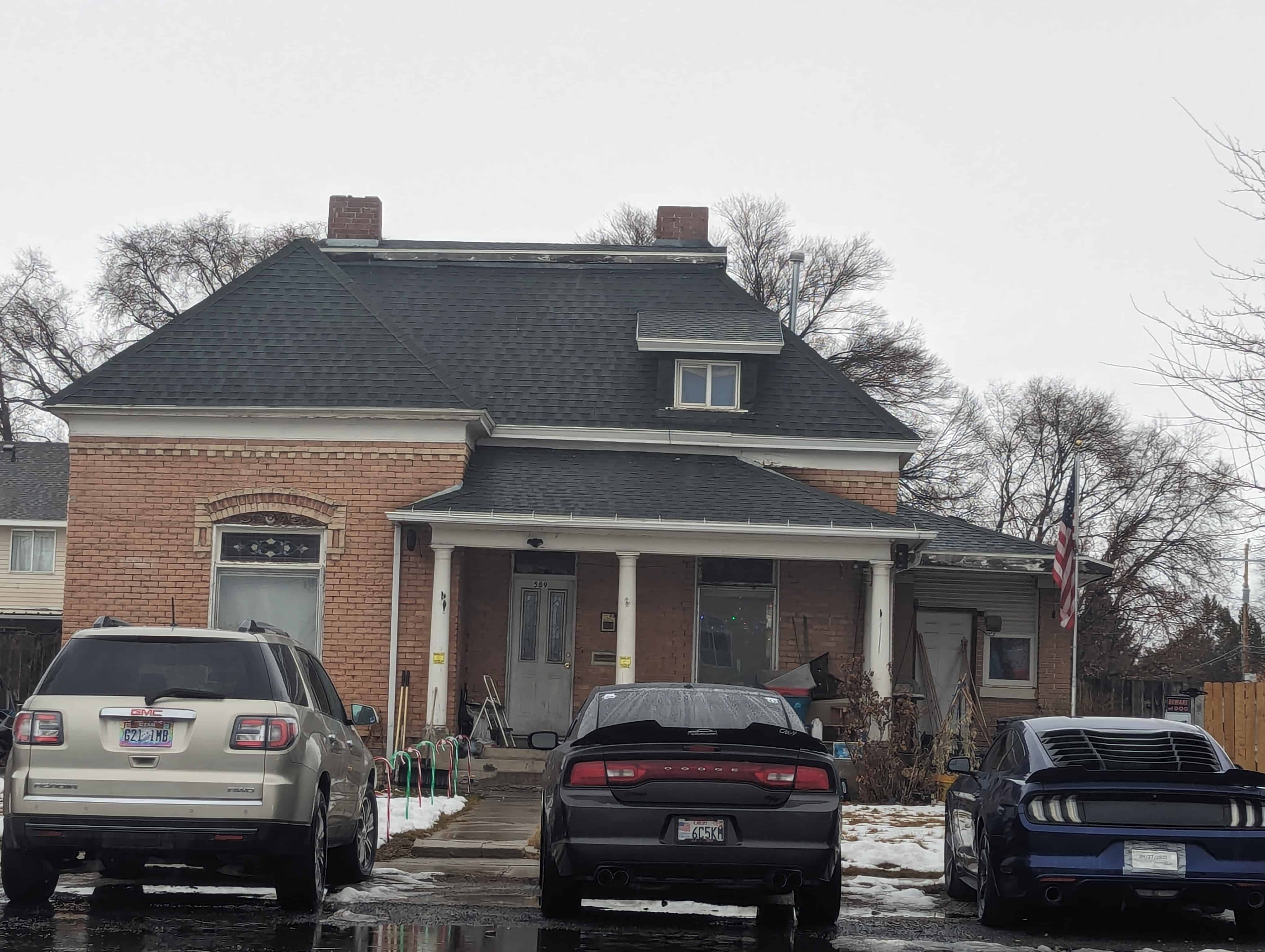
Pioneer from Nauvoo, Illinois, Warren B. Smith settles in American Fork in 1856. He became a church, business and civic leader in this city. In 1897 he built this home for his residence. It was rennovated by Robert Nelson Ballard and listed on the Utah State Register of Historic Sites on September 6th, 1978.
The home is located at 589 East Main Street in American Fork.
The house is significant as an attractive and representative example “of the modest late-Victorian dwellings to be found in many of Utah’s small towns,” and for its association with Warren B. Smith, its builder. Smith was a blacksmith who became a leading citizen in American Fork, including serving on the city council. He spent four years in two full time missions for the LDS church. He supported three wives, and took a fourth wife late in his life, at age 63, in 1907, and spent six months in the Utah Territorial Penitentiary for his violation of the Edmunds-Tucker Act. He led the American Fork choir for thirty years.
Constructed of brick in 1876 by Simon Peter Eggertsen, a Danish immigrant and handcart pioneer to Utah in 1857. The home remained in the Eggertsen family until 1945.
Built in 1876, The Simon P. Eggertsen, Sr., Home is a two-and-a-half story brick house. The home still contains the original living room, central hall and stairway, parlor, and dining room. Since the home was first built, a kitchen and a bathroom are also included on the main floor. Three bedrooms and a bathroom, as well as two bedrooms in the attic, make up the second floor. The unfinished cellar serves as a storage unit. The inside of the home is still in great condition. “Its walnut bannisters and spindles, oak-grained woodwork and marble-grained plaster in the halls are extant, as are the fireplaces, casings, base and doors. The original room configurations and tall ceilings are also intact.”
Simon Peter Eggertsen, Sr., was born in Vestr, Skevhuset, Odense County, Fyen (a Danish island), on February 7, 1826. Simon served in the army of Denmark from the year 1848 to 1850, and during that time attained the rank of a sergeant. In 1853 Eggertsen joined The Church of Jesus Christ of Latter-day Saints (LDS Church), and served as a Danish missionary until he migrated to America four years later.
Once in America, Eggertsen, along with a group of twenty four other people, traveled across 1300 miles through the Great Basin, and into Salt Lake City, arriving September 13, 1857. The following year Eggertsen married a woman named Johanne Thomson. Once Simon and his family had settled in Provo, he traded his vest and coat for the property for his future home. The Eggertsen family lived in a one-room log house for 17 years before building the Simon Peter Eggertsen Sr. House. Eggertsen took the money he had earned through his hard work as a farmer, and spent it to send his children to Brigham Young Academy (now university), and used the leftover funds to build his new home. Eggertsen, speaking of the cost of the home, said “It took 50,000 bricks to build it. The (bricks) costed me 310 dollars. The carpenter work 1,000 dollars. In the spring we moved in and felt very grateful for our blessings (Call p. 1).” The home was built by Eggertsen and some of his friends that were Danish.
After the construction of the home, Simon Peter Eggertsen served another two years in Denmark as a missionary, and supported a large family. His son – Simon Jr., owned the West Co-op and served as an educator within the county for over fifty years. The home remained in the family until 1945, after which the home belonged to Mr. And Mrs. Craig M. Call.
The Simon Peter Eggertsen Home is located at 390 South 500 West in Provo, Utah and was added to the National Register of Historic Places (#77001321) on September 13, 1977.
“Built in 1904, the Thomas N. Taylor house exemplifies the “dream home” of many in Utah’s second generation. This house is significant as the most outstanding and well-preserved example of the Classical Box style in Provo. The box style was used extensively in Salt Lake City but was not common in Provo. Its classical detailing, irregular massing and unaltered condition make it particularly distinctive among the limited number of Provo examples of this type. Thomas N. Taylor was a popular man in the area. He served as manager of the Taylor Brothers Store, Provo mayor, and President of the Utah Stake of the LDS Church (Historic Provo p. 9).” The Thomas Taylor House was designated to the Provo City Landmarks register as of July 28, 1995.
Thomas N. Taylor’s home at 342 North 500 West in Provo, Utah is quite the site, it is listed on the National register of historic places and known now as the White Willow Reception Center.
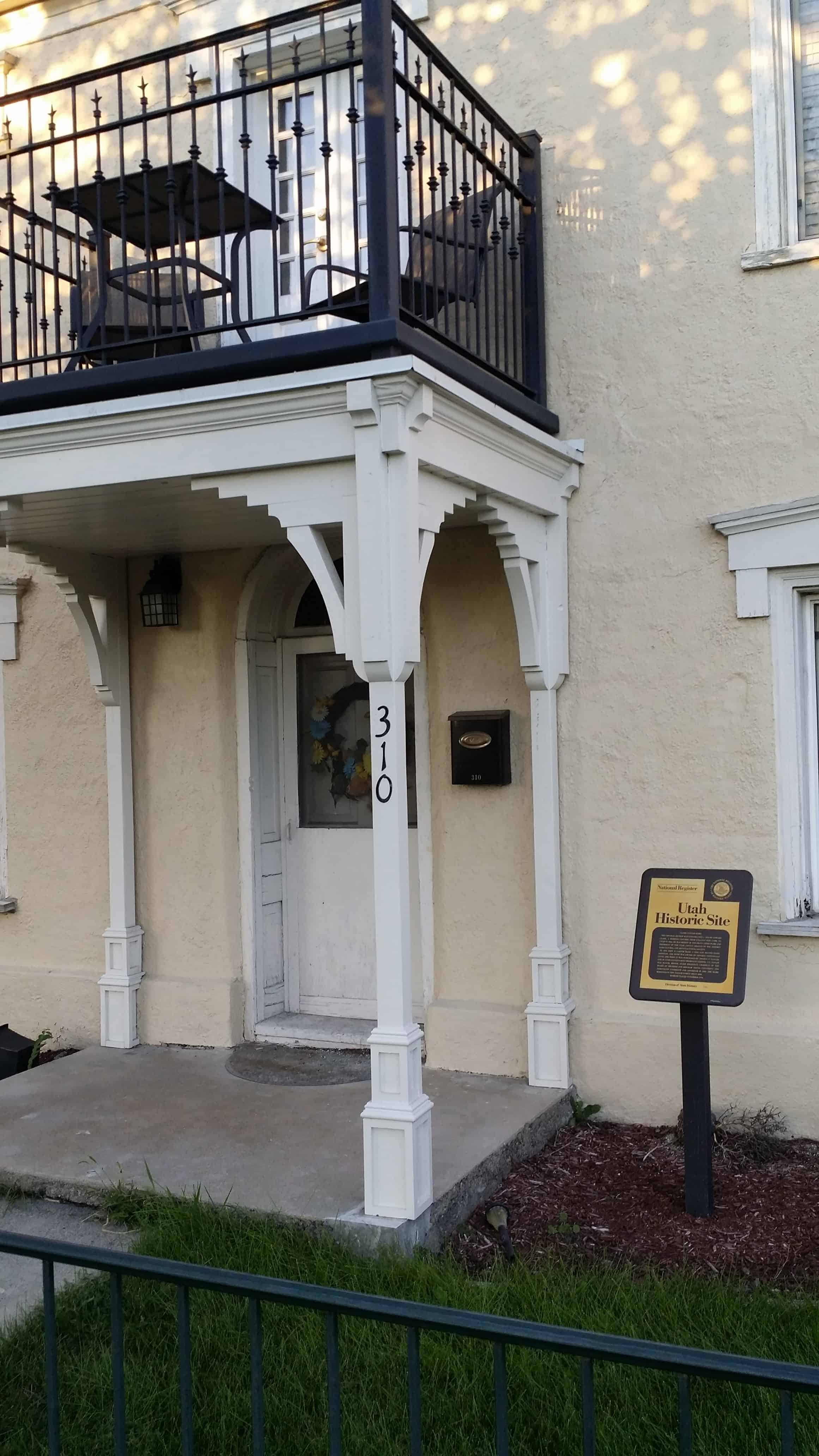
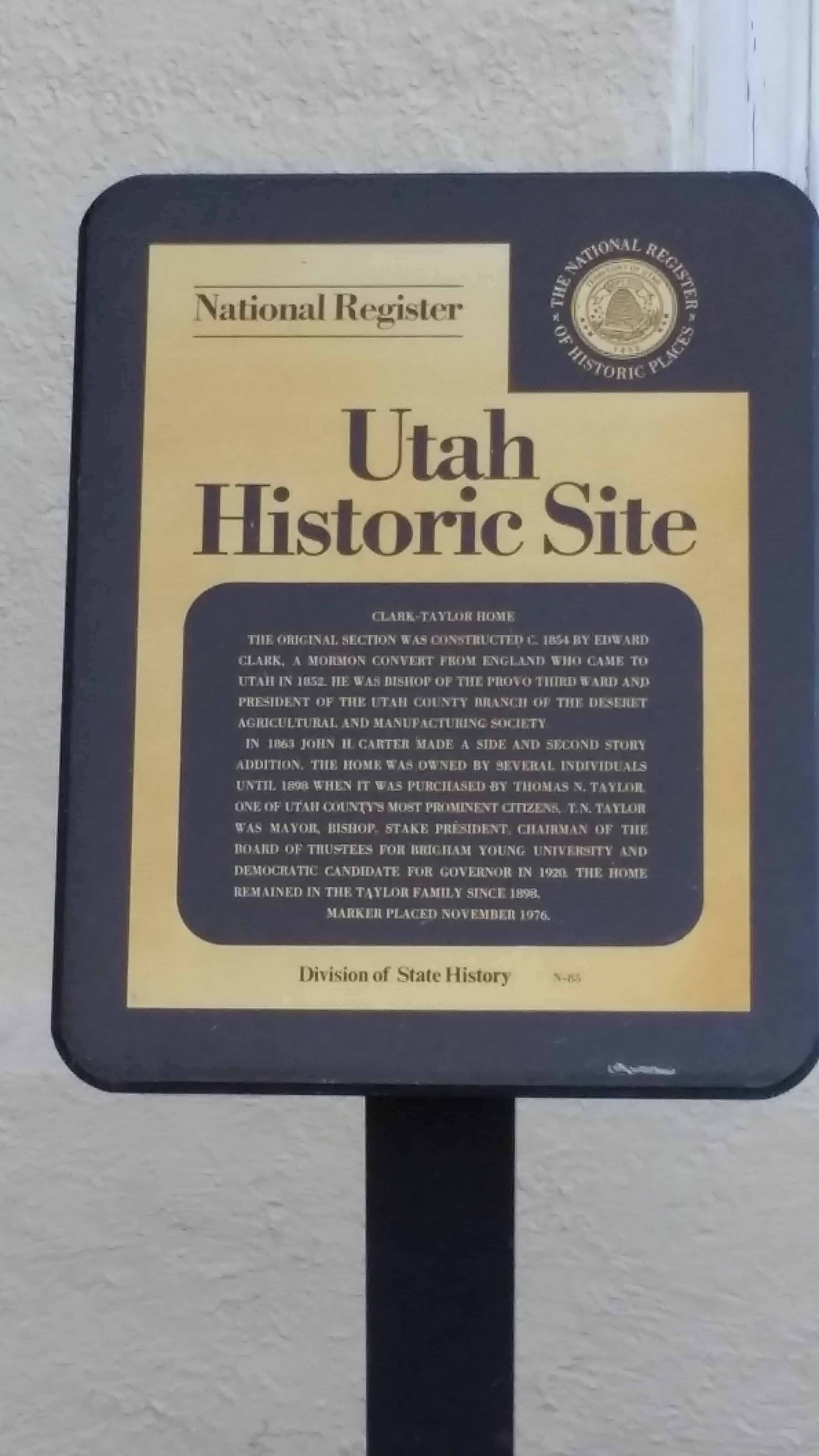
The original section was constructed C. 1854 by Edward Clark, a Mormon convert from England who came to Utah in 1852. He was Bishop of the Provo Third Ward and President of the Utah County Branch of the Deseret Agricultural and Manufacturing Society.
In 1863 John H. Carter made a side and second story addition. The home was owned by several individuals until 1898 when it was purchased by Thomas N. Taylor, one of Utah County’s most prominent citizens. T.N. Taylor was Mayor, Bishop, Stake President, Chairman of the Board of Trustees for Brigham Young University and Democratic Candidate for Governor in 1920. The home remained in the Taylor Family since 1898.
This is one of the oldest homes in Utah, it is located at 306 North 500 West in Provo, Utah and was added to the National Register of Historic Places (#75001829) on October 7, 1975. The following is from the nomination form from when it was added to the register:
The Clark-Taylor house is first mentioned in a consecration deed by Edward W. Clark of Prove to Brigham Young, trustee-in-trust of the Church of Jesus Christ of Latter-day Saints, and dated July 24, 1855. In the deed, Clark gives to the Church, “my claim and ownership” to the plot including “an adobe house thereon and one log (house?) for a shop with 2 rods of fort wall attached.” Thus the records show that CIark’s home was one of the first built after the settlers of Provo moved out of the fort in 1852-53. Built within eight years after the arrival of the first party of Mormon pioneers to the Valley of the Great Salt Lake, and within six years after the initial settlement of Provo, the Clark home is one of the oldest pioneer buildings in Utah. It is also one of the best documented and well preserved pioneer structures.
for
Edward Clark (1820-1909) came to Provo from England in 1852. He was the bishop of the Provo Third Ward, a veteran of the Indian War and director of the Utah County branch of the Agricultural and Manufacturing Company. Later he was prominent in the settlement of Santaquin, Utah.
The house and land (situated on Main Street of the first Provo city survey, now 500 West) was next owned by John H. Carter, who was Edward Clark’s counselor in the bishopric, an alderman and a blacksmith. Carter made a second story addition to the home in 1863. In the early I870’s, John Carter apparently traded his property in the city to Benjamin Bachman, a Provo merchant, for 85 acres of land in the area now called CarterviIle(after Carter), between Provo and Orem. Bachman owned the house until 1897 when George H. Church bought it, owned it briefly, then sold it to Thomas N. Taylor in 1898.
T. N. Taylor was one of Provo’s most prominent citizens at the turn of the century. He was mayor, bishop, stake president, Chairman of the Board of Trustees of BYU and Democratic candidate for governor (1920). He also served as president or directorof Farmer’s Mercantile Bank, Provo Building and Loan, Taylor Investment Company, Ma I ken Glass and Paint, Provo Woolen Mills, and Mapleton Sugar Company. Besides these, he was manager of Taylor Brothers, oneof Provo’s first department stores, founded by his father, George Taylor, 1866. George Taylor came to Provo as a photographer in 1863. One of his first jobs was helping John Carter with the construction of a second story of this house, made of adobe.
T. N. Taylor and his wife lived in the little house until their home next door (342 North 500 West) was completed about 1904. In 1915 when his son, T. Sterling, married, T. N. Taylor gave him the house as a wedding present. The house is presently owned by Thomas S. Taylor, son of T. Sterl ing.
Physical Appearance:
The Clark home derives significance from its age and its representative architecture. There are few other examples of substantial and reasonably preserved homes in the state built within the first ten years after the arrival of the Mormon pioneers in 1847. Aside from some log cabins, we know of no buildings in Utah County older than the Clark home. In form, size, plan and detailing, the home is representative of better homes of the 1850’s and 60’s.
General form: built in two sections, the two-story western section is a rectangular, gabled roof, single depth, 2/2 “I-form” structure. The eastern section has one story with a large attic. It is situated laterally with respect to the western section and has a broad gabled end.
Plan: The two sections together form a plan that is nearly square in shape. The two-story western section consists of a hall/parlor arrangement on the main floor with two bedrooms above. The eastern section contains a kitchen, bath, bedroom and screened porch. The original plan appears to have experienced little alteration since initial construction of the various parts.
DetaiIing: construction and decorative elements are typical of early pioneer structures: a) Windows: handmade frames and sashes. The front casement windows (8-8) are rather rare. Other windows are more traditional 6/6 double-hung sash type. b) Doors: the front door has one large panel and a large circular The door and bay are Roman arched an unusual feature. The side door has panes (3X5) of about the same size as the window panes. A door with this of gl s also unusual. The door to the summer porch is of common raised panel type. c) Trim: the milled trim is quite refined and decorative. – 1) Lintel caps: Federal in style – 2) Window trim: moulded casings; boxed frames; wooden sills. – 3) Door trim: recessed doors within paneled, box encased bays. – 4) Cornice: boxed soffit; moulded cornices and returns; slight frieze. d) Masonry: adobe walls with stucco finish; double end-wall chimnies are brick with slight corbeling.
A second story was added to the original house in 1863. From that date until 1915 the house was unchanged. T. Sterling Taylor remodeled the house when he moved there, installing new stairways, flooring and a new furnace. He enlarged the root cellar into storage for coal and put on a new front porch. His father-in-law, John W. Taylor, did not like the picket fence in front, so brought his family over one day and tore it down. Some grillwork had been added to the front of the house and T. S. Taylor removed it also. The original adobe has been sheathed with stucco (date unknown)
The house is neglected and rundown, but is, to all appearances, structurally sound. A great deal of work would be required to restore the home, but the fiber and integrity are enough intact to justify the effort.
The present owner, Thomas S. Taylor, has recently determined to restore the house and will utilize the services of a local restoration architect to accomplish this goal.
Located at 388 West 300 North in Provo is the Charles E. Davies House, listed on the National Register of Historic Places.
The Charles Davies House was built about 1885. “The house, a double-gable H-plan type, is the only example of the H-plan in Provo and its distinctive Victorian bay windows make it one of the best examples of such houses in the state (Historic Provo p. 8).” The Charles E. Davies House was designated to the Provo City Historic Landmarks Registry on March 7, 1996.
Built in the double-gable H-plan style, this home is very representative of the average home in this area during the period in which it was built. There are several windows on the front facade of the house. The two windows closest to the small porch in the front are relatively simple and slim, while the two double-hung sash windows on the front facade have a more elegant appearance and are each enhanced by a relieving arch hovering over them, complete with raised extrados. The front door used to be aligned under the porch, but has subsequently been bricked in. The west wall is adjacent to a gable.
Born in the country of Wales in 1859, Davies was a farmer by profession, and after he converted to the LDS Church he immigrated to the United States. Settling down in Provo, Utah, he married Rachel E. Davis in Salt Lake City.
The Charles E. Davies house, built in Provo in about 1885, is a significant example of late-nineteenth-century vernacular architecture in Utah. The house, a double-gable H-plan type, is one of thirty-four significant sites identified during an intensive survey of Provo in the summer of 1980. The Davies house, one of a number of domestic architectural forms available to Provo residents during the late 1800’s, is at once typical and exceptional. In size, scale, and appointments, the home is generally representative of the average homes being constructed here during this period. At the same time, although the double-gable H-plan type is found in other Utah communities, its relative scarcity makes it an uncommon architectural feature in Utah. The Davies house is the only example of the H-plan in Provo and its distinctive Victorian bay windows make it one of the best such houses in the state.
The double-gable H-plan house is a late-nineteenth-century transformation of the Greek Revival inspired “temple-form” house type (see figure 1). During the early 1800’s, a resurgence of interest among architects in the monumental buildings of classical Greece led to the introduction and eventual acceptance of a house form which imitated the Hellenic temples. This house had its main facade located on the narrow, gable-end rather than on the wider, broad side as was the usual practice during the eighteenth century. In its original configuration, the main entrance was located on the gable-end of the house behind a colossal temple front. Side wings were also often present. As the house entered the builders’ vernacular of the early nineteenth century, the pretentious pedimented porticos were usually discarded. In this scaled-down and simplified version, the temple-form house became a popular farmhouse on the New England frontier.
As settlers pushed into the upper Midwest, the temple-form house was increasingly seen with the main entrance moved form the central, gable facade to one of the side wings. This change is recorded from mid-century, and the resulting form has been variously called the “modified temple-form,” “T-plan,” or “upright and wing” house. Both the temple-form house and its modified relative (modified temple-form) were carried to Utah after 1847 by members of the Church of Jesus Christ of Latter-day Saints, the Mormons. These gable facade buildings constitute one of the major domestic architectural forms in the state.
One logical variation of the modified temple form house can be found in the placing of a second forward-facing gable to the end of the side wing. Repeating the gable makes the house symmetrical and effectively closes up a visually incomplete and open design. Such houses are found in many Utah communities, attesting to the popularity of the type. They are greatly outnumbered by their “T-plan” cousins, and must be considered a rare architectural type. Such houses are often called “H-plan” house by local architectural historians. Such an alphabet designation, however, should not obscure the houses historical and design relationship to the old temple-form plan.
Charles E. Davies, the original owner of this house, was born in South Wales in 1859 and later immigrated to the United States after joining the LDS Church. He eventually settled in Provo and married Rachel E. Davis in the Endowment House in Salt Lake City. By trade Davies was a farmer.
The vernacular H-plan house was constructed in about 1885, and David L. Van Wagenen, a prominent local merchant, bought the house in 1907. He owned and operated the D. L. Van Wagenen Mercantile Company in Provo for many years. Van Wagenen apparently sold the house in 1912 but continued to live there until 1922. The house has since been used as rental property, as the owners of the house have not been listed as living in the house. In 1912 Van Wagenen sold the house to Eliza Smith Stewart who in turn sold it to Thomas Callister in 1918. Callister sold it to Georgianna Parry in 1920 and she sold the house to Clyde Bunnell in 1923. The house was owned by the Bunnells until 1929 when the property was conveyed to Ray Barrett. In 1945 the house was sold to Madeline Hales who sold it the same year to Arthur S. Roberts. Roberts deeded the house to Clark S. Nelson in 1950. It remained in the Nelson family until 1956 when it was sold to Dr. Orlo Alien. Alien sold the house to Howard L. Jensen in 1960 and Jensen sold it to Louis B. Jones the same year.
The Charles E. Davies house in Provo is a one-story brick house which has a distinctive double-gable facade. The house consists of two parallel rectangular units separated by a smaller square unit on the inside. The gabled ridge of the internal unit runs perpendicular to the roof lines on the outside rectangles. Viewed from above, the house plan resembles the letter “H,” and it is not surprising that such houses here have come to be called “H-plan” houses. The house type is actually a rather uncommon variant of a popular vernacular type, the gable-facade “temple-form” house. The double-gabled H-plan house is, then, one of a number of nineteenth-century vernacular types which were present in most Utah towns. As such, the Davies house is typical of the architecture of the period.
Each of the gable ends of the “H” contains a rectangular bay capped with a truncated hip roof which is pierced by a gable. On the three sides of the bay are double-hung sash windows, narrow ones on the sides and a pair of standard size windows separated by decorative mull ions on the facade. All the windows of the house with the exception of two later additions in the rear have a decorative arch over them with jigsaw cut ornament and are capped with a segmented relieving arch which has raised extrados and a pair of centered bricks that resemble a keystone. Most of the windows are the two-over-two double-hung sash type. The main door was originally centered under the porch which spans the bar of the “H”, but it has been bricked in. The two windows that flanked that door are still intact. The two doors that open onto the porch from the gable ends are long and narrow, and have oval transoms. The west wall, the broad side of one of the legs of the “H”, is pierced by a gable. Under the gable is centered a door flanked by two windows. The door has a square glass panel with carved wood trim around it, and may be original. Other major alterations are evident only at the rear of the house. The two additions in the rear between the legs of the “H”, one of which may be original, and the changes in the fenestration of that section do not, however, detract significantly from the original integrity of the building.
The Harvey Cluff House was built in 1877 by John Watkins of Midway, Utah, a noted architect and builder of that era and friend of Cluff. Inspired by the Greek Revival movement of the early 1800s, this type of architecture is often called a “temple-form” house because early examples had a colossal temple front. The Harvey H. Cluff House was designated to the Provo City Historic Landmarks Registry on May 22, 1996.
The temple form is often referred to as being part of Greek revival architecture, however when it expanded to Utah it had some Gothic Revival attributes. Features of gothic architecture included in this form as apparent in Utah are: A steeper pitch to the roof, wall dormers, finials, bargeboards, and frame bay windows. There have been approximately six Gothic temple-form houses recorded in Utah, and this home stands as a historical representative of this style.
Born in 1836 in Kirtland, Ohio, Harvey H. Cluff and his family settled in Provo, Utah in the year 1850. In the late 1850s, Cluff and his brothers built a furniture factory. Later, due to the experience he had gained at the factory, he was charged to be superintendent of the construction of important historical buildings such as the Provo Tabernacle and the Academy Building of Brigham Young Academy. Cluff also had the opportunity to serve as president of the company which published the local newspaper, The Enquirer, to serve as a director of the First National Bank in Provo, and to serve as President of the Provo Foundry and Machine Company. Also highly participatory in community affairs, Harvey H. Cluff served in the city council. An important leader within the Mormon faith, he held numerous leadership responsibilities, such as a counselor in the Utah Stake Presidency, the bishop of the Provo Fourth Ward, and a mission president of the Sandwich Islands. Cluff relocated to Salt Lake City in about 1915, after which he sold his home to a man by the name of W. Ray Ashworth, a carpenter. The Ashworth family retained the home until 1974, when the title passed to Willard C. Nelson.The house was listed on the National Register of Historic Places in 1982.
Located at 174 North 100 East in Provo, Utah and listed on the National Register of Historic Places.
Located at 284 East 100 North in Provo is the George M. Brown House, it was built as a home for a “polygamous wife” of lawyer George M. Brown. It is listed on the National Register of Historic Places.
The George M. Brown House was built in the 1880s, on property obtained from Abraham O. Smoot. This is a two-story, central-hall, vernacular type house. “The Brown House exhibits the versatility and decorative jigsaw work usually found in the Gothic Revival, but displays the horizontal siding, simulated quoins, and symmetry of the local building tradition.” The George M. Brown House was designated to the Provo Historic Landmarks Registry on March 21, 1996.
Though built during the Victorian era, the George M. Brown House is a distinguished example of carpenter Gothic architecture. Containing thin wooden tracery, a monochromatic color scheme, and steep gables as well as other features, the Gothic style is very evident in this home. The Carpenter Gothic style emerged as builders became more concerned with costs, namely the cost of stone. “The Brown home attempts to combine the best of two generations with its asymmetrical Victorian east elevation and its symmetrical, dormered north elevation which contains nearly all the elements of typical pioneer homes of the mid-1870s (Roberts p. 2).” Decorative elements on the home include bargeboards, Quoins, a bay window, chimneys, window trim, door trim, dormers, a cornice, siding, and windows.
Born on April 5, 1842, in Macedonia, Illinois, George Mortimer Brown settled in Utah with his family in 1842. A member of the Mormon faith, George served a mission to Norway in 1866, the same year he began his marriage to Elizabeth Olsen. After his mission, George became an attorney. In addition to Elizabeth, George married two more women – Amelia West and Pearl Wilson.Shortly after the initial construction of the home, Brown’s first wife attained the title to it, and Brown and his two other wives and children left and settled in Colonia Diaz, a Mormon settlement in Mexico. He ran a store there until he died on July 6, 1894.
261 East 100 North
Status: Provo City Landmarks Register
After Mayor Abraham O. Smoot divided the lots in 1872, this parcel was purchased by Ephraim’s father, Isaac Sutton. Isaac deeded the lot to his oldest son, who then built the house in 1897. Isaac and Emma Sutton were early Mormon pioneers sent by Brigham Young to help settle Provo. Ephraim built a home very typical of what was popular in turn-of-the-century Provo. The home is Victorian-Eclectic, featuring neoclassical details on the front porch, heavy drip hoods of rusticated brick above the windows and doors, and segmental arch openings. Other artistically-noticeable details include the transom window above the front entrance with rusticated drip head, a half-round window above the porch, sitting in a small gablet, and gabled windows on the front and west facades.