Original building was erected by James Bascom in 1878. The first trading post west of Fort Hall. Station for Pony Express and Ben Halliday (sic, Holladay) Stage Line. The largest artery of wagon travel in United States passed here on old Oregon Trail in 1834. This building was donated by Mrs. Lucy H. Stricker on her 83rd birthday.
When mail was delivered by horseback in remote areas of the West, local residents referred to it as the “pony express.” This site is not on the National Pony Express route.
This is Daughters of Utah Pioneers historic marker #86 erected in May of 1942 at the Rock Creek Station & Stricker Homesite in Rock Creek, Idaho.
In April 1879 members of the Church of Jesus Christ of Latter-day Saints from Tooele, Utah, under direction of Wm. E. Martindale, arrived in Oakley where James Dayley and his two sons had staked claims and built cabins. On Sept. 24, 1882, the Saints were organized into a Ward with Horton D. Haight, Bishop. In 1902 the Cassia Stake Tabernacle was built of native stone, with a seating capacity of 700. It was completed at a cost $12,000. Destroyed by fire in 1965.
This is Daughters of Utah Pioneers historic marker #335 erected in 1967 at Oakley City Park in Oakley, Idaho.
In the summer of 1880 George Starrh, a placer miner, established a ferry 4 miles west of the present city of Burley. Rich mineral mines had been discovered in the Wood River country and freight was hauled between the mines and Kelton, Utah, (the nearest railroad). The wagons were taken across the Snake River on this ferry which was operated by cable and horse power. Later Thomas Starrh bought the ferry from his brother and operated it until 1905 when the railroad came to Buhl, Idaho.
Starrh’s Ferry across the Snake River was located one mile north of this monument which was relocated on June 1, 1995, by the Cassia County Company, Daughters of Utah Pioneers.
This is Daughters of Utah Pioneers historic marker #75 erected November 22, 1941 and located on Highway 30 in Burley, Idaho.
The first pioneer families from Utah came here in 1879 and were met by a Spanish prospector, Guadelupe Valdez. Rockland was named for Rock Creek, which runs the full length of the valley. It was one of the early settlements of Idaho. The first L.D.S. Meetings were held in homes. In 1884 the Saints were organized into a ward with Isaac Thorn as Bishop. This building was erected by Rockland Relief Society in 1914. In 1954 it was repaired and used as a meeting place and relic hall by the Daughters of Utah Pioneers.
This is Daughters of Utah Pioneers historic marker #223 erected in 1956 at 160 S Cedar in Rockland, Idaho.
In 1811 the first white expedition to go through this area of the Snake River and the lower end of the Raft River Valley was the Wilson Price Hunt expedition from St. Louis to Astoria. However, the area was well known to the French and British trappers.
The California Cutoff was first proven a feasible route in 1826 by Peter Skene Ogden and his Snake Brigade who crossed Granite Pass. Joseph Chiles, in 1842, determined a wagon route was feasible as he wandered from California toward Fort Hall. In 1843, Chiles, with Joseph Walker, as guide, eight wagons, and thirty emigrants, turned southwest here and headed to California. Walker defined the California Wagon Trail from here to the Humboldt and to California. John C. Fremont camped September 26, 1843, on the Raft River. From 1843-48, the California Cutoff was the main route from here, southwest to the City of Rocks.
Between 1841 and 1860, about 500,000 people passed this point. Before 1848, more than 100,000 emigrants turned here on their California journey. The route continued to be used until the railroads connected in 1869.
The Parting of the Ways could be called Decision Point because here some people finally decided between heading to Oregon or California. As noted in the diary of H. M. Judson, August 11, 1862, “…bid goodbye to…they take the California road, we keep our eyes straight ahead. No tear shed, no regrets expressed. We feel considerable relieved and think we have had our train purged of many a contrary stubborn disposition and shall have less contention and fault finding.”
When the California Trail met the Salt Lake Cutoff, many pioneers took that trail into the Salt Lake Valley. Returning members of the Mormon Battalion, traveling east, pioneered a route to Salt Lake. Addison Pratt, of the Mormon Battalion, named “Twin Sisters” in the City of Rocks. This route was used by 25,000 travelers in 1849-1850, and thousands more passed through until 1869. An estimated one-third of the forty-niners traveled this way.
This is Daughters of Utah Pioneers historic marker #520 erected in 2001 at N 42.57710 W 113.21934 on Yale Road in Cassia County near Raft River, Idaho.
March 1879, the first of many hardy, courageous pioneers to settle here were Mr. and Mrs. O. C. Fisher and son Will, Mr. and Mrs Albert Richardson and Joseph Fisher and family. First white child born, H. J. Fisher 16 December 1879. First public building was a combined log post office and home of James and Anna Kearney. They forded “Dry Bed Channel” of Snake River to bring mail to their central place which became known as “Annie’s Place.” Kearneys applied for postal service in 1886 which was granted 1896 but with the name of Annis. Little Butte Cemetery’s first recorded burial, 1879. Brush Canal combined with Island Irrigation Co., 1886. C. A. Casper built a store, 1886 which included the millinery shop of Nancy Casper. Other firsts were: Little Butte School, 1894; Utah Idaho Sugar Co., 1908; Beet Dump by rail- road spur from Menan to Hawkins Grove, 1917.
This large bell hung in the belfry of Annis brick school building for sixty years, 1908-1968, calling children to school for many generations, season after season.
This is Daughters of Utah Pioneers historic marker #230 located at the Annis Little Butte Cemetery in Menan, Idaho.
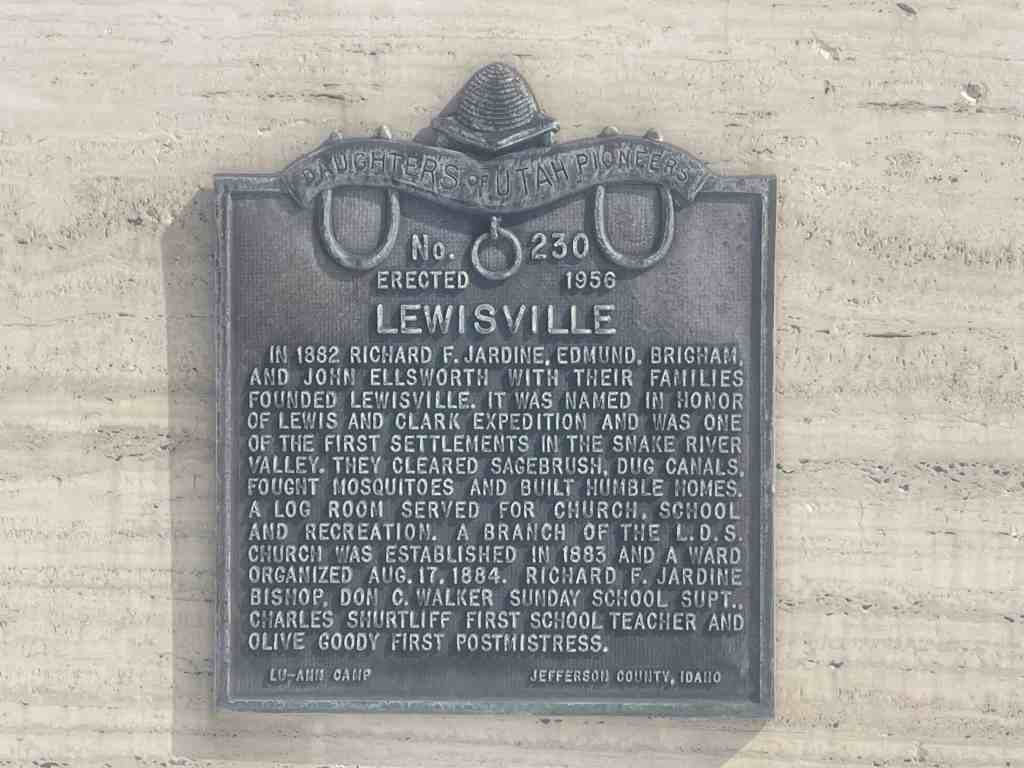
In 1882 Richard F. Jardine, Edmund, Brigham, and John Ellsworth with their families founded Lewisville. It was named in honor of Lewis and Clark expedition and was one of the first settlements in the Snake River Valley. They cleared sagebrush, dug canals, fought mosquitoes and built humble homes. A log room served for church, school and recreation. A branch of the L.D.S. Church was established in 1883 and a ward organized Aug. 17, 1884. Richard F. Jardine Bishop, Don C. Walker Sunday School Supt., Charles Shurtliff first school teacher and Olive Goody first Postmistress.
This is Daughters of Utah Pioneers historic marker #230 located at 474 North 3450 East in Lewisville, Idaho.
In 1884 a group of Utah Mormons settled and pioneered this locality. They cleared sagebrush land, dug canals and erected humble log homes. They built a log room which was used for church, school and recreation. Daniel S. Robbins, a Veteran, was made Presiding Elder, and in his home, located two hundred yards from here, the town of Rigby was named in honor of William F. Rigby of the Latter-day Saints Stake Presidency. In the year 1886, George A. Cordon taught the first school.
This is Daughters of Utah Pioneers historic marker #106 located at Veterans Memorial Park at 305 South Veteran Memorial Drive in Rigby, Idaho.
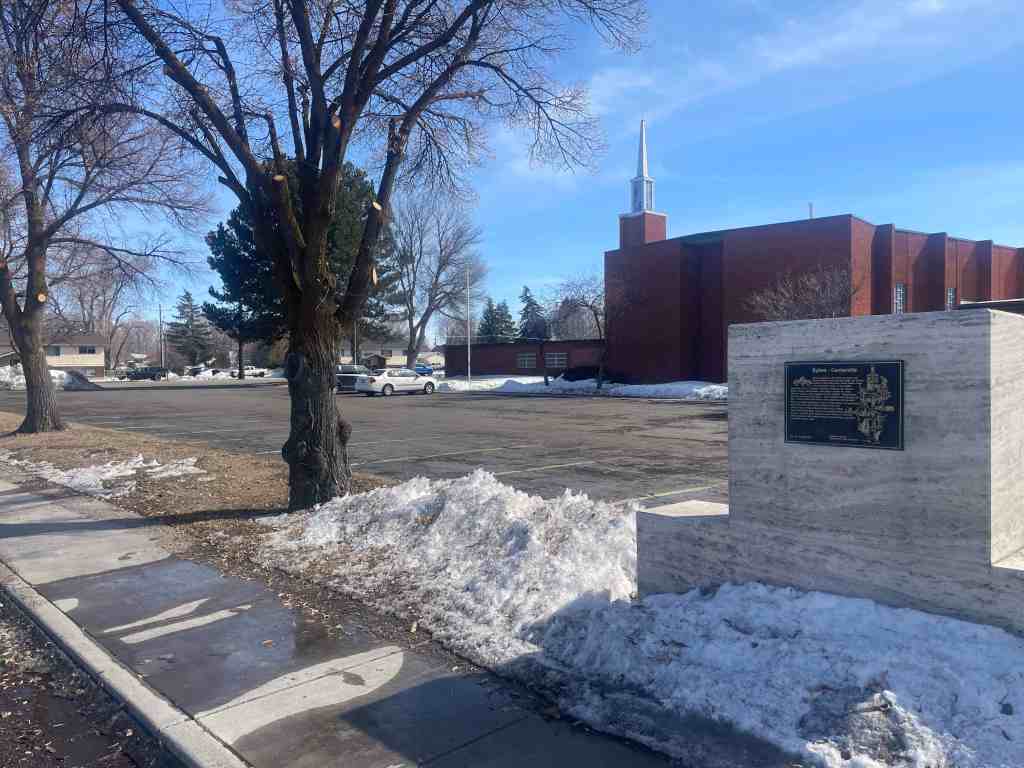
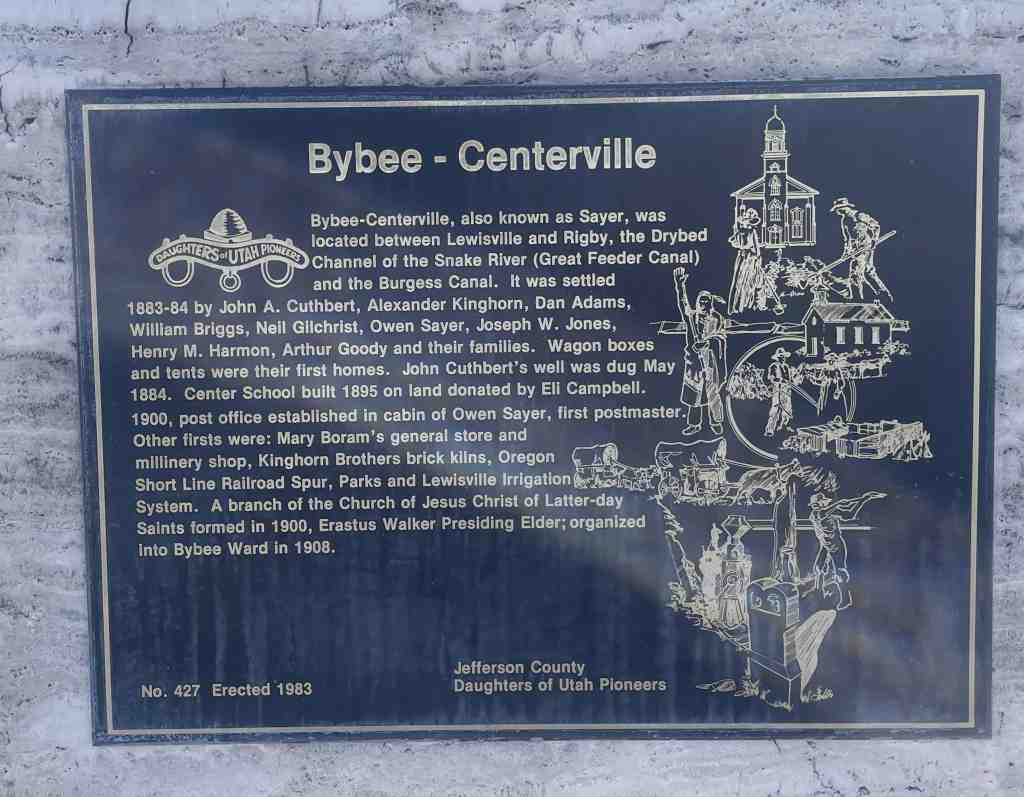
Bybee-Centerville, also known as Sayer, was located between Lewisville and Rigby, the Drybed Channel of the Snake River (Great Feeder Canal) and the Burgess Canal. It was settled 1883-84 by John A. Cuthbert, Alexander Kinghorn, Dan Adams, William Briggs, Neil Gilchrist, Owen Sayer, Joseph W. Jones, Henry M. Harmon, Arthur Goody and their families. Wagon boxes and tents were their first homes. John Cuthbert’s well was dug May 1884. Center School built 1895 on land donated by Eli Campbell. 1900, post office established in cabin of Owen Sayer, first postmaster. Other firsts were: Mary Boram’s general store and millinery shop, Kinghorn Brothers brick kilns, Oregon Short Line Railroad Spur, Parks and Lewisville Irrigation System. A branch of the Church of Jesus Christ of Latter-day Saints formed in 1900, Erastus Walker Presiding Elder; organized into Bybee Ward in 1908.
This is Daughters of Utah Pioneers historic marker #427 located at the LDS Church at 401 West 1st Street in Rigby, Idaho.
Pooles Island, first settled 1879 by members of Church of Jesus Christ of Latter-day Saints, John R. Poole, Presiding Elder. Cedar Butte Ward organized 1884, Robert L. Bybee, Bishop. Long Island Canal water right decreed 1880; school began 1881; Susie P. Lawson, Teacher; Townsite surveyed 1883; Grist Mill 1894; Pioneer merchant, C. A. Smith, Sr. Postoffice established 1885, changed Cedar Butte name to Menan, Indian word for Island. Francis M. Bybee, Postmaster.
This is Daughters of Utah Pioneers historic marker #378 located at the Menan Idaho Red Brick Church at 3547 East Menan Lorenzo Highway in Menan, Idaho.