• About JacobBarlow.com
  • Cemeteries in Utah
  • D.U.P. Markers
  • Doors
  • Exploring Utah Email List
  • Geocaching
  • Historic Marker Map
  • Links
  • Movie/TV Show Filming Locations
  • Oldest in Utah
  • Other Travels
  • Photos Then and Now
  • S.U.P. Markers
  • U.P.T.L.A. Markers
  • Utah Cities and Places.
  • Utah Homes for Sale
  • Utah Treasure Hunt

JacobBarlow.com

~ Exploring with Jacob Barlow

JacobBarlow.com

Tag Archives: Nevada Historic Markers

Consolidated Telephone-Telegraph Company Building

29 Tuesday Nov 2022

Posted by Jacob Barlow in Uncategorized

≈ 1 Comment

Tags

Goldfield, Goldfield National Historic District, Historic Markers, Nevada, Nevada Historic Markers

Consolidated Telephone-Telegraph Company Building

This building was the communications center of Goldfield from 1908 until 1963. The Consolidated Telephone-Telegraph Company Building was one of the few spared by a fire that destroyed 53 blocks of the downtown area in 1923. Today, this building survives as an unspoiled expression of the work of turn-of-the-century craftsman, and serves as an example of the business life in the Tonopah-Goldfield area from the years when the mines were producing millions and bringing new prosperity to Nevada. From 1904 to 1910, the gold mines of the region boomed. With more than 15,000 people, Goldfield was the largest city in Nevada during that period, having four railroads and other modern conveniences. The town was damaged by a flash flood in 1913 and mining was in decline, so many people left the area. The fire of 1923 caused the remaining residents to leave. Today the largest employer in Goldfield is Esmeralda County.

This is Nevada State Historical Marker #242, located outside the Esmeralda County Courthouse in Goldfield, Nevada. See others on this page:

  • Nevada Historic Markers

The Southern Nevada Consolidated Telephone-Telegraph Company Building was built in 1905, telephone and telegraph lines were first extended from Tonopah to Goldfield in January 1904. By mid-1907 at the peak of Goldfield’s boom, with over 20,000 people, telephone and telegraph service had become an indispensable element of business and mining activity. After the decline of Goldfield and for the next six decades, this building continued to serve the communication needs of the area. Jim Casey co-founder of UPS owned and operated a messenger service in this building in 1906.

Located in the Goldfield National Historic District in Goldfield, Nevada

Jackrabbit

20 Saturday Aug 2022

Posted by Jacob Barlow in Uncategorized

≈ Leave a comment

Tags

Historic Markers, Mining, Nevada, Nevada Historic Markers

Jackrabbit

Local legend attributes the discovery to the locator picking up a rock to throw at a jackrabbit and finding himself holding high-grade silver. The Jackrabbit District, named for the mine, was located in 1876 by Isaac Newton Garrison. Early mine production of the camp, at one time named Royal City, was about ten tons per day, carrying native silver in flakes, yielding about $40 per ton – sometimes as high as $2,000 per ton. Mineral production declined during the 1880s, but when a fifteen-mile narrow gauge railroad was opened in 1891 between the Jackrabbit Mine and Pioche, mining soon increased. After 1893 the mines fell silent except for several short periods of activity in 1906-1907 and 1912-1914.

This is Nevada State Historical Marker #204, see others on this page:

  • Nevada Historic Markers

Goldfield

10 Wednesday Aug 2022

Posted by Jacob Barlow in Uncategorized

≈ Leave a comment

Tags

Esmeralda County, Goldfield, Historic Markers, Nevada, Nevada Historic Markers

Goldfield

For a 20-year period prior to 1900 the mining in Nevada fell into a slump that cast the entire state into a bleak depression and caused the loss of a third of the population.

The picture brightened overnight following the spectacular strikes in Tonopah and, shortly afterwards, in Goldfield. Gold ore was discovered here in December 1902 by two Nevada-born prospectors, Harry Stimler and Billy Marsh. From 1904 to 1918 Goldfield boomed furiously. The city had a railroad that connected into Las Vegas and a peak population of 20,000. Between 1903 – 40 a total of $86,765,044 in metals was produced here.

This is Nevada State Historical Marker #14, located outside the Esmeralda County Courthouse in Goldfield, Nevada. See others on this page:

  • Nevada Historic Markers

Union Pacific Depot

02 Tuesday Aug 2022

Posted by Jacob Barlow in Uncategorized

≈ Leave a comment

Tags

Caliente, Historic Markers, Lincoln County, Mission Revival, Nevada, Nevada Historic Markers

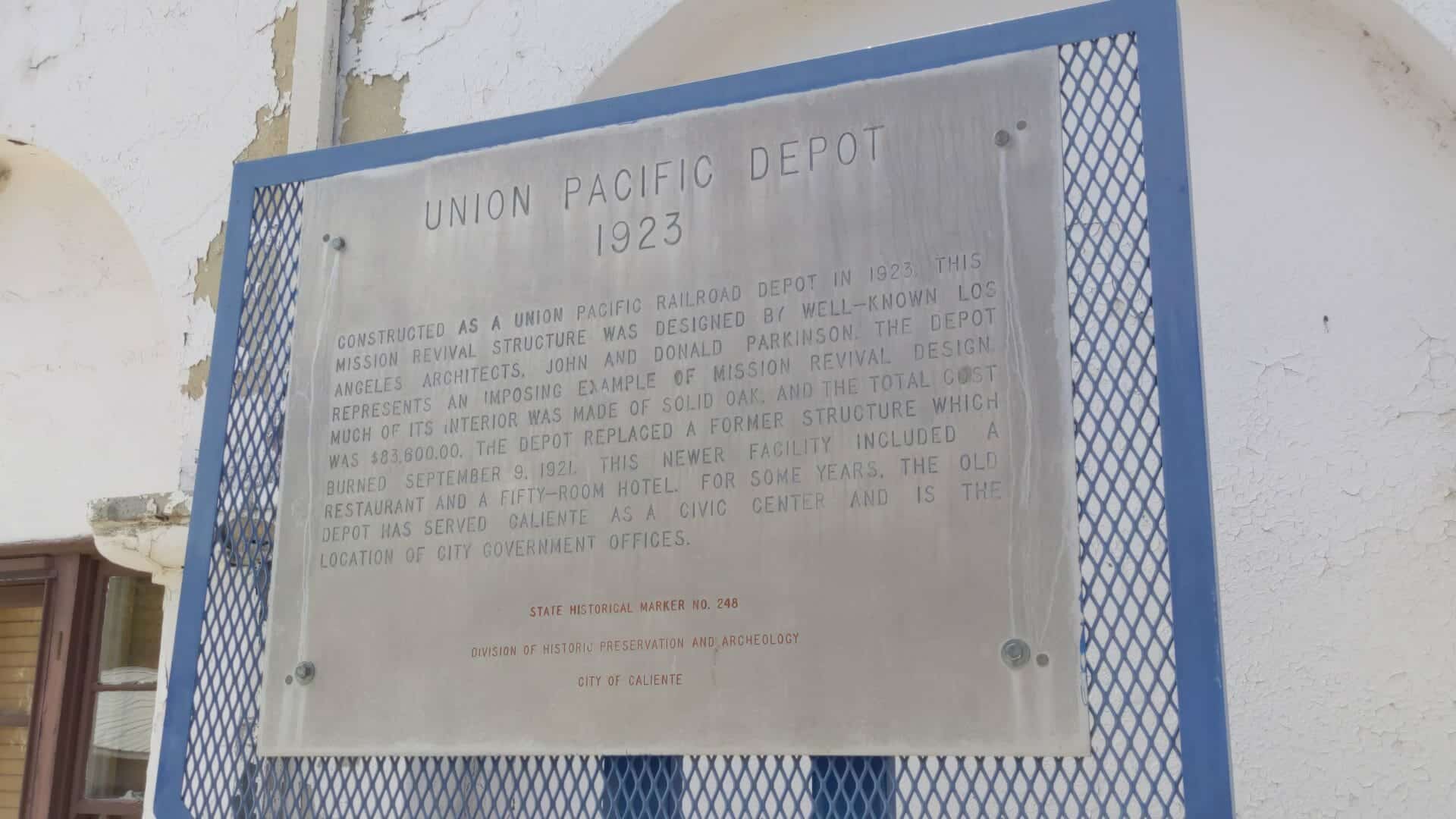
Union Pacific Depot
1923

Constructed as a Union Pacific railroad depot in 1923, this mission revival structure was designed by well-known Los Angeles architects, John and Donald Parkinson. The depot represents an imposing example of mission revival design. Much of its interior was made of solid oak, and the total cost was more than $80,000. The depot replaced a former structure which burned on September 9, 1921. This newer facility included a restaurant and fifty-room hotel for some years. The structure has served Caliente as a civic center and is the location of city government offices.

This is Nevada State Historical Marker #248, located at the Caliente Railroad Depot in Caliente, Nevada. See others on this page:

  • Nevada Historic Markers

Note, there are two markers numbered #248, the other is: Virginia & Truckee Railroad Right of Way

Caliente

31 Sunday Jul 2022

Posted by Jacob Barlow in Uncategorized

≈ Leave a comment

Tags

Caliente, Historic Markers, Lincoln County, Nevada, Nevada Historic Markers

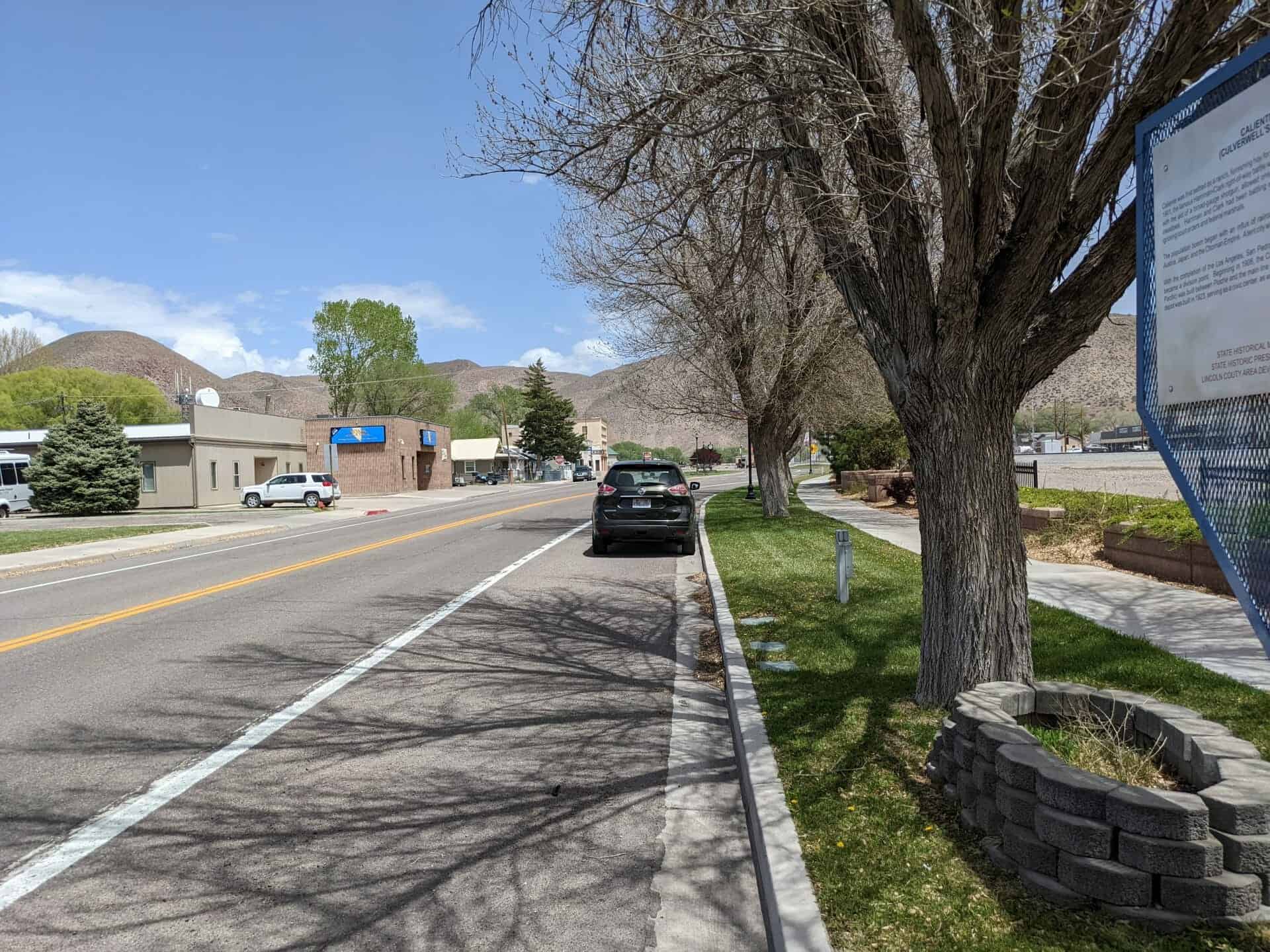
Caliente
(Culverwell’s Ranch)

Caliente was first settled as a ranch, furnishing hay for the mining camps of Pioche and Delmar. In 1901, the famous Harriman-Clark right-of-way battle was ended when rancher Charles Culverwell, with the aid of a broad-gauge shotgun, allowed one railroad grade to be built through his lush meadows. Harriman and Clark had been battling eleven years, building side-by-side grades ignoring court orders and federal marshals.

The population boom began with an influx of railroad workers, most of them immigrants from Austria, Japan, and the Ottoman Empire. A tent city was settled in August 1903.

With the completion of the Los Angeles, San Pedro, and Salt Lake Railroad in 1905, Caliente became a division point. Beginning in 1906, the Caliente and Pioche Railroad (now the Union Pacific) was built between Pioche and the main line at Caliente. The large Mission Revival-style depot was built in 1923, serving as a civic center, as well as a hotel.

This is Nevada State Historical Marker #55, located in Caliente, Nevada. See others on this page:

  • Nevada Historic Markers

Schellbourne

21 Thursday Jul 2022

Posted by Jacob Barlow in Uncategorized

≈ Leave a comment

Tags

Historic Markers, Nevada, Nevada Historic Markers, Pony Express, Rest Areas, Schellbourne

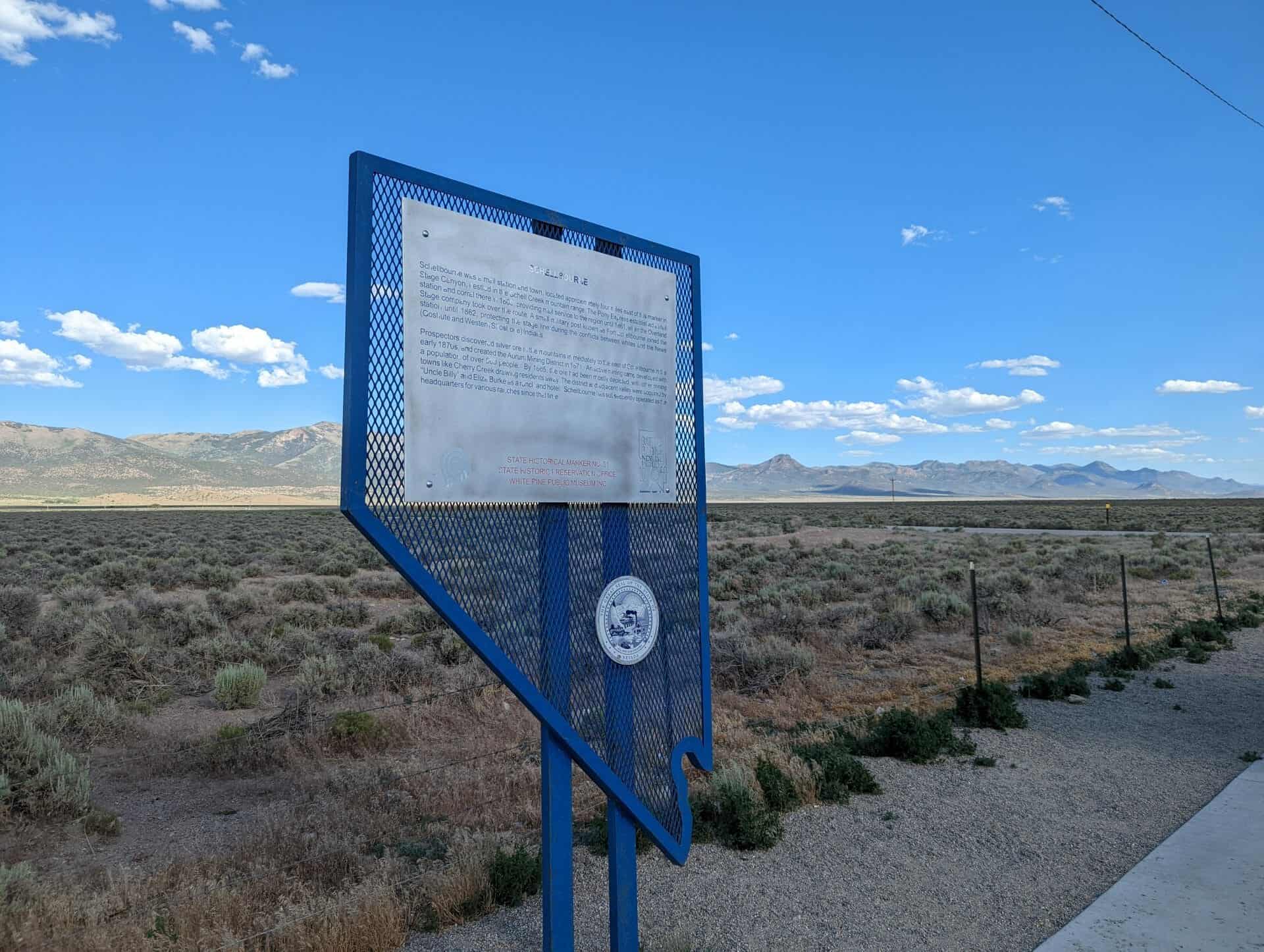
Schellbourne

Schellbourne was a mail station and town, located approximately four miles east of this marker in Stage Canyon, nestled in the Schell Creek mountain range. The Pony Express established a mail station and corral there in 1860, providing mail service to the region until 1861, when the Overland Stage company took over the route. A small military post known as Fort Schellbourne joined the station until 1862, protecting the stage line during the conflicts between whites and the Newe (Goshute and Western Shoshone) Indians.

Prospectors discovered silver ore in the mountains immediately to the east of Schellbourne in the early 1870s, and created the Aurum Mining District in 1871. An active mining camp developed with a population of over 500 people. By 1885, the ore had been mostly depleted, with other mining towns like Cherry Creek drawing residents away. The district and adjacent valley were acquired by Uncle Billy” and Eliza Burke as a ranch and hotel. Schellbourne has subsequently operated as the headquarters for various ranches since that time.

This is Nevada State Historical Marker #51 located at the Schellbourne rest area along Highway 93 in Nevada.

See others on this page:

  • Nevada Historic Markers

Related:

  • Pony Express

Jedediah Strong Smith

21 Thursday Jul 2022

Posted by Jacob Barlow in Uncategorized

≈ Leave a comment

Tags

Nevada, Nevada Historic Markers

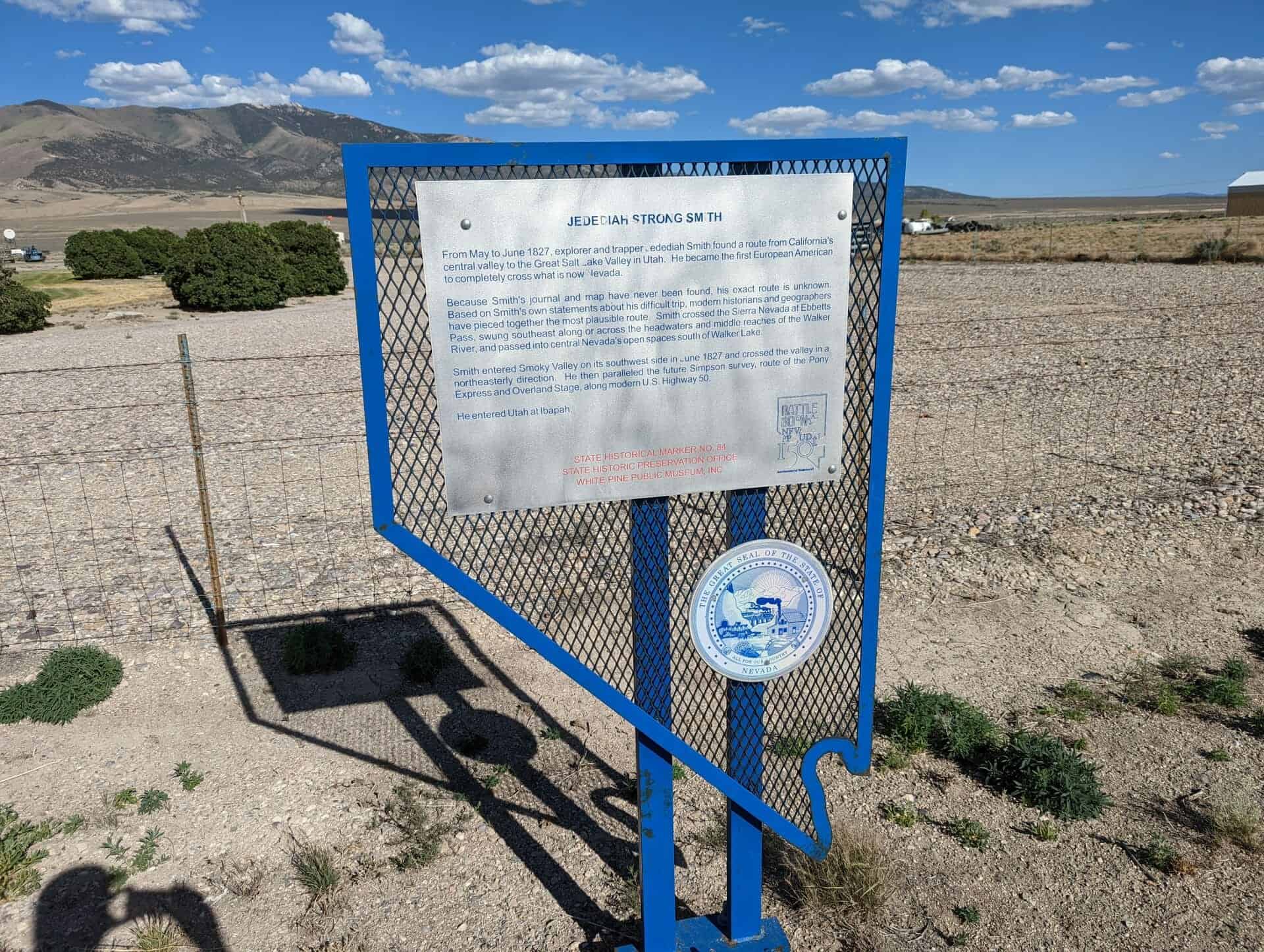
Jedediah Strong Smith

From May to June 1827, explorer and trapper Jedediah Smith found a route from California’s central valley to the Great Salt Lake Valley in Utah. He became the first European American to completely cross what is now Nevada.

Because Smith’s journal and map have never been found, his exact route is unknown. Based on Smith’s own statements about his difficult trip, modern historians and geographers have pieced together the most plausible route. Smith crossed the Sierra Nevada at Ebbetts Pass, swung southeast along or across the headwaters and middle reaches of the Walker River, and passed into central Nevada’s open spaces south of Walker Lake.

Smith entered Smoky Valley on its southwest side in June 1827 and crossed the valley in a northeasterly direction. He then paralleled the future Simpson survey, route of the Pony Express and Overland Stage, along modern U.S. Highway 50.

He entered Utah at Ibapah.

This is Nevada State Historical Marker #84 located at the White Pine Public Museum at 78 North McGill Highway in Ely, Nevada.
See others on this page:

  • Nevada Historic Markers

Related:

  • My page on Jedediah Strong Smith

Bullionville

21 Thursday Jul 2022

Posted by Jacob Barlow in Uncategorized

≈ Leave a comment

Tags

Bullionville, Historic Markers, Lincoln County, Nevada, Nevada Historic Markers

Bullionville

Bullionville began early in 1870 when John H. Ely and W. H. Raymond, removed their five-stamp at Hiko and placed it at this point. The enterprise prospered and during the next two years most of nearby Pioche’s mills were located here because of the proximity to water. The town grew rapidly and by 1875 it had five mills, a population of 500, and the first iron foundry in eastern Nevada. During the same year a water works was constructed at Pioche, which eventually led to the relocation of the mills. Although a plant was erected here in 1880 to work the tailings deposited by the former mills, this failed to prevent the decline of Bullionville.

This is Nevada State Historical Marker #203, located just outside Panaca, Nevada.

Related:

  • Nevada Historic Markers

Nevada Northern Railway

20 Wednesday Jul 2022

Posted by Jacob Barlow in Uncategorized

≈ Leave a comment

Tags

Ely, Historic Markers, Lincoln Highway, Nevada, Nevada Historic Markers, Railroad, White Pine County

Nevada Northern Railway

Mark Requa’s Nevada Consolidated Copper Company laid 150-mile of track from Cobre, on the Southern Pacific line, to Ely in 1905-06 to haul ore from the Copper Flat mines west of Ely.

Ore was loaded into railroad gondolas at Copper Flat for the trip to the smelter at McGill, over a double-track trestle that was 1720 feet long. The trestle burned in 1922 and was replaced with an earth-fill span.

Passenger service and the “school train” carrying McGill youth to Ely High School ended in 1941. With the closing of local copper mines in 1983, the railroad ceased operations. Currently, part of the line serves the Nevada Northern Railway Museum for live steam rides. The East Ely shop complex for the Railway was listed as a National Historic Landmark District in 2006. 

This is Nevada State Historical Marker #100 located at the White Pine Public Museum at 2000 East Aultman Street in Ely, Nevada.

See others on this page:

  • Nevada Historic Markers

Related:

  • Lincoln Highway Markers

Cherry Creek and Egan Canyon

20 Wednesday Jul 2022

Posted by Jacob Barlow in Uncategorized

≈ Leave a comment

Tags

Cherry Creek, Historic Markers, Nevada, Nevada Historic Markers

Cherry Creek and Egan Canyon

The town of Cherry Creek before you was part of a network of mining districts that operated in the nineteenth and twentieth centuries, including the Gold Canyon district in Egan Canyon, five miles to the south.

Peter Corning and John Carpenter helped start the town of Cherry Creek when they staked the Tea Cup gold claim in 1872, resulting in a boom and the development of a town. At the town’s peak in 1882, it boasted a population of over 1,800. While production fluctuated, Cherry Creek continued to produce gold and silver ore into the 1940s.

Egan Canyon to the south was part of the 1855 route established by Howard Egan and the Mormon Battalion, and surveyed for use in 1859 by the U.S. Army. By 1860, the Pony Express placed a change station at the west opening of the canyon. Between 1861 and 1869, Butterfield’s Overland Mail and Stage established a station here that grew into a small temporary town.

In 1863, soldiers from Fort Ruby discovered gold in the canyon, leading to the creation of the town of Egan and a mining district. By 1865 there were three stamp mills in Egan processing ore from the district. Like Cherry Creek, to the north, Egan boomed and busted into the 1920s before mining ceased.

This is Nevada State Historical Marker #52 located in Cherry Creek, Nevada.

See others on this page:

  • Nevada Historic Markers
← Older posts
Newer posts →

Follow Jacob

Follow Jacob

Blog Stats

  • 2,011,545 hits

Social and Other Links

BarlowLinks.com

Recent Posts

  • John A. Henrickson Home
  • Fred H. Thompson Home
  • G.W. Thatcher Home
  • Fort Douglas Commanders House
  • Herbert B. Maw Home

Archives


Loading Comments...