• About JacobBarlow.com
  • Cemeteries in Utah
  • D.U.P. Markers
  • Doors
  • Exploring Utah Email List
  • Geocaching
  • Historic Marker Map
  • Links
  • Movie/TV Show Filming Locations
  • Oldest in Utah
  • Other Travels
  • Photos Then and Now
  • S.U.P. Markers
  • U.P.T.L.A. Markers
  • Utah Cities and Places.
  • Utah Homes for Sale
  • Utah Treasure Hunt

JacobBarlow.com

~ Exploring with Jacob Barlow

JacobBarlow.com

Tag Archives: Rich County

Randolph Historic Marker

11 Monday Aug 2014

Posted by Jacob Barlow in Uncategorized

≈ 1 Comment

Tags

historic, Randolph, Rich County, utah, Woodruff


Randolph lies in the shadow of the Crawford Mountains against the western foothills of the Upper Bear River between two creeks, Big Creek on the south and Little Creek on the north. In answer to a call from the general authorities of The Church of Jesus Christ of Latter-day Saints, Randolph H. Stewart and others arrived in the Bear River Valley March, 1870. One week later, Apostle Charles C. Rich and Company came. They surveyed the town and named it Randolph, in honor of the first Bishop, Randolph H. Stewart. Many others soon followed and by the spring of 1871 Randolph was a thriving town, having established a post office, store, blacksmith shop and sawmill. These early settlers were men and women with courage and fortitude ready to brave the severe climate and hardships. Progression has continued with the coming of electricity, the water system, modern communications and transportation. From the one-room schoolhouse, education continues with the latest technology and modern facilities. The cattle and sheep industries have sustained many families throughout the years. The stately tabernacle, dedicated July 26, 1914, depicts the faith of the early settlers. This devotion is evident today as men and women serve missions throughout the world. As the need to defend our freedom has arisen. many have responded to the call of our country … some having made the supreme sacrifice.
f33e6cd6-a1ad-496c-a189-3aefb667c72f
We salute those who have contributed to the development of this community. They are men and women of foresight and dedication … all desiring to establish an abundant life for now as well as for future generations!

546e8d5c-83a2-4906-9f76-59aefe9c1f26

Randolph

27 Tuesday May 2014

Posted by Jacob Barlow in Uncategorized

≈ Leave a comment

Tags

DUP, historic, Randolph, Rich County, utah

  • picture16aug07-048

Located in Randolph, Utah.

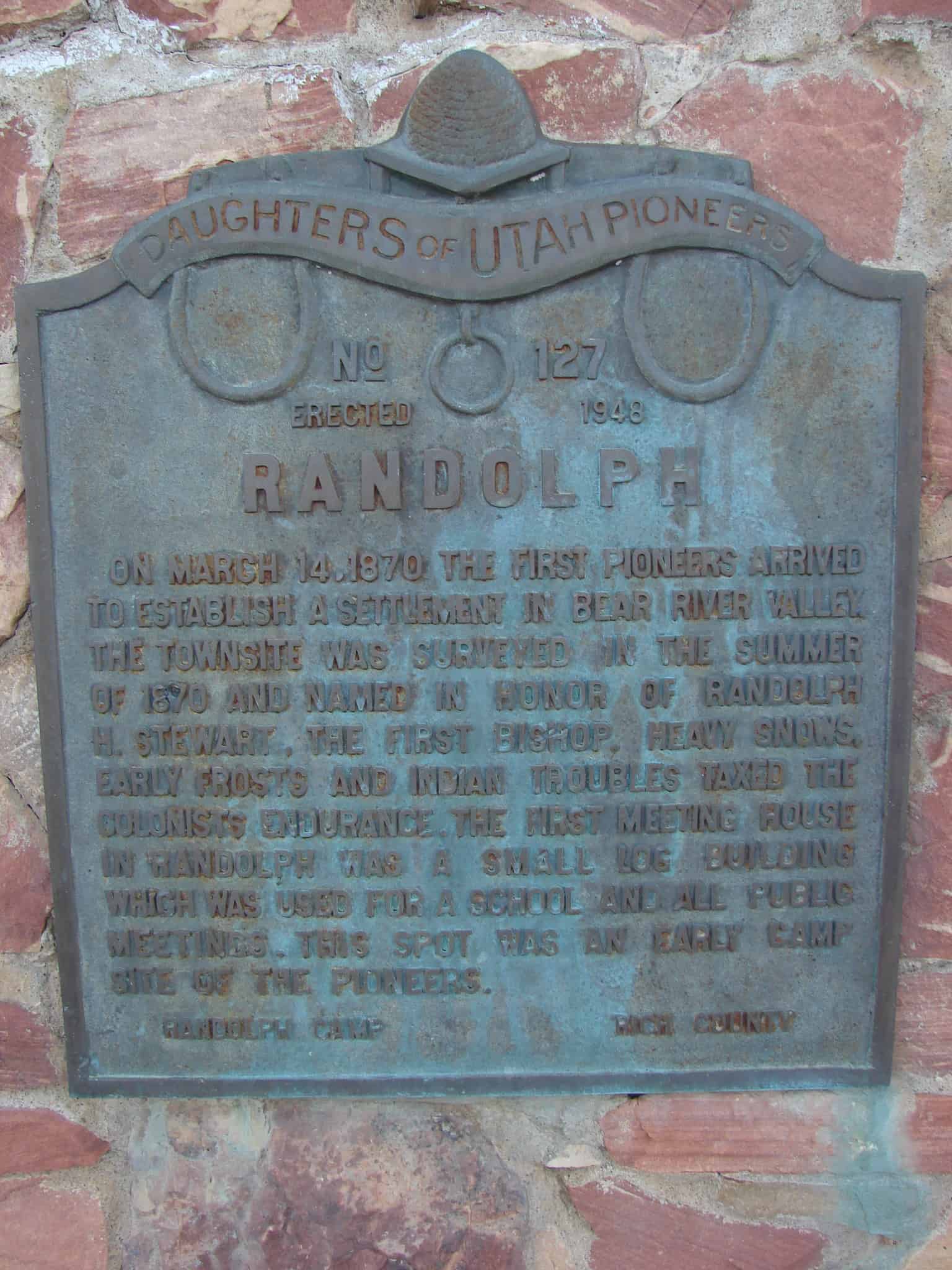
On March 14, 1870, the first pioneers arrived to establish a settlement in Bear River Valley. The townsite was surveyed in the summer of 1870 and named in honor of Randolph H. Stewart, the first Bishop. Heavy snows, early frosts and Indian troubles taxed the colonists’ endurance. The first meeting house in Randolph was a small log building which was used for a school and all public meetings. This spot was an early camp side of the pioneers.

  • Image

Check out all of the historic markers placed by the Daughters of Utah Pioneers at JacobBarlow.com/dup

Woodruff, Utah

11 Monday Nov 2013

Posted by Jacob Barlow in Uncategorized

≈ 2 Comments

Tags

Randolph, Rich County, utah, Woodruff

Image

Woodruff, Utah

  • Woodruff Stake House
Image

Woodruff, Utah

One D.U.P. Marker in town says:
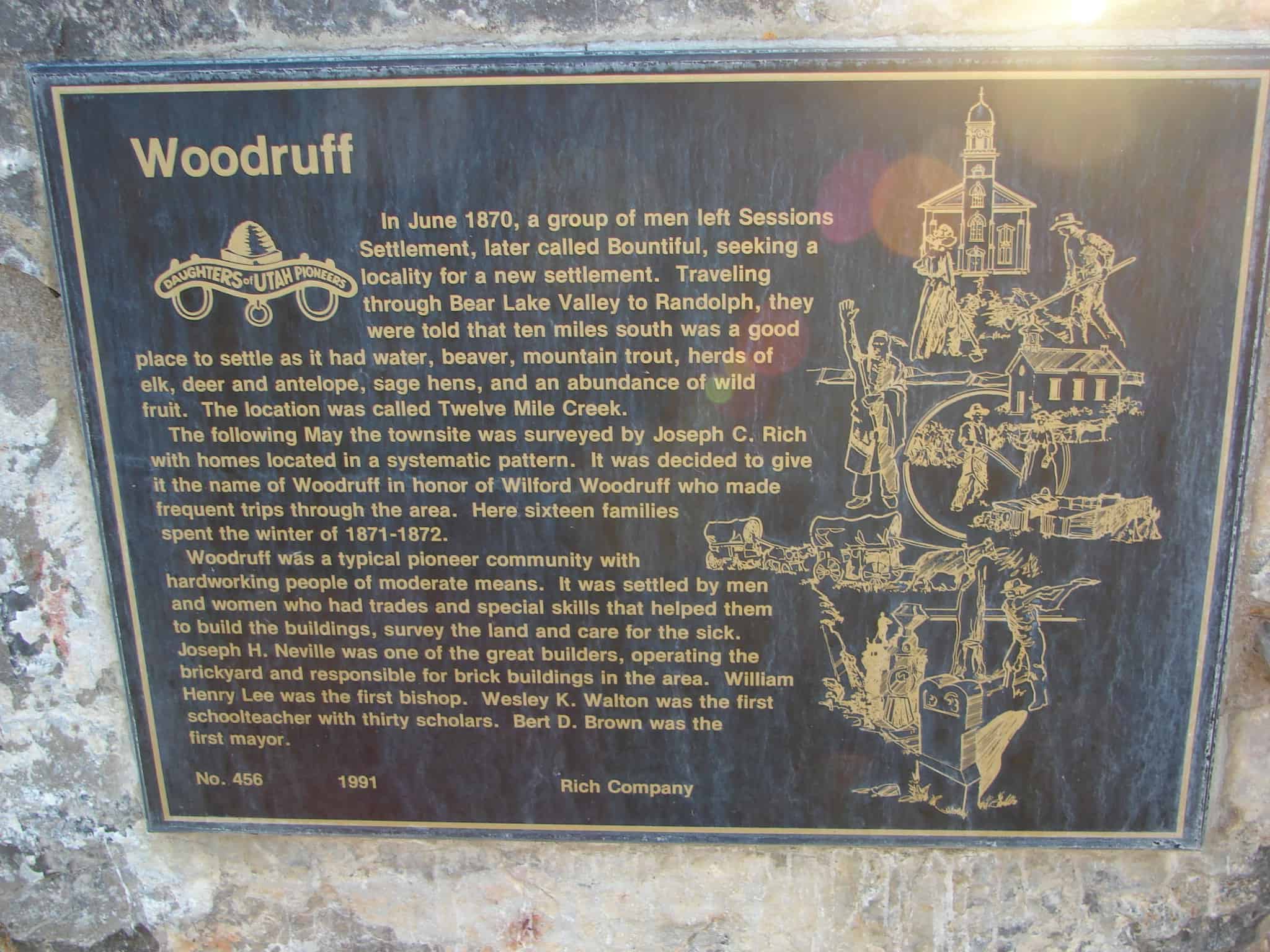
In June 1870, a group of men left Sessions Settlement, later called Bountiful, seeking a locality for a new settlement. Traveling through Bear Lake Valley to Randolph, they were told that ten miles south was a good place to settle as it had water, beaver, mountain trout, herds of elk, deer and antelope, sage hens, and an abundance of wild fruit. The location was called Twelve Mile Creek. The following May the townsite was surveyed by Joseph C. Rich with homes located in a systematic pattern. It was decided to give it the name of Woodruff in honor of Wilford Woodruff who made frequent trips through the area. Here sixteen families spent the winter of 1871-1872. Woodruff was a typical pioneer community with hardworking people of moderate means. It was settled by men and women who had trades and special skills that helped them to build the buildings, survey the land and care for the sick. Joseph H. Neville was one of the great builders, operating the brick-yard and responsible for brick buildings in the area. William Henry Lee was the first bishop. Wesley K. Walton was the first schoolteacher with thirty scholars. Bert D. Brown was the first mayor.

Image

Woodruff Post Office

Another historical marker reads:
In June 1870 a group of men left Session Settlement (later called Bountiful) seeking a locality for a new settlement. They traveled north, and entered the Bear Lake Valley. They continued over the divide to a new settlement formed from a company from Paris, Idaho, later named Randolph. The travelers were told of a stream of water about 10 mile up that would make a good settlement. After arriving they were more than pleased. They saw the broad valley and green grasses and willows. They made ponds in the streams causing them to overflow, which helped keep the valley green, the mountain trout in the streams, the elk and deer herds in abundance. The Indians were friendly and Chief Washakie was the leader at that time. In May 1871, the town site was surveyed by Joseph C. Rich. (Woodruff is located in Rich County) His survey permitted the location of homes to follow a systematic pattern with George Eastman building the first home. A name was sought for the new settlement and it was decided to give it the name of Woodruff in honor of Wilford Woodruff who made frequent trips to Randolph to visit relative.

During 1895-96 Woodruff area population was around 486 and its residents were anxious for the long awaited day Utah would become a state. Jan. 4, 1896 at 10:00 A.M. the news was wired to Woodruff, and the Town bell (which now hangs at the Town Hall) was rung for five minutes and again at noon. In Dec 1930 Woodruff received its first power lines and also its first power outage as everyone wanted to use electricity. It wasn’t until Dec. 4, 1933 that Woodruff was granted petition by the Commissioners to become incorporated. Its first officers were; B.D. Brown Pres., James Stuart, Rowena Tingy, Cloyd Eastman, and Sarah Cornia as Trustees. In January 1996, 100 years after statehood Woodruff area populations is around 350.

Image

Visit my list of places in Utah.


Woodruff

11 Monday Nov 2013

Posted by Jacob Barlow in Uncategorized

≈ 1 Comment

Tags

DUP, historic, Rich County, utah, Woodruff

picture16aug07-046

In June 1870, a group of men left Sessions Settlement, later called Bountiful, seeking a locality for a new settlement. Traveling through Bear Lake Valley to Randolph, they were told that ten miles south was a good place to settle as it had water, beaver, mountain trout, herds of elk, deer and antelope, sage hens, and an abundance of wild fruit. The location was called Twelve Mile Creek. The following May the townsite was surveyed by Joseph C. Rich with homes located in a systematic pattern. It was decided to give it the name of Woodruff in honor of Wilford Woodruff who made frequent trips through the area. Here sixteen families spent the winter of 1871-1872.

Woodruff was a typical pioneer community with hardworking people of moderate means. It was settled by men and women who had trades and special skills that helped them to build the buildings, survey the land and care for the sick. Joseph H. Neville was one of the great builders, operating the brick-yard and responsible for brick buildings in the area. William Henry Lee was the first bishop. Wesley K. Walton was the first schoolteacher with thirty scholars. Bert D. Brown was the first mayor.

The text on this page is from Daughters of Utah Pioneers historic marker #456, located at 195 South Main Street in Woodruff, Utah

  • D.U.P. Historic Markers

Randolph, Utah

07 Thursday Nov 2013

Posted by Jacob Barlow in Uncategorized

≈ 3 Comments

Tags

Laketown, Randolph, Rich County, utah

f9978a9b-87b2-4322-9869-617c6fe65cf3

1caad7d5-b2a8-4e32-9ec5-ce4567d1920f
4b12c519-4036-4078-be56-7bdf64f9b20f
ea89dad3-e189-4bdb-89d5-3a894d2467ce

Related Posts:

  • Randolph D.U.P. Marker
  • Randolph Historic Marker
  • Randolph Tabernacle 
  • Wilford Woodruff Home

On the 14th of March, 1870, the first settlers came into this valley, responding to a call from the general authorities of the Church of Jesus Crist of Latter-day Saints. Coming from St. Charles, Idaho, where: Randolph H. Stewart, Robert and Charles Pope, Edwin T. Pope, William Pearce and others. One week later, March 21st, Apostle Charles C. Rich and Company arrived. They located the town using a rope as a surveyors chain, and laid it off in 10 acres to a block with 8 lots in each. The town was named Randolph, in honor of it’s first bishop, Randolph H. Stewart. Many others soon came, including: Levi O. Pead, William Howard Jr., Mrs. Agnes Smith, Samuel Henderson, Alfred G. and William Rex, John Cameron, Samuel Brough, William Tyson and Archibald McKinnon, Sr. They continued to come with a spirit of hope, not seeking wealth, but responding to a call wanting only a peaceful, progressive way of life. To a great extent, the town has revolved around the church. A log building was completed, serving as a place of worship, school house and amusement center. However, an adobe building soon replaced this small structure as the men became tired of having to stand outside waiting a turn to dance. The spring of 1871 found Randolph a thriving town. The tall sage was being grubbed, making more space for the lush, wild prarie grass to grow. Canals and ditches were surveyed and dug. Timber in near-by canyons, water and grazing were abundant. Streams abounded with fish and the wild game was plentiful. A post office, store, blacksmith and saw mill were soon established. In August, 1883, President John Taylor visited Randolph for a conference. After the services were dismissed, and many had departed, President Taylor called them back. Raising his right hand he said, “In the name of Jesus Christ, I not only bless you, but I bless this land for your sustenance.” Many significant changes were made during the next century. Sacrifice, hard work and united effort built the beautiful brick tabernacle. With the coming of electricity, modern communications and transportation, progress has been made. Powerful machinery now subdues the land producing bounteous hay and grain crops. Modern schools have long replaced the first small one-room building. A few of the family names which are woven into the early settling of Randolph not before mentioned are: Brown, Corless, Evans, Gray, Gunn, Hatch, Hoffman, Jackson, Jacobson, Johnson, Jones, Kennedy, Buir, Nicholls, Norris, Peart, Smith, Snowball, South, Spencer, Telford, Wilson and others. Fond memories were relived at the Randolph Centennial Celebration in 1970. Hundreds have responded to missionary calls throughout the world, as well as military service to our country. Many brave souls have paid the supreme sacrifice for the preservation of our freedom. Still thrives essential goodness in the hearts of it’s people. Through triumphs and discouragements have come significant contributions of work, faith and human compassion which compells us to continually move forward.

Randolph, Utah is the County seat of Rich County.

Image

Newer posts →

Follow Jacob

Follow Jacob

Blog Stats

  • 2,063,785 hits

Social and Other Links

BarlowLinks.com

Recent Posts

  • The Heinrich Gubler Home
  • The Temple Quarry
  • The Old Settler’s “Swallow’s Nest”
  • Arthur Miles Home
  • Navajo Shadehouse Museum

Archives

Loading Comments...