Tags
Woodruff Stake House / Woodruff Stake Tithing House
Completed in 1901, the Woodruff Stake House is locally significant as the only remaining historic building in Woodruff that represents the Mormon Church and its strong influence in the community. The church’s principal building, the chapel or meetinghouse, was demolished in the mid-1980s. The stake house served as offices for the local ward (congregation) as well as the regional stake, which is comprised of several wards. The bishop of the Woodruff Ward occupied the north wing of the building from 1901 until 1949, and the president of the Woodruff Stake had his offices in the south wing throughout that same period. The building also served as the ward “tithing office,” the place where church members settled their voluntary contributions of one-tenth of their annual “increase,” and as a meeting place for the women’s Relief Society. The community used the building for nonchurch purposes as well, including meetings for organizations such as the local livestock association and for school purposes when space was needed. It is the only remaining civic-use building in Woodruff. The building is one of twenty-seven tithing offices remaining in Utah, as documented in the 1985 National Register of Historic Places thematic resource nomination of Tithing Offices and Granaries of the Mormon Church.
Located at 50 South Main Street in Woodruff, Utah and added to the National Historic Register (#00001586) on December 28, 2000.
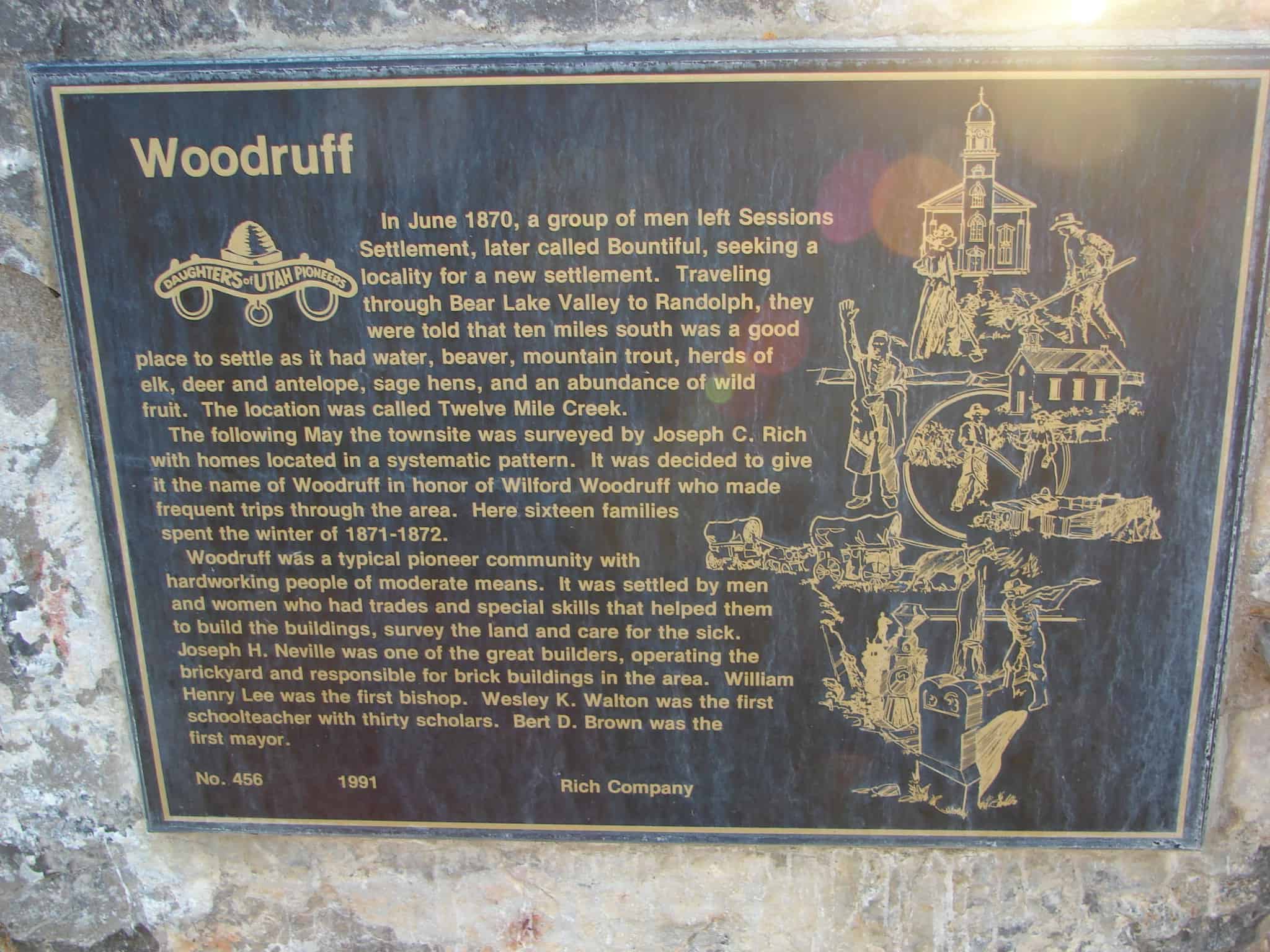
Woodruff is a small, livestock-based town in extreme northeastern Utah near the borders of both Idaho and Wyoming. Though the town is actually much closer, geographically, to the Wyoming hub-town of Evanston than to any Utah city of substantial size, its history is deeply embedded in Mormon-settled Utah. The town was settled in 1865 as part of the Mormon Church’s systematic plan to establish settlements throughout the Utah region after relocating here from the Midwest in 1847. The town’s name is derived from one of the prominent early settlers in the region, Wilford Woodruff, who later served as president of the Church of Jesus Christ of Latter-day Saints (Mormon or LDS Church) from 1889 until his death in 1898.
The decision to construct the stake house was made by leaders of the LDS Woodruff Stake (a stake is comprised of several wards or congregations) on March 10, 1900, and work commenced on March 17. Church headquarters contributed $400 toward the cost of the building, and the balance was covered by the Woodruff Ward and wards from other towns in the stake. A local history of the town notes that the building contained “a clerk’s office, a High Council Chamber [apparently the center room on the main floor], a Bishops Office and also a room upstairs for a prayer circle.” The “clerk” referred to was the stake clerk, who kept track of stake affairs under the direction of the stake president. In February 1901, a local correspondent to the statewide Deseret Evening News noted that “[W]e have a fine Stake house office, with five rooms nearly completed. It was built by contributions from each settlement, and is a credit to the people of this Stake.” The fifth room referred to in this article is probably the small, windowless room adjoining the upstairs prayer room. This small room may have been used to store sacred clothing used for the prayer circles, an activity now reserved only for temples, the most sacred of Mormon structures. It was more common in the late-nineteenth and early twentieth centuries for remote communities to perform some of the lesser temple functions, such as prayer circles, in non-temple facilities.
Though the building was usually referred to locally as the “stake house,” it was sometimes called the stake tithing office as well. Tithing offices or bishop’s storehouses, as they were also known, were built in most Mormon settlements as a place to accept contributions from ward members. Through the nineteenth century those contributions were usually “in-kind” farm commodities such as eggs, hay, livestock, and so forth. Tithing yards of the period included granaries, barns, and corrals to accommodate these contributions.
In Woodruff the tithing lot and granary were established in 1891 and “located west of and adjoined to John M. Baxter’s home.” (These tithing lot structures are no longer standing.) Baxter was the bishop at the time and later served for 38 years as stake president. Though most tithing lots were usually separate facilities, it was not uncommon for them to be located on the bishop’s property. Even after the task of settling tithing accounts shifted to the new stake house, the tithing lot remained in its former location; there never was a granary, barn, or other such facility on the stake house property. The stake house was constructed during a period in which tithing throughout the church was undergoing a transition from in-kind contributions to cash payments, so there was less of a need for the traditional tithing lot structures. Eventually in-kind contributions ceased altogether.
The Woodruff Stake House is unusual in that it was both constructed and used by both the ward and stake. Most tithing offices were simply ward structures. While there are probably other examples of this dual use, it was not the norm. The building is also unusual in that it continued with its original use until 1949. By mid-century, most other wards and stakes had long since moved their offices into newer or remodeled meetinghouses and either sold their tithing offices or allowed them to be used by auxiliary organizations.
The building’s temple-form design is much more representative of 1870s Utah architecture than it is of early 20th-century buildings. Shortly after the completion of this building, the LDS Church apparently came out with standard plans for such buildings. Tithing offices constructed in a number of Utah communities after 1900 represent some of those standard plans. By 1910, however, the construction of tithing offices appears to have been terminally suspended. The new concept was to consolidate all activities under one roof. The new church buildings that emerged in the 1920s were much larger than the earlier meetinghouses because they not only included a chapel but also a bishop’s office, classrooms, women’s Relief Society meeting room, and amusement/recreation halls.
The church’s women’s organization, the Relief Society, also used the building for its meetings. This is somewhat unusual given that most ward Relief Societies preferred having their own building. The nineteenth-century pattern of separate buildings for the various ward groups and functions changed in the early twentieth century, and by the 1920s new meetinghouses included those various functions under one roof.
The Woodruff Stake House served other non-church purposes as well. It served briefly as a home for Savannah and Marie Putnam after their home burned to the ground on March 2,1917. The first and second-story rooms accommodated school children for a year when the town’s school was overcrowded in the late 1920s. It also served as a meeting place for the Woodruff Livestock Association and very likely was used for town meetings as well, since there was not a town hall. Besides the stake house, there are no other civic or public buildings remaining in Woodruff from the nineteenth or early twentieth centuries.
In 1949, with the completion of major additions to the LDS meetinghouse, the ward and stake moved out of the stake house and decided to sell the building in order to help pay for some of the cost of the new facility. According to county records, Woodruff Ward sold the building in February 1950 to Osro and Fuchsia Cornia, who owned it for three years. They sold the house to Al and LaVerl Miller in January 1953. The Millers, who are generally credited with converting the stake house into a residence, owned it until 1971. Subsequent owners include Frank and Helen Shelby (1971-75), Ralph and Sally Eastman (1975-95), and the current owners Jef T. and Gayle Jensen. The house is currently vacant and for sale.


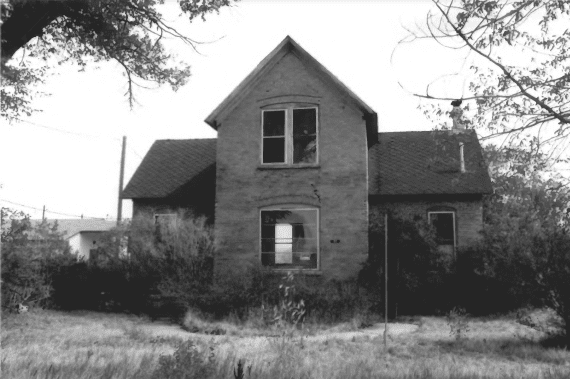
The Woodruff Stake House, constructed in 1900-1901, is a late example of the temple-form type that was typically constructed in Utah during the 1850s-1870s. The symmetrically composed brick building faces west and features a two-story central section with its gable end facing the street, characteristic of the temple form type, and flanking one-story wings on either side. Despite a few relatively minor alterations to both the exterior and interior, the building retains a significant amount of its historic integrity.
True to the classical origins of the temple form type, the building features a symmetrical facade. Windows are centered in the central gabled section, and the flanking wings contain a mirrored door/window arrangement, though both doors were enclosed in the 1950s after the building was converted to residential use. Other changes likely made at that time include the removal of Victorian-style porches in front of both one-story sections (see historic photo) and the replacement of the original paired double-hung window on the first-story facade with a c. 1950s window (though the overall size of the opening has not changed). The open porch on the rear was probably constructed or expanded in the 1950s, given its flat roof and open-rafter construction; its turned columns may have been recycled from the front porches. The foundation of the building is randomly laid fieldstone, and the walls are constructed of locally manufactured brick. Though the Victorian porches are now gone, vestiges of that stylistic influence include the segmental arches over the windows and the lathe-turned porch columns and single engaged column at the southwest corner that may have supported a sign for the building.
The interior contains three main rooms on the ground floor corresponding to the three sections visible from the exterior and a room upstairs in the central two-story section. There is also a small “attic” room above the north wing, though inexplicably there is not a matching room above the south wing. The upstairs is accessed by an unusual, enclosed frame stairway attached to the back of the building. This stairway, which is almost certainly original, includes a coal room on the north end of the ground floor under the stairs, accessed only from the exterior. The north wing on the main floor was divided into two rooms in the 1950s or ’60s to accommodate a bathroom after the building was converted into a home. Built-in propane heaters were installed in the corners of the rooms at about that same time. The ceiling height and woodwork have been retained on the interior. Those are the only alterations of note to the interior.
The stake house is located on Main Street (State Route 16) in Woodruff, a block north of where the LDS meetinghouse was located. Both in scale and setback from the street, the building is more typical of residential buildings in the community, as opposed to institutional buildings.
Also located on the property (at the northeast corner) is a frame single-hole outhouse constructed by the WPA in the 1930s. It has a shed roof, drop siding with 1×4 corner boards on the exterior, and distinctive WPA features on the interior, such as a concrete base and riser set diagonally in a rear corner, metal vent pipe, and a rectangular wooden lid and latch to hold it in an upright position. Though it is possible this outhouse was moved in later, it is more likely that the structure was built to serve the needs of this building. It is considered a contributing building on the property. Noncontributing features include the flagstone, freestanding outdoor fireplace behind the building and the flagstone planter box that replaced the porch in front of the north wing.