Samuel Green House
Built in 1870 and originally owned by Samuel Green, an immigrant from England.
264 East 200 South in Pleasant Grove, Utah

10 Saturday Feb 2024
Posted in Uncategorized
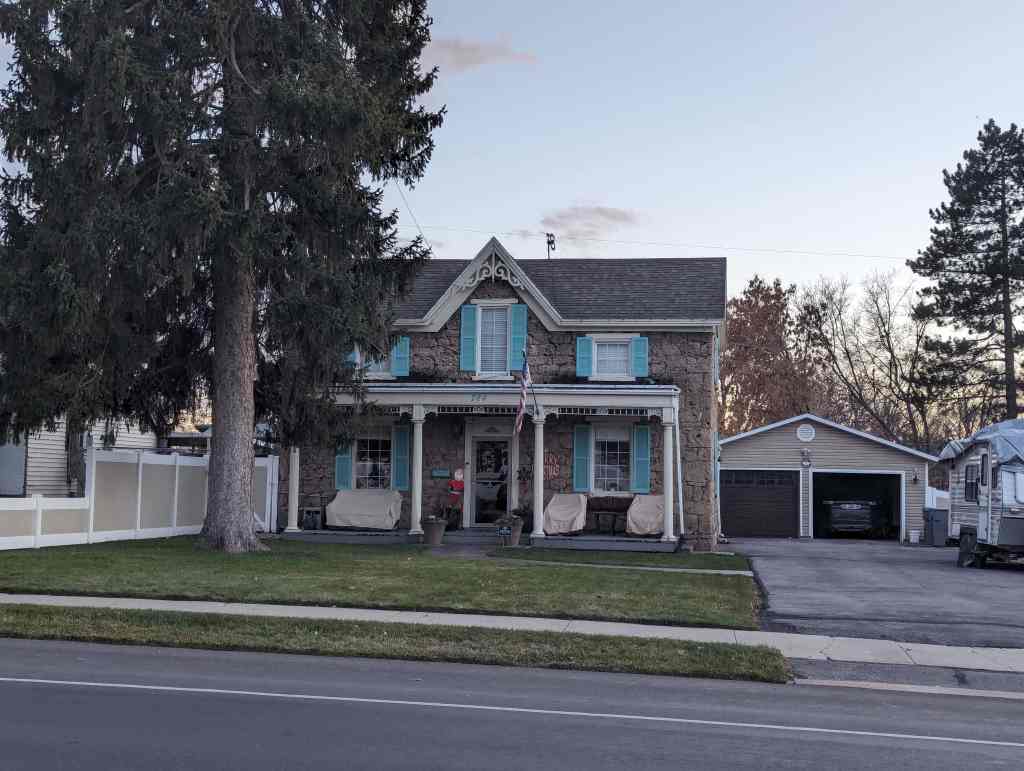
Samuel Green House
Built in 1870 and originally owned by Samuel Green, an immigrant from England.
264 East 200 South in Pleasant Grove, Utah
08 Thursday Feb 2024
Posted in Uncategorized
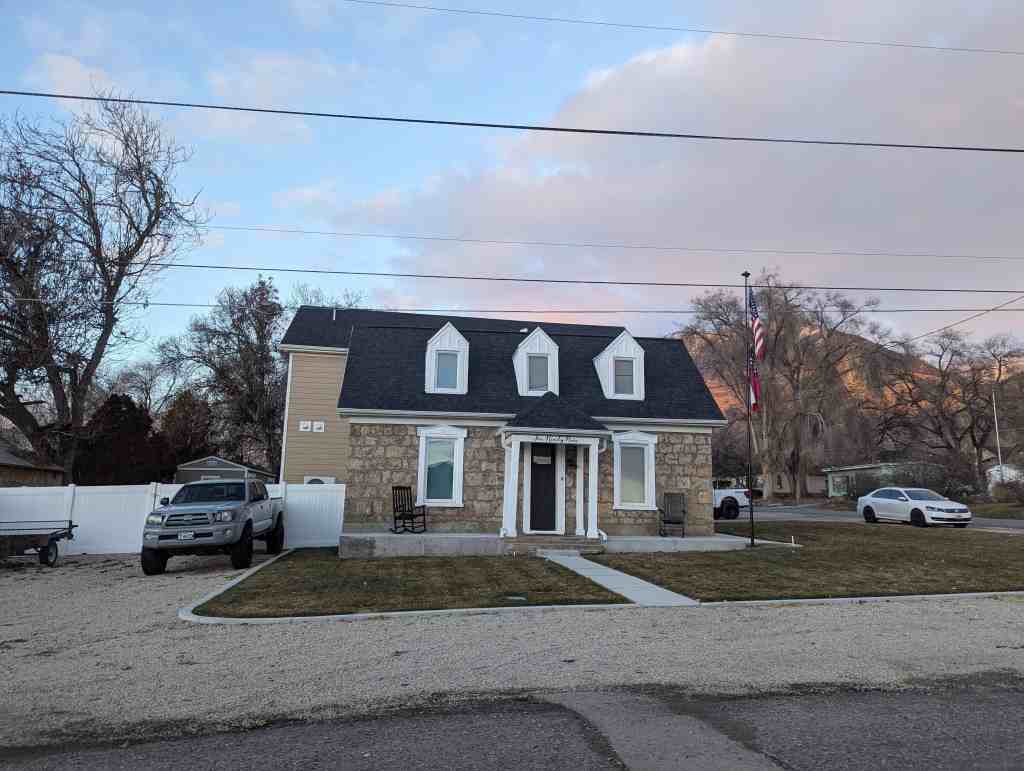
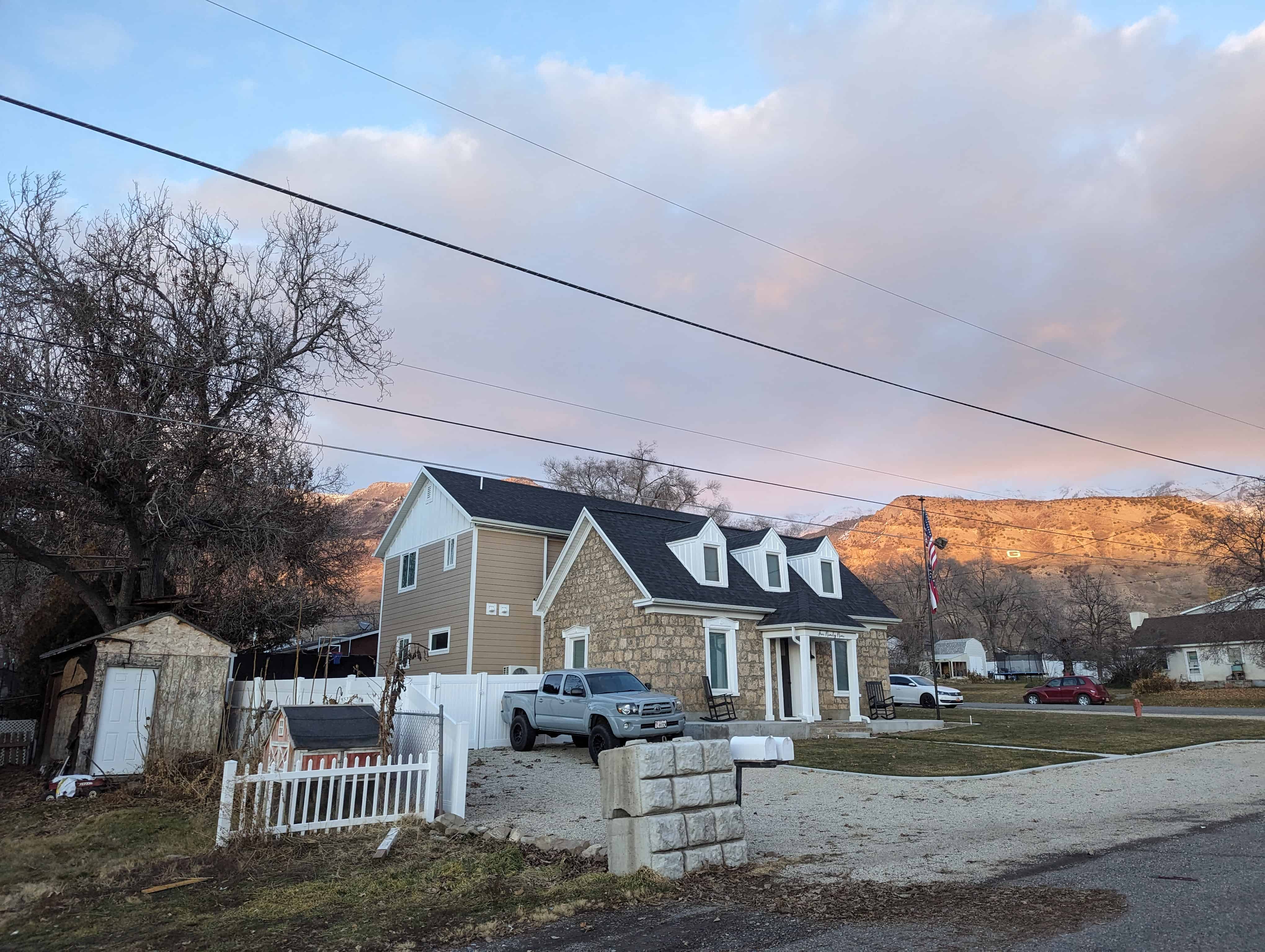
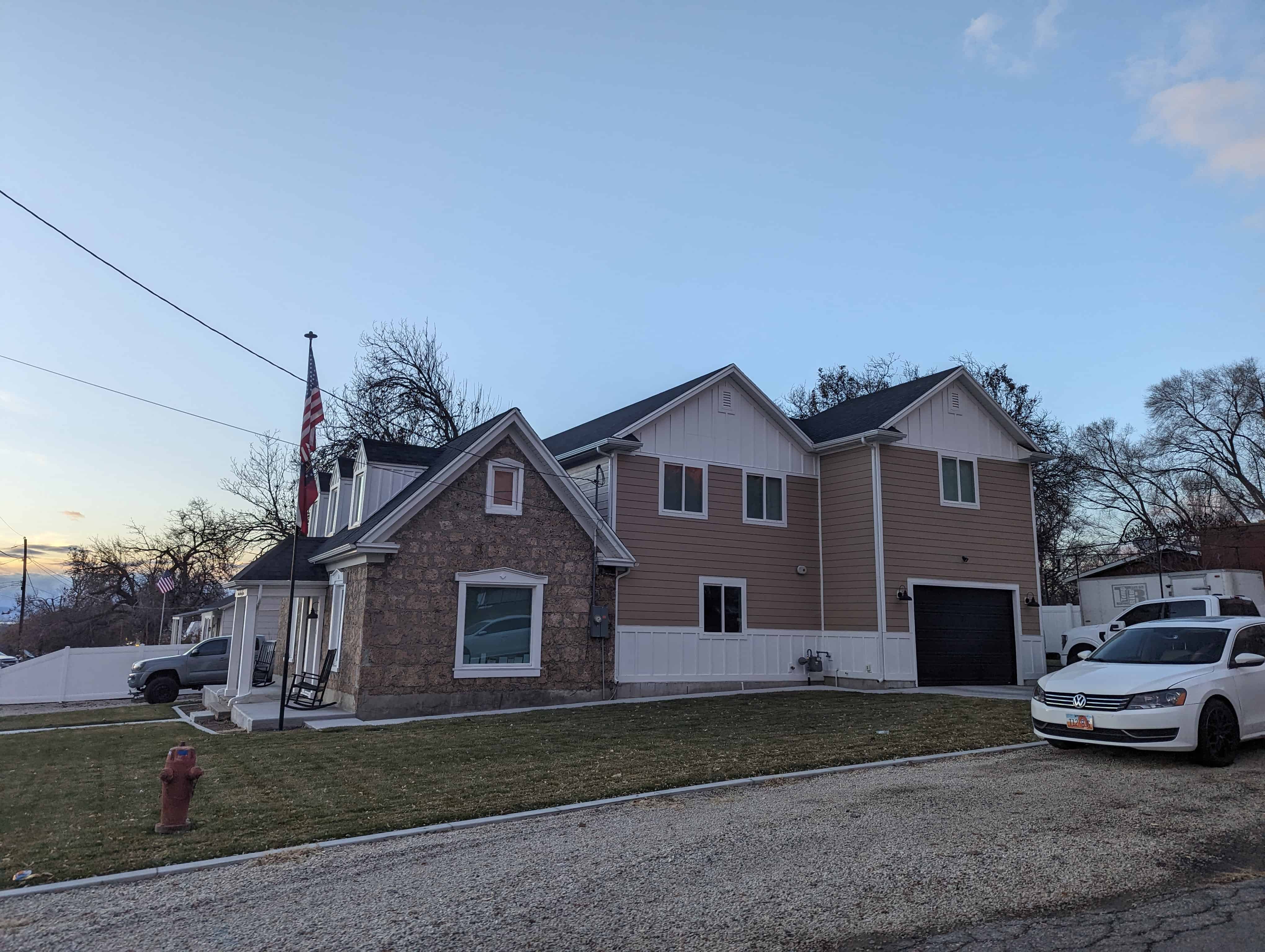
Jacob Hanmer White House
Built in 1874 and originally owned by Jacob White, whose father Samuel Steven White was one of the first settlers of Pleasant Grove.
599 East 100 South in Pleasant Grove, Utah
07 Wednesday Feb 2024
Posted in Uncategorized
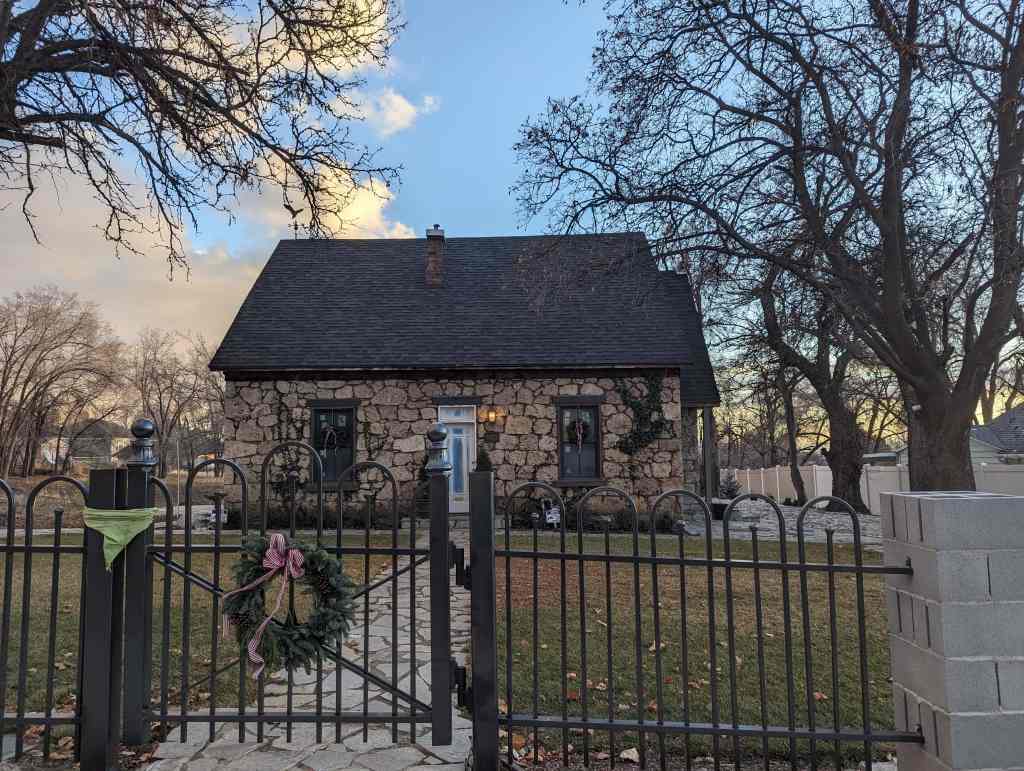
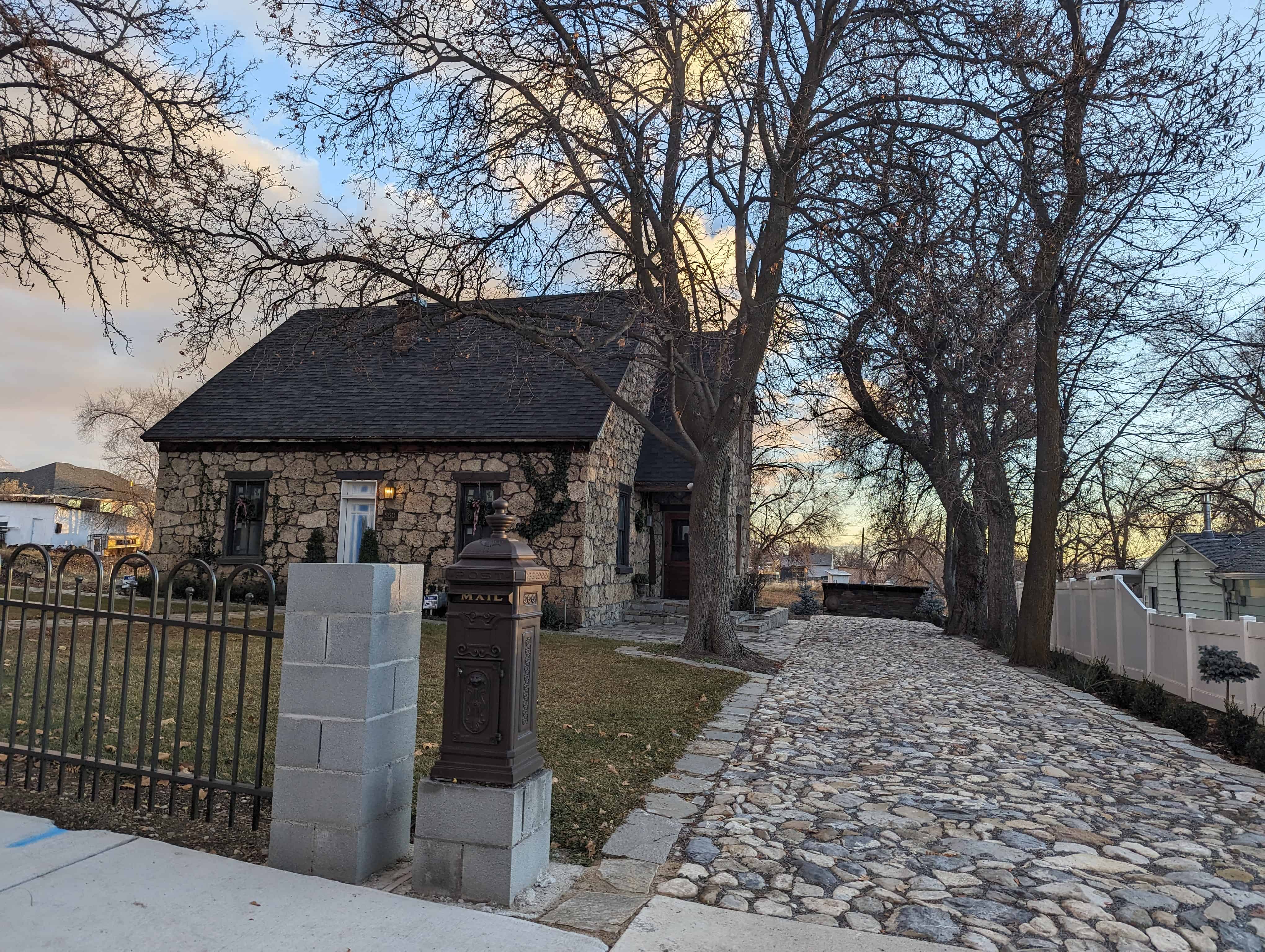
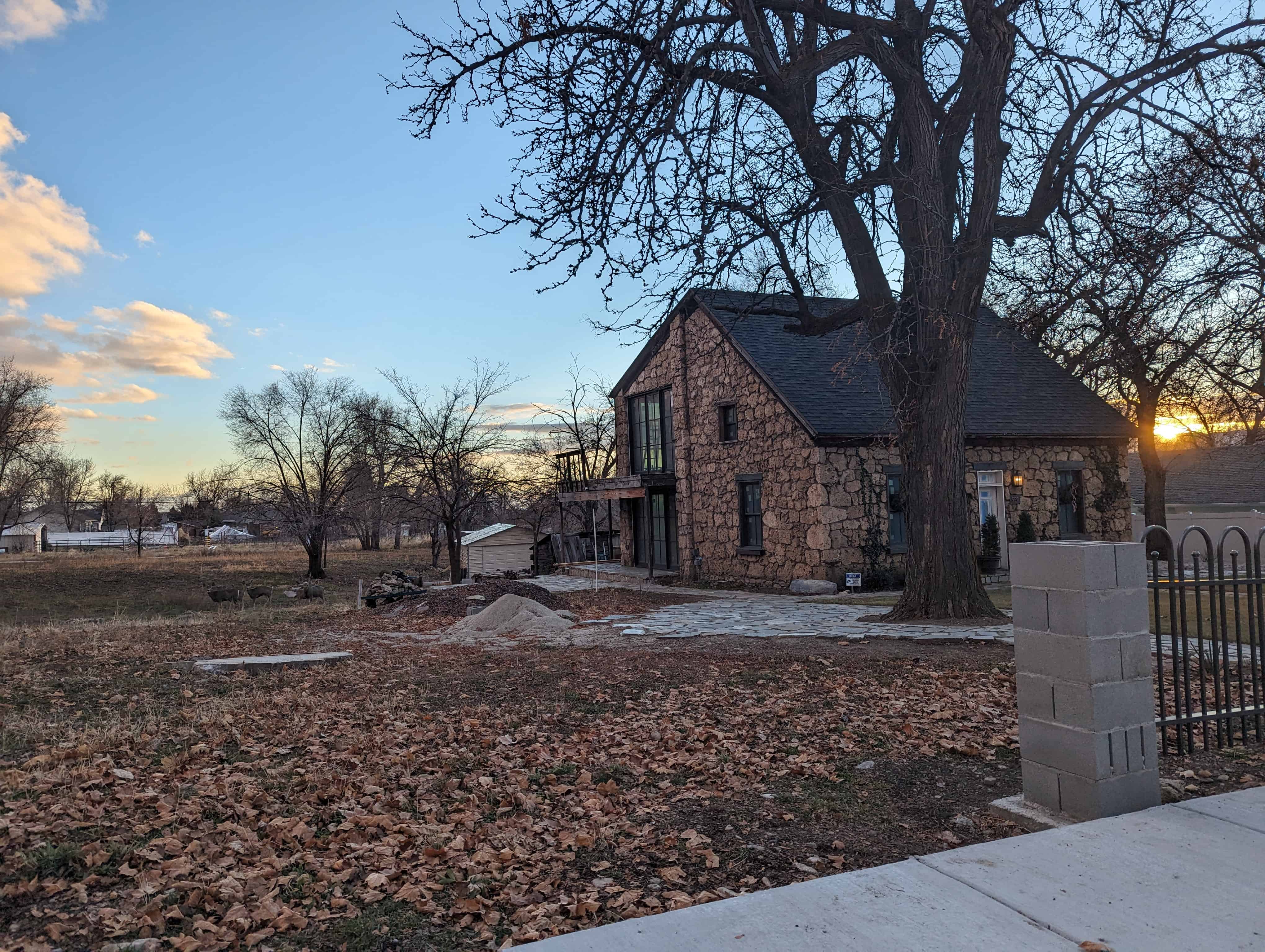
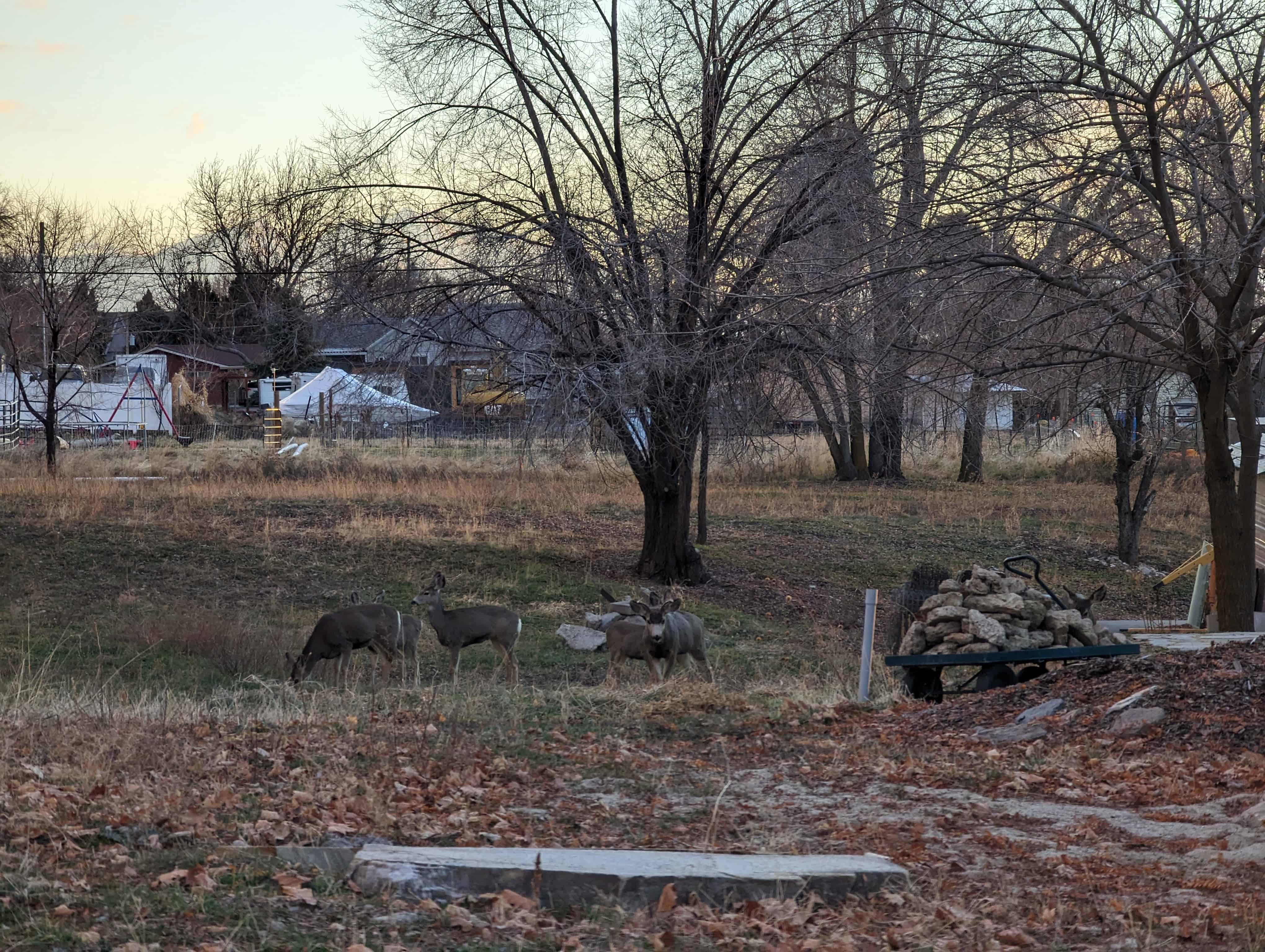
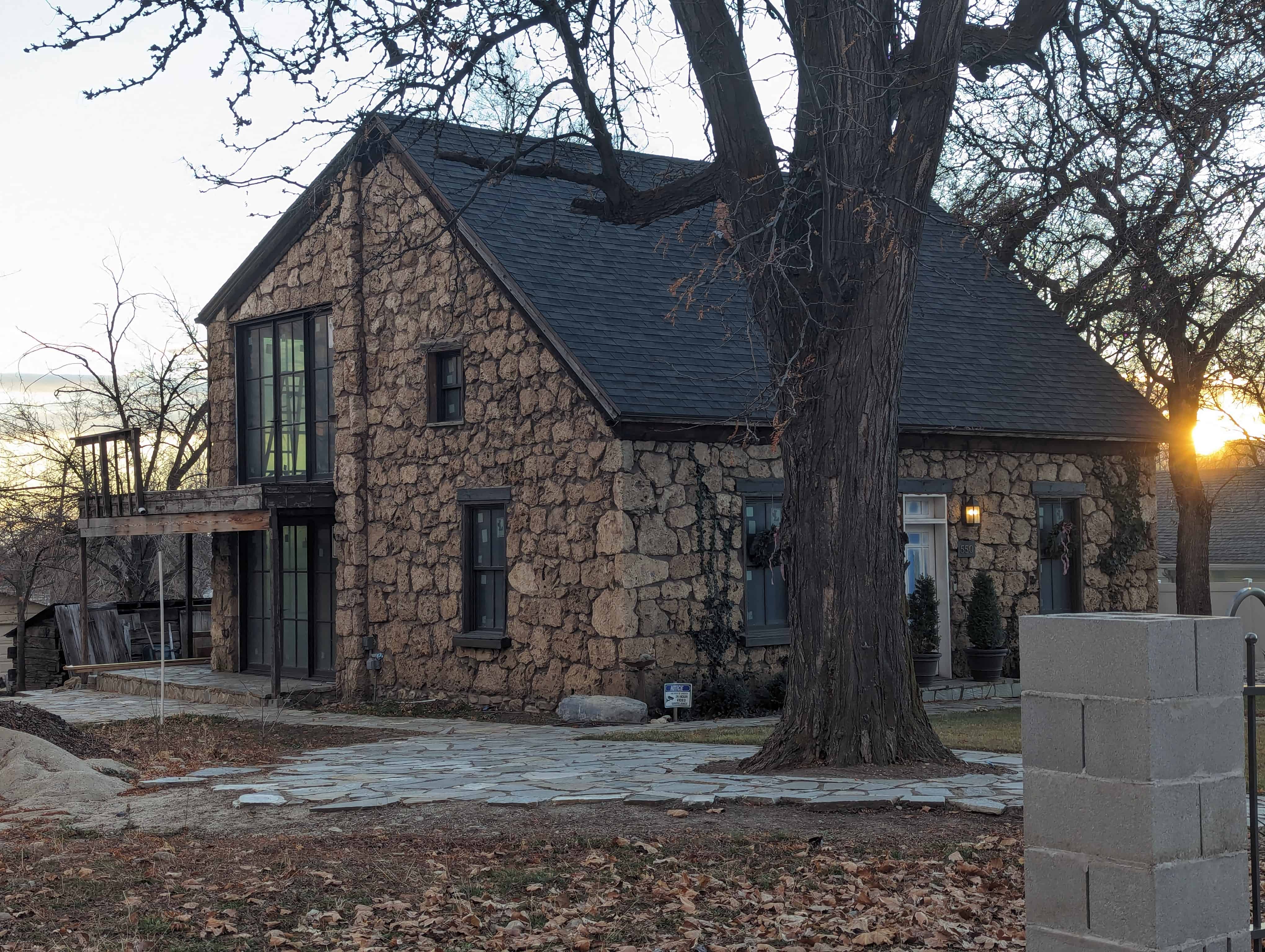
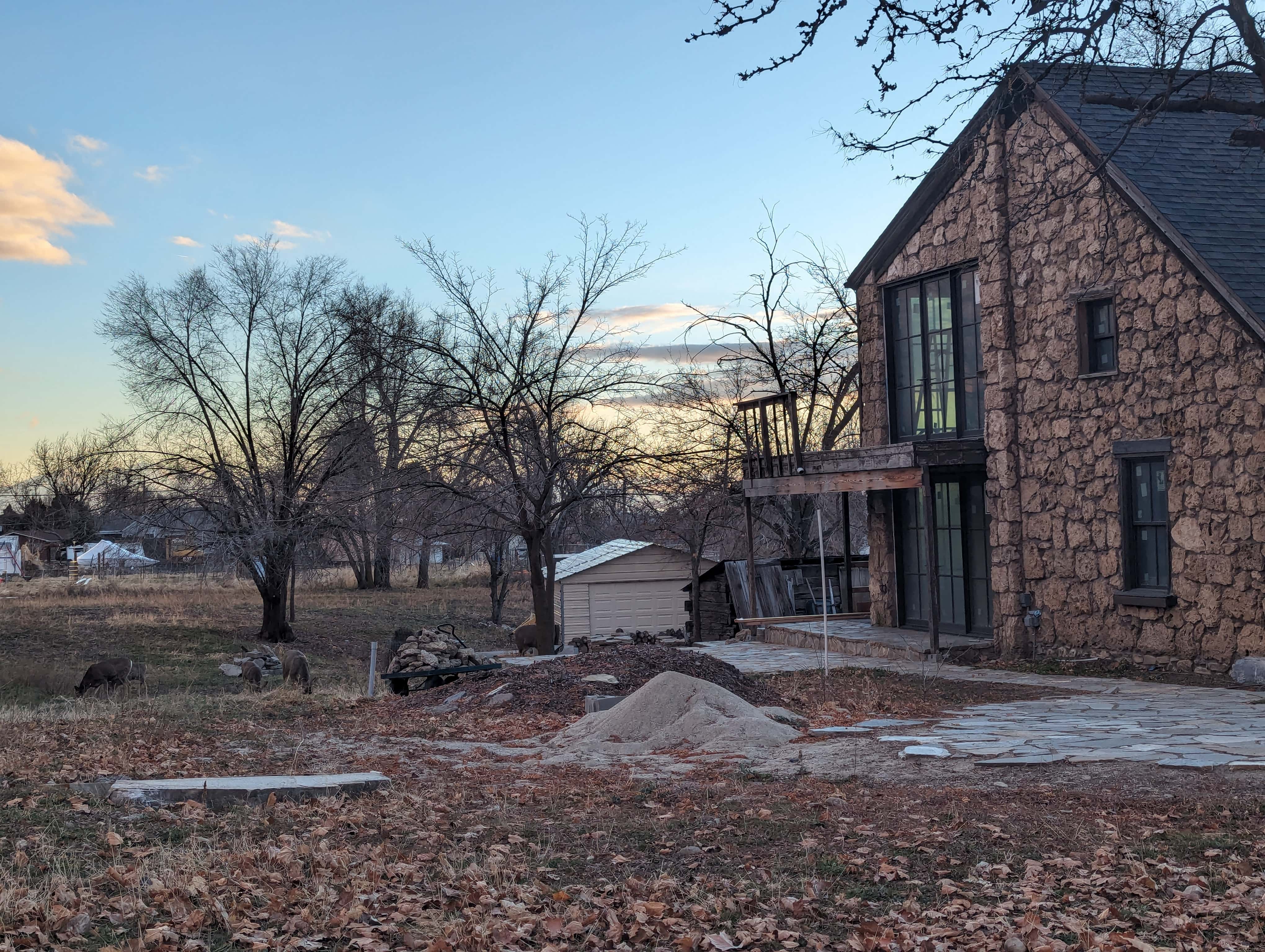
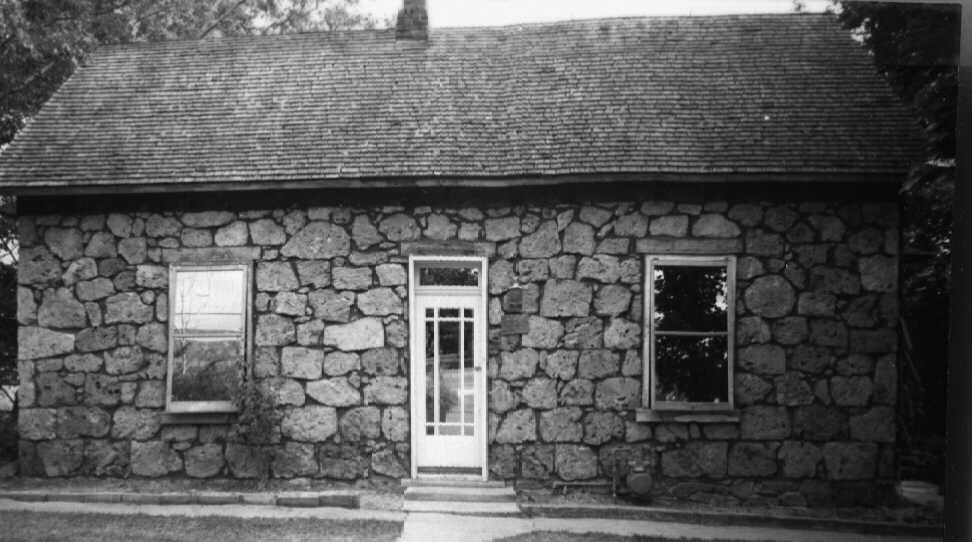
William Friend Young House
Built in 1885 and originally owned by William Young, a stone mason.
550 East 500 North in Pleasant Grove, Utah
06 Tuesday Feb 2024
Posted in Uncategorized
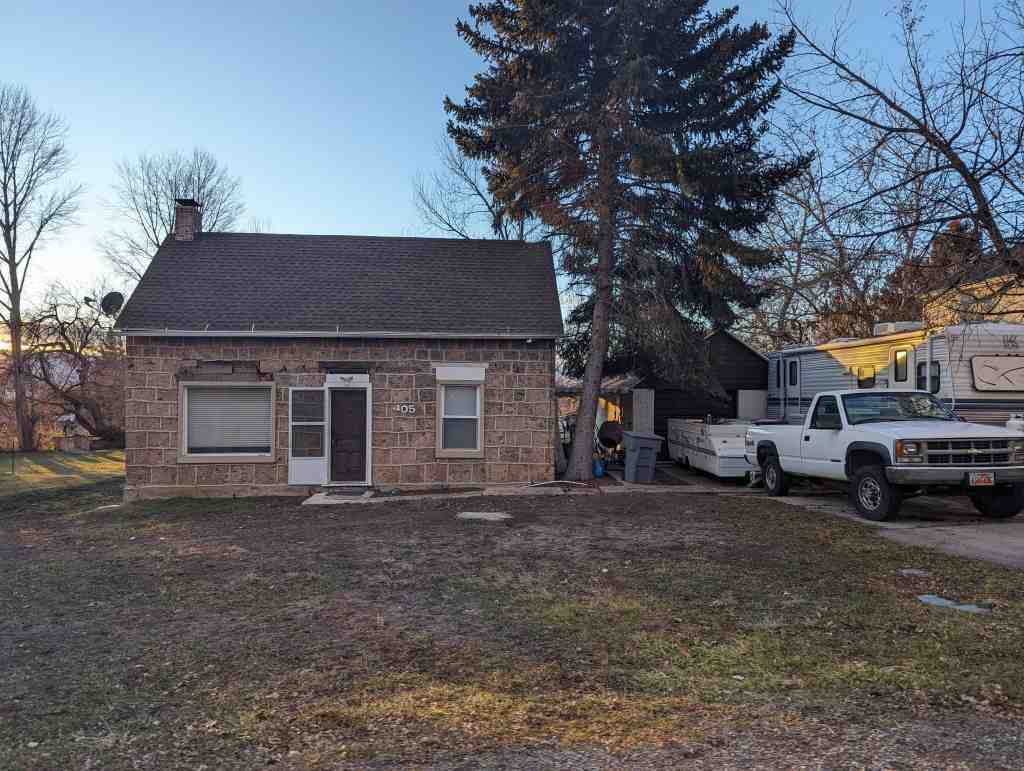
Thomas A. Richins House
Built in 1897, originally owned by Thomas Richins, a local farmer.
491 North 500 East in Pleasant Grove, Utah
06 Saturday Jan 2024
Posted in Uncategorized

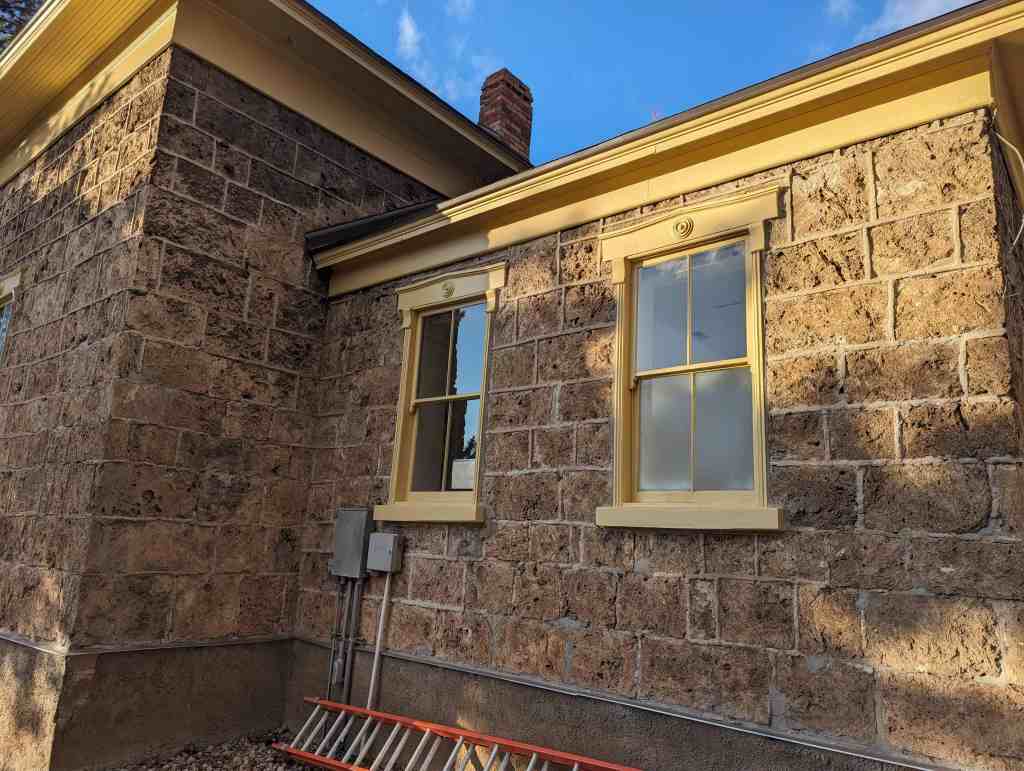
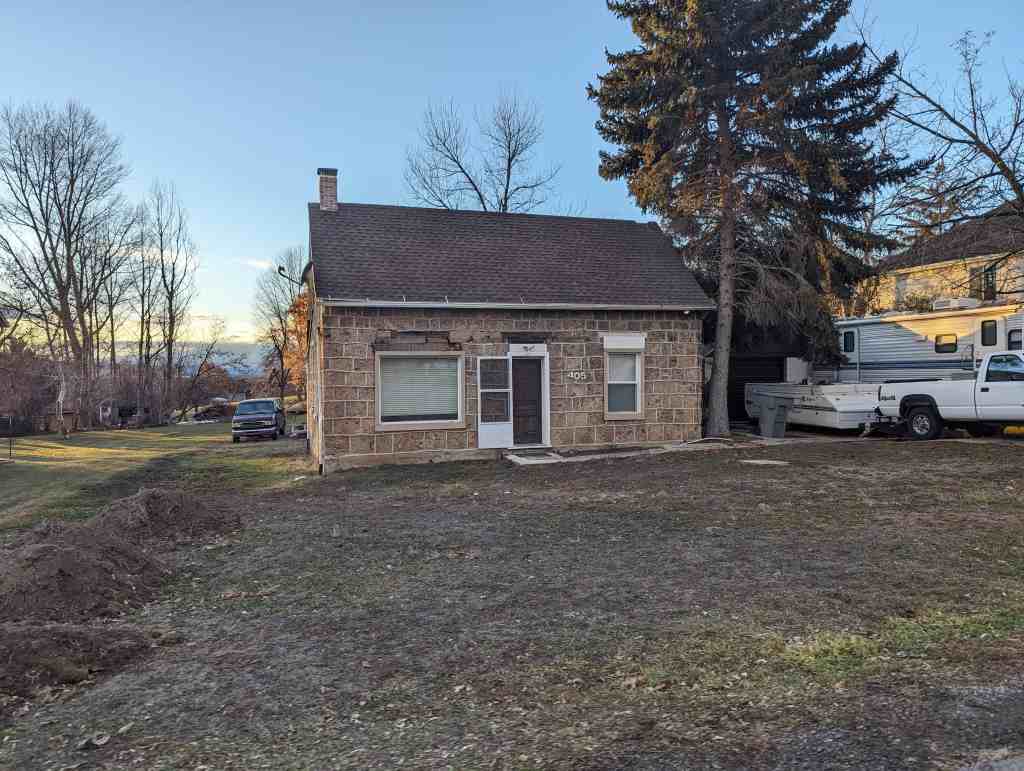
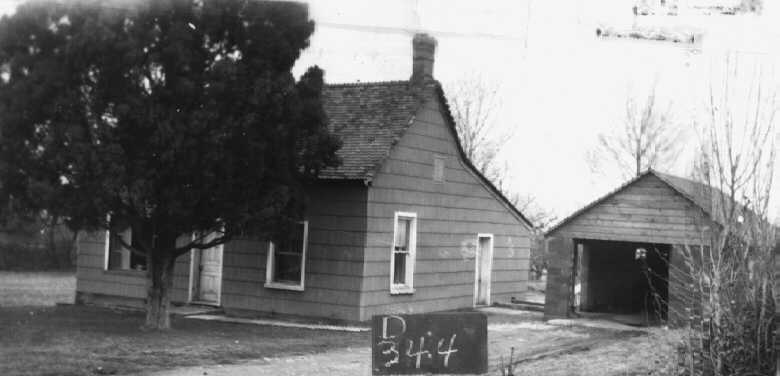
The pioneers who settled Pleasant Grove found a unique type of building rock northeast of the town. The rock was a soft, porous limestone formed when minerals in water accumulate around vegetation. The pioneers called it “Soft-Rock” because when in the ground, they could easily cut it into blocks with a saw or axe. Soft-Rock had excellent insulating qualities to keep structures warm in the winter and cool in the summer. Geologists call the rock “Tufa”. Between 1865 and 1900 over 100 buildings were erected using Soft-Rock including the first Town Hall, next to the monument and the Ashton/Driggs house south of this site. In 2021, only 19 Soft-Rock buildings remain with the original rock walls visible. Many other Soft-Rock buildings are hidden under stucco or siding. The Soft-Rock on top of this monument is a remnant of the K.V. and Gwen Adams House pictured (built in 1880 and demolished in 2012). The visible notch was cut with an axe to support a window. Historical information about the Pleasant Grove Soft-Rock Buildings is available from the Pleasant Grove Historic Preservation Commission.
This historic marker is Sons of Utah Pioneers historic marker #276, located in Rose Garden Park/Pioneer Park at 107 South 100 East in Pleasant Grove, Utah
Related:


04 Thursday Jan 2024
Posted in Uncategorized
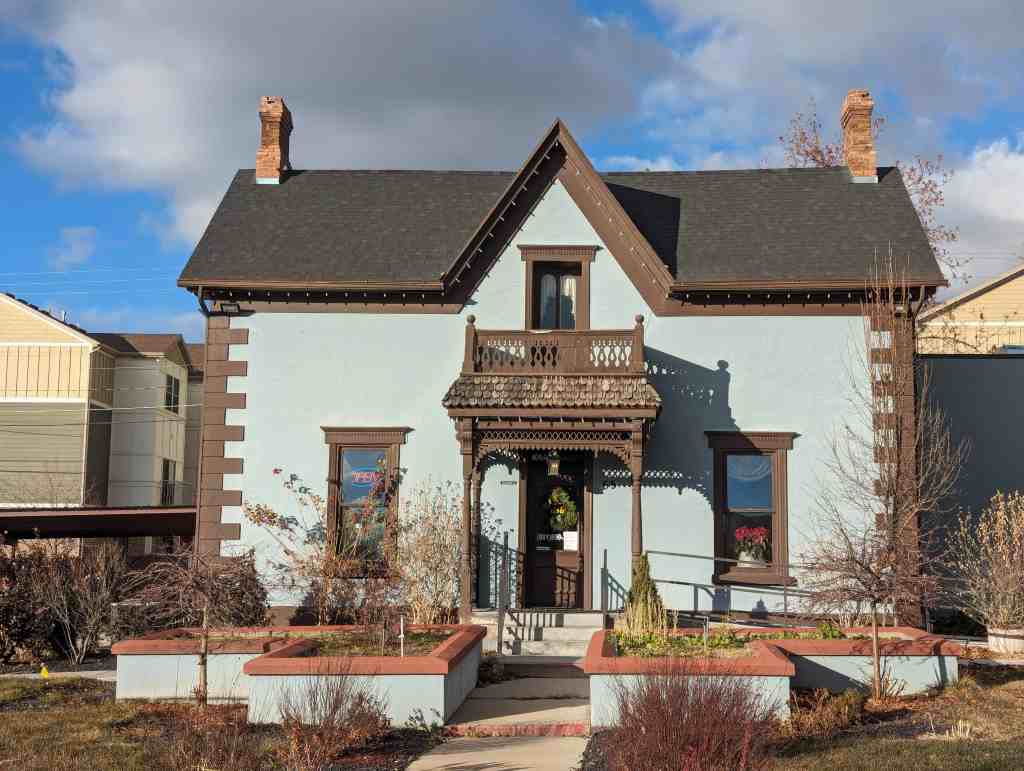
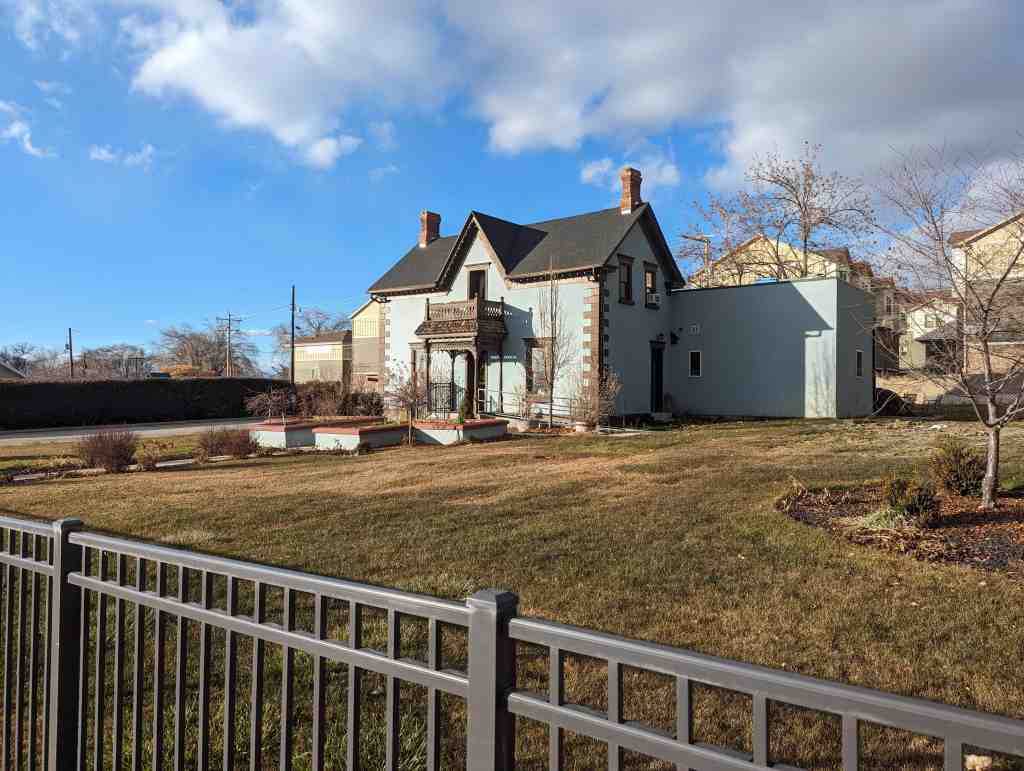
Cyrus Benjamin Hawley House
Built in 1869 of soft-rock this one and one-half story house with a steeply pitched cross-gable roof illustrates the subtle use of Gothic Revival styling for a vernacular house type. The Hawley house is representative of several houses built near that year. With these houses an attempt began to stylize vernacular house types in Pleasant Grove. Before this year, gable-roofed houses were lower-pitched and undecorative. Near the 1890s, a frame lean-to attached to the rear of the house was replaced by the existing two-story section. At that time Victorian porches were added to the back and front, a second story walk-out porch placed above the front porch, the soft-rock stuccoed and splotched with black paint to resemble granite, and corner quoins scored. The house was extensively renovated and restored in 1984; new decorative wood replaced the old, using the elaborately saw-cut ornamental originals as patterns. All original outbuildings were removed from the property at that time.*
55 East Center Street in Pleasant Grove, Utah


31 Sunday Dec 2023
Posted in Uncategorized
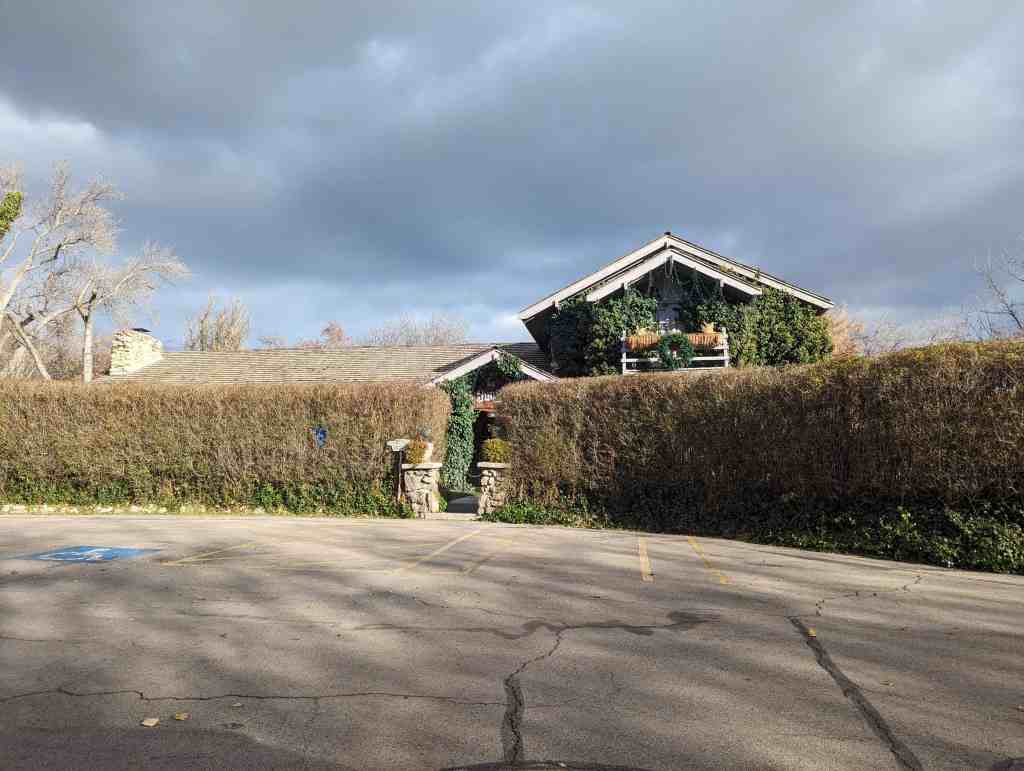
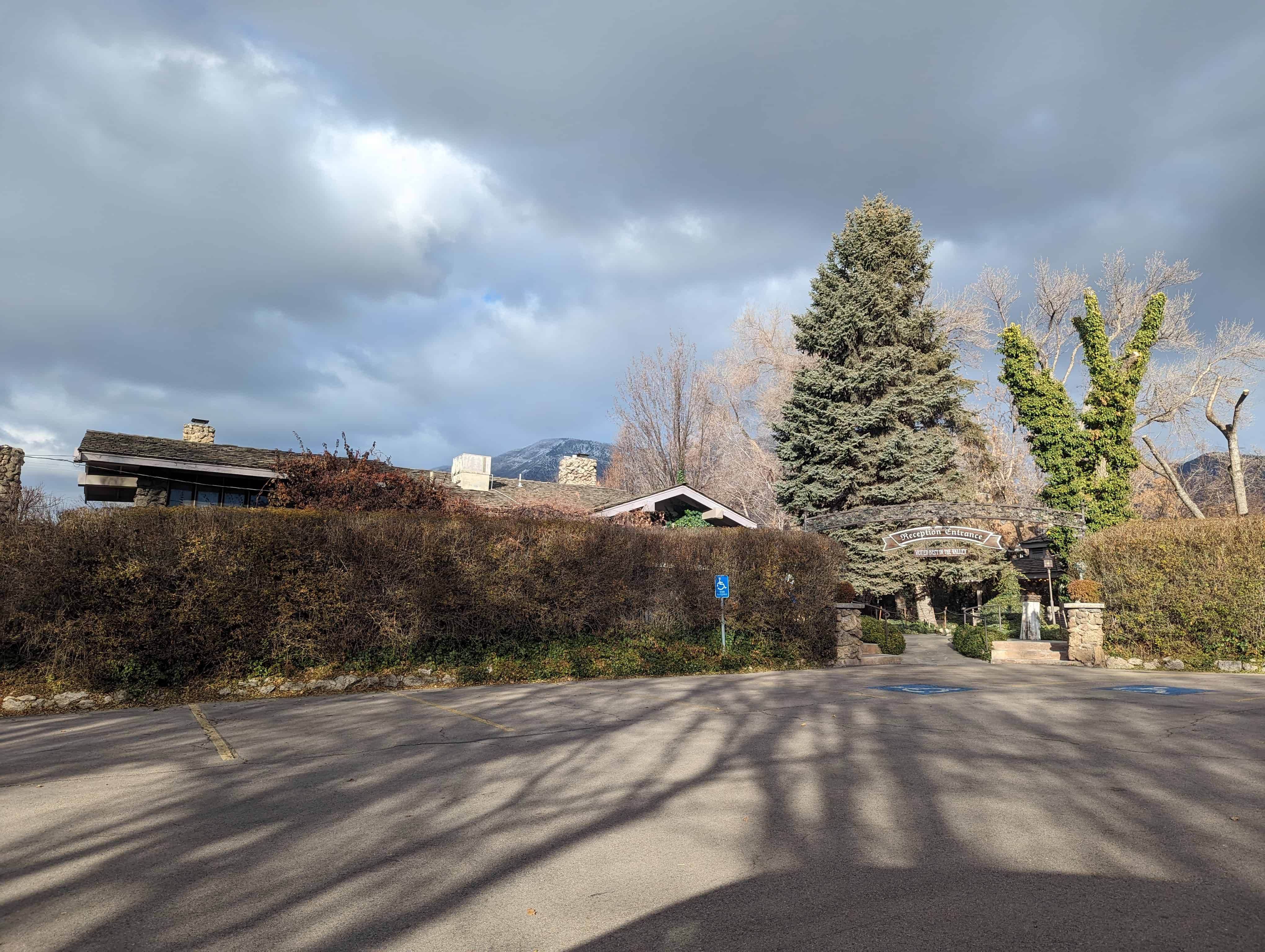
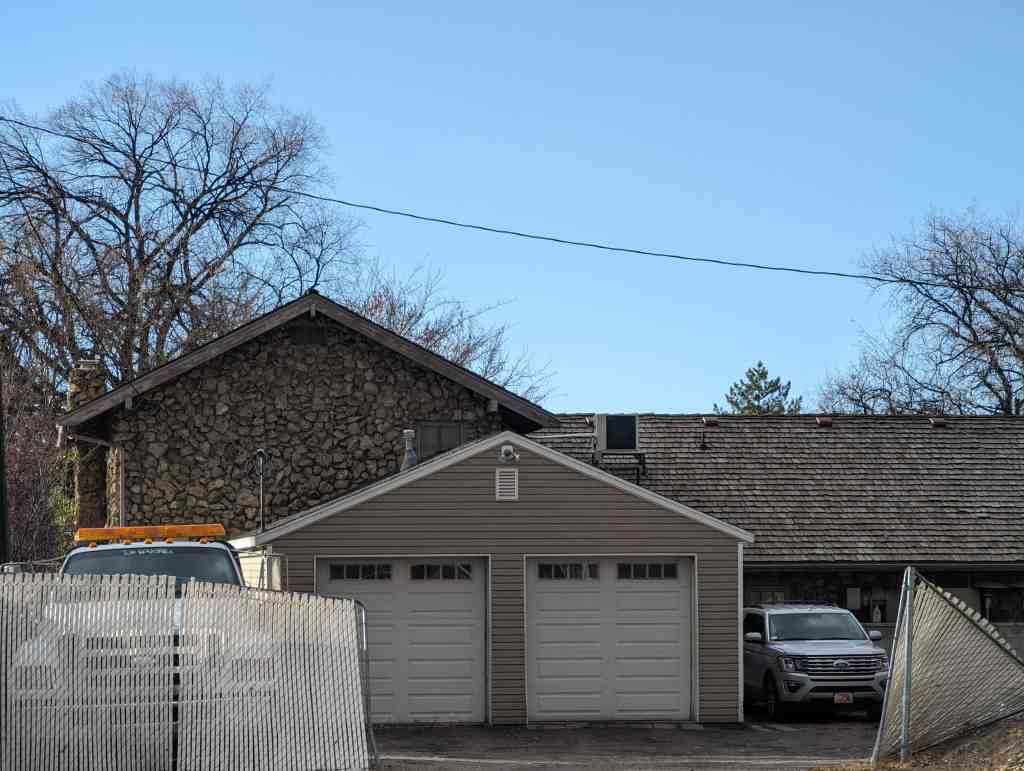
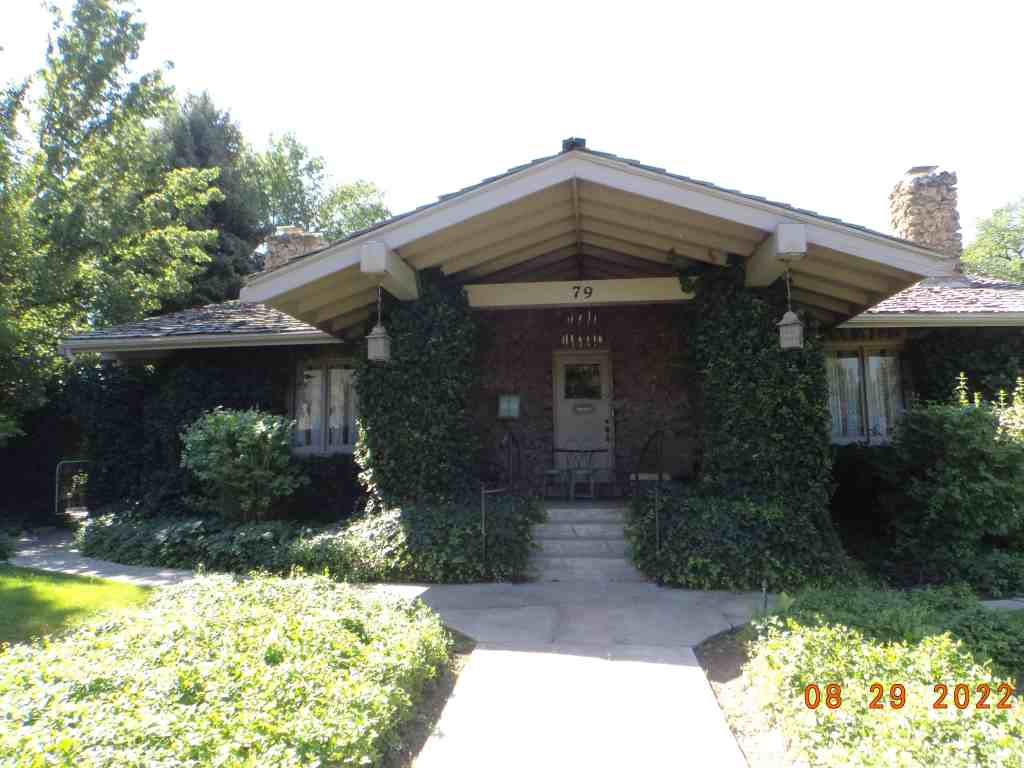
Harvey M. Vance/Burleigh C. Linebaugh House
Built in 1917 for a combined house and medical practice. It remains one of the best examples of the California Bungalow style south of Salt Lake City. It is built of native soft-rock, giving it the cobbled texture often used in the California Bungalow. Although widely used for forty years in Pleasant Grove, the stone had been a discontinued building material for some twenty years, since brick began to be produced locally. Other stylistic features are the exposed purlins and rafters under the broad low-pitched gable roof, and bands of casement windows. Built on a corner lot, the lower west elevation accesses a walk-in full basement.*
235 South 100 West in Pleasant Grove, Utah (also 79 West 200 South, but the parcel it is on is 235 S 100 W)

25 Friday Jun 2021
Posted in Uncategorized
Tags
City Hall Buildings, New Deal Funded, Pleasant Grove, PWA Projects, Soft-rock constructed, utah, utah county

This historic building was built as Pleasant Grove City Hall as one of the many New Deal Funded projects in Utah between 1938 and 1940. It had the jail downstairs and is now a sign company.
Located at 37 South Main Street in Pleasant Grove on historic Main Street.
Related:
Built in 1938-40, this two-story city government building was financed with money obtained through the Federal Works Project Administration. This WPA Moderne style was often built during the 1930s financed by the Federal Government. Native Soft-rock was salvaged from Clark Hall, the building it replaced, sawed into blocks, and reused in the city hall. Other stone was taken from the hills northeast of town. The Soft-rock building is stuccoed. This building shows the modern streamline design of that period, and is void of ornamentation.*


25 Monday May 2020
Posted in Uncategorized
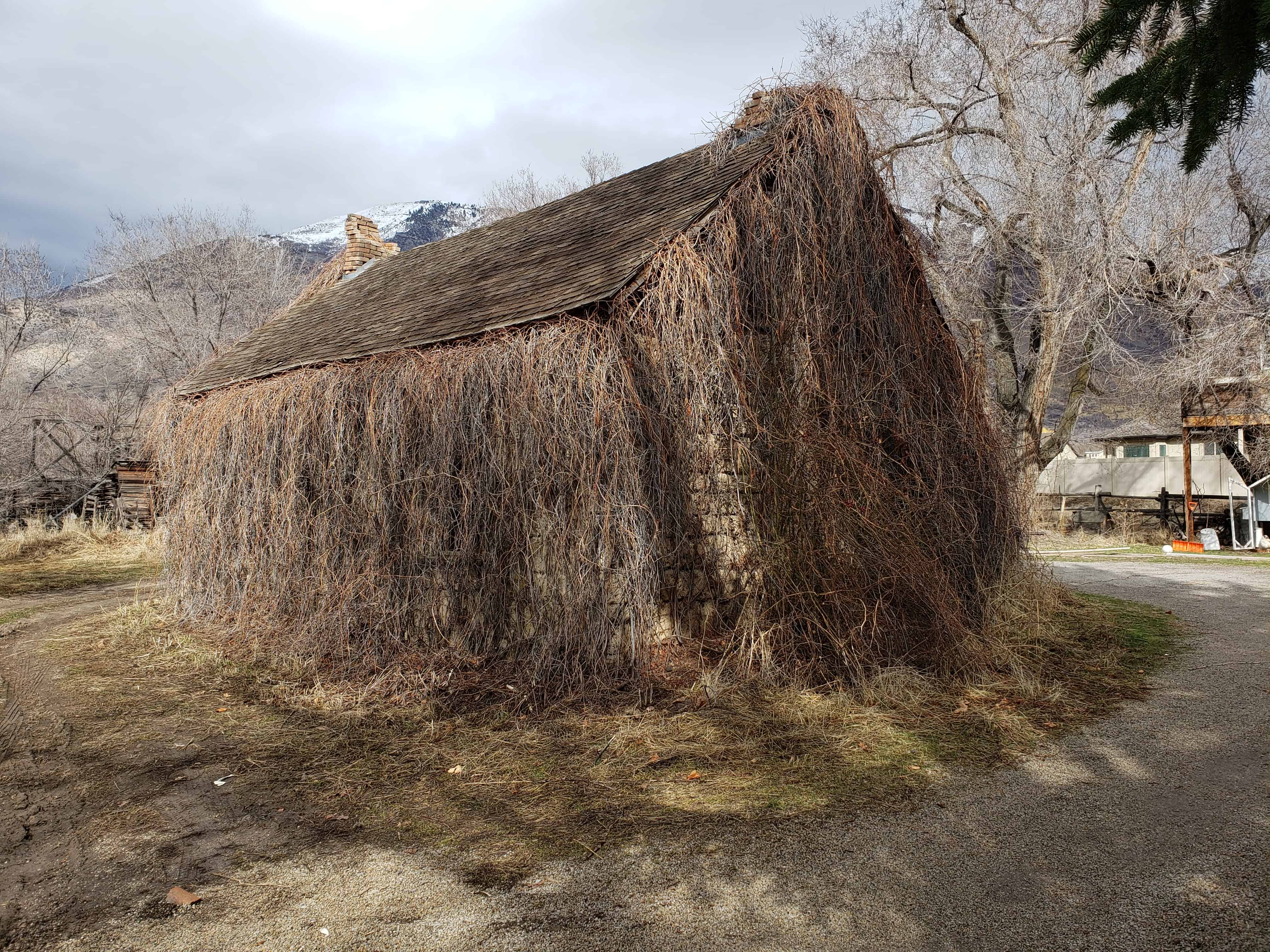
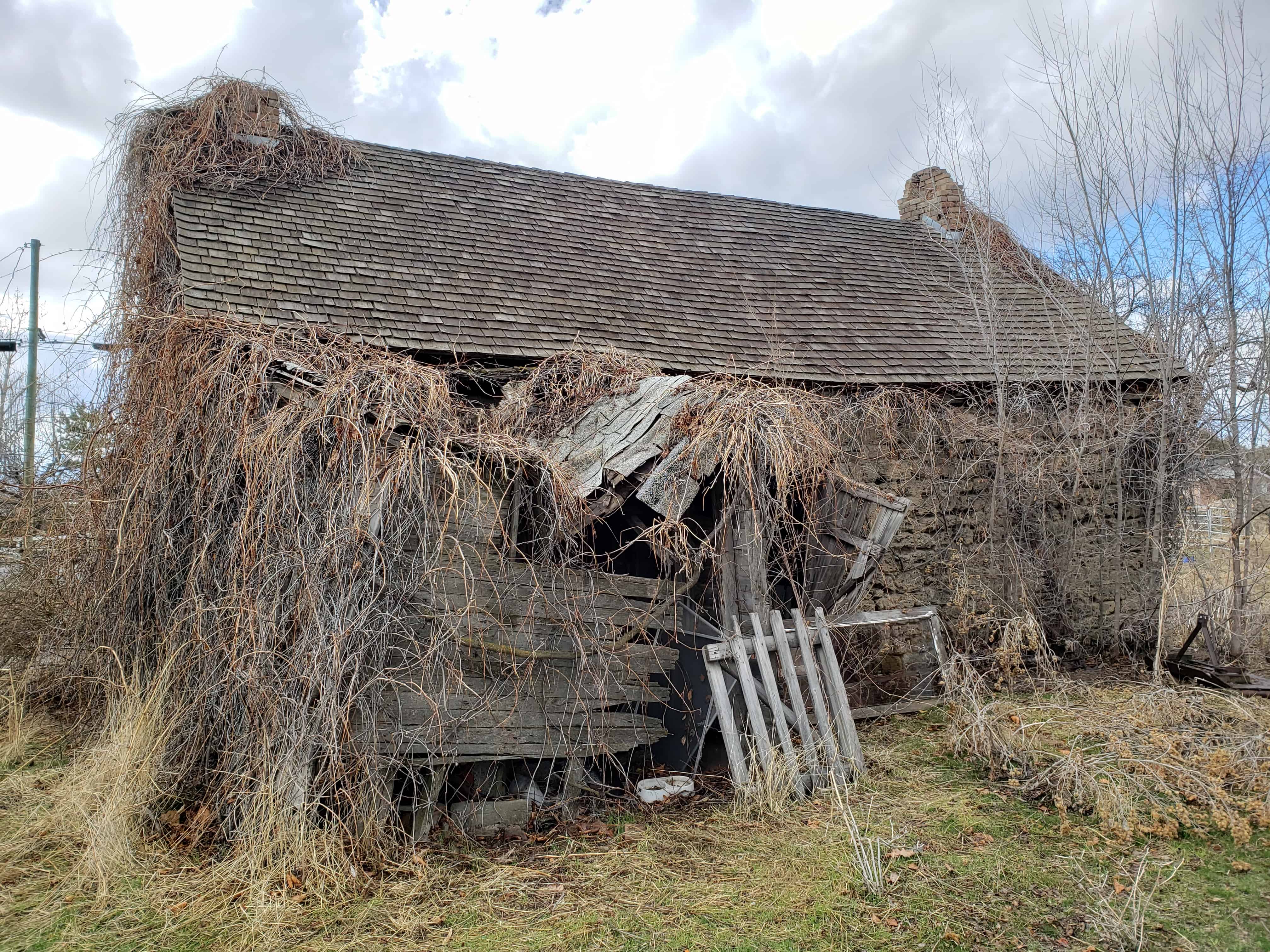
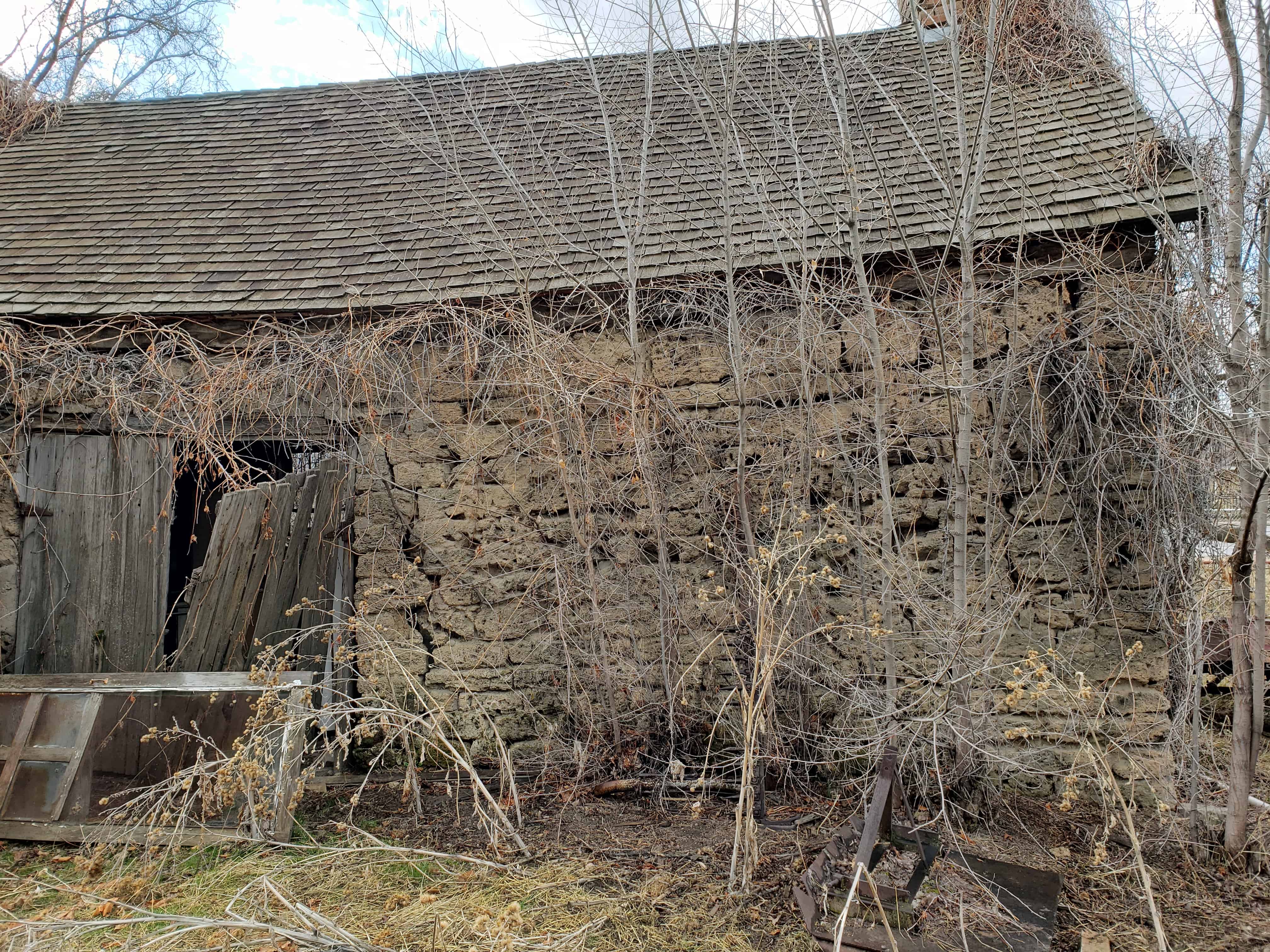
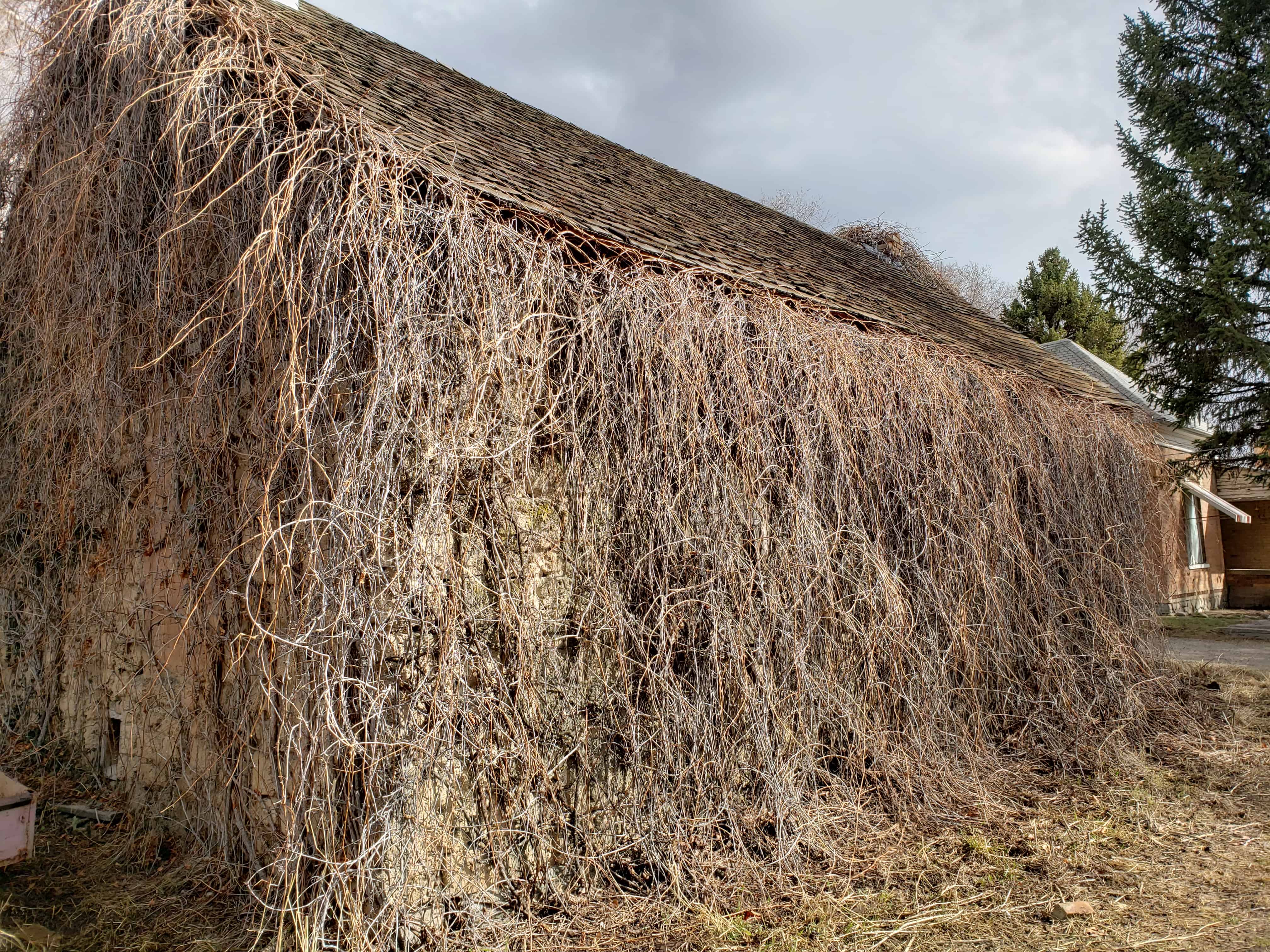
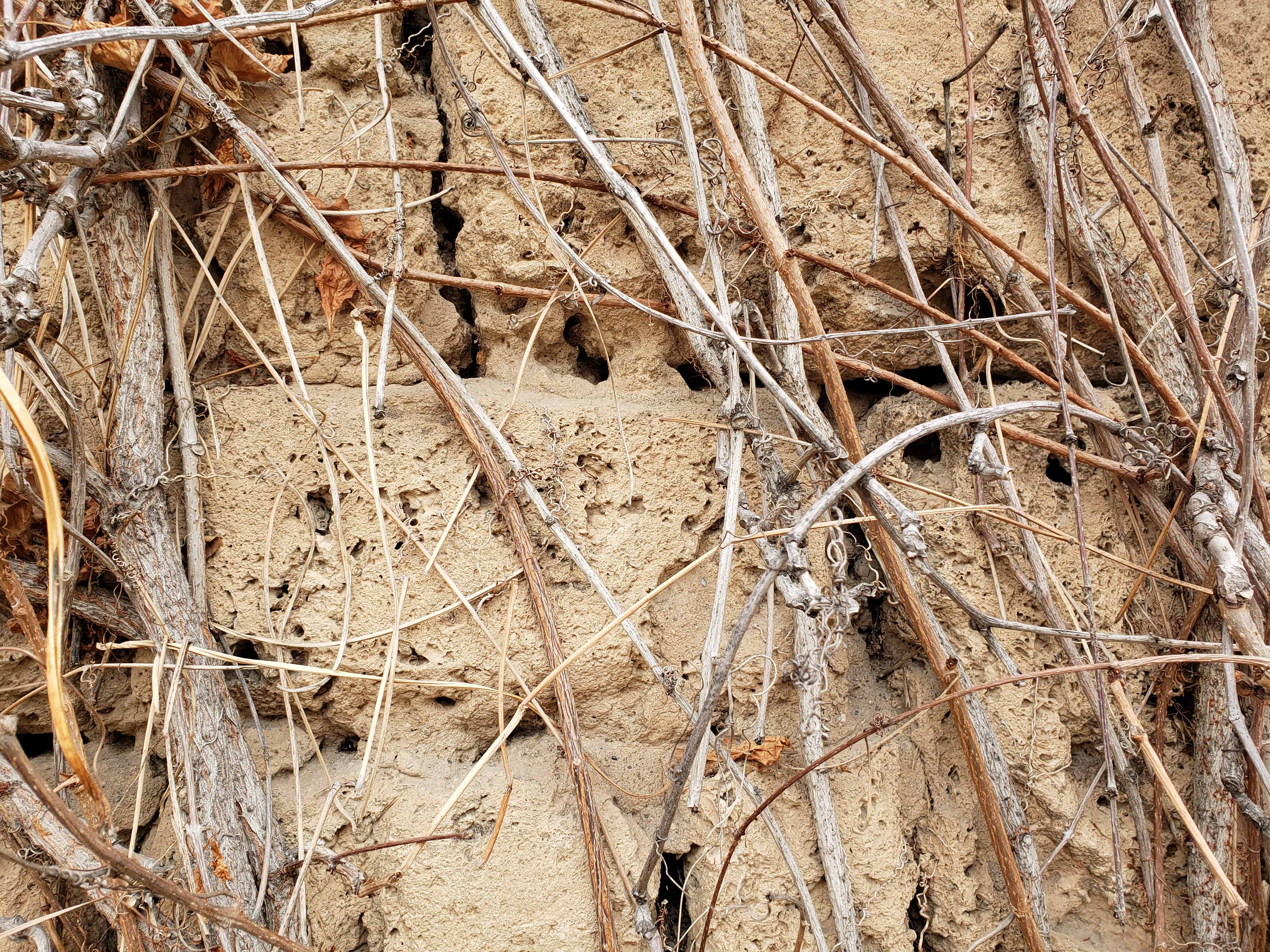
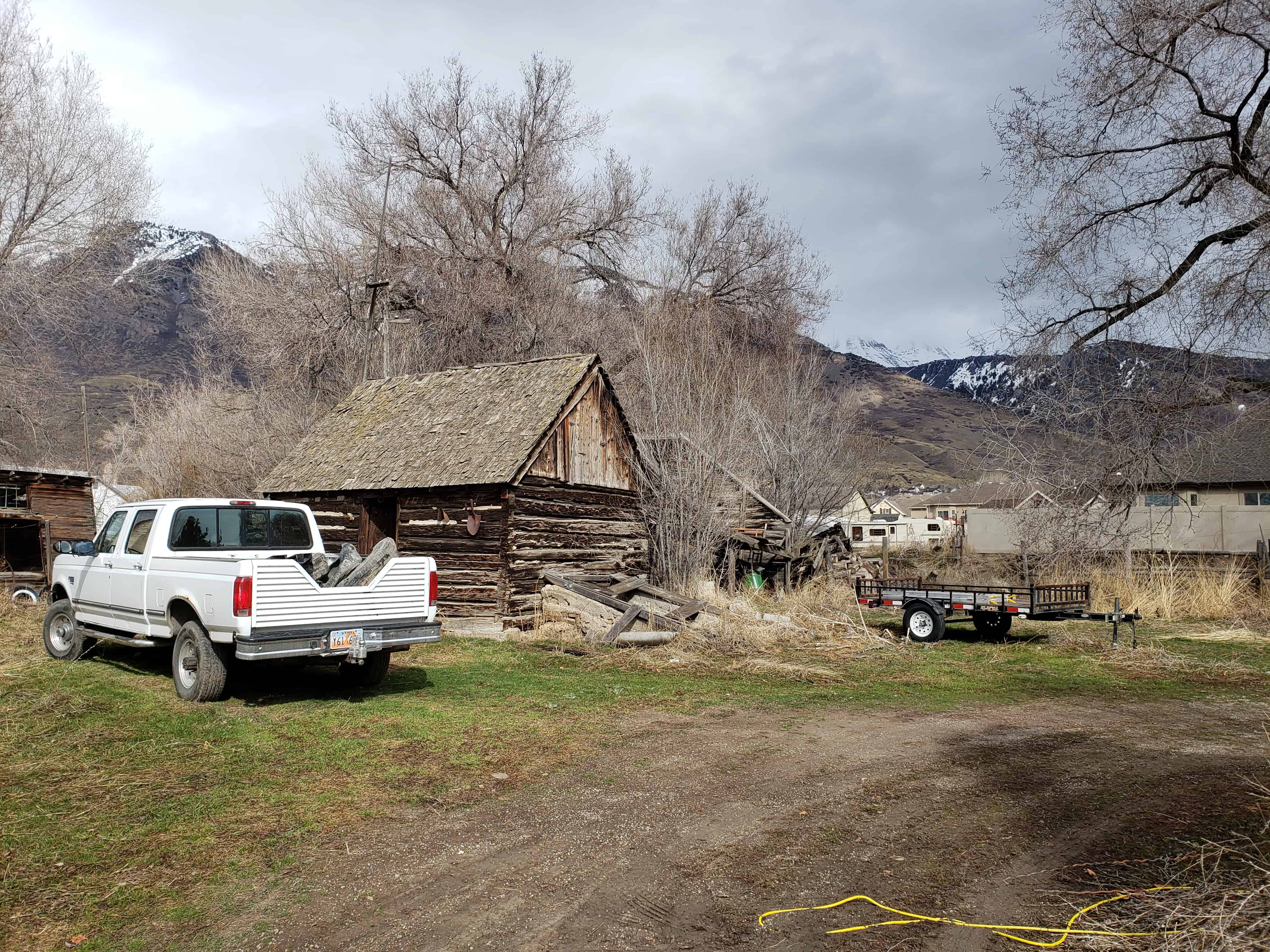
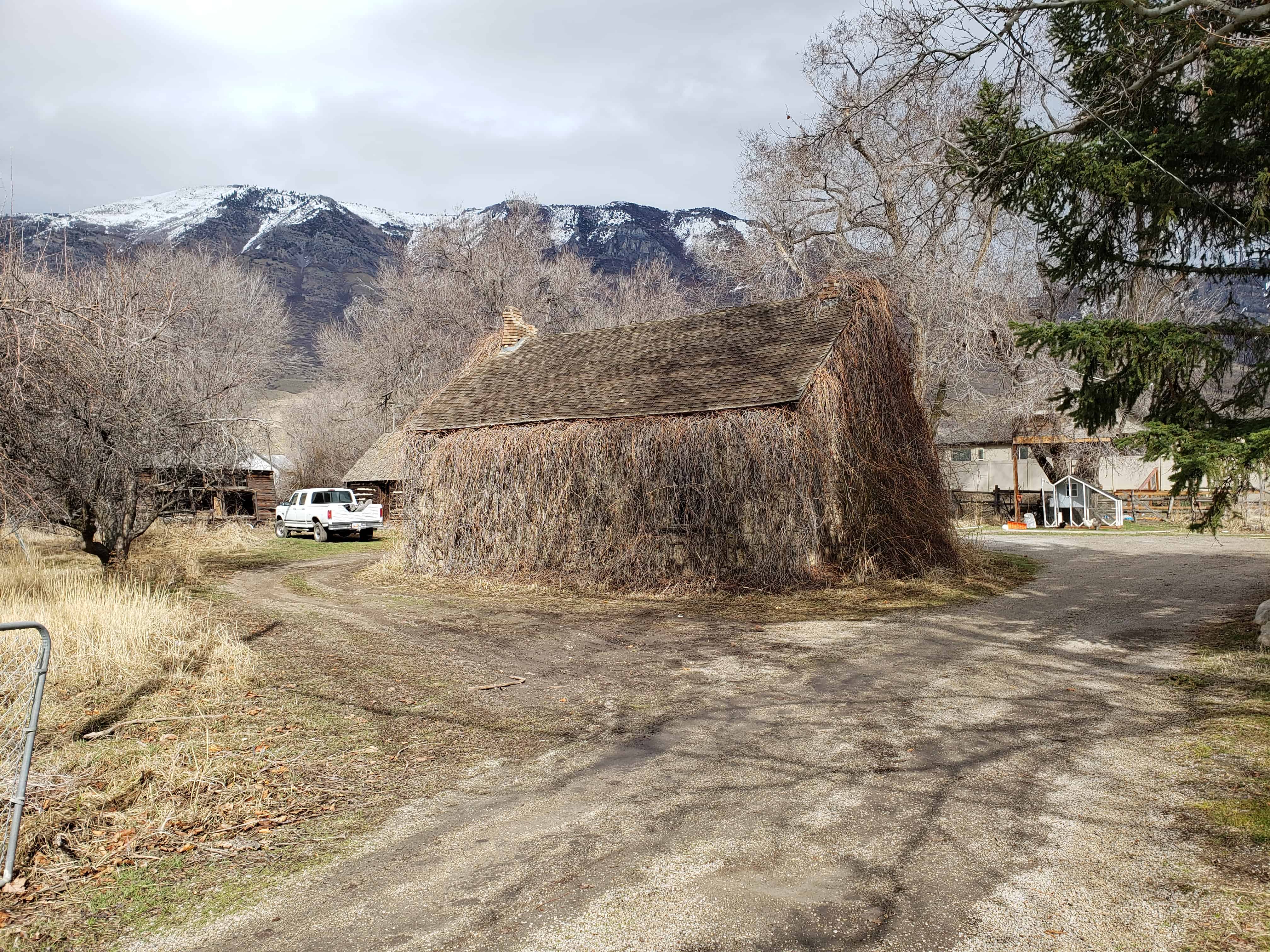
Built c. 1870, the Neils Peter Larsen House is one of the 13 buildings included in the Pleasant Grove Soft-rock Buildings Thematic Resource nomination. Soft-rock buildings are significant because they help document the distinctive regional diversity found in nineteenth-century building stones in Utah. They also represent a distinct phase of the building construction industry in the Pleasant Grove area. Mormon community building in the Great Basin West rested upon the dual principles of order and permanence, and the grid-iron town plan and the use of stone as an early building material have become important symbols of Mormon settlement values. A great variety of local stones were used throughout the state, and the soft and easily worked tufa stone, popular in Pleasant Grove between about 1865 to 1900, remains one of the most distinctive. About 130 soft-rock buildings were known to have once stood in Pleasant Grove, yet there are only 13 well preserved examples today. Most of the earlier buildings in the community, constructed during the 1850s and ’60s, were made of adobe, which was easily made and worked. As fired brick became more available and fashionable during the late nineteenth and early twentieth centuries, it replaced soft-rock as the dominant local building material. The remaining soft-rock buildings are important examples of a local architectural tradition and contribute to an understanding of the regional diversity of Utah’s early architectural history.
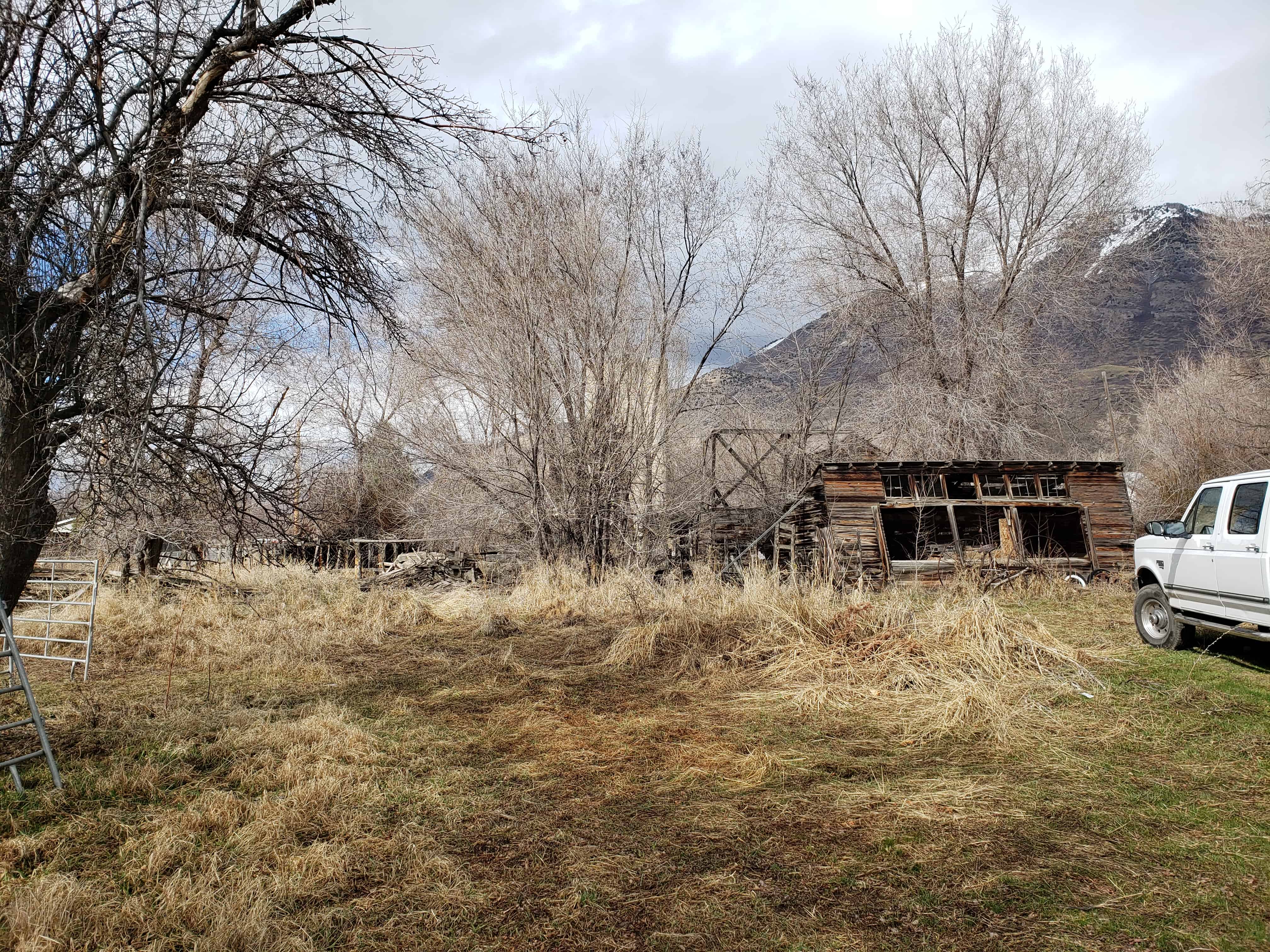
In May 1862, Neils Peter Larsen homesteaded a quarter section in what was known as the north fields of Pleasant Grove. The first home on this ground was a dugout, a submerged room dug into the earth and covered with a roof of mud and willows. This provided living quarters for one of his polygamous families until this soft-rock home was built c. 1870 on the corner of the farm at 1150 North 100 East. One wife and family occupied this home while the other two wives and one family continued to reside in the Larsen home one mile south at 181 E. Center Street in Pleasant Grove. During the 1880’s the nations attention was focused on polygamous Mormons. The U.S. Government sent federal officers to the Utah Territory to arrest and prosecute the Mormons practicing polygamy. Neils Peter Larsen, having three wives, was one of the sought-after men. In order to escape arrest, he hid in the attic of the small soft-rock house while the marshals were in the vicinity, which was quite often.
A desire for a financially independent territory brought another use for the small attic of this home. To help make Utah independent of outside industry, a domestic silk industry was begun. The Larsens were one of the families that became involved. They converted the attic of the house into a home for more than a thousand silk worm houses in cases and cared for by family members. A grove of mulberry trees was planted to feed the silk worms. Being on the outlying northern area of Pleasant Grove, the house served as a neighborhood school for the Larsen children and the children of several other families Niels oldest daughter Annie was the school teacher. Besides unusual uses, the house did serve the family of Karen Kirsten Swendsen, the second wife, as a residence. She and Neils Peter Larsen raised their five children in this home until 1897. At that time Neils moved back to his town residence in Pleasant Grove. The north field property, including house and farm, was sold in 1897 to the oldest child, Joseph, and his new bride, Osstella Baker. Joseph built a large brick home just south of the soft-rock house that same year. The soft-rock house has not been used as a residence since that time, and now serves as storage. The current owner is Joseph Wendell Larsen, a son of Joseph and Osstella. He and his wife, Gwen, purchased this property from his parents in 1956 and still reside in the brick home built by his parents.(*)
The home is located at 1146 North 100 East in Pleasant Grove, Utah
Related Posts:











19 Friday Oct 2018
Posted in Uncategorized
Tags
City Hall Buildings, Historic Buildings, Historic Churches, Librairies, NRHP, Pleasant Grove, Soft-rock constructed, utah, utah county

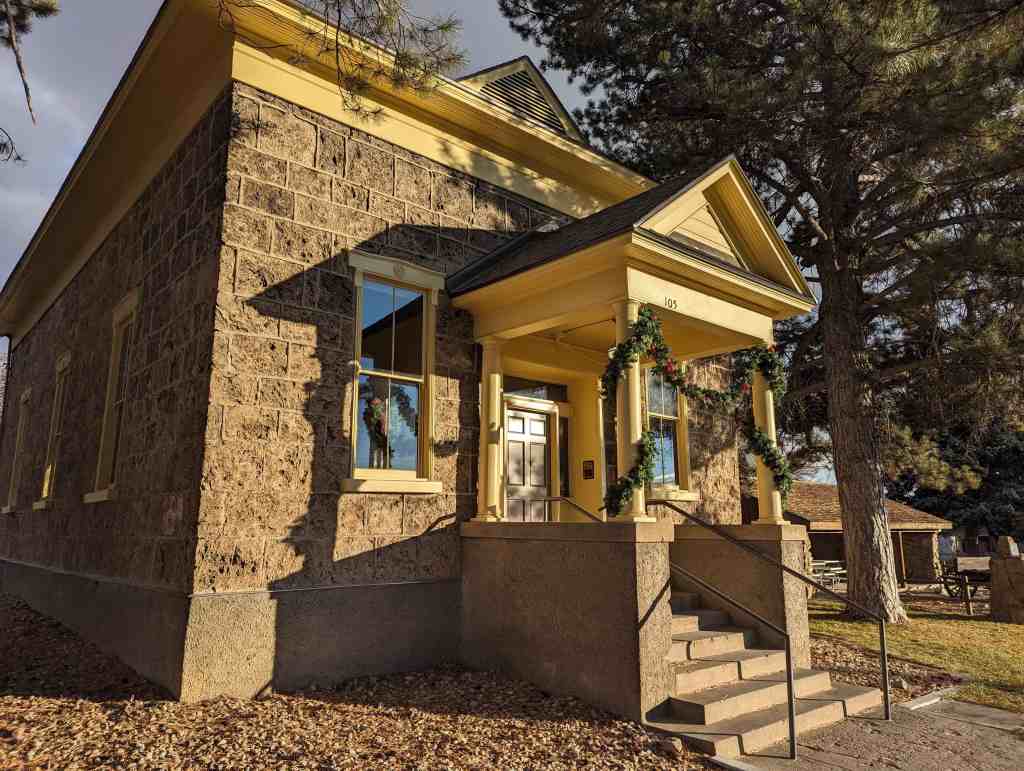
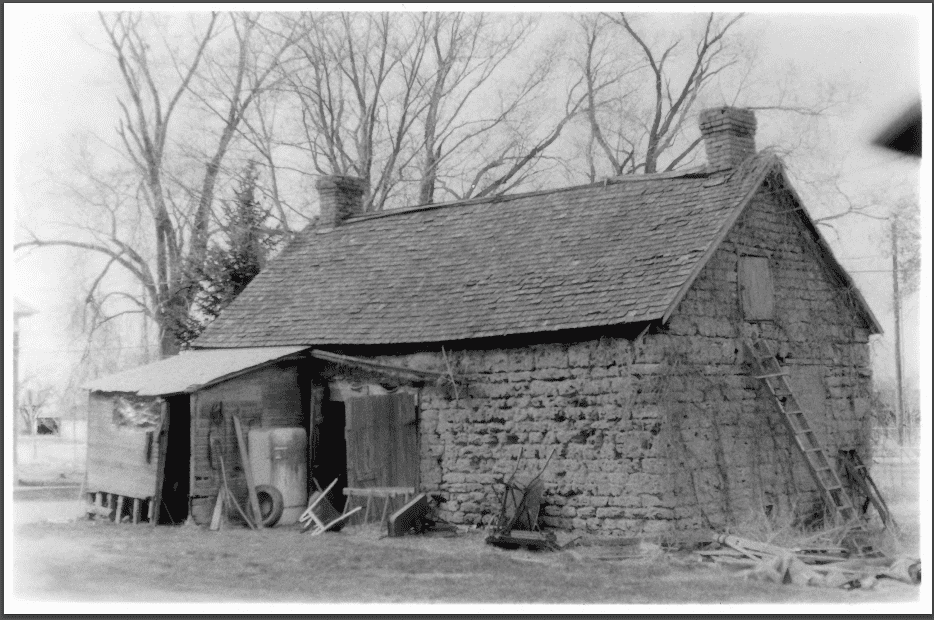
Pleasant Grove Town Hall
The Pleasant Grove Town Hall, built in 1887, replaced the city’s first town hall, which was a one-room log building. It was used as town hall building until 1940, when a third town hall building was built in the city. The Pleasant Grove Town Hall building was then used as a lunchroom for Pleasant Grove High School until 1949. Since that time, it has been used as the home of the Pleasant Grove First Baptist Church and the Pleasant Grove Public Library. Today it is home to Bliss Photo Studio and Boutique.
Located in Rose Garden Park/Pioneer Park at 107 South 100 East in Pleasant Grove, Utah


Built in 1887 from the widely used native soft-rock. The one-story rectangular building has the block massing of early Utah civic buildings. The symmetrical three bay façade features the center door covering of an angular pediment portico supported by Roman Doric columns. The angular pediment is repeated on the hip roof as a decorative dormer directly above the portico. Under the roof is a wide plain entablature.*