• About JacobBarlow.com
  • Cemeteries in Utah
  • D.U.P. Markers
  • Doors
  • Exploring Utah Email List
  • Geocaching
  • Historic Marker Map
  • Links
  • Movie/TV Show Filming Locations
  • Oldest in Utah
  • Other Travels
  • Photos Then and Now
  • S.U.P. Markers
  • U.P.T.L.A. Markers
  • Utah Cities and Places.
  • Utah Homes for Sale
  • Utah Treasure Hunt

JacobBarlow.com

~ Exploring with Jacob Barlow

JacobBarlow.com

Tag Archives: Tooele County

Tooele Valley Railroad Complex

31 Tuesday Mar 2026

Posted by Jacob Barlow in Uncategorized

≈ Leave a comment

Tags

NRHP, Railroad, Tooele, Tooele County, utah

Tooele Valley Railroad Complex

Built in 1909, the Tooele Valley Railroad Complex is historically significant for the integral role it played in the transformation of Tooele from a primarily agricultural community to an industrial based community. For over 60 years the Tooele Valley Railroad transported products from the smelter east of town to the main railway lines west of town. The smelter, constructed in 1909-10 and dismantled in 1972, was one of the major facilities of its kind in the state and served locally as a dominant factor in the growth and economic development of the community. The depot is the only remaining building in Tooele closely associated with the activity of the smelter. During much of the time of its operation, the Tooele Valley Railroad also served as an important local carrier of passengers and freight.

The Tooele Valley Railroad Complex is located at 35 North Broadway Avenue in Tooele, Utah and was added to the National Register of Historic Places (#84002426) on May 17, 1984.

The Tooele Valley Railroad (TVR) was built as a connection between the International Smelting and Refining Company’s plant, (built 1909-1910) located five miles east of Tooele, Utah, and the Union Pacific and Western Pacific railways at Warner, Utah, two miles west of Tooele. The International Smelting and Refining Company brought many new peoples to the Tooele area. By 1912 a new town had been built east of Tooele to house 1,000 people. Most of these new citizens were from the Balkans, Italy, and Mediterranean areas. The TVR transported smelted products from the smelter to the main railway connections in Warner, two miles west of town. For years, the TV (as the railway was called) was a familiar sight as it passed through town several times a day hauling workers to and from the smelter as well as ore and supplies to and from the Warner depot.

The Tooele Valley Depot was built “car door to dock high” to facilitate loading and unloading less-than-car-load (LCD freight for Tooele merchants. Prior to 1909, Tooele merchants had to have their goods hauled by team and wagon from the Warner depot. In 1942 the depot was handling three cars of LCL items each week, but, with the advent of graveled roads, automobiles and trucks gradually took over Tooele Valley Railroad’s LCL business. By 1950 a trucking line had taken over all of the railroad’s small lot shipments.

The depot was the operations center for the railroad. Weigh bills and bills of loading for outgoing freight from the smelter and local shippers were prepared there. The depot issued operating instructions to railroad conductors and section foremen and processed reports received from them. The building provided office space for a telegrapher, station agent, time keeper, paymaster, two accountants, and the TV railroad superintendent as well as a baggage room and scales.

age room and scales. Besides serving the International Smelting & Refining Co. and local merchants, the TVR provided passenger service that matched Union Pacific Railroad’s schedule (tickets were sold at a small office at 18 West Vine). Rail spurs also served coal and oil companies in the area with car load lots. Approximately seven miles of track was serviced by crews working 7 hours a day, three shifts each day. Four steam driven, coal fired engines pulled the freight along the tracks. The last run made by one of these steam locomotives was on May 30, 1963 when they were replaced by two diesel/electric locomotives.

By 1970 the price of lead was 14tf per pound while it cost the International Smelting and Refining smelter 18tf per pound to produce lead. About this time the Environmental Protection Agency was also requiring installation of pollution control devices. Faced with increased production costs and decreasing prices, it was decided that the smelter would be shut down. This was Utah’s last copper-lead and zinc smelter. In 1972 the smelter was dismantled. Without the International Smelting and Refining smelter operating, ore concentrates were trucked to the Union Pacific Railroad for shipment to Japan where they would be smelted. This action made the Tooele Valley Railroad unnecessary. After over sixty years of operation the railroad was abandoned and the tracks, except those near the depot, were torn up. The depot currently houses the Tooele County Museum run by the Settlement Canyon Chapter of the Sons of Utah Pioneers.

———-

The Tooele Valley Railroad Complex appears very much the way it did at the time of its construction in 1909. A chain link fence currently surrounds the 2.10 acre parcel of land which includes the buildings and some of the railroad cars which served as the vital elements on the railroad’s operations. The property includes the depot, the section head’s house, a frame maintenance shed, and four railroad cars. Also included on the property are two out-of-period outbuildings and three ineligible railroad cars which were not part of the railroad’s operation.

The Tooele Valley Railroad depot, built in 1909, is a one-story brick building on a raised concrete foundation. It is a rectangular building measuring 61′ 4″ by 31′ 3″ on the outside. It is surrounded on the east, north, and south sides by a wooden dock approximately 4 feet high and 8 feet wide. On the south side of the building is a three part bay window, which was used as the work location of the telegrapher. The roof is a gablet roof with overhanging eaves. The detailing of the building is very simple. The windows are two-paned, long and narrow and double hung. They are topped by two rows of radiating arched brickwork while the two doorways are topped by large square transoms. On the west and south sides of the building are two large freight doorways. The building is in good condition. It is unaltered and appears as it did at the time of construction in 1909.

The section head’s house is a 1 1/2 story frame house with a gable roof and horizontal lap siding. A full-width porch spans the gable-end east facade, and a smaller porch is attached on the southwest rear corner of the house. Other features of the house include a central, ridgeline chimney, two-over-two double hung windows, a concrete foundation, and a rear shed extension, possibly original. The house appears to be in a virtually unaltered condition.

The maintenance shed is a one-story frame building with a gable roof and horizontal lap siding. The broad, gable end east facade features returns on the eaves and two openings, a doorway and a window, arranged symmetrically. The building is in good condition and appears to be unaltered.

he four eligible railroad cars include two cabooses, a coal car, and a locomotive which was built c. 1905 and acquired by the Tooele Valley Railroad around 1909.

The complex is currently being used as a museum by the Settlement Canyon Chapter of the Sons of Utah Pioneers.

Commencing at the Northwest corner of the Vine Street and Broadway Avenue intersection, thence North 216 feet, West 423 feet, South 216 feet, and East 423 feet to beginning. This parcel of land was chosen because:

1) it is visually well defined by the fence surroumng it;
2) it is part of the original railroad headquarters property; and
3) it includes all of the resources identified in this nomination.

This 2.10 acre parcel is only part of the overall 3.42 acre parcel of land as legally defined in the county property records. The additional acreage comprises a narrow unfenced piece of land extending to the west of the 2.10 acre parcel, paralleling and including the old railroad grade. The legal description for the overall 3.42 acre parcel of land is as follows:

Beginning South 2031.8 feet and West 1275.4 feet from the Northeast corner of the Northwest quarter of Section 27, Township 3 South, Range 4 West, Salt Lake Base and Meridian on the West line of Broadway Street; thence South 216.58 feet to the Southeast corner of Block 153 of Plat C and the North line Vine Street; thence West 280 feet to the Southwest corner of said Block 153 and the East line of 3rd Street; thence North 13.91 feet; thence North 80 degrees 32 minutes West 143.17 feet; thence North 38.27 feet to the South line of the Tooele Valley Railroad Southerly line; thence South 81 degrees 59 minutes West 379.11 feet to the North line of said Vine Street; thence West 206.42 feet along the North line of said Vine Street to the East line of 1st Street; thence North 83 feet to the South line of Lot 4 of Block 142, Plat C; thence North 81 degrees 59 minutes East 587.87 feet to a point South 2094.41 feet and West 1698.56 feet from said Northeast corner of the Northwest quarter of Section 27; thence North 66.75 feet; thence South 89 degrees 28 minutes East 423.18 feet to the point of beginning. Being situate within Blocks 142, 154, and 153 of Plat C, Tooele City Survey, Tooele City and said Section 27, Township 3 South, Range 4 West, SLB&M.
John T. Rich House

31 Tuesday Mar 2026

Posted by Jacob Barlow in Uncategorized

≈ Leave a comment

Tags

Grantsville, NRHP, Tooele County, utah

John T. Rich House

The John T. Rich House, built about 1880, is architecturally significant as one of eleven documented extant examples of Italianate box in Utah. The Rich house is the only Italianate box that was built of adobe, and is one of only two examples of this type located in a rural area. The other nine houses are all located in Salt Lake City. There was great variation in the local expression of the style, ranging from vernacular to high style forms. Utah’s Italianate, following a national trend for such houses is found in three distinct forms: the large cross-wing house, the two story box; and the one story cottage. A great majority of Utah’s Italianate houses were the two story box type with a side passage, built as affordable middle class homes. The attenuated verticality of the box form and the low pitched hip roof with overhanging eaves provided the basic form to which additional elements of the style could be added if funds were available. The characteristic elements of the style include: rectangular massing and side hall plan; a low hip roof with overhanging eaves; a wide cornice with decorative brackets; projecting bays; long narrow windows; and other elements of classical detailing. All of these elements were incorporated in the Rich house. The Rich house is distinctive in that its rectangular form has been expanded to include a square bay on the north side and a large two story bay on the east side, effectively documenting the flexibility of form as one of Utah’s standardized house types. Of the eleven documented examples of the two story Italianate box in Utah, five have been listed on the National Register, and one has been determined eligible for listing in the National Register. Four other examples of the Italianate Style are also listed on the National Register.

The John T. Rich House is located at 275 West Clark Street in Grantsville, Utah and was added to the National Register of Historic Places (#84002423) on May 2, 1984.

John T. Rich was born at Mineral Point, Illinois on June 28, 1840. His parents were John Rich and Agnes Taylor. His mother was the sister of John Taylor, the second president of The Church of Jesus Christ of Latter-day Saints (Mormons). John Rich later came to Utah and settled in the Grantsville area. The 1870 Census indicates that Rich, his wife Agnes, and two daughters were living at St. lohusa, a small community located in northeastern Tooele County. Rich was a livestockman and his estate was valued at $400 while his personal property was valued at $4,000. In October 1875 Rich purchased the land on which this house was built. The 1880 census shows that Rich had his wife and six family members living in his household. In August of 1875 Rich was elected mayor of Grantsville but resigned from the position one month later. From August 1879 through March 1887 Rich served as a city councilor (1879, 1883, 1884) and as city alderman (1881, 1884, 1887). On March 26, 1887 Stephen S. Worthington was appointed to fill Rich’s place because Rich “was absent from the city,” Rich had apparently moved to Brigham City, in northern Utah, at this time. In August of 1889 Rich sold his Skull Valley Ranch (northeastern Tooele County) of 1280 acres to the Mormon church for $35,000. Rich’s ranch became the community of losepa which was inhabited by Hawaiian converts to the Mormon church. Ranch animals were also purchased from Rich. He received $12,279 for 129 horses and 335 head of horned cattle. In Brigham City Rich “invested most of his large fortune. . .in lands, the Bank of Brigham City, [and] the Electric Light System.” Rich eventually bought the Bank of Brigham City and became its president. At the same time Rich was involved in the livestock business. John T. Rich died on February 8, 1897 in Brigham City, Utah.

Tooele County has a dry and windy climate and older Grantsville residents report that Rich’s wife, Agnes, was displeased living in the area. Her dissatisfaction found Rich building three or four houses, each one more impressive than the last, in an effort to change her mind. The house at 275 West Clark Street is purported to be the last of these houses. Apparently the elegance of this Italianate Style house was not enough to help her overcome the stark Grantsville environment. After living in the house for about eight years the Riches moved to the more hospitable environment of Brigham City, Utah.

Rich sold the home to Hyrum Sutton in March of 1890. Sutton borrowed $5,500 from Rich (Rich was then living in Brigham City) to pay for the house and accompanying land. Sutton was in the sheep business and in August of 1893 he leased 2,000 head of sheep from Rich. Sutton remained in the sheep business until 1913 when he retired from sheepraising, though, he kept a small flock of sheep at his home. Sutton then concentrated on cattle raising and did some dairying and farming. In 1919 an historian wrote about Sutton, he “has never sought nor desired public office, preferring to concentrate his efforts and attention upon his business affairs, and as a sheep raiser he has been very successful, while at the present time he is winning a substantial measure of prosperity from his cattle interests and his dairying.” Hyrum Sutton died September 27, 1941.

Following is a list of the 11 documented extant examples of the Italianate Box house in Utah and the status of each house with regard to listing in the National Register.

  • William Morrow Home ( 390 Quince Street in the Capitol Hill Historic District in Salt Lake City, Utah)
  • Jonathan C. and Eliza K. Royle House (635 East 100 South in Salt Lake City, Utah)
  • Frederick A.E. Meyer House (929 East 200 South in Salt Lake City, Utah.)
  • Albert H. Kelly House (418 South 200 West in Salt Lake City, Utah)
  • Charles R. Snelgrove House (744 South West Temple in Salt Lake City, Utah)
  • George Q. Cannon House (1354 South 1000 West in Salt Lake City, Utah)
  • George Q Cannon House (1494 South 1000 West in Salt Lake City, Utah)
  • George Q Cannon House (1134 West Indiana Ave in Salt Lake City, Utah)
  • Joseph E. Smith House (615 East First Avenue in The Avenues in Salt Lake City, Utah)
  • John C. Sharp House (Vernon, Utah)
  • John T. Rich House (275 West Clark Street in Grantsville, Utah)

John C. Sharp House

31 Tuesday Mar 2026

Posted by Jacob Barlow in Uncategorized

≈ Leave a comment

Tags

NRHP, Tooele County, utah, Vernon

John C. Sharp House

Completed in 1883, the Sharp House, home of John C. Sharp, a prominent church leader and rancher in the Vernon area for many years, is both historically and architecturally significant. It is historically significant for its association with Sharp who, as bishop of the Vernon Ward of The Church of Jesus Christ of Latter-day Saints for twenty-five years, was instrumental in the religious and civic affairs of the community during that time. Additionally this large, elaborate brick house is the only house remaining in the community which represents the financial success of many of the early ranchers and farmers, most of whom left the area as soon as they could afford to. Also located on the property are a c. 1888 timber frame barn and a c. 1888 brick milk house, which further document the significance of the Sharp House and property as a well-preserved example of a successful nineteenth century farmstead in the Vernon area. Architecturally the Sharp House is significant as one of few extant examples in Utah of a common house type, the Italianate box with a side passage plan. There are eleven documented extant examples of this type in the state.’ Nine of the eleven houses are in Salt Lake City. The Sharp House is one of only two examples that is located in a rural area. There was great variation in the local expression of the style, ranging from vernacular to high style forms. Utah’s Italianate, following a national trend for such houses, is found in three distinct forms: the large cross-wing house; the two story box; and the one story cottage. A great majority of Utah’s Italianate houses were the two story box type with a side passage, built as affordable middle class houses. The attenuated verticality of the box form and the low pitched hip roof with overhanging eaves provided the basic form to which additional elements of the style could be added if funds were available. The characteristic elements of the style include: rectangular massing and side hall plan; a low hip roof with overhanging eaves; a wide cornice with decorative brackets; projecting bays; long, narrow windows; and other elements of classical ornamentation. All of these elements were incorporated in the Sharp House. The Sharp House is distinctive, however, in that its box form has been expanded to include a square bay on the north side and a three part, tent roofed bay on the south side, effectively documenting the flexibility of the form of one of Utah’s standardized house types. Of the eleven extant examples of the two story Italianate box in Utah, five have been listed in the National Register, and one has been determined eligible for listing in the National Register. 2 Other examples of the Italianate style listed in the National Register include: the Charles R. Savage House, 80 D Street (cross-wing type), and the Howe C. Wallace House, 474 Second Avenue (cottage type), in the Avenues Historic District, Salt Lake City; the Lewis S. Hills House, 126 South 200 West, Salt Lake City (cross-wing type); and the David McDonald House, 4659 Highland Drive, Salt Lake City (cross-wing type).

The John C. Sharp House is located in Vernon, Utah and was added to the National Register of Historic Places (#84002424) on July 13, 1984.

John C. Sharp was born on the Kaw River, Kansas, May 28, 1850 to Joseph and Jeannette Sharp, who were en route to Salt Lake City, where they arrived August 28 that same year. His father was a well-known freighter across the plains and the owner of a large amount of livestock. John, after attending public schools in Salt Lake City, married Sarah Bethula Palmer on February 12, 1872. Soon after he moved to Vernon, Tooele County, about 60 miles southwest of Salt Lake City, where he engaged in ranching and farming in addition to serving as the first postmaster for several years. He remained in Vernon for twenty-eight years, ranching and farming, but during that time purchased interest in several major business firms in Salt Lake City.

In 1875 John Sharp was chosen to preside over the Vernon Branch of The Church of Jesus Christ of Latter-day Saints (LDS Church), and in 1877 when the branch had grown and was organized into a ward, he was chosen as its bishop, a position he held until 1900. As bishop, he directed the religious affairs of the predominantly LDS community and was instrumental in completing the substantial brick chapel in 1892. He also served as Sunday School President in the ward for fifteen years.

Sarah Bethula Palmer Sharp was born in Pennsylvania, January 30, 1851 and came to Salt Lake City with her parents in 1861. In addition to her numerous activities in the LDS church, “Sula” sang in the Mormon Tabernacle Choir and played the organ at the Salt Lake Theatre.

Historian Edward Tullidge, writing in 1888, made the following observations on Vernon while visiting the town. “The place contains only one hundred people. They have done but little in making pleasant homes, but are wealthy in cattle, horses and sheep, there being 40,000 of the latter owned in the place, John C. Sharp…is making a striking contrast with his surroundings in the way of a fine homestead, on which is nearing completion a brick residence in elegance and solidity of construction next to none in the county. Doubtless the beneficial effect of his example will be seen in the future in his ward.”3 Construction of the house began in 1883, but was not completed until 1888, the date on the stone plaque set in the facade.4 It is not known where in Vernon the Sharps lived before this house was built. The house, which is located at the southern edge of town, originally faced the road into town, but that road has since been re-routed approximately one hundred yards behind the house to the east. The small brick building located at the rear of the house was built at about the same time as the house and served as the mail room for John Sharp, who was postmaster for several years.5 Beneath this building is a cellar in which the milk was stored

Tullidge’s assumption that the Sharp House would set an example for other houses in Vernon proved to be overly optimistic. No other houses of either the scale or quality of Sharp’s were constructed, primarily because most of the ranchers and farmers, as they became wealthy, moved to other cities instead of building new, larger homes in Vernon, and left the task of establishing a sense of permanence and community structure to those who remained, primarily the settlers of Scandinavian origin.’ John Sharp was one of the few, if not the only one, of the wealthy ranchers who remained, and his construction of this fine, large home illustrates his commitment to making the town his permanent home.

In 1900, however, the Sharps too moved from their ranch in Vernon to Salt Lake City after having relocated most of their sheep herds to ranches in Idaho. John’s business investments in Salt Lake City had apparently grown to the point where he felt it necessary to live in the city and manage them, or perhaps his return to the city was a form of semi-retirement for him after almost three decades of ranch life. From 1900 until his death in 1921, John Sharp lived at 26 E Street (demolished) in Salt Lake City, during which time he continued to be active in business and church affairs. At the time of his death he was serving as director of Deseret National Bank, Beneficial Life Insurance Company, Intermountain Casket Company, and Standard Furniture Company. He also served for twelve years as a member of the Board of Trustees of Utah Agricultural College and for many years as president of the State Board of Sheep Commissioners.

Vol lowing is a list of the 11 documented extant examples of the Italianate Box house in Utah and the status of each house with regard to listing in the National Register.

  • William Morrow Home ( 390 Quince Street in the Capitol Hill Historic District in Salt Lake City, Utah)
  • Jonathan C. and Eliza K. Royle House (635 East 100 South in Salt Lake City, Utah)
  • Frederick A.E. Meyer House (929 East 200 South in Salt Lake City, Utah.)
  • Albert H. Kelly House (418 South 200 West in Salt Lake City, Utah)
  • Charles R. Snelgrove House (744 South West Temple in Salt Lake City, Utah)
  • George Q. Cannon House (1354 South 1000 West in Salt Lake City, Utah)
  • George Q Cannon House (1494 South 1000 West in Salt Lake City, Utah)
  • George Q Cannon House (1134 West Indiana Ave in Salt Lake City, Utah)
  • Joseph E. Smith House (615 East First Avenue in The Avenues in Salt Lake City, Utah)
  • John C. Sharp House (Vernon, Utah)
  • John T. Rich House (275 West Clark Street in Grantsville, Utah)

GAPA Launch Site and Blockhouse

27 Friday Feb 2026

Posted by Jacob Barlow in Uncategorized

≈ Leave a comment

Tags

NRHP, Tooele County

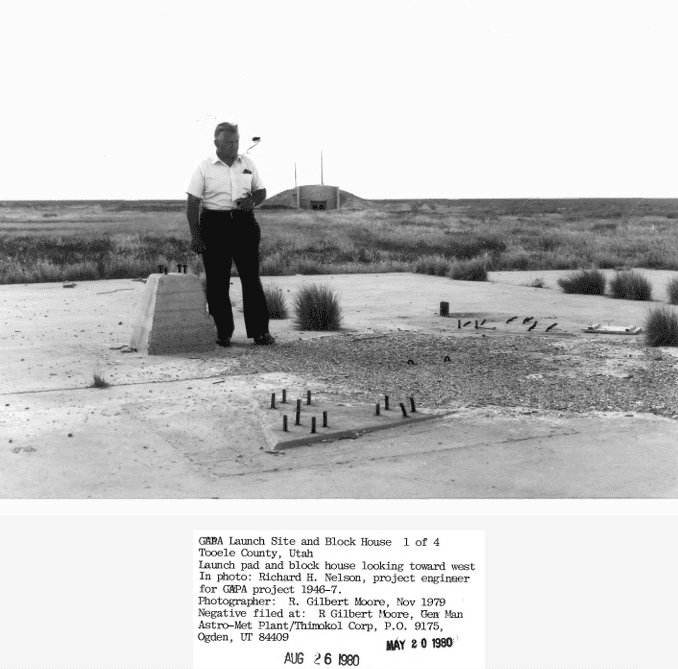
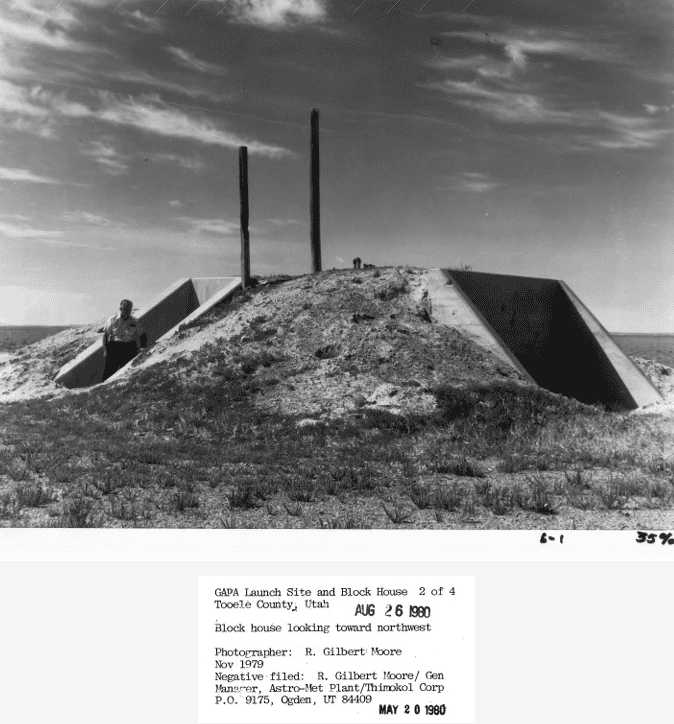
GAPA Launch Site and Blockhouse

This site is significant as the original launch site for the United States Air Force’s first supersonic guided missile, which was named the Ground-to-Air Pilotless Aircraft (GAPA). Thirty-eight two-stage GAPA solid-rocket-propelled aerodynamic test vehicles were launched by the Boeing Airplane Company from this site between June 13, 1946, and July 1, 1947. Stable supersonic flight was first achieved by GAPA test Vehicle 600 Series, Serial Number 10 on August 6, 1946. The GAPA program was subsequently transferred to Holloman Air Base in New Mexico, where an additional 73 missiles, propelled by various combinations of ramjet engines and solid and liquid rockets, were launched between July 24, 1947 and May 9, 1950.

GAPA was the lineal ancestor of the Air Force’s Bomarc air defense missile, which first flew on September 10, 1952, and is still in limited service 28 years later. The original GAPA launch site in Utah was the birthplace of the United States Air Force supersonic missile flight test program.

The GAPA Launch Site and Blockhouse was added to the National Register of Historic Places (#80003972) on August 26, 1980.

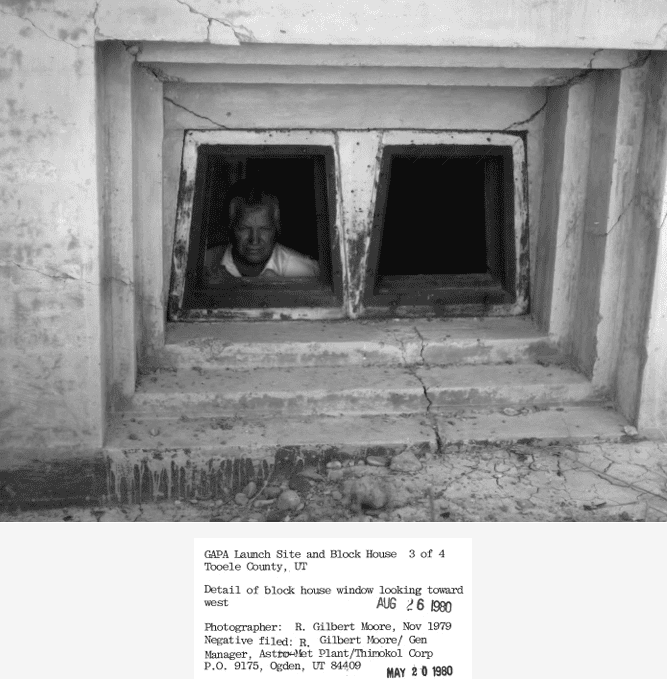
Reinforced concrete, semisubmerged blockhouse and launch pad. The Blockhouse is in original condition, except for damage caused by a single act of vandalism, to wit: entry door blown off hinges, glass viewports gone, hole blown in concrete floor and walls cracked, all apparently from a single explosive charge placed on blockhouse floor.

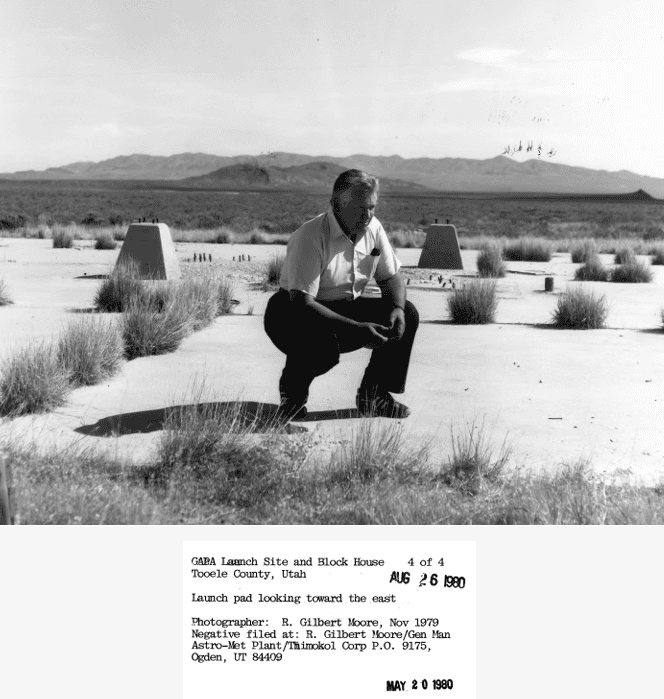
Reinforced concrete launch pad in same condition as when site was abandoned in July 1947. Steel launch tower no longer present.

The GAPA launch site and blockhouse is located three miles east and seven miles north of Knolls, Utah. The site includes the reinforced concrete launch pad approximately 100′ x 100′. The 40 foot steel tower, used in the launching moves, has been removed. Approximately 300 feet south of the launch pad is the original blockhouse from which the GAPA missiles were launched by remote control. The blockhouse remains in original condition except for damage done when an explosive charge was set off on the blockhouse floor. The explosion blew the entry door off its hinges, broke the glass view-ports, cracked the walls and left a hole in the concrete floor. The blockhouse is build of concrete, rises six feet above the ground level and is approximately 40 feet x 40 feet in size.

Soldier Creek Kilns

17 Wednesday Dec 2025

Posted by Jacob Barlow in Uncategorized

≈ Leave a comment

Tags

Kilns, NRHP, Tooele County, utah

The Soldier Creek Kilns / Waterman Coking Ovens

The Soldier Creek Kilns, comprising the remnants of four charcoal kilns and one lime kiln, are significant because of their economic importance to the Utah mining industry in the Qphir and Rush Valley Mining Districts, which were among the oldest mining areas in the state. The charcoal kilns dating from about the 1870’s, represent only a few remaining kilns of the early mining efforts in Utah, especially as they occurred in the leading smelter area in Stockton, near Rush Lake. Of equal sigificance is the historical-archealogical potential of the area immediately surrounding the kilns in providing a more complete documentation of the charcoal industry and the activities of its workers in Utah and the west. Charcoal was necessary as a fuel for the early smelting of ores, and it was smelting that made mining of lower grade areas economically feasible, thus fostering the growth of commercial mining in Utah. Mining has remained a vital component of the states economy.

The Kilns were added to the National Register of Historic Places (#80003973) on August 19, 1980. The text on this page is mostly from the nomination form for the national register.

Related:

  • Kilns in Utah

Commercial mining for the precious metals began in Utah with the arrival of Colonel Patrick E. Connor and the Third California Volunteers in 1862. By 1863 Connor’s troops, many of whom were experienced miners from the California and Nevada boom towns, were prospecting the mountains to the east and west of Salt Lake City. Initial discoveries were made in 1863 and in the immediate years prospecting and mining blossomed. The mountains to the west of Salt Lake were especially fertile for early mining.

The Rush Valley district, in Tooele County, was formed in June, 1864. First occupied as a military post, the Stockton area became a smelting point for areas mined in the surrounding hills, both from the Qphir and Rush Valley districts. Many claims in Rush Valley had been filed by soldiers stationed at Camp Douglas in Salt Lake. After the Civil War these men left the territory, having made their claim in the district perpetually valid by adhering to the by-laws of the district. This action prevented subsequent locations of the same grounds and retarded the development of Rush Valley for many years, with title lapsing by 1870. It also explains the paucity of solid documentation for this area.

Sporadic work in the district occurred through the 1870’s, including the building of small smelting works to accommodate various grades of ore. Several sources list various smelters as follows: Jacobs Smelting Company Works, Carson and Buzzo Smelting Works, Chicago Smelter, and the Waterman Smelting Works. All were located near the town of Stockton and on the shores of Rush Lake.

The Soldier Creek Kilns were built during the mid-1860’s to 1870’s period at a point…. Since charcoal was a necessity as fuel to fire the furnaces of these “smelters, the kilns represented a vital stage in the entire process. Early transportation of ores was difficult, therefore, ores from Ophir as well as Rush Valley were shipped to the Stockton smelters. Information relating directly to these kilns is most incomplete. However, in 1874 a mining newspaper, in describing the Chicago operation stated:

“In the rear of the furnaces are the fuel sheds, in which a supply is maintained of 20,000 bushels charcoal, and forty tons of coke. The charcoal is obtained under contract, from the adjacent mountains, and produced chiefly from nut pine, delivered at the works at twenty-one to twenty-two and half cents per bushel. The coke used is obtained from Pennsylvania at a cost of $36 to $42 per ton, …”

Sources also indicate that the Soldier Creek Kilns supported a small camp of fifteen to twenty families. The kilns were beehive kilns built of stone, and the presence in the area of a lime kiln illustrates the construction and maintenance stages of the process. Timber was harvested off the slopes of Bald Mountain, some two miles east of the kilns. In this regard the site was most appropriate, located on a flat between Silver Creek and the north flank of the canyon, near the mid-point between the lumber supply and smelters. A detailed historical archaeological survey may prove of great significance in better understanding this camp and its social and economic dynamics.

Information is available on the Beehive Kiln in general, thus, shedding light on the Silver Creek Kilns. The Beehive Kiln was introduced from the east and built in a form of a parabolic dome, with a base of fifteen, twenty, to twenty-four feet in diameter and a height of nineteen to twenty-two feet. In some sections it was a rule to make the height of the kiln equal to the diameter. Thicknesses of the walls varied from the base, (greater), to the summit, (smaller). Two openings existed and were generally closed by iron doors. One opening was at the base and the other approximately two-thirds of the way to the apex, used to load the kiln with wood. A 16-foot kiln held about 15 cords of wood, while a 26-foot kiln held 45 cords. Kilns ranged in cost from $500 to $1000 and since, if maintained, they lasted a long time, represented a relatively small investment.

Kilns were usually fired at the bottom center of the structure. The fire was drawn to the top by a space left in the upper door. The door was then closed entirely and the fire regulated by vent holes at the base of the kiln. Cracks in the kilns had to be patched, and the Silver Creek kilns exhibit this patching with stucco-like material present on both the interior and exterior surfaces. Duration of the burning was from three to seven days and another three to six days for a cooling period.

Little is actually known about the charcoal industry in Utah. This is especially true concerning the social aspects of the industry. The Silver Creek site, as noted in the description, offers the possibility of recovering information archeologically to shed much needed documentation on this vital phase of early mining in Utah. Mining has been recognized as having been critical to Utah’s economy and since the charcoal industry was of significance to mining, the dynamics of that industry may prove of added importance to an understanding of the total Utah mining experience.

Wendover Air Force Base

25 Thursday Sep 2025

Posted by Jacob Barlow in Uncategorized

≈ Leave a comment

Tags

Air Force, Air Force Bases, Military, Military Bases, NRHP, Tooele County, utah, Wendover

Wendover Air Force Base

Related:

  • Historic Wendover Field

The Wendover Air Force Base is located in south Wendover, Utah and was added to the National Register of Historic Places (#75001827) on July 1, 1975. The following text is from the nomination form for the historic register:

The history of the base began in 1939 when the Air Corps commenced an extensive expansion program. High on the priority list v/ere adequate bombing and gunnery ranges.

By 1940 a site was located at Wendover. The Air Corps desired some 3,000,000 acres of land 90% of which was public domain. However, because of grazing commitments, the Interior Superintendent was willing to release only 1,500,000 acres. Livestock men in the area suggested that another site be selected or the area reduced in size. They estimated that use of the 1 1/2 million acres would “wipe out 100 outfits” of livestock men and cost the state about $1,500,000 annually.

Despite these objections, work began on the base in November 1940. Temporary barracks were constructed and two 150 x 7000′ runways with taxi strips and anchorage areas were graded and graveled. In May 1941, the areas were paved and more extensive construction began.

The first training unit arrived at Wendover April 6, 1942 and found the area ideal for bombing and gunnery practice. Because of the abundance of salt, obtainable from the nearby Bonneville Salt Flats, a city of salt was constructed near the mountains for bombing practice.

The historical significance of the base is its role as the training site for the 509th Group under the command of Colonel Paul W. Tibbets, Jr. It was Colonel Tibbets, flying his B-29, “The Enola Gay,” who dropped the atomic bombs on Hiroshima and Nagasaki in August 1945.

The 509th Group was organized December 17, 1944 and trained at Wendover until May of 1945 when it left for Tenian Island in the Marianas. During its stay at Wendover, the group was housed in a maximum security area. Information about the group’s mission was so restricted that even members of the 509th did not know the purpose of this training.

Although the bombing of Hiroshima and Nagasaki has been regarded by some people as a means too terrible even for use in world wide conflict, it did bring to an end the war with Japan. The crew of the u Enola Gay’ proved that an atomic bomb could be used under combat conditions. The threat of its future use served the United States as an important post war foreign policy tool. For its role in ushering in the Atomic Age, the Wendover Air Force Base deserves recognition.

Wendover Air Force Base is located just south of the town of Handover, Although presently unoccupied the base chapel, hospital, barracks, administration offices, hangars, and other buildings remain.

The fire station is still in use by the base caretakers–the base was closed by the Air Force in 1963. One runway is still in use for commercial and private air traffic into Wendover. The Air Central building serves as headquarters for this limited use of the base.

The barricaded area, where the crew of the Enola Gay was housed, remains on the south side of the base separated from the other buildings by the runways.

The buildings which do remain were built in the typical World war II temporary military use style. They are frame buildings and, since 1963, have deteriorated from lack of use.

At present the state of Utah is attempting to acquire the air base site. Several businesses have expressed an interest in using the air base buildings for offices and warehouses. The runway will continue to serve as Wendover’s airport.

Lincoln Highway Bridge

18 Thursday Sep 2025

Posted by Jacob Barlow in Uncategorized

≈ Leave a comment

Tags

Bridges, Dugway, Lincoln Highway, NRHP, Tooele County, utah

Lincoln Highway Bridge

During the early days of Tooele County area around 1900 a road was constructed over Johnson Pass and on west across what is now Dugway Proving Ground. The Goodyear Tire and Rubber Co. was interested in opening a road to the west which became the Lincoln Highway. Mr. Fisher was president of the company and invested a large amount of money in the project. A group of convicts from Utah State Prison were camped at Clover Creek in order to start the construction, and later moved west as the road progressed. Their work included the construction of subject bridge and tiie building up of the elevated causeway from Granite Peak to the west edge of the salt flats. The portion of the road from Johnson Pass to west edge of the salt flats was known as the Goodyear Cut-off in honor of the interest and money the company invested. Attempts to make this road the main route to the west coast were not successful as certain influential persons in Salt Lake City wanted the western route to pass through that city. Therefore the Lincoln Highway passing through Dugway Proving Ground was abandoned in the early 1920’s, and was used by local ranchers and mining interests. This bridge is an existing structure of the original national Lincoln Highway from Lincoln, Nebraska to Sacramento, California. It is the only significant structure in this area that remains of the original proposed national highway.

The Lincoln Highway Bridge was added to the National Register of Historic Places (#75001825) on May 21, 1975 and is located in the Ditto area of Dugway, Utah.

Related:

  • Lincoln Highway Markers

The bridge is of hewn logs and log supports. Hewn logs make up deck of bridge and circular logs make up supporting members. Abutments are of rock construction with concrete added in early 1930’s by CCC Camp to support badly deteriorated rock abutments. Dimensions are.14V-6″ long by ll’-6″ wide. Rails along the sides of the bridge have fallen “off. It is estimated that the structure was built about 1900, with rehabilitation by CCC Camp at Clover Creek in the early 1930’s. A new road and bridge diverted traffic away from bridge; consequently, it has remained in fairly good condition.

Bonneville Salt Flats Race Track

28 Wednesday May 2025

Posted by Jacob Barlow in Uncategorized

≈ Leave a comment

Tags

NRHP, Tooele County, utah

A part of the Great Salt Lake Desert, the Bonneville Salt Flats were formed by precipitated salt from Lake Bonneville, an ice-age lake which covered some 20,000 square miles of which the Great Salt Lake is the last remnant.

The text on this page is from the nomination form for the National Register of historic places, the race track was added to the register on December 18, 1975 (#75001826)

The raceway is just north of Interstate 1-80 and three miles ease of Wendover, Utah.

The racing area is approximately 13 miles and consists of hard salt sufficiently thick to support the heavy racing machines.

During most of the year the. racing area is either under water or too moist for racing. However, the dry Utah summer evaporates the moisture and by August and September the flats are ideal for racing. During this time a tent city of several thousand people springs up adjacent to the race area.

In 1939, Ab Jenkins enthusiastically described the quality of the Salt Flats in this manner:

“The salt beds are better than any of the existing board, brick , or cement tracks of the world because none of these is large enough. I made my first 24-hour run on the board track at Atlantic City, New Jersey in 1928, and know that on such a 1 1/2 mile circular course you can’t exceed 145 MPH because the centrifugal force would send the car over the bank unless the track were on a 90 degree grade. Another factor too, is that the pressure of the car may crash it through the timbers. Also, board tracks are seldom over 40 feet wide, which doesn’t give the driver much room to spin should he have trouble.

All of these handicaps are overcome on the salt, where there is plenty of room. The actual racing area on the flats measures about 10 by 15 miles. There would be an even larger area if it weren’.t for the dikes caused by the digging for potash on the beds during the War. [World War I]

Why are the slat beds better, then, than Daytona beach, Florida, where world racing marks were met until a few years ago? Daytona beach has a longer straightaway. It is 25 miles long. But Daytona Beach is only 100 to 200 feet wide. That doesn’t give much room to spin.

Yet, even though Daytona Beach were wider, it wouldn’t offer the safety of the salt. If your tire blows out, the rim of the wheel digs into the comparatively soft sand, and that means your car will likely go into a somersault…Never has a speed car overturned on the salt flats.

Then, too, the concrete-like salt has a cooling effect on tires which is found on no other track. However, because the salt is always a little moist, it does not furnish quite as much traction as does a dry dirt, board, or concrete track.”

There is presently concern that the nearby potash operations by the Kaiser Chemical Company are causing a deterioration of the salt flats as a raceway. Two conflicting conclusions were drawn from a study done in 1967. The Division of State Parks and Recreation is planning another geologic survey to investigate ways of preventing further deterioration.

William D. Rishel is credited with being the man who discovered the Salt Flats as an ideal speedway. In 1896, George Randolph Hearst had just started his New York Journal and felt it would be an exciting publicity stunt to send a message by bicycle from his San Francisco Examiner to his New York Journal. Rishel, then living in” Cheyenne, Wyoming, was hired by Hearst to blaze a bicycle trail from Cheyenne to Truckee, California. Accompanied by his friend C. A. Emise, Bill Rishel crossed the Salt Flats in twenty-two hours. However, their experience nearly rivaled that of the ill-fated Donner-Reed Party of 1846. In many places their bikes broke through the thin salt crust and they were forced to carry their mud-clogged bikes many miles. In addition, they ran out of drinking water and had to contend with sticky marshes and sweeping clouds of mosquitoes.

Rishel returned to the Salt Flats again in 1907. By this time he had envisioned the possibility of a highway across the flats and the opportunity for some racing. Rishel and two Salt Lake City businessmen, Frank Botterill and Wallace Bransford, started out for the Salt Flats in a four-cylinder Fierce-Arrow. As they neared the salt beds, they saw what they thought was a lake of water covering the flats. Discouraged, they returned to Salt Lake City. A short time later Rishel learned from some of the old timers that they had been fooled by a mirage.

Finally Rishel and his friend, Ferg Johnson, succeeded in driving Johnson’s Packard onto the Salt Flats via the railway ties. After driving on the smooth, flat salt beds, Rishel became fully convinced that they would make the world’s best speedway.

The following year, 1912, Rishel took A.L. Westgard, National Pathfinder for the National Trails Association, onto the salt flats and convinced the national automobile figure of the area’s potential for racing.

Westgard did not fulfill his role as a propagandist for the salt flats and it was up to local enthusiasts to seek other ways of publicizing the salt flats as a speedway.

In 1914, Ernie Morass, who had been barnstorming the country with a fleet of several racing cars, arrived in Utah. His fastest car, the Blitzen Benz s driven by Teddy Tezlaff, had set a worlds land speed record for the mile with a 140.87 MPH run at Daytona beach on April 23, 1913.

W.D. Rishel and other Salt Lake City businessmen arranged for an exhibition of the racing cars. They were able to secure the railroads help hauling the cars to the flats after one hundred railway tickets were sold. According to the stop watches of the timekeepers, lezlaff pushed the Dlitzen-Benz passed its earlier world record speed to 141.73 MPH. To the dismay of local promoters, both the American Automobile Association and the Automobile Club of America refused to acknowledge the new record.

In 1925, to commemorate the completion of 40 miles of highway constructed across the salt desert between Knolls and Handover, the Salt Lake City Rotary Club planned a special celebration. One of the events was a race between Ab Jenkins, a local racing enthusiast driving a Studebaker, and the special excursion train traveling from Salt Lake City to Wendover for the official ceremony, Jenkins won the race and in so doing became a stalwart convert to the possibilities of the Salt Flats for a speedway.

Ab Jenkins went on to set several records including the crosscountry record from New York to San Francisco, 76 hours in 1927; and the world’s stock car record of 82.5 MPH average on a board track at Atlantic City, .’Jew Jersey in 1928.

y in 1928. In 1932, Ab returned to Utah to prepare for an attempt at setting the world’s 24 hour record on the Salt Flats. Enlisting the help of the Utah State Road Commission to survey the course and some of his Utah friends, including W. D. Rishel of the Utah State Automobile Club and Gus P. Backman of the Chamber of Commerce, Jenkins set out to break the world’s record.

The course was marked off with four foot stakes placed every 100 feet and was lighted by 20 small oil flares. In describing the race Jenkins recorded:

…I remained at the wheel the full 24 hours without a relief driver. Though I stopped about 12 times to refill the gas tank, not once did I leave the seat of the car. The machine wasn’t equipped with plumbing either!

After I had driven a few hours, I was stone deaf. This, however, did not bother me so much as did other factors. The weather was ideal throughout the run, but the mirages on the salt drove me almost crazy. At night there was a bright moon. Shadows were cast over the sparkling salt. Sometimes they took the form of huge walls. I thought I was steering right into them. I could almost hear the sound of the crash.

On other occasions, the railway tracks on the beds some miles away would teasingly come off and on the course. Every once in a while the locomotive would seem to run across it, directly over my path. There was an airline beacon on a hill about ten miles from the course which seemed to change position every time I rounded the track.

Yes, the beds were like one big haunted house.

The Fierce-Arrow driven by Jenkins traveled 2,710 miles during the 24 hour period; however, the 112.92 MPH average was not officially recognized because it was not clocked by the American Automobile Association.

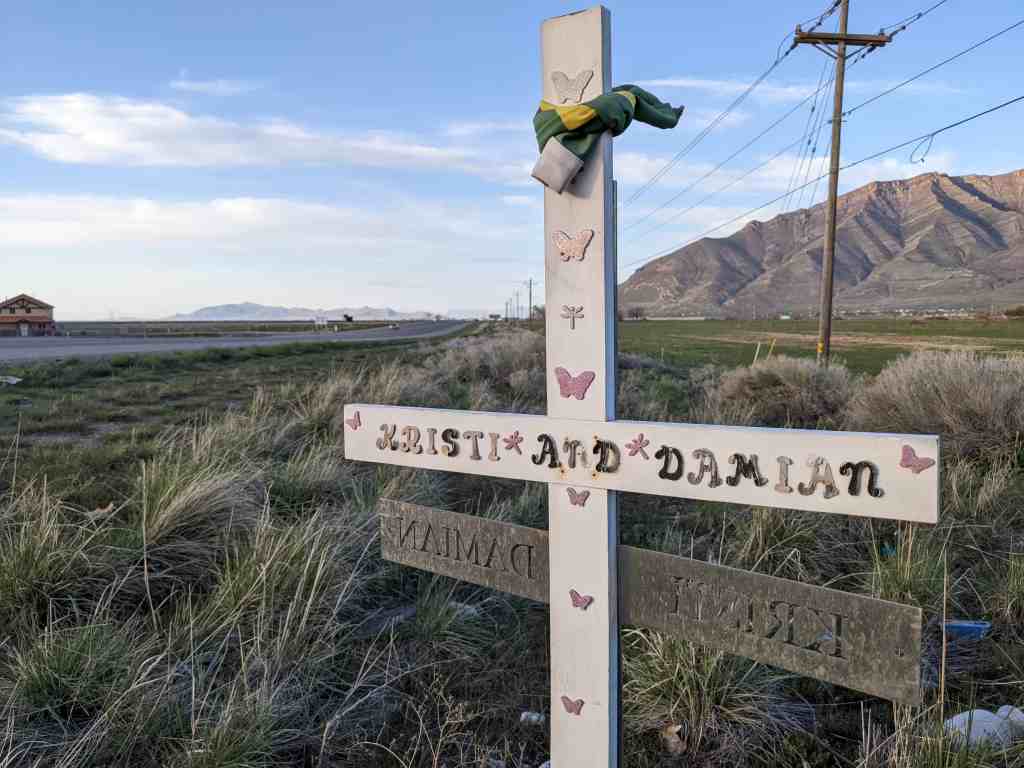
Kristi and Damian

28 Sunday Jan 2024

Posted by Jacob Barlow in Uncategorized

≈ Leave a comment

Tags

Memorials, Tooele County

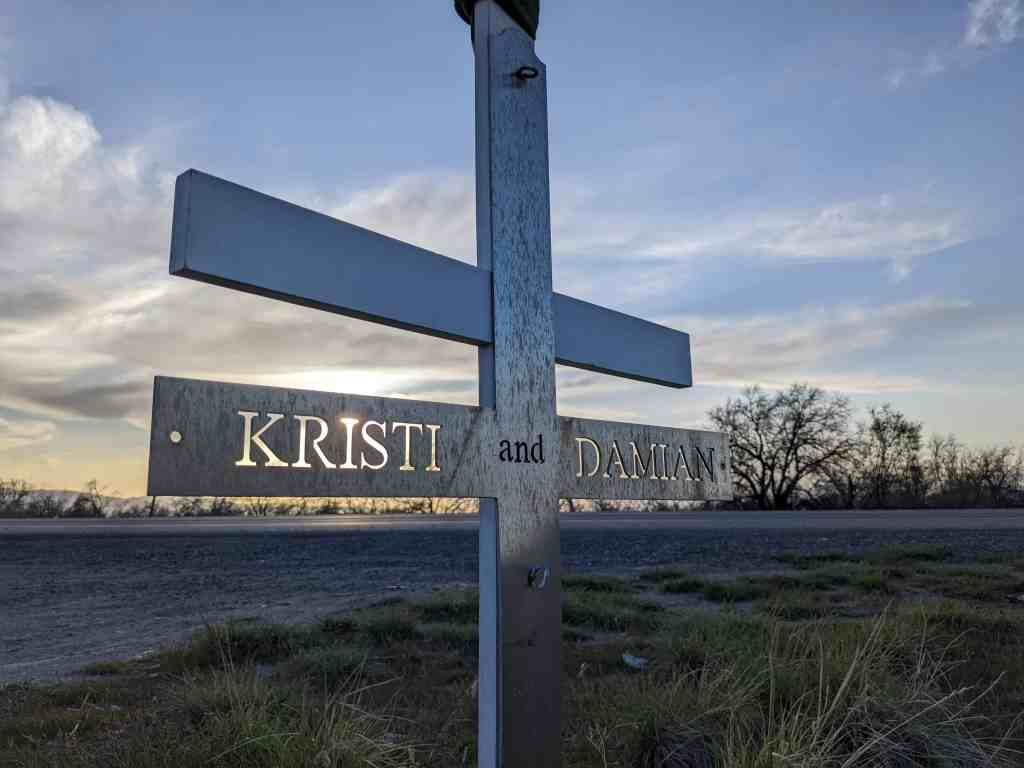
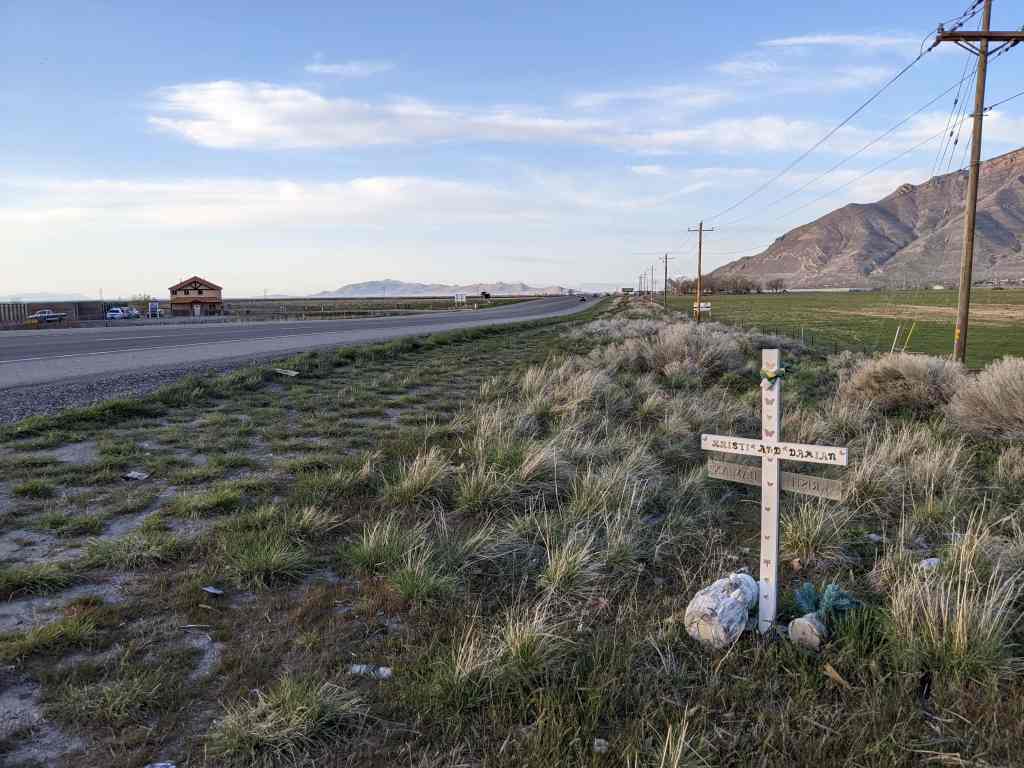
Kristi Westfall, also known as Kristi Newingham; her boyfriend, Jacob Herrera; and their 9-month-old son, Damian passed away here January 28, 2010.

N 40.66264 W 112.28778

James Lynn Bevan

26 Tuesday Dec 2023

Posted by Jacob Barlow in Uncategorized

≈ Leave a comment

Tags

Historic Markers, SUP, Tooele, Tooele County, utah

James Lynn Bevan
March 10, 1931 – June 14, 2016
Blessed, Honored Pioneer!

“It is good to look to the past to gain appreciation for the present and perspective for the future. It is good to look upon the virtues of those who have gone before, to gain strength for whatever lies ahead. It is good to reflect upon the work of those who labored so hard and gained so little in this world, but out of whose dreams and early plans, so well nurtured, has come a great harvest of which we are the beneficiaries. Their tremendous example can become a compelling motivation for us all, for each of us is a pioneer in his own life…”
-Gordon B. Hinckley, 1984

These words are now found on a plaque at the entrance of the Pioneer Museum, the place that Jim Bevan loved so much. Jim loved these words because they epitomized his own thoughts and feelings. He had a drive and desire to help everyone visualize and understand the struggles and sacrifices that were made by those men and women that lived in the very early days of Tooele.

Jim was a descendent of the faithful pioneers that established the city of Tooele. He was the 10th of eleven children born to Eli Edson Bevan and Sarah Shields Bevan. He was named after his relative James Bevan who was born in 1821 in Herefordshire, England and came to Utah in 1847 after coming from California, as a member of the Mormon Battalion. Jim’s father, they called him Kelly, was an engineer of the train that used to travel Vine Street every day giving the men a ride to and from the Tooele Smelter. Jim’s mother died when he was only twelve years old. Jim worked at the lumber company in Tooele, at the Tooele Ordinance Depot and finally at Utah Power and Light Company. He served the LDS church as a bishop, a high counselor and stake president.

Over the years Jim spent thousands of hours with his friends Russ Hammond and John Bryan and gave much in the way of personal resources in an effort to establish a place where people could visit to catch a glimpse of the past. His desire to share his love of those early pioneers and their struggles resulted in many of the displays at the Pioneer Museum. The museum now stands as a monument to his life.

The text on this page is from Sons of Utah Pioneers historic marker #249, located at the James L. Bevan Tooele Pioneer Museum at 39 East Vine Street in Tooele, Utah.

  • S.U.P. Historic Markers
← Older posts

Follow Jacob

Follow Jacob

Blog Stats

  • 2,029,640 hits

Social and Other Links

BarlowLinks.com

Recent Posts

  • Angels Are Near Us
  • Hiram Clawson Silver
  • Bingham Fort
  • Goulding’s Trading Post
  • Kyle’s Apartment – American Murderer Filming Location

Archives


Loading Comments...