Tags

The Mount Timpanogos Utah Temple is the 49th operating temple of The Church of Jesus Christ of Latter-day Saints (LDS Church). The temple is located in American Fork, Utah and is the second temple built in Utah County and the ninth in Utah.


10 Wednesday Aug 2016
Posted in Uncategorized
Tags
The Mount Timpanogos Utah Temple is the 49th operating temple of The Church of Jesus Christ of Latter-day Saints (LDS Church). The temple is located in American Fork, Utah and is the second temple built in Utah County and the ninth in Utah.
18 Thursday Sep 2014
Posted in Uncategorized
Tags
American Fork, historic, Historic Homes, NRHP, utah, utah county

At 317 E. Main St. in American Fork is the Delbert and Ora Chipman House. This home is significant as the earliest known surviving example of the Tudor Revival Style in American Fork. The residence originated as a small, late-1870s adobe farmhouse on the outer edge of the city’s original plat. Radically remodeled and enlarged in the 1930d, the house has since remained virtually unchanged. The property, including the large frame sheep barn located on the site, is also significant as it documents the social and economic influence of sheep production in American Fork and Utah County prior to WWII, when it was the local economy’s most important industry. Delbert Chipman, whose career as a sheep raiser spanned several decades during the 20th century, was the third in his family line of prominent American Fork agri-businessmen.
Related Posts:

Located on the eastern edge of Main Street, American Fork’s most prominent 19th and early 20th century residential street, the Delbert and Ora Chipman House is significant as the earliest known surviving example of the Tudor Revival Style in American Fork. This residence originated as a small circa late 1870s adobe farmhouse located on the outer edge of the city’s original plat. Radically remodeled, enlarged and stylistically altered from 1930 and 1934, the Chipman house has since remained virtually unchanged. The house, adjacent porte-cochere, barn and selected landscape features possess integrity of location, setting and most particularly design (as it evolved and then halted in 1934).
The property is also significant as it documents the social and economic influence of sheep production in American Fork and north Utah County, prior to World War II, when it was the local economy’s most important industry. Delbert Chipman (b.1893), was third in his family line of prominent agri-businessmen of American Fork. His great-grandfather Stephen Chipman, founded the community that would become American Fork and established a relatively small but significant family agricultural, banking, and industrial empire that influenced American Fork into the mid-20th century. The Chipman property also documents, with the house and adjacent barn, the once typical inclusion of both domestic and agricultural operations within a large city lot in 19th and early 20th century municipal Utah. Some years after purchasing their house, the Chipmans purchased the lot east of their residence, to create a home base for their agricultural operation. The barn, which is the only feature that remains (albeit the central feature) of a once small agrarian complex behind the house, documents the once ubiquitous practice of mixed-use of residential lots in rural Utah towns in the 19th and early 20th centuries.
Delbert Chipman’s career as a sheep raiser spanned from the early 1920s to his death in 1980. Born in 1893 into a family of cattlemen, Chipman and his brothers eventually turned to sheep when the Forest Service reduced and restricted cattle grazing permits in the Uintah Forest. After his father’s death in 1930, Chipman took his share of the estate and with the help of the federal government’s Reconstruction Finance Co,, bought out all other heirs. Grazing sheep during the winter in the West Desert (near Dugway Proving Grounds, Simpson Springs, etc.) and in American Fork Canyon (north as far as Deer Creek) during the summers, Chipman eventually developed one of Utah Valley’s largest sheep operations. 4 He and his wife Ora, both became nationally recognized industry leaders (National Wool Growers Association), he as president and she as president of the women’s auxiliary organization.
Ora Velma Holman Chipman (b. 1896) was a leading light in social causes, as northern Utah County’s first social worker during the Great Depression and as a Red Cross worker for thirty-four years; in education, by introducing the concept of kindergarten to the Alpine School District; in civic enterprises, by starting the fund-raising effort for American Fork’s first municipal hospital; in youth recreation, by assisting in the establishment of Mutual Dell, a church and later civic youth camp in American Fork Canyon; and as leading dilettante, assisting in the introduction of American Fork’s “Pageant of the Arts” program and by chairing scores of pageants, musicals and special events. In all of this, Ora Chipman was both civic leader and local trend-setter/taste-maker, as was reflected in her house remodeled in the pastoral and picturesque style of the Tudor Revival. The Chipman House possess ample integrity of feeling and association to document the relative prosperity brought to northern Utah County by agri-business in early 20th century.
In regards to its architectural significance, the property embodies the selective characteristics of historical eclecticism adopted by many upper middle-class Utah farmers and ranchers in the 1920s and 1930s; with the historical allusion being reserved almost entirely to exterior applique instead of any underwriting design theory or schemas. Set back in a relatively large lot surrounded by a once sprawling lawn with a stone lined canal, flower and vegetable garden plots, and sheep barn and corrals fenced off some distance away, the Chipman’s Tudor Cottage and surrounding pastoral compound expressed, via this picturesque aesthetic, the ambition and social standing many well-to-do agriculturalists aspired to in the rural Utah. This included an appreciation and desire for modernity and order, along with a quest for traditional association and community respectability.
The Chipman House also documents, with all of these alterations and additions, the constantly evolving, organic nature of Mormon Utah’s housing stock during the 19th and early 20th centuries. There are throughout the house tell-tale signs of this evolution, such as the thick adobe walls of its previous forms, the classical proportions and detail of the pre-1900s gables, and the interior finish work from all three periods of construction. This adaptability is expressive of the pragmatic and restrained sensibilities of rural Mormon Utah society during the period of significance. The house is significant because of its numerous and historically yielding changes, as noted above; but even more so because this physical evolution was suspended in 1934, thus documenting the general aesthetics of domestic life in upper middle class rural Utah, during the era of the Great Depression and pre-World War II.
The house also documents a much broader regional trend. In 1929 during the early days of the Great Depression and throughout the 1930s, the predominate area church (the Church of Jesus Christ of Latter-day Saints) instituted a church-wide campaign that urged members to repair, update and “beautify” their homes and communities. An influential program, many rural 19th century houses and landscapes were renovated (if not entirely destroyed) during this period to modern 1930s tastes. As community leaders as well as active, life-time members in the Mormon Church, the Chipman’s 1930-1934 renovation would also chronicle this regional aesthetic trend.
Narrative Description
The Delbert and Ora Chipman House is located three blocks east of the community center of American Fork, Utah County, Utah. Settled by Mormon colonists in 1850, American Fork is located in north-central Utah, at the eastern edge of the Great Basin on the western front of the Wasatch Mountains. The city center and the Chipman property are both located approximately one mile north by north east of Utah Lake.
Situated on a block platted originally as one-half acre city lots, the Chipman property is flanked to the west by a heavily remodeled, c.1891 cross-wing, stucco over adobe brick house and to east, beyond a vacant lot also once owned by the Chipmans, a c.1930 bungalow. Across the street to the south is a small city park and more residential buildings dating from the 1890 to 1940s.
The Chipman House is now an interesting example of the Tudor Revival Style or English Cottage, after it was completely remodeled and enlarged from 1930 and 1934 (see mortgages between 1930-1934 on title search form). Prior to its alteration, the house was a late-19th century cross-wing house with classical massing and detail. Restrained by its previous form, the house does not have the numerous, steeply pitched, gables as is generally associated with the Tudor Revival style, although, in all other aspects, the house is replete with English Tudor Revival features — or at least as they were perceived and adopted by its remodelers. The house has remained relatively unchanged, essentially suspended, since its transformation over fifty years ago.
The house is essentially a one story cross-wing or “T” cottage with two lean-to attachments. The first construction occurred circa late 1870s, with the cross-wing addition being added no later than circa 1900. (See attached floor plan.) At the rear center is a large squared hipped-roof addition attached behind the original portion, built sometime between 1930-1934. West of the house is a delicate semidetached porte-cochere/pergola structure built of painted dimensional lumber on concrete supports. On the front elevation, attempting to counter the severe right angled cross-wing behind it, is a small stuccoed frame entry hall with an asymmetrical and a relatively steeply pitched English gable roof with flared overhanging eves.
The floor plan is as follows (front to rear): a small entry hall, a parlor to the left (west) and a dinning room to the right (east), a small bedroom east of the dinning room, a kitchen and small bathroom behind the parlor accessed from the dinning room, and two bedrooms in the northeast accessed from a hallway located directly behind the dinning room. The hallway connects the kitchen, dinning room and bedrooms. Adjacent to the kitchen, and attached to the first hallway, is another hallway that leads to the rear entrance and to a stair to the basement. The basement includes two simply finished rooms and three partially enclosed storage rooms.
The house has an elaborate exterior finish scheme that, too, follows the romantically reputed English Cottage Revival fashion, fabricated in modern, circa 1930s, steel lathe and concrete stucco. The finish plan includes a foundation of cobble stones, covered with stucco, placed diagonally in layers just above grade; the lower walls are finished in a coarse pebble dash, concluding with a concrete string course; the upper walls are finished in a smooth floating stucco finish.
All but one of the windows (southeast, front facade) were replaced or was heavily altered in keeping with the pervasive 1930s revival design. All of the windows seen from the street have muntins with a simple open, orthogonal cross-hatch which is the exterior’s leitmotif. Following more Moderne impulses than historical references, all of the windows and door surrounds have machine cut-like edges with only the sills projecting from the wall plane. However elaborate the 1930s renovation might have been, the simple pre-1900s cross-wing form is still clearly evident.
Based primarily on physical evidence uncovered during a recent renovation (foundation, walls, finishes, etc.), it appears the original house was a simple rectangular hall-parlor form built with a stone and mortar foundation and adobe walls by a Joseph Shelley, circa 1870-1880s. In circa 1890-1900, a cross-wing was constructed, also built of adobe but with an exterior sheathing of common brick, west of the original house. Much larger in scale than the original house, the addition had a prominent stone foundation (camouflaged by a later alteration) with taller walls that allowed a 9’6″ ceiling for the interior. This addition appears to have been a simple two room form as well (a single adobe load bearing interior wall suggest this). A veranda was also built across the front elevation sometime after this addition (the veranda was removed during the early 1930s renovation). Prior to the 1930s, the adobe brick walls were left exposed.
Between 1930 and 1934, Delbert and Ora Chipman completely transformed their house’s appearance, having a basement dug out across the entire house plan (a remarkable task considering the pre-1900 house had load-bearing adobe brick walls), lowering floor joists to create a common floor height, removing and replacing interior walls, building a large brick addition in the rear and a small frame entry hall in the front and completely refinishing the exterior (including enlarging the windows and replacing the roof). With the exception of a series of succeeding exterior and interior finishes, the house has remained essentially unchanged since this major alteration.
Other significant architectural features that contribute to the historical integrity which date to the 1930s (or earlier), include: a large fireplace with a brick mantle, surrounded by a built-in bookcase that spans the entire wall (constructed of pine and glazing, the doors having the same fore mentioned cross-hatching muntins); an elaborate series of floor to ceiling built-in kitchen cabinets and drawers; a near intact 1930s bathroom (adjacent to the kitchen); arched and geometric plaster archways between the parlor and dinning room, in the kitchen and in both hallways; a telephone niche in the dinning room; built-in cabinets and drawers in all of the hallways; a swinging butlers door between the kitchen and bedroom hallway; paneled doors throughout; circa 1870s, 1900, and 1930s door and window surrounds and baseboards; c.1930s finish hardware throughout; and finally, a dirt chute in the bedroom hallway that drops refuse into a cabinet (which holds a small rubbish bin) in the basement.
Besides the house and adjacent semi-detached porte-cochere/pergola, there is a large frame sheep barn, built c.1920, with a gambrel clerestory roof with side bays, built of 4×4 lumber or smaller, covered with pine lap siding. The barn is currently situated on the rear of the lot, directly north, behind and some distance from the house.
Prior to Delbert and Ora Chipman’s deaths the entire Chipman parcel was nearly an acre (94/100). This included the residence, side and rear gardens, and a concrete block garage (since demolished) in the rear of the house; then behind and beside the residential area to the north and south, separated by fence and hedges, a concrete cellar (directly behind the landscaped yard), then further north, a series of wooden corrals and pens (stakes, rough and dimensional lumber) which surrounded the barn on the west and south sides. Against the corral was a wooden loading ramp that faced an opened field and road to the east. East of the residential area was a sheep pasture and road that lead to the rear barn and corrals. It is suggested that the sheep were herded or trucked into this small agricultural complex seasonally for care and shearing.
The Chipmans purchased the east lot (.50 of an acre) in 1946 from Utah County for back taxes from 1929-1946 (Books 384:358 and 462:473, Utah County Recorders Office). Although the lot was purchased by the Chipmans in 1946, the lot may have been used or rented by Chipmans much earlier, possibly since the early 1930s. The Chipmans used the east lot for a pasture, for equipment storage, and to access the rear of their lot. The barn is the only remaining element in this once agrarian complex used from c.1920s to 1970.
15 Monday Sep 2014
Posted in Uncategorized
Tags
American Fork, historic, Historic Homes, NRHP, utah, utah county
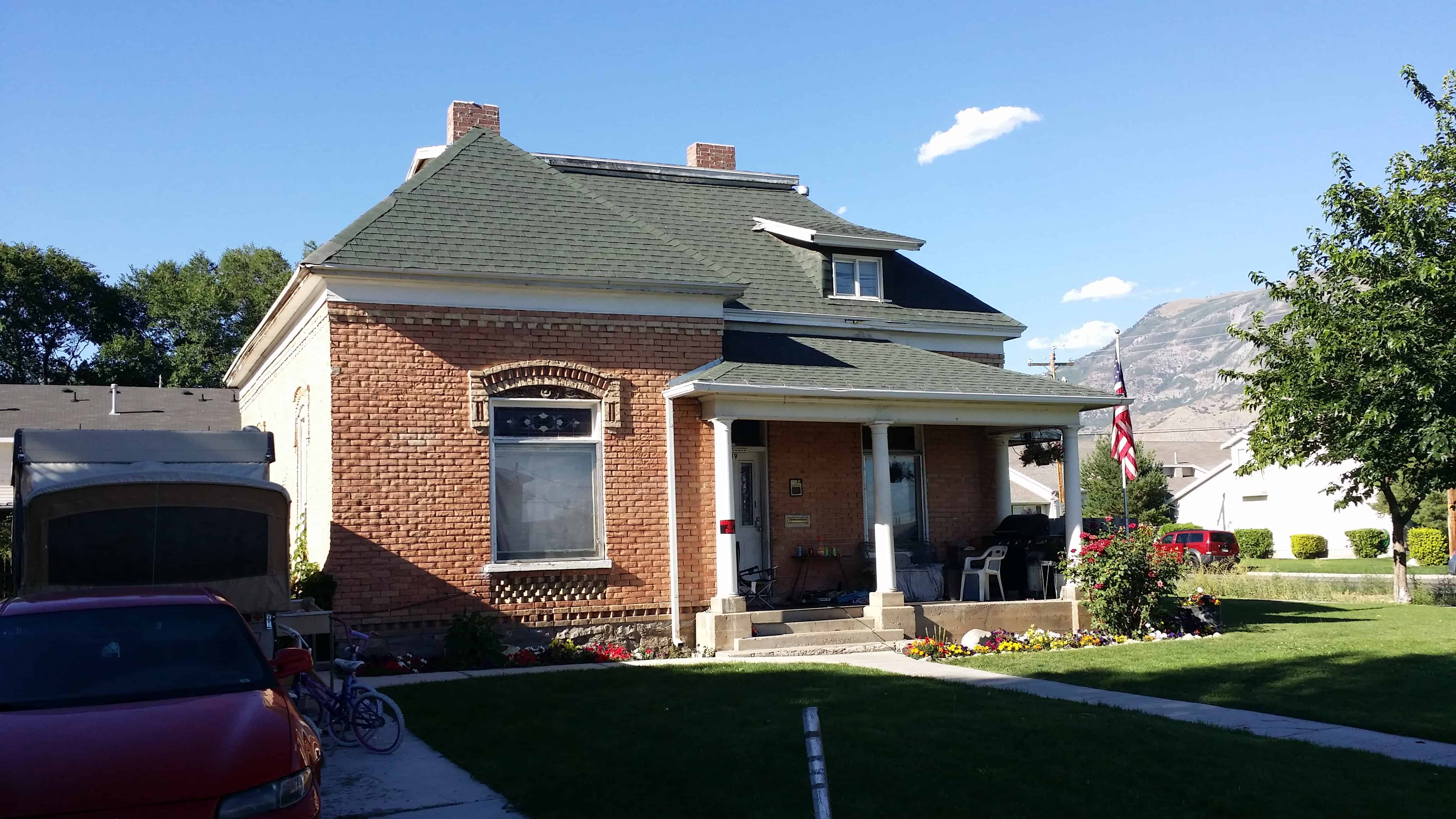
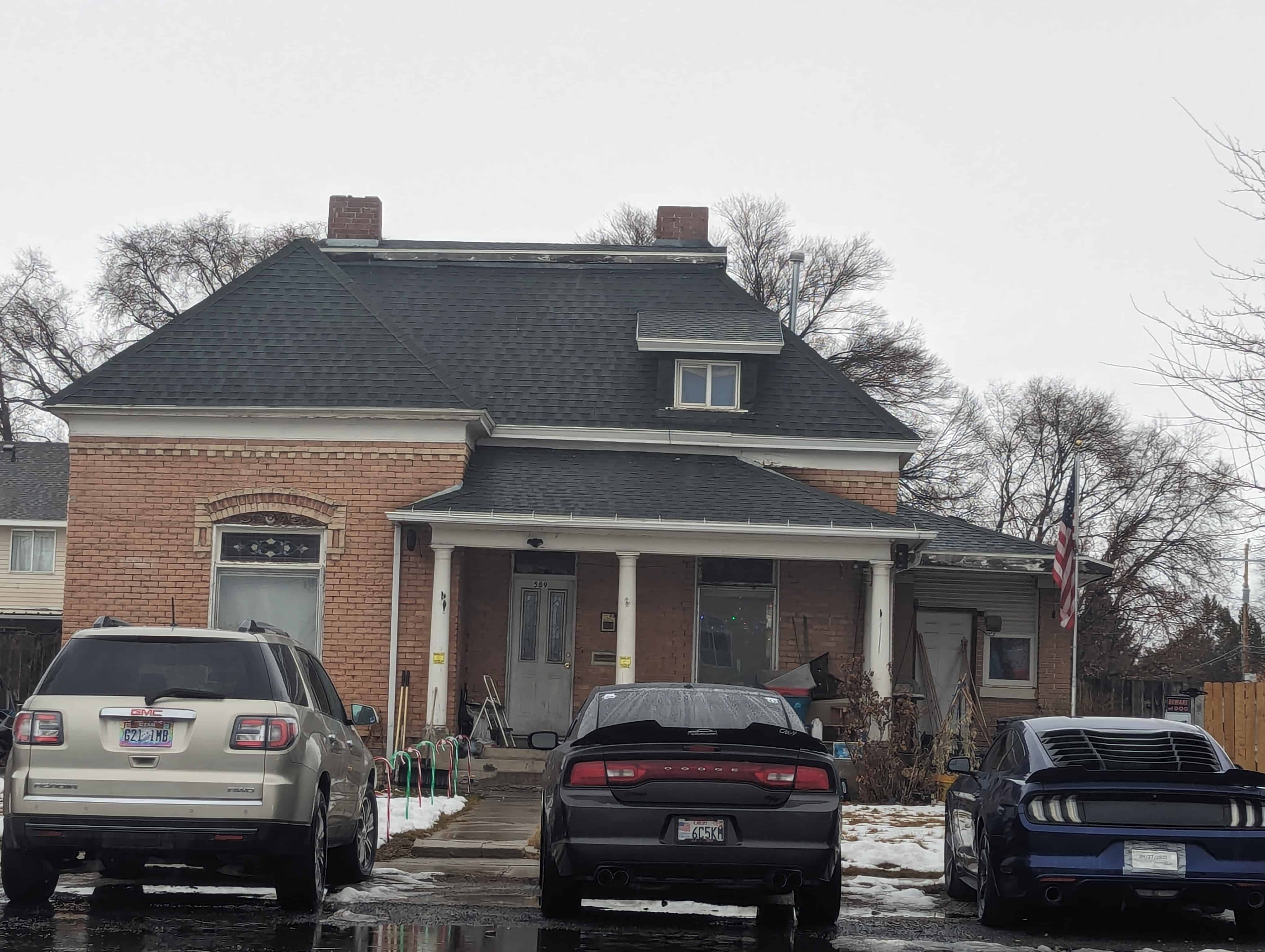
Pioneer from Nauvoo, Illinois, Warren B. Smith settles in American Fork in 1856. He became a church, business and civic leader in this city. In 1897 he built this home for his residence. It was rennovated by Robert Nelson Ballard and listed on the Utah State Register of Historic Sites on September 6th, 1978.
The home is located at 589 East Main Street in American Fork.
The house is significant as an attractive and representative example “of the modest late-Victorian dwellings to be found in many of Utah’s small towns,” and for its association with Warren B. Smith, its builder. Smith was a blacksmith who became a leading citizen in American Fork, including serving on the city council. He spent four years in two full time missions for the LDS church. He supported three wives, and took a fourth wife late in his life, at age 63, in 1907, and spent six months in the Utah Territorial Penitentiary for his violation of the Edmunds-Tucker Act. He led the American Fork choir for thirty years.



22 Thursday May 2014
Posted in Uncategorized
Tags


First Free Public School
The Territorial Legislature, February, 1866, authorized the levy of a tax for the support of schools within each district. Pursuant to this act Mayor Leonard E. Harrington called a meeting and the majority of citizens of American Fork approved the plan. School opened in November, 1867 with Jos. B. Forbes, E.A. Henroid, Editha Anderson and Elizabeth G. Griffith, teachers. Wm. Greenwood, Wm. Paxman, James W. Preston, trustees. American Fork thereby became Torch Bearer of the present free school system.
“When upon Life’s Path We Tread”, sang 25 lusty young voices as morning school bells called the students to order. Those lyrics to the tune “Hark, Listen to the Trumpeters”, from the old Sunday School Song Book, were favorites of that school class. “When upon life’s path we thread, we come to many a place, where if not careful we will fall and sink into disgrace. So, my children one and all, please mind your parents dear and teacher, as you go through life then you’ll have not to fear. Through life’s journey…” “When the pioneers moved to the west, with courage strong they met the test. They pushed their handcarts all day long as they pushed they sang this song. For some must push and some must pull as we go marching up the hill; so merrily on our way we go until we reach the valley-o” Picture of handcart and an ox cart etched on south side.


Check out all of the historic markers placed by the Daughters of Utah Pioneers at JacobBarlow. com/dup
04 Tuesday Feb 2014
Posted in Uncategorized
Tags
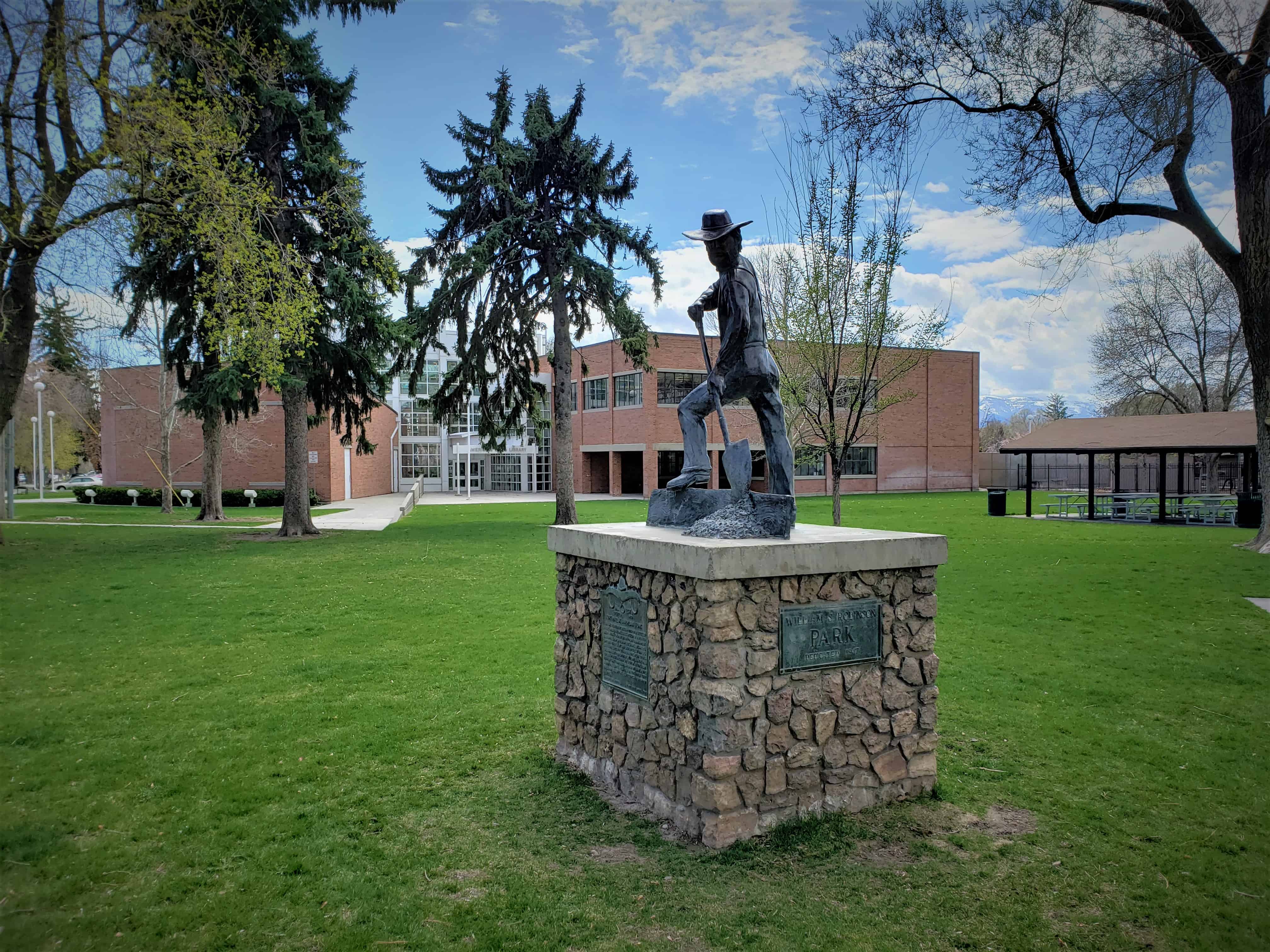
In 1852 Mormon Pioneers who had settled on the American Fork creek received orders to build a fort for protection from Indians. Most cabins were moved into an enclosure 80×74 rods, covering 37 acres. By 1855 each of the families built a wall 12×6 feet across the rear of his lot, using clay poured into log forms. A tax was levied to erect a corral in center of the fort with gates at corners. This monument marks the south wall. The bell was on the first city hall and tolled for all meetings and curfew at nine.
This marker is located in William S. Robinson Park.
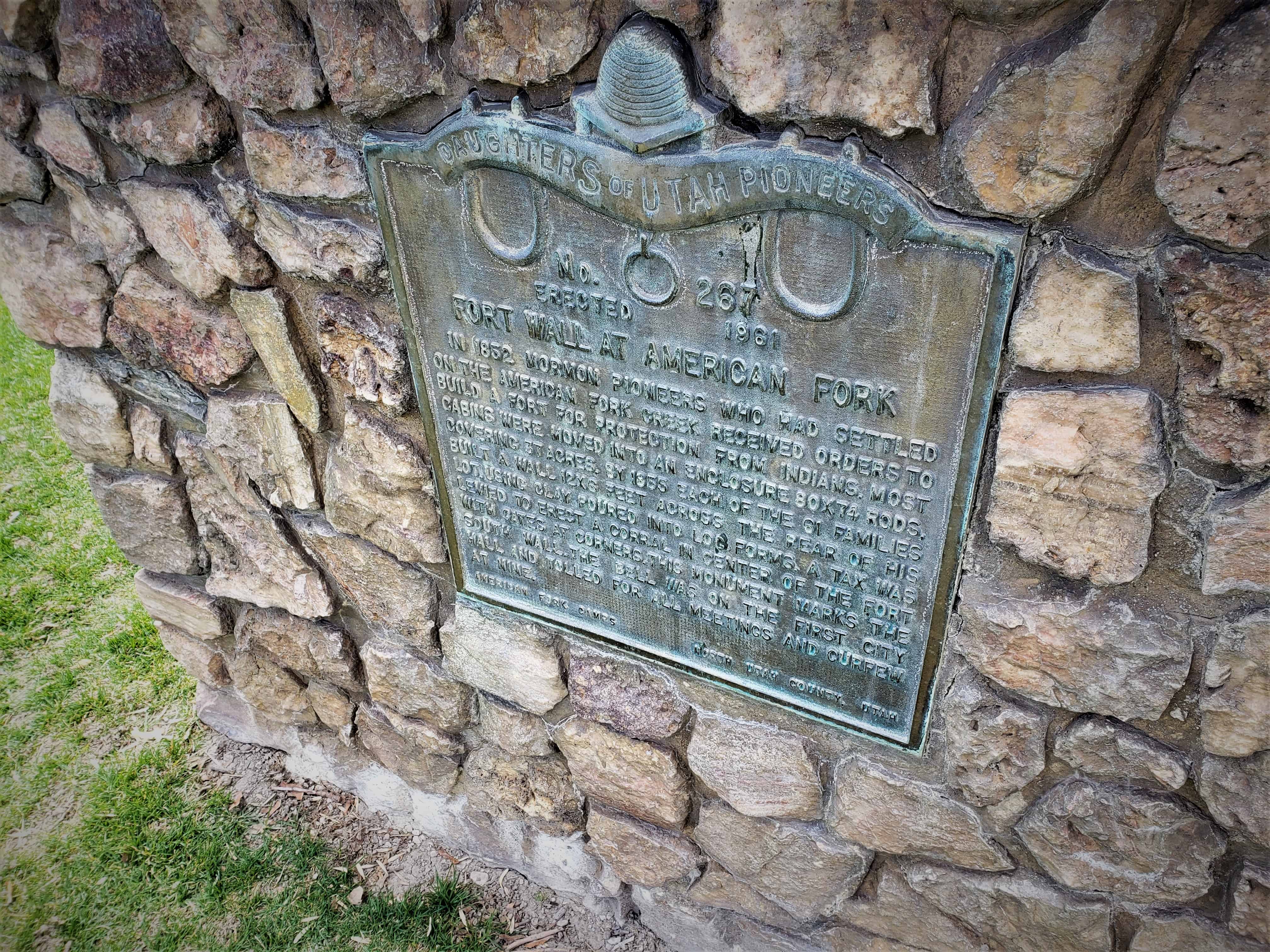


Check out all of the historic markers placed by the Daughters of Utah Pioneers at JacobBarlow. com/dup
12 Tuesday Nov 2013
Posted in Uncategorized
Tags
Alpine, American Fork, Cedar Hills, Highland, Lehi, utah, utah county

Located between Alpine and Highland on the slopes of Mount Timpanogos, Cedar Hills is small but one of the faster growing towns in Utah.

Cedar Hills
(taken from the city’s website)Cedar Hills is built upon an alluvial fan, or bench, created thousands of years ago when it was a shoreline of Lake Bonneville. Early settlers referred to the area as “the Bench.” Because of the growth of cedar trees (later becoming Manila’s source of Christmas trees), the area was later referred to as Cedar Hills. The bench provides a beautiful view of the surrounding mountains, Utah Lake, and Utah Valley. Cedar Hills was established as a community in 1977. The surrounding cities such as Pleasant Grove and Alpine were settled in 1849 and 1850.
Various forms of wildlife flourished in the area. Coyotes prowled along the bench. Wild cats, red foxes, bears, deer, skunks, and rabbits also lived in the area. Some deer, skunks, and rabbits can still be seen around Cedar Hills.
The dry bench upon which Cedar Hills is located provided little attraction to Native Americans. They preferred camping near streams, such as in American Fork Canyon. Several Native American artifacts were found upon the bench, however, including an Indian bowl (found by Paul Adams and currently on display at a Brigham Young University museum) and numerous arrowheads. The arrowheads were probably dropped during skirmishes between the Utah Valley Indians and the Shoshones.
Between 1849 and 1850, early settlers began to make their homes in settlements around Cedar Hills. A large portion of Cedar Hills was used for dry farming, which proved to be unsuccessful. A few planted plots existed among the sage brush. Much of the area was used to pasture livestock. Other forms of livelihood among early settlers of Cedar Hills included trapping and turkey farming.
The bench became a turkey ranch. The David Evans Company Advertising Agency, advertiser for the National Turkey Federation, would take pictures of the Adams turkey ranch because of its impressive background. In 1939, the National Poultry Congress in Cleveland, Ohio, displayed photographs of turkeys raised on the beautiful bench upon which Cedar Hills is now located. And, as NBC ran a news story about turkey farming on the bench, the photographer was taken back by the beauty of the bench and continued to say, “beautiful, beautiful.” In 1962, the Saturday Evening Post also ran stories about turkeys living upon the bench.
Visit my list of places in Utah.
07 Sunday Apr 2013
Posted in Uncategorized
Tags
American Fork, Cemeteries, DUP, historic, Historic Markers, Pioneer Cemeteries, utah, utah county

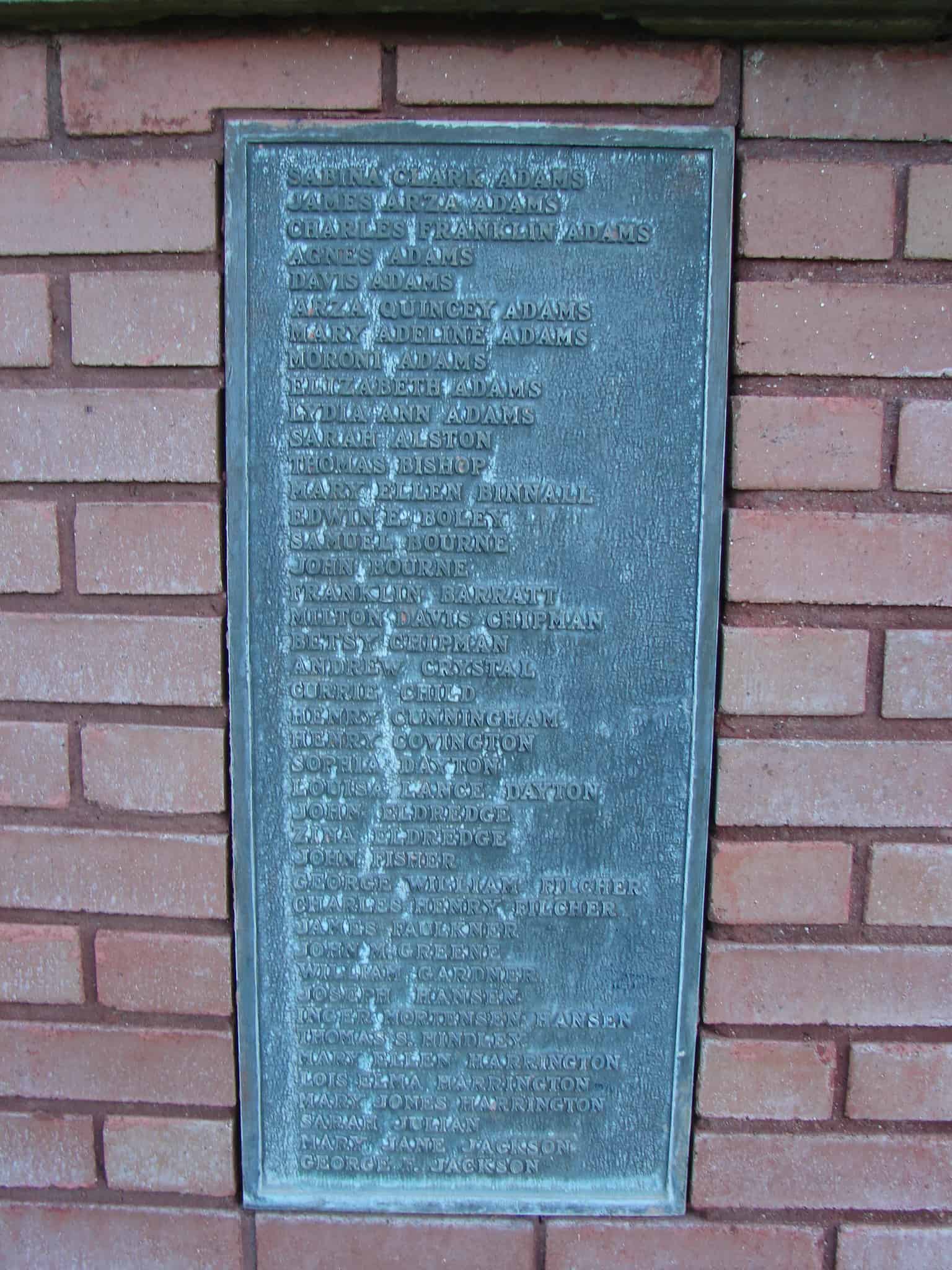
This spot served as burial ground for pioneers of American Fork from about 1852 to 1868. When death came to the village, bodies were prepared for burial and graves dug by friends and relatives. Some Indians were buried here.
Listed on plaques are names of the pioneers buried here.
South Plaque
North Plaque
Related Posts:
Located in Pioneer Park.