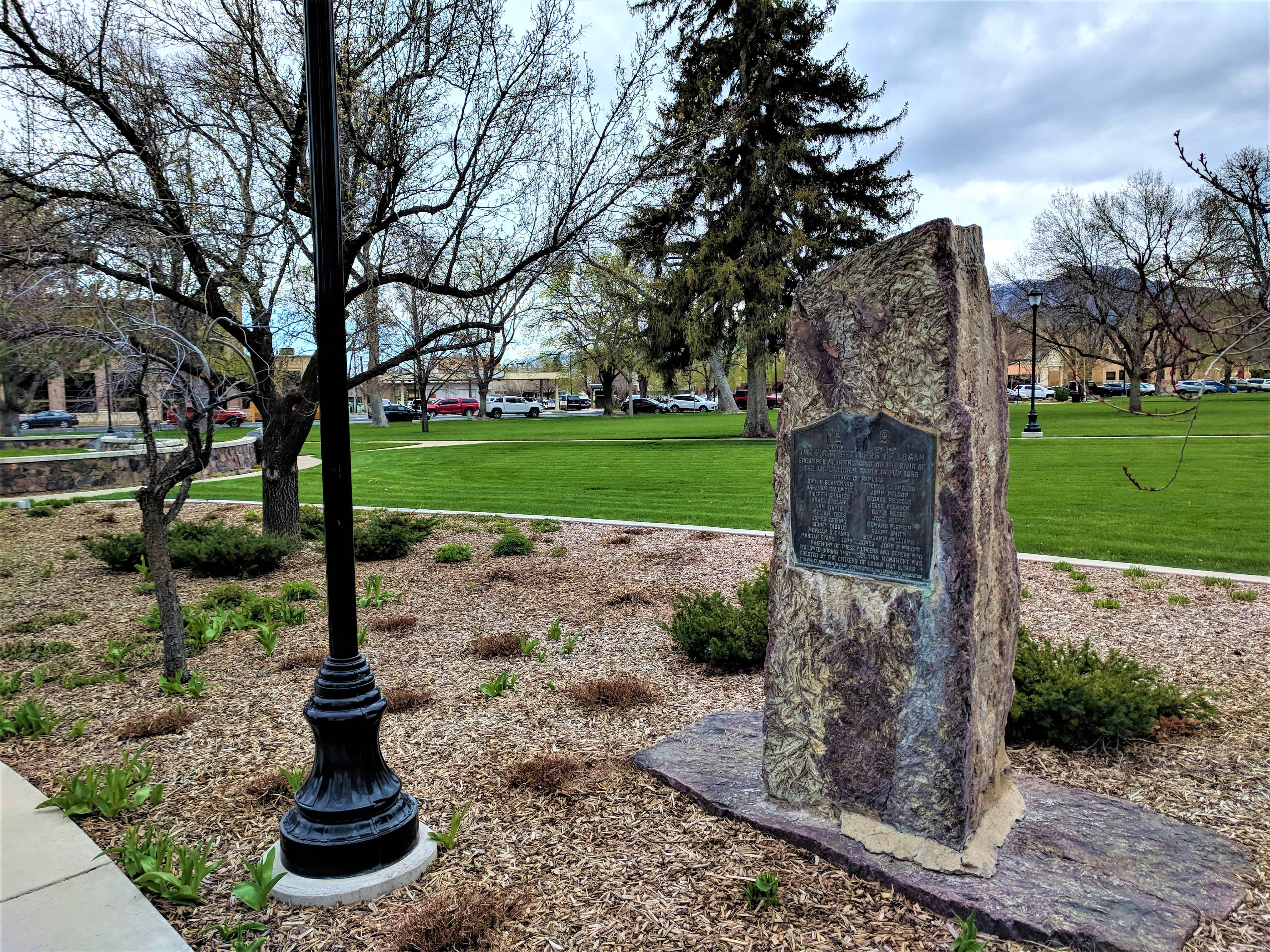
The first settlers of Logan encamped near this spot on the bank of the Little Logan early in May 1859
Heads of families
John R. Blanchard
Thomas E. Landers
Abraham Caldwell
John Nelson
Griffith Charles
George Peacock
Israel J. Clark
Jesse Pearson
Ann Davis
David Reese
William Dees
Joel Ricks
James Deming
Edward W. Smith
Sidney Dibble
Ralph Smith
Morgan S. Evans
Benjamin Williams
Morgan Evans
John E. Jones
John P. Wright
In memory of these pioneers and others who followed during that year. This monument was erected by the citizens of Logan May 6, 1909
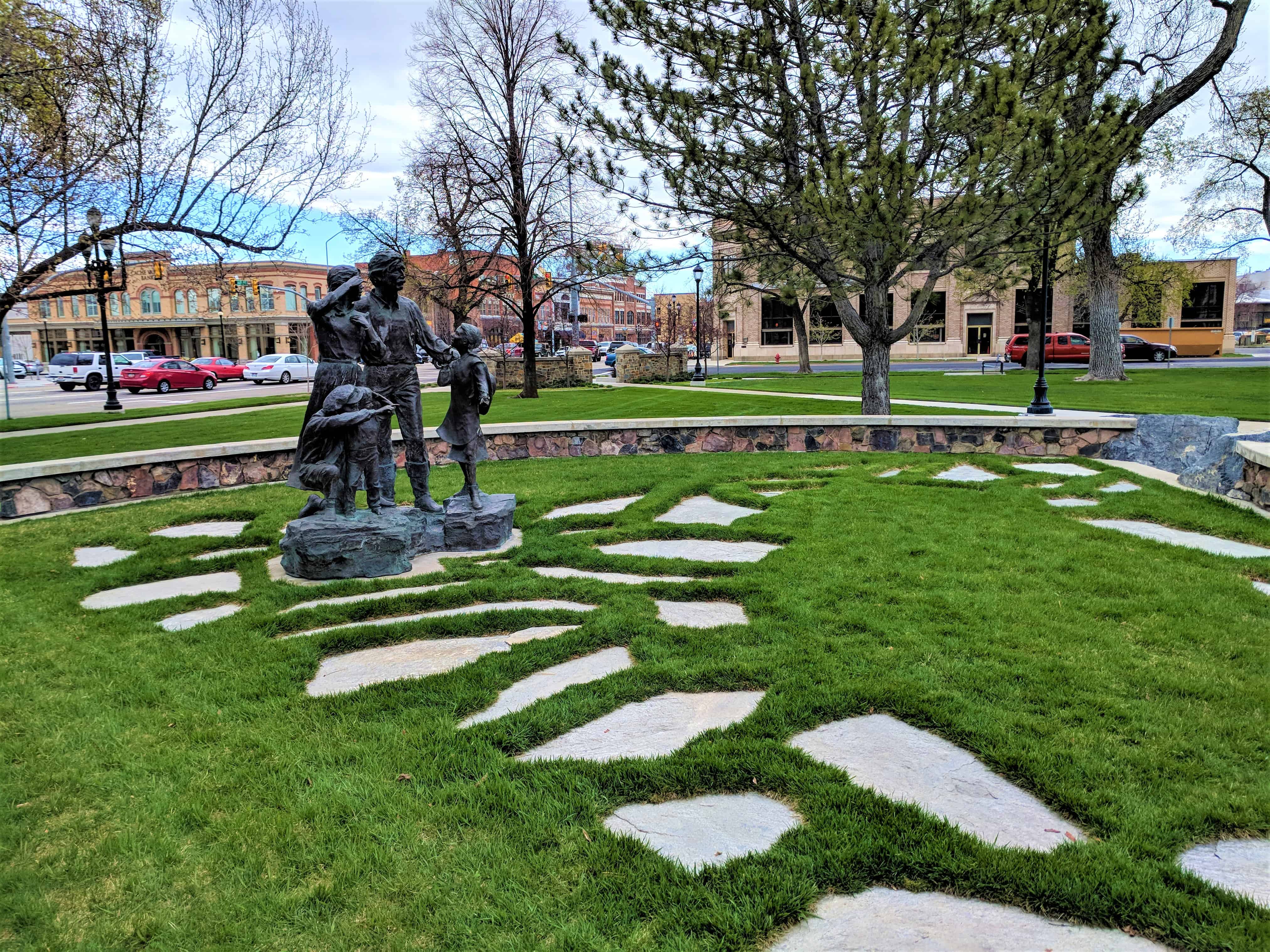
This marker is located at the Logan Tabernacle in Logan, Utah. Check out all of the historic markers placed by the Sons of Utah Pioneers and UPTLA at JacobBarlow. com/sup
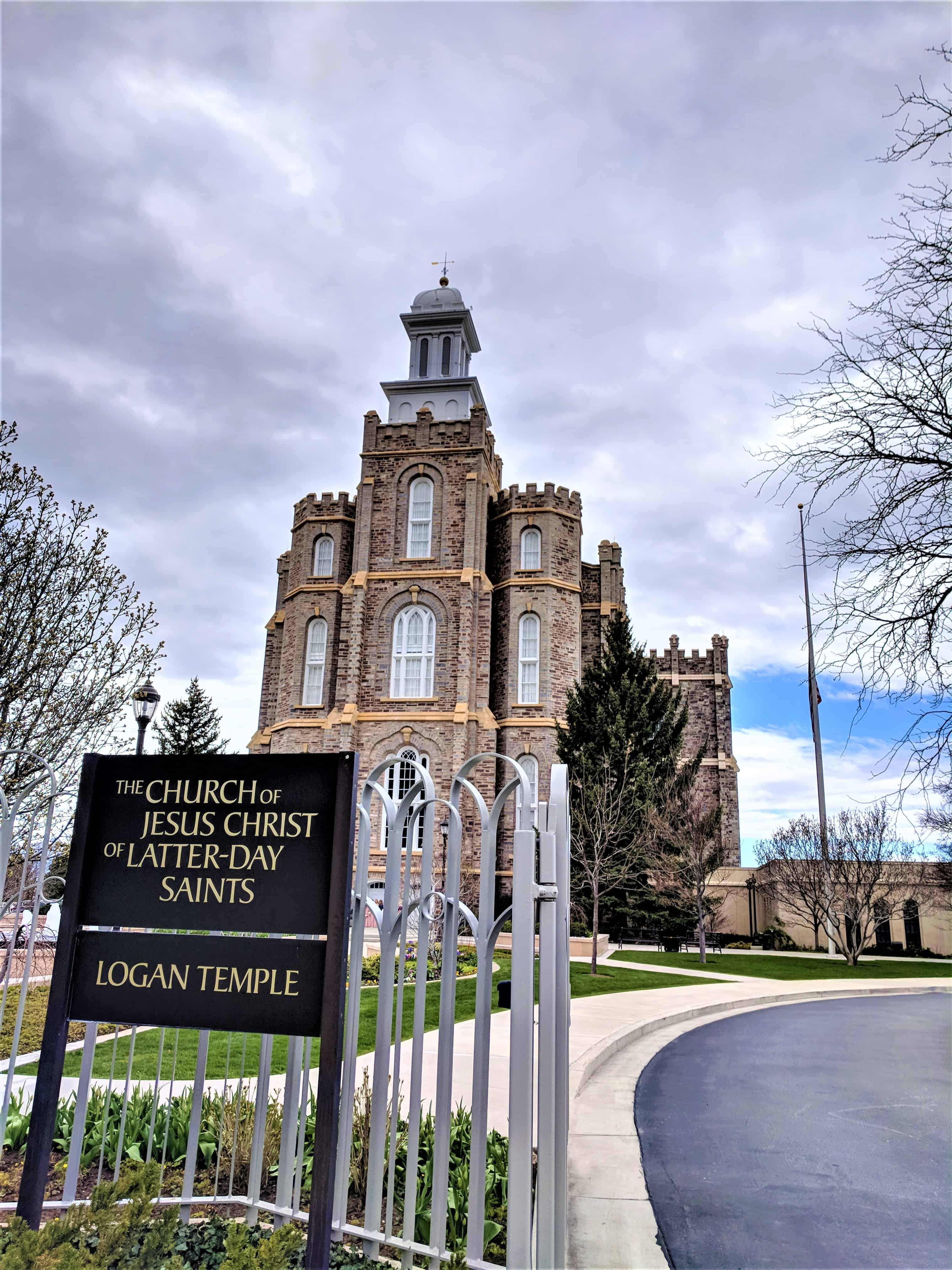
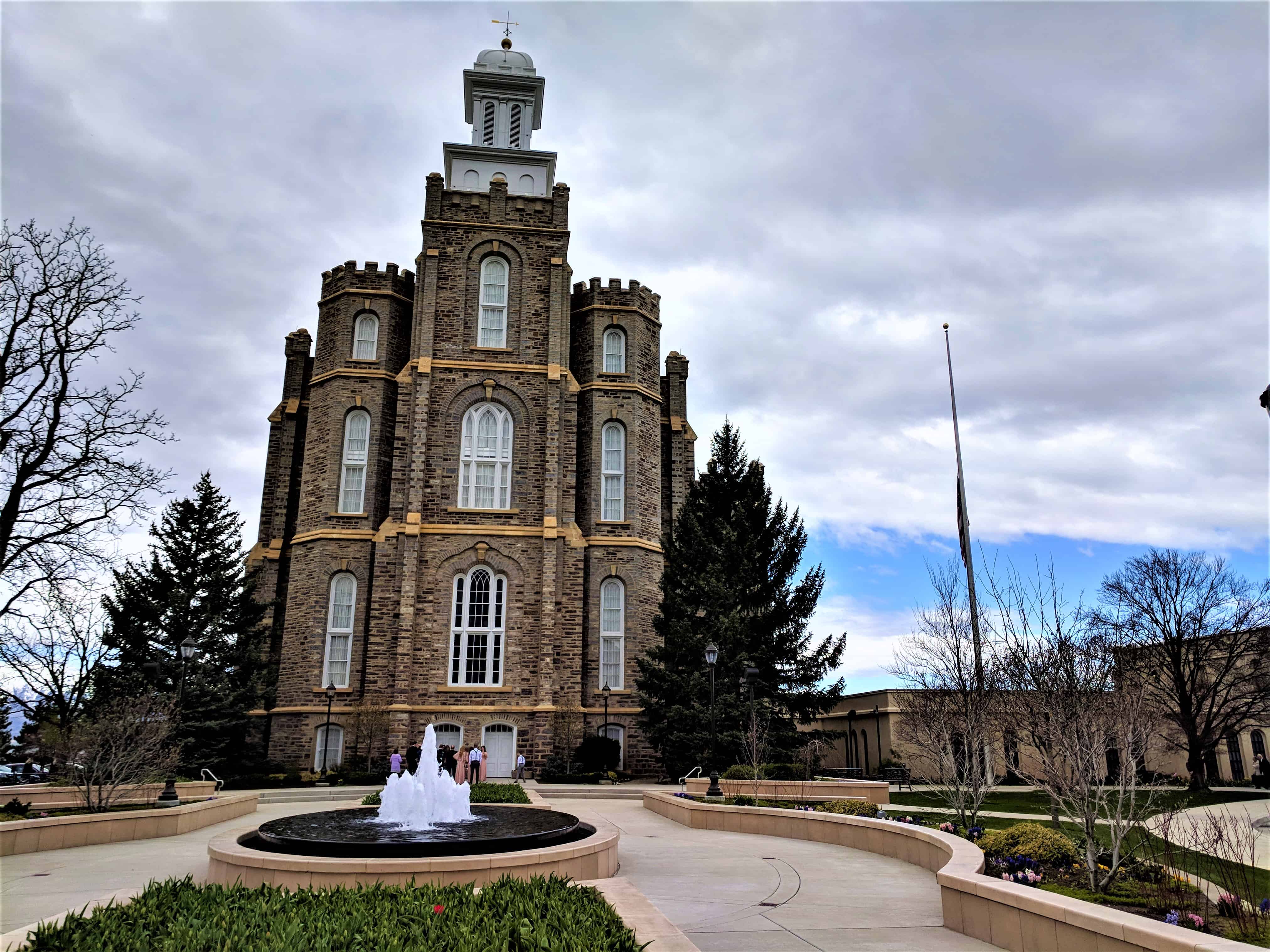
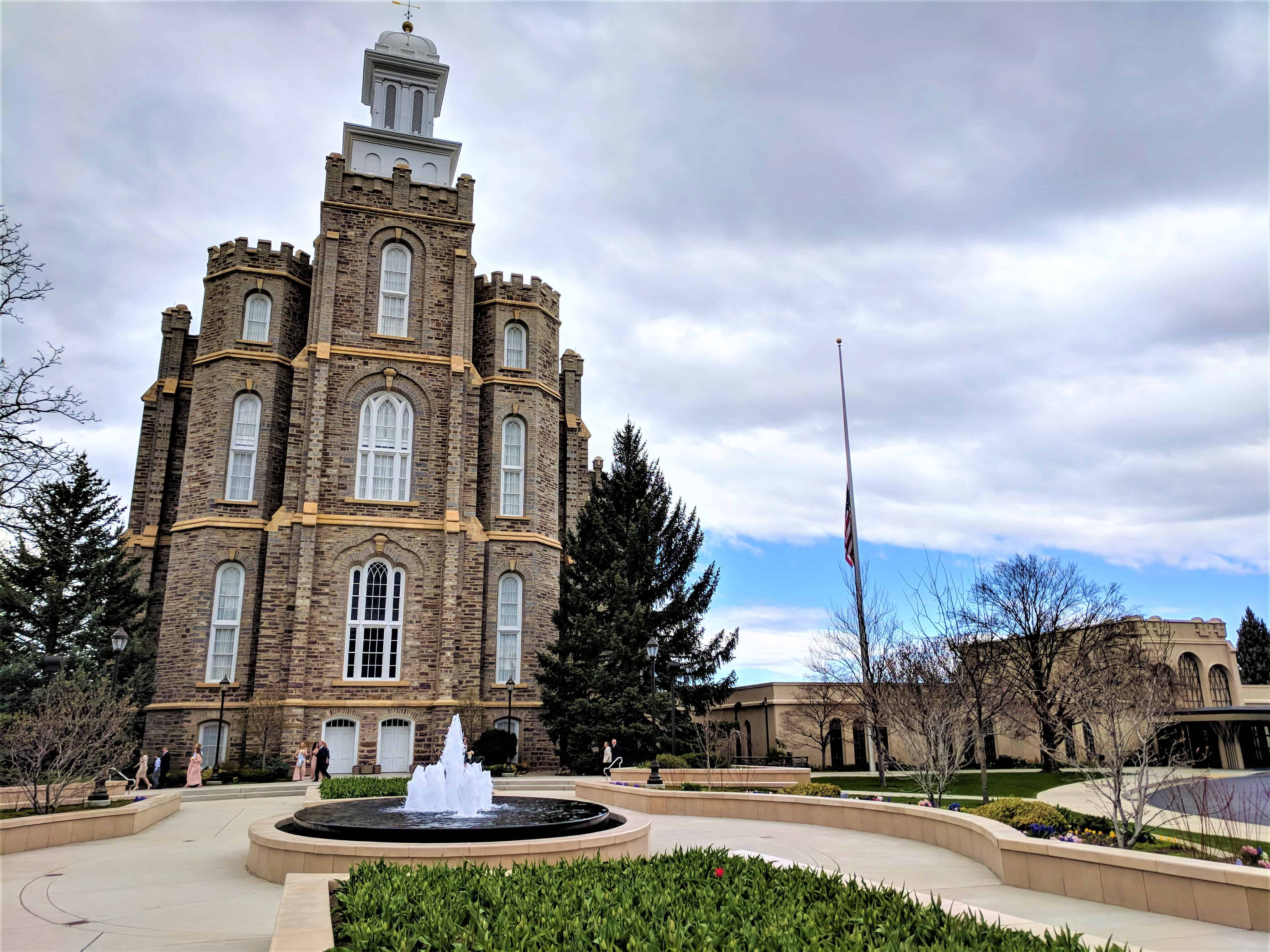
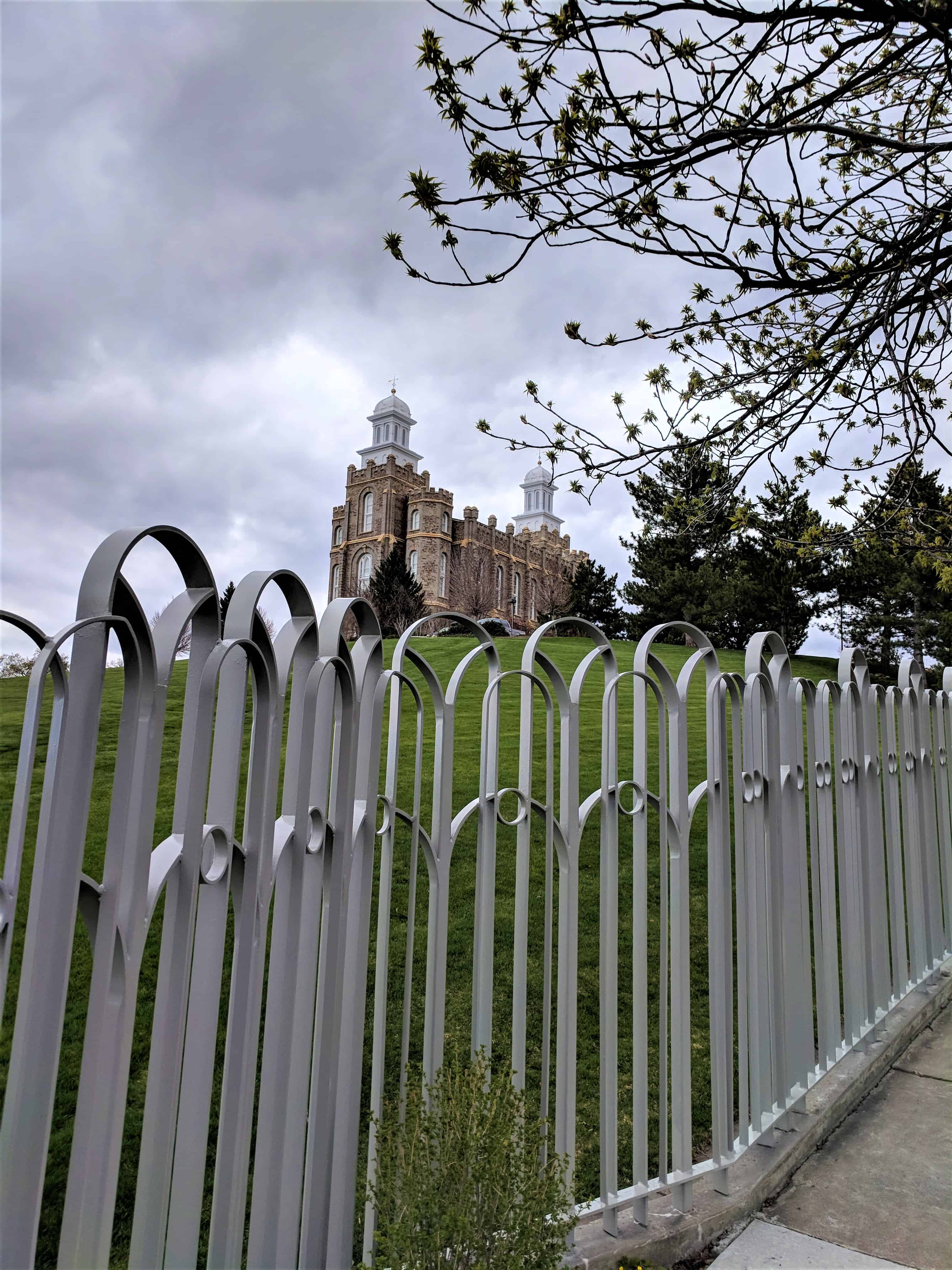
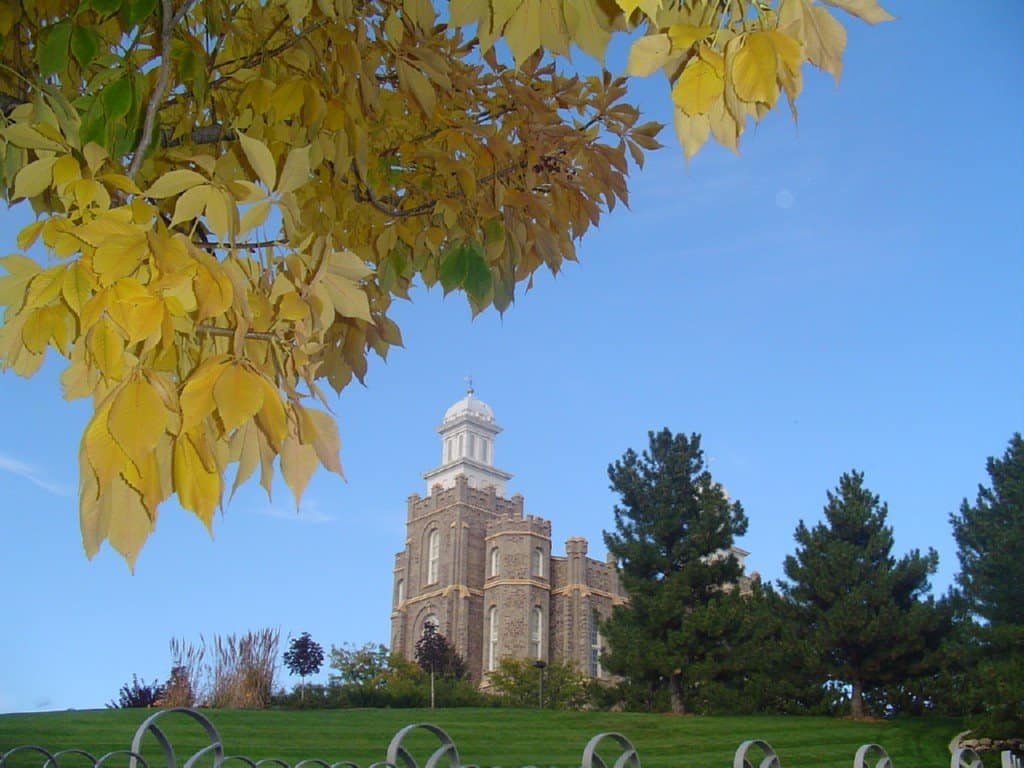
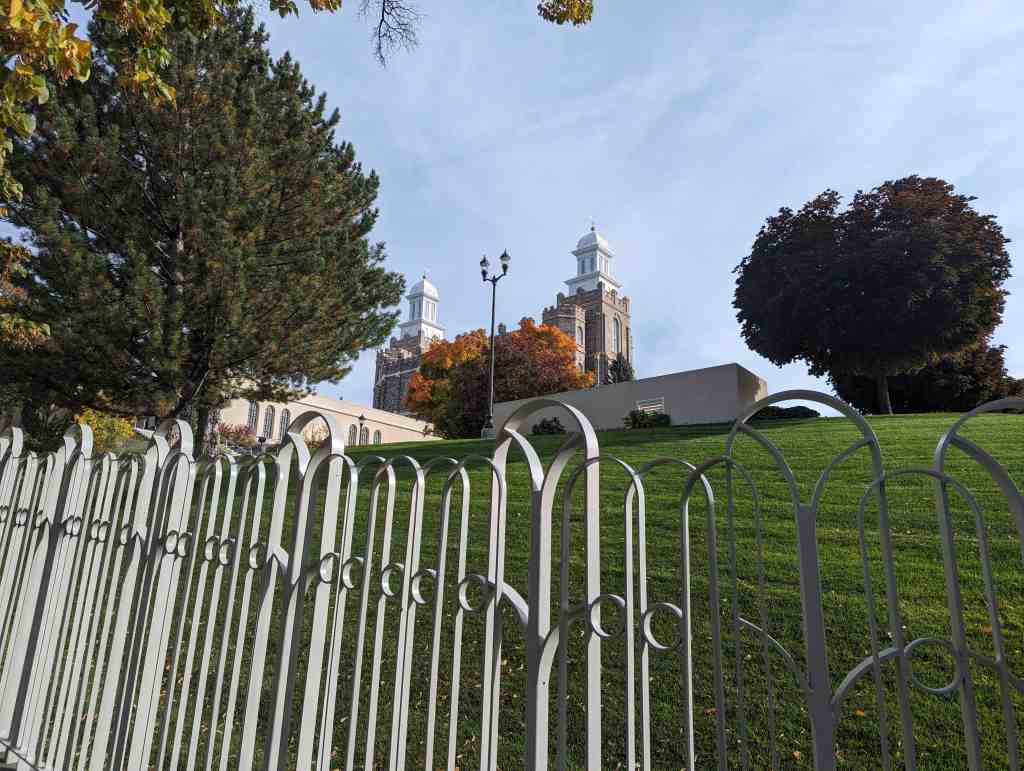
Located at 175 North 300 East in Logan Utah and added to the National Register of Historic Places (#75001801) on November 20, 1975 – the text below is from the nomination form from the national register:
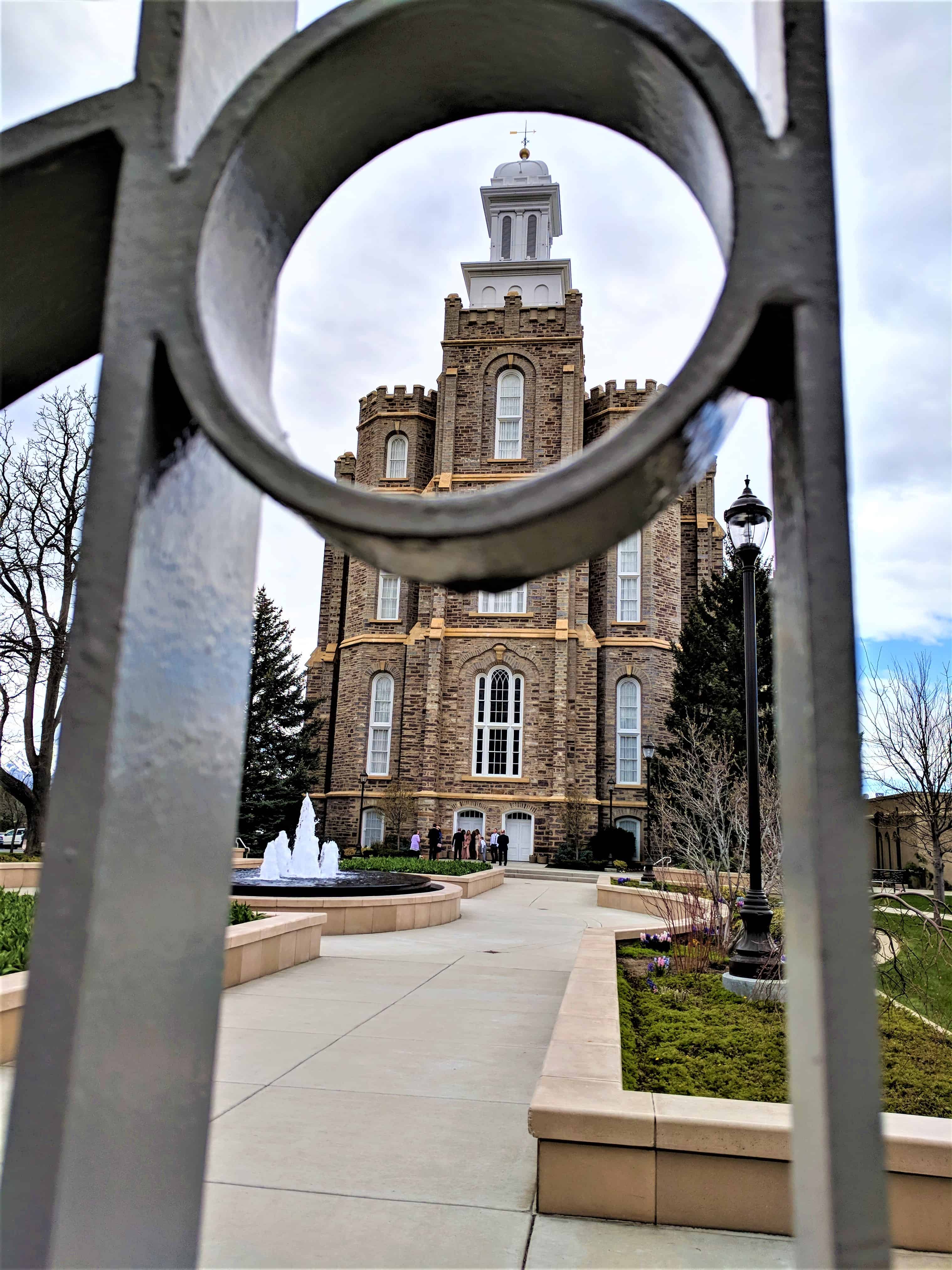
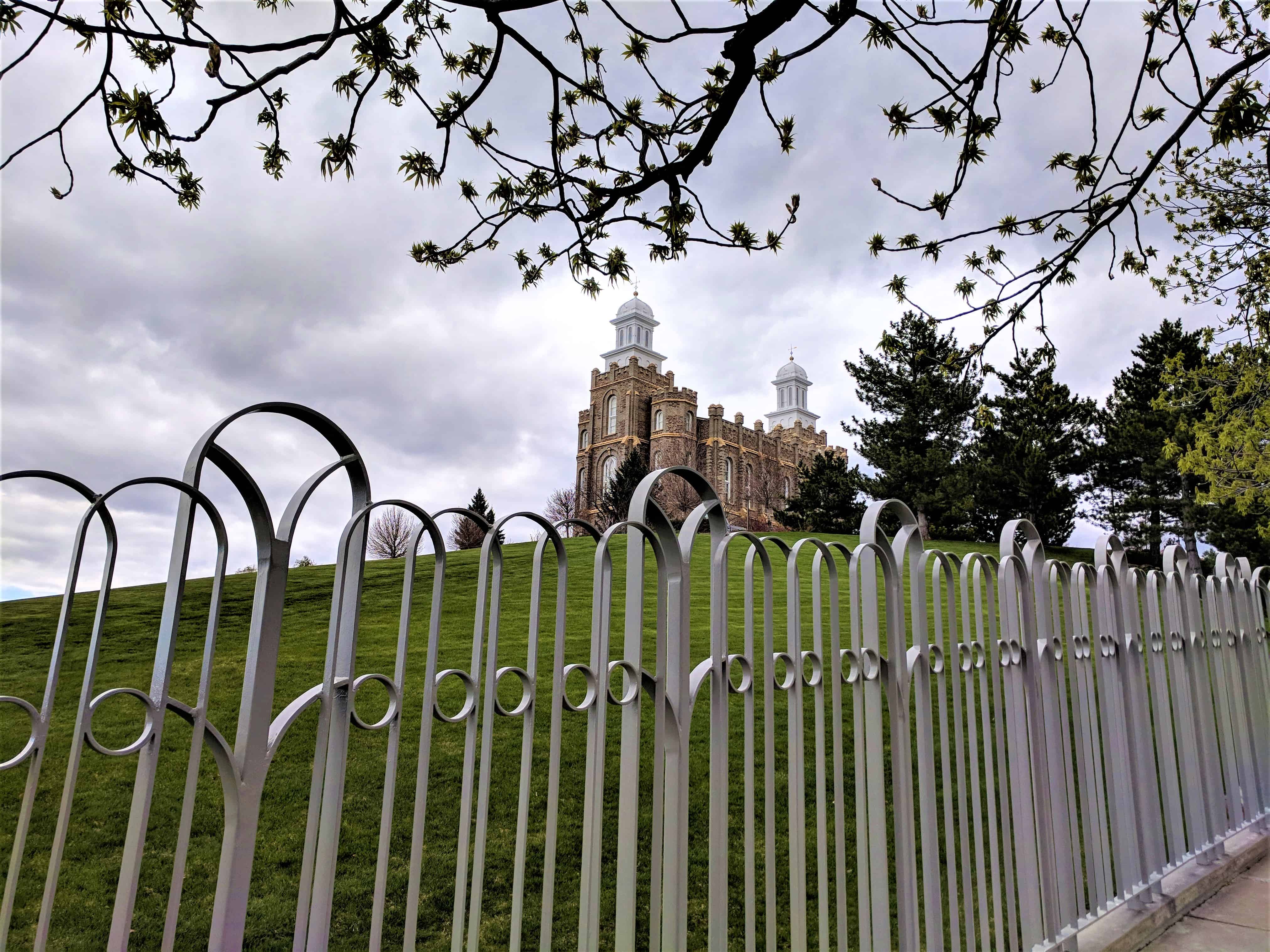
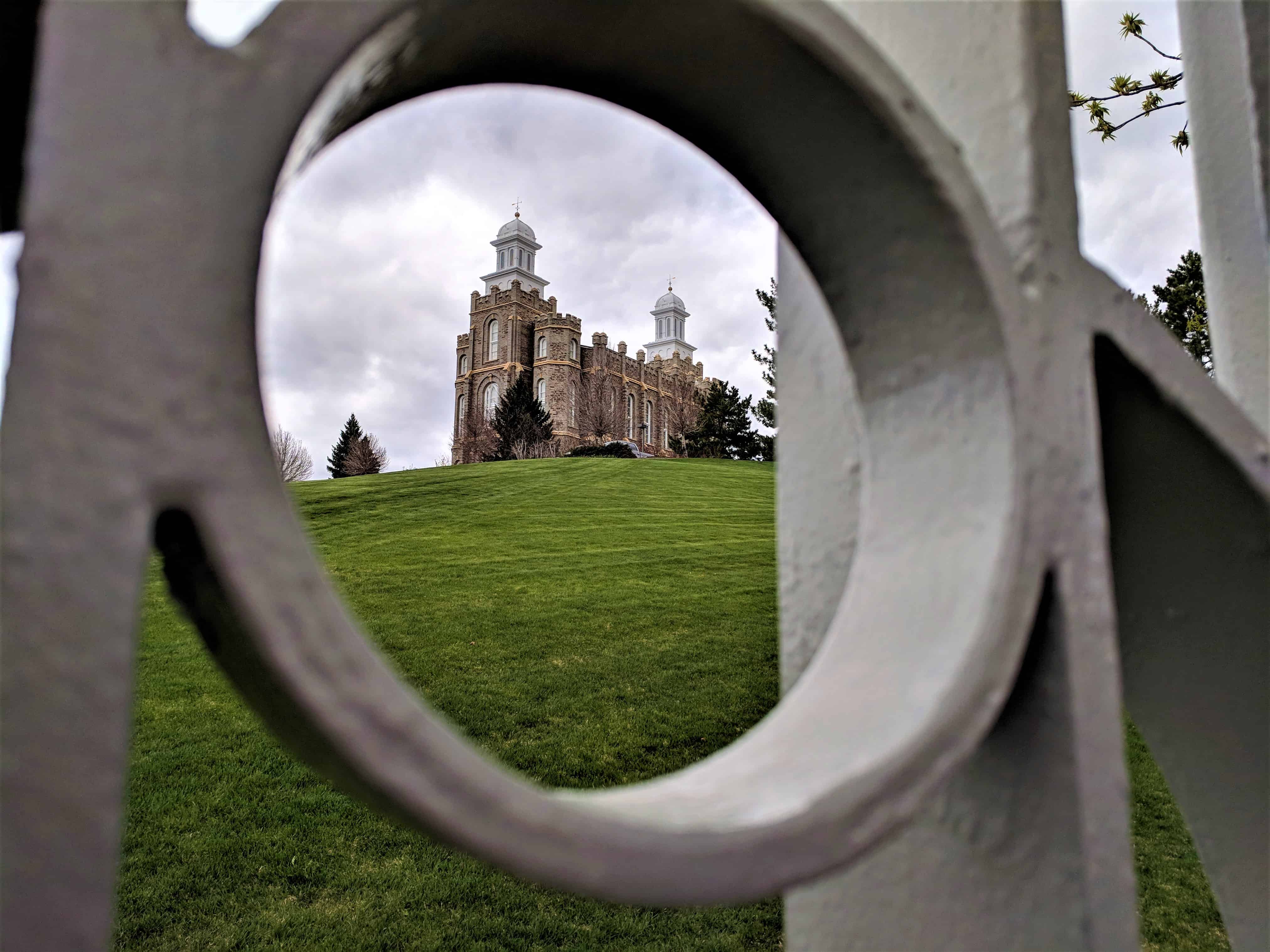
The Logan Temple has been defined as the structural and spiritual symbol of Cache Valley. Built on a hill near the center of Logan, the temple can be seen from almost every part of the valley,
Worship in the LDS temples is restricted to the devout and faithful members of the Mormon Church and the Logan Temple is, for the Mormons of northern Utah and southern Idaho, the most important religious shrine in their vicinity,
In 1871, Wilford Woodruff, at that time a member of the Quorum of the Twelve Apostles, while speaking at Logan predicted that a temple would be built on the east bench of Logan and two years later Brigham Young also suggested that ” fine temple … be built on the bench crowning the eastern part of the city.” (quoted in Joel E. Ricks, ed., The History of a Valley, p. 283.)
Groundbreaking ceremonies were held on May 18, 1877. Brigham Young, presiding at the dedication, outlined the procedure by which the temple would be built “We require the brethren and sisters to go to with their might and erect this temple; and from the architect to the boy who carried the drinking water, to the men that work on the building, we wish them to understand that wages are out of the question. We are going to build a house for ourselves, and we shall expect the brethren and sisters, neighborhood after neighborhood, ward after ward, to turn out their proportion of men to come here and labor as they shall be notified by the proper authorities.” (quoted in Leonard J. Arrington and Melvin A, Larkin, “The Logan Tabernacle and Temple,” Utah Historical Quarterly, Summer, 1973, p. 305.)
Six temple industries were established to provide materials for the temple construction:
A sawmill was established in Temple Fork (Mauqhan’s Fork) in Logan Canyon. Here they cut red pine (Douglas fir).
A wood camp was set up a few miles down the canyon. This provided firewood, for the lime kilns and scaffolding for workmen, railroad ties for sale, and telegraph poles for their cooperative Deseret Telegraph Company.
A lime kiln was built in the mouth of the canyon. The firewood to provide fuel was floated downstream on the Logan River.
The main stone quarry was developed in Green Canyon, east of North Logan. Here they quarried the dark fucoid quartzite which is the main component of the exterior walls.
Another quarry in Hyde Park Canyon provided additional stone for the walls.
A third quarry northeast of Franklin supplied sandstone for the water tables, caps, and window ledges. (Ibid., p. 306.)
In addition to supplying materials for the temple f the industries also provided building materials used in the erection of homes, farms and businesses by those temple employees who received their pay in these essential supplies.
Records indicate that a total of $607,000 was donated for the temple construction in the following categories: $30,000 in merchandise (5 percent) $30,000 in livestock (5 percent) $71,000 in produce (12 percent) $93,000 in cash (15 percent) $380,000 in labor (63 percent) $3,000 in wagons and teams (Ibid., p. 308.)
The temple was under construction for seven years, from 1877 to 1884, during which time about one hundred fifty men and fifty teams worked constantly on the temple or at the temple industries.
Truman O. Angell, architect for the Salt Lake temple, St, George temple, Beehive House, Lion House and Territorial Capitol at Fillmore, also designed the Logan temple. The temple was formally dedicated on May 17, 1884.
In their article, Arrington and Larkin explain the economic significance of the temple project:
“In essence, the temple project was a means of redistributing income. Those of greater property and income supported craftsmen and laborers to work on the temple during the seven years of construction, Since the materials were nearly all supplied locally, the money, labor, and materials were not lost to the community. Very little was expended outside the valley, In essence, those able to furnish resources did so, and the community economy thus was enriched. In most frontier economies, surplus resources were used to build large homes for the wealthy. In Cache Valley, such large homes were products of the twentieth century when there were not projects as effective as the tabernacle and temple in utilizing surplus for the benefit of the entire community.” (Ibid., pp. 309-310).
Symbolically they conclude:
“The temple was a kind of private mountain a corporeal embodiment of their ideals a formidable defender of the Saints’ way of life, symbolically guarding the church from the threats of the larger society around them, It was also a symbol of their reaching out to God of their closeness to God a place to which the Savior would come to dwell with them, In many respects the temple came to be regarded almost in a mystical sense, In actuality, it was a more explicit formulation of the rugged and majestic mountains around them a man-made sentinel, guarding their Promised Valley.
“Today the Logan Temple can be seen from almost every part of the valley. It symbolically demonstrates the early settlers’ belief that life is more than a struggle for physical survival. To the twenty-five thousand persons who built it and labored on it ‘without purse or scrip,’ it was a visual reminder of the omnipresence of eternity. “ (Ibid., p. 314).
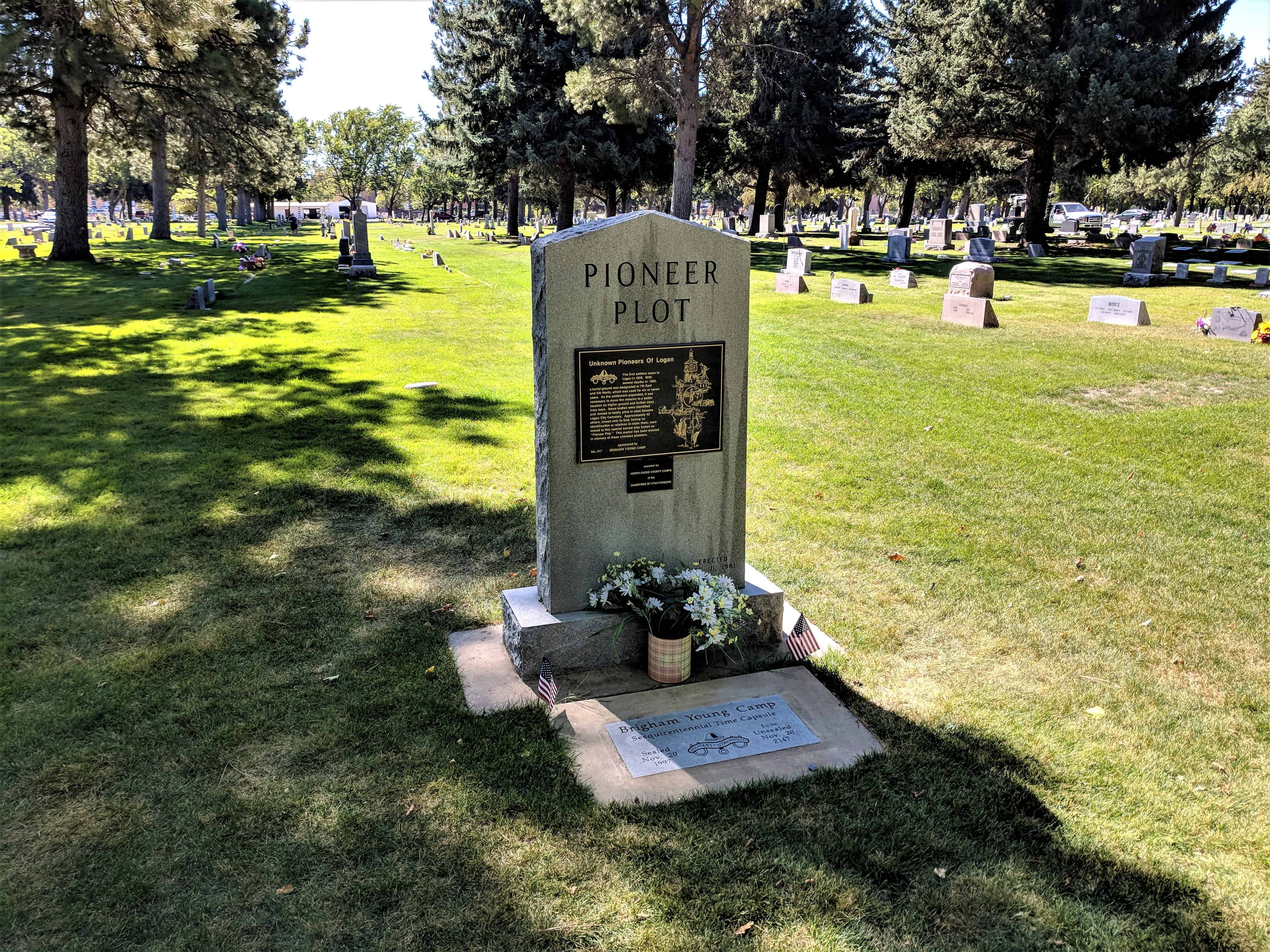
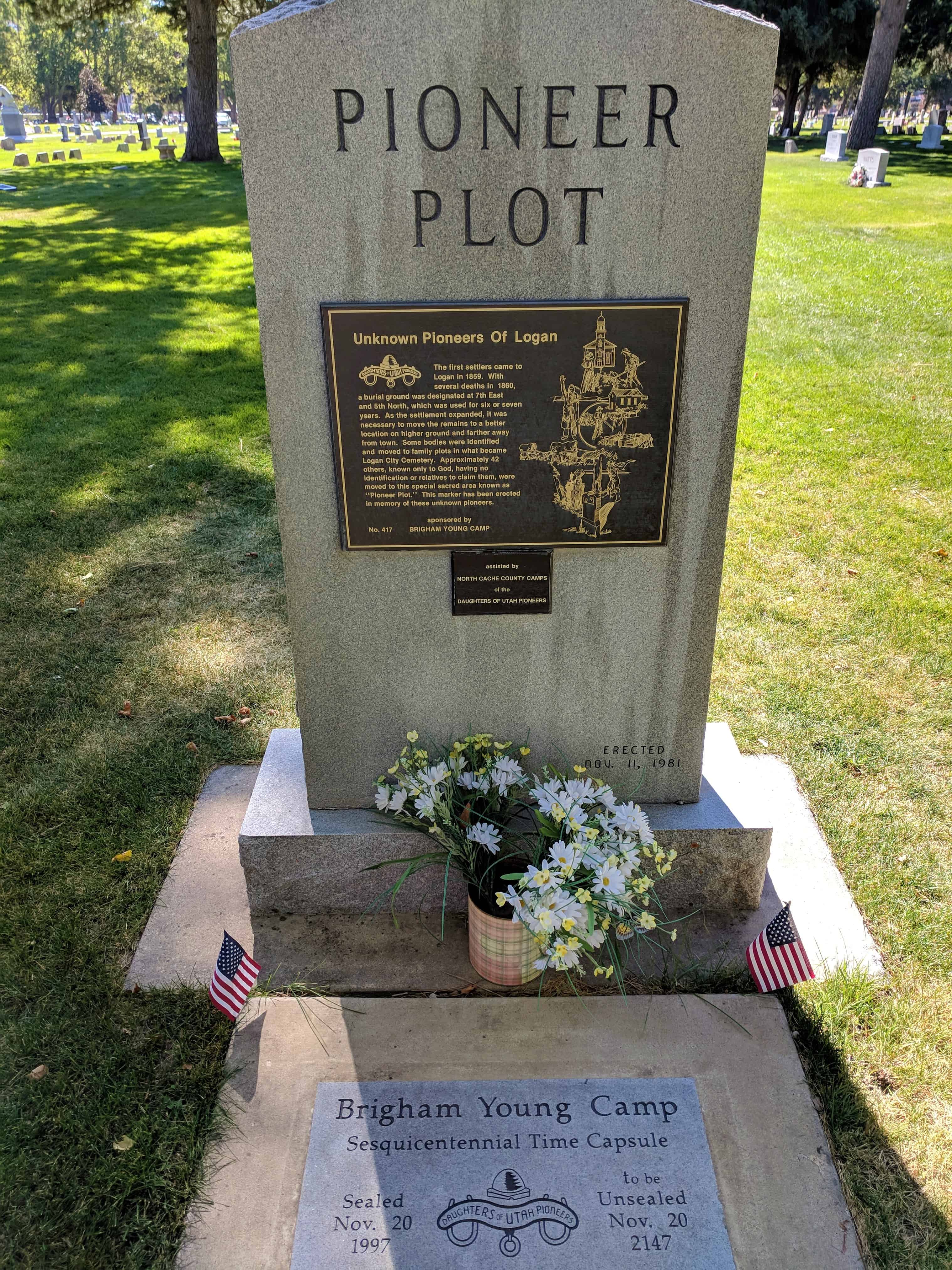
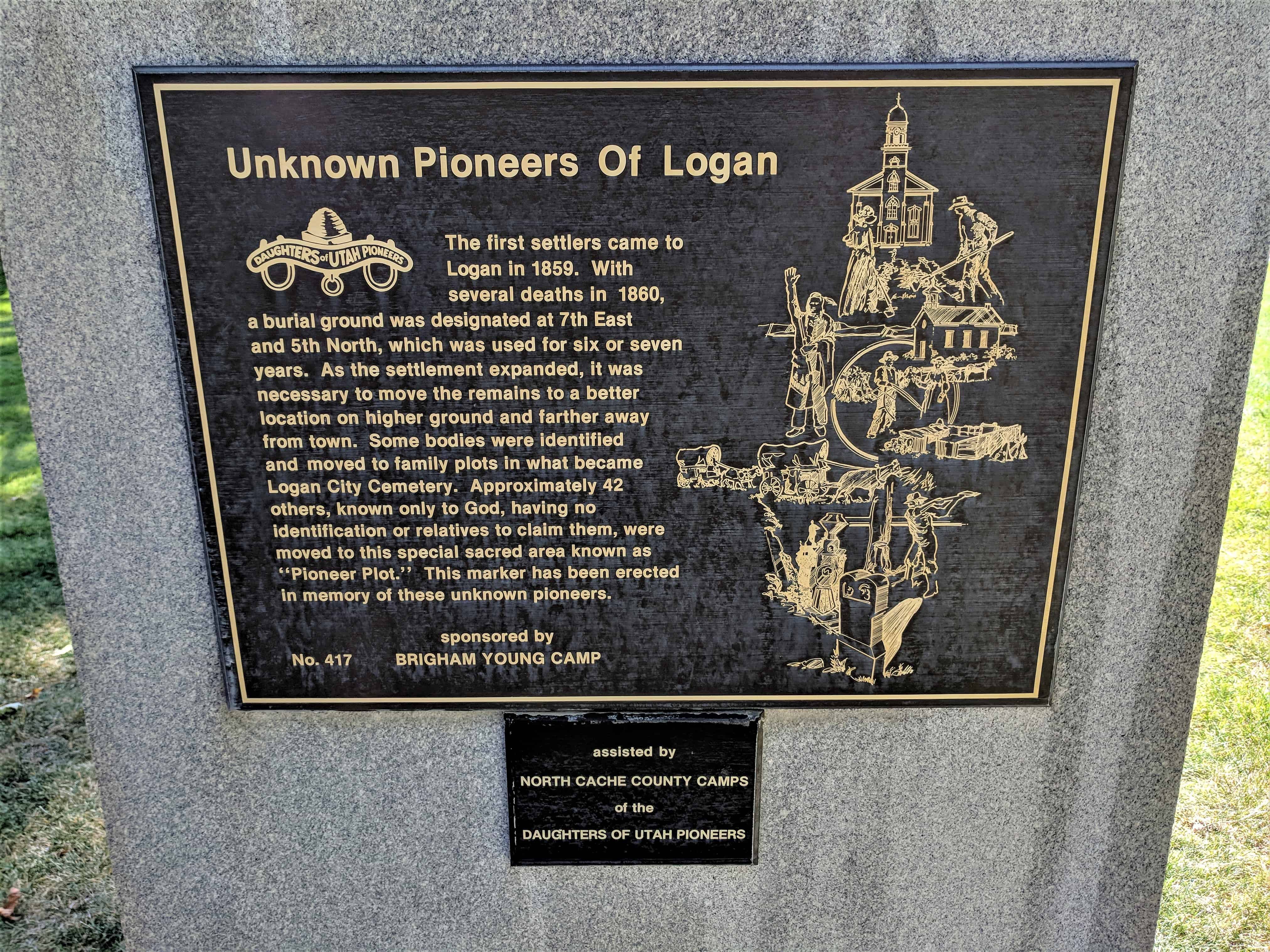
The first settlers came to Logan in 1859. With several deaths in 1860, a burial ground was designated at 7th East and 5th North, which was used for six or seven years. As the settlement expanded it was necessary to move the remains to a better location on higher ground and farther away from town. Some bodies were identified and moved to family plots in what became Logan Cemetery. Approximately 42 others, known only to God, having no identification or relatives to claim them, were moved to this special sacred area known as “Pioneer Plot.” This marker has been erected in memory of these unknown pioneers.
This is D.U.P. Marker #417 located in the Logan Cemetery in Logan, Utah. For other D.U.P. Markers visit this page.
Cove is a census-designated place (CDP) in Cache County, Utah, United States. The population was 460 at the 2010 census. It is included in the Logan, Utah-Idaho Metropolitan Statistical Area.
From OnlineUtah: Lewiston, Utah, is located in the geographic center of Cache Valley, twenty miles northwest of Logan and ten miles south of Preston, Idaho. The town occupies a triangularly shaped land area of approximately 24 square miles, with a base along the Utah-Idaho state boundary in the north, and extends southward between the Bear River on the west and the Cub River on the east to a point where the two streams join in the south. The area is almost entirely flat and contains some of the most productive agricultural land in the state.
Lewiston has always been an agricultural community. The dairying and livestock industries are predominant, and most crops are grown to support them. Some acreage is devoted to supplying vegetables to canneries in the area, but wheat, barley, and alfalfa are the major crops produced. Sugar beets, an important crop for many years, declined in importance after the town’s sugar factory closed in 1972. Many residents supplement their farm incomes by working in local factories or through other non-farm occupations.
The town of Logan was founded in 1859 by settlers sent by Brigham Young to survey for the site of a fort near the banks of the Logan River. They named their new community “Logan” for Ephraim Logan, an early fur trapper in the area. Logan was incorporated on 17 January 1866. Brigham Young College was founded here in 1878 (but later closed), and Utah State University – then called the Agricultural College of Utah – was founded in 1888.
The town of Smithfield (originally known as “Summit Creek” )in Cache Valley, Utah, was tied to the early Mormon colonization of Utah. Part of what has been labeled “the inner cordon of settlements,” Cache Valley was itself settled in 1856, and Smithfield in 1859. As an agricultural region in northern Utah, Cache Valley aided in the supplying of goods not only to northern Utah, but also to mining regions in Idaho and Montana. Smithfield, which began as a settlement of dugouts and wagons, in 1860 became a village with houses arranged in “fort style” (forming a square where the rear portions of the buildings constituted the walls of the fort). It had been named Smithfield in 1859 for John Glover Smith, the first Mormon bishop, who exercised power in both church and civic affairs.