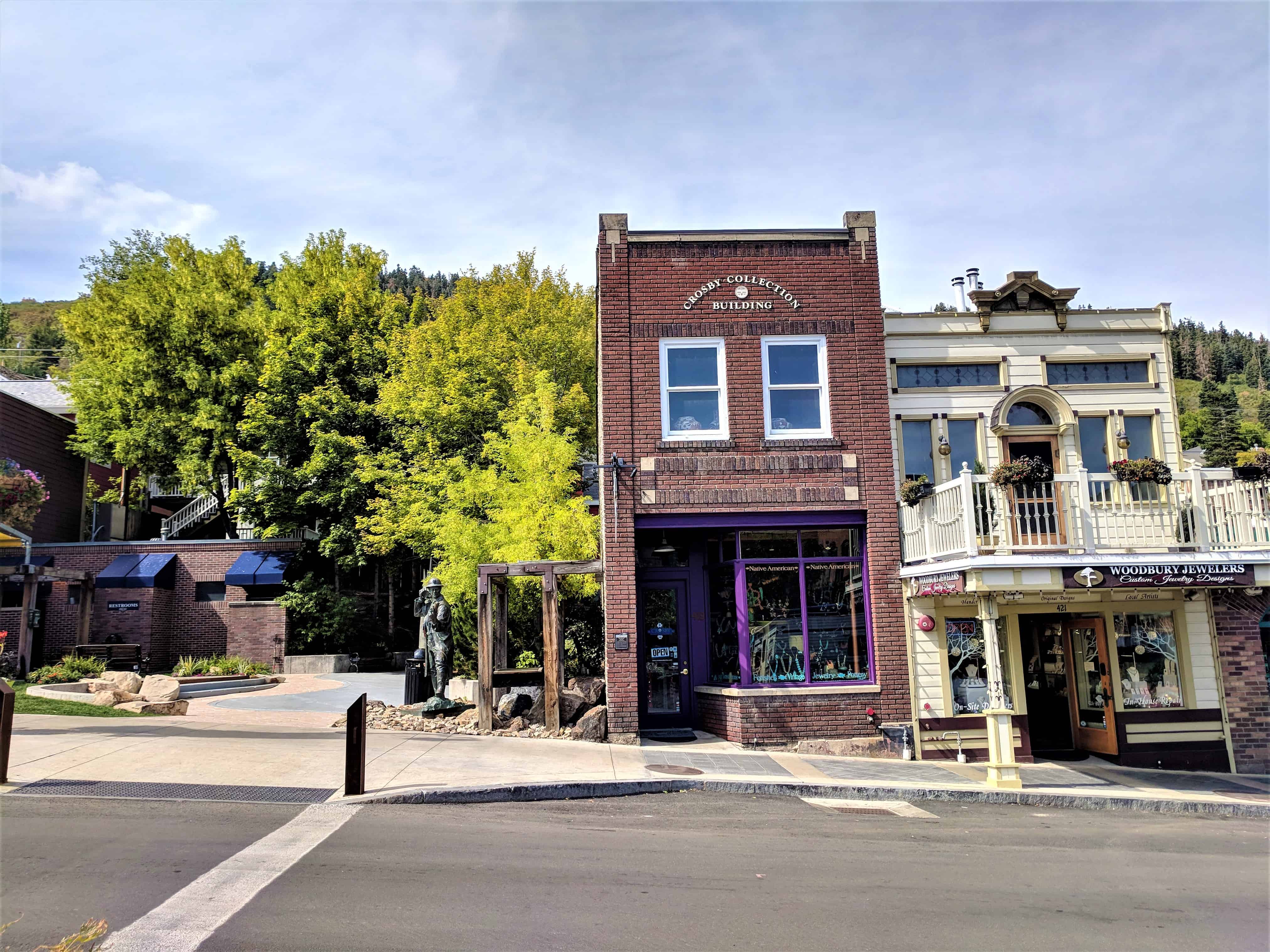
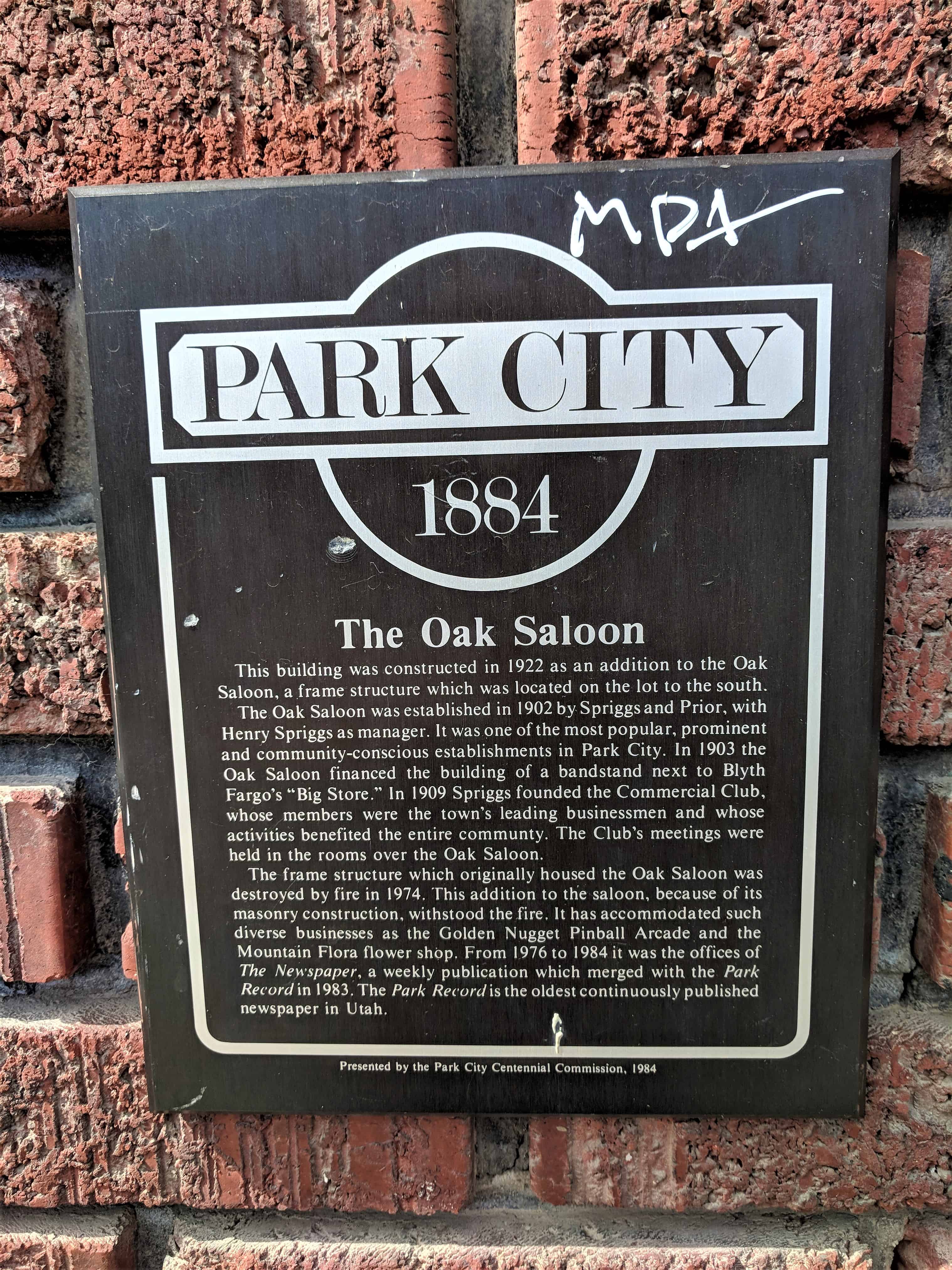
This building was constructed in 1922 as an addition to the Oak Saloon, a frame structure which was located on the lot to the south.
The Oak Saloon was established in 1902 by Spriggs and Prior, with Henry Spriggs as manager. It was one of the most popular, prominent and community-conscious establishments in Park City. In 1903 the Oak Saloon financed the building of a bandstand next to Blyth Fargo’s “Big Store.” In 1909 Spriggs founded the Commercial Club, whose members were in the town’s leading businessmen and whose activities benefited the entire community. The Club’s meetings were held in the rooms over the Oak Saloon.
The frame structure which originally housed the Oak Saloon was destroyed by fire in 1974. This addition to the saloon, because of its masonry construction, withstood the fire. It has accommodated such diverse businesses as the Golden Nugget Pinball Arcade and the Mountain Flora flower shop. From 1976 to 1984 it was the offices of The Newspaper, a weekly publication which merged with the Park Record in 1983. The Park Record is the oldest continuously published newspaper in Utah.
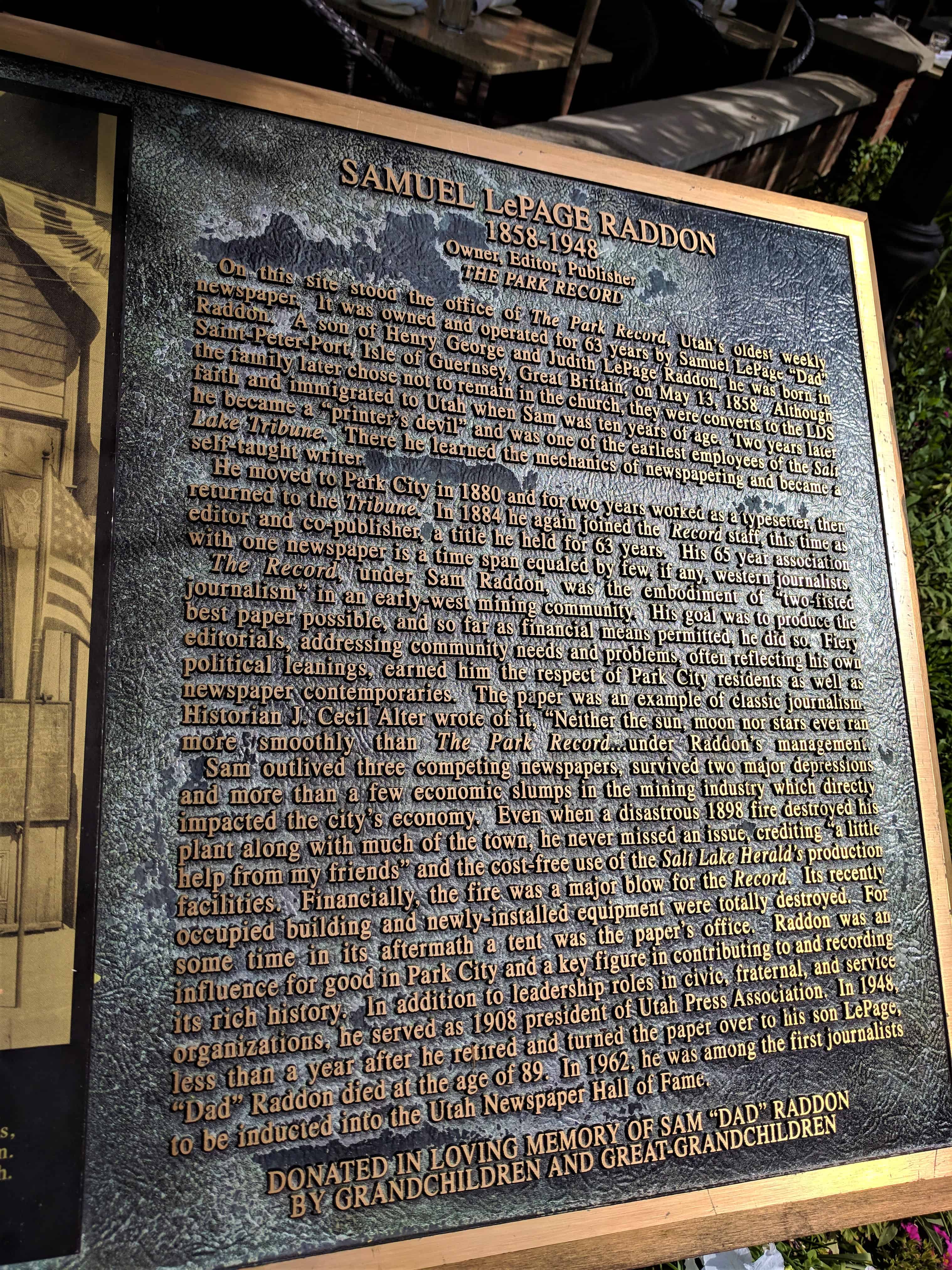
On this site stood the office of The Park Record, Utah’s oldest weekly newspaper. It was owned and operated for 63 years by Samuel LePage “Dad” Raddon. A son of Henry George and Judith LePage Raddon, he was born in the Saint-Peter-Port, Isle of Guernsey, Great Britain, on May 13, 1858. Although the family later chose not to remain in the church, they were converts to the LDS faith and immigrated to Utah when Sam was ten years of age. Two years later he came a “printer’s devil” and was one of the earliest employees of the Salt Lake Tribune. There he learned the mechanics of newpapering and became a self-taught writer.
He moved to Park City in 1880 and for two years worked as a typesetter, then returned to the Tribune. In 1884 he again joined the Record staff, this time as editor and co-publisher, a title he held for 63 years. His 65 year association with one newspaper is a time span equaled by few, if any, western journalists.
The Record, under Sam Raddon, was the embodiment of “two-fisted journalism” in an early-west mining community. His goal was to produce the best paper possible, and so far as financial means permitted, he did so. Fiery editorials, addressing community needs and problems, often reflecting his own political leanings, earned him the respect of Park City residents as well as newspaper contemoraries. The paper was an example of classic journalism.
Historian J. Cecil Alter wrote of it, “Neither the sun, moon nor stars ever ran more smoothly than The Park Record…under Raddon’s management.
Sam outlived three competing newspapers, survived two major depressions and more than a few economic slumps in the mining industry which directly impacted the city’s economy. Even when a disastrous 1898 fire destroyed his plant along with much of the town, he never missed an issue, crediting “a little help from my friends” and the cost-free use of the Salt Lake Herald‘s production facilities. Financially, the fire was a major blow for the Record. Its recently occupied building and newly installed equipment were totally destroyed. For some time in its aftermath a tent was the paper’s office. Raddon was an influence for good in Park City and a key figure in contributing to and recording its rich history. In addition to leadership roles in civic, fraternal, and service organizations, he served as 1908 president of Utah Press Association. In 1948, less than a year after he tired and turned the paper over to his son, LePage, “Dad” Raddon died at the age of 89. In 1962, he was among the first journalists to be inducted into the Utah Newspaper Hall of Fame.
Miners are the anonymous thousands whose only monuments are the waste dumps in the mountains
This sculpture is dedicated to the remarkable accomplishments of those men who mined with great effort and ingenuity the silver and lead ores found in these mountains, men who simultaneously established the community of Park City which is now our legacy to preserve and enjoy.
The mining engineer is examining a piece of rock which was cored from the earth by a diamond drill, capable of extracting ore from over 1,000 feet away. Miners were always hopeful that another bonanza was about to be discovered.
Jim Ivers (1914-2000), a mining engineer who modeled for this sculpture, had a humble beginning in the mining industry. In 1928, as a 14 year old, he drove a horse drawn wagon to Thaynes Canyon, delivering supplies to remote operations. Like his father and grandfather before him, Jim worked in the Park City mines. His interest spurred him to obtain two degrees in Mining Engineering from Columbia University. He came back to work in the Silver King Mine for many years, then left to work in other mining camps, returning to Park City as President and General Manager of United Park City Mines Co. In the 1960s Jim shared the responsibility of directing the mining company’s new ski area, now called Park City Mountain Resort.
At one time Park City was well known as the site of a great silver mining bonanza: now it is world famous for its skiing.
This sculpture is the work of Peter Fillerup of Midway, Utah. It was dedicated on Miner’s Day September 5, 1999 and given by the citizens of Park City to the community.
The building originally located on this site is believed to have been constructed in the mid-1800s, but was leveled by the great fire of 1898. The lot stood empty until 1907 when this one-story brick structure was built for prominent Park City merchant Julius Frankel. His clothing store was housed here and was a thriving part of Park City’s commercial district for several decades.
Renovation of the building in 1966 created the Silver Palace Saloon. In the 1970s the Mt. Air variety store was located here and then the structure was converted to a restaurant in 1980. In 1983 the building reverted to its original use as a clothing store, and then was completely renovated in 1988 and used again as a restaurant.
The Frankel Building is a typical example of mining town vernacular architecture and features the large display windows and recessed entryway seen in most commercial buildings of its time. The brick walls illustrate the preoccupation with using more fire retardant materials generated by the 1898 fire. Of particular interest are the pressed metal ceiling and the exposed brick foundation on the south side of the building. The building is listed on the National Register of Historic Places as a contributory period structure to the main street commercial district.
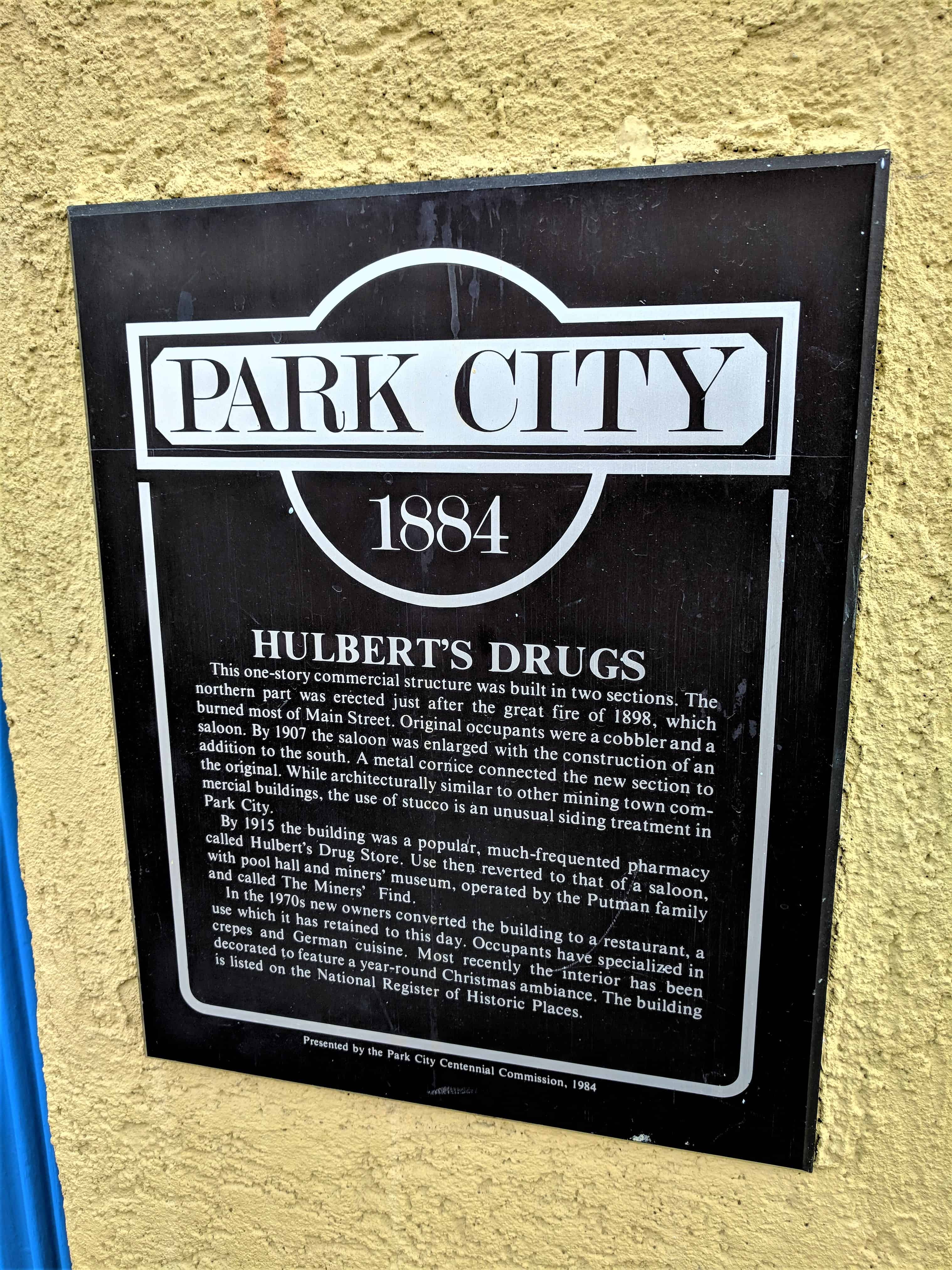
This one-story commercial structure was built in two sections. The northern part was erected just after the great fire of 1898, which burned most of Main Street. Original occupants were a cobbler and a saloon. By 1907 the saloon was enlarged with the construction of an addition to the south. A metal cornice connected the new section to the original. While architecturally similar to other mining town commercial buildings, the use of stucco is an unusual siding treatment in Park City.
By 1915 the building was a popular, much-frequented pharmacy called Hulbert’s Drug Store. Use then reverted to that of a saloon, with pool hall and miners’ museum, operated by the Putman family and called The Miners’ Find.
In the 1970s new owners converted the building to a restaurant, a use which has been retained to this day. Occupants have specialized in crepes and German cuisine. Most recently the interior has been decorated to feature a year-round Christmas ambiance. The building is listed on the National Register of Historic Places.
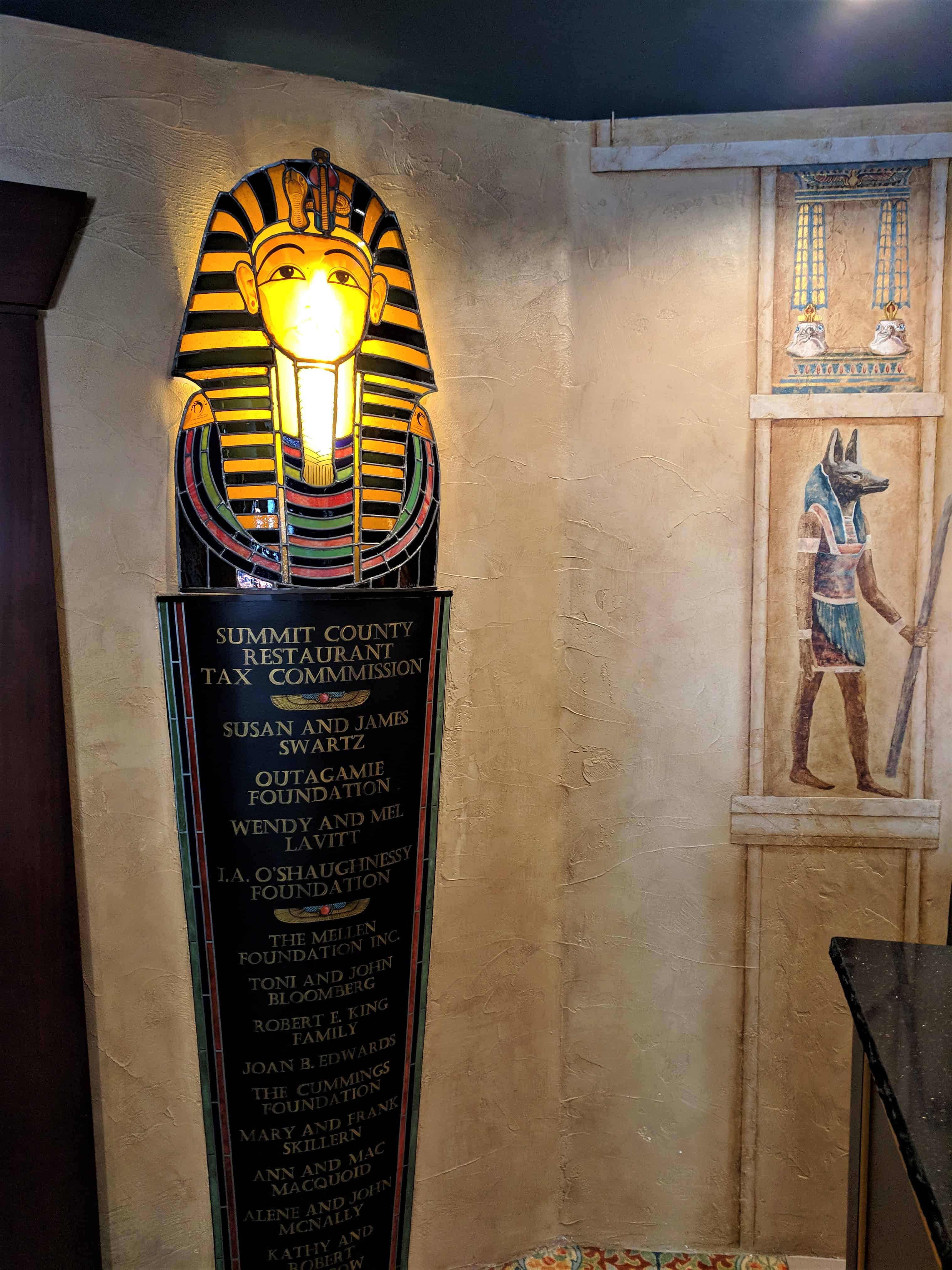
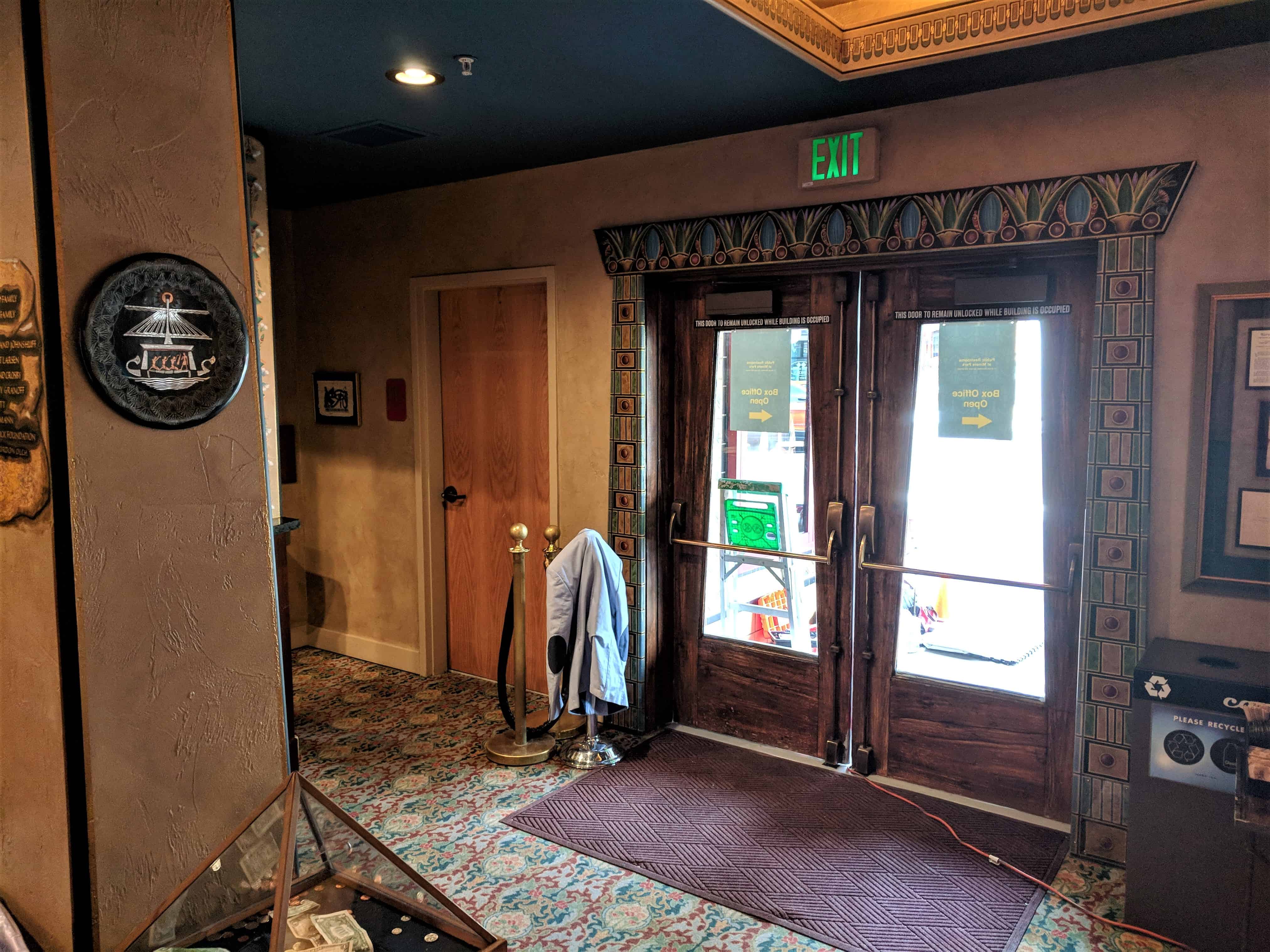
In the early 1900’s Park City’s social and entertainment needs were served by a number of flourishing theaters and social halls. When the Dewey Theatre, originally on this site, collapsed under a heavy snow load, John Rugar replaced it with the Egyptian Theater built in 1926. It was designed to seat 400 and to accommodate both movies and vaudeville. It became the first “sound movie” theater in Park City.
After being remodeled in 1963, the building opened as the Silver Wheel Theatre, and old fashioned “meller dramas” were performed for the next 15 years. In 1978 the building’s architectural integrity was threatened by an attempt to change its facade to a western motif. Preservation of its distinctive Egyptian features was achieved, however, when the building became home of Park City Performances in 1981.
The Egyptian Revival Style represents a unique period architecture which peaked in American around 1930. Egyptian theaters are rare, and this is only one of two remaining in Utah. Originally the interior combined replicas of Egyptian artifacts. This is a masonry structure with a false front shielding its hip roof. Tiles at the base of the ticket booth and pilistars in obelisk shape reinforce the Egyptian motif.
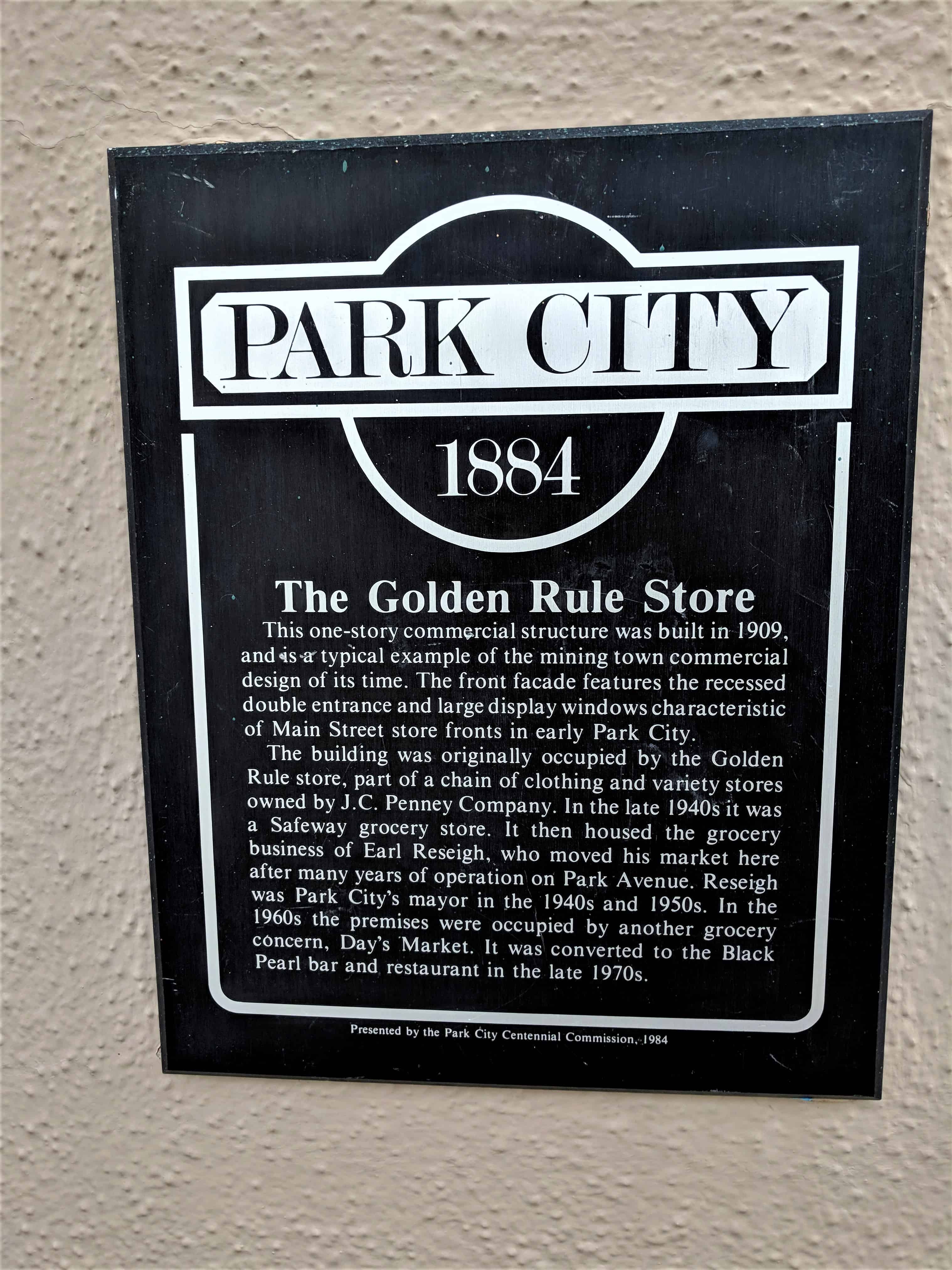
This one-story commercial structure was built in 1909, and is a typical example of the mining town commercial design of its time. The front facade features the recessed double entrance and large display windows characteristic of Main Street store fronts in early Park City.
The building was originally occupied by the Golden Rule store, part of a chain of clothing and variety stores owned by J.C. Penney Company. In the late 1940s it was a Safeway grocery store. It then housed the grocery business of Earl Reseigh, who moved his market here after many years of operation on Park Avenue. Reseigh was Park City’s mayor in the 1940s and 1950s. In the 1960s the premises were occupied by another grocery concern, Day’s Market. It was converted to the Black Pearl bar and restaurant in the late 1970s.
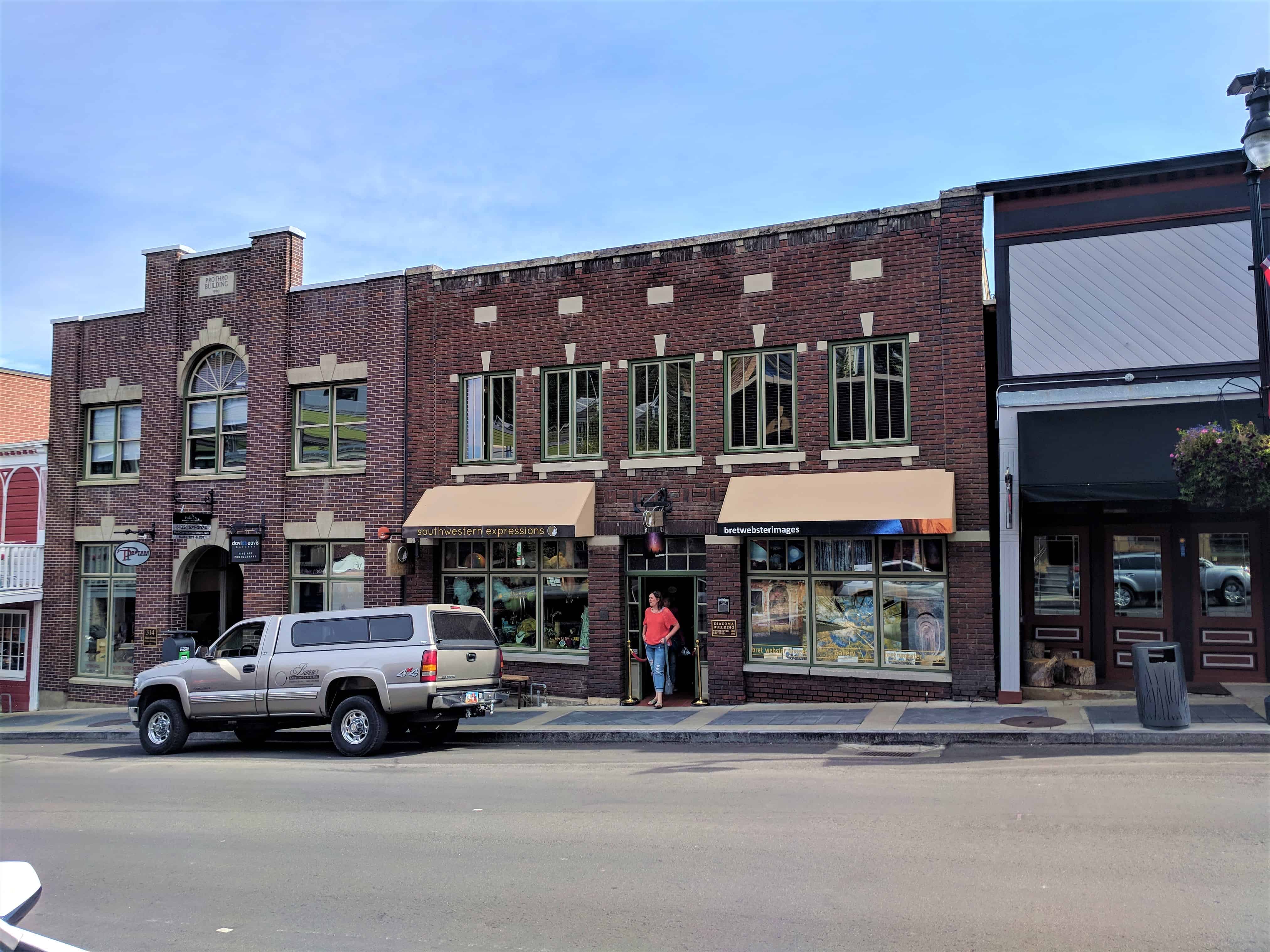
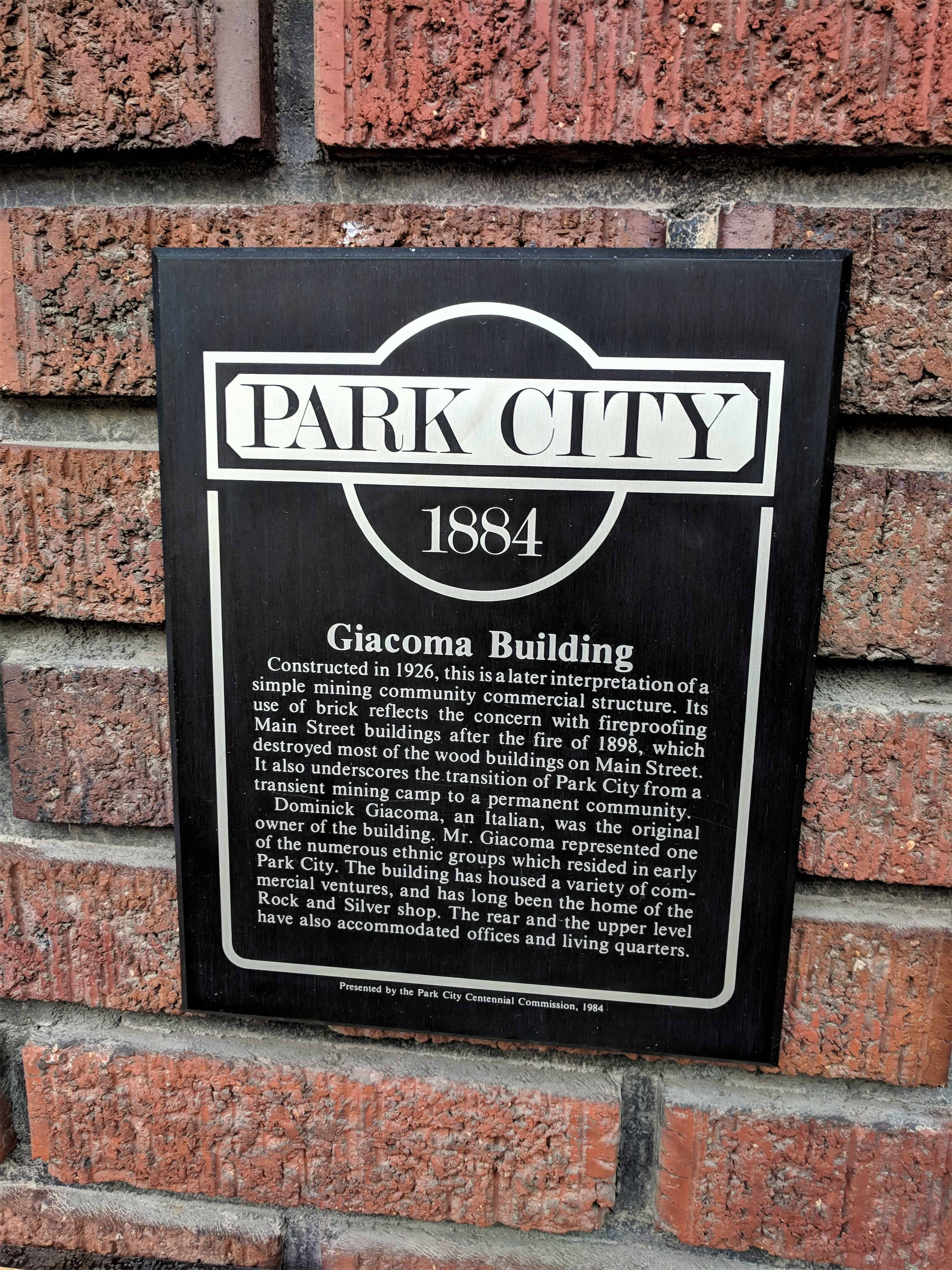
Constructed in 1926, this is a later interpretation of a simple mining community commercial structure. Its use of brick reflects the concern with fire proofing Main Street buildings after the fire of 1898, which destroyed most of the wood buildings on Main Street. It also underscores the transition of Park City from a transient mining camp to a permanent community.
Dominick Giacoma, an Italian, was the original owner of the building. Mr. Giacoma represented one of the newer ethnic groups which resided in early Park City. The building has housed a variety of commercial ventures and has long been the home of the Rock & Silver shop. The rear and upper level have also accommodated offices and living quarters.
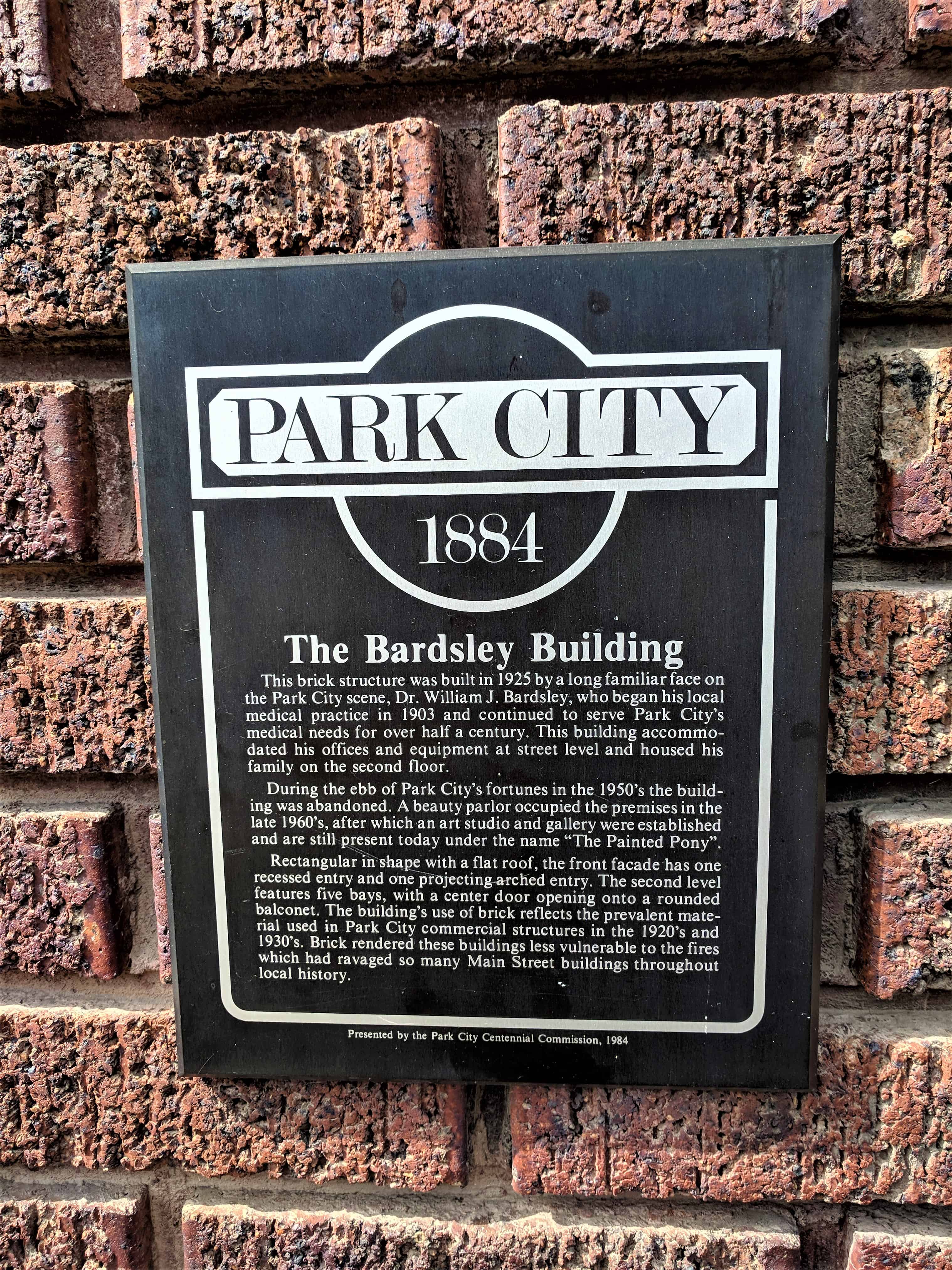
This brick structure was built in 1925 by a long familiar face on the Park City scene, Dr. William J. Bardsley, who began his local medical practice in 1903 and continued to serve Park City’s medical needs for over half a century. This building accommodated his offices and equipment at street level and housed his family on the second floor.
During the ebb of Park City’s fortunes in the 1950’s the building was abandoned. A beauty parlor occupied the premises in the late 1960’s, after which an art studio and gallery were established and are still present under the name “The Painted Pony”.
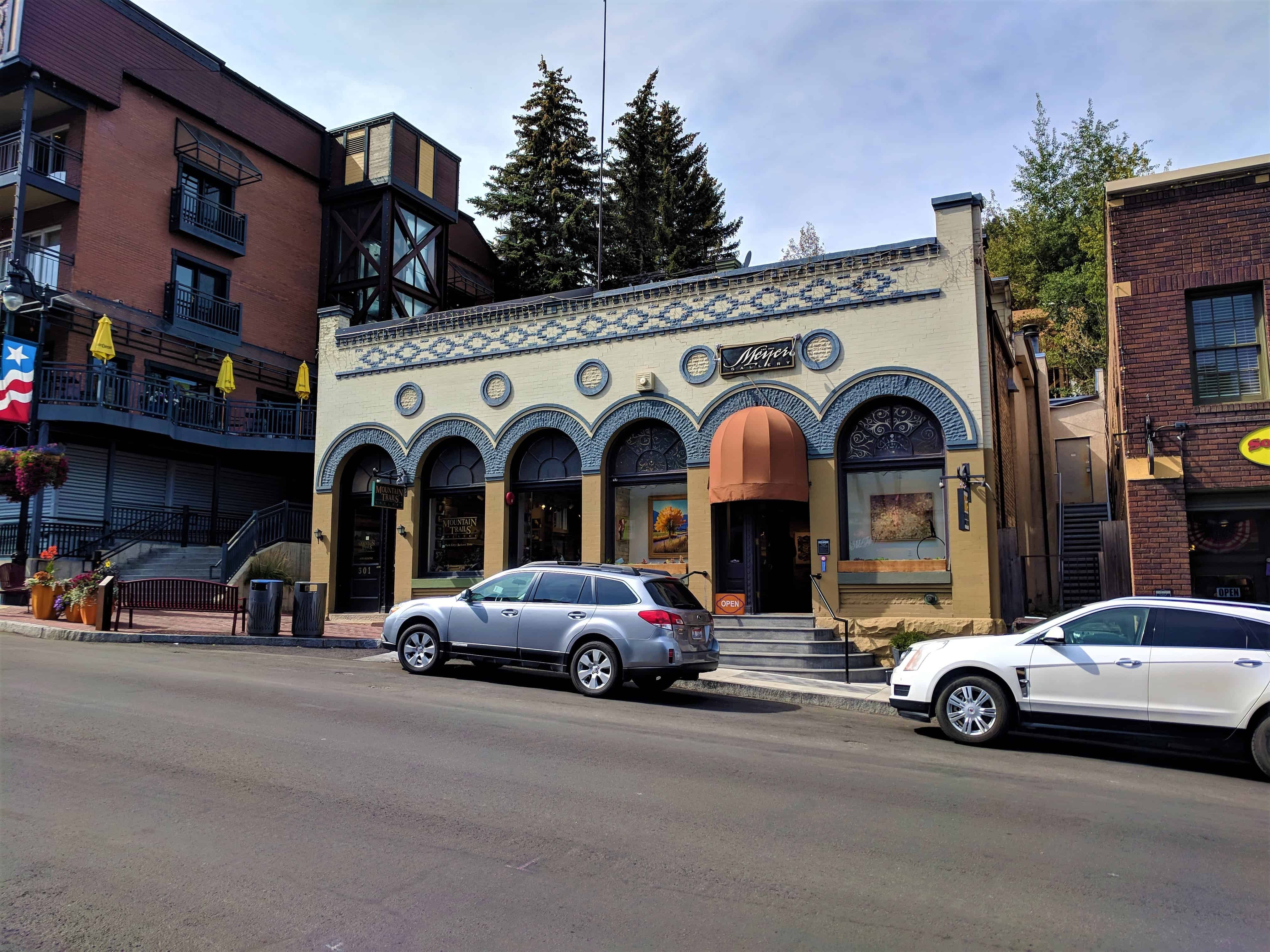
Rectangular in shape with a flat roof, the front facade has one recessed entry and one projecting arched entry. The second level features five bays, with a center door opening onto a rounded balconet. The building’s use of brick reflects the prevalent material used in Park City commercial structures in the 1920’s and 1930’s. Brick rendered these buildings less vulnerable to the fires which had ravaged son many Main Street buildings throughout local history.
One of the first brick buildings begun after the 1898 fire, this commercial structure served the banking, mining, and general business activity of the First National Bank and Silver King Mining Company, and such prominent Utah mining entrepreneurs as David Keith, James Farrell, W.V. Rice and Senator Thomas Kearns.
Victorian commercial in style, the building features an ornate brick cornice and a stone foundation. The facade is comprised of six glass arches with leaded glass transom windows. It was originally, and remains, divided into two sections in the interior. Then, as now, the two halves of the building served separate business entities.
One of the most architecturally interesting buildings on Main Street, it is also highly significant for its contribution to the commercial and mining activity of turn-of-the-century Park City.