

Park City Main Street
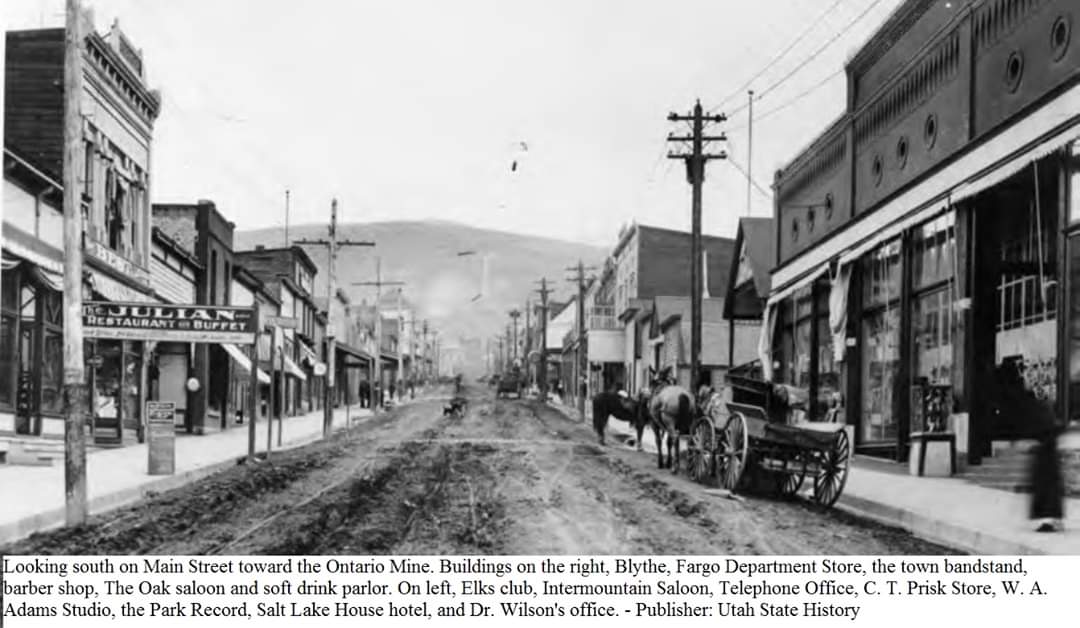
Park City’s commercial historic district represents the best remaining metal mining town business district in the state of Utah, exhibiting unique historical and architectural qualities. The Park City mining district, opened in 1869, early was recognized as a top bonanza camp; and, according to one historian, ranked high “as one of the most profitable argentiferous lead mines of the world.” Consumed by a conflagration in June 19, 1898, Park City’s main business district lay in ruins; and its rebuilding, through public and private support, attested to the confidence and attachment demonstrated toward the city. The present commercial district is a product of that confidence of 1898, and also of a confidence born out of the area’s rebirth as a recreational center, beginning in the 1960s.
The Park City Main Street Historic District in Park City, Utah was added to the National Register of Historic Places (#79002511) on March 26, 1979 and the boundary was expanded January 21, 2020.
Some of the places on Main Street:
- 601 Main St – Rodney W. Schreurs Centennial Park
- 586 Main St – The Mortuary
- 573 Main St – The Claimjumper Hotel
- 560 Main St – Franz The Bear
- 540 Main St – Masonic Hall
- 528 Main St – City Hall Park City, Park City Museum, “Ten O’Clock Whistle” and Old Public Library
- 524 Main St – Emmett “Bud” Wright
- 515 Main St – Star Meat & Grocery
- 509 Main St – Summit County Sheriff’s Office
- 508 Main St – XIX Olympic Winter Games
- 461 Main St – Anderson Apartments
- 450 Main St – Post Office
- 449 Main St – The Club
- 447 Main St – The Alamo
- 442 Main St – Frank Andrew Building
- 438 Main St – Car 19
- 434 Main St – Rocky Mountain Bell Telephone Office
- 430 Main St – Jenkins Photography Studio – Jenkins Confectionery
- 427 Main St – War Veterans Memorial Building
- 420 Main St – Samuel LePage Raddon
- 419 Main St – The Oak Saloon
- 417 Main St – Miner Memorial
- 402 Main St – Banksy Art at the Hulbert’s Drugs building
- 368 Main St – The Frankel Building
- 350 Main St – The Golden Rule Store
- 328 Main St – The Egyptian Theater
- 312 Main St – Giacoma Building
- 309 Main St – The Bardsley Building
- 301 Main St – The First National Bank
- 109 Main St

Mining has played an important role in the history of Utah as well as in the history of the United States. Its contribution to industrialization, technology, and the economy is well documented. In the case of Utah, mining helped to diversify the economy by precipitating much of the area’s subsequent industrial development. Additionally, many of Utah’s mining ventures attracted, and provided ample profits for, numerous entrepreneurs, both on a state and national level.
The early search for precious metals in Utah was promoted primarily by non-Mormon groups, especially the U.S. Army. Brigham Young had instructed church members to pursue agriculture, and warned that the lure of precious metals would cause outside infiltration into the Utah Territory.2 In 1862, Colonel Patrick E. Connor led a force of Nevada and California volunteers into Utah to protect the overland mail route and to watch the Mormons. His men were veterans of the California and Nevada gold fields; thus, experienced miners. As a consequence, their abundance of leisure time was spent in prospecting the hills of the Wasatch and Oquirrh mountains. By 1868, Conner’s men, and other prospectors, entered the area that was to become Park City.
Sources remain uncertain as to who made the first discovery, but the first claim filed in the district became the Young American lode, recorded on December 23, 1868. However, the discovery of the rich Ontario mine initiated efforts to mine lode ores and acted as the catalyst for Park City’s rapid noteriety as a great silver mining camp. In 1872, shortly after the discovery, the mine was sold to George Hearst, a San Francisco “mining man,” and run by R. C. Chambers until 1901 (sold for $27,000 and reportedly produced some $50,000,000).
Coupled with the completion of the Transcontinental Railroad, that spurred mining development in 1869, the Ontario ignited new growth in the district of Park City. The Pinon, Walker and Webster, Flagstaff, McHenry, Buckeye, and others also shipped small amounts of ore. By 1879, the Ontario operation flourished, with homes springing up near the mine and lower down the canyon near the present site of Park City a camp burgeoned.
Studies have characterized the development of mining communities as having occurred primarily in three stages: settlement, camp and town. Settlement being the initial phase, while the camp stage signified a period of population growth, promising mineral strikes, building booms (principally in wood), formation of governments, and the laying out of streets. The town phase occurred when a camp established itself as a significant location because of its mining prosperity. Architecture became more elaborate, as wood structures exhibited more elaborate detailing and were joined by more decorative stone and brick edifices. Park City appeared to have followed this mold.

As a harbinger of things to come, the city suffered a fire in December, 1882, that destroyed several of its principal buildings, including F. Fisher’s Hotel, Wisemann § Clark’s Jewelry, the Theriot Building (saloon), and the Park City Bank Building. In August, 1885, another fire claimed the .American Hotel. Such setbacks did not scorch spirits as Park City became a “city” in 1884.
Mining operations continued to develop in the late 1880s and early 1890s. In 1885, John J. Daly formed the Daily Mining Co., and later the Daly West, with claims owners J. B. Haggin, George Hearst, R. C. Chambers, and Daly. The Daly-Judge (John Judge) Mining Co., formed in 1901, and consolidated its holdings in 1902. In 1892, David Keith, W. V. Rice, Thomas Kearns, A. B. Bnery, and John Judge acquired a lease on the Mayflower claim, and while working the interior found that it extended into Silver King property. Thus, the Silver King Mining Company was incorporated for $3,000,000. The property, well managed, quickly attained high ranking among bonanza silver lead mines. Prosperity loomed as eternal.
Financial crises, especially the Panic of 1893, dampened the flame of prosperity. Economic upturns and downturns have always affected mining regions. But the Silver King endured, as it began to produce in 1893 when most silver mines closed, such as the Daly-West and Ontario. However, it was not the depression that threatened Park City’s future, but a fire that gutted the lower end of the town.
On June 19, 1898, fire raged through the Park City Commercial district. The blaze was then the greatest in Utah history. Main Street lay in ruins, with only a few gaunt walls remaining. Loss was estimated at over $1,000,000 and some 200 business houses and dwellings perished. Park City and its future appeared dead.
Residents, merchants, and concerned citizens responded with incredible speed. The Park Record, the local newspaper set up shop in a tent, and a Women’s Relief Committee, headed by the wives of prominent mine owners, organized on June 20. Merchants began to rebuild almost immediately, a sign of the confidence in Park City’s future.

As mentioned, Park City began to develop as did other mining communities, from settlement to camp, to town. Several fine brick and stone structures perished in the blaze. For example, City Hall, the Park City Bank, and the Grand Opera House, exhibiting fine architectural design in the use of window and entry arches, as well as elaborately detailed facades and decorative cornices. These structures, and others, represented the transition of Park City from camp to town, but the fire altered that course. Thus, Park City retreated back to a “camp” phase, at least in terms of its physical character.
Frame buildings sprang up quickly. These structures (some remaining) exhibited architectural styles of typical Victorian period mining town commercial buildings–one and two story structures, some with flat roofs, others with gable roof and false fronts, and most often wood cornices (some bracketed). Facades generally had central indented entrances flanked by display windows and transoms over windows and doors. Two story blocks also contained an entrance, either next to the ground floor entry or to the side, for access to the upper floor. Some contained porches and second story balconies (elements that are reappearing in restoration projects). By August, 1898, E. D. Sutton and Co., Meats and Grocery, had erected the largest building (remaining) since the blaze.
Stone and brick followed, however, with new commercial buildings using similar door and window placements as the frame, but adding decorative detailing, such as door and window arches, Queen Anne brick work, and piers (all elements remaining). M. A. Hancock, a local contractor who rebuilt many of the structures, was given the contract to rebuild City Hall, which reached completion in November 1898. Architect Fred A. Hale, Salt Lake City, designed a fine brick structure to house the First National Bank of Park City, and the Silver King Mining Co. office. The building remains, invoking the memory of David Keith, Thomas Kearns, W. V. Rice, and James Parrel, prominent entrepreneurs of Park City and the state. Likewise the Rocky Mountain Bell Co. hired Richard Kletting, Utah’s foremost architect, to design their brick office (remaining) and in 1905 the Utah Independent Telephone Co. housed itself in a most unique brick structure fashioned in the Mission style of architecture complete with a curvilinear gable roof line. The interior brick ceiling is composed of a series of barrel vaults (the structure remains and was named “The Alamo”).
Main Street was rebuilt. The Salt Lake Tribune lamented the way in which mining camps were laid out. Specifically, that mines were often located at the head of a ravine, in the direction of the prevailing winds, and streets set in that direction, with buildings on either side. Despite the concern, Park City’s Main Street remained the same in direction, but different in content. Building commenced in frame, but between approximately 1904 and through he 1920s stone and brick appeared more often.12 The town phase of development appeared complete.
The Park City commercial district contained numerous businesses, as well as various social halls and meeting places, public buildings and at the base the Union Pacific Railroad Depot (built in 1885, withstanding the 1898 fire, and remining). A scrutiny of Utah business directories reveals that in 1892-1893, 112 businesses (including physicians and lawyers, but not mining companies) existed; while in 1903-1904, approximately 136 concerns operated in Park City. By 1918-1919, the number had declined to 87, and in 1920-1921, 75. All facets of daily living were embodied in the district, and while the situation has changed, Park City’s present recreational emphasis still finds Main Street as a vital link in every day life.
City Hall, the Post Office, and a W.P.A. War Memorial Building helps to document public life. Labor strife and discontent in 1916 led to the jailing of members of the Industrial Workers of the World (I.W.W.), or Wobblies. Documenting this event is an insignia, dated August 8, 1916, burned on the wall of the communal cell in the basement of City Hall, which remains. The jail area itself stands in fair condition. In addition, City Hall functioned as a territorial jail for Utah Territory. The W.P.A. War Memorial Building, built in 1939, served the community as a recreational facility.
Social halls, saloons, and a theater remain as reminders of Park City’s heritage. The I.O.O.F., Masonic, and Elks buildings help to document the existence of numerous fraternal and secret societies that flourished in most mining towns, and who comprised a major thread in the town’s social fabric. Rasband’s Hall, now the Young Apartments, functioned as a dance hall, with fine dances and orchestras well remembered in its confines. Constructed in 1926, by John Rugar, the Egyptian Theater, which replaced the Dewey Theater, remains as the only such structure, and is remembered as the first movie house in Park City having sound movies.
Thus, the significance of the Park City commercial district lies in the areas of commerce, politics, government, social, transportation, labor and mining; as well as signifying the contributions made by prominent and well-known members of the community (i.e. David Keith, Thomas Kearns, W. V. Rice, James Parrel, E. D. Sutton, Mrs. C. V. Hodgson, to name a few). As mentioned, the area functioned and continues to function as an important element in daily life in Park City. A low ebb was reached in the city in the 1950s, but the area’s rejuvenation as a recreational community in the 1960s has prompted a surge; thus an increase in commercial activity. Such a condition has heightened the community’s awareness of Park City’s mining town character and heritage. As such, a Land Management Code, delineating historic districts and instituting preservation ordinances, was passed in 1976. Main Street merchants seem especially desirous of restoring and preserving these structures, which truly form one of Park City’s key assets in documenting both its own history as well as that of the mining era in the state of Utah.