The Lincoln Highway America’s First Coast-to-Coast Automobile Highway
The Lincoln Highway was established in 1913 when a group of businessmen involved in the automobile industry decided to sponsor and promote a transcontinental highway for automobile traffic.
They organized the Lincoln Highway Association and dedicated their proposed highway to the memory of President Abraham Lincoln. On September 10, 1913, the route of the highway was announced, and the general public was invited to become members of the association. Contributions to help finance the improvement of the highway were solicited from businesses and private citizens.
The route that was chosen for the Lincoln Highway went from New York City to San Francisco, following the straightest line that was possible. In the beginning, the route was laid out along already existing roads, but an important part of the plan was that these roads would be improved and the route shortened wherever possible.
A major goal of the Lincoln Highway Association was to persuade local, state, and the federal government to get involved in the improvement and construction of automobile roads and highways. The Association wanted the Lincoln Highway to be a model for the building of roads throughout the United States. By 1928 they felt that for the most part they had achieved their goals, and it was decided to dissolve the association. But the Lincoln Highway lives on. Although most of the original highway has been replaced by modern roads such as US Highway 30, US 40, and Interstate 80, many sections of the Lincoln Highway are still being used today.
In western Utah, the original 1913 route of the Lincoln Highway came through the city of Grantsville, then continued west through Skull Valley, Fish Springs, Callao, and Ibapah. In 1919, construction projects at Johnson Pass in the Stansbury Mountains and on the mud flats west of Granite Peak were completed, and the route was changed to go through Tooele and Gold Hill, which shortened the route by about 50 miles. Grantsville was dropped from the route. But another change came in 1927. For several years, the state of Utah had been working on a road across the Great Salt Lake Desert to Wendover, a small town on the Nevada border. This project was completed in 1925, and two years later, the Lincoln Highway Association made the decision to incorporate this new road into its official route. Grantsville was on the Lincoln Highway again.
This is Sons of Utah Pioneers historic marker #178, located at Lincoln Park, 550 West Clark Street in Grantsville, Utah
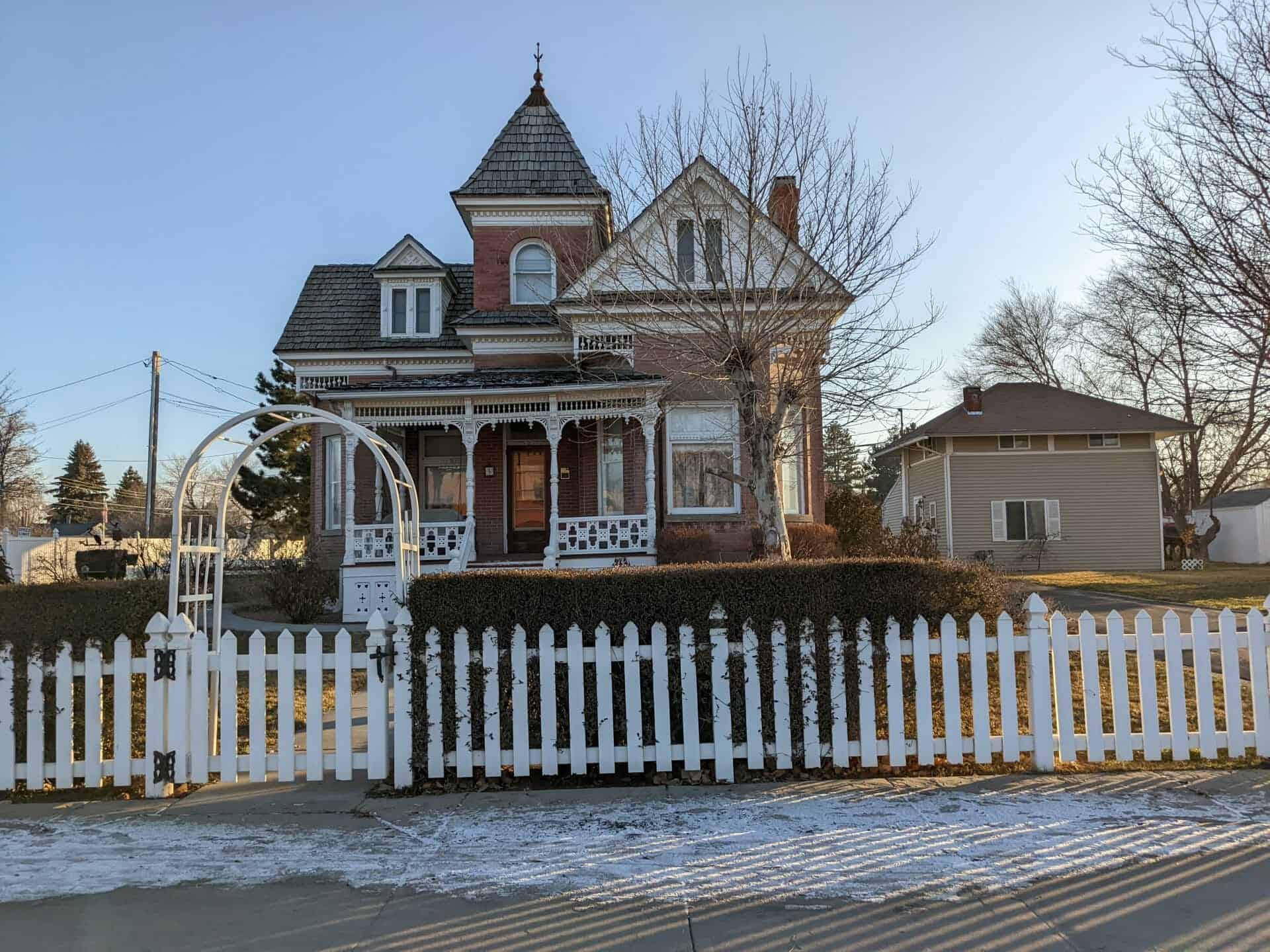
The Alex and Mary Alice Johnson House is located at the corner of Main Street and Hale Street in Grantsville. It is a one-and-one-half story brick home in the Queen Anne style built in 1900. The plan of the main floor gives the impression of a cross-wing house with a square tower at the intersection of the wings. However, more substantial than a typical cross-wing, it may also be considered a modified central-block with projecting bays. The house is on a one-half acre property with three outbuildings that retain their historic integrity but do not contribute to the historic significance of the house.
The house sits on a coursed rubble foundation. The masonry consists of two types of brick. It is faced with a fired red brick and lined with adobe. The courses are laid in a running bond with 4″ projections at the corners of the octagonal bays. The lintels, sills, and water table are of sandstone. The main floor fenestration is a combination of large fixed sash windows with transoms and smaller double-hung windows. There are paired double-hung windows in each of the four gable ends and the two small dormers. The tower has round arched windows, brick voussoirs, and decorative brick-work at the imposts. The tower’s pyramidal roof is capped with a metal finial.
Probably the most striking part of the house is the decorative woodwork, which according to one source, has always been painted white. The gable trim includes octagonal shingling with lozenge patternwork in the peak. Engaged pilasters with bracket “capitals” flank the windows. Similar details occur on the dormers. Dentils are found on the main cornice completely surrounding the house, as well as on the tower cornice. Corner brackets with lathe-turned spools and spindles occur at either side of the bays. The north and east porches are particularly elaborate. Each consists of lathe-turned columns and console brackets which support a spool and spindle frieze. Other decorative elements on the porches include dentils, fan-shaped brackets, pendants, and paterae. Scroll-cut woodwork is found on the balustrades and the base enclosure.
The principle elevations of the building have remained virtually unaltered since its construction. Minor alterations have been made to the rear, or south elevation, and concrete steps have been added to the east porch. A porch which spanned the length of the rear elevation was enclosed probably within a decade of the original construction. The east half of the porch was screened and the west half was fully enclosed to form a room. A doorway was cut from the main house to this room. In the 1950s, both the room and the screened porch were removed. They were replaced by a concrete porch supported by simple metal columns. Two other changes occurred in 1993: the cellar stair enclosure on the west elevation was repaired and the mid-century asphalt roof was replaced with wood shingles.
( This was added to the National Register of Historic Places (#95001433) on December 13, 1995 and is located at 5 West Main Street in Grantsville, Utah )
The interior of the house consists of several large well-lighted rooms with eleven-foot high ceilings. A small entrance foyer is at the base of the tower and contains separate doors to the dining room and parlor. The two rooms are also connected by a set of double doors. A large kitchen runs the east length of the house, with an enclosed staircase parallel to it. A second set of cellar stairs is found under the main staircase. The west side is separated into two smaller rooms: one was probably used as a bedroom, while the other was the family bathroom (the house was reportedly one of the first to have indoor plumbing in Grantsville). On the second floor there are four bedrooms, a nursery and a small office in the tower. The attic can be accessed from a trap door near the stairs.
Except for some changes in wallpaper and paint, the interior is in good historic condition. Some woodwork has been painted, however, most of the panelled doors, window casings, and other woodwork are stained and varnished. With one exception, both interior and exterior doors have working hopper transoms and all original hardware. Decorative elements at the doors and windows include corner blocks and paterae. Most of the glass appears to be original.
The house has a full fireplace in the parlor and stove-pipe flues in the kitchen and main floor bedroom. The parlor boasts a tall mirrored mantel with Ionic columns and a carved festoon/wreath. The interior is remarkably well-preserved. In the 1950s the kitchen was partitioned to create a laundry room and new appliances were added. There was also some work done to the kitchen in the 1970s. However, the original wainscotting is still visible on two sides of the room and only the lattice at the top of the partition seems out of period. The bathroom also contains fixtures from the 1950s remodel and includes the blocked door to the missing back room. Other than paint, wallpaper and new flooring, the second floor has seen little modification since a second bathroom was added in the 1950s. The house is still heated by its original boiler and radiators.
The site has three outbuildings which were used by the original household. The small pumphouse at the rear most likely dates to the original construction and supplied water to the house. A small chicken pen has been added to the pumphouse. In the southwest corner of the property sits a large framed three-car garage, built sometime after 1910. The garage also includes a room originally used as an icehouse. A two-story frame summerhouse sits west of the house, and was probably built after the garage (around 1915-1920). The main floor of this building served as a laundry and the upper floor was used for bedrooms. This building has been partially covered with aluminum siding and is currently rented as a residence. An L-shaped asphalt driveway covers a large portion of the property, but the remainder consists of trees, lawns, and flower beds. A rock garden and fountain have been built near the east porch. Sidewalks run from the perimeter to the north and east porches. The property has a combination of picket, post, and chain-link fences.
The Alex and Mary Alice Johnson House, built in 1900, is an excellent example of the Victorian Queen Anne style. This style of architecture documents an important period of growth in Utah. The design, though executed by a local builder influenced by pattern-books, combines a remarkable unity of composition with elaborate decoration. With its prominent position on Main Street, the Johnson House is one of the most distinctive architectural landmarks of Grantsville. Both the exterior and interior details of the home have been extraordinarily well-preserved. The house meets National Register Criterion C in the area of Architecture as the most outstanding example of a Queen Anne house in the community.
Alexander Johnson began construction on the home in 1899, just after his marriage to Mary Alice Anderson. Both were natives of Grantsville, born in 1870 and 1878 respectively. His parents were Charles Johnson and Charlotte Erickson, Swedish immigrants to Grantsville in 1863. Her parents were John Anderson and Mary Ann Clark. Alex and May built their house on the property was just south and across Main Street from the Deseret Mercantile (Johnson Hall) built in 1898, where Alex was engaged in the family business with his father and brothers. During his lifetime Alex also raised sheep, cattle, and horses. A successful businessman, he served as the director of the Grantsville Deseret Bank. He and his wife Alice were both members of the Church of Jesus Christ of Latter-day Saints (Mormon) and served the community in both church and civic positions.
The builder of the Johnson House was Charles Zephaniah Shaffer. He was born in Pennsylvania in 1842, listed as a carpenter in the 1900 business gazetteer, and died in 1904. Shaffer also constructed a Queen Anne home at 5 North Center Street. It is not known whether he was responsible for other Queen Anne homes in the Grantsville area. 2 The Johnson house contains all the characteristics of the style: an asymmetrical plan and façade, a variety of materials and textures, decorative shingling and brick, elaborate woodwork, and a tower.
Great care was taken in the construction of the house. According to Mildred J. Conway, a daughter of Alex and Mary Alice, each red brick, imported from California, came individually wrapped in paper. When completed in 1900 at a cost of $4,500, the home was one of the most elegant and modern (with its indoor plumbing) in the community. The ornate mantelpiece cost $75.
Alex and Mary Alice Johnson raised ten children in the home. In addition, they also took in Alex’s three nephews and a niece, who had been orphaned. The already spacious home was augmented by the building of the summerhouse, c.1920. The three-car garage was reportedly built for the four Model-T Fords the Johnsons acquired to transport their large family. Alex’s mother also lived with them and a room was built on the back porch for her. The home was literally at the center of community life in Grantsville. From his office at home in the second floor tower, Alex could view his mercantile business just across the street, known as Johnson Hall, and also used as at various times as the town’s bank, post office, and dance hall.
During the depression, with most of their children grown, Alex and Mary Alice took in boarders. Throughout the thirties and forties, the house was called the Lone Pine Tourist Home after the large pine tree in the front yard. Its distinctive architecture, its proximity to the Lincoln Highway, and a scarcity of housing near the Tooele Army Depot insured the lodge never lacked tenants.
Alex died in 1943 and Mary Alice in 1952. The Johnson’s daughter, Mildred J. Conway, moved into the house after her mother died. The few alterations which have made to the house were done while Mildred was the owner. She lived in the house until 1989 and died in 1991. In November of 1989, the house was sold to Grantsville natives, Gary and Janet Fawson. The Fawsons only lived in the house one month before moving to California. It was then used as a rental property. It was sold to Francis and Betty Menalis in October 1992. Betty had seen the house several years earlier and was determined to purchase it if ever it became available. She and her husband are committed to preserving and restoring the original appearance of the house, including re-roofing the house in 1993 with wood shingles. Betty has also been able to purchase some of the original furnishings and return them to the house.
Despite its use as a boarding house and a rental property, the Alex and Mary Alice Johnson house is in excellent condition and retains its historic integrity. This is due in part to its remaining in the same family for eighty-nine years, as well as the appreciation of subsequent owners of the artistic value of the architecture.
The Victorian Queen Anne style is reflective of changes that occurred in Utah near the turn of the century. The architecture in Utah was founded in American building traditions and the early builders had been, for the most part, isolated from the secular influences of much of the country and used established methods brought with them from their homes of origin. As Utah grew and became more integrated with non-Mormons, the architectural styles that were made popular through pattern books were readily available to Utah builders. The building boom of the 1880s and 1890s corresponded with the growth of the non-Mormon population in Utah and brought with it the opportunity to bring in new building traditions such as those published in the style books, popular in Utah during the late nineteenth and early twentieth centuries. With the introduction of plan books, “the former isolation of rural areas was no longer an obstacle to building due to the widespread dissemination of information and building materials.” Plan book Victorian stylistic features were based upon the use of multiple forms and elements and were probably influential in building the uniquely stylized, eclectic, Alex and Mary Johnson residence. The Queen Anne style is one of the most picturesque of the late-nineteenth-century styles and became the most popular style of the period in America. It was popular in Utah between 1885-1905.
Goshute people were one band of many Shoshone Indians living in the Great Basin Region.
The term “Gosiute” means, Kusiutta” describing their original dusty, well-traveled look. Goshute people inhabited the lush riparian areas of the region including Deep Creek Valley long before the coming of settlers. Other tribes conducted raids on the Goshutes to acquire slaves for trade, which contributed to the depiction of the Goshute’s deprived state. In this environment, Goshutes were resourceful and cunning.
Living in small family groups, they ate berries, pinenuts, pickleweed, insects and small game, and lived in roofless, brush windbreaks or cedar bow wickiups. Clothing was scare, consisting of fur pelts made into capes, breech cloths, leggings or moccasins, and woven fiber skirts for the women.
By the 1860s, the Goshutes were seriously threatened by an influx of settlers which diminished their food resources. The Indians eventually adapted many of the white mans ways on government and church farms established in Deep Creek Valley in 1914. Today, the Goshutes have tribal government promoting various forms of industry.
The Grantsville Meetinghouse constructed in 1865-66 is locally significant as one of a limited number of early LDS meetinghouses still standing that was built in the traditional style of early church buildings, based on the Greek Revival temple form, and in traditional building materials, adobe that was plastered over. It is particularly unusual among early meetinghouses in that the vestry was attached at the rear of the building and not on the front as was most common. The building served as a center for religious and community activities in the early days of Grantsville and is a reminder of the importance of the church in all aspects of pioneer life. A 1952 addition is not included in the historic register nomination.
The Grantsville First Ward Meetinghouse is located at 297 West Clark Street in Grantsville, Utah and was added to the National Register of Historic Places (#82004165) on February 11, 1982.
In 1848, Thomas Ricks and Ira Will-is built the first structure on what is present day Clark Street in Grantsville. The building was a herd house used by the two men who were herding stock for Brigham Young and Bishop Edwin D. Wooley.
On October 10, 1850, Joseph McBride, Harrison Severe and their families arrived and established Willow Creek. In March of 1851, the families moved across the valley and resided in the settlement of Pine Canyon. The reason for this move was for protection against the Indians in the area who had been raiding cattle from the white settlers. In December of that year, McBrides, Severes, and five other families returned to establish a permanent settlement. It was at this time that the first “branch” of the IDS Church was established at Grantsville. In 1852, the townsite was surveyed by Jesse W. Fox under the direction of Colonel George W. Grant, an officer in the Nauvoo Legion. Grant had been chosed by Brigham Young to help the Saints protect themselves against the Indians in the area. In 1853, the town was renamed “Grantsville” in honor of Col. Grant.
In March, 1854, Elder Wilford Woodruff called for more volunteers to help settle the area. This call took place at a conference of the church held in the tabernacle in Salt Lake City. In 1853, a fort was begun and by fall of 1854, it was nearly completed. The fort wall had a five foot thick base that gradually narrowed to an eighteen inch thickness at the top. The wall was twelve feet high. It was during this period of time that the first meetinghouse was built. The log structure had a dirt floor and was approximately 20′ x 16′. The building served as the hub of community life. It was located in the area west of the chapel that is now Cooley Street. In 1865, plans were made for a new meetinghouse. The building was to be located within the fort walls. The building would be made of adobe bricks and the clay for these bricks came from the pits located a quarter mile north of the building.
In July of 1865, construction of the building began under the direction of Hugh Alexander Ross Gillespie, a native of Scotland who had come to Tooele in 1853. Gillespie is also responsible for building some of the structures at Camp Floyd and bad come to Utah to work on the Salt Lake City Temple. The building was completed in June of 1866 at a reported cost of $10,000. The building was 60 feet in length and 38 feet wide, with a vestry located on tbe back of the building that was 22 feet by 18 feet. The “Presiding Elder” of the Grantsville Branch at the time of construction was Thomas H. Clark.
Dedicatory services for the building were held July 14, 1866. Those attending the services included Brigham Young, Wilford Woodruff, George Albert Smith, and Franklin D. Richard, with the dedicatory prayer being offered by George Q. Cannon. At these services, Brigham Young blessed the Saints and requested that there should be not dancing in the new meetinghouse. Members of the community are proud of the fact that every man who is or has been president of the LDS Church, has spoken in this building with the exception of Joseph Smith.
In 1877, the Grantsville Ward was established and William Jefferies became the first bishop of Grantsville. During these early years, the church continued to serve as the hub of the community, as did the log structures in the 1850s and early 1860s. The meetinghouse was the center of social and community life, as well as religious life. By the early part of the Twentieth century. Grantsville had grown to the point that the ward was divided and the Grantsville Second Ward was established. This took place in 1914. It was at this time that the Second Ward Meetinghouse was built on Main Street. This building was recently demolished (1980). The addition on the eastern end of the First Ward building was added in 1952 to provide classroom space. The meetinghouse was used until 1978, when a new building was built. After the move to the new building, discussion as to the use of this building took place. Plans included demolition at one point. There was also speculation about the city buying it. When the city decided not to buy the building, Tate Mortuary of Tooele purchased the building. In the future, the building will be used for viewings and funeral services.
The Grantsville Ward Meetinghouse is a one story, gable roof, rectangular structure whose style is derived from the Greek Revival temple form. It is situated gable end to the street. Classical elements include a boxed cornice with returns on the gable ends, and quoins. The pattern of the quoins is repeated around the door which is centered on the facade.
The meetinghouse was constructed of adobe, and then stuccoed. The thickness of the walls exceeds two feet. Wood shingles have been replaced by asphalt shingles on the roof. A vestry was added to the rear of meetinghouse. It has a gable roof and a cornice similar to the meetinghouse.
The façade is symmetrical, the door centered between two windows. Above the door is a medallion on which is printed, “LDS Chapel, First Ward, 1866.” All the windows on the meetinghouse and vestry are the double hung sash type, and those on the meetinghouse have a transom over them.
The main assembly room has undergone extensive remodeling. The choir loft was removed to make way for a bigger rostrum area. In 1952 a complex of classrooms and other auxiliary rooms was added to the east of the chapel, it detracts only slightly fromthe original integrity of the building and is not included as part of the nomination.
This historic marker is located at the Grantsville First Ward Chapel at 297 West Clark Street in Grantsville, Utah. It was erected July 24, 1934 by the Grantsville Chapter of the Daughters of Utah Pioneers and by the Utah Pioneer Trails and Landmarks Association.
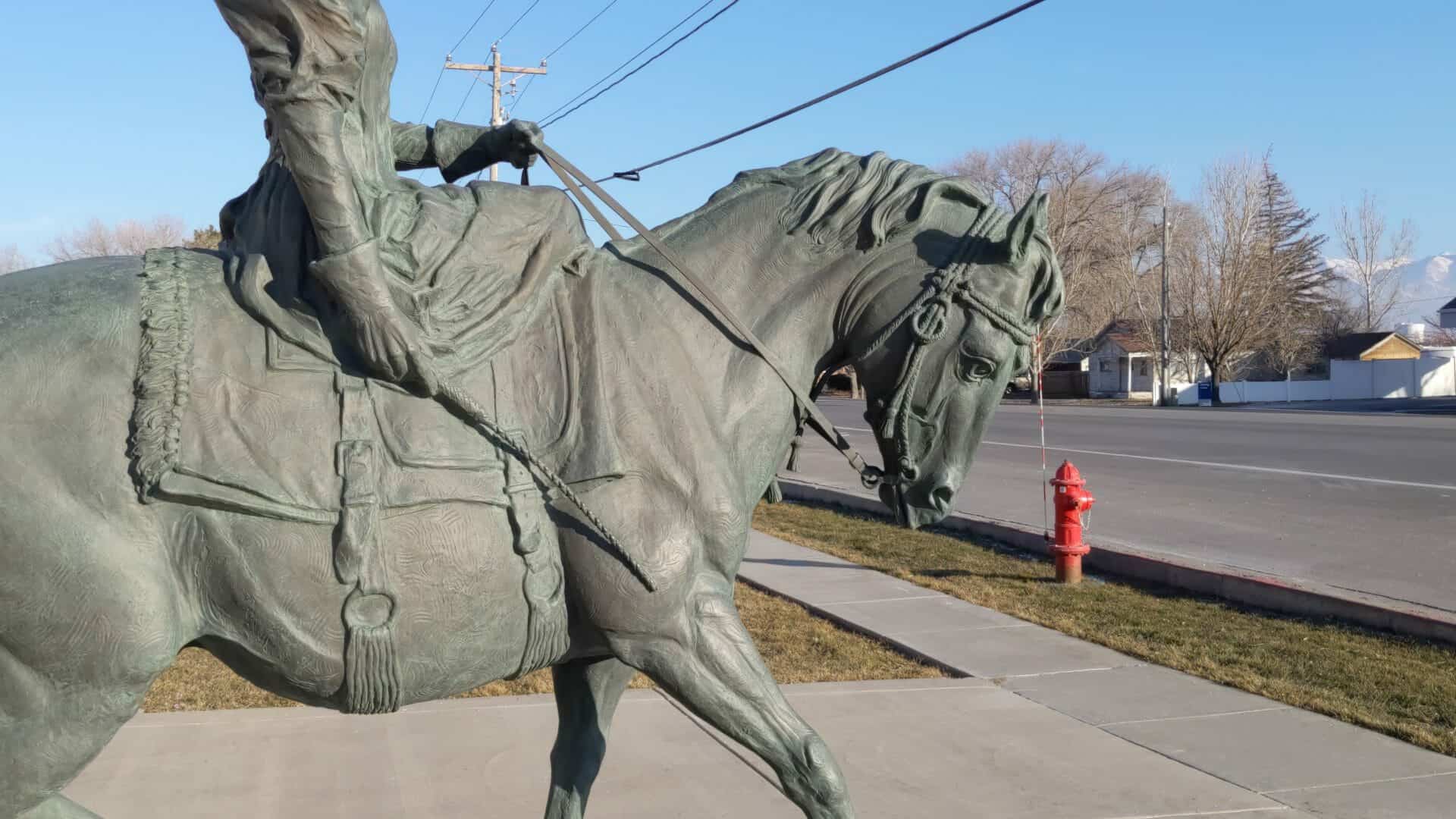
Hilda Anderson Erickson, born in Ledsjö, Sweden October 11, 1859 was the last surviving immigrant pioneer. In 1866 at the age of 6 she crossed the plains with her family in the Abner Lowry Company. She married John A. Erickson in the Endowment House in 1882. Soon after the couple was called to serve an LDS mission among the Goshute Indians in Ibapah, Utah. Later the couple homesteaded the “Last Chance Ranch” with their son Perry and daughter, Amy.
A talented seamstress, tailor, and licensed obstetric, Hilda was known as the “Doctor” to many expectant mothers. After the ranch was sold Hilda opened a store in Grantsville which she operated for 21 years. She drove her own car until she was 94 and at 99 flew to Nauvoo, Ill. to be honored by the Centennial Commission of Utah. Her return flight was the first passenger jet airplane to land at the Salt Lake Airport. She passed away in Jan. 1968 at the age of 108.
Kate B. Carter in Our Pioneer Heritage said of Hilda, “Probably no woman in our state has lived a more energetic life.”
This monument to a grand lady was erected by the Sons of Utah Pioneers to honor all Utah pioneers.
Sculptor Peter M. Fillerup
Note: President James E. Faust dedicated this statue that stands in front of the Grantsville City Hall, on June 7, 1997. Hilda Anderson Erickson was the last survivor of 80,000 pioneers who crossed the plains prior to 1869 by handcart or wagon.
This is Sons of Utah Pioneers marker #69, located at 429 East Main Street in Grantsville, Utah
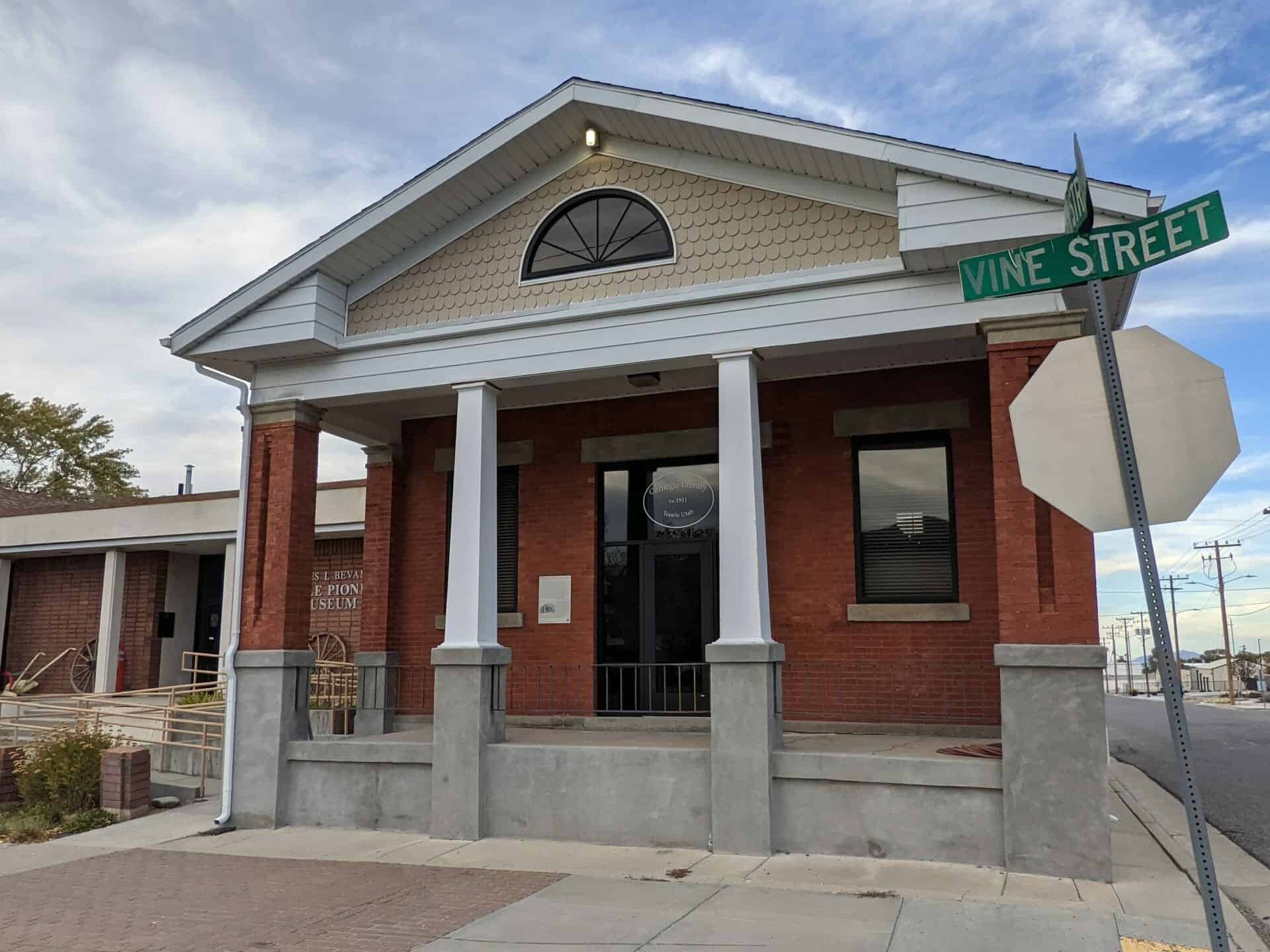
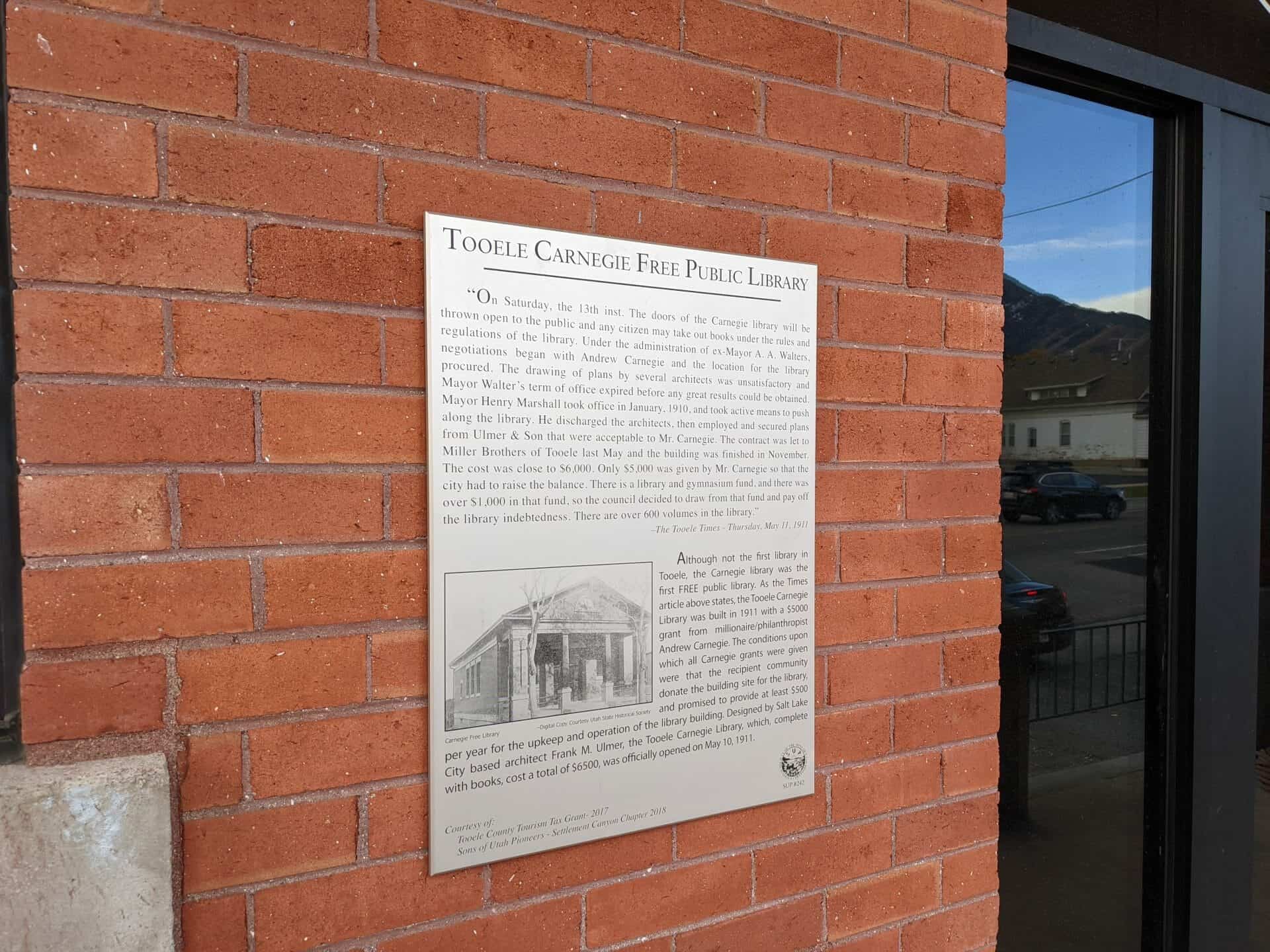
“On Saturday, the 13th inst. The doors of the Carnegie library will be thrown open to the public and any citizen may take out books under the rules and regulations of the library. Under the administration of ex-Mayor A. A. Walters, negotiations began with Andrew Carnegie and the location for the library procured. The drawing of plans by several architects, was unsatisfactory and Mayor Walter’s term of office expired before any great results could be obtained. Mayor Henry Marshall took office in January, 1910, and took active means to push along the library. He discharged the architects, then employed and secured plans from Ulmer & Son that were acceptable to Mr. Carnegie. The contract was let to Miller Brothers of Tooele last May and the building was finished in November. The cost was close to $6,000. Only $5,000 was given by Mr. Carnegie so that the city had to raise the balance. There is a library and gymnasium fund, and there was over $1,000 in that fund, so the council decided to draw from that fund and pay off the library indebtedness. There are over 600 volumes in the library.” – The Tooele Times – Thursday, May 11, 1911
Although not the first library in Tooele, the Carnegie library was the first FREE public library. As the Times article above states, the Tooele Carnegie Library was built in 1911 with a $5000 grant from millionaire/philanthropist Andrew Carnegie. The conditions upon which all Carnegie grants were given were that the recipient community donate the building site for the library, and promised to provide at least $500 per year for the upkeep and operation of the library building. Designed by Salt Lake City based architect Frank M. Ulmer, the Tooele Carnegie Library, which, complete with books, cost a total of $6500, was officially opened on May 10, 1911.
This page is for the Sons of Utah Pioneers historic marker on the building, the page directly for the building itself is located here: Tooele Carnegie Library
This building was built by Walt Shubert, the mayor, to be furnished with the original equipment from the retired shoe shop located at Vine Street in Tooele, Utah. The original shoe shop on Ophir was owned and operated by Carl Berg.