This rail car was moved to Ophir by Leo Ault to represent the St. John & Ophir Railroad that carried ore and passengers to the main Union Pacific line in Rush Valley. It contains old pictures and documents of significance to Ophir, the State of Utah, and the United States.
This one room house was lived in by men who worked as teamsters or miners. When it became vacant in the 1930’s it served as a clubhouse for the boys of Ophir. It was moved to its present location from Miners Street and was restored to represent the Ophir Post Office, which had been torn down. The post office box, window, and desk are from the original Ophir Post Office.
Archibald C. Shields and his brother Robert C. Shields, developed the first brick making business in Pine Canyon, Tooele, Utah in about 1865. They made the bricks on their farm and fired them in kilns constructed for that purpose.
This kiln measures 30-feet high and 12-feet in diameter with a dome-shaped top and resembles a very tall beehive.
Other kilns were built in Pine Canyon, some for the making of bricks and others were used to process charcoal. This is the only remaining pioneer charcoal kiln that has survived.
In 1869 bricks from these kilns were hauled to Stockton, Utah, south of Tooele, for the construction of a smelter. The smelter was needed to process the gold, silver, iron ore and other metals from the mines in Stockton, Ophir, and Mercer, Utah. Additional bricks were fired and were sold to pioneers living throughout Tooele Valley. They were able to build a number of homes, some of which are still standing.
The Daughters of Utah Pioneers commemorate two fine pioneers— great entrepreneurs who provided jobs for their community. They produced bricks and charcoal that were needed by the smelters, and who in turn, hired men to work so they could provide for their families.
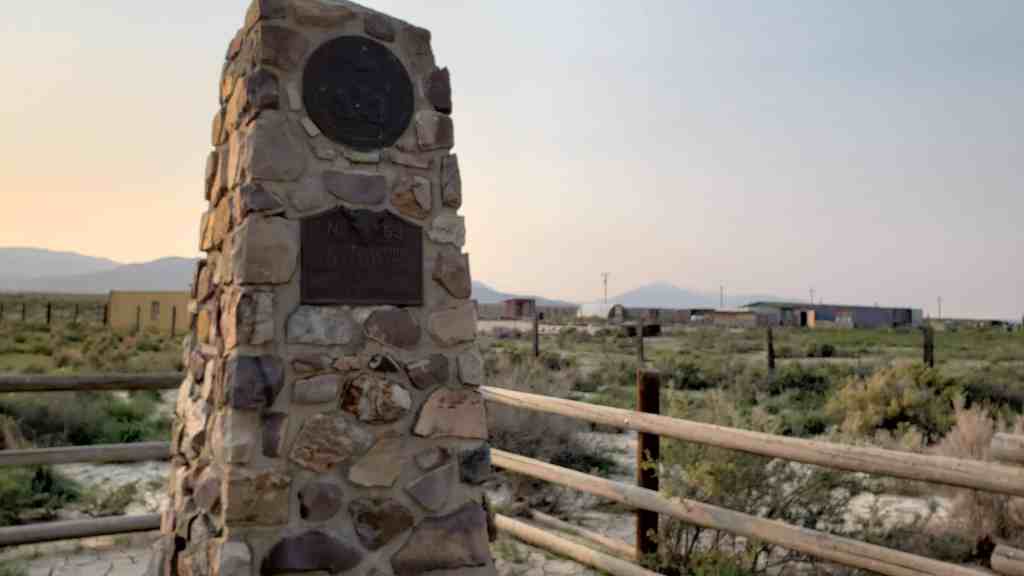
This is D.U.P. historic marker #586, erected in 2018 by the Helen Gillespie Shields DUP Camp at 1631 Pine Canyon Road (private property) in Tooele, Utah
In 1845, it took six months to get a message from the east coast of the United States to California. By the time it arrived, the news was old. In the late 1850s, a half million people had migrated west, and they wanted up-to-date news from home. Something had to be done to deliver mail faster and to improve communication in the expanding nation.
“The Central Overland California and Pikes Peak Express Company,” a subsidiary of Russell, Majors, and Waddell, announced the formation of the Pony Express on January 27, 1860. They planned to carry letter mail between St. Joseph, Missouri and Sacramento, California in only ten days. Although the Pony Express was a financially risky enterprise, the company hoped to attract a lucrative contract with the U.S. Postal Service.
Knowing that a healthy horse could run at a full gallop for only 10 to 12 miles, the Pony Express needed stations for its riders to change mounts. They utilized existing stage stations on the eastern end of the route, but needed to build many new station in remote areas across the Great Basin. Alexander Majors said that 400 to 500 mustang horses were purchased, 200 men were hired to manage the station, and 80 riders signed on to begin the run of the Pony Express.
Although the Pony Express captured the admiration, imagination, and hearts of people, it was a financial disaster for its founders. The Pony era, however, was not brought to an end by its financial failure, weather, or even problems with Indians – but by the completion of the Transcontinental Telegraph on October 26, 1861.
“Every neck is stretched, and every eye stained… Across the endless prairie a black spec appears… In a second or two it becomes a horse and rider, rising and falling, rising and falling – sweeping toward us – growing more and more distinct, and the flutter of hoofs comes faintly to the ear – another instant a whoop and a hurrah from our upper deck, a wave of the rider’s hand, but no reply, and man and horse burst past our excited faces, and go winging away like belated fragment of a storm.” – Mark Twain – Roughing It, 1872.
Expedient Delivery
The goal of the Pony Express was to provide speedy and dependable mail service between Missouri and California. Before the first ride, an important task was to develop a shorter route – especially across the wild open spaces between Utah and California. With only two months to prepare, the owners of the Pony Express needed to insure that the mail would get through in a timely manner. to do so meant finding a route that would be more expedient than the established California Trail.
Settlements and homesteads between Utah and California were rare prior to the Pony Express. Fortunately for Russell, Majors, and Waddell, recent explorations southwest of Salt Lake City and work already in progress by other private companies provided the means to shave nearly 300 miles off the Humboldt River Route.
In the mid-1850s, a Mormon settler named Howard Egan scouted and developed a trail across the Utah west desert to drive his cattle between Salt Lake City and the markets in California. Learning about Egan’s route, entrepreneur George Chorpenning, who had previously developed three different routes along the Humboldt River, quickly realized the value this new route would have for his mail and freight business. Together, Chorpenning and Egan began building the road and developing provisioned way stations for passenger stagecoaches, freight wagons, and transporting mail.
Learning about Chorpenning and Egan’s roadwork, U.S. Topographical Engineer Captain James H. Simpson spent a few weeks in the late fall of 1858 exploring the desert area southwest of the Great Salt Lake. The following spring the U.S. Army ordered Simpson to survey the entire route as a potential road for transporting supplies to its outpost at Camp Floyd. On Simpson’s recommendation, in 1859 and 1860, the Army made some route adjustments and vastly improved the road and the water holes located along it for use by military freight wagons.
When the Pony Express began its first run in early April of 1860, only a handful of way stations existed across the new Central Overland Route. These first stations were toughly 20 to 25 miles apart. Pony Express riders would have to push their mustangs 50 to 70 miles between stations at Salt Lake City, Faust, Willow Springs, and Deep Creek until the new 10-mile relay stations were in place. With only two months to prepare , those new replay stations often began with nothing more than a tent canopy for the station keeper and a makeshift corral for the horses.
When the Pony Express began its first run
Only The Finest Horsemen
Both speed and stamina were required of the horse and rider team as they relayed mail back and forth between Dt. Joseph, Missouri and Sacramento, California in 10 days or less.
Pony Express rider Thomas O. King recalled: “[the Express] required the best riders, [those] physically able to stand the strains of endurance by day or night and in all kinds of weather and other dangers.”
Eighty tough, experienced youths were hired to ride either active and nimble western mustangs or the best-blooded American racing horses money could buy. Upon seeing his first express rider while en route to Salt Lake City in 1860, British explorer Sir Richard Burton wrote: “They ride 100 miles at a time – about eight per hour – with four changes of horses, and return to their stations the next day.”
Express riders had to be able to stay in the saddle over grueling distances – with or without relief. Nick Wilson, who had ridden in Nevada and Utah, recalled: “Not many riders could stand the long, fast riding at first, but after about two weeks they would get hardened to it… When we started out, we were not to turn back no matter what happened, until we had delivered the mail at the next station… We must be ready to start back at half a minutes’ notice, day or night, rain or shine, Indians or no Indians.”
“Not only were they remarkable for lightness of weight and energy, but their service required continual vigilance, bravery, and agility. Among their number were skillful guides, scouts, and couriers, accustomed to adventures and hardships on the plains – men of strong wills and wonderful powers of endurance.” – Alexander Majors, 1893 memoirs.
This house was built by Carl “Charley” Berg at this original location. He repaired shoes for the people of Ophir. After his death, it was occupied by several couples and small families. Poker games were played as a regular pass time.
This one room house was built by Carl Berg at this original location. It was used as a rental, mostly by bachelor miners. It has been restored to its old time appearance.
From onlineutah.us: Lofgreen was settled in 1898 by Herman Lofgreen (Lofgren) along the Union Pacific Railroad track going south from Lake Point. In earlier days there was a small schoolhouse in the settlement. The residents earned their living by breaking wild horses and working as section hands for the railroad. The settlement was abandoned after creosote was discovered, since this greatly reduced the demand for section hands. (Applying Creosote to railroad ties keeps them from rotting.)
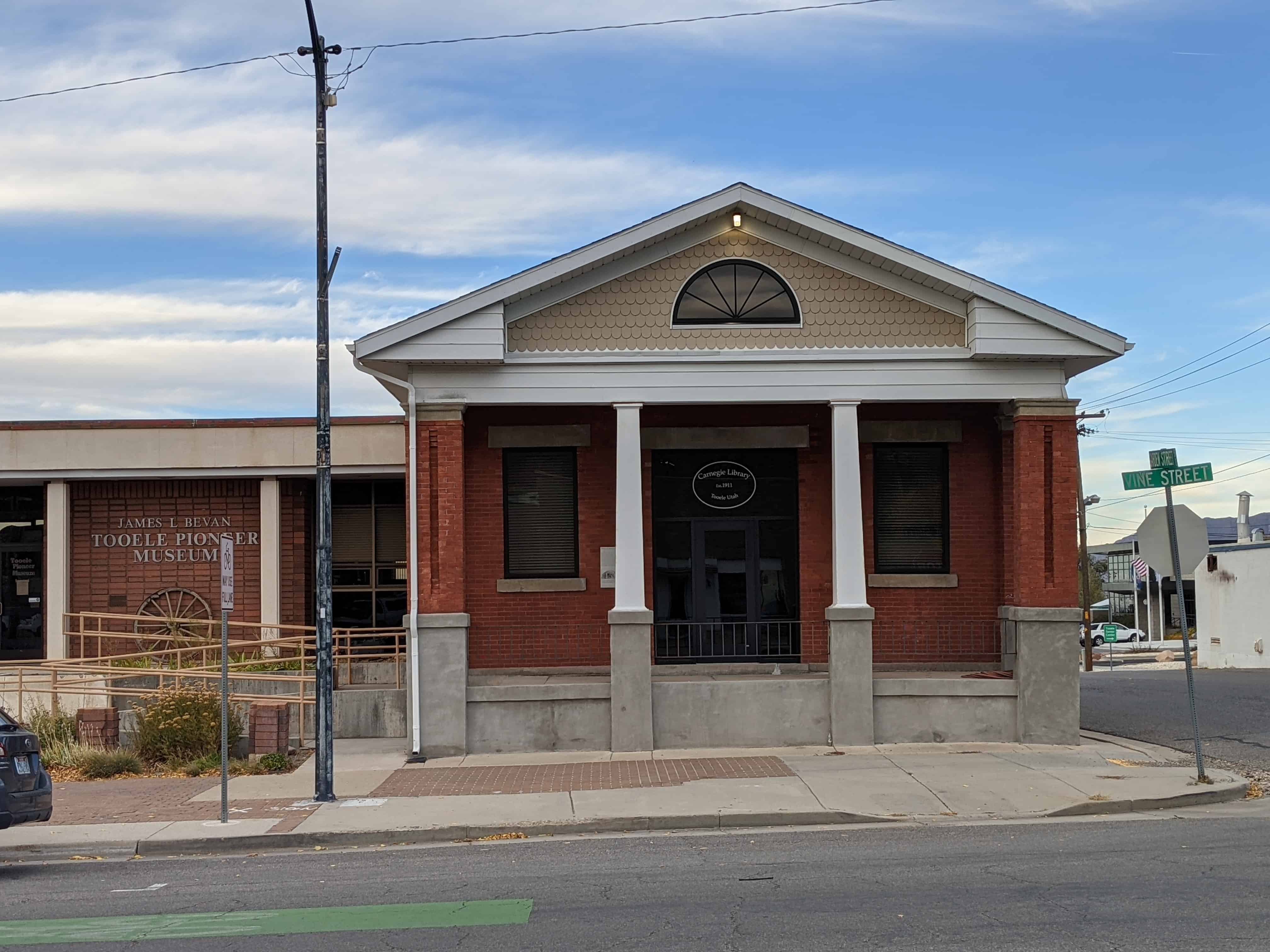
Built in 1911, the Tooele Carnegie Library is significant as one of sixteen remaining Carnegie libraries of the twenty-three built in Utah. Thirteen of the sixteen library buildings maintain their original integrity and are included in the Carnegie Library Thematic Resource Nomination. In addition to making important contributions to public education in their respective communities, these libraries are Utah’s representatives of the important nation-wide Carnegie library program, and they document its unparalleled effect in the establishment of community-supported, free public libraries in Utah.
Located at 47 East Vine Street in Tooele, Utah and added to the National Historic Register (#84000420) on October 29, 1984.
The Tooele Carnegie Library was built in 1911 with a $5000 grant from millionaire/philanthropist Andrew Carnegie. Carnegie funded the construction of over 1650 library buildings in the U.S., 23 of which were built in Utah communities. The conditions upon which all Carnegie grants were given were that the recipient community donate the building site and provide an annual maintenance budget of at least 10% of the grant amount. The city of Tooele provided the books and building site for the library, and promised to provide at least $500 per year for the upkeep and operation of the library building. Designed by Salt Lake City based architect Frank M. Ulmer, the Tooele Carnegie Library, which, complete with books, cost a total of $6500, was officially opened on May 10, 1911.
Although the Carnegie library was the first building constructed and used specifically for library purposes in Tooele, it was not the first library organized in the city. The Tooele City Library Association was first organized in February 1864 under a territorial legislative charter. Due to financial difficulties brought about by the Association’s involvement in the construction of a social hall in the town, the book collection was taken over by the Tooele (LDS church) Ward Ecclesiastical Board in 1878. Members of the library were assessed annual dues to cover the operation expenses of the library and to pay the $35 annual salary of the librarian. The library operated out of the social hall (known as the Opera House), which it shared with other community activities. A private, fiction library was opened in Tooele in 1893 by William C. Foster, secretary of the library association. Foster, who operated his library until his death in 1906, rented out books for a fee of 25tf per month. The $5000 Carnegie grant enabled the city to replace those private, user-funded libraries with the city-supported Tooele Free Public Library. It has continued to serve as the city’s library up to the present, although the original building was expanded in 1973 by a major addition on the west. Despite that addition, the building retains its original integrity.
The Tooele Carnegie Library is a long rectangular building set on a slight hill so that from the façade it appears to be a one story building, but it actually drops off to two stories in the rear. It is oriented gable end to the street, resembling a temple-form building, with a door centered between two windows, and has a portico spanning the façade. The low pitch of the gable roof, the domestic scale of the building and porch, and the use of fish-scale shingles in the gable section are reminiscent of bungalows that were being built at the same time. The symmetrical arrangement of openings on the façade, the returns of the cornice, and the wide frieze of the entablature, however, counter the domestic character and emphasize Classical Revival influences.
Alterations to the Tooele Carnegie Library include the addition of a large brick wing on the west side of the building in 1973, which cuts into the west wall of the library building, and the painting of the exterior brick walls (n.d.). These changes, however, do not substantially affect the original integrity of the building. The addition was set back far enough that the façade of the library is completely unaffected by the addition. The 1973 addition visually joins the library building with the 1867 stone Tooele County Courthouse/City Hall on the west, although the addition is joined to the courthouse only at the roof level and the two buildings neither share a common wall nor are connected on their interiors. The Tooele County Courthouse/City Hall was listed in the National Register in 1983.