Tags
Fires, Indianola, Sanpete County, utah, utah county, Wildfire

31 Friday Jul 2020
Posted in Uncategorized
Tags
Fires, Indianola, Sanpete County, utah, utah county, Wildfire
31 Friday Jul 2020
Posted in Uncategorized

From Findagrave:
Olive Beth Kimball Mack died Friday, September 14, 2018 from the natural affects caused by ninety-six years of an amazingly full and abundant life.
Her mortal journey started in Safford, Arizona on July 31, 1922. “Bobby,” as she was called by her family and friends, was the second of four children and the only daughter of Spencer W. and Camilla Eyring Kimball. Her life was full of adventure, laughter, service, love, and dedication to her family, friends, church, and the Savior that she loved so much.
She was married to Grant Miller Mack in the Salt Lake Temple of The Church of Jesus Christ of Latter-day Saints on December 6, 1943. They were blessed with seven children.
Her love for people was demonstrated in the nineteen years she served as an elementary school teacher. She also enjoyed twenty-two years singing and traveling the world as an alto in the Mormon Tabernacle Choir. She was a devoted wife, and raised and influenced three generations of grateful descendants.
Located in the Memorial Holladay Cemetery.


30 Thursday Jul 2020
Posted in Uncategorized

From Findagrave:
Paul James, voice of the BYU Cougars and longtime KSL-TV anchor and radio sportscaster, died at his home Saturday, Oct. 6, after a long illness. He was 87.
“He was always known as ‘The Voice,’ in our office,” said former BYU sports information director Ralph Zobell. “Whenever we referenced him, he was The Voice. He was universally known everywhere he went. He was always very kind and talented. He did incalculable research before a game and was a wealth of knowledge statistically. Yet, those who traveled with him got to see a tender Paul, who loved to entertain and visit with people.”
James had a unique, deep, booming voice and his emotion and performance behind a microphone became a household sound in many homes throughout the state. He used a technique taught to him by his high school speech teacher, according to Zobell.
James witnessed some 1,300 games during his 50-year career, calling 450 football games. He was an outgoing, popular speaker and personality who frequently was the center of attraction on cruise ships and gatherings throughout the state.
Located in the Memorial Holladay Cemetery.

30 Thursday Jul 2020
Posted in Uncategorized

Located in the Lower 25th Street Historic District in Ogden, Utah.
260 25th Street
This building was constructed circa. 1888 by Solomon C. Stephens. The family owned land and constructed several commercial buildings on the north side of the 200 Block of 25th Street. Stephens owned the property until 1895 when it was sold to the First National Bank. Later owners included Herbert H. Hayes, and Tom and Akiko Kinomoto who sold the property in 1993 to the current owners, Carma Whiting and Karen White.
The earliest recorded businesses to occupy the structure were “The Switch”, a sample room which served wines and liquors, and the “European Lodging House”, small hostelry. City directories indicate that several saloons occupied the building during the early 1900s, one of the longest tenants being a saloon owned and operated by the Frazzini Brothers. During the era of prohibition, a sort drinks and billiards business operated in the building. During the mid-1940s, Kinomotos established the American Eagle Cafe in the building which operated on 25th Street for several decades. The building was renovated in 1993 to accommodate “Panhandlers.”
The brick structure is a two story, two part commercial block with some limited Italianate detailing. The second story includes three symmetrically placed, two-over-two double-hung windows. Each corbeled arch window opening is topped with a segmental arch of sandstone block. Decorative corbeling is located below the window line and along the cornice line of the front parapet wall. The street level section includes a recessed central entry door flanked by large display windows on either side and an entry door for the second story located west of the storefront.


30 Thursday Jul 2020
Posted in Uncategorized
Tags

Benchmark: LP0357 “BACCHUS AF PLANT 81 TANK”
Another benchmark I’ve documented, see this link for others.
4640 S 6400 W, West Valley City, Utah


| 01/01/1962 by CGS (FIRST OBSERVED) |
| DESCRIBED BY COAST AND GEODETIC SURVEY 1962 (JCC) STATION IS THE TOP CENTER OF THE TANK, WHICH IS ABOUT 300 FEET IN HEIGHT, PAINTED A CHECKERED RED AND WHITE COLOR AND NEAR THE TOWN OF BACCHUS, WHICH IS ABOUT 14 MILES SOUTHWEST OF THE CENTER OF SALT LAKE CITY. THE TANK BELONGS TO AIR FORCE PLANT 81. |
| 01/01/1973 by NGS (GOOD) |
| RECOVERY NOTE BY NATIONAL GEODETIC SURVEY 1973 (JRS) THE BACCHUS AIR FORCE PLANT 81 WATER TANK WAS VISITED AND RECOVERED AS DESCRIBED IN 1962. |
| 01/01/1983 by DMA (GOOD) |
| RECOVERY NOTE BY DEFENSE MAP AGENCY 1983 (GAS) RECOVERED AS DESCRIBED. |
| 06/15/1985 by NGS (GOOD) |
| RECOVERY NOTE BY NATIONAL GEODETIC SURVEY 1985 (ERP) THE STATION IS A TANK. RECOVERED AS DESCRIBED. |
29 Wednesday Jul 2020
Posted in Uncategorized
Tags
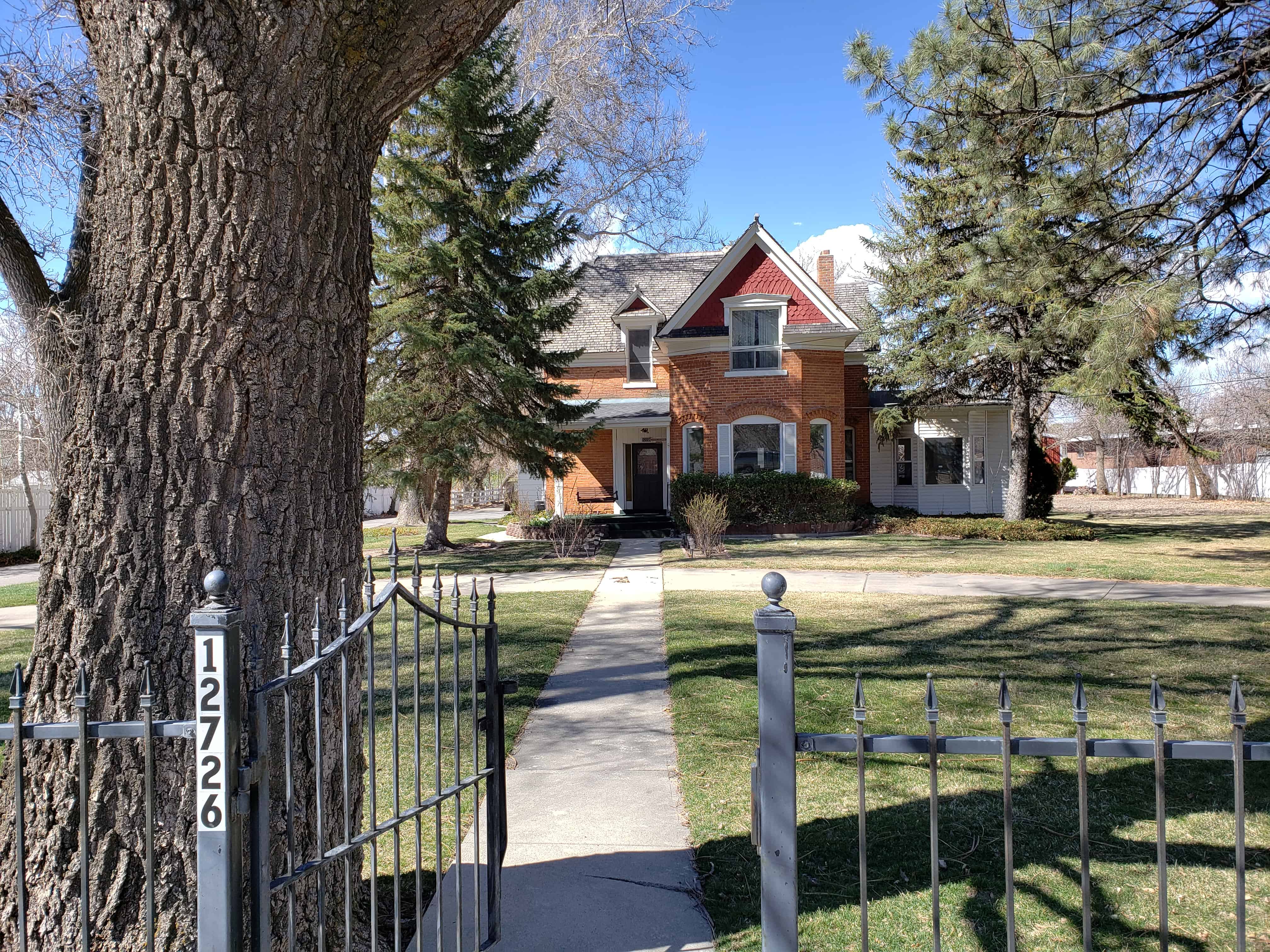
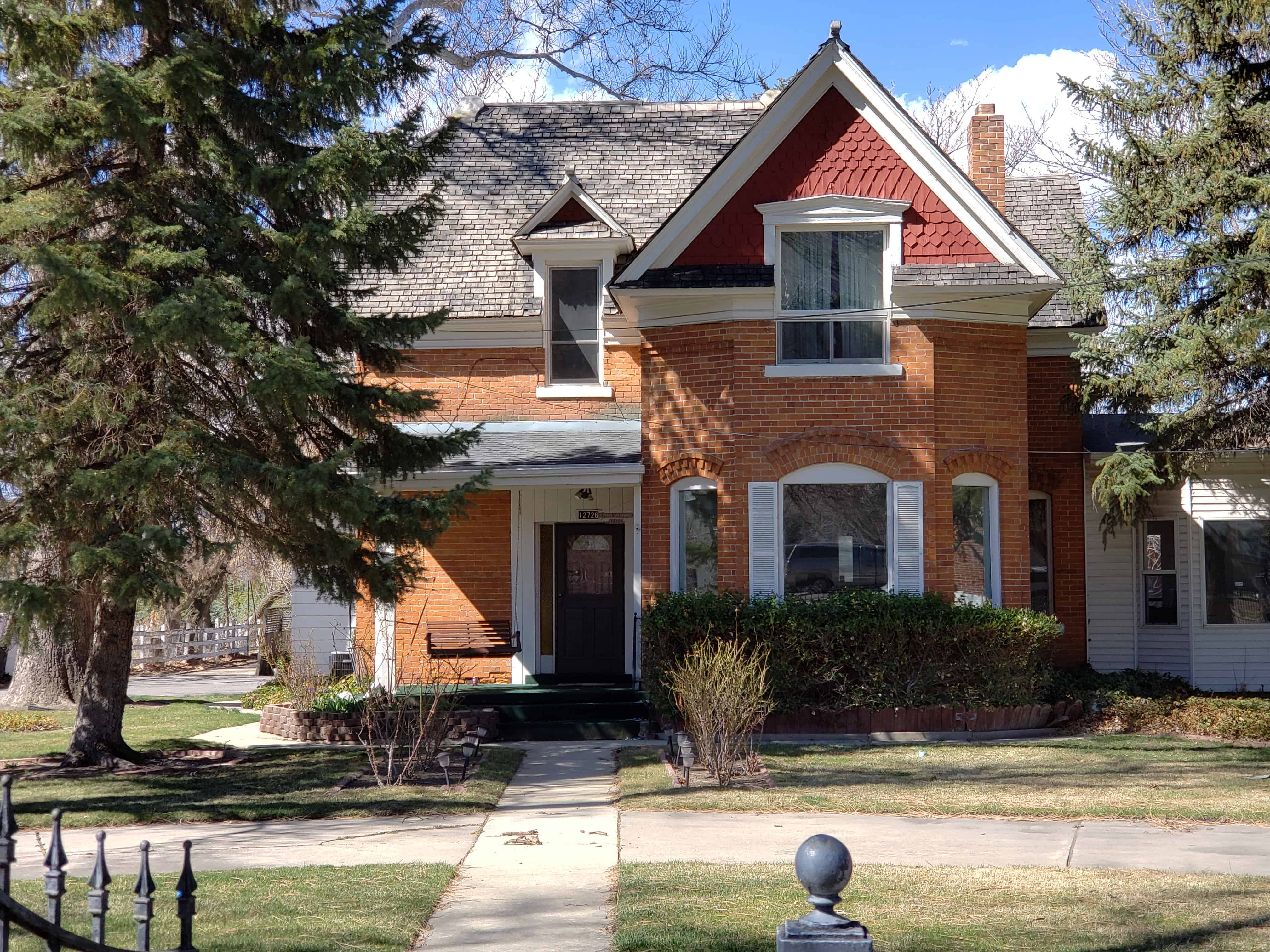
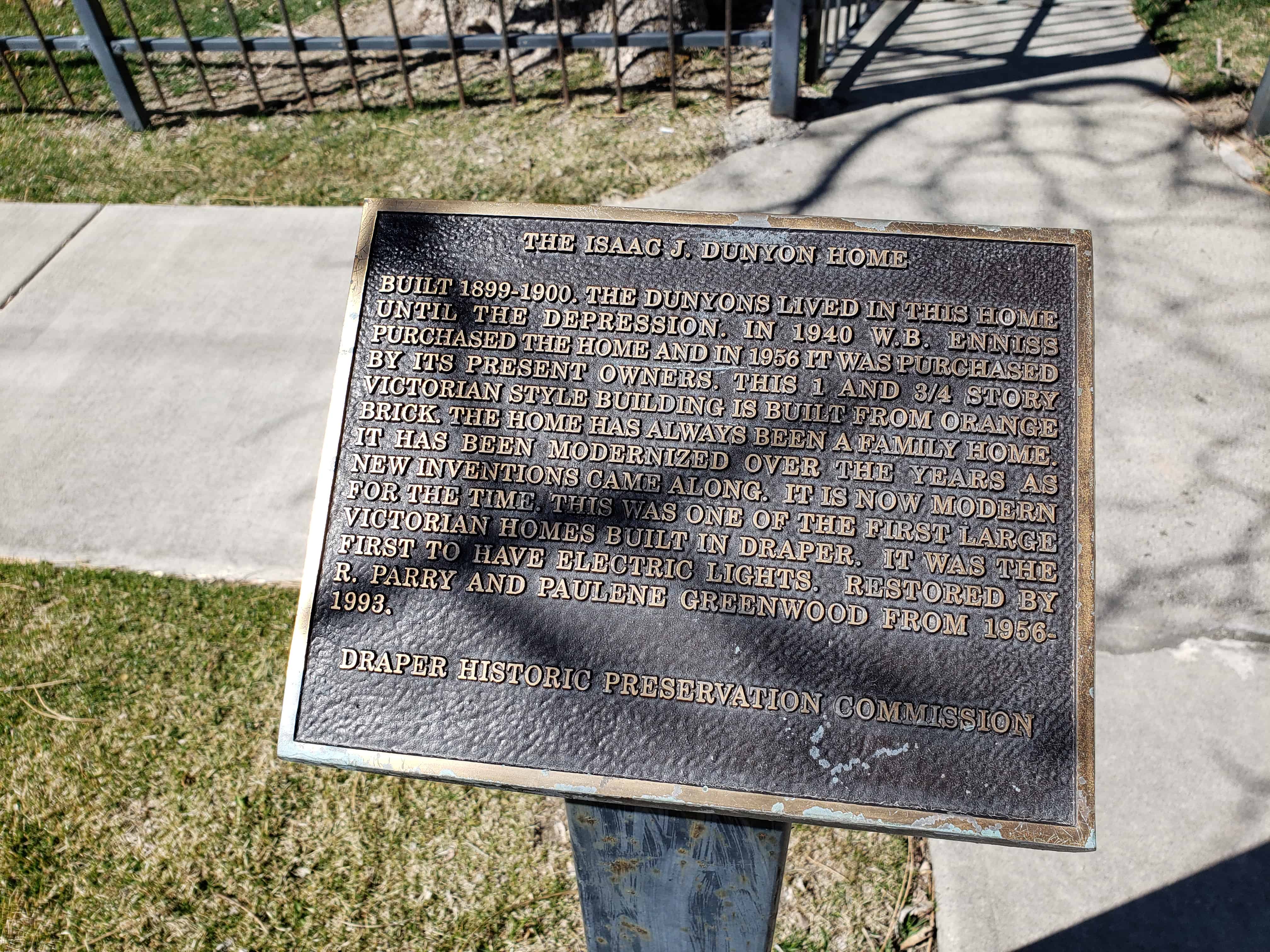
The Isaac J. Dunyon Home
Built 1899-1900. The Dunyons lived in this home until the depression. In 1940 W.B. Enniss purchased the home and in 1956 it was purchased by its present owners. This 1 and 3/4 story Victorian style building is built from orange brick. The home has always been a family home. It has been modernized over the years as new inventions came along. It is now modern for the time. This was one of the first large Victorian homes built in Draper. It was the first to have electric lights. Restored by R. Parry and Pauline Greenwood from 1956-1993.
Related Posts:
The home was demolished in 2023 and was located at 12726 South Fort Street (950 East) in Draper, Utah
29 Wednesday Jul 2020
Posted in Uncategorized
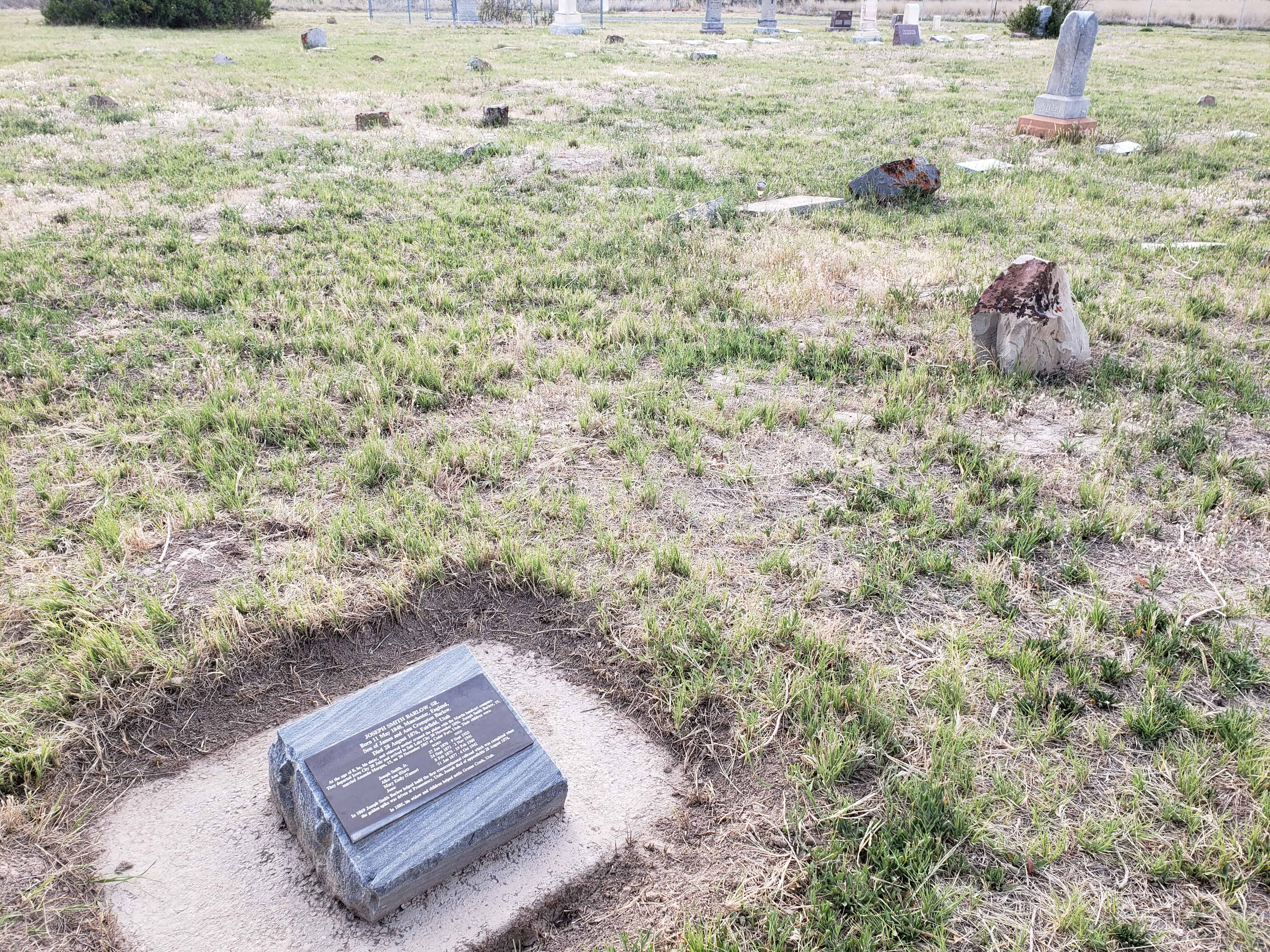
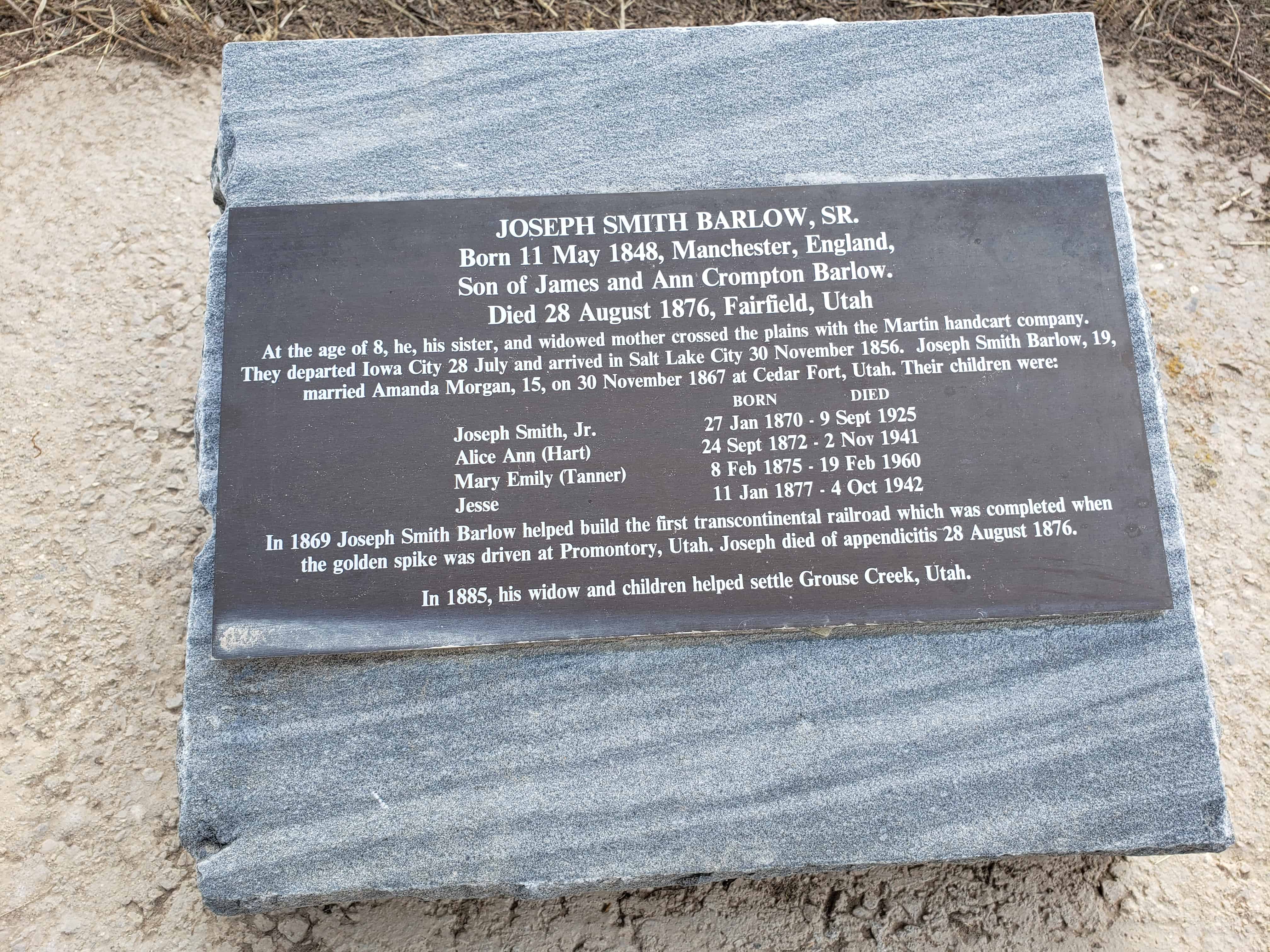
Joseph Smith Barlow, Sr.
Born: May 11, 1848 at Manchester, England
Son of James and Ann Crompton Barlow
Died: August 28, 1876, at Fairfield, , Utah.
Buried in the Fairfield Cemetery.
At the age of 8, he, his sister and widowed mother crossed the plains with the Martin handcart company. They departed Iowa City July 28th and arrived in Salt Lake CIty November 30th, 1856. Joseph Smith Barlow, age 19 married Amanda Morgan, age 15, on November 30th, 1867 at Cedar Fort, Utah.
Their Children were:
In 1869 Joseph Smith Barlow helped build the first transcontinental railroad which was completed when the golden spike was driven at Promontory, Utah. Joseph died of appendicitis August 28, 1876.
In 1885, his widow and children helped settle Grouse Creek, Utah.
29 Wednesday Jul 2020
Posted in Uncategorized

Fairfield District School
This one-room, Victorian Eclectic style school building was constructed in 1898, replacing an earlier adobe school that sat on the property. The builder was Andrew Fjeld, a brick and stone mason from Lehi. In addition to serving as the town’s only school, the building was used for church and civic meetings as well. A small brick addition was built on the rear in 1935 to provide restrooms and a furnace room. The school was closed in 1937 after the decision was made to bus Fairfield school children to the neighboring town of Cedar Fort. The building continued to serve as the meeting place for civic and church groups until the 1960s.

Fairfield Schoolhouse
A Monument to Utah’s Education History
The Fairfield District School was built in 1898, replacing Fairfield’s original adobe school built in 1870. Richard C. Watson, (Watkins) the school’s architect, also designed the Peteetneet School in Payson, Maeser School and the Knight Block Building in Provo.
Ethel Warnick Mecham, who taught at the school in 1925, recalled there were about 20 children attending classes. “The kids loved stories and singing songs,” she said. “At recess they played Rounders and the boys liked to wrestle.”
The school was forced to close in 1939 despite the efforts of Fairfield parents, students and teachers to keep it open. Restoration of the schoolhouse was completed in 2005.
Today, the schoolhouse plays an important part in the educational mission of Camp Floyd/Stagecoach Inn State Park and Museum. It is used for social gatherings, educational programs and local meetings.


29 Wednesday Jul 2020
Posted in Uncategorized
Tags

I enjoy hunting for and documenting benchmarks, for others click here.
These one is located in Fairfield, Utah behind this historic marker.

29 Wednesday Jul 2020
Posted in Uncategorized

Built in 1858 by John Carson as a family home and Inn.
Used as a Pony Express and Overland Stage stop during the 1860’s.
Built on the site oh John Carson’s original fort.

Stagecoach Inn
Because of its proximity to Camp Floyd r the old “Stage Coach Inn” served as a stopping place for visitors to/the camp and travelers enroute to California. The station served as one of the Overland Stage Stops until the coming of the transcontinental railroad in 1869. It was also used as a pony express stop between 1860-1861.
Related:
The Stagecoach Inn is located in Camp Floyd / Stagecoach Inn State Park at 18035 West 1540 North in Fairfield, Utah and was added to the National Historic Register (#71000857) on May 14, 1971.

John Carson had settled in Cedar Valley with four brothers as early as 1855. Their first protection from the Indians was a stone fort four rods square, within which they built their log and adobe living quarters. The north wall of the old fort was about where the south wall of the inn now stands.
With the “Mormon War” an influx of military personnel arrived in Utah. Colonel Albert Sidney Johns ton located his command of 3,500 men, 586 horses, 3,000 mules and 500 wagons, near Fairfield in Cedar Valley and where he established Camp Floyd. As a result, the population of Cedar Valley burgeoned in 1858, to more than 7,000 souls.
The old stone fort was torn down and John Carson built a two- story adobe and f rams hotel and inn. Mr. Carson, an “Elder” in the Mormon Church, would permit no liquor to be served in his inn, nor would he permit “round dancing,” then frowned upon by the more pious in his church. Thus the inn became an oasis of decency for prominent visitors and dignitaries, including Louis Greeley, a nephew of Horace Greeley, who occupied it for some time.
Both passengers and freight moved along this central route to California in the late 1850’s. Captain J. H. Simpson surveyed and mapped a route through the region in 1859. During the era of the pony express, the inn became a mail stop between Salt Lake City and Faust, further west. In addition, the “Carson House” served as the first Overland Stage Station west from Salt Lake City.
With the coming of the Civil War troops from Camp Floyd were recalled. Colonel Philip St. George Cooke replaced General Johns ton and renamed the post Fort Crittendon. However, on May 17, 1861 he was ordered east with his command. Camp Floyd was gone. By September of 1861 only 18 families remained Jn the little community of Fairfield.
John Carson remained and raised his family in the inn. After his death Carson’s widow and children continued to operate it as a hostelry, it finally closed in 194?. In 1959 John Carson, a son, turned the property over to the Utah State Parks and Recreation Department who have restored it and opened it in 1964 as a museum.
It sets today in an historic setting little changed from 1858.

The Stage Coach Inn was originally a large family residence built for the Carson family before conversion to an Inn. It had 14 rooms, seven of them bedrooms. The building is “L” shaped with two stories 52’*’ 8″ x 59′ 6″. It is made of brick and plaster except for the two-story addition at the west which is frame with ship lap cove siding. Some of original pine flooring and glass windows remain. The fireplaces have been restored, although they are no longer used for heat.
The first floor, behind the front gallery, has two square rooms, each with outside doors. The single story wing extends to the rear with two square rooms, each with a door to the east porch. Four small square rooms in a line adjoin the rear room and occupy the lean-to. The frame addition has a single large room on the west front but does not open to the rest of the inn. The second floor has two square rooms in the masonry portion and one front and two rear bedrooms in the rear addition.
Heating was done originally with four fire places. Two stairways in the northeast and west portions allow ascent from the first to second floors.
The restoration has attempted to return the structure to as near its original condition as possible. The furnishings are consistent with the period.
Across to the south the old commissary building of Camp Floyd has also been restored; however, it will be treated later as a part of the historic site of Camp Floyd.