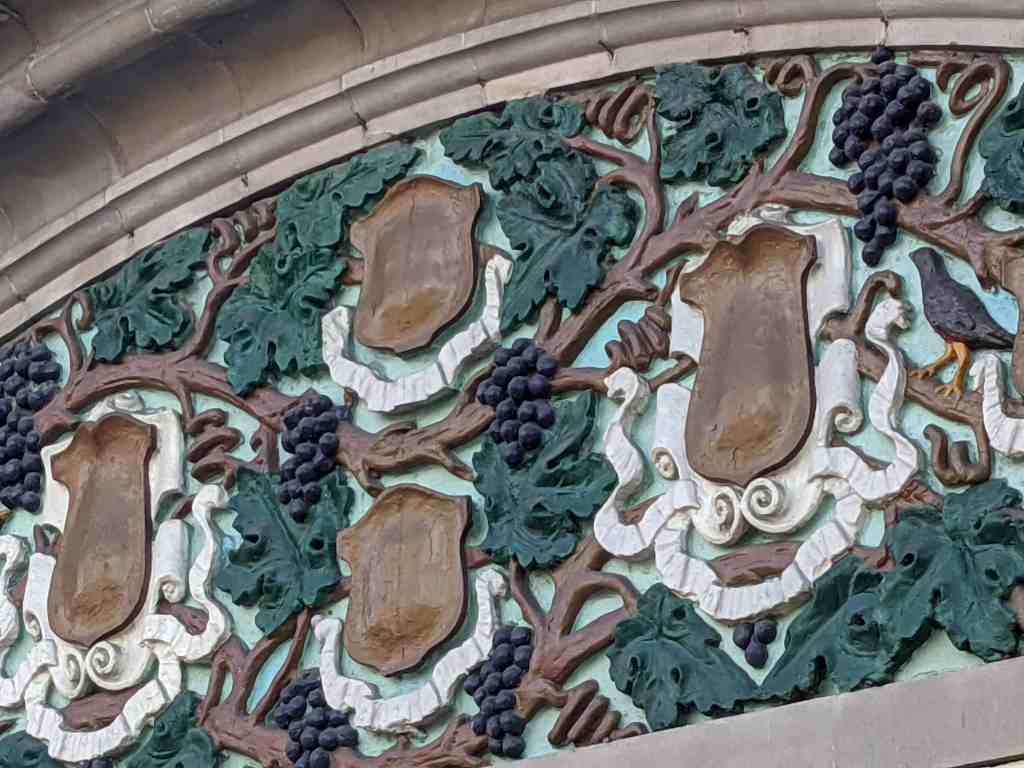
Located at 1990 South 500 East in Salt Lake City, Utah Designed by Rutherford & Ashton and built in 1926 (the Amusement Hall portion was built in 1920.)
Original building was erected by James Bascom in 1878. The first trading post west of Fort Hall. Station for Pony Express and Ben Halliday (sic, Holladay) Stage Line. The largest artery of wagon travel in United States passed here on old Oregon Trail in 1834. This building was donated by Mrs. Lucy H. Stricker on her 83rd birthday.
When mail was delivered by horseback in remote areas of the West, local residents referred to it as the “pony express.” This site is not on the National Pony Express route.
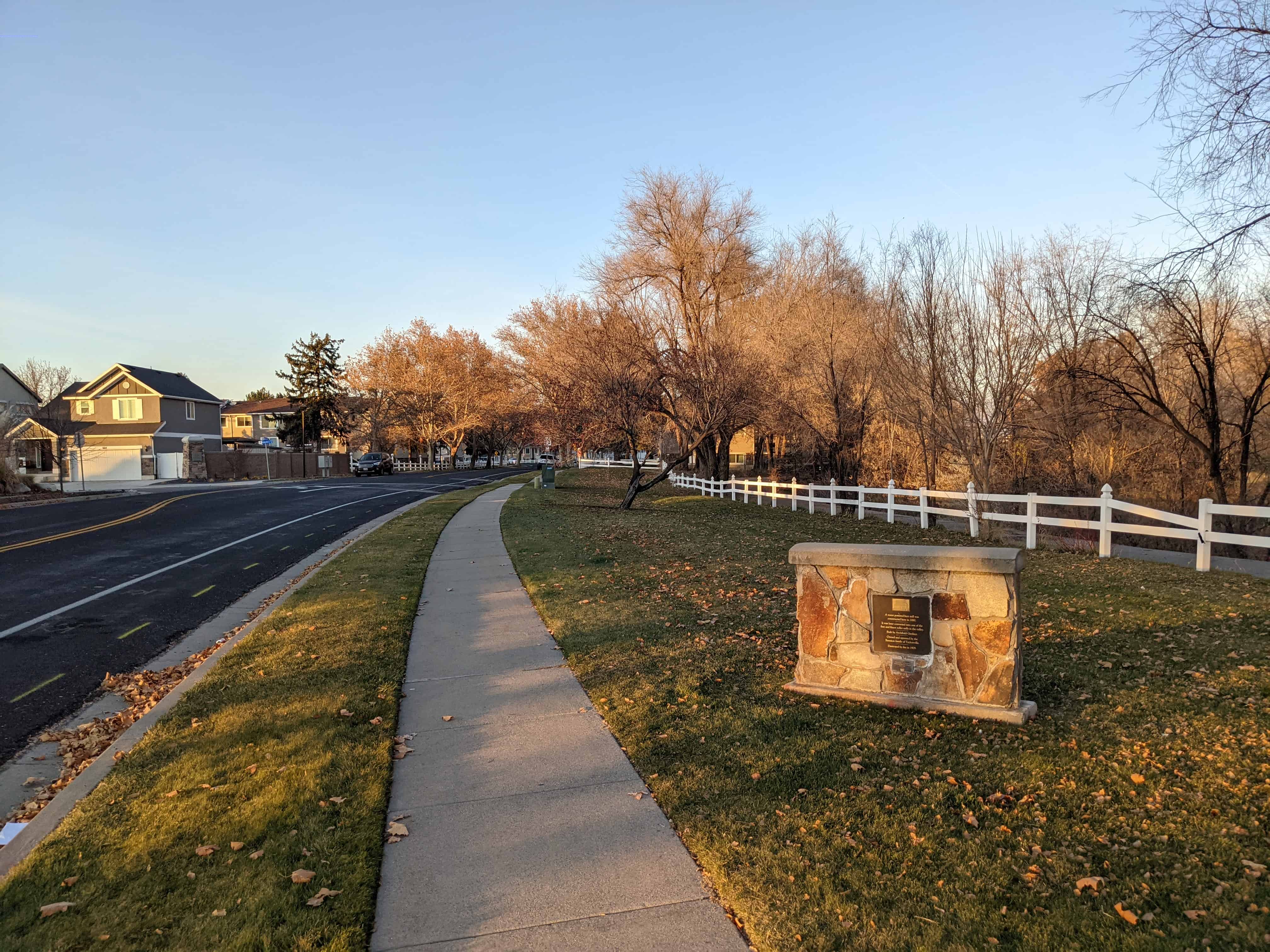
This is Daughters of Utah Pioneers historic marker #86 erected in May of 1942 at the Rock Creek Station & Stricker Homesite in Rock Creek, Idaho.
In April 1879 members of the Church of Jesus Christ of Latter-day Saints from Tooele, Utah, under direction of Wm. E. Martindale, arrived in Oakley where James Dayley and his two sons had staked claims and built cabins. On Sept. 24, 1882, the Saints were organized into a Ward with Horton D. Haight, Bishop. In 1902 the Cassia Stake Tabernacle was built of native stone, with a seating capacity of 700. It was completed at a cost $12,000. Destroyed by fire in 1965.
This is Daughters of Utah Pioneers historic marker #335 erected in 1967 at Oakley City Park in Oakley, Idaho.
In the summer of 1880 George Starrh, a placer miner, established a ferry 4 miles west of the present city of Burley. Rich mineral mines had been discovered in the Wood River country and freight was hauled between the mines and Kelton, Utah, (the nearest railroad). The wagons were taken across the Snake River on this ferry which was operated by cable and horse power. Later Thomas Starrh bought the ferry from his brother and operated it until 1905 when the railroad came to Buhl, Idaho.
Starrh’s Ferry across the Snake River was located one mile north of this monument which was relocated on June 1, 1995, by the Cassia County Company, Daughters of Utah Pioneers.
This is Daughters of Utah Pioneers historic marker #75 erected November 22, 1941 and located on Highway 30 in Burley, Idaho.
The first pioneer families from Utah came here in 1879 and were met by a Spanish prospector, Guadelupe Valdez. Rockland was named for Rock Creek, which runs the full length of the valley. It was one of the early settlements of Idaho. The first L.D.S. Meetings were held in homes. In 1884 the Saints were organized into a ward with Isaac Thorn as Bishop. This building was erected by Rockland Relief Society in 1914. In 1954 it was repaired and used as a meeting place and relic hall by the Daughters of Utah Pioneers.
This is Daughters of Utah Pioneers historic marker #223 erected in 1956 at 160 S Cedar in Rockland, Idaho.
In 1811 the first white expedition to go through this area of the Snake River and the lower end of the Raft River Valley was the Wilson Price Hunt expedition from St. Louis to Astoria. However, the area was well known to the French and British trappers.
The California Cutoff was first proven a feasible route in 1826 by Peter Skene Ogden and his Snake Brigade who crossed Granite Pass. Joseph Chiles, in 1842, determined a wagon route was feasible as he wandered from California toward Fort Hall. In 1843, Chiles, with Joseph Walker, as guide, eight wagons, and thirty emigrants, turned southwest here and headed to California. Walker defined the California Wagon Trail from here to the Humboldt and to California. John C. Fremont camped September 26, 1843, on the Raft River. From 1843-48, the California Cutoff was the main route from here, southwest to the City of Rocks.
Between 1841 and 1860, about 500,000 people passed this point. Before 1848, more than 100,000 emigrants turned here on their California journey. The route continued to be used until the railroads connected in 1869.
The Parting of the Ways could be called Decision Point because here some people finally decided between heading to Oregon or California. As noted in the diary of H. M. Judson, August 11, 1862, “…bid goodbye to…they take the California road, we keep our eyes straight ahead. No tear shed, no regrets expressed. We feel considerable relieved and think we have had our train purged of many a contrary stubborn disposition and shall have less contention and fault finding.”
When the California Trail met the Salt Lake Cutoff, many pioneers took that trail into the Salt Lake Valley. Returning members of the Mormon Battalion, traveling east, pioneered a route to Salt Lake. Addison Pratt, of the Mormon Battalion, named “Twin Sisters” in the City of Rocks. This route was used by 25,000 travelers in 1849-1850, and thousands more passed through until 1869. An estimated one-third of the forty-niners traveled this way.
This is Daughters of Utah Pioneers historic marker #520 erected in 2001 at N 42.57710 W 113.21934 on Yale Road in Cassia County near Raft River, Idaho.
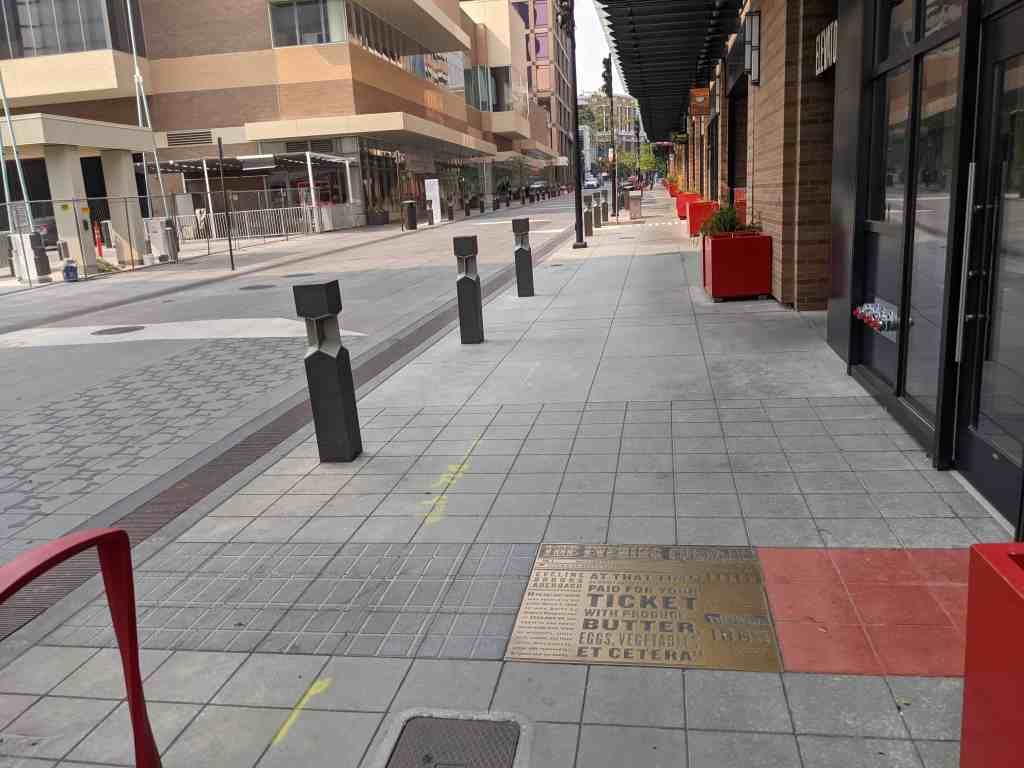
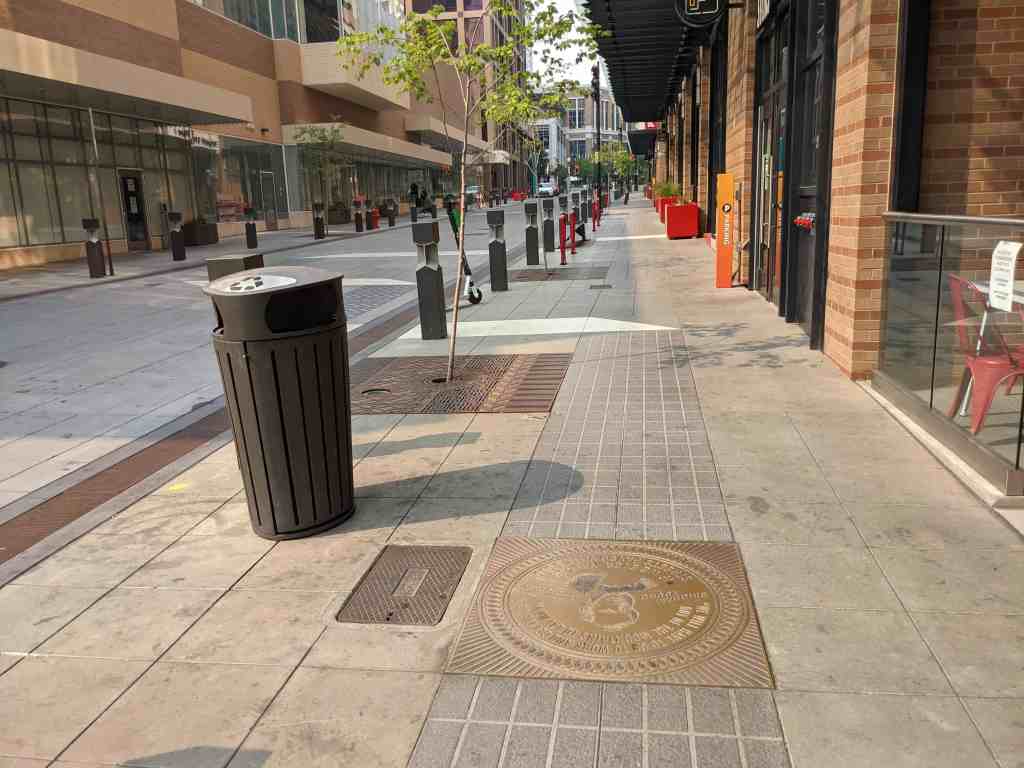
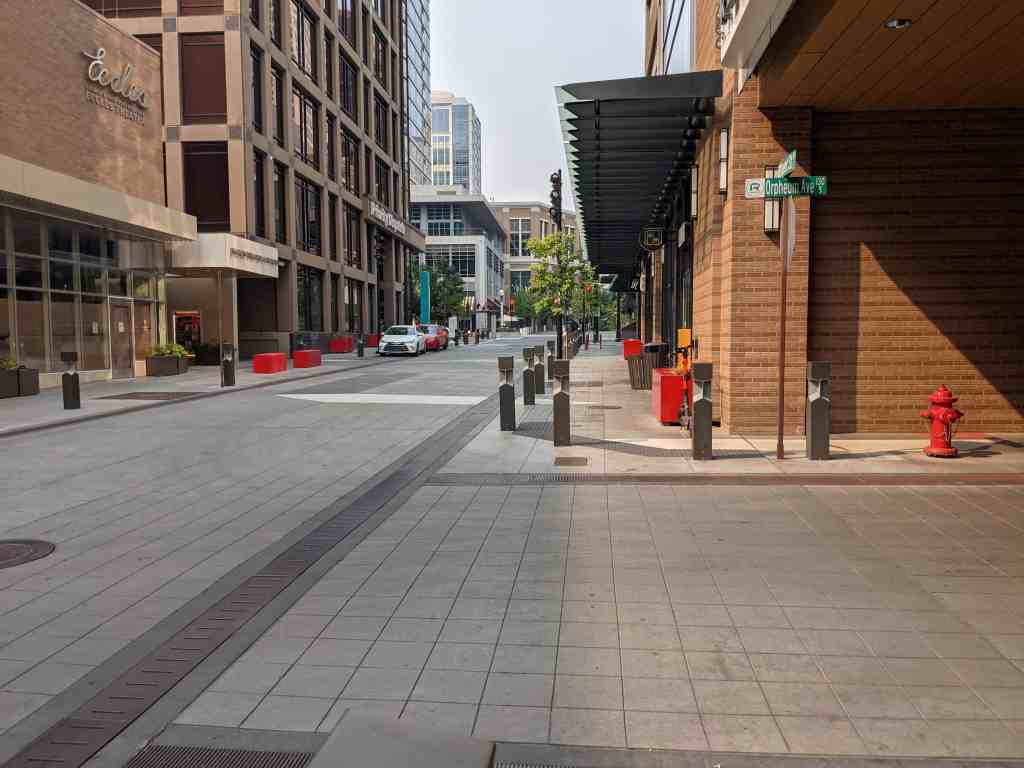
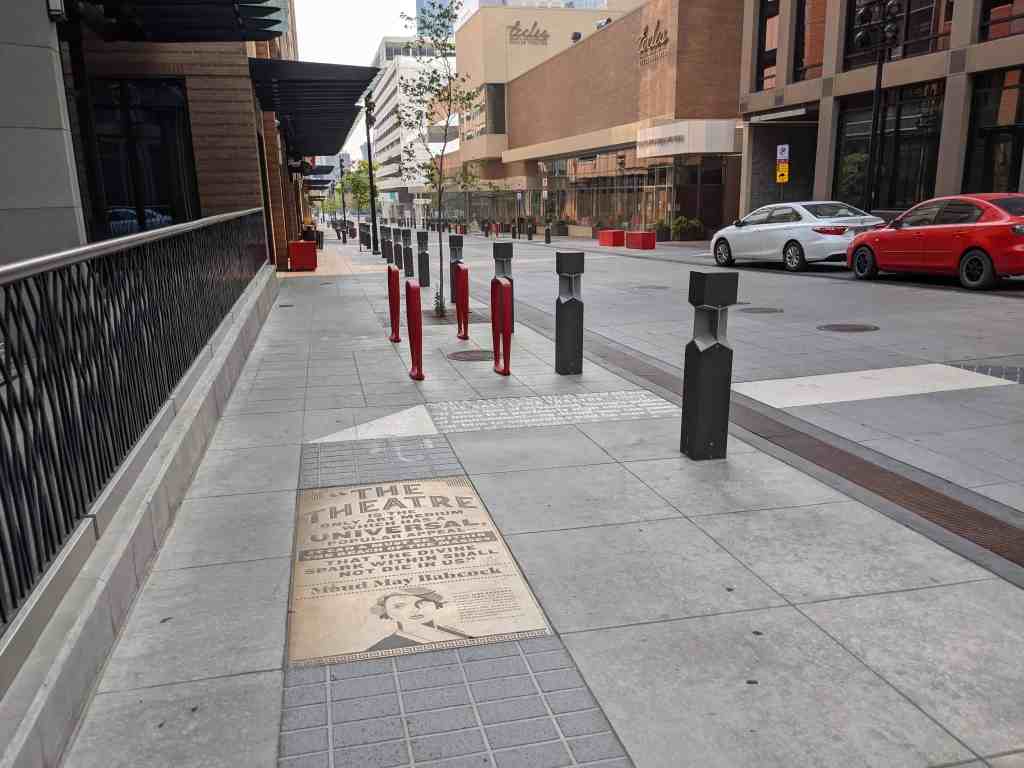
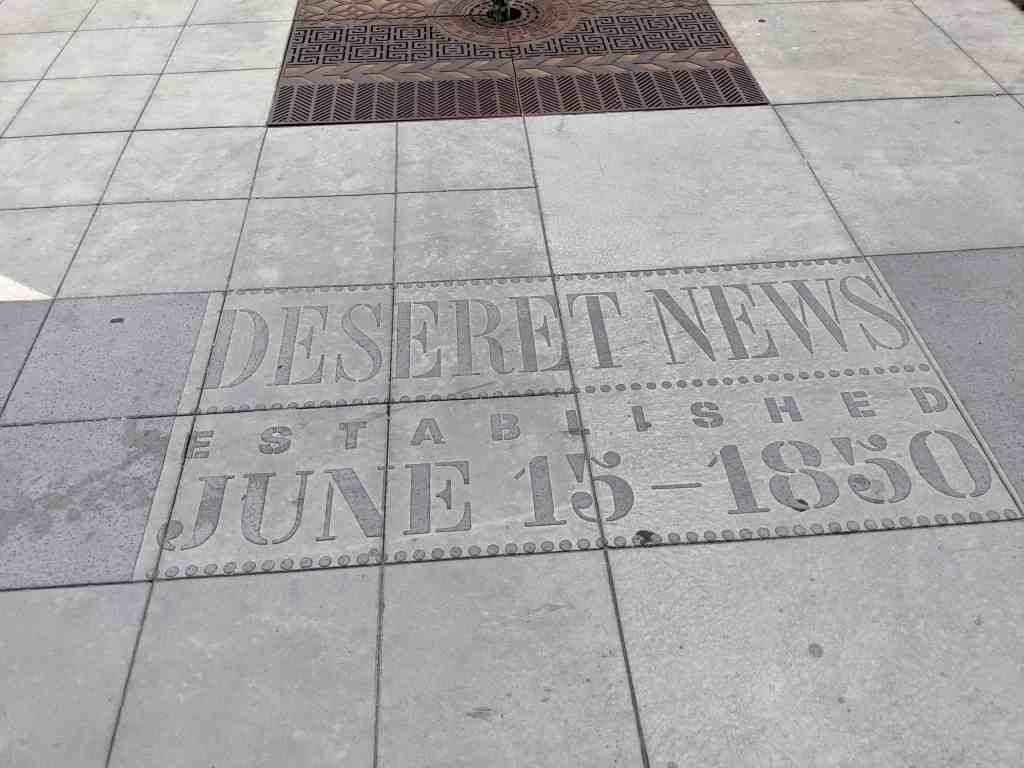
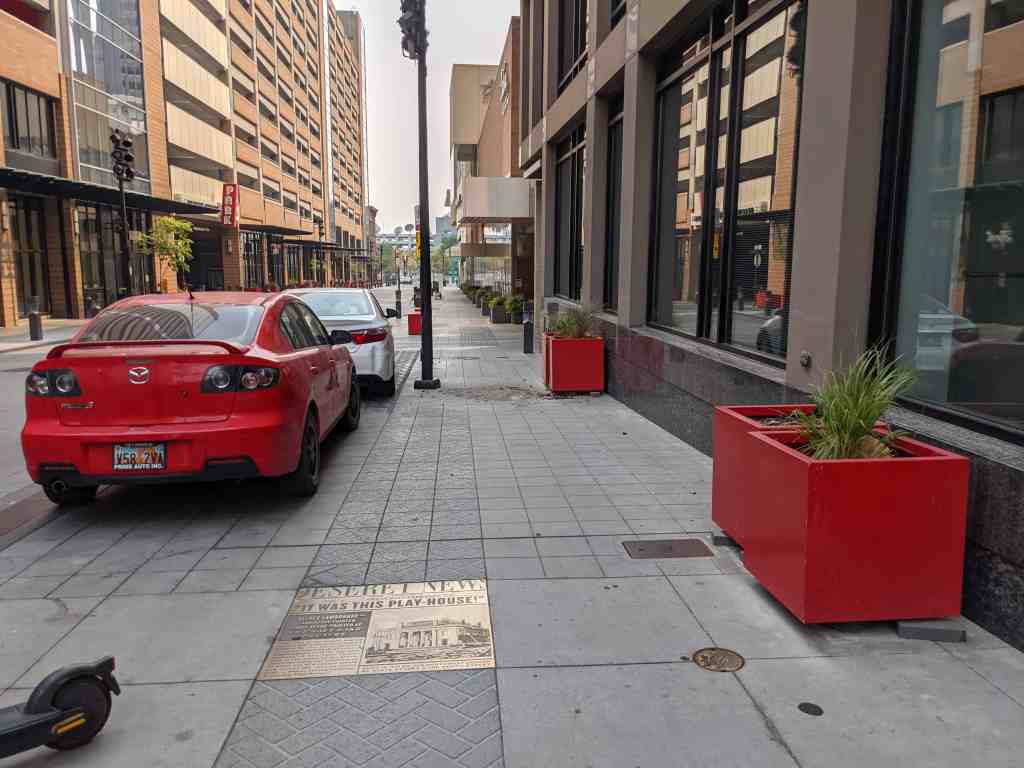
Inspired by the printing presses of Regent Street that busily churned for years publishing The Salt Lake Tribune and Deseret News, the Regent Street press sheet winds its way down the street.
Along its meandering path you’ll find stories about the long and diverse history of this part of Salt Lake City. Once called Commercial Street, Regent Street has been the site of Salt Lake City’s red light district, a home to Chinese immigrants in the late 19th century, a center for headline news in the 20th century, and now is at the heart of the city’s cultural core.
“In those days the hot spots of Salt Lake were located in a tidy manner on a street that ran between 1st and 2nd South and Main and State. Within the street were saloons, cafés, parlor houses, and cribs that were rented nightly to the itinerant ladies of the calling. It was against the rules to solicit, so these soiled doves would sit at the top of the stairs and coo their invitation to ‘C’mon up, kid.'” – John Held, Jr.
John Held, Jr. (1889-1958) was an American cartoonist, printmaker, and one of the best known magazine illustrators of the 1920s. He worked as a cartoonist at The Salt Lake Tribune and illustrated covers for LIFE, The New Yorker and Vanity Fair.
Plum Alley ran north and south dividing the city block between Main and State Streets, the cross streets being 100 South and 200 South. During the early 20th century, within and around Plum Alley, the Chinese developed a microcommunity with grocery and merchandise stores, laundries and restaurants.
“On New Year’s Day they had a big New Year’s celebration in Plum Alley, some of them old guys would come over and give us the red envelopes with lucky money in them. That was quite a haul, when you’d get up there you might get twenty bucks in silver dollars.” – Henry Ju
Henry Ju (1923-1990) was the son of Joy Ju, one of the first merchants on Plum Alley. The family store, Wo Sang, sold merchandise such as chinaware and silk from China.
“The Salt Lake Theatre was opened to the public March 8, 1862. It was built by Brigham Young at a cost of $200,000.00 and equal to any opera house in the East. It had an orchestra, stalls, first, second, and third circle, three boxes on either side reserved for Brigham and his family. At that time no money was in circulation, and you paid for your ticket with produce – butter, eggs, vegetables, et cetera.” – Eveline Brooks Auerbach.
Eveline Brooks Auerbach (1859-1924) was born in the California mining town of Timbucktoo in 1859. Her family lived as merchants in various towns in the western U. S., eventually settling in Salt Lake City. In 1879 she married Samuel Auerbach, a German-Jewish immigrant in the goods business in Salt Lake City. She raised a family and lived in Salt Lake City for most of the rest of her life. Her published memoir touched on business and social conditions as well as relations among religious groups.
“We will have to go to work and get the gold out of the mountains to lay down, if we ever walk in streets paved with gold.” – Brigham Young, an original settler of Block 70.
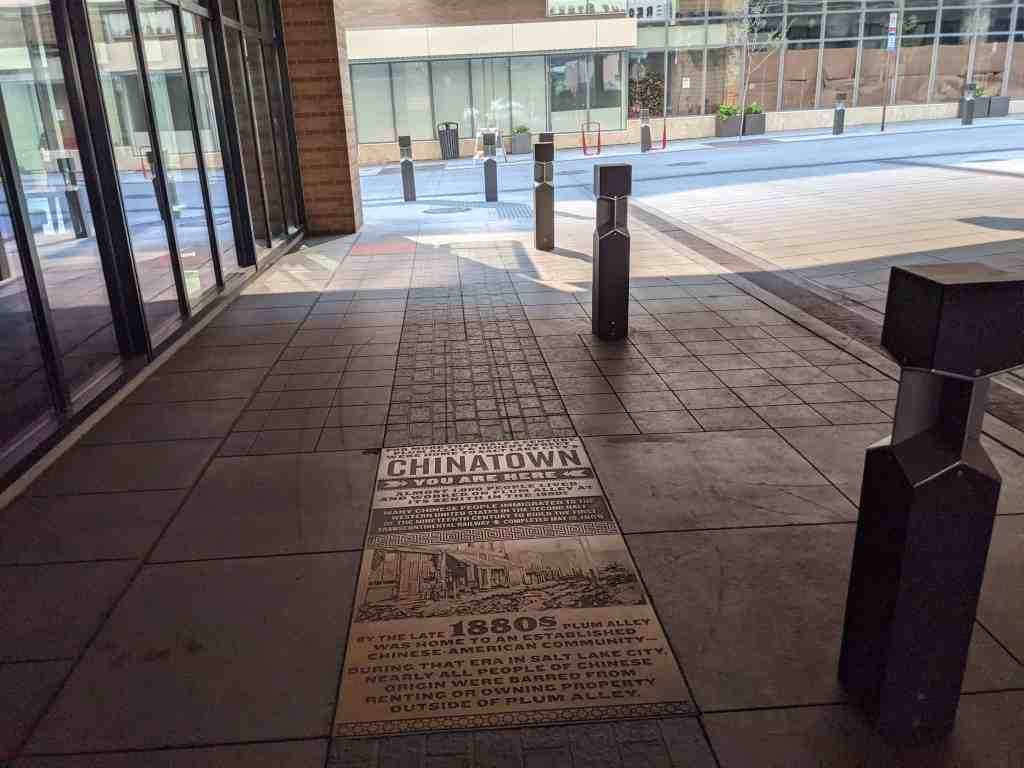
For more than half a century, Plum Alley & Regent Street were home to Salt Lake City’s Chinatown. Almost 1,000 people lived and worked on Plum Alley at its zenith in the 1890s.
Many Chinese people immigrated to the western United States in the second half of the nineteenth century to build the first transcontinental railway – completed May 10, 1869.
By the late 1880s Plum Alley was home to an established Chinese-American community – during that era in Salt Lake City, nearly all people of Chinese origin were barred from renting or owning property outside of Plum Alley.
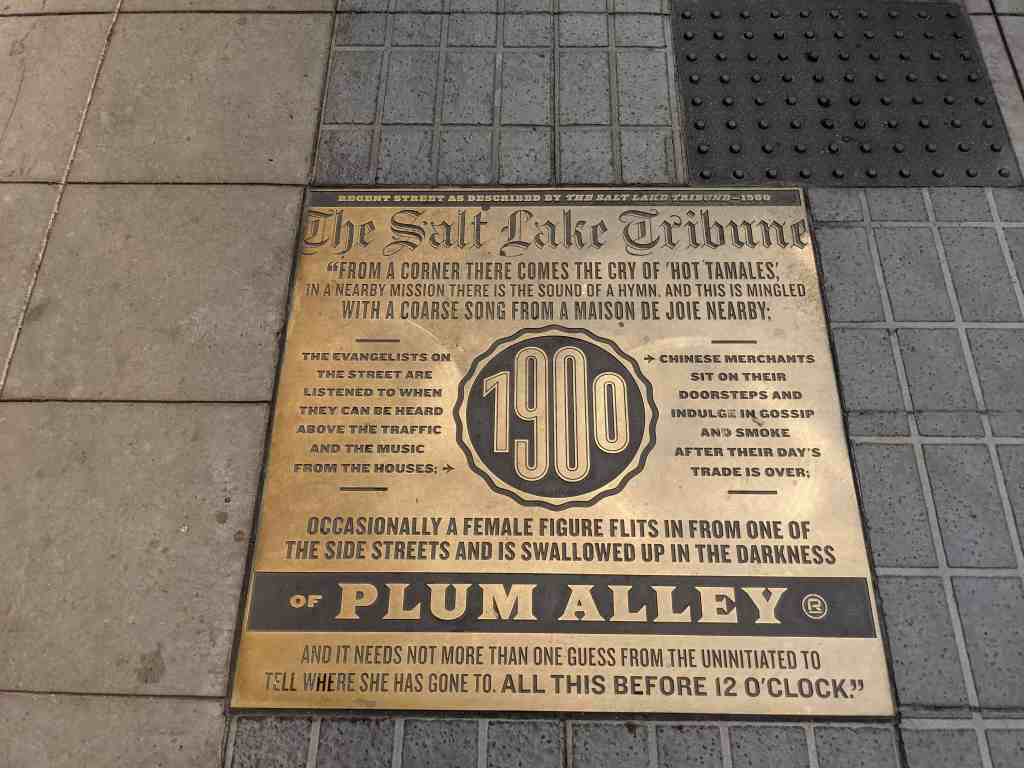
“From a corner there comes the cry of ‘hot tamales,’ in a nearby mission there is the sound of a hymn, and this is mingled with a coarse song from a Maison De Joie nearby; the Evangelists on the street are listened to when they can be heard above the traffic and the music from the houses; Chinese merchants sit on their doorsteps and indulge in gossip and smoke after their day’s trade is over; occasionally a female figure flits in from one of the side streets and is swallowed up in the darkness of Plum Alley and it needs not more than one guess from the uninitiated to tell where she has gone to. All this before 12 O’clock.” – The Salt Lake Tribune – 1900
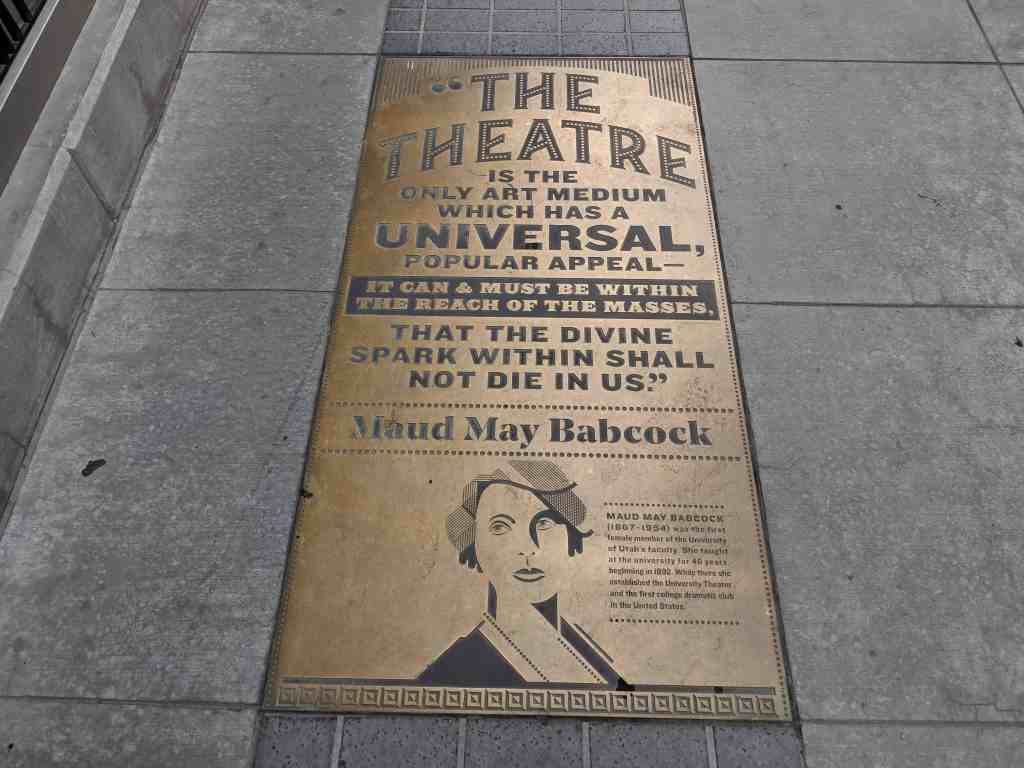
“The theatre is the only art medium which has a universal, popular appeal – it can & must be within the reach of the masses, that the divine spark within shall not die in us.” – Maud May Babcock
Maud May Babcock (1867-1954) was the first female member of the University of Utah’s faculty. She taught at the university for 46 years, beginning in 1892. While there she established the University Theater and the first college dramatic club in the United States.
“It was one of President Young’s prides to have it a perfectly high class place of amusement – no detail was too small for him to supervise and he was justly proud of the results.” – Sara Alexander – Pioneer era star of the stage. (The Salt Lake Theatre – 1861)
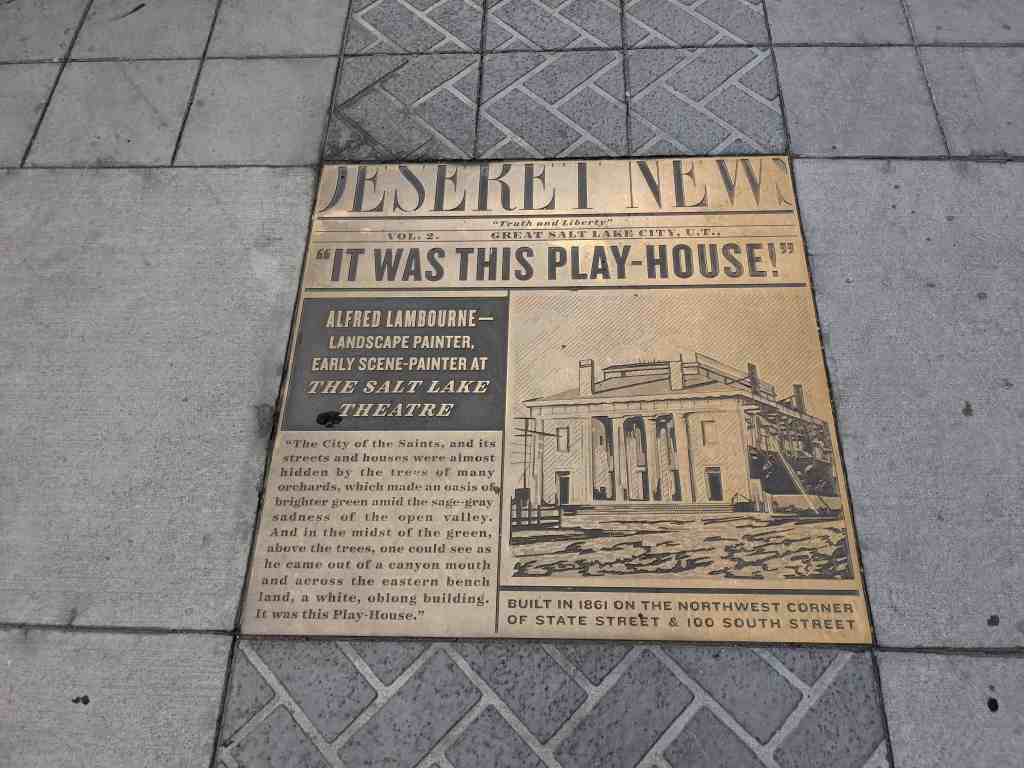
“The City of the Saints, and its street and houses were almost hidden by the trees of many orchards, which made and oasis of brighter green amid the sage-gray sadness of the open valley. And in the midst of the green, above the trees, one could see as he came out of a canyon mouth and across the eastern bench land, a white, oblong building. It was this Play-House.” – Alfred Lambourne – Landscape painter, early scene-painter at The Salt Lake Theatre.
Built in 1961 on the Northwest corner of State Street & 100 South Street.
Pony Express Riders sworn oath:
“I, do hereby swear before the great & living God that during my engagement & while I am an employee of Russell, Majors & Waddell – I will under no circumstances use profane language, I will drink no intoxicating liquors; that I will not quarrel or fight with any other employee of the first and that in every respect I will conduct myself honestly, faithful to my duties, & so direct my acts, as to win the confidence of my employers, so help me God.”
Salt Lake City’s Pony Express Station was located at 143 South Main Street.
“One cannot be pessimistic about the West. This is the native home of hope. When it fully learns that cooperation, not rugged individualism, is the quality that most characterizes and preserves it then it has a chance to create a society to match its scenery.” – Wallace Stegner
Wallace Earle Stegner (1909-1993) was an American novelist, environmentalist, and historian. Although he had lived in many places, he always referred to Salt Lake City as his “hometown.” Educated at the University of Utah, he is considered among the most influential Western writers and won the Pulitzer Prize in 1972.
History of Salt Lake City’s Red Light District
The growth of Salt Lake City in the 19th century mirrored that of other Western cities in many respects, including prostitution. A red light district emerged on Regent Street in the 1880s and continued to exist there through the early 20th century, with some brothels persisting on Regent until the 1930s. Regent Street’s location within the commercial district on Block 70’s interior made it a setting where prostitution was tolerated as it was not easily visible from the major streets surrounding it. Brothels were unofficially regulated (through intermittent arrests and fines for people engaged in the trade) in this area until 1908, when the red light district was moved to the west side of Salt Lake City.
Describing the area in 1900, The Salt Lake Tribune stated: “From a corner there comes the cry of ‘hot tamales,’… in a nearby mission there is the sound of a hymn, and this is mingled with a coarse song from a maison de joie nearby; the evangelists on the street are listened to when they can be heard above the traffic and the music from the houses; Japanese, Chinese, negroes, and white mix together in a friendly way; occasionally from one of the saloons some tough… is seen to shoot out of a door-he doubles his fist, Vows vengeance and then slides away; out from a dark and badly-scented alley comes a pale-faced man whose chief occupation in life is to smoke opium; Chinese merchants sit on their doorsteps and indulge in gossip and smoke after their day’s trade is over; … occasionally a female figures flits in from one of the side streets and is swallowed up in the darkness of Plum Alley, and it needs not more than one guess from the uninitiated to tell where she has gone to. All this before 12 o’clock.”